Writing well really does pay according to a new survey

slide_272894_1944735_freeAs a journalist, there’s nothing more annoying than finding spelling mistakes or grammatical errors in your own work.

I confess that I always read my own stories first in the Australian Financial Review – the newspaper I write for – and feel gutted if there is a glaring error – spelling, punctation or grammar. Thankfully, it doesn’t happen too often.

Writers hold their own written work in high esteem, as they should, as it represents their personal brand.

Errors make you look stupid and can be downright embarrassing – or very funny if it’s not your own work.

A while back, a bestseller called “Eats, shoots and leaves” by British radio journalist Lynne Truss attempted to, very humouresly, highlight common punctuation mistakes and how they often change the meaning of a sentence. Her aim was to lift writing standards which have arguably gotten worse since publication of the book given the popularity of Twitter, Facebook and text messaging.(Embarrassingly, Truss made mistakes of her own, in her book).

You may scoff as you type out a garbled text message on your phone or dash off an unreadable tweet, but new research has found that there is a high correlation between how accurately you write and how well you do your job – and very importantly – the level of pay you earn.

Regardless of whether you are a salesman, lawyer, engineer or accountant – those who make fewer mistakes in their emails, reports and presentations are better regarded by those that employ them, and, they earn more money.

This came out of a study of  448 profiles on freelance jobs website Elance by Grammarly, a start-up proofreading web application that finds and explains in-depth grammar, spelling, and punctuation mistakes online.

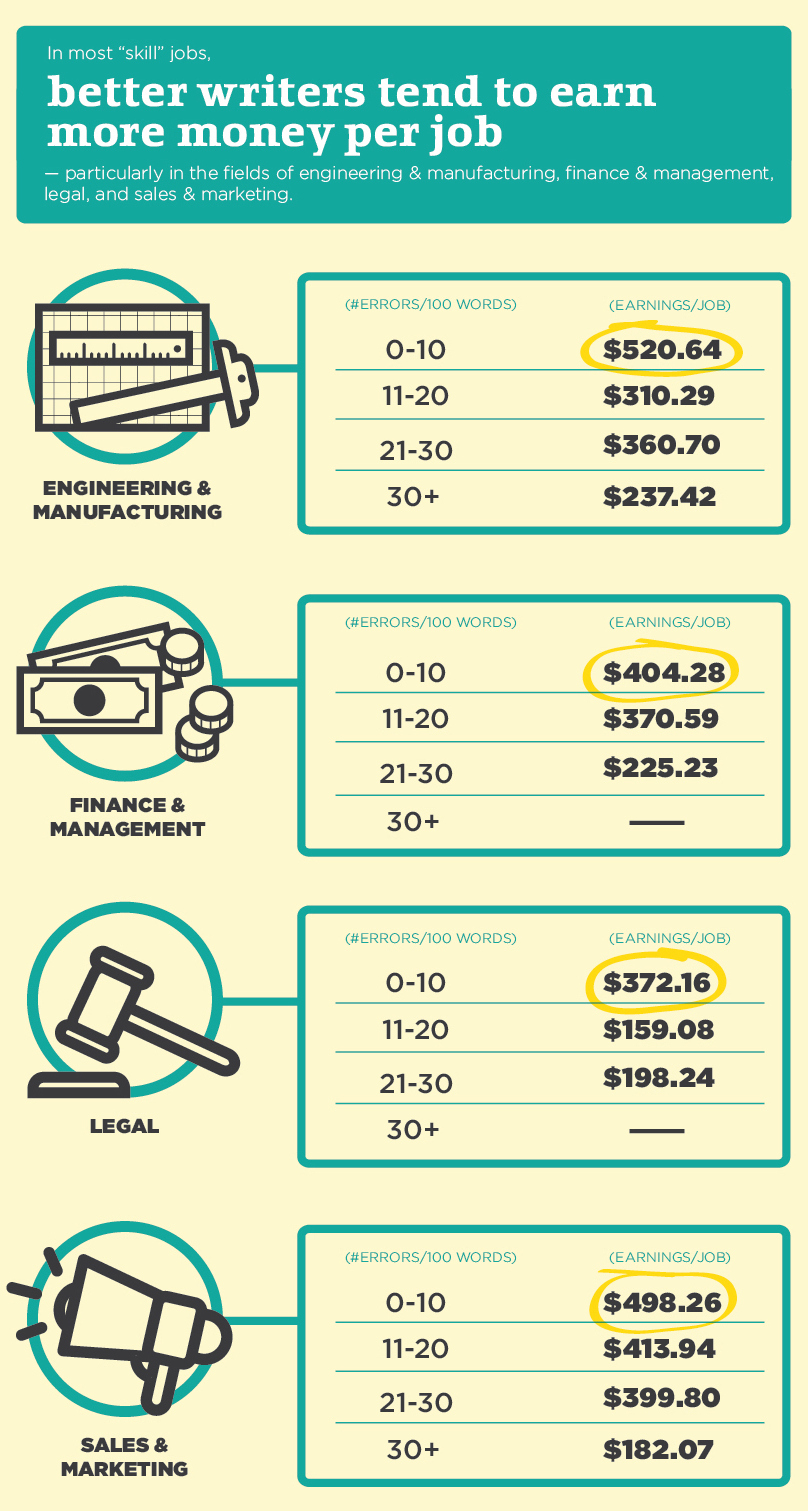
Grammarly found that an engineer who made 10 or fewer errors per 100 words written in their online profile earned on average $521 per project while an engineer who made 30 or more errors earned less than half that.

Similarly, lawyers who made less than 10 errors per 100 words earned $372 per job, while those that made three times as many errors earned only $198.

Overall, it found that freelancers who made the fewest mistakes received the highest reviews from their employers – those who made the most mistakes were rated much lower.

In short, accurate writing increases credibility, hireability and pay.
writing_skills_matter(1)-001

Grammarley survey: writing well pays better

Journalists and others that write for a living will be pleased to know that – according to the study – writers make the fewest mistakes, followed closely by those in admin and  legal roles.

While it was perhaps not surprising to find that IT professionals make more mistakes on average than any other professional – almost one in every five words – it was alarming to learn that those in leadership positions (in finance and management roles) are almost as bad.

Perhaps it explains why big companies all hire expensive public relations executives – to find and correct all those top management mistakes, before they become public relations disasters.
34d1609

Freshlyworded.com is also giving away one free premium access account to Grammarly. Just send your name and email to freshlyworded@gmail.com – The first email received will win the premium pass.

Melburnians – enjoy the world’s best liveability while it lasts

traffic jam

Gridlock: where Melbourne is heading

Melburnians love to crow about Melbourne’s long-running status as the world’s most liveable city.

Melbourne has ranked top city in the world for the last four years in a row according to the Economist Intelligence Unit’s liveability survey – with Sydney a lowly seventh.

Melburnians rightly love to lord it over Sydneysiders and other global city dwellers, but I’m afraid our world’s best status is fading fast.

I could point to a hundred different articles (try this one on urbanisation by Fairfax economics writer Ross Gittins) or extensive research data to explain that we are building upwards at such a rate but without the necessary investment in transport infrastructure to get everyone to and from work, schools and the shops. 

My own daily commute into work is a good case study of the looming chaos that awaits. It begins with a short 15 minute bicycle ride from my home in Niddrie in the northern burbs to Essendon Station, where the Craigieburn line stutters along towards the city, 15 kilometres away.

What a year ago was a pleasant cycle down a quiet backstreet, where I could drift off into my own thoughts, is now a busy road packed with frustrated people-movers, utes, sedans and station wagons, who weave past me in desperation to avoid the gridlock on the main thoroughfare, Keilor Road.

Even this far out from the city, any vacant lot, deserted car yard or decrepid office building is giving way to an apartment block with dozens of units crammed on top. On the quieter streets, old houses have been bulldozed and replaced with three townhouses. 

 More people, more cars, same roads, same frequency of trains and trams. 

At Essendon Station, Rose Street is most days clogged with cars and buses while the train platform is just as crowded, heaving with already weary-looking fellow commuters.

melbourne platform

Flinders Station, Melbourne

There’s a collective groan as the citybound train pulls in and commuter’s faces stare back from inside carriages, pressed against the glass.

And that’s on a good day when there isn’t a dreary announcement about a train cancellation forcing two sets of commuters onto the same train, resulting in carriages packed so tightly you fear getting an itch you could never scratch.

Finally, twenty minutes later we pull into Southern Cross station. I extract my head from under a stranger’s armpit, apologise for inadvertently rubbing my backside against a pensioner’s bald head (hey, at least they got a seat), exhale, and make my way towards the escalators and the exit. Here a gang of transport Gestapo (train police) are usually standing by ready to spear tackle the elderly, children, mothers with babies and minority groups, should they have forgotten to swipe their Myki card.

Lucky for me I fit none of those categories.

queen liz

Fit for a queen? I think not!

Yet more fun awaits me later in the day when I hop onto a tram on Collins or Bourke Street for a meeting uptown – the geniuses who came up with the idea of free CBD trams seemingly did not factor in that every man, woman, child, homeless bum and confused tourist now chooses to take a tram rather than walk a city block.  Tempers flare as we all contort ourselves into weird shapes and postures. The tram driver, oblivious to the gang of drunk vagabonds that have boarded the train with shopping trolleys, four large dogs and a spicey pepperoni aroma, yells out that he won’t close the doors until we get off the steps.

Cursing under my breath, I decide to walk back to the office from my meeting…

Liveability my ass.

Melbourne’s crown is slipping as the city grinds towards eventual gridlock.

Anyone who takes a bus, train or tram – or is crazy enough to drive into work – can surely see that for themselves. The old cliched saying of “what goes up, must come down” applies when “up” means high rise apartments and “down” means liveability without investment in public transport

Dealing with my Twitter addiction or: please be kind and retweet

twitterHello world. My name is Larry Schlesinger and I am an addict.

It’s not crack cocaine, or alcohol or heroin or chocolate that I can’t get enough of.

I am addicted to Twitter. I make this confession openly and honestly and promise to change.

I realised I was addicted to Twitter – really realised – when I sat down on a Tuesday evening last week in front of the television to watch an episode of my favourite show, the UK detective drama Midsomer Murders. As the killer was unmasked by Detective Inspector Tom Barnaby of Causton CID, I was completely clueless as to how the great sleuth had reached this stunning conclusion (Who would have thought it was the priest with a limp in love with his brother’s ex-girlfriend?)

The truth was I had completely lost track of the plot, Christ, I didn’t even know who the main characters were anymore.

It was all because of Twitter.

It seemed impossible that I could go more than 15 minutes of a Midsomer murder (in some quaint flower-encrusted cottage) before, with sweaty palms and gritting teeth, I yanked my phone out of my pocket and ravenously checked the updates on my Twitter feed.

Had I missed something? An explosion? A plane crash? A new government crisis? Had Tony Abbott spontaneously combusted? Had someone cooked a hamburger all by themselves? Or remembered the name of their dead pet parrot? Or decided they liked the colour blue more than red?

How could I possibly go on watching Barnaby as he traipsed through the English countryside finding clues while all these important things were happening in the lives of others – some of whom I don’t even know?

And then the utter ludicrousness of it dawned on me.What the f-ck was I doing? Had I gone mad?

Yes, Twitter is without any doubt the most powerful social media device in the world bar none – I realised this the day someone at work yelled out: “Someone has just tweeted that Oscar Pistorious has been arrested for shooting his girlfriend” – but the addiction (and the envy: he has how many followers???) came much later.

Never mind breaking news about really significant events – where Twitter has its true power – I had to know the insignificant minutiae of everybody else’s lives – and tell my eager 1,500 or so followers all the boring crap about my own. Had it really come to this?

Of course I am not the only one addicted like a twit. There are millions of us updating the world about ourselves, 140 characters at time. We’ve all become experts at the “#” and “@”. We know what’s trending. We know who said what to whom.

Get on any train in Melbourne or Sydney or Paris or London, or a bus in Dar-es-Salaam of Caracas, or a camel in Morocco and there will be someone tweeting or retweeting or favouriting or replying.

The kind of crap you used to mutter to yourself on a lonely stretch of highway as the tumbleweeds drifted buy  – that’s what’s become breaking news in the Twit-o-sphere.

– I just saw a dog that looked like my grandpa. Better tweet that.
– What a beautiful row of palm trees. Better tweet that. Etc etc.

I am pleased to say I am dealing with my addiction, though temptation is the route of all smart phone evil.

For the last two days, there has been no Twitter and no inane tweeting after work. I’ve actually given my wife and my daughter my full attention between the hours of 6.30pm and 8.30pm. It’s been a struggle, my palms have been itchy, my fingers twitching, seeking out the phone I’ve stuck in a locked drawer, but I’ve managed…somehow.

Home in the evening has become a Twitter-free zone, especially as the bodies start dropping all of over Midsomer County, the deadliest county in England.

Baby steps, Baby steps…each day is a struggle, but I think it is getting easier.

I’m so pleased with myself, so delighted with my progress that I think I’ll celebrate. Yes, this is what I will do: I’ll compose a little congratulatory message to all my ‘friends’.

Exactly 140 characters.

The freshlyworded 2 minute review: Serial

141023_CBOX_SerialPodcast.jpg.CROP.promovar-mediumlargeWhat’s being reviewed?

Serial

What is it ?

A 12 podcast series produced by ‘This American Life’ a  syndicated American radio program and WBEZ Chicago, a community radio station.

What’s it about?

Part story telling, part investigative journalism, part amateur sleuthing in the style of Scooby Doo (as one reviewer put it), Serial tells the story of the 1999 murder of Baltimore high school student Hae Min Lee and the conviction, after two trials, of her former boyfriend Adnan Syed, who was given a life sentence. In each episode, journalist and broadcaster Sarah Koenig attempt to unravel a different element of the case to answer the question: Did Adnan do it?

If you only know one thing…

It’s the most downloaded podcast of all time with more than 5 million downloads as of January this year.

Is it any good?

Yes. If you love a good detective story or a riveting documentary, you will love Serial. The show’s executive producer, Ira Glass said of it: “We want to give you the same experience you get from a great HBO or Netflix series, where you get caught up with the characters and the thing unfolds week after week, but with a true story and no pictures. Like House of Cards, but you can enjoy it while you’re driving.”

What I liked most about it?

The chatty, personal style that exploits the audio-only medium and draws you in. How much you learn about criminal investigation and procedure. The setting, Baltimore, one of America’s most interesting cities. The interweaving of narrative, interviews, opinion and evidence that gives Serial its power.

What I disliked?

Trying to remember all the details and keep track of the various plotlines. At times confusing. The ending may disappoint some.

How much time do you have to invest?

Eight and a half hours of listening time, plus many more hours on the Serial website, doing your own research and reading analysis and comments about the show. It’s addictive.

How do I listen to it?

It’s free. Download it from iTunes or from serialpodcast.org

Can you recommend something similar, in another medium?

The Oscar-nominated documentary: “Capturing the Friedmans” about dark secrets in a upper middle-class Jewish family in New Jersey. And watch The Wire, a television series set in Baltimore about criminals and the police that pursue them. Arguably the greatest television show ever made.

The Asian Cup of rogue nations

afc-asian-cup-1420749072-2318216It struck me – with the force of a Tim Cahill wonder strike – that there was something decidedly wrong with the 2015 Asian Cup.

North Korea. Iran. Saudi Arabia. All run by brutal dictatorial regimes, all with appalling human rights records, but allowed to compete in an international sporting event.

Has the world gone mad? Have we lost our moral compass?

I ask from the perspective of a South African who remembers our isolation from world sport, forced to live off a diet of local competitions and the occasional ‘rebel’ cricket or rugby side visit.

Of course, it was quite right that we were banned, given our cruel apartheid policies, though there were some who argued that sport and politics should be kept separate and that we shouldn’t punish individuals, many of whom opposed the government’s policy of separation, from competing internationally.

Certainly, there were many great South African sportsmen and women denied their opportunity on the world stage, barred from competing at  Olympic and Commonwealth Games and from cricket, rugby and soccer world cups.

We had a world-beating cricket team in 1970 (thrashing Australia 4-0 at home) before we were kicked out of world sport, champion rugby and soccer players, swimmers and athletes.

But, I got a real shock when I saw North Korea arrive in Australia to take part in the tournament, a ridiculous charade, given they refused to give media conferences or engage with the public and thankfully were bundled out in the group stages. Clearly instructions came straight from mad dictator Kim Jong-un and his henchmen on how to behave in a foreign country, a rare treat for the lucky few who were able to travel outside of their home country. The rest stay home and starve.

Iran’s another shocker. “The Islamic Republic of Iran is a jihadist theocracy that has dragged Iran into economic depression while executing, imprisoning and intimidating its domestic opponents” wrote the Sydney Morning Herald’s Paul Sheehan recently. Iran is more dangerous than the Islamic State, he added.

Iran’s people are beaten, imprisoned, tortured…but its team is allowed to compete in the Asian Cup. Even the players over here play with fear in their hearts: during the tournament players were warned not to be photographed with young female fans.

As for Saudi Arabia, being a Jew I wouldn’t be allowed into the country (not that I have any plans to visit). Saudi Arabia is by all reports a brutal, repressive place, with medieval laws. The penalty for homosexuality is death. The penalty for blasphemy is death.  Commit adultery and the punishment is to be stoned to death. Steal and you lose a hand. State your opinion in a blog and you get flogged.

So, I ask again, has the world lost its moral compass?

Do we now turn a blind eye now to every human rights violation in the name of sport and entertainment?

Or have we finally decided that sport and politics should not mix. If so, a lot of South African sportsmen and women deserve an apology.

Would you like to ‘go large?’ ‘Super Size Me’ and McDonald’s a decade on

super-size-meHere’s an old joke. A man walks into a McDonald’s…

He order a quarter pounder with cheese meal.

Before he has time to lay a $10 note on the table, the fresh-eyed young lady behind the counter asks: “Would you like to ‘go large?”

Doesn’t she just mean ‘super size’? he wonders to himself. Sensibly, he declines the upgrade.

A minute late, his meal is on a tray in front of him…

It’s just over 10 years since Morgan Spurlock made Super Size Me (the film was released in September 2004), a low-budget documentary about the fast food industry, where he nearly killed himself eating a McDonald’s meal three times a day for a month, and where he forced himself to ‘super-size’ his meal whenever it was offered.

I watched Super Size Me for the first time recently (it aired late one night) and thought it a very engaging, thought-provoking and entertaining film, if you can stomach watching a young bloke quickly push his previously fit and healthy body toward’s ruination to prove a point about the evils of the fast food industry.

The film was made for just $65,000 and grossed almost $12 million. Made two year’s after Michael Moore’s groundbreaking Bowling for Columbine, it cemented documentary film-making as a mainstream film genre, earned an Academy Award Nomination and dozens of other film prizes.

Anyone who remembers the film will remember that famously gross scene, when Spurlock eats a double quarter-pounder supersize meal about the size of his car steering wheel and then, soon after, vomits it all up out the window of his car.

Morgan Spurlock: My arms… I feel like I’ve got some McSweats goin’. My arms got the McTwitches going in here from all the sugar that’s going in my body right now. I’m feeling a little McCrazy.

Over the course of the film Spurlock develops numerous medical conditions – high cholesterol, strange bodily sensations, depression and finally fast food addiction with his team of doctors and specialists flabbergasted at the decline of his health.

super-size-me-1

Not only did Spurlock show how unhealthy McDonald’s food is – very high in fat, salt and sugar – but also how the fast food industry had gained control of America’s lucrative high school lunch menus and how it spends billions of marketing dollars every year to virtually brainwash young kids into consuming its products via its catchy advertising, bright colours and cheap meals.

Morgan Spurlock: In 2001, on direct media advertising…McDonald’s spent US$1.4 bn worldwide…[By comparison] In its peak year the [US] Five-a-Day Vegetable Campaigns total advertising budget in all media was a lowly $2m.

At the end of the film, and thankfully not dead, Spurlock declares a victory of sorts with McDonald’s announcing an end to its super size offer.

Or has it? It was me who ordered that McDonalds meal. Was there anything really different in principle (yes the quantities may be a little smaller) between “going large” and super-sizing’?

Over the years some things have changed. McDonald’s has introduced healthier menu items like salads, water and yoghurts, while in 2012 it started including kilojoule labelling in all its restaurants.

But deep down, it’s the same philosophy driving the company: greasy burgers, made cheap, sold in their millions.

If it had changed, the woman behind the counter would have asked if I wanted a salad or fries with my burger (as is a healthier option). Instead, she asked me: “Would I like to go large?”

Of course I am an adult and can make an educated choice, children are far more impressionable and McDonald’s is fighting harder than ever for it’s new generation of customers.

It continues to promote its ‘Happy Meals‘ complete with toys and popular movie tie-ins. (In its PR spin it makes the ridiculous claim that toys are “a response to the desire of parents for their child’s Mcdonald’s experience to be a fun and special occasion”.)

McDonald’s also continues to sponsor local youth sports events including athletics, rugby league, union, AFL, soccer and netball.

In Melbourne, my home town, McDonald’s has kept its restaurant contract with the government’s Royal Children’s Hospital and will also have a restaurant in the new Monash Hospital, when it opens in 2017.

It also has the backing of the recently appointed Labor Victorian government with premier Daniel Andrews – a former health minister no less – defending the company from suggestions that its hospitals should perhaps consider a healthier food offering.

Mr Andrews told people – including parents, doctors and nutritionists – to “get over themselves” and said McDonald’s at the children’s hospital was “here to stay”.

McDonald’s will argue that it gives millions of dollars to sports programs, children’s charities and community events and that it creates jobs, which is true.

But what it gets back is billions of dollars in revenue –  the fast food giant has about 20 per cent of the $17 billion Australian market – and millions of new customers, many of whom are young and impressionable.

This in a country with one of he highest rates of obesity in the world – double what it was 20 years – it seems we are losing far more than we are gaining.

As for the end to McDonald’s super sizing, which Morgan Spurlock proclaimed a decade ago was a direct result of the popularity of his film, it seems a pretty hollow victory now.

(Admission: the author does occasionally eat fast food, including McDonald’s. I usually wish I hadn’t).

Freshlyworded online bites: Five hand-picked yarns to enjoy this week

media bitesJanuary 15 edition (inaugural edition)

The internet is a vast, limitless place and very distracting.The worst thing you can do is waste your time reading drivel like this or this

Every week freshlyworded.com scours the internet for five worthy reads and shares them with you, completely free of charge.

The only criteria are that they be interesting/startling/enlightening (or preferably all three), that I have read them myself, that they are not behind a pay wall and that they can be enjoyed in the time it takes to drink a good cappuccino (sometimes quite slowly).

This week’s five are:

1. A Craigslist ‘Missed Connection’ Lure (New York Times)
“It all felt so sweet, strange and surreal. And impossibly romantic.”

– Finding ‘true love’ on Craiglist isn’t as easy as you think by Rosemary Counter (@RosemaryCounter).

2. Reconciling faith with political power (The Age)
“Others, including myself, are puzzled that the most Catholic Coalition Cabinet in Australia’s history can be so cruel in slashing our aid program – the lowest  in our history.”

– Being Christian at home does not mean being kind in public office writes Tim Costello. (@TimCostello)

3. Laughing at the Establishment in Thailand ( Time Magazine)
“The Bangkok Post dubbed Winyu Wongsurawat’s frenetic style ‘Jon Stewart on crack,'”.

– How a satirist is taking on Thailand’s military junta via a hugely popular YouTube show by Charlie Campbell. (@CharlieCamp6ell)

4. Selma’ Distorts History by Airbrushing Out Jewish Contributions to Civil Rights (The Jewish Daily Forward)
“The black-Jewish relationship is complex, with many changes over time, but the historical record is clear.”

– A new film about the 1965 Civil Rights processes omits the role played by Jewish leaders writes Leida Snow. (@LeidaSnow)

5. RJ Mitte: ‘Nothing I do will ever compare with Breaking Bad’ (The Guardian)
“When Mitte read the character summary for Walt Jr seven years ago, it came as a welcome shock. “The breakdown pretty much described me,” he says, still slightly amazed by his luck. “Dark hair, big eyebrows, cerebral palsy … I was like, ‘I have this covered.’”.

– RJ Mitte, the actor who played Walt Jr in Breaking Bad talks about his acting and how he overcame his disability by Homa Khaleeli. (@homakhaleeli)

If you have a worthy yarn, send a link to freshlyworded@gmail.com and I will review for possible inclusion.

The story of how an apartheid pariah became a $66 billion media Goliath

ecommerceIf you were asked to name the world’s ­fastest-growing e-commerce company behind Alibaba and Amazon, it’s a pretty sure bet that names like eBay and Japanese giant Rakuten would spring to mind.

But the answer – as measured by ­year-on-year growth in monthly average desktop visits – is South African ­company Naspers.

Few Australians would have heard of Naspers, or know of its roots as a publisher founded to provide a voice for nationalistic Afrikaners after the Boer War defeat. But it just might ­provide a ­perfect example of how a ­modern media company can adapt to the digital world.

naspers graph

Source: Naspers 2015 interim results

Before it began re-inventing itself as an internet, e-commerce and pay ­tel­evision business in the early 1990s, Naspers (short for Nasionale Pers, ­Afrikaans for “National Press”) was a strong supporter of white minority rule and cruel ­apartheid policies.

Its first newspaper was Die Burger (The Citizen) and the paper’s first editor, Daniel François Malan, was a clergyman and ultra-conservative politician. In 1948, Malan led the National Party to victory over the more moderate United Party in white-only parliamentary elections, becoming prime minister. Later he would lay the framework for apartheid.

These policies were supported by Naspers until the release of Nelson ­Mandela in 1990.

Koos Bekker

But it was only in 1997 that Naspers sought to publicly sever its ties with the past (though you won’t find any mention of this in the history section of its website). That was also the year it appointed Koos Bekker, a graduate of Columbia University as chief executive.

Bekker, who had pioneered pay ­TV in South Africa (now called DSTV), led the ­company into the digital age.

In 2001, Naspers made its most sig­nificant ­investment when it paid just $US32 million ($39 million) for a 46 per cent stake in China’s Tencent ­Holdings, which was at the time the ­operator of unprofitable instant messaging ­platform QQ.

Today, Naspers has a market ­capitalisation of around $US66 billion, thanks mainly to its 34 per cent stake in Tencent, which has grown into a Hong Kong-listed mass media giant through mobile chatting applications like WeChat, which has more than 470 million subscribers.

Dozens of e-commerce investments

Off the back of this, Naspers has invested in dozens of other e-commerce and internet ventures targeted at ­emerging markets like India, Russia, ­eastern Europe and Latin America, with fast-growing populations and ­rising internet use.

Naspers has a 29 per cent stake in ­Russian online portal mail.ru, and owns global online classifieds business OLX, which receives 11 billion monthly page views, and online payment system PayU.

Of the $US6.5 billion in revenue Naspers raked in for the six months to September 2014, more than half came from its online investments and activities, with pay TV responsible for a third.

The company still prints newspapers, although print accounted for just 10 per cent of total revenue.

Chinese internet censorship

While the story of Naspers’ ­re-invention is the stuff of legend and the envy of struggling media companies the world over, questions have been asked of its role in policing China’s harsh online ­censorship regime on behalf of Tencent.

China was recently ranked third worst country in the world for internet freedom by US independent watchdog Freedom House.

Naspers chief executive Bob Van Dijk , who replaced Koos Bekker in February 2014 when he retired, has responded only by saying that Naspers complies with the laws of the countries in which it operates.

This prompted South African Sunday Times business columnist Rob Rose to note: “When the Chinese government says it fancies trawling through your ­servers, you probably lift your skirt.”

None of this is likely to trouble Naspers’ biggest shareholder, the South African government – through the Public ­Investment Corporation – which recently inked a free trade agreement with China.

As for Bekker, he elected to receive Naspers stock options rather draw a ­salary, leaving him with a $US2.5 billion fortune (the Naspers share price has risen more than fifty-fold since 2001).

No wonder the expression “You never lose with Koos” has become popular in South African business circles.

A version of this article first appeared on afr.com

A haunting monument to Nelson Mandela’s struggle and sacrifice

Driving through the green and rolling Natal Midlands and trying to find a roadside sculpture, we got lost and ended up in a small rural village.

There were goats and chickens about and small brick houses that lined the bumpy country road.

An African man was mowing the lawn outside his house in the overcast, misty morning.

This image – of a black man mowing his own garden – struck me with some force. As a child I’d only known black men that mowed the lawn of white folks. We called them “garden boys” even though they were grown men.

It was a small reminder of how much has changed in South Africa in the last 20 years and also a reminder of my sheltered, privileged upbringing in a white, Jewish home.

We eventually found the right road and reached the ‘Capture Site’ marked by a poster with the words “Mandela” imprinted alongside photos of the great man depicting him during various stages of his life, from young tribesman to elderly world’s statesman.

OLYMPUS DIGITAL CAMERA

It was on this ordinary piece of road, three kilometres outside the town of Howick, on August 5, 1962 that Nelson Mandela, posing as a chauffeur for the impeccably dressed Cecil Williams, (a freedom fighter and theatre director), and on the run for 17 months, was finally captured by the apartheid police.

For the next 27 years, following his trial and conviction, he would disappear from public view.

The actual monument to this pivotal moment in the democratic struggle can be seen from the roadside, but not really seen at all.

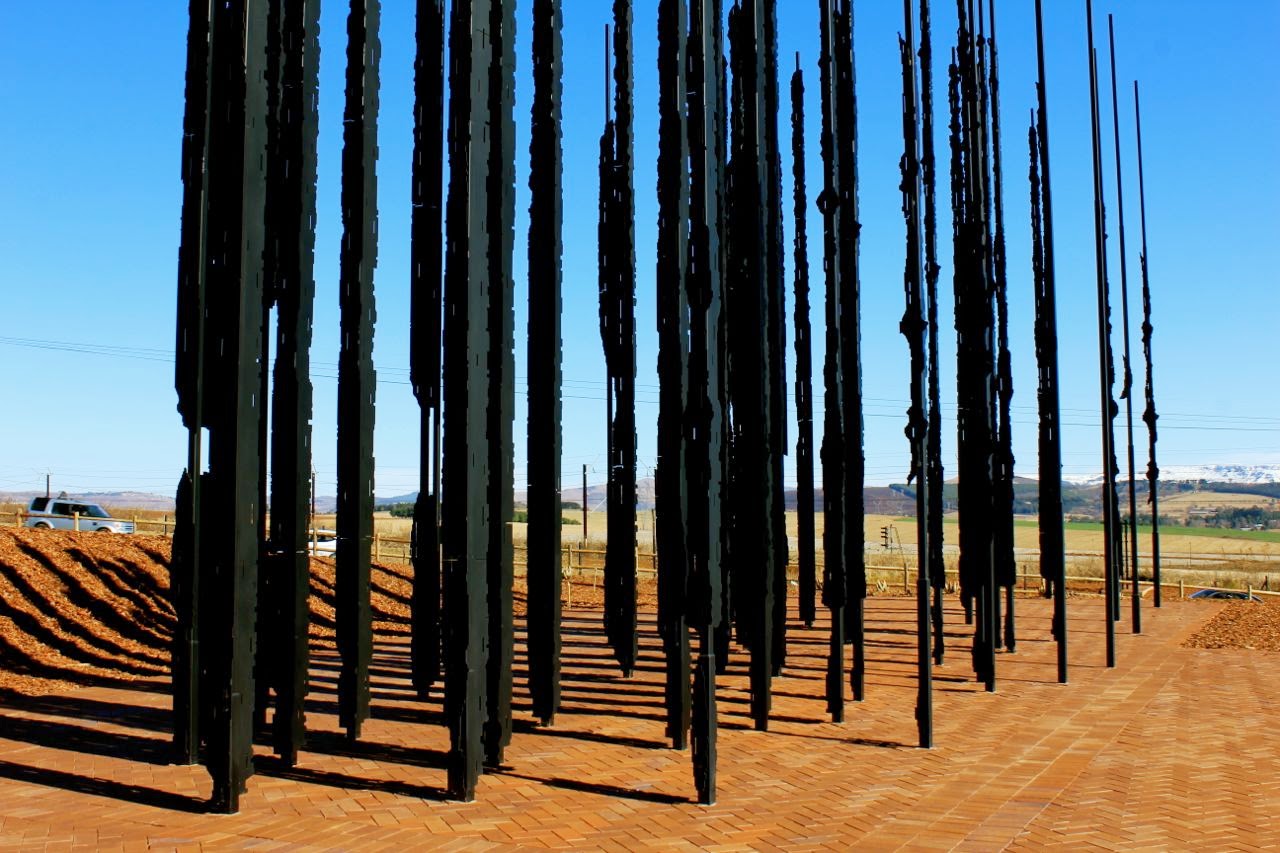
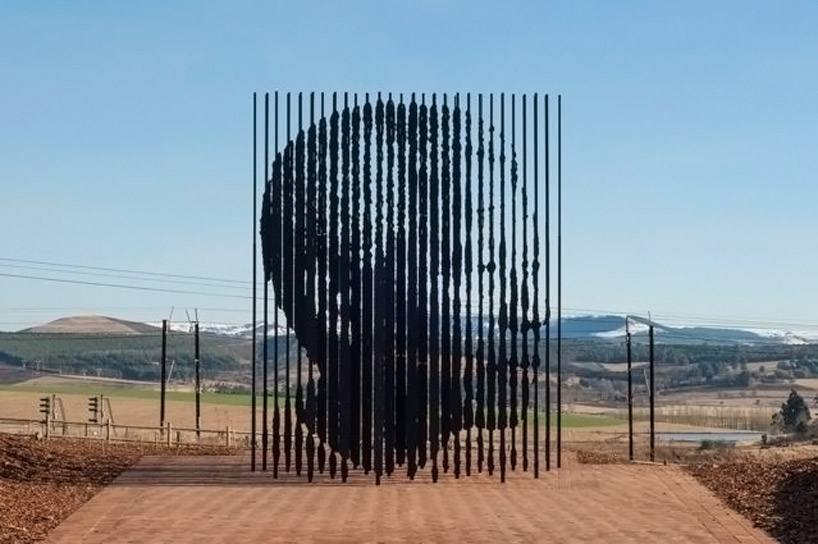
All you see is a seemingly abstract arrangement of 50 steel columns designed by South African artist Marco Cianfanelli.

Marco-Cianfanelli-Nelson-Mandela-Capture-Monument

We park the car and walk down the red-brick walkway towards the steel columns, the rolling hills a backdrop. A car passes behind every now and then, a reminder of events 52 years ago.

On that fateful day in August 1962, the Austin Westminster Mandela was driving was stopped and he was asked by the police if he was indeed Nelson Mandela.

“I am David Motsamayi,” Mandela replied, using the alias he acquired on his travels to Morocco and Ethiopia.

Later, after some questioning, Sergeant Vorster of the Pietermaritzburg police said:”Ag. You’re Nelson Mandela and this is Cecil Williams  and you are under arrest!

Mandela would recall that earlier he had seen a Ford V-8 filled with white people shoot past and that “in that instant I knew that my life on the run was over; my seventeen months of ‘freedom’ were about to end.”

About 35 metres from the steel columns, an optical illusion occurs, the distinctive profile of an elderly Nelson Mandela emerges, looking out contemplatively towards the green hills.

Behind him, you can see the spot where he was captured.

mandela21

While the 50 steel columns mark the 50 years from the time of Mandela’s capture to the sculpture’s completion in 2012, Marco Cianfanelli says they represent much more:

[They] suggest the idea of many making the whole; of solidarity. it points to an irony as the political act of Mandela’s incarceration cemented his status as an icon of struggle, which helped ferment the groundswell of resistance, solidarity and uprising, bringing about political change and democracy.‘

It is a wonderful tribute to the moment of Mandela’s capture and its significance in the struggle to free the country from the shackles of apartheid.

OLYMPUS DIGITAL CAMERA
It’s one of many beautiful and powerful reminders: museums, monuments, institutions that have sprung up since 1994 to keep the story alive of the struggle, of what was sacrificed, what was painfully endured and why.

Having spent some time gazing at the face of Mandela, we returned to the car park and had lunch in the tea rooms. An old friend, who lives nearby, joined us for lunch.

She told us that on the day Mandela died – just over a year ago on December 5, 2013 – she went with a young friend to place flowers at the monument. Many others who live nearby, had done the same.

“A few years back, when it was under construction,” she said, “locals were up in arms. The government was spending all this money and all you saw were these steel poles.”

The visit to the Capture Site was one of the last things we did in South Africa. We flew back to Melbourne a few days later after a wonderful holiday.

Of all the things we saw and did over almost four weeks – some inspiring, some depressing – the Capture Site memorial reminded me of the country’s incredible ability to tell stories, to make the past come alive for future generations and of its creativity and spirit.

Footnote, travels through apartheid history

I recommend the following for anyone visiting South Africa who is interested in exploring its history and democratic evolution:

– the Apartheid Museum, which tells the story of inhumane racial policy of separation and degradation and the freedom that was eventually won,

– the Hector Peterson Museum and Memorial in Soweto which pays tribute to the students who died in the 1976 riots against forced education in Afrikaans,

– Constitution Hill in Hillbrow, a former fort and jail where Mandela and Ghandi were imprisoned and now the home of South Africa’s highest court, the Constitutional Court and

– Liliesleaf Farm in leafy Rivonia, the secret headquarters for the resistance movement in the 1960s.


Travels through literature, alcohol and America: A review of ‘The Trip to Echo Spring’ by Olivia Laing

The trip to echo springErnst Hemingway, F. Scott Fitzgerald, Tennessee Williams, John Cheever, John Berryman and Raymond Carver had at least two things in common: they are all giants of 20th Century American literature and…they were all confirmed, raging alcoholics.

These two commonalities are the basis for ‘The Trip to Echo Spring’ by English author Olivia Laing, a writer and book reviewer for The Guardian and The Observer newspapers.

The title of the book refers a line said by the sexually conflicted character Brick in Tennessee Williams’ great Southern play ‘Cat on a Hat Tin Roof‘.  He says it to indicate he is going to get a drink of whiskey: to numb the pain of his “mendacity”.

Laing sets out to explore how these six writers – whom she admired greatly and who shaped the course of American fiction – experienced, thought about, wrote about and dealt with their addiction to alcohol.

She does so by undertaking a physical trip across America in the Spring of 2011 starting in New York and staying in the Elysee, a hotel in Manhattan’s theatre district where Tennessee Williams spent his last days, and finishing in Port Angeles on the Strait of Juan de Fuca in the upper north corner of Washington State, where Raymond Carver lived the last years of his life  and wrote some of his best short stories while living with the poet Tess Gallagher.

In between, Laing heads down to New Orleans to sit at the hotel bar where Tennessee Williams came in for a drink and to pick up young men and to attend the annual Tennessee Williams Literary Festival, flies south-east to balmy Key West, Florida to visit Hemingway haunts, takes a train west to Baltimore and North Carolina to follow Fitzgerald’s own journey and then chugs out west to Illinois and Minneapolis, tracing the fatal path of the poet, John Berryman.

Amongst all this travel, are Laing’s reflections and contemplations of the alcoholic lives of these writers interwoven with meditative observations of the vast, constantly changing American landscape, mostly from her train window. She writes:

“In Alabama the earth was red and their was Wisteria in the trees. Somewhere deep in the country the train stopped in a pine forest. It was very quiet. A needle dropped lazily through the warm air. The woman beside me was on the phone…”

“Between Tuscaloosa [Alabama] and Meridian [Mississippi] we ran through uninterrupted miles of forest. The hills were covered in bone-grey timber, split and weather-worn into fantastic shapes. Then open country with cows grazing…

I awoke again at dawn. This time the world outside was white. North Dakota, flat as an ironed sheet.

The constant travel not only gives the book it’s part travel-guide feel, but also it’s momentum. Laing is not only on a journey to discover more about her literary heroes and their afflictions, but is also on a journey of self-discovery; making sense of a disjointed, dysfunctional upbringing and one washed through with alcohol. Her mother’s partner was a violent alcoholic.

One of the great strength of ‘The Trip to Echo Spring” and a sign of its success is that makes you want to go out and read (or re-read) the works of Williams, Hemingway, Cheever, Fitzgerald, Berryman and Carver, reminded as you are of their massive contribution to the world of literature despite the booze, blackouts, collapses, rehabilitations and relapses.

Raymond Carver

Raymond Carver

Just off the top of my head I could reel off a dozen books, plays and poetry collections I’ve now added to my “must read” list:

– The Glass Menagerie (Williams)
– Sweet Bird of Youth (Williams)
– For Whom the Bell Tolls (Hemingway)
– Death in the Afternoon (Hemingway)
– Tender is the Night (Fitzgerald)
– The Great Gatsby (Fitzgerald – AGAIN!)
– Cathedral (Carver)
– Dream Songs (Berryman)
– Recovery (Berrryman)

Already, a copy of Cheever’s novel “Falconer” about a jailed heroin addict is waiting beside my bed and I’ve begun to read the opening scene of “A Streetcar Named Desire” from an old paperback that was tucked into the book shelf. And I am waiting for the opportunity to watch Cat on a Hot Tin Roof” starring Elizabeth Taylor and Paul Newman as Maggie and Brick.

Laing has great empathy for her heroes because of the writing they produced,  but she does not sentamentalise them, brush aside their faults or criticise their weaker efforts. Nor is their any glamorization of alcoholism:

[On Cheever’s drinking in 1966]: “…his drinking had passed well beyond normal measures now, even bearing in mind the norms of the time. When he wasn’t on location [filming his short story ‘The Swimmer’] he wrote in the early hours of the morning and by half past ten could be found twitching in the kitchen waiting for his family to disperse so he could administer the first self-soothing scoop of scotch or gin. If they didn’t leave quick enough he’d drive himself to the liquor store, where he’d buy a bottle, motor on to some pretty back street and sit there suckling, inevitably spilling a good slug down his chin.

All six writers were at times monstrous personalities, capable of inflicting great cruelty on their wives, children, lovers, friends and families: Raymond Carver almost killed his wife and was resentful of his own children, Tennessee Williams once defecated in a university hallway, John Cheever projected his closeted homosexuality into rage against his wife.

The book is rich with analysis of the works of fiction these writers produced as well as their non-fiction articles and memoirs. But she is no literary snob, relishing the opportunity to join a tour group visiting Hemingway’s home and museum in Key West or do a Tennessee Williams walk in New Orleans or enjoy meals with retired farmers on her train journeys.

The conclusions she reaches about these writers are not surprising – that they drank to deaden the pain of their childhood, their parents, their sexuality, their broken-ness, their perceived and real failures, while writing was a way to try to become whole again.

None,  apart from John Cheever, managed to stop drinking though they all tried. None lived into old age and two – Berryman and Hemingway –  died at their own hand.

But ultimately it is the journey that Laing takes you on through the minds and immense body of work of these giants of fiction that is the real joy

Not the destination.

Links:
An interview with the author, Olivia Laing  (Buzzfeed)
A review of The Trip to Echo Springs by The Times Literary Supplement
Olivia Laing’s personal website