To Rome with love (and a bit of hate)

to-rome-with-loveWoody Allen’s ‘To Rome with Love’ is a gorgeous tribute to the “eternal city” and a feast for the eyes.

The Coliseum, the Trevi Fountain, the Roman Forum, the Spanish Steps, quiet cobbled back streets and rooftop panoramas are the backdrops to four off-beat stories about people caught up in various adventures and mis-adventures in Rome.

While not a classic among the director’s huge body of work (no less than 50 movies), it is filled with enough classic “Woody Allen” moments to make it one I would recommend to fans.

There are plenty of trademark Annie Hall-style intellectual jokes delivered by Woody Allen’s character, Jerry an unhappily retired opera director, much to the exasperation of his wife Phyllis (played by the always brilliant Judy Davis):

Jerry: “I couldn’t be a communist. I could never share the bathroom”

And…

Jerry: “You know, you married a very bright guy. I got a 150/160 IQ.
Phyllis: You’re figuring it in euros, in dollars it’s much less

There are also some very funny moments as when Giancarlo (played by real Italian opera singer Fabio Armiliato) – the soon to be father-in-law of Jerry’s daughter Hayley  – is wheeled on stage in a production of the opera Pagliacci singing in a portable shower while he soaps himself (I am sure you can work out the reason for yourself).

to-rome-with-love-12

Jerry: I see New York. I see Vienna Opera House. I see Paris.
Phyllis: All in the shower?
Jerry: Yes. They love it that he sings in the shower. They identify. You know, he’s going to be the most popular opera singer in the world.
Phyllis: Certainly the cleanest.

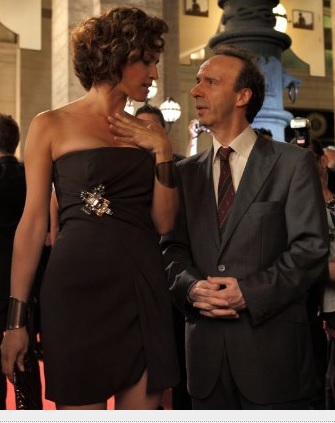
Like the more successful Midnight in Paris, elements of magical realism are interwoven in the story as when Leopoldo (played by the charismatic Italian Oscar winner Roberto Begnini) awakes one morning transformed into an instant celebrity (much like George Samsa in Kafka’s Metamorphosis, though a slightly more appealing predicament) hounded by the paparazzi:

Journalist: Good morning. We are at the home of  Mr. Leopoldo Pisanello. It’s half past seven, and Mr. Pisanello is shaving…an event that we document
from first to last gesture. Mr. Pisanello is having his hair cut. – Look, just a trim – He opted for only a trim.

begning

Roberto Begnini finds himself irresistable to beautiful Italian women

There’s also a sensational performance by Penelope Cruz as Anna a gorgeous, buxom prostitute and great cameos by Italian actors Rosa Di Brigida and Antonio Albanese among others.

Watching ‘To Rome with Love’ took me back to my last visit to the city, in 2010, when I was backpacking around the world with my wife.

I blogged on July 15 under the heading: “No roman holiday” –

“Rome is too bloody hot, too overcrowded with tourists and we can’t wait to leave”

Rome felt nothing like the care free, enchanting city depicted by Woody Allen.

Our few days in the “infernal city” had been a disaster from beginning to end starting from nearly getting run over by Italians in small cars as we hiked down a narrow road, in desperation, trying to find our budget hotel on the edge of town.

After that ordeal, we spent our days fighting our way through traffic jams of tourists at every famous site and on every crowded piazza. Even getting a simple scoop of gelato meant standing in a long line. Worse was the sun which pounded down relentlessly while Rome seemed to offer no shade or escape from the heat. Everything was too expensive, the subways and trains were like ovens and we felt like the only two fools in Rome without a penny to scratch between us. We were glad to leave.

This was nothing like my experience of Rome about eight years prior, when I visited with friends.

I was living in London at the time and money was less of an issue.

We hired a large rooftop flat with sweeping views over the city. We ate delicious pizza and pasta al fresco on big piazzas with the locals. We drank lots of Italian red wine, sipped cappuccinos and shots of Amaretto liquer and watched the sun sink below the white church domes from our mock-castle in the sky. At least that’s how I remember it!

We visited all the sites; stared up at the ceiling of the Sistine Chapel and explored countless old churches. We went walking along the Appian Way to find the ancient catacombs and took naps in parks in the afternoons.

I remembered getting lost outside the Altare della Patria, the white marble national monument known as the ‘wedding cake’ on our way to find some famous site just as Hayley (Alison Pill) does at the start of the movie, only for Michelangelo (Flavio Parenti) to show her the way.

When John (an architect played by Alec Baldwin) is drinking a glass of wine with his wife and friends on the piazza, I remembered sitting at an outside table in front of the Pantheon, ordering a ‘prosciutto’ pizza only for the waiter, confused by my poor pronunciation to bring me a ‘bruschetta’ – much to the amusement of my friends.

‘To Rome with Love’ is not Woody Allen’s greatest film or even a great one, but as a homage to Rome, it is practically flawless.

It reminded me of all the reasons I loved Rome the first time.

My great great grandfather: the adventurous Prussian soldier who loved a drink

OLYMPUS DIGITAL CAMERA

This is a picture of my great great grandfather Heinrich Gimkiewicz  (with impressive beard) and his wife Helene taken in Berlin in 1881.

I have come to know a little about Heinrich through a self-published book by a cousin, Keith Kaye, a urologist who lives in Minneapolis.

Keith translated and published the diary Heinrich kept while serving as a non-commissioned officer during the Franco-Prussian war, a largely forgotten but bloody dispute that took place in Western Europe between July 1870 and May 1871, won by Prussia thus unifying the various German states.

The diary was bequeathed to the University of the Witwatersrand in Johannesburg by Heinrich’s granddaughter Helga, It was here that I studied various degrees between 1992 and 1998, emerging, finally with a Bachelor of Arts in 1996 and a Post-Graduate Diploma in Management in 1998.

All that time, I had no idea a diary was kept by the University library detailing the daily marches, battles and ruminations of my distant paternal descendent.

When I began reading the translated diary entries I was at first bored. Heinrich details his movements from one town to the next, the long marches or train rides, complaints about the cold, waiting around for orders and details of the various civilian billets where he stayed in occupied French towns.

The names of towns and army commanders meant very little to me.

But as I read and persevered, I found Heinrich to grow more interesting and to see things in his personality that reminded me of myself.

It became apparent to me that my great great grandfather enjoyed a drink, preferably an alcoholic one (as I do) and sometimes drank until he was “tipsy”.

He writes of a stay in Rheims on November 12, 1870:

We stay here today, and so we try to get to know the town. Provisions are quite bad here, but there is lots of wine…

On November 16, in the hamlet of Coucy la Ville between La Fere and  Soissons:

It is quite nice here, there are lots of apples; the people make a pleasant drink out of them. It is available in quantity, and we like it very much, there being no wine.

And later, in Roumare on December 28:

I go and get my baggage, we prepare our meals and sit together until 10pm, having a good time. There is enough cider, each day we drink a considerable amount.

He was also fond of exploring the towns that he visited and had an appreciation of architecture, food and the hospitality and the customs of local French people, even if they were the ‘enemy’. However, unruly Frenchmen are not tolerated and one, he reluctantly admits to slapping.

He is also more than a little mischievous and I surmise – not always that honest  – with his diary entries – particularly when he visits a Rouen brothel:

It happens on February 16, towards the end of the war when he is billeted in the home of a cotton manufacturer. Heinrich writes that at 6.30pm he eats dinner with his landlord, “who is a very friendly man” then goes out again “this time on a less moral path”.

We want to have a look at a French brothel. There are many here. The first one is the Maison Stephan, which is high-class. The second one is a normal one. We return at 11pm.

No description is given of what he did for four hours, but we can guess. His fondness for the ladies reveals itself on a number of occasions with glowing descriptions of local landladys (one is”an aristocratic woman called Madam de Savers” who is “very friendly”) and the daughter of one of his landlords.

Rouen was a special place for Heinrich in the war. He writes of its bustling life after the armistice is declared and that “in all the places and in all the cafes it now becomes obvious  that this beautiful city belongs among the greatest in France”.

I would whole heartedly agree. My wife and I visited Rouen in the summer of 2010, staying in a little shoebox apartment above shops on the main road. Our landlord was a small, dark-skinned moustached man, who spoke not a word of English. We cooked tinned Cassoulet on a portable gas burner in the evening after exploring the exquisite, historic town in the day.

Now, I wonder, if I tread on the same cobbled stones as Heinrich did all those years ago as he explored the various districts and drunk in its cafes and restaurants.

Heinrich also writes intriguingly of the Yom Kippur service for Jewish soldiers, the holiest day in the Jewish calendar.

A proud Prussian man willing to die for his country, Heinrich could not have known that this war, which unified Germany, would create some of the circumstances that led to the First World War in 1914 and later the Second World War, where German Jews were betrayed and murdered in their millions by their homeland.

He writes of the Yom Kippur service in St Barbe on October 6:

…all in all there were 400 men of our denomination there.  It was Rabbi Blumenstein who came especially from Mannheim…it was moving. Most of us had probably never prayed as intensely as we did today.

My favourite extract – and where I feel a strong connection with my great great grand father – comes towards the end of the campaign, when Heinrich’s regiment reaches the town of Fecamp, on the Atlantic Ocean:

Now we are to see the ocean. We are led there one platoon after the other, it is a gorgeous view…with its huge waves…a clear difference from our eastern sea. This mighty sea with its waves which exist in such height only here, surrounded by high white chalk cliffs is really indescribable and unforgettable. This great view truly compensates for all our strains of the last days and we are grateful to our captain who kept his promise.

With the war over, Heinrich returned Berlin and married Helene 10 years later. They had four children.

The family move to South Africa in 1899 was most likely sparked by a wave of anti-Semitism surging through Europe at the time and the prospect of making one’s fortune amid the gold fields of the Witwatersrand.

Heinrich’s daughter Else would later marry an Austrian-born geologist and mining engineer called Bruno Schlesinger in 1907 and I would emerge into the world in 1973, a chubby child with a curly mop of hair to carry on the Schlesinger name.

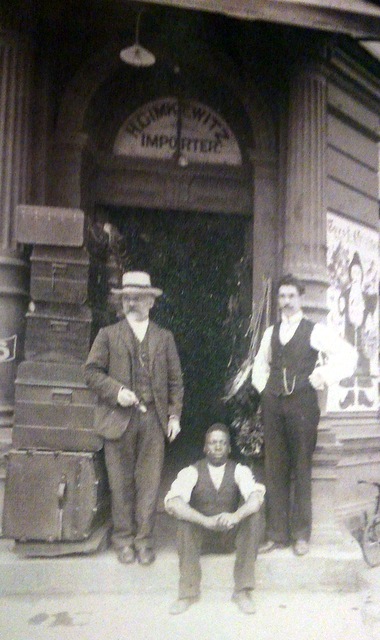
Heinrich ran a toy shop in  the centre of Johannesburg with merchandise imported from Germany. A photo outside the store shows him to be a dapper dresser in three-piece suit and hat, bearded with fob chain dangling from waist coat.

Heinrich, top left, in front of his Johannesburg toy shop

Heinrich, top left, in front of his Johannesburg toy shop

Sadly, anti-German feeling in 1915 following the sinking of the British ocean liner the Lusitania  forced Heinrich and his family into veritable hiding as mobs attacked anyone of German descent. Being unable to import German goods, he lost most of his customers.

Heinrich died in 1922 aged 75, 10 days after his wife Helene apparently of a broken heart. They are both buried in Johannesburg’s Brixton Cemetery.

– I think I would have enjoyed sharing a glass of wine with him. Or maybe some Cider.

Threshold to the Kingdom: Art, MH17 and sudden departures and arrivals

In November 2001 I visited the Whitechapel Art Gallery in the East End of London.

In a darkened room  I watched a video art installation called “Threshold to the Kingdom” by the acclaimed British artist Mark Wallinger

It showed the gates at an airport arrivals hall opening and closing in super slow motion as passengers emerged and made their way home after a long overseas flight.

In the background, rang out the 500-year-old chant of Allegri’s ‘Miserere mei, Deus‘ – a psalm about a man asking for God’s forgiveness written to be sung in the Sistine Chapel.

Their slow movements and the haunting music transformed the arriving passengers into poised, graceful dancers, as if each movement of arm and leg were in perfect rhythm.


(A 3 min excerpt of the 13 minute art work)

I remember being completely mesmerised,  in a state of Zen-like contemplation: I saw the passengers coming through the automatic gates as angels arriving into some earthly heaven, not one full of puffy white clouds and cherubs playing harps.

This  interpretation may sound strange, but it was only two months earlier that I had walked back to work in the West End and watched with sheer disbelief as jet planes crashed into the World Trade Centre towers in New York, bursting into balls of red and orange flame, obliterating lives in an instant.

In that darkened art gallery room, I thought of people that never arrived and those they left behind in airport arrival halls.

The recent shooting down of Malaysian Airlines MH 17  brought the memory of that London afternoon vividly back in my mind.

As I did back in 2001, I think now of all those bright, happy people, returning from family holidays or on their way to an exciting destination- and then gone in an instant, never to arrive at their final point of disembarkation.

Perhaps they have not disappeared, but have arrived someplace else. It is that feeling which “Threshold to the Kingdom” instilled in me so powerfully.

Daily Telegraph art critic Martin Gayford  wrote of the effect of the artwork:

 It gets its strange power from the conflation of Allegri’s soaringly spiritual music with the banal, anonymous setting of an international airport. Yes, the gates of heaven might be like this – ordinary, yet marvellous.

Reflecting on all the families and friends of the passengers of flight MH 17 dealing with their overwhelming, unbargained for grief, I remember “Threshold to the Kingdom” with ever greater poignancy.

It seems a fitting memorial to the victims of MH 17 as it was back then – in my mind – to the victims of 9/11.

———————————————————————————————–

The full, haunting version of Allegri’s ‘Miserere mei, Deus:

What’s to really like about Irvine Welsh’s Filfth?

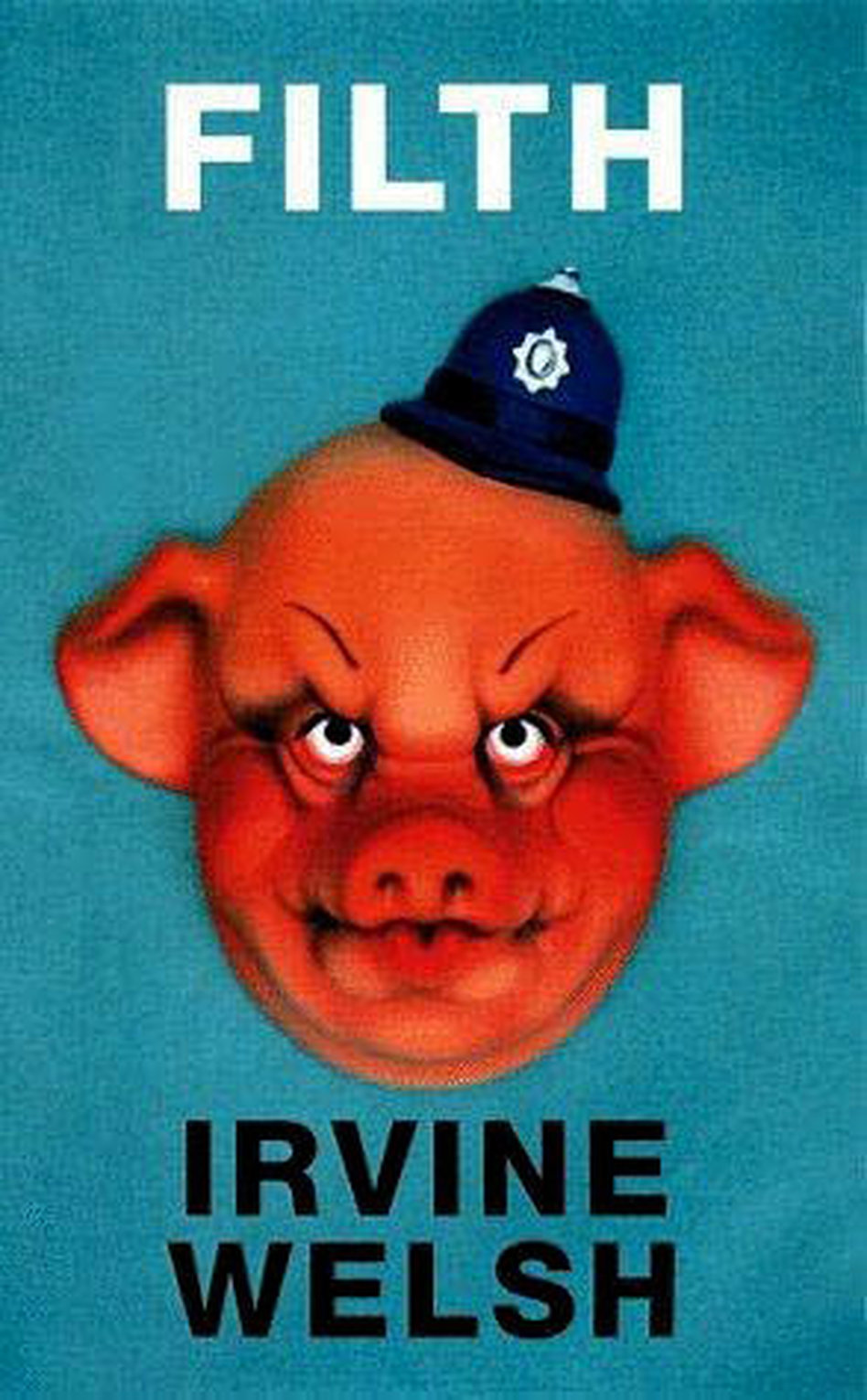
filfth“Failure is much more interesting to me than success,” said Trainspotting author Irvine Welsh in a recent talk I attended in Melbourne

“I write about people who are going through a bad time, when things are falling apart. I try to show these characters grasping for the light switch,” he said in an attempt to explain the grim reality of many of his characters.

In the case of Scottish Detective Sergeant Bruce Robertson, the light switch might as well have been in Hawaii, in an abandoned, graffiti stained warehouse where the power has long been turned off.

He is beyond hope of redemption, right from the very first pages:

After two fruitless strikes I feel a surge of euphoria on my third as his head bursts open. His blood fairly skootches out…

Robertson its an utterley despicable character. A murderer, a rapist, a racist, a misogynist, a betrayer of his friends and family, a drug fiend, an alcoholic, a rabid consumer of pies, chips and deep fried food; a man with eczema-encrusted genitals that rise at the slightest whiff of sexual conquest, who retreats to the bathroom to give his itchy anus “a good clawing”.  Into the mix, throw in a distinct lack of interest in personal hygiene, fetishes that include erotic asphyxiation (strangulation sex) and a side interest in bestiality, and you get a pretty good picture of DS Bruce Robertson.

And yet it’s an enjoyable book to read mainly because Robertson is an entertaining, wise-cracking first person narrator who speaks directly to his reader without any sense of remorse, who plots the downfall of his work colleagues, friends and adversaries with Machiavellian cunning. One enjoys his scheming and plotting in the same manner as one enjoy Blackadder and his many “cunning plans”.

At the heart of it all is a man who hates everything but his own shadow, driven by a burning rage that will not cool:

I hate them all, that section of the working class who won’t do as they are told: criminals, spastics, niggers, strikers, thugs, I don’t fucking well care, it all adds up to one thing: something to smash.

Robertson is a voyeuristic release for every bad thought a (male) reader has ever had (and yet there are also female fans of this book).

There’s a guilty pleasure in allowing Robertson to enter your head, knowing that you can close the book and return to the real world where hopefully some sense of morality and decency remains.

Perhaps this is partly why Welsh wrote it, to get all his inner demons on the page to expunge the Bruce Robertson buried in his pysche. Either that, or it’s an opportunity to write about a character who remarks during a bout of sex with an Amsterdam prostitute:

I’ve given the pole a good greasing but she’s pretty tight. Once I get in though, it starts to slide up. I can tell that she’s in a bit of distress cause she’s making hissing noises and her back muscles are tensing, but it’s probably  just cause the fucking hoor’s loving every minute of it.

These type of graphic descriptions dominate the book in between heavy bouts of drinking, drug taking and “hooring”.

The female degradations inflicted by Robertson reminded me of a question a woman asked at the same talk Welsh gave in Melbourne. She asked him about his depiction of woman characters and whether there was something misogynistic about it?

At the time I scoffed at the question, but having read Filth, I’ve reconsidered.

Women are the chief focus of Robertson’s humiliations. They are reduced to play things without feelings or emotions. They are objects for his pleasure and derision most horrifyingly illustrated in a scene I won’t even dare to quote where Robertson drives a prostitute to an isolated farm to have sex with a sheep dog.

It was this scene where – out of sheer revulsion – I considered putting the book down.

Trainspotting was Welsh’s first book and I wager – though I have only read it and now Filth – his finest by a country mile. Trainsportting was  a brilliant depiction of the post-Thatcher generation lost to drugs. A modern classic.

Filth is almost pure literary pornography with an enigmatic villain unlike any created in fiction who engages in every possible depravity. There’s whiffs of Trainspotting in Robertson’s occasional hilarious commentary on Scottish football, tabloid journalism (Robertson is a big reader of The Sun – for the football and the girls on page 3) restaurant food and local politics. But it has little gravitas and nothing meaningful to say about the society that created such a monster as Bruce Robertson.

Yes, we learn something of Robertson’s motivations and inner psyche –  through a tapeworm in his bowels that speaks in Queen’s English. But in the end and upon reflection, I tend to agree with what The Observer book critic Alan Taylor wrote of the novel when he reviewed it in 1998:

“As an archetype, Robertson is over the top. Welsh slips so easily into degradation mode that pages slip by in wodges, a miasma of pornography that is mindnumbing…Welsh lets him sink so low he is not resuscitable. For such a man, the idea of redemption seems risible. His sin goes beyond breaking the law. Guilt, ultimately, is the least of his problems. He has committed the cardinal crime. He is a crushing bore.”


Peter Greste and my own bittersweet memories of Egypt

Having tea near Tahrir Square, Cairo - October 2010

Having tea near Tahrir Square, Cairo – October 2010

The recent wrongful conviction of Australian and Al Jazeera journalist Peter Greste and his two colleagues by a corrupt Egyptian court has stirred up memories of the week my wife and I spent in Egypt in 2010 as part of a round-the-world trip.

Before I turned to my own diaries to recall what I wrote about those days in Cairo and Alexandria in a hot October (just a few months before the start of the Arab Spring) I was moved by an re-collection of Cairo by a colleague at the Australian Financial Review, Tony Walker, who lived there as a foreign correspondent between 1983 and 1994.

Mr Walker reminisced:

My own memories drift back to my Cairo home at 19 Gabalaya Street, Zamalek on the Nile, where I lived securely and contentedly for 10 years surrounded by Egyptians who were my friends, including my assistants, Hoda and Shahira, my late ­tennis-playing friend, Eduard Malek, who was killed in a road accident in the office ­Mercedes I had bequeathed to him at the end of my assignment…In my apartment building resided some of Egypt’s foremost citizens, including Samia Gamal, the Arab world’s Margot ­Fonteyn of belly dancers, and Faten Hamama, the region’s Sophia Lauren and first wife of Omar Sharif.

Mr Walker described the case made against Mr Greste and his colleagues as a “judicial farce” and concluded, mournfully: “Egypt, I do not know you”.

Cairo, for anyone who has not visited is a manic place – perhaps the most manic in the world – crammed with 20 million or so people (no one seems to know exactly how many), packed with buildings new and ancient in a metropolis that never seems to end and roads clogged with cars, trucks and busses, where you cross at your own peril. Cairo has both crumbling majesty in its ancient monuments – the pyramids of Giza the most famous – bustling trade in the markets of Islamic Cairo and touch of the modern city in its efficient metro system, one of only two in Africa.

DSCN9258

Me, in Islamic Cairo, October 2010

But my abiding memory of Cairo was of playing the Western fools, with our map spread open on Tahrir Square trying to find our way to the Nile or the Egyptian Museum and caught out at every turn by scam artists and confidence tricksters.

We were scammed almost every day in Cairo – nothing of the amount to ruin our trip – but enough to leave a sour taste in our mouths when we flew off to a “sedate” (by comparison) Mumbai.

The opening remark in my journal on Wednesday, October 6th (our fourth day in Cairo) begins: “We awoke with the intention not to be scammed today.”

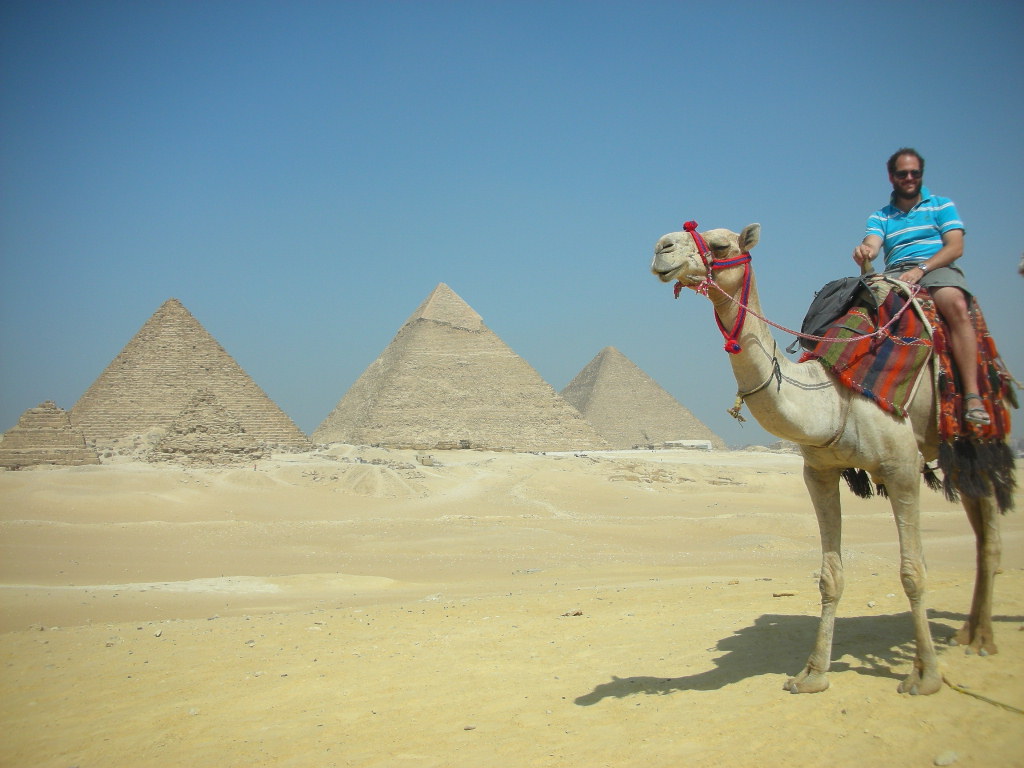
Of all the cons played on us – from the jovial family man Abdullah who “just happened” to bump into us after his hotel shift on the way to catch a bus to the pyramids and who steered us straight into the arms of US dollar charging camel ride purveyor, to the man who led us straight to his uncle’s perfume shop rather than where – as promised – the felucca boats departed on the banks of the Nile,  the saddest was perpetrated by a kindly looking old man with white beard and moustache (think the Egyptian Colonel Sanders), who caught me out on our second evening in Cairo, when I was walking on my own near Tahrir Square (my wife was still battling a cold and had stayed in the hotel room that evening).

A very expensive camel ride at the Pyramids of Giza

A very expensive camel ride at the Pyramids of Giza

I had just returned back to the centre of Cairo after having a wander around the dark lanes of Coptic Cairo (home to ancient ruins, churches and synagogues of Cairo’s Catholic and Jewish descendants dating back 1500 or more years) with its mud-brick homes. tiny convenience stores and less than friendly stares of the local children.

I emerged from Sadat Station looking for somewhere to eat when I was stopped by a portly, balding man with a white beard and glasses who asked me where I was from.

“Not a minute had passed and I found him walking alongside me as if we were old friends,” – I wrote in my journal. “He looked so innocent,” I added.

At one point during our walk he stopped to write my name out in Arabic. Later he told me he played the organ in the church and that he was a sculptor.

At some point, I told him I was hungry but could not find somewhere to eat:

Next minute I was tucking into chicken, rice and vegetables. He watched me and said little except to enquire if the food was any good. He later stepped outside to chat to the owner.

After the meal – all he had was a soft drink – nothing was paid in the restaurant and in my naivety as we left, I wondered if perhaps – out of the goodness of his christian heart – he had paid for me. I wrote:

As we walked on, he said I owed him 43 Egyptian pounds, not a king’s ransom, but double what the meal would have cost me anywhere else. When I gave him a 50 pound note, he then had the temerity to ask if he could keep the change. I said no, but he still short-changed me by 3 pounds.

I walked back glumly to my hotel to recount the story to my wife. I felt both stupid and sad.

Looking back at it now, in the wake of the Arab spring which promised so much for Egypt and its struggling people, I feel mostly sympathy for the little old man who conned me out of a few pounds.

I wonder what has happened to him and if he is still trying his routine on  unsuspecting tourists – if any still visit in the wake of 2013 military overthrow and the terrible situation of Peter Greste, his colleagues and thousands of others arrested, tortured and murdered.

One further incident remains fresh in mind –

It is of my wife and I running to catch a bus outside the Egyptian Museum guided by our new friend Abdullah urging us to jump on the rickety thing while it was still moving.

Along side was a man throwing his ten bags of groceries on to the steps of the bus before leaping on himself (buses in Cairo, we learnt slow down but don’t stop to let passengers on).

Safely on the bus, I found myself staring at a little kid – perhaps 12 – sitting in the ticket seller’s seat as we sped past Cairo University who demanded I buy a ticket from him.

Just before I handed over a few coins, Abdullah stopped me.

“He is not the ticket seller, just some kid.”

Having reassured us that he was our guardian, he then proceeded to scam us.

The strange, dangerous, addictive world of @Twitter

twitterA colleague at work tells me I’m the worst tweeter in the world.

I laugh and shrug, but agree he could be right  (some of the time).

Mostly, it’s to do with my inane comments on sport, particularly Australian Football, which I admit I know very little about.

Still that doesn’t stop me winding up my 1200 or so followers, some of whom are friends who support opposing teams to the high-flying Sydney Swans, the team I barrack for.

What can  I say, I like to wind people up by saying this coach couldn’t teach a primary school woodwork class or that full forward couldn’t hit a cow’s arse with a banjo – let alone guide the Sherrin through the middle posts.

My problem is that I occasionally tweet my private thought and let’s be honest everyone has some pretty dark or silly ideas running through their brains at one time or another (before Twitter came along in 2008 the worst you could do is send a text message while drunk or angry) .

Some tweets are so explosively bad, they have the potential to be disastrous.

This was famously illustrated last year when PR executive Justine Sacco tweeted to just 400 followers before boarding a long-haul flight from the US to South Africa:

Image

Twelve or so hours later, her racist remarks had been retweeted thousands of times – by people who had tens of thousands of followers creating a huge multiplier effect – and the Twitter-sphere was up in arms.

A hashtag #HasJustineLandedYet trended around the world and Ms Sacco found herself with 8000 unwanted “followers”.

Ms Sacco lost her job, her reputation was in tatters and she promptly vanished from Twitter and social media to lick her wounds (though amazingly someone has hired her again!)

Of course other more famous people have gotten into trouble for tweeting including fiery cricketer Dave Warner, who tweeted an expletive-ladden attack on cricket writers and was promptly fined by Cricket Australia and Hollywood actor Ashton Kutcher who tweeted to his 8 million followers his support for American college football coach Joe Paterno after he was sacked for not doing enough to prevent the abuse of children by his assistant coach Jerry Sandusky.

A bad tweet can end a career, ruin a reputation and cost a lot of money in legal fees – comedian Roseanne Barr was sued by the parents of George Zimmerman, the man who shot Trayvon Martin – after she tweeted their home address. The Zimmermans claimed Ms Barr incited a lynch mob. She later deleted the tweet but the damage was already done.

Undeniably, Twitter has incredible power.

While Facebook’s influence is arguably waning, Twitter is getting bigger and bigger (pop star Katy Perry has 54 million followers) and it has that incredible multiplier effect through retweets. Give a tweet time (as in the case of Justine Sacco) and the results can be tsunami-like.

Twitter’s power is its immediacy, punchiness (just 140 characters forcing people to condense their thoughts into bite size chunks) and ability to reach so many people.

Unlike Facebook, LinkedIn and others, where there is some level of privacy (messages can be restricted to friends and networks), Twitter is a free-for-all where everything is public.

It’s an addictive place where you can read the private thoughts of some of the world’s most powerful people  like right-wing media baron Rupert Murdoch  – @rupertmurdoch  – who actually writes his own rambling tweets.

It’s where you can interact with your favourite celebrities (who doesn’t like to brag about getting a reply from a favourite actor or a retweet or mention) and get involved in discussions on politics, sport, religion and every topic in between.

There’s a strange kind of pleasure when people from far-flung places respond to your tweets. For example, this exchange after I posted my thoughts on the book Birdsong by Sebastian Faulks, which I had just read. I got a reply from an actor appearing in the play of the novel in the UK.

Image

Twitter is a great place for sharing stories, thoughts, inspiration, recipes, photographs, anecdotes, jokes and grievances (nothing better than winding up a big corporation who can’t help themselves but responding to every criticism).

Twitter is where many of the biggest news stories are broken (I remember a colleague at work shouting out: “Someone has just tweeted that Oscar Pistorious has shot his girlfriend” before it became a huge worldwide story).

But you have to be careful what you write even if you are a humble journo hack like me.

A point I have to keep reminding myself every time I think I’ve thought up something witty to say and have my finger hovering over the “Tweet” button.

“Just remember Justine Sacco,” I tell myself.

Follow me @larryschles


Downloading a movie is wrong, but is it the same as stealing a car?

Perhaps you remember this ad:

It was an anti-piracy commercial warning the DVD viewer that downloading pirated movies was the same as stealing a car, or a handbag or a television.

People who downloaded movies were very bad people, the ad insinuated, a message that was replicated around the world in similar campaigns like this:

illegal download campaigns2

M-Tv anti-piracy ad

I was reminded of this campaign strategy after reading that the Australian government under the direction of Attorney General George Brandis planned a fresh move to crack down on movie pirates. Mr Brandis said:

“The government will be considering possible mechanisms to provide a legal incentive for an internet service provider to co-operate with copyright owners in preventing infringement on their systems and networks.

“This may include looking carefully at the merits of a scheme whereby ISPs are required to issue graduated warnings to consumers who are using websites to facilitate piracy.”

It’s unlikely this will succeed.

In 2012, an Australian High Court ruled that internet service provider iiNet (the second biggest ISP in Australia) was not responsible for the conduct of its subscribers and could not be ordered to terminate services of repeat copyright offenders.The five high court judges in the case ordered Warner Bros, Disney, Fox and Paramount Pictures and 29 other companies including Australian independent distributors and TV networks under the umbrella of the Australian Federation Against Copyright Theft to pay $9 million in court costs.

In addition, prosecutions of individuals who pirate material remain rare and are primarily restricted to those who make and sell pirated DVDs (the kind you can pick up overseas or in a dodgy market for a few bucks) and the websites that host them.

Campaigns like “You wouldn’t steal car…” and more recent ones by the Intellectual Property Awareness Foundation which appeal to the public’s guilty conscience have also failed.

Australians are downloading pirated movies and TV shows in record numbers, as seen in the recent download stats for hit HBO show Game of Thrones, where they accounted for the highest proportion (around 11 per cent) of the 7.5 million people worldwide who downloaded the finale of season four within days of it being shown on pay television, according to website Torrentfreak.com.

By comparison, about 500,000 people watched the episode legally on Foxtel when it premiered.

thrones-cast

“Australia, I am sorry to say, is the worst offender of any country in the world when it comes to piracy,” Senator Brandis told the Australian Senate.

But, contrary to what’s being said, people who download or stream movies illegally (between 25 per cent and 55 per cent of Australians depending on what survey you read) are not also stealing cars or handbags or televisions. They’re not trying to put someone out of work (about 6,000 jobs are lost each year as a result of piracy) or send a production company bankrupt.

Most go to work, pay their taxes, pay their mortgage, pay for their groceries at the checkout counter and pay for their petrol after filling their tank. They’re your friends, your work colleagues, your bank manager, the guy making your chai latte at your favourite cafe, your kid’s kindergarten teacher – everyone is doing it.

The main reason people download shows illegally are convenience, to save money and anger and frustration at the cost of paying for it legally.

The internet has made it incredibly easy and safe to download or stream favourite show just by clicking on a link.

Many people are rebelling against the high cost of movies (now above $20 for some time slots), and the inflexibility and arrogance of providers like Foxtel, which does not allow subscribers to pick and choose their movie channels they want (channels are bundled) and which has a virtual monopoly on pay television in Australia, (though this is being challenged by online competitors).

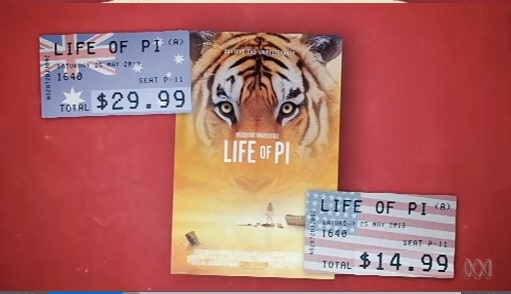
There’s also the anger at service providers like Apple iTunes, which charges Australian customers between 50 and 100 per cent more for movies and music than they do customers in the US (as highlighted in the ABC’s The Checkout) for the same products

The relative cost of buying the movie "Life of Pi" in Australia and the US (from The Checkout)

The relative cost of buying the movie “Life of Pi” in Australia and the US (from The Checkout)

There’s nothing like the feeling that you are getting ripped off to encourage you to try and get something for free.

There’s also the harm factor. While some Australian companies may be impacted by lost revenue to piracy the public will also be aware that the really big entertainment companies are still doing rather well despite it.

Time-Warner reported revenues of US$7.5 billion for the first quarter of 2014 and earnings of $1.5 billion primarily from shows like Game of Thrones, True Detective and The Lego movie. Nobody at Time-Warner is crying poverty.

Australia’s biggest entertainment group, Seven West Media (owners of Channel 7) reported a 4 per cent rise in television revenue to $683 million for the six months to December 2013 and profits of $190 million.

Foxtel – half-owned by Rupert Murdoch’s News Corp – has 2.5 million subscribers (not far off one in two Australian households) and last year had revenues of $3.1 billion and earnings of almost $1 billion.

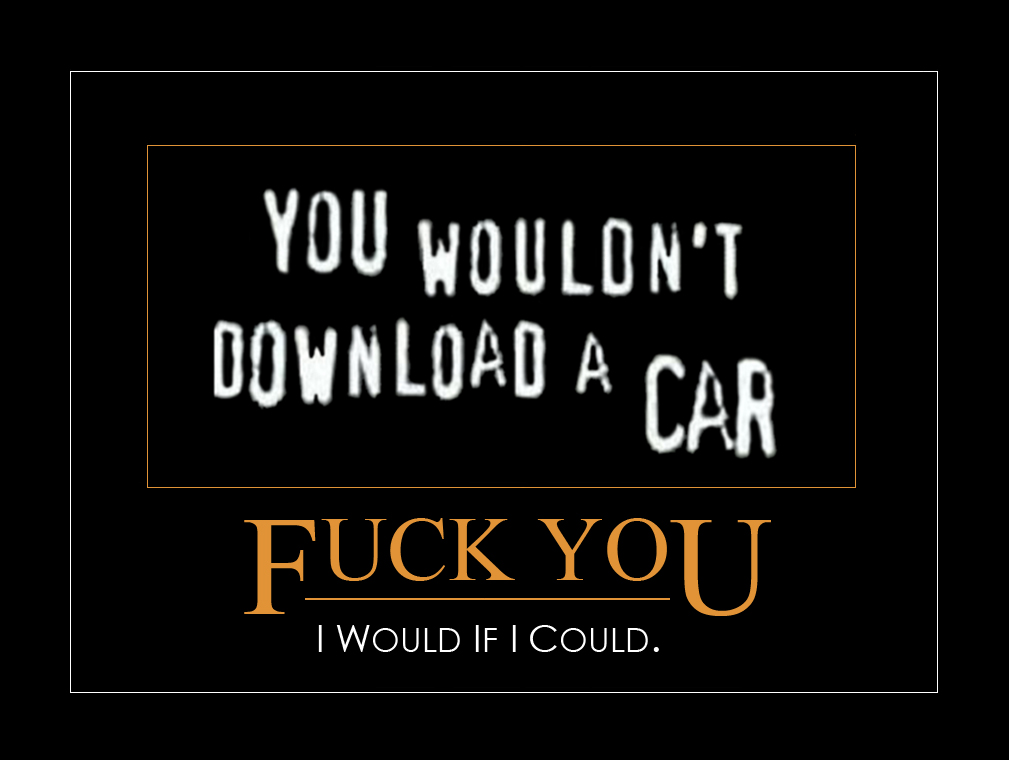
Add the $20 – $30 million plus some Hollywood stars get paid to appear in a single movie  and you can understand why some people’s attitudes to movie piracy is this:

illegal download campaign - parody

Or this:

illegal download campaign - parody2

Intriguingly, while pay television companies, cable networks and cinema owners shake their fists at the public for being pirates and Australian attorney general George Brandis threatens tough new measures, others are taking a far more realistic view.

Jeff Bewkes, CEO of entertainment giant Time-Warner, owner of network HBO, which produces Game of Thrones, said during an earnings call last year that having the most pirated show of the year was “a tremendous word-of-mouth thing” and “better than [winning] an Emmy.”

He wasn’t alone. Game of Thrones director David Petrarca said piracy contributed to the show’s “cultural buzz”, while author of the novels, George R.R. Martin also called it a “compliment,” (though one he would rather not receive).

Mr Bewkes compared piracy to “cable-splitting” (illegally sharing a cable subscription) and said it had in fact contributed to HBO subscriptions and greater penetration of the HBO brand.

Also interesting to note is that US movie streaming service Netflix uses piracy data to decide which shows to buy, a back-handed compliment to the tastes of online pirates.

And perhaps also a concession that piracy is part of the entertainment industry like popcorn and paparazzi – and something that they will have to learn to live with even as the authorities threaten a clampdown.

Five Woody Allen movies infinitely better than Blue Jasmine

woody_allen__1218229285_1191I’ll be honest. I was a little bit disappointed with Blue Jasmine.

It certainly wasn’t a Woody Allen clunker like Celebrity or Curse of the Jade Scorpion or Small Time Crooks, but it wasn’t up their with his best work. It was better than his middle-of-the-road stuff, and neatly reflected in the IMDB  score of 7.4 out 10.

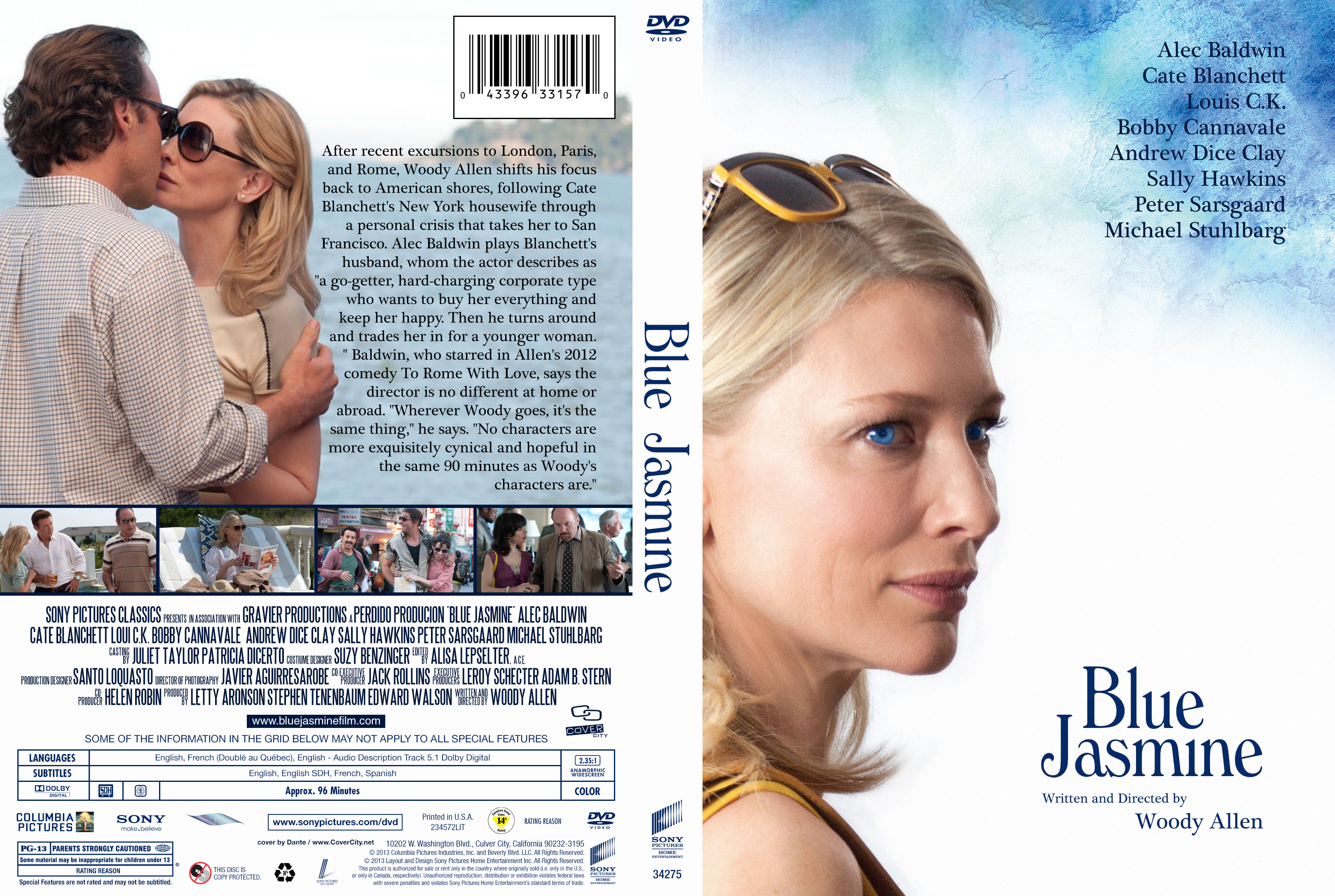
Blue JasmineThe acting was excellent, particularly Cate Blanchette as Jasmine – the neurotic, snobby and materialistic New York socialite brought down to earth by the scandal of her New York husband’s Hal’s  (Alec Baldwin) Bernie Madoff-like fraud, who flees to San Francisco to start her life over. There are also excellent performances by Sally Hawkins (who plays her sister Ginger) Andrew Dice Clay (Ginger’s ex-husband) and Bobby Cannavale (Ginger’s cocky love-struck boyfriend).

For me, the film started incredibly strongly and then just lost momentum two-thirds of the way through with an obscure, annoying ending (I won’t spoil it for those who have not seen it). It felt like Woody Allen wrote the film mainly to win an Oscar for Cate Blanchette – roles involving dysfunctional, intense female characters having a history of Oscar success, consider: Angelina Jolie in Girl Interrupted, Jennifer Lawrence in Silver Linings Playbook, Natalie Portman in Black Swan to name just three (all far better films than Blue Jasmine).

Blue Jasmine is worth watching for the acting and some excellent scenes, but if you want to watch classic Woody Allen at his best, there are more than a dozen films that are better from his vast oeuvre going back five decades.

For Woody Allen novices, these are five of my favourites, all absolute classics:

Crimes and Misdemeanours (1980)

Woody Allen’s greatest cinematic achievement. Interweaves multiple plotlines in a film about the nature of comedy, guilt, forgiveness, betrayal and love. Incredible performances from Martin Landau, Angelica Huston, Alan Alda, Sam Waterston, Mia Farrow and Jerry Orbach. Some of his funniest jokes, some of his most poignant moments in film. IMDB rating 8.0

Judah Rosenthal: I remember my father telling me, “The eyes of God are on us always.” The eyes of God. What a phrase to a young boy. What were God’s eyes like? Unimaginably penetrating, intense eyes, I assumed. And I wonder if it was just a coincidence I made my specialty ophthalmology.

Annie Hall (1977)

A romantic comedy about Alvy Singer (Woody Allen), a neurotic, over-sexed comedian who falls for the utterly charming but ditzy Annie Hall (Diane Keaton) filled with Jewish New York humour, witty observations about sex, love, family and relationships. IMDB rating – 8.2

Annie Hall: Sometimes I ask myself how I’d stand up under torture.
Alvy Singer: You? You kiddin’? If the Gestapo would take away your Bloomingdale’s charge card, you’d tell ’em everything.

Manhattan (1979)

Shot beautifully in black and white to the music of George Gershwin, this is Woody Allen’s homage to his favourite city, New York. It stars Allen as Isaac Davis, a divorced writer of TV shows caught in a dubious love affair with teenage Tracy, (a very young Mariel Hemingway), but who falls in love with his best friend’s mistress (Diane Keaton). IMDB rating 8.0

Isaac Davis: My analyst warned me, but you were so beautiful I got another analyst.

Match point (2005)

Set in London high society, a tennis professional (Jonathan Rhys Myers) engages in a steamy affair with visiting American Nola Rice (Scarlett Johansson) while engaged to Chloe (Emily Mortimor) the innocent daughter of a wealthy family. A film that examines the nature of good and evil, temptation and fidelity and injustice. IMDB rating 7.7

Christopher “Chris” Wilton: It would be fitting if I were apprehended… and punished. At least there would be some small sign of justice – some small measure of hope for the possibility of meaning.

Play it Again Sam (1972)

A screwball, slapstick comedy set in San Francisco about Allan (Woody Allen) a neurotic film critic who takes dating advice from his alter ego (Humphrey Bogart as Rick from Casablanca) and best friend Dick. Predictably he falls in love with Dick’s wife (Diane Keaton).

Allan: If that plane leaves the ground, and you’re not on it with him, you’ll regret it – maybe not today, maybe not tomorrow, but soon, and for the rest of your life.
Linda: That’s beautiful!
Allan: It’s from Casablanca; I waited my whole life to say it.

And here’s a whole bunch more to add to your “Must watch” list:

Love and Death (1975)
Deconstructing Harry (1997)
The Purple Rose of Cairo (1987)
Broadway Danny Rose (1984)
Husbands and Wives (1992)
Might Aphrodite (1995)
Hannah and her Sisters (1986)
Interiors (1978)
Midnight in Paris (2011)

The economic (non)sense of hunting in Victoria

hunting fool

98 per cent of hunters in Victoria are blokes

This week, among the many silly press releases that arrived in my inbox, was one from the Victorian government, titled: “Hunting’s $439 million boost to Victoria”

It proceeded to explain how much recreational hunting is worth every year to the Victorian economy, how it supports the equivalent of 3,500 full-time jobs and that those who hunt (the 46,000 game licence holders in Victoria) contribute to local economies across the state as they buy “hunting and camping equipment, food, fuel,and other supplies related to their pursuits”.

Reading through the government’s PR spin, it became apparent that this was  really nothing more than a thinly disguised election year publicity stunt, designed to garner a few more votes from would-be rambos running around bushland shooting at things.

“The Victorian Government will invest $17.6 into game management over the next four years and the new Game Management Authority, an election commitment from the Coalition, comes into effect on July 1,” said Agriculture minister Peter Walsh in a pledge to the trigger-happy rifle brigade.

The economic benefits highlighted in the press release were based on a detailed 116 page report commissioned by the Victorian Department of Environment and Primary Industries (DEPI) and undertaken by three private consulting firms. RMCG, EconSearch and DBM Consultants.

The report followed some very bad press for the hunting fraternity and the government after the Box Flat duck massacre at the start of Duck hunting season. This was the illegal slaughter of 800 ducks by hunting louts in the state’s north west, their carcasses left to rot in the water. The victims included 104 freckled ducks, one of the world’s rarest duck species.

What’s really silly about the press release is the implied logic: that hunting is good because it makes economic sense:.

Such reasoning could be used to justify any number of socially abhorrent activities that make money but have virtually no societal benefits such as plundering wildernesss areas for mineral deposits or manufacturing illegal drugs like heroin or ice and selling them to addicts.

That hunting is an absurd blood sport offering little benefit to wider Victorian society (except allow the 46,000 licensed hunters to ruin the natural calm of he bush with gunshot and blood) is abundantly clear in the findings of the survey by the consultants in the same government report.

More than 90 per cent of the 1000 hunters surveyed said they “strongly agreed” with the statements that hunting “let them enjoy nature” and helped them “connect with nature”.

Perhaps they interpreted “connect” to mean the moment a bullet connects with deer or duck brain matter?

Even the economic benefits of hunting are minimal.

Hunting is in fact a tiny part of the Victorian economy and represents well under 5% of the $9 billion of revenue derived from tourism activities every year.

The $17.6 million set aside for game management could easily be directed to encourage economic and socially beneficial outdoor programs that support nature conservation and eco-tourism.

And hunting is not popular among the wider electorate: In a 2012 survey, more than three-quarters of Victorians opposed the shooting of native water birds, an activity which is being banned in NSW, Queensland and Western Australia.

In the UK, the cruel but traditional sport of fox hunting with hounds – favoured by rich landowners and Tories – has been banned since 2004. A survey this year found that more than 8 out 10 Britons supported the ban, after British prime minister David Cameron considered removing it.

The Australian (and Australia’s) propaganda war against boat people

boat peopleI was dismayed – no gutted – to read a story in The Australian newspaper last week.

The story ran under the headline “Lowy Institute poll shows strong support for asylum-seeker policies”.

It’s first paragraph said: “More than 70 per cent of Australians support the Abbott government’s Sovereign Borders Policy, including the idea that boats should be turned back when safe to do so.”

This information was correctly reported and seemed to confirm that, depressingly, most Australians have bought the propaganda – dished out regularly from both sides of politics about asylum seekers.

This is, that asylum seekers are queue jumpers, possibly terrorists and that if they want to come to this country, they should get in line and wait their turn – regardless of the circumstances in their home country. If they arrive by boat, they should be sent back to where they came from.

This sentiment was spelled out 13 years ago when former prime minister John Howard said in his election victory speech: “We will decide who comes here and the circumstances under which they come.”

He was referencing the Tampa affair, where a Norwegian freighter carrying rescued asylum seekers was denied access to Australia. This hard line attitude has been stamped into the heads of the voting public ever since.

But The Australian article conveniently forgot to mention another finding of the same Lowy Institute survey.

This was that the majority of Australians (57%) polled disagreed with the former Rudd government and current Liberal Party government policy that ‘no asylum seeker coming to Australia by boat should be allowed to settle in Australia’.

This statistic is nowhere to be found in Rowan Callick’s article – and which, if it were included, might have led to a different headline or at least told the full story.

Now, the margin of error in the poll was 3% so it could be that as many as 60% of Australians believe that asylum seekers who arrive by boat should be allowed to come and live in Australia, should there claims be genuine.

At worst 54% of Australians are opposed to the policy which is seeking to settle asylum seekers who arrive by boat on Papa New Guinea, Nauru or possibly even Cambodia in grubby cash-for-people deals.

So the end result is that I feel a little bit better about my country (of adoption) and my fellow countrymen.

But then again, reading numerous other articles and following the social media conversations, it is clear there are many Australians who feel like I do – that we are behaving abominably to the most desperate and needy in society.

For more balanced views, try:

Sadly though too many people appear to have been brainwashed following years of propaganda and believe – against all factual evidence – that asylum seekers arriving by boat are the first wave of potential invading hoards.

boatproportion

Source: Crikey.com.au

This is in no part due to the aforementioned article in The Australian, but also do to News Corp popular columnists like Andrew Bolt who regularly rounds of his tirades against Labor, the ABC, Fairfax, the Greens etc with thoughts like: “it is grossly irresponsible to allow thousands of illegal immigrants from countries very different from our own to crash our borders when we know it exposes Australians to extra risks they don’t want and never accepted.”

Or comments like this: ” Tens of thousands of ‘refugees’ would swarm each year through the Greens’ open door, more than we could safely accept, and the thousands rejected as refugees would not just go home.

All designed to stir up fear and hysteria of invading hoards and keeping John Howard’s 2001 message alive and well.

Reject the propaganda and form you own, educated view. Don’t be an ignorant fool.

(For more of my articles on this topic, go here.)