Why do I delay my citizenship application?

IMG_0072I’ve been eligible for Australian citizenship for over four years and yet I still I haven’t applied. In fact, I haven’t done a thing.

This seems odd. Doesn’t the whole world want to move over here? Aren’t people jumping aboard rickety boats, making perilous journeys across choppy seas for the chance – faint though it now may be – to call themselves ‘Aussies’?

Seven years ago, I got taste for it when I attended my wife’s citizenship ceremony in the Sydney Town Hall. There we were seated in a room packed with would-be Aussies of every denomination, ethnicity, faith and sexual persuasion, all full of joyous anticipation.

My principle memory of that day is not of my wife’s beaming smile as she received her certificate from Lord Mayor Clover Moore, but of  a middle-aged, Middle Eastern-looking man who leaped up weeping with joy as his name was called out, completely overcome with emotion.

There were tears in everyone’s eyes as this humble man-made his way to the stage, embraced the diminutive Lord Mayor, yelping and hooting and proclaiming with joy: I am an Australian.

I can only begin to imagine the journey he had made from a life of struggle, possibly horror and brutality, to sit in a wood panelled room above George Street in the middle of one of the world’s friendliest, safest cities and take his place among the 23 million privileged citizens of this Great Southern Land.

I was jealous. Not even a permanent resident back then, living on a 457 work visa, I longed for the time when I would hear my own name being called.

Time has passed. I am now, through marriage, a permanent resident and have been eligible since about April or May of 2011 for citizenship and an Australian passport.

But apart from printing out the booklet that you’re supposed to read before doing your citizenship test, I’ve done nothing about actually applying.

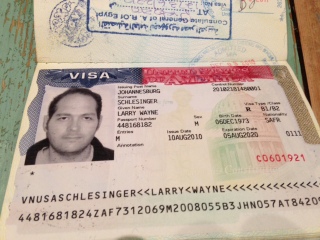
Perhaps, I’m just addicted to those colourful visa stickers that have filled up my South African passport for more than 20 years.

IMG_0068

Indeed, I almost wept with joy when I found by chance after more than two years of looking, an old South African passport of mine that I had given up as lost.

It was the one I used on a round-the-world trip backpacking trip I made with my wife in 2010  (a trip I faithfully recorded in a blog called the BEEG Adventure) The passport with the coat of arms long since faded was buried between the pages of a car manual in the glove compartment of our Ford stationwagon. I found it in February, when we were trading in our car.

IMG_0069

It’s jam-packed with colourful visa stamps from Europe, the USA, Morocco, India, Egypt, Turkey and Thailand, tracing the journey we took over the course of a year, a fine souvenir.

FullSizeRender(1)

It eventually became so full of visa stamps that I ran out of blank pages and I had to get a new one.

My nostalgia aside, becoming an Australian citizen would entitle me to an Australian passport and my visa application days would be a thing of the past.

I would also be proud to be an Australian having put down roots here for more than a decade, gotten married, had Australian kids and forged a career and a good life.

But the paperwork, form-filling and document gathering required (I must also apply to the South African government if i wish to be a dual citizen) put me off time and time again.

Perhaps, also, on some subconscious level I feel uneasy about becoming an Australia . For I feel revulsion at our refugee policies and those poor, desperate asylum seekers locked away in secret and in miserable conditions with little hope to cling to.  Perhaps, they are more deserving then I of that coveted citizenship? Perhaps this is some form of protest?

Maybe this is not the greatest country in the world after all, despite what those liveability surveys may say.

Remembering Clive Rice and why you never truly forget your childhood sporting heroes

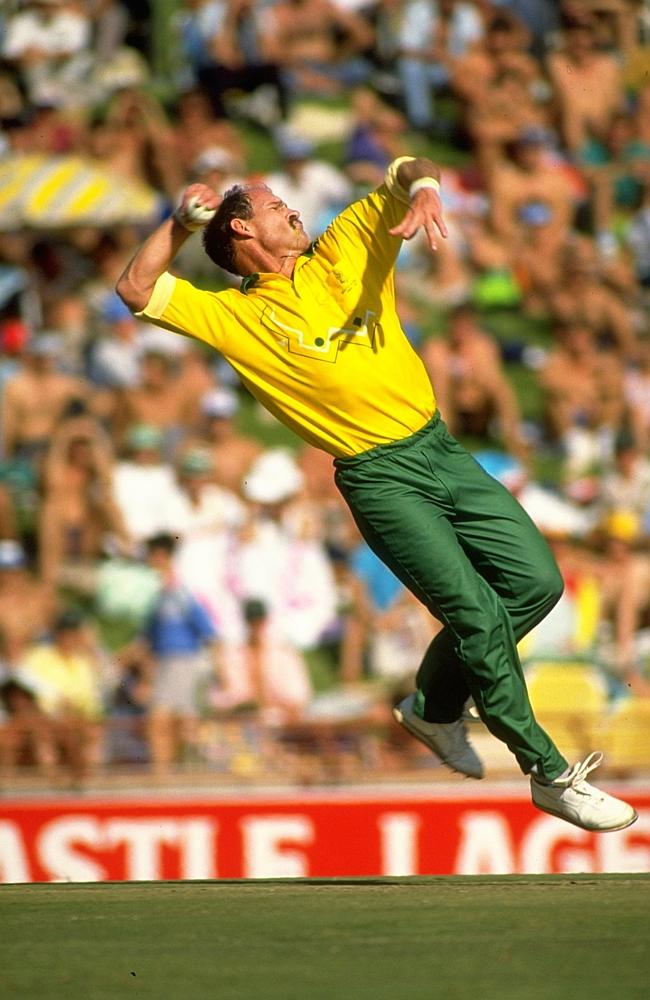
clive rice bowling

Clive Rice and his distinctive bowling style

It was with great sadness tinged with a palpable nostalgia that I learned of the passing of South African cricket all-rounder Clive Rice.

The sadness was understandable – Clive Rice was one of the country’s all time sporting heroes.

But the nostalgia caught me by surprise.

The truth is I’d not thought about Clive Rice or indeed any other of those “great” players from my childhood for a very long time.

To be honest, I didn’t even know that Clive Rice had been so unwell and for such a long time.

But his passing at the relatively young age of 66, brought back a flood of memories both personal and sporting.

In my memories of growing up in Johannesburg as a privileged white kid, Clive Rice, with his handle bar moustache, balding head, unflappable demeanour and larrikin nature looms larger than a life, a sporting hero during a time when we were isolated from the world game.

I remember him as both a fearsome all-rounder – able to rescue a middle order collapse with his batting or destroy the opposition with his fast bowling, in particular those deadly in-swinging yorkers. He was also a formidable leader of province (Transvaal), county (Nottinghamshire) and country (South Africa during the rebel cricket tours) and could – I believe – have guided South Africa to that elusive World Cup had we been allowed to compete.

Sadly, despite his sporting talents, Clive Rice was denied the opportunity to prove himself on the world stage because nearly all of his long career – he retired in his early forties – coincided with South Africa’s banishment from world cricket. Indeed he was picked for the South African tour to Australia in the early 1970s that was later cancelled, heralding our sporting isolation for two decades.

He played just three one day internationals and no official test matches, captaining South Africa on their historic return to world cricket in India in 1991.

His first class playing record speaks for itself. Twenty-six thousand odd runs at an average of 40 and nearly 1000 wickets at average of just 22.

Not many modern-day cricketers can boast a record like that. Rice, had he played a full international career, would have been comparable to the best in the game: Imran Khan, Ian Botham, Richard Hadlee and Jacques Kallis.

Captaining South Africa against India in 1991

Captaining South Africa against India in 1991

As I read the numerous articles of tribute to Clive Rice – and deservedly there were many like this great piece by South African journalist Luke Alfred for espncricinfo.com – I found my mind drifting back more than twenty years.

I am 13 or so years old. A nervous, awkward kid in owl-shaped glasses and a dorky t-shirt.

It’s Saturday. A gorgeous Johannesburg summer morning. A light breeze is blowing and there’s clear blue skies, about 22 degrees. I am sitting with my dad in the old wooden bleachers at the Wanderers stadium – long before they were replaced them with bucket seats.

We eating our homemade sandwiches and taking turns with the binoculars.  I’m thumbing my way through the match day program studying the player profiles while my dad reads the Citizen newspaper and sips from a can of TAB.

Clive Rice is there of course, commanding his troops on the field as fearsome West Indies quick Sylvester Clarke or Spook Hanley or Neal Radford steam into bowl for Transvaal, the unbeatable ‘Mean Machine’.

Or perhaps he’s in the dressing room as Jimmy Cook, Graeme Pollock or Alvin Kallicharran bat us into a commanding position.

At the lunch time break we walk onto the field to inspect the pitch (these were the days when you could still do that) as informal games of cricket are played against the advertising boards. Then we stroll around the ground – my dad and I, perhaps both wearing denim shorts – as the smell of boerewors and steak waft into the highveld air from smokey braais.

A thrill for me: spotting some of the players as they stroll past us on their way to lunch in their cricket whites, gentleman warriors from a tribe of sporting gladiators.

Other sporting memories crowd in:  Afternoons watching Currie Cup rugby on the sofa eating biltong and naartjies (Mandarins). Getting into arguments with my younger brother as Spurs lose again to Man United.  Trying to study for exams while Wimbledon tennis is on TV. Watching the rebel cricket tours. Watching Australia thrash England in the Ashes again.

And then Clive Rice returns again to my thoughts.

To those momentous days in November 2001, Mandela a free man, the country on a shaky path to freedom as he leads an awed team of old and new players back from the sporting wilderness in front of those huge, adoring crowds in India.

Though he hopes to play in the 1992 World Cup in Australia, these are the final days of his great career.

There he is with the handle bar moustache, the suavity, the grin and almost completely bald head, but just as cool as I remember him from those days when he was one of my sporting idols.

Rest in peace Clive. Thanks for the memories, both yours and mine.

Reading newspapers, video store browsing, cinema without distraction, film processing anticipation and other pleasures killed off by the digital revolution

I still get immense pleasure from reading the newspaper, accompanied by a cup of coffee.

It's not the same reading an iPad on the toilet

It’s not the same reading an iPad on the toilet

It’s not that I don’t get most of my news from other sources (I am a Twitter addict, and the most used apps on my iPad are those for ABC News, The Guardian Australia, The Age, the BBC, CNN and of course the AFR), it’s just there is a certain pleasure that I get from reading the newspaper that cannot be replicated digitally, even with e-ink.

In a digital world of endless distractions and diversions – a newspaper is a finite sum of its parts and that’s something to cherish.

And so it seems to me utterly unfathomable – even though the boffins say its inevitable – that there may one day be a world without this compendium of daily stories, facts and figures, photographs, commentary, weather reports,  obituaries and trivialities.

For me it’s still one of life’s great pleasures – reading the paper, but it seems a dying one too, or on life-support at best.

And it got me thinking about other things I took for granted while growing up that have all but disappeared thanks to the digital revolution.

Like…

14196995087_160e0fed5b_zThe uninterrupted movie

– the ability to sit through a 90 minute movie in a darkened room, transfixed by the screen, without any distraction, appears lost for ever. It seems every time I go to the movies, I must also sit through a second viewing via a giant screen lighting up in front of me the size of a human head as someone in the audience gets bored and scrolls through their Facebook account on their smartphone. Cinema etiquette – that you sit quietly and focus on the film you are watching (and forked out a small fortune to watch) – has long disappeared. I don’t even bother complaining anymore, sometimes I check my own phone.

Remember these?

Remember these?

Developing your camera film

Remember those bygone, halcyon days when you put film in your camera, took 24 or 36 what you thought were well-considered shots and then handed the film into a man behind a desk in a little shop. The next day you would return with knots in your stomach in anticipation of your artistic genius as you received an envelope of glossy pics (Remember the little sleeve for the developed negatives?). Now I can’t remember the last time I bought a roll of film. Do they even sell film anymore? Didn’t Kodak go bankrupt? Now its all instant gratification, you can take thousands of shots and see the results immediately. You don’t even need a camera, just a good quality smartphone. And does anyone print out their photos anymore? Or create albums of their holiday? It’s all just digital folders marked “Holiday, August 2012” on your computer.

16571720284_4de9e13b6e_z-1The writing and receiving of letters

I used to love getting hand-written letters, but I can’t remember the last one I received, or, the last one I wrote one myself, affixed a stamp and dropped in the letter box. Emails, texts, Viber messages, are instantaneous  – and brilliant in many ways – but what happened to the anticipation of receiving a hand written letter from a far off country covered in stamps and post office markings?

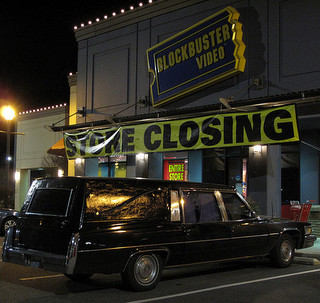
4165217347_ec1dabe345_zChoosing a movie in a video store

I have previously blogged about the demise of the suburban video or DVD store – we have none left in our suburb – killed off by video streaming services, video kiosks and – dare I say it – online piracy. Once a part of the Saturday night ritual for many lonely hearts, kid-weary families and movie geeks, prowling the aisles, the local video store is disappearing fast.

751707089_c25111d1c8_zPsychiatrists & psychologists

Ah, lying on the couch and talking about your problems. I have no hard evidence for this but surely demand for the services of shrinks is plummeting when you have Facebook. This seems to have become the place where everyone pours out their problems. And while I groan at every “oh woe is me” post, I can see the appeal: There’s instant feedback ( you can count the ‘likes’) and advice from your pop psychology Facebook friends via the inane comments they write.

There’s plenty more things killed of by the internet, or dying slowly – here’s a list of 40 compiled by the UK’s Daily Telegraph newspaper.

I wonder how many of these things my five-week old son, Aubin, will know of when he is older?

Will there still be newspapers around when he is old enough to read them? Will he laugh in disbelief when I tell him of the time I forgot to put ‘film’ in my camera on my first visit to London? (Yes that did happen).

Perhaps like the skateboard and vinyl records, some will make a comeback…

hoverboard_shoes

Perhaps a hover board instead of a skate board?

A special thank you to the nursing staff and doctors at Melbourne’s Royal Children’s Hospital

Our darling little boy, Aubin Clarke, was born on June 19, healthy and strong and feeding well.

aubin sleeping

Aubin a few days old

Three weeks later he contracted bronchiolitis from two common cold viruses – something that would just have meant a running nose and a cough for older children –  but because he was so young, he quickly became very ill.

He spent a week in the Butterfly Ward – the neo-natal intensive care unit on level five- at Melbourne’s Royal Children’s Hospital hooked up to machines to help him breath, a nasal feeding tube, a drip,a catheter and all manner of monitoring devices.

While incredibly distressing for us as parents, we were soothed by the brilliant team of nurses and doctors who cared for him and nursed him back to health.

A week after being admitted, he came home, and has made a complete recovery.

I want to especially thank all those wonderful nurses who looked after Aubin 24-hours-a-day and who fed him, changed his nappy, dressed him, soothed him when we were not there (you cannot sleep overnight in ICU), who monitored all his vital signs into the early hours of the morning and who reassured us he would be fine.

Apart from being absolutely brilliant professionals,  you were exceptionally kind and caring and when we had to leave him at night, we knew he was in the best of hands.

For this we will always be very grateful.

Thank you from the bottom of our hearts.

Aubin with her big sister Edie

Aubin, aged five weeks, with his big sister Edie

The Junkie in literature: A review of ‘The Lotus Crew’ by Stewart Meyer

lotus crew cover

Cover of the original novel The Lotus Crew

Of all the junkie authors I have read and reviewed on this blog – Burroughs, Welsh, De Quincey, Garner etc – for my mini-project “The Junkie in Literature” Stewart Meyer would undoubtedly be the least well-known.

Meyer, a protegé, friend and chauffeur of William S. Burroughs and a regular at Burrough’s Bowery apartment writer hangout known as ‘The Bunker’  published The Lotus Crew in 1984.

Lauded to a degree at the time of its publication – no doubt helped by Meyer’s association with Burroughs and his Beat Generation entourage – The Lotus Crew has been largely forgotten by the literary establishment, but has been given a fresh audience with its recent re-publication in e-book format by Open Road Media.

The Lotus Crew is a gritty, moment-in-time novel about the hectic drug scene in Alphabet City on Manhattan’s Lower East Side in the early years of the Reagan era.

Meyer throws you into the junkie cesspool – at street level – amidst the “blanco” junkies full of sickness and the Hispanic drug lords and their “crew” who peddle dope bags from abandoned tenement flats and underground parking lots and where the threat of a police bust is ever-present.

A misleading calm prevailed as they descended on Alphabet City. The biggest smack emporium on the East Coast stretched before them as they drove through narrow bombed-out streets. Blacks, Latins, blancos, shadows in somber colors; lips tight and drawn down, eyes dead but active with the scuffle. Waiting, watching, copping, splitting.

You only have to look at photos taken of Alphabet City and other parts of the Lower East side around the time the novel is set – 1982 – to see the appalling, run-down state of the streets and the desperate characters that walked them looking for a soothing fix to cure junk sickness.

A photo of the Lower East Side of NY in 1980s

A photo of the Lower East Side of NY in the 1980s

There’s a lyrical street poetry to Stewart Meyer’s prose reinforced by him assembling a collection of half a dozen quintessential “junkie” characters who tell the story of what it was like back then to be immersed in that type of desperate society of the powerful, cruel, sick and tortured.

There’s thoughtful, introspective and loyal Alvira, who tried to get clean in LA but who returns to New York having relapsed and who “felt like the proverbial incongruity when not opiated”.

There’s Tommy (or T) who dreams of becoming the emperor of Alphabet City selling the best heroin in town. We meet 16-year-old heroin scholar and drug pusher John Jacob (JJ), eager for a slice of the action and his weak-minded, doomed sidekick Furman.

And there’s the ‘blancos’, the white guys with big heroin habits who are easy pickings for knife-wielding gangs, like Jewish taxi driver Eric Shomberg who cannot “resist the sweet ambiguity of opium, the way it softened the real world without negating it altogether like booze did” or Bronx bartender Dave Skully “a few hours away from severe withdrawal”.

Like Irvine Welsh’s Trainspotting (read my review here) which is written in the Glaswegian Scottish dialect, much of the dialogue in The Lotus Crew is written in the broken down, sing-song Hispanic English and street slang of the time.

This street authenticity combined with Meyer’s snappy writing style and short, punchy, action-filled chapters that describe episodes in the lives of junkie players gives it a vivid, documentary quality and a engrossing depiction of the heroin game.

And while perhaps not as powerful a text about heroin addiction  as his great mentor’s “Junkie” (perhaps because Meyer was an observer, not – it seems – a user) he knows his subject well and has the narrative skills and poetry to give it life:

Desperation was part of the game, and no matter how long you did bizz with someone, if you caught them at the wrong time you’d be chumped and scumbagged for every cent you had. Just a rule of the road, a piece of the code.

Stewart Meyer cooking a meal for Burroughs (from his Facebook page)

Stewart Meyer cooking a meal for Burroughs (from his Facebook page)

“In Youth is Pleasure”: exploring the forgotten literary talents of Denton Welch

cover61513-mediumWere it not for his untimely death in 1948, aged just 33, Denton Welch might have become a household name in modern literature, perhaps spoken of in the same breath as George Orwell, Raymond Carver or Charles Bukowski.

Until very recently, I had never heard of him (Thank you to Open Road Media for sending me a review copy of ‘In Youth is Pleasure’ and getting me acquainted).

That he was admired by the likes of Beat writer William S. Burroughs, celebrated English playwright Alan Bennett and literary giant E.M. Forster says something quite significant I think about his concise career. Denton Welch was struck by a car while out cycling in Surrey when he was 20. He suffered permanent damage to his spine, an injury that would eventually lead to his early death. Despite his chronic ill-health, he continued to explore, observe and write, acquiring a distinctive literary voice set within the English countryside and acquiring many admirers of his vivid prose and precise descriptons.

He produced numerous novels including In Youth is Pleasure plus many short stories and was a prodigious diarist. As a classically trained painter at Goldsmiths College, London he had mixed success, but did produce a striking, colourful self-potrait showing a gaunt, thoughtful young man in glasses and a purple collared shirt that hangs in the National Portrait Gallery.

In Youth is Pleasure’ is a deeply autobiographical novel with Welch transformed into Orvil Pim, a 15-year-old public school boy, who spends his summer holiday with his father and two older brothers in a grand old hotel in the English countryside.

It should be an idyllic time, indeed the novel begin in almost fairy tale fashion:

One summer, several years before the war began, a young boy of fifteen was staying with his father and two elder brothers at a hotel near the Thames in Surrey…

But, adolescence is never that much fun especially for a sensitive soul like Orvil Pym whose only wish is to be left alone so he can explore the hotel gardens, or take walks along the river, set sail on a canoe, ride a bicycle to an old church or search for curios in an antique shop.

Welch beautifully creates a portrait of the adolescent mind with all its longings, desires, pangs of guilt and rich imaginative powers.

Orvil’s dealings with strangers from the adult world beautifully describe adolescent confusion, most notably in Orvil’s unsettling encounters with an eccentric holidaying schoolmaster, with whom he forms both a fatherly attachment and something of a homo-erotic crush.

Welch’s compact writing style reminded me of George Orwell and his dictum not to use too many words when few will do. The text is sparse, pared back, the descriptions of Orvil’s adventures and mis-adventures precise, creating vivid pictures of the English countryside in summer and the inner world of Orvil’s imagination.

Upon entering an empty church on one of his ramblings, Orvil is filled with a “tingling expectancy”. Later on, discovering a gothic brass tombstone inside, he suddenly “without knowing why” lies down at full length on the cold slab and put his lips to the brass lady’s face, kissing her “juicily.”

The novel bristles with undertones of sexual expectation, desire, uncertainty and excitement: Orvil is voyeuristic, he takes off his clothes when alone and unobserved, he consumes different medications at once, he steals great gulps of communion wine in an empty church and smears his lips and cheeks red with stolen lipstick.

Mostly, like every rebellious adolescent, he longs to be left alone and not forced to return to boarding school, with its “iron beds like black enamelled skeletons”

He saw himself refusing to go back to school and disappearing completely. He was alone in a small London room with a gas-ring. He was working on something at a desk. It might have been a book, or a painting, or even a wool mat. It didn’t matter; it was real work, all alone, full of joy.

Self-potrait of Denton Welch hung in London's National Gallery

Self-potrait of Denton Welch hung in London’s National Gallery

The last third of the book is given over to a delightful detail-rich account of Welch’s walking tour as an 18-year-old through southern England called I Left My Grandfather’s house.

He recounts his lonely walks along country roads and through fields, his meetings with fellow travellers and eccentric hostel dwellers (not much has changed in that regard) and descriptions of ancient, ruins, old churches, architecture, art, food and the English countryside.

Here, again, Welch displays his talent for painting vivid scenes and for creating that longing in the reader to join him in his lonely wanderings.

In an article published in The Guardian in 2005 following the publication of a biography of Welch, Alan Bennett writes of his admiration for Welch’s vivid writing style, sensitivity and his ability to speak directly to him as a young man who read his journals in the early 1950s. 

“Utterly unlike any person I had come across, he seemed a sympathetic voice and – a characteristic of books read when young – seemed to be speaking particularly to me,” Bennett wrote.

William S. Burroughs pays Welch the highest compliment, saying that he was the writer that “most directly influenced” his own work – a statement that should encourage others to explore this forgotten writer.

With the publication of Welch’s novels in e-book format, a new generation may yet discover his talents.

Literary adventures in the female perspective: four books worth reading

FullSizeRenderFor anyone interested in exploring the female point of view, I can recommend four excellent books I read recently.

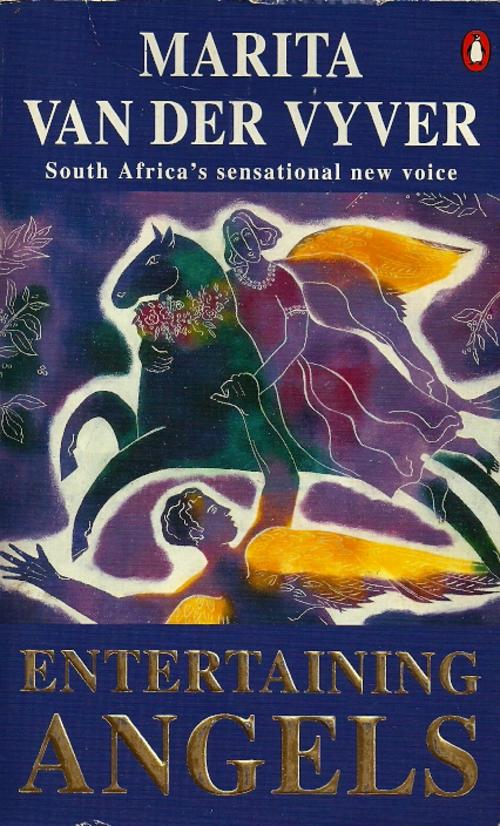
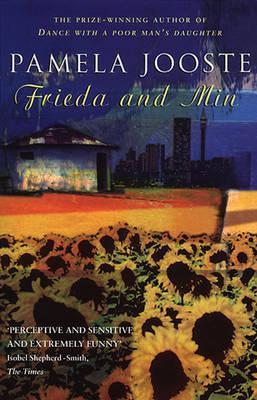
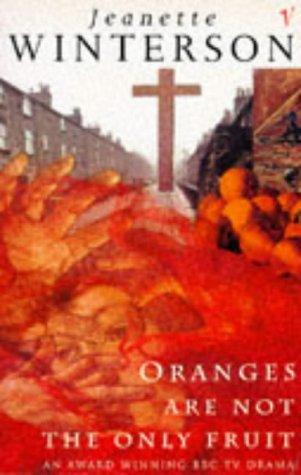
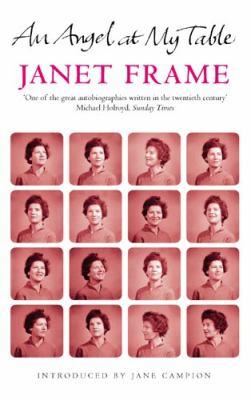
They’re all written by women. Two are novels by post-apartheid South African writers being Marita Van Der Vyer’s  ‘Entertaining Angels’ and Pamela Jooste’s  ‘Frieda and Min’. The third is ‘Oranges are Not the Only Fruit’ by English writer Jeanette Winterson  and the fourth is a collection of three autobiographies by the late New Zealand novelist and poet Janet Frame called ‘An Angel at My Table’.

All are prize-winning writers, all broke new ground and while each tell very different stories set in different places and times, there is a common thread running through each: they tell stories about women that go on painful journeys of self-discovery and emerge stronger, more complete and with a defining sense of who they are.

While all four novelists would, I am sure, happily where the tag of “feminist” they are really “humanist” writers, telling stories about the female human condition.

For me, it was an un-expected journey into the female psyche that began by accident when I picked up the two South African novels in a tiny little second-hand bookshop in Norwood, Johannesburg, run by two elderly African ladies, while on holiday last year. Later, back in Melbourne, I found the two other books on a shelf of ex-library books for sale outside our local library.

entertaining angelsEntertaining Angels (translated from Afrikaans) was the first book I read. Set in 1989, just before the collapse of apartheid, it tells the story of Griet whose life is in a downward spiral: her husband has thrown her out, she lost her baby and her attempt to kill herself by sticking her head in the oven – a la one of her literary heroes, Sylvia Plath – failed (rather comically) because a dead cockroach inside put her off. Griet starts to see a therapist and begins writing fairy tales as a path to healing.

It was a ground breaking South African novel when first published in 1992 in the early days of the ‘new South Africa’. Van Der Vyver broke free from her conservative Afrikaans culture with the story of a young, well-read, enlightened Afrikaans woman writing about grief, sex, Mandela and ‘The Struggle’ and literary heroes like Germain Greer, Virginia Woolf and Anais Nin.

Van Der Vyver’s writing has a magic realism to it as it flits between Griet’s contemplation of her real life journey – alone and barren living in an unfurnished flat with cockroaches – and her fairy tales adventures and travels back in time to Grandma Hannie and Grandpa Petrus’s old farm-house in the stillness of the Karoo.

Written from the perspective of an intense, questioning, deeply thoughtful young Afrikaans woman trying to heal herself in the days before the end of Apartheid, Entertaining Angels is deeply nostalgic, quirky, tender and wryly funny.

But everyone knows it’ easier for a man to live out of a suitcase. What do you do if you begin menstruating in the middle of the night and you discover you didn’t pack your Lil-lets? Or if you forgot your imported night cream….

frieda and minFrieda and Min is a ‘coming of age’ novel spanning three decades of friendship between Frieda Woolf, a Jewish girl growing up in a traditional, poor family in a South African mining town near Johannesburg and Min, a fiercely principled young girl of the same age who dreams of becoming a rural doctor to black South Africans, defying the orders of the Apartheid regime and its puppets. Being Jewish and having grown up in the same mining town as the novel is partially set (Germiston is Frieda’s home town) gave it a deeply personal resonance, but for anyone else, it’s a classic story of two friends from different backgrounds and beliefs and how their lives unfold and diverge, and eventually come back together amidst personal and political upheaval. Despite having many stereotypical characters – the idealistic white girl taking on the evils of apartheid, the Jewish girl looking for a husband and marrying the wrong (rich) man – and plotlines, the writing is superb and fresh. Each girl tells their story in their own words and in the first person as they lose their innocence and come of age. In parts it reminded me of Neil Simon’s ‘Brighton Beach Memoirs‘ but with the Jewish family in South Africa and the apartheid themes of Alan Paton’s ‘Cry the ‘Beloved Country’ with a dash of JM Coetzee‘s stoic fatalism.

Frieda: My mother loves shul. She’s there twice a week. You have to take either a train or two buses to get there and everything costs money, but you couldn’t keep her away if you tried. Where we live in Germiston she may be the Jewish woman, but when she gets to Waverley, she is the Queen of the Waverley shul.

orangesOranges are Not the Only Fruit, is written from the perspective of Jeanette, a young gay girl growing up under the thumb of her religious, adoptive mother in an ultra-conservative English Pentacostal Community in a Northern industrial town. Jeanette has been indoctrinated into her evangelical beliefs, but as she grows older, she questions them. Then one day she falls in love with and has an affair with Melanie. There follows an attempt at exorcism, she returns to the fold, but later after another affair with a woman she runs away, discovering her independence and identity. Drifting into allegorical fairy tales, it has a dark humour (chiefly Jeanette’s at times terrifying mother) and provides a ride into the bizarre outposts of religious excess (exorcism and fiery sermons) and obsession.

I knew that demons entered wherever there was a weak point. If I had a demon my weak point was Melanie but she was beautiful and good and had loved me.

an-angel-at-my-tableAn Angel at My Table is the title of three autobiographies that trace the life of New Zealand’s most famous literary hero, Janet Frame, from her birth in Dunedin to her impoverished childhood in the coastal town of Oamaru and later her great journey to live in London and the island of Ibiza, returning seven years later as a famous novelist. The first volume deals primarily with her family – her sacrificial mother, her early attempts at poetry, the musing of a bright, highly sensitive, creative mind and the death of her sister Myrtle, who had dreamed of a life in showbiz. The most famous part of her life – Frame’s lengthy stay in a mental institute where she was wrongly diagnosed as a schizophrenic and narrowly avoided a lobotomy. Part three follows her journey to the North island of New Zealand, where she meets the short story writer Frank Sargeson, who invites the intensely shy Frame to live at his guest house and encourages her talent and is the impetus for her seven-year overseas odyssey.  Perhaps no one has written as intimately about the inner workings of a fragile, doubting, creative mind as Janet Frame. Reading all three intricate autobiographies is an extraordinary adventure that requires a devoted reader, but the pay-off – sharing the monumental journey with Janet Frame – is well worth it.

(Back in London from Europe)…my own past continued to loom. How could I regain my confidence when I had never been able to tell ‘my side of the story. I knew it was time for me to find out ‘the truth [about my schizophrenia]’…In the meantime I found a job, a literary agent, and I bought an encyclopaedia of sex.

Anzac Day: an immigrant’s education

6968598698_f28850d25b_z This Anzac Day, my eleventh in Australia, was a milestone for me.

While I didn’t attend a Dawn service – something I would still like to do – for the first time I got an education about April 25, 1915 and what it means

(And…what it clearly doesn’t mean to a fair proportion of Australians, including SBS sports journalist Scott McIntyre, sacked for his disparaging views.)

Firstly, I wanted to understand why “April 25” and what in fact was being commemorated.

An excellent article by Age journalist Tony Wright “Nation forged by heroes & horror” was a great starting point. Wright wrote his account of the significance of Anzac Day in Gallipoli ahead of the commemoration services.

While evoking the horror of the battles below the cliffs at Anzac Cove –  “shells roaring a few metres overhead, the bodies piling up and the flies and the lice” – Wright provided a neat summary of the important facts and figures:

– that about 40 per cent of the male population between the ages of 18 and 44 enlisted to fight in the Great War (the Returned Services League provides the exact number, 331,781)

– that they were all volunteers (this came as a complete shock)

– that they all thought they were going on a “fine adventure’ (another shock), the RSL says they “rushed to enlist for an exciting war”.

– that 8709 young Australian men died at Gallipoli on a patch of land ” barely larger than an Australian farm” and more than 21,000 were injured, (and that more than 60,000 in total died during the War and more than twice that number were wounded).

– that the invasion of Gallipoli by the Anzacs was a military failure, that achieved “precisely nothing for the invaders in the course of World War 1”.

The innocence, bravery and naivety of the Anzacs astonished me, the loss of life monumental for a small country of just 4.9 million at the time (though I disagree with Wright that the numbers are unimaginable: as a Jew, the slaughter of six million by the Nazis in the holocaust is truly unimaginable).

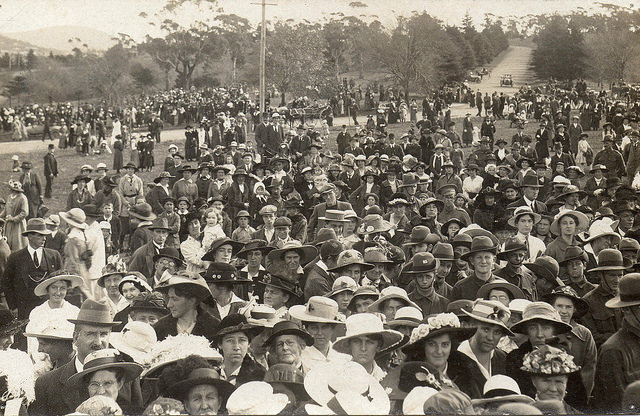
First Anzac Day, Hobart Domain, Tasmania - 1916

First Anzac Day, Hobart Domain, Tasmania – 1916

Another excellent article, by Tony Stephens, author of The Last Anzacs entitled “Legend outgrows the men who fought“, provided an understanding of what was achieved from the point of view of actual Anzac veterans.

Peeling back the almost cult-like, untouchable heroic status that Anzac Day has undoubtedly achieved among many Australians (among them, the “poorly-read, largely white, nationalist drinkers and gamblers” McIntyre derides in his contentious tweets) there thoughts are sobering and cautionary:

– Tom Epps of the 27th Battalion: “It provided a lesson in the futility of war.”

– Harry Newhouse of the 4th Battalion: “The Turks never did anything to us and we never did anything to the Turks. We did not think we were going to fight them, poor buggers.”

– Albert White of the 25th Battalion: “I never understood what we were fighting for. I went because most of my cobbers went.”

– Ted Matthews, of the Ist Division Signals: “Some people called us ‘five-bob-a-day murderers’ but the politicians were the murderers. Politicians make up the wars. They don’t go to them.”

Stephens writes that Gallipoli built national pride and confidence, but that it’s a “tired cliché to say it marks the birth of a nation, or a coming of age”.

Other events, he says like Federation in 1901, prime minister John Curtin defying Churchill in the Second World War and bringing troops home to defend Australia against Japan, the 1967 referendum that included aborigines in the Census ( I would add the 2008 Rudd government apology to the stolen generations), could all be said to be defining moments in the continual evolution of the shifting Australian national identity.

Many Australian I know – educated, smart, well read – don’t care much for Anzac Day, or how it is remembered.

There views may not be as extreme as Scott McIntyre, but what they really want is some authenticity about how Gallipoli and the Anzacs are remembered and they revile the crass commercialisation, hijacked by the likes of VB, Anzac biscuit makers, Woolworths and others.

1429076519206

There were hundreds of people, including senior politicians like Malcolm Turnbull who welcomed the sacking of McIntyre for airing his views, but debate about what Anzac Day should mean is healthy and necessary if it is to have resonance for immigrants like myself and our children.

I agree with Guardian columnist and satirist Geoff Lemon, who wrote in light of the sacking of McIntyre, that while his tweets were historically “flawed”…

“…the greatest insult you can offer the fallen is to lie about who they were and what they did – to whitewash their sins and burnish their glories.

Keeping Anzac Day alive and strong starts with education – in my case self-education – not deception, myth-making, political spin and marketing tricks.

I feel a greater affinity with my adopted country, armed with a bit more knowledge about its history.

Lest we forget (…what really happens in war-time)

Why you should drop the fear and visit Johannesburg

2212355983_74be3eec5f_zFor any ex-“Jo-burger” living in Melbourne, one can probably count the number of kind things said about Johannesburg on the palm of one’s hand, including comments from ex-South Africans.

For most it exists in the mind as crime-ridden, lawless place with rolling blackouts and road rage – and for those visiting South Africa, the only memory they may wish to have of Johannesburg will be of the ultra-modern airport and perhaps a short cab ride along the motorway – or via the Gautrain – to the safety of their hotel in the leafy suburbs of Rosebank or Sandton.

Most will no doubt wish to head straight out of “Jozi” or “eGoli” (as it is affectionately known by its six million plus residents) for Cape Town and its nearby wineries, the beaches and warm oceans of Kwazulu-Natal or the world-famous Kruger National Park Game Reserve. Anywhere, but hanging about in Jo’burg…

Not even die-hard Jo’burg fans such as myself would be foolish enough to argue that crime is not so bad – you only have to look at the ridiculously high walls and electrified cables which surround nearly all the homes or read the front page of any newspaper to know this is true.

But there is certainly a lot more to the city than tales drenched in blood.

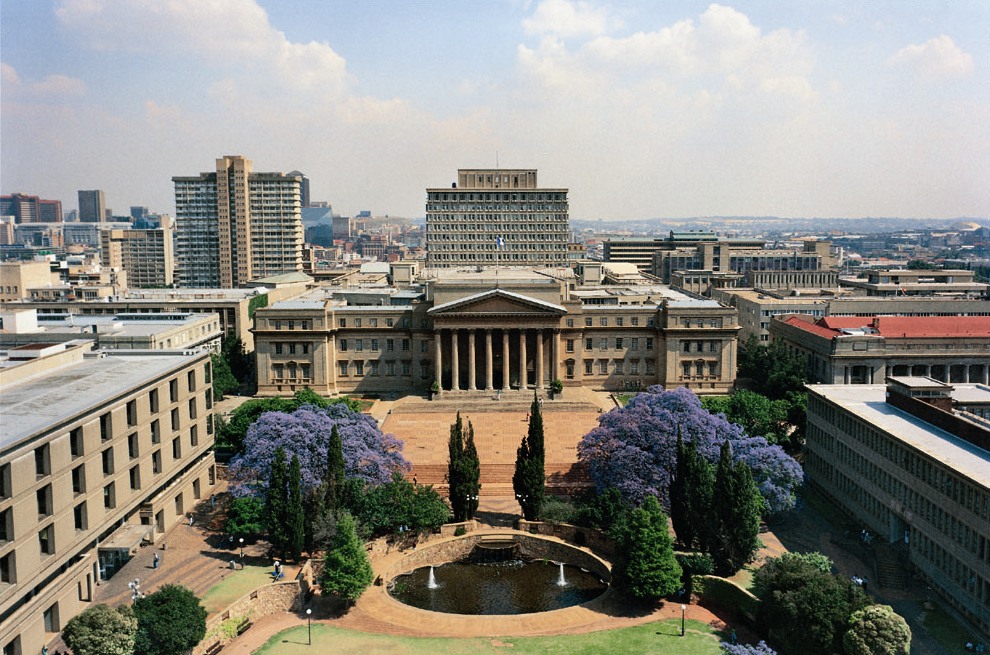
The Johannesburg CBD skyline

The Johannesburg CBD skyline

The city, like South Africa itself is constantly changing and much is being done to shake off the cobwebs and re-energise Johannesburg in a very positive sense – meaning there is a lot to see for any tourists brave enough to venture beyond their hotel room.

The Apartheid Museum

Symbolic seperate black and white entrances to the Apartheid Musuem

Symbolic seperate black and white entrances to the Apartheid Musuem

First on any tourist itinerary should be a visit to the Apartheid Museum, situated just a short distance from the Gold Reef City Theme Park and Casino – (a gaudy monument to Johannesburg’s modern roots as site of the world’s biggest ever gold rush in 1886).

The museum was completed in 2001 and provides a totally exhaustive and engrossing history of the struggle to end what was a brutal, tyrannical and inhumane regime.

Upon entering the museum visitors are arbitrarily and symbolically classified as either “white” or “non-white”. Once classified, visitors may only enter the through the gates allocated to their race group. Much like the high, windowless concrete walls of Berlin’s holocaust memorial, such devices immediately transport one back into the dark day of Apartheid, setting the tone for the museum, which is designed to be as interactive as possible.

It’s an enormous exhibition full of photographs, video footage and installations detailing apartheid’s genesis, life under the regime, and the resistance struggle which took root in the 1960s and saw Nelson Mandela’s rise to power.

Give yourself at least four or five hours to explore – more if you are one of those people who likes to read every word and watch every video.

Constitutional Hill

Next stop on the political trail should be the Constitutional Hill complex near Hillbrow, seat of the Constitution Court, the highest court in the land, where South Africa’s constitution – considered the most democratic in the world – has its home.

The old prison cells - home to Ghandi and Mandela at one point at Constitution Hill

The old prison cells – home to Ghandi and Mandela at one point at Constitution Hill

The complex is built on the site of the Old Fort, the notorious prison built originally by Boer leader Paul Kruger in a vain attempt to defend Johannesburg from the British.

Visitors to Constitutional Hill should sign up for a guided walking tour to get a real feel for the place. Local guides take visitors through cell blocks which housed every famous political prisoner the country produced including Nelson Mandela and Mahatma Ghandi.

Mandela’s cell has been recreated and besides the video footage on display it contains original letters written by Mandela – a qualified lawyer – written in elegant curved freehand, detailing his numerous requests from prison authorities for access to books, legal counsel and to see his family.

On the way visitors bypass the now empty and incredibly eerie cellblocks – like everything under apartheid, divided into white and black sections.

As the guides explain and visitors can see for themselves, Apartheid’s reach was limitless. The walk takes one passed notice boards which detail meal rations for prisoners (more meat and extra coffee and sugar for white prisoners, less for Indian prisoners and virtually no luxuries for black inmates).

But constitutional hill is also an uplifting experience culminating in a visit to the Constitutional Court itself. Decorated with paintings and sculptures by some of the country’s finest artists (the nearby art gallery is a must) the building has literally taken what was once a symbol of oppression and turned into a symbol of freedom – an entire wall of the court building is made from the bricks of a section of the old prison.

Ancient histories

For history that predates the arrival of the first Dutch settlers who moored at the Cape of Good Hope in 1652, say by a couple of hundred thousand years, another new permanent exhibition has sprung within an hours drive of the city. Called “Maropeng” or “The Cradle of Mankind” it remains one of the world’s great fossil sites and is rightly listed as a “World Heritage Site”.

Looking like a massive ant hill, and surrounded by ominous orange signs telling visitors to “Beware of snakes” (surely not likely to scare off any Australian tourist), the tour main walk way is lined with human and animal fossil finds which lead into the main building. Here a ride through an underground lake takes one to a massive exhibition hall where the “history of mankind” is put on display including some of its most famous fossil finds.

If that’s not enough, there is also an opportunity to visit the nearby cavernous Sterkfontein caves, complete with dripping “stalactites” and “stalagmites”.

Soweto

A painted old power silo near Soweto

A painted old power silo near Soweto

No visit to Johannesburg can ever be called complete without a visit to the adjacent township of Soweto. Gone are the days when no one ventured near the township unless they lived there, it’s now a major tourist magnet (and with good reason) with numerous tour companies offering full day tours.

For about $90 you can spend an entire day with a Soweto resident as he takes you in air-conditioned mini-bus on a dazzling tour of the South Western Townships.

Putting aside its significance as the centre of the anti-apartheid struggle, the following tidbit should be enough to pique your interest in paying Soweto a visit.

6268519080_0efa4845fe_zAll tours of the township will take you down Vilikazi Street, a dusty street, lined with mostly small, compact houses and unique in this aspect – it is the only street in the world where two Nobel Peace Prize winners lived – the country’s greatest leader and former president, the late Nelson Mandela, winner of the prize in 1993  and the enigmatic, Desmond Tutu, the much-loved retired archbishop of Cape Town, who won the prize in 1984.

The tours include a walking tour through traditional African markets – complete with an African witch doctor who can give you a remedy for making anyone of the opposite sex swoon at your feet, outdoor butcheries and once illegal drinking taverns called “Shebeens” where you can sample South African curries and semolina pudding, commonly known as “pap”.

Those brave enough can try dried Mopani worms (similar to Wichita grubs) washed down with Amazi, the traditional African “sour” beer.

244346804_b2a0a47fea_z

The Hector Pieterson memorial in Soweto

You will also visit the site of the Soweto Uprising of 1976, when students protested against being forced to study in Afrikaans, and where Hector Pieterson a 13-year-old schoolboy was gunned down by police and whose dead body (famously photographed by Sam Nzima) became a symbol of the evils of apartheid.

Multi-cultural shopping and dining

Not all the things touristy in nature in Johannesburg are about history.

Given that one Australian dollar buys you around Nine South African “Rands”, shopping in eGoli can be a real spending spree. The city is littered with mega-malls stocking the latest local and international brands. For those on the hunt for modern finery and expensive African crafts, the ultra-chick Sandton City Mall and Hyde Park Shopping centre in the city’s North are enormous palaces to consumerism, while for sheer ridiculousness, the Monte Casino resort is worth visiting. Besides housing an enormous array of slot machines (pokies) and poker tables, the shopping and eating mall is designed as a fully enclosed Italian village, complete with washing hanging on the line, fake pigeons and a twinkling ceiling, where it’s forever nighttime.

Fake Italian: inside gaudy Monte Casino

Fake Italian: inside gaudy Monte Casino

There are many adventures to be had in the City of Gold, all of which can be done relatively safely, provided you stick to basic rules like not walking down quiet streets alone at night, leaving your expensive jewellery at home and keeping gadgets out of sight.

Most importantly keep in mind that Johannesburg is a friendly, multi-cultural place filled with some of the loveliest, most hospitable and zany people you will ever meet.

So go on, next time you’re flying into Jo’burg – spend a few nights and explore!

I dare you!

Writing well really does pay according to a new survey

slide_272894_1944735_freeAs a journalist, there’s nothing more annoying than finding spelling mistakes or grammatical errors in your own work.

I confess that I always read my own stories first in the Australian Financial Review – the newspaper I write for – and feel gutted if there is a glaring error – spelling, punctation or grammar. Thankfully, it doesn’t happen too often.

Writers hold their own written work in high esteem, as they should, as it represents their personal brand.

Errors make you look stupid and can be downright embarrassing – or very funny if it’s not your own work.

A while back, a bestseller called “Eats, shoots and leaves” by British radio journalist Lynne Truss attempted to, very humouresly, highlight common punctuation mistakes and how they often change the meaning of a sentence. Her aim was to lift writing standards which have arguably gotten worse since publication of the book given the popularity of Twitter, Facebook and text messaging.(Embarrassingly, Truss made mistakes of her own, in her book).

You may scoff as you type out a garbled text message on your phone or dash off an unreadable tweet, but new research has found that there is a high correlation between how accurately you write and how well you do your job – and very importantly – the level of pay you earn.

Regardless of whether you are a salesman, lawyer, engineer or accountant – those who make fewer mistakes in their emails, reports and presentations are better regarded by those that employ them, and, they earn more money.

This came out of a study of  448 profiles on freelance jobs website Elance by Grammarly, a start-up proofreading web application that finds and explains in-depth grammar, spelling, and punctuation mistakes online.

Grammarly found that an engineer who made 10 or fewer errors per 100 words written in their online profile earned on average $521 per project while an engineer who made 30 or more errors earned less than half that.

Similarly, lawyers who made less than 10 errors per 100 words earned $372 per job, while those that made three times as many errors earned only $198.

Overall, it found that freelancers who made the fewest mistakes received the highest reviews from their employers – those who made the most mistakes were rated much lower.

In short, accurate writing increases credibility, hireability and pay.

writing_skills_matter(1)-001

Grammarley survey: writing well pays better

Journalists and others that write for a living will be pleased to know that – according to the study – writers make the fewest mistakes, followed closely by those in admin and  legal roles.

While it was perhaps not surprising to find that IT professionals make more mistakes on average than any other professional – almost one in every five words – it was alarming to learn that those in leadership positions (in finance and management roles) are almost as bad.

Perhaps it explains why big companies all hire expensive public relations executives – to find and correct all those top management mistakes, before they become public relations disasters.

34d1609

Freshlyworded.com is also giving away one free premium access account to Grammarly. Just send your name and email to freshlyworded@gmail.com – The first email received will win the premium pass.