An opinionated journalist's thoughts on media, film, books, sport, politics and the occasional rant. Or as William Burroughs put it: "A writer must write"
Financial institution CommSec recently published an interesting global retailing index called the iPad Index.
The index ranks the cost of a buying an Apple Air 16 GB wi-fi iPad in 51 different countries converted into US dollars at prevailing exchange rates, mirroring The Economist’s much more famous Big Mac index.
The latest iPad Index shows Australia slipped from 4th cheapest country to purchase the popular computer tablet in September last year to 13th on the latest list – still (surprisingly) one of the cheapest places in the world to buy the gadget.
The fall down the list reflects a decision by Apple to lift local pricing rather than currency fluctuations – the Australian dollar was around 94 US cents when the index was compiled, hardly changed from an exchange rate of 94.3 US cents in September last year.
The Apple iPad Index
Malaysia at $494 is actually the cheapest place for Australians to buy an iPad, saving you around US$68 off the Australian price ($562). Canada and Japan both add sales taxes to their purchases, pushing their iPad prices well above $500.
As the index shows, you certainly wouldn’t want to buy an iPad while visiting Brazil for this year’s Fifa World Cup while much of Europe is also a no-go zone for cheap iPad purchases, mainly because of high taxes.
Alternatively, if you’re a Kiwi heading over to Australia for the Bledisloe Cup, you could save yourselves around $90 by purchasing an iPad over here.
Even if you’re not planning any overseas trips, the fall in Australia’s iPad Index ranking is interesting for a number of reasons:
Firstly, it could be interpreted to reflect Apple’s gouging of its Australian customers at the same time as its also gouges those who purchase songs and movies on iTunes (ABC show The Checkout highlighted this recently and provided a way around it), whilst gouging the Australian Tax office by shifting all of its taxable profits offshore. If you’re not feeling the Apple love, perhaps a Samsung or Google Nexus device will do instead.
Secondly, in the word’s of CommSec chief economist Craig James the index reflects why “on-line shopping sites and the power of travel are putting pressure on Australia retailers to remain competitive”. “If local pricing isn’t responsive to exchange rate changes then Aussie shoppers will increasingly look overseas to purchase imported items,” James says.
Thirdly, for investors, the current index could be interpreted to mean that the Australian dollar is overvalued if you compare it with the cost of an iPad in California ($543) but undervalued if you compare it with what it costs in China ($578) where all iPads are manufactured.
Fourthly, the higher price may also reflect higher Australian freight costs, tariffs and mark-ups.
So it’s a useful index both for retailers who want to remain competitive and for consumers, if they’re planning a holiday in the coming months and want to upgrade their tablet.
Alternatively, if you’ve got a friend visiting from Argentina or Brazil or Europe, a visit to an Australian Apple store might be a good suggestion.
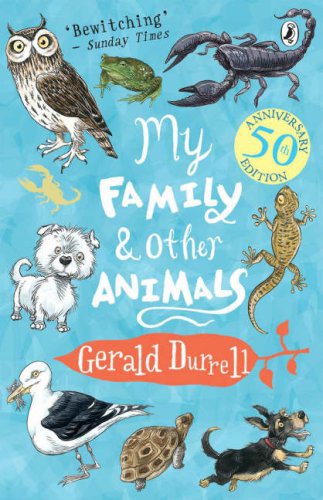
I had hardly thought of Gerald Durrell, the author and naturalist until my wife bought me his boyhood memoir “My family and other animals” as a gift.
It tells the story of the four years he spent from 1935 to 1939 as a young boy living with his family on the Greek island of Corfu.
The family left the dampness and cold of London for the fresh air, sunshine and open spaces of the Greek island at the behest of Lawrence Durrell – Gerald’s oldest brother, who himself would go on to be a famous novelist, essayist and travel writer.
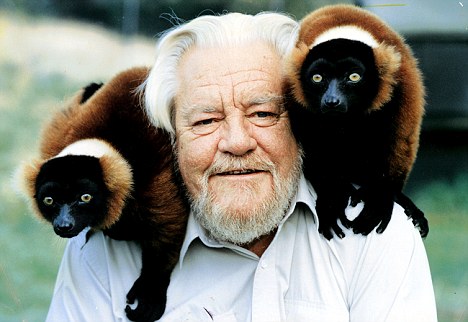
Picking up the book, I recalled a childhood memory of Gerald Durrell from a television show he presented that ran on South African television in the 1980s: a short, plump man with a white beard who appeared on television to tell us fascinating things about exotic animals. I looked at photos of him online and my memory served me well for he was indeed, short, plump and bearded.
Gerald Durrell as I remember him from my childhood
The book is a wonderful account of an idyllic childhood for a young boy fascinating with nature. It’s one of the most entertaining books I have read, full of wonderful anecdotes about Gerry (as the family called him) and the animals he collects and brings into the family home.
These include: an owl, snakes (that end up being kept in the bath tub), frogs, a pigeon called Quasimodo, a tortoise and scorpions (that scatter one day across the floor during dinner) to name just a few.
Gerry Durrell is part Steve Irwin – unafraid to pick up creatures to see them up close – but more so Sir David Attenborough, with a wonderful eye for the details of nature and how it works plus the skills of a gifted novelist to bring it all to life.
In one scene he describes a gecko who has come to live in his room, which he names Geronimo:
He would sit on the window sill gulping to himself, until it got dark and a light was brought in; in the lamp’s golden gleam he seemed to change colour from ash-grey to a pale translucent pinky pearl that made his neat pattern of goose pimples stand out and made his skin look so fine that you felt it should be transparent so that you could see the viscera, coiled neatly as a butterfly’s proboscis, in his fat tummy. His eyes glowing with enthusiasm, he would waddle up the wall to his favourite spot, the left hand outside corner of the ceiling, and hang there upside down, waiting for his evening meal to appear.
This wonderful gift for describing a scene and revealing the wondrous details and idiosyncracies of nature is found throughout the book.
It is a mix of boy’s own adventure (Gerry accompanied by his faithful dog Roger exploring the island with almost unlimited freedom in which “all discoveries” filled him with “tremendous delight”) accompanied by hilarious tales of family life – Larry and his arty friends invading the island, his diet-obsessed sister Margo and the adventurous, gun-mad Leslie.
The other wonderful aspect of the book are the lovable eccentric local characters: There’s Spiro, the Durrell’s taxi driver, “guide, mentor and friend” – a “short, barrel-shaped man” with a unique grasp of the English language and who adored the family, the tremendously fat and cheerful Agathi who taught Gerry peasant songs and the immaculately groomed, sparkly eyed, Dr. Theodore Stephanides, who became Gerry’s guide to the natural world plus a parade of doctors, housekeepers and tutors.
Gerald Durrell with ‘Spiro’ on Corfu
Durrell writes of an afternoon spent with Agathi outside her “tumbledown cottage high on a hill:
Sitting on an old tin in the sun, eating grapes or pomegranates from her garden, I would sing with her and she would break off now and then to correct my pronunciation. We sang (verse by verse) the gay, rousing song of the river, Vangelio and how it dropped from the mountains, making the gardens rich, the fields fertile and the trees heavy with fruit.
By the time I finished reading the book, I yearned for just a few days of Corfu sunshine and a walks among its hills, valleys, gently swaying Cypress trees and olive groves.
I challenge you to find a more charming, magical account of a childhood we should only dream of giving to our children.
In Lonesome Traveller, he’s poetic, mystical, sometimes incomprehensible account of wanderings and odd jobs in the mid-1950s, the beat writer Jack Kerouac writes of a trip to Mexico:
“There is no violence in Mexico, that was all a lot of bull written up by Hollywood writers or writers who went to Mexico ‘to be violent’.”
Kerouac continues:
“I know of an American who went Mexico for bar brawls because you usually don’t get arrested there for disorderly conduct, my God I have seen people wrestle playfully in the middle of the road blocking traffic, screaming with laughter, as people walk by smiling – Mexico is generally gentle and fine, even when you travel among the dangerous characters as I did – ‘dangerous’ in the sense we mean in America – in fact the further you go away from the border, and deeper down, the finer it is, as though the influence of civilizations hung over the border like a cloud.”
I recall the warnings from well meaning friends and family – There’s still time to change your plans/It’s not safe/It’s a dangerous place/Don’t go – before we boarded a New York flight in Christmas 2010 for a month long Mexican bus sojourn from Cancun all the way west to Guadalajara.
Though the notion of Mexico as a violent place is indeed “a load of bull” but still seemingly engrained in the American psyche more than fifty years after he wrote about it, Kerouac’s description of Mexico as “generally gentle and fine” is wonderfully precise.
There is little violence south of the shady border towns where the stories of gangs, beheadings, shootings and drugs garner garish headlines in American newspapers and stoke the flames of fear.
A fruit stall, Mexican style
As travellers, we found the biggest danger in Mexico to be from a falling coconut while snoozing under the shade of a palm tree on an unspoilt sandy beaches on Isles Mujeres or Tulum.
Or perhaps from one of those mad windy bus journeys – where brakes are unnecessary accessories – up through the mountains to postcard perfect town like San Cristobel de las Casas, where the only sense of danger are the dolls, paintings and postcards for sale in souvenir shops depicting the Zapatista rebels with guns criss-crossed across their chests (and scary steely stares).
The colourful, quite streets of San Cristobel de las Casas beneath the mountains
I write in my journal of a day spent in this oasis of bright colours, cobbled quiet streets and lazy wanderings:
“Students and tourists abound.The streets are lined with brightly painted mainly single story houses and shops in shades of yellows, reds, blues and oranges and with slanting roofs of Spanish-style red tiles…the perfect place to wander, sit and sip a coffee or beer and people watch.”
In comparison to the constant pleadings, coercions and tourist tricks and traps in Thailand, India, Morocco and Egypt (all places I nonetheless loved), Mexicans are so laid back they hardly bother when it comes to approaching tourists.
On Isles Mujeres, the little island off Cancun, this lack of savvy was perfectly captured by a man offering boat trips to see whales:
“Wanna go on a whale ride?” he enquired as we strolled by one afternoon.
“No gracias,” we replied.
Silence, then he said sleepily:
“Lotta whales…”
Ice creams in the park, Valledolid
No one harasses you in Mexico. Not in the small, sleepy afternoon siesta towns like Valledolid (where we visited the ruins of Chichen Itza and swam in the underground Cenotes) and not in sprawling, bustling Mexico City, the world’s best functioning mega-sized city.
Are there dangers in Mexico? Of course. I would not be so naive as to suggest otherwise. But the risks are small unless you’re smuggling drugs, heading for the seedy border towns or in the words of Kerouac going there “to be violent”
The Mexico I remember is that of little black haired men with moustaches; their plump wives pulling chihuahuas on leads, climbing steps to find churches painted in brightest pink and orange, wandering streets in shades of yellow and red, the little taco stands sizzling away by the side of the road, poodles sleeping in hammocks, glorious, colonial Spanish architecture, the boulevards of Mexico City, the murals of Diego Rivero, Frida Kahlo’s sad paintings in the blue house in Coyoacán, ancient Mayan ruins overlooking beaches and azure oceans.
Alive in colour, light and smiles. A sentiment Jack Kerouac would have agreed with, I think.
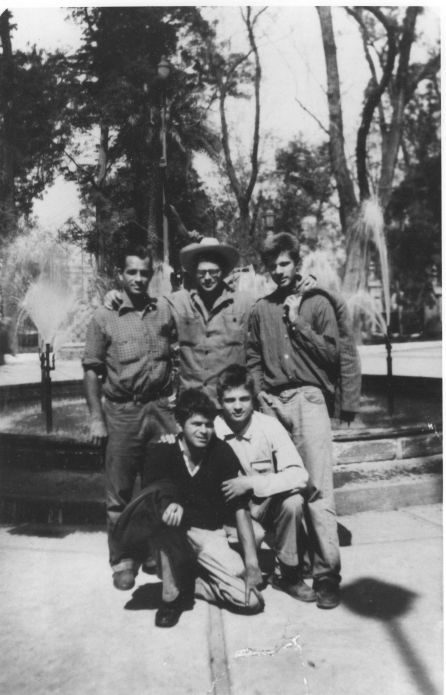
Jack Keroauc top left next to the poet Allen Ginsberg and firends in Mexico City
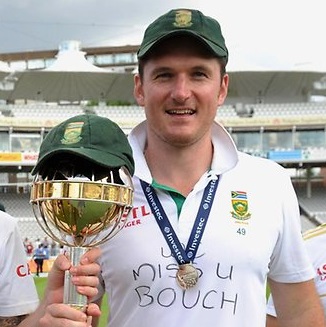
Retired skipper Graeme Smith with the Test mace, signifying South Africa’s number one ranking
To be a South African cricket supporter residing in Australia is to be a true cricket tragic.
As we slid to another home series defeat against Australia in Cape Town, I dashed off a tweet about the last Test side to beat the Baggy Greens at home, a team know as the “Invincibles” which white-washed Bill Lawry’s tourists 4-0 way back in 1970. A colleague replied: “Oh come on, Larry, nostalgia is the last refuge.”
Perhaps he was right. Perhaps it was a foolhardy attempt to prop up my spirits after yet another home series failure against the old foe; the only blight on an exceptional record that has seen South Africa rank as the No. 1 Test side in world cricket for many years and unbeaten in 14 Test series dating back to 2009.
No defeat hurts more than to lose against Australia (the 1999 World Cup semi-final still haunts me), no victory is more sweetly savoured.
When we finally did win a Test series against Australia in 2009, away from home, and then again 2012, also away from home, it was indeed a sweet moment for a biltong-eating expat like myself.
But a home Test series win against Australia has eluded us in seven attempts since we returned to world cricket in 1992 with just two draws and five defeats.
Back in 1970, just prior to being cast into the sporting wildness, South Africa was a dominant side with a host of superstars in the making. Top of the pile was Graeme Pollock, considered by many to be the finest left-handed batsman the game has produced. In a career of just 23 Tests, Pollock scored 2256 runs at an average of almost 61. I was lucky enough to see Graeme Pollock bat in the early 1980s, when he was approaching 40 and in the twilight of his career. It was at the “Bull ring” – the Wanderers Stadium in Johannesburg, where Pollock would come into bat at number 4 for provincial side Transvaal, known then as the “Mean Machine” and packed with star players including West Indians Alvin Kallichirran and Sylvester Clarke (relics of earlier “rebel” tours). The side was captained by the handlebar-moustached all rounder Clive Rice, whose rich talents sadly coincided with our period of isolation, meaning he never played a single official Test. I’d sit there with my dad in the wooden seats, long before they knocked down the old grandstand, eating a chicken mayo sandwich, binoculars trained on the pitch, watching the bowlers run in.
When it was his turn to bat, Pollock would lazily stroll to the wicket Viv Richards-style and take his guard nonchalantly. When in form, he was a sight to behold, able to clip a fast bowler off his toes for six with just a flick of his bat. I still have his signature in a little green autograph book I kept as a lad. Others in that 1970 Test side that never got the opportunity to fulfil their burgeoning talents included opening batsman Barry Richards, who scored 508 runs against Australia at an average of 72 (in what was to be his only Test series), all rounder Mike Procter, who picked up an incredible 26 wickets at 14 a piece and captain Ali Bacher, whose record against Australia was seven wins from eight matches (he was also part of the team that beat Australia 3-1 in a home series in 1966-67, captained by Peter van der Merwe).
Softly spoken, calm and diplomatic Ali Bacher was a constantly on television. As our leading cricket administrator, he organised the rebel tours in the 1980s that kept cricket alive during isolation and in 1992 led the country back into world cricket. Of course, I remember everything back then – the smell of boerewors wafting up from braais (barbeques) around the stadium; the colourful match programs packed with statistics about my heroes; walking across the field to inspect the pitch with my dad during the lunch break – from the viewpoint of a privileged white upbringing.
I was too young and naive to understand the country’s cruel reality: that apartheid robbed generations of black, Indian and mixed-race South Africans of participating in the game.
Thankfully, that’s all changed and our team is a now a better reflection of the ‘‘rainbow nation”, with players of colour like Hashim Amla, Vernon Philander and Alviro Peterson all households names. Just last month, a junior South African side packed with players of all colours beat Pakistan to win the under 19 World Cup. Perhaps they will one day guide us to a home series win against Australia. A World Cup win would be nice too.
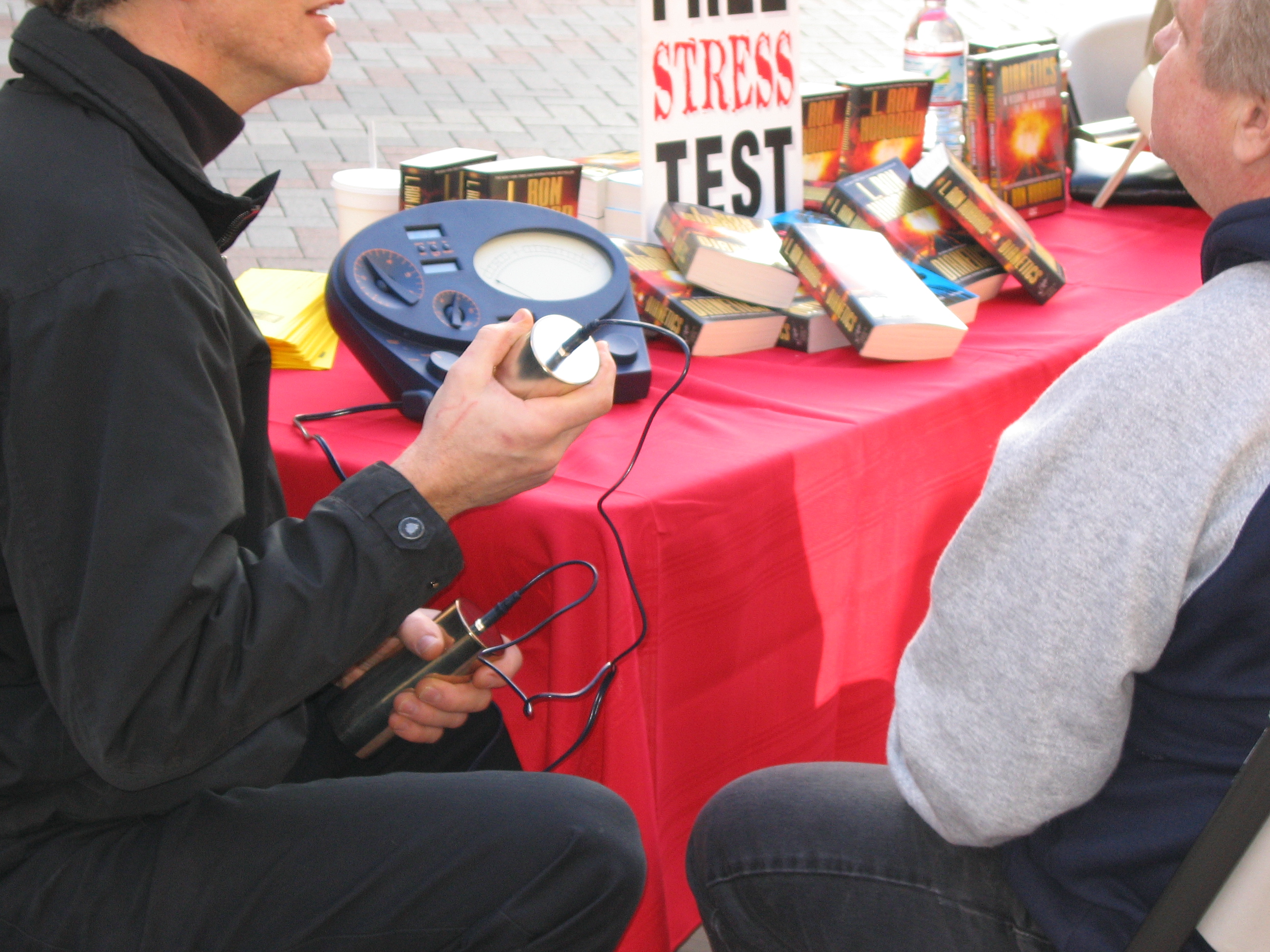
I’ve always found Scientology, the “religion” founded by science-fiction writer L. Ron Hubbard creepy. For one thing, there’s those people standing outside train stations and shopping centres offering free “stress” tests via a device called an “e-meter”.
Then there’s the wacko celebrity endorsement from devotees like Tom Cruise (who infamously claimed in 2005 in a television interview that neither psychology nor psychiatry “worked”) and the claim at the core of Scientology that through elimination of the “reactive mind” (the unconscious mind) devotees can increase intelligence, eliminate unwanted emotions and alleviate a wide range of illnesses (including asthma, arthritis and sexual deviance, which is deemed to include homosexuality).
A Scientologist carries out a stress test using an e-meter
But did you also know that L. Ron Hubbard was a supporter of South Africa’s white supremest apartheid government during its darkest days?
I also discovered that in 1960, L. Ron Hubbard lived in a house on Linksfield Ridge, Johannesburg just a few minutes drive from where our family once lived, though of course, separated in time by more than three decades. In a sense, we were neighbours, and I never knew it.
L Ron Hubbard came to South Africa in September 1960 and made his home on Linksfield Ridge, an outcrop of grass and rock. rising up over Johannesburg’s northern suburbs, dotted with gated townhouse complexes and multi-storey mansions.
(During rugby practice, I remember having to run up a windy, steep road to the top of the ridge, all the blokes complaining as our calves and thighs burned.)
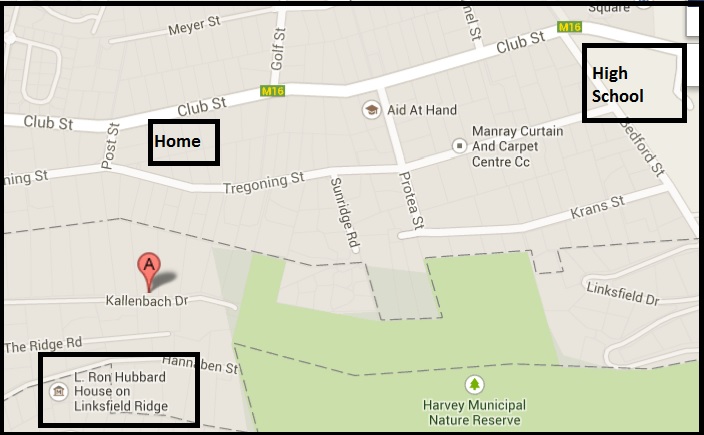
Map showing L Ron Hubbard House, our family home at 50 Club Street and location of my high school, King David High School, Linksfield Ridge
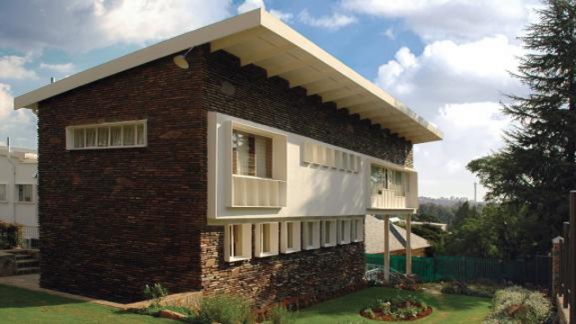
The L Ron Hubbard House, Linksfield Ridge
The Scientology house on Hannaben Street, which has impressive views over the tree-lined northern suburbs towards upmarket Rosebank and Sandton, has been restored as a museum. Had I known I would surely have visited.
Of course the L. Ron Hubbard website, which has a special section devoted to Johannesburg, makes no mention of his admiration for former South African prime minister Dr Hendrik Verwoed, the architect of apartheid’s harshest laws.
A polished, sycophantic video confirms Hubbard arrived in Johannesburg in September 1960, but that the home was a place for him and others to discuss and send off letters to the South African government detailing “his plans for equality in South Africa”.
Quite, how he planned to do just that, cocooned in his luxurious castle in the heart of white Johannesburg is not explained though it does include the highly duplicitous claim that while there he delivered “Scientology spiritual counselling to the improve the lives of his African domestic staff”.
Clearly then, L Ron Hubbard, was content to not just to live in luxurious surroundings, far, far away from the liberation struggle, but he was also happy to enforce the master-servant relationship that existed between white South Africans and black domestic workers, in his own home. This irony is not noted on the website either.
Rob Rose writes: “What Scientologists don’t want you to know is exactly what was in those letters to the South African ministers. He continues:
They’ve gone out of their way to airbrush Hubbard’s craven fawning over the apartheid government, specifically, his gushing praise for the father of the racist ideology, Dr Hendrik Verwoerd.
Rose goes on to quote from a letter written by Hubbard to the Verwoerd government:
May I state that you have conceived and created in the Johannesburg townships what is probably the most impressive and adequate resettlement in existence. Any criticism of it could only be engaged upon by scoundrels or madmen, and I know now your enemies to be both.
For those wishing to verify this quote, you can find it here in a digital version of the Kotze Commission. This was set up in 1970 to investigate Scientology, and which then banned it for two decades (one of the few intelligent things the government at the time did).
Of course, even if you dispute this transcript, it would take some distorted logic to understand why someone who claimed to believe in racial equality would choose to move to South Africa during the height of apartheid and live in an affluent white neighbourhood with black servants tending him hand and foot, rather than choose to live amongst African people in Soweto.
Sadly, many South Africans are unaware of this fawning over the apartheid regime or choose to ignore it.
According Rob Rose, since its unbanning in the 1990s, Scientology has gained 150,000 devotees in South Africa and earns about $10 million a year for L. Ron Hubbard’s church and estate.
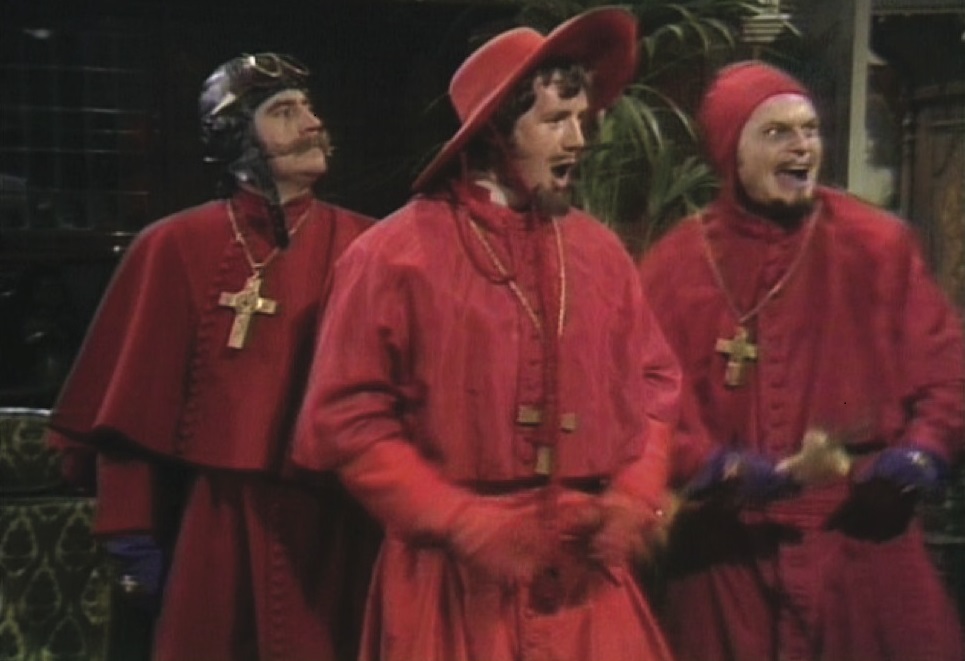
“Nobody expects the Spanish inquisition…our chief weapon is…surprise.”
So begins the famous Monty Python sketch heralded by the arrival of evil clergy in red robes.
Well I wasn’t wearing a red robe or any identifying markings at a recent business lunch when as discussion turned to who would pay the bill, someone remarked:
“I’ll be the Jew and leave” – or words to that effect, before they got up to go.
A general snickering followed. Someone remarked flippantly that you should be careful what you say – you never know who may be around – and it was quickly forgotten.
No one knew there was a Jew at the table.
Me.
I never said anything, nor did I regard the person who said it with any particular malice. But I was a bit taken aback. It made me feel uncomfortable; I felt inclined to say something but also reluctant to make a fuss.
Others I know would have had no indecision. They would be proclaiming their Jewishness loudly and demanding an apology accompanied by accusations of anti-Semitism.
Did the person who made this remark hold some deeply felt hatred towards the jewish race or religion, or was it just like the time I remarked, flippantly, to an ex-girlfriend of mine who was half Asian that the kitchen of the digs I shared with friends in London “resembled a Chinese laundry”.
(I also recall that she distinctly did not like the South African colloquialism “china” used in the same way Australians say “mate”).
Anyway, as the words came out my mouth, I realised what I’d said, but it was too late. An uncomfortable moment followed as I apologised profusely.
And wouldn’t this person sitting across from me at lunch, who suggested “he be the Jew” have acted similarly had he known I was Jewish.
My gut feel, is yes.
And does he harbour some ill-will towards Jews. Probably…
Would he suddenly dislike me if he found out I was Jewish – probably not.
The truth is everyone has made a remark like this at some point in their lives -and it’s hard to think of anyone I know who does not hold some kind of prejudice or quasi-prejudice against some other race, religion, sexual orientation or political belief system.
At the same time, it strikes me that my Jewish brethren appear the most sensitive of all races, colours and creeds to offensive remarks, no matter how harmless or slip of the tongue they may be.
Years of persecution – the pogroms, the holocaust, indeed the Spanish Inquisition – will often be the explanation for such an acute sensitivity.
My own experience growing up in South Africa is of a deeply racist Jewish community, with the racism passed down through the generations as it is every where else.
Words learnt and bandied around Jewish social gatherings (white people only apart from the black domestics serving food or minding the children) included the horrible sounding “schvarzte” and “shoch” meaning a “black” person and “chatis” for an Afrikaner.
These words were used regularly at dinners, family gatherings, teas and barbeques – often in earshot of the African domestic clearing away plates or bringing food to the table.
Sadly they were often spoken by those who had fled pogroms or persecution or were the children of those who had. We as kids would play cricket in the garden, while the adults (BMW or Mercedes parked down the driveway) would chat away about their privileged lives: trips overseas, new restaurants opening, community gossip. As you got older, you’d join the adults and hear the conversations, where “shochs, schvartzes and chatises” were mentioned all too frequently.
Paradoxically, these same people would often stick their heads into the kitchen to say hi to the African domestic washing the dishes, to ask about their children or their health.
But it was always in the realm of the ‘master and servant relationship’:
“How are you today Sophie?”
“I am well thank-you master.”
“How are your children?”
“They are well thank you master.”
So what’s happened to these people who I remember with their expensive cars, who would sit around discussing the cricket or rugby with the odd racist remark thrown in from time to time?
Many of them have packed up and moved to Australia. They’re living on the best streets of Bondi, Vaucluse, St Ives, Toorak, Caufield, Bentleigh and Dianella. Some – would you believe it – have even brought their domestics along to do the dishes.
Few have dropped their prejudices and most will happily tell you South Africa has “gone to the dogs since the blacks took over”.
It reminds me of something someone very dear to me (but with horribly dated ideas) once said to me a long time ago:
“I don’t believe in apartheid. But really, you can’t put the blacks in charge.”
It is also my 100th post on this blog. I dedicate 95 of those posts to Nelson Mandela, for each of the 95 years of his life:
I will always remember voting in South Africa’s first democratic elections on April 27, 1994. It was a miracle they took place at all; far-right-wing organisations threatened civil war, and only last-minute negotiations and concessions ensured all key political parties took part in the historic vote.
Such was the fear that some people took to draining their swimming pools and stocking them with cans of baked beans, mineral water and tinned tuna in case all hell broke loose — or so the urban legend went. But certainly there were empty shelves in the supermarket and a tremendous sense of tension in the air.
In the lead-up there had been bomb blasts at Johannesburg airport instigated by the paramilitary AWB (Afrikaner Resistance Movement) and, a year before, the terrible slaying of Communist Party leader Chris Hani carried out by a white Polish immigrant named Janusz Walus as part of a right-wing plot that had pushed the country to the brink of anarchy.
But the doomsayers were all proved wrong.
On April 27 the front-page headline in Johannesburg’s The Star newspaper proclaimed boldly “Vote the beloved country”, a play on Alan Paton’s famous novelCry, The Beloved Country about apartheid’s injustices, which we all read at school. Underneath the headline was a photo taken from a helicopter showing a snaking line of people stretching beyond the confines of the photograph waiting patiently to vote for the first time in their lives.
A mural in Cape Town depicting voting in South Africa in 1994
People queued for hours. In the big cities. In country towns. In townships. In rural villages. On hillsides.
Apart from getting married and the birth of my daughter, it was the single greatest day in my life. It was a privilege to be alive and still young (I was 21 at the time), but old enough to play my small part in such a defining moment in our troubled country’s history.
I remember it as a glorious crisp, early autumn day. Blue skies. Electricity in the air.
I voted at the nearby primary school just a short drive from home. I am not someone who shows his emotions, but as I drove past the line of people waiting on the pavement, there were tears in my eyes, and my heart felt like it was ballooning out of my chest.
In that queue was Nelson Mandela’s vision, why he had spent 27 years of his life imprisoned on Robben Island and why he had emerged not to proclaim war against those who oppressed him but to suggest a vision of the “rainbow nation” where everyone, no matter the colour of their skin, could feel proud to call themselves South African.
That queue outside the primary school in leafy suburban Jo’burg, in queues all over the country from Cape Town at the bottom of the country to Messina on the Zimbabwean border, the rainbow nation was brought to life for the world to see.
“… white middle-aged Jewish women in designer outfits, who for years had kept domestics (or “maids” as we called them) to raise and feed their children, stood quietly behind those they employed.”
Having parked my car some distance away, I took my place in the line. Ahead of me white middle-aged Jewish women in designer outfits, who for years had kept domestics (or “maids” as we called them) to raise and feed their children, stood quietly behind those they employed. Dapperly dressed old African men, once forced to carry “passbooks” regulating their movements in white areas under apartheid, stood beside Portuguese-born restaurateurs, Italian hairdressers and sun-loving British immigrants. Petrol attendants stood next to lawyers, suburban housewives, next to black mini-cab drivers. Black gardeners stood side-by-side with white doctors and accountants. Petrol attendants in blue overalls stood next to white old ladies with permed hair and tissues tucked under their sleeves, who stood behind Indian shopkeepers and coloured fruit sellers.
There was something in the air that day. Yes the tension remained, but there was the sense the dream could be real, that we could all learn to get along and in doing so rebuild and repair centuries of inequality, injustice and brutality. It would not be easy, but it was possible.
Soon after, the votes tallied, Nelson Mandela was sworn in as our first president.
The following year, South Africa won the Rugby World Cup; Mandela famously wore his No.7 jersey alongside Francois Pienaar (I retreated to my bedroom, head under my pillow, too anxious to watch the dying seconds of the match before Joel Stransky’s wondrous drop goal) and we all danced together in the streets, waving our new and strange-looking flag with gusto. The following year our soccer team, Bafana Bafana (“the boys”), won the African Cup of Nations in front of 120,000 screaming fans in Soweto.
Of course the euphoria over those early days of freedom have faded into reality. There are many challenges still facing the Rainbow Nation: crime, AIDS, inequality, corruption. But the new South Africa, even with these big problems, is a vastly better place than I remember through the rose-tinted glasses of my privileged white upbringing.
I never met Mandela, though I often drove past his imposing Houghton house a few suburbs from my own on my way home from work. With a bit more luck I might have bumped into him as his picked up his medications at the local pharmacy in the cosmopolitan neighbourhood of Norwood, a few kilometres down the road. Sadly, it never happened.
What would I have said to him? Perhaps, thank you for those glorious days in April. And for giving us hope and a glimpse of what might still be.
One Saturday morning in July, I received a call from Jennifer Nash, a single mother living in Logan City, south-east Queensland.
She asked if I would consider writing an article about her son, Jordan Nash, to be posted on Wikipedia, the free user-sourced internet encyclopedia. She hoped a Wikipedia article would draw attention to his sad story.
Jordan Nash, as a young school kid
I said I thought I could help.
Her story tumbled out over the phone: she was at war with the Queensland government and the Federal Government since Jordan – who has learning difficulties – was removed from school almost 10 years ago.
Jennifer claimed she’d been bullied, mistreated, harassed, ignored, hit with a $28,000 court bill and been the victim of judicial corruption because a court transcript – which proved she had been bullied and mistreated – had been “edited”.
Over the next few months I spent many hours on the phone with Jennifer, an exhausted, but determined and sincere woman, as she described what had been done to her.
Much of her and Jordan’s story appeared on unofficial media sites – essentially citizen journalism or blogging sites like Independent Australia – but some of it did make it into the mainstream media.
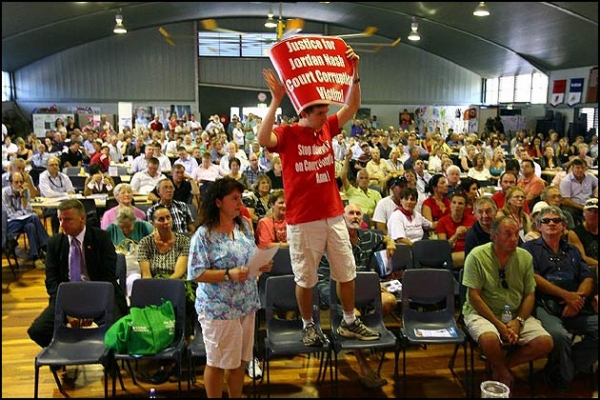
In March 2011, WIN Television reported her address to former Queensland state premier Anna Bligh at a community forum at Toowoomba, where she said, quite eloquently, that “this soul crushing travesty of justice cannot be allowed to be covered up any longer”.
Last year she appeared in the Brisbane Times, which incorrectly reported that she’d called then prime minister Julia Gillard “white trash” at a community cabinet meeting at Redbank Plains outside of Brisbane. The story, later corrected by the online newspaper, was that she had in fact told the prime minister “We are not white trash” as she explained to radio presenter Gary Hardgrave on radio station 4BC
Jennifer and Jordan Nash speaking out at a community cabinet
Her battle reached the upper echelons of power this year, when both her and Jordan were banned from attending a federal government community cabinet in Rockhampton by Jamie Fox, a government secretary working within the cabinet of then prime minister, Kevin Rudd, who was due to speak at the event.
Asked why she’d been banned, Jamie Fox responded via email that following checks by “security agencies” the government had been advised by the Attorney-General’s Department and the state police that she had a “history of disrupting public events” at other community cabinets and would not be permitted to attend.
“I am responsible for organising community cabinet meetings and this decision is taken on my authority,” wrote Fox.
Jamie Fox’s email to Jennifer Nash
Just what had a single mother without any financial or political muscle done for the Australian government to ban her from airing her views in a forum seemingly open to all?
The answer: stand up on a chair and demand justice for her and her son.
Hardly the sought of behaviour I thought to warrant a security crackdown or a sneering email from one of Kevin Rudd’s flacks.
In late August, I submitted the story of Jennifer and Jordan Nash to Wikipedia.
It was rejected by someone called “Sionk” who wrote:
This submission’s references do not adequately evidence the subject’s notability
Sionk also remarked:
Maybe there has been extensive news coverage of Jordan Nash, but there isn’t any presented here. The way this is written is also problematic, Wikipedia isn’t the place to make lengthy, one-sided (and poorly sourced) legal arguments.
Essentially, what Sionk was saying was that Jordan Nash was not worthy of a Wikipedia article because his case had not been reported in the mainstream press and he was not someone of note.
I explained to Jennifer that no matter how many times I re-wrote it, I did not think her story would make it onto the pages of Wikipedia for the reasons above.
Every now and then I do a search for “Jordan Nash” wondering if Jennifer has managed to convince Wikipedia editors they should publish her story. But there’s still no entry.
Interestingly, many of the people who she accuses of mistreating her do have Wikipedia entries such as Queensland state member for Logan, Michael Pucci, who Jennifer says refused to help her, Supreme Court justice Jean Dalton, who dismissed Jennifer’s initial complaint at the Queensland Anti-Discrimination Tribunal (QADT) and former minister for education, Cameron Dick who dismissed further investigation into claims the court transcripts had been edited.
There’s some consolation for Jennifer. At least Jamie Fox, the government flack who barred her from the forum, doesn’t get a Wikipedia page.
(If you’d like to read more about Jennifer’s case, Independent Australia provides a fairly comprehensive summary).
“All the President’s Men” – Carl Bernstein and Bob Woodward’s account of how they uncovered and reported the Watergate Scandal in 1972 and 1973 in the Washington Post and brought down President Nixon and his goons – should be compulsory reading for any journalist wanting tips on how to break a big story. It’s practically a ‘how to’ manual on investigative journalism.
I don’t know if they still make journalists like Bernstein and Woodward, but even in the digital age, where research and information is just a search term away, the techniques, tricks and cunning they employed still apply. Truly great stories don’t come from Google.
Firstly there are the sheer number of characters and the very convoluted plot. In the inside introductory pages of my paperback edition there is a list of 51 people – presidential staff, advisers, aids, campaign directors, lawyers, editors and prosecutors – who were the main players in the scandal. I found I had to constantly turn back to the beginning of the book to remind myself of who each person was as the plot diverged into a myriad different strands.
This may sound harsh, given Bernstein and Woodward’s reporting (and others on the paper) helped the Washington Post win the Pulitzer Prize for Public Service in 1973, but it’s also not incredibly well written. Perhaps writing a 300 page book gave crack newspaper reporters – accustomed to writing 500 – 1000 word articles – too much leeway to tell their story. There’s too much information crammed into paragraphs and too many minor incidents that get in the way of the overall plot – a good, tight edit would have done marvels to the finished work.
That being said, it does provide some incredible insights into how these two brave, foolhardy, and belligerent reporters dug down the deepest of rabbit holes to uncover the truth.
Married journos need not apply
The first thing that’s apparent is the long and strange hours Bernstein and Woodward put in to crack the story. Neither of them were married at the time or in relationships, nor did they have children. This made it easier for them to work late into the night in the offices of the Washington Post, or drive out to the outlying suburbs of Washington or jet off to Miami or Los Angeles to track down and interview people and give up their weekends in pursuit of a story.
Anyone journalist today married or in a relationship would find it impossible to put in the hours they did – they would either end up divorced or entirely burnt out, or both.
Woodward famously would head out well after midnight to meet up with “Deep Throat” (later revealed to be the FBI’ no.2 man Mark Felt) in deserted car basements to verify information or seek help with stories.
Both journalists also had no qualms about ringing up legendary Washington Post executive editor Ben Bradlee at 2am and asking if they could come over to discuss an idea or situation.
Hit the phones relentlessly. Put in the hard yards.
In the book, Woodward and Bernstein recount countless hours spent calling people on long lists, hoping to come across someone in the White House, Justice Department or some friend of a friend willing to share confidential information with them.
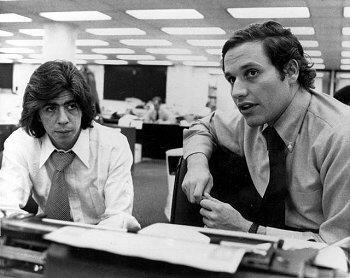
Carl Bernstein and Bob Woodward at the offices of the Washington Post in 1972
By beginning at the top of a list and working their way through it, Woodward Bernstein would eventually find someone willing to speak to them. Sometimes they’d spend the whole day just telephoning people in the hope of finding a useful contact. In this way, they built up an incredible network of insiders. This is how they worked:
Each kept a separate master list of telephone numbers. The numbers were called at least twice a week. Eventually, the combined totals of names on their lists swelled to several hundred, yet fewer than 50 were duplicated.
Think laterally, be creative
Bernstein and Woodward were very savvy and had to be because the might of President Nixon, his ‘men’ and the CIA were out to prevent the ties between Watergate and the White House cover-up ever being revealed.
Sometimes they crossed the line and veered into the murky borders of the unethical or illegal – for instance, when they contacted members of the grand jury investigating Watergate who weren’t supposed to talk to the press or on one occasion, Bernstein not identifying himself as Washington Post reporter.
One of Woodward and Bernstein’s scoops on Watergate
On another occasion, they met with chief prosecutor Earl Silbert in his fastidiously tidy office. Bernstein noticed a piece of paper on his desk that had as its letterhead the name of the company where bugging equipment for Watergate had been purchased. He used this information to write a story and was severely admonished by Silbert who called his methods “sneaky, outrageous and dishonest”. Bernstein apologised, but saw it differently:
Bernstein had learnt years before that the ability to read upside down could be a useful reportorial skill…
The point is that no opportunity was passed up. Every lead, idea or suggestion was followed up.
Get people to talk
Bernstein were masters at getting people to talk. One way, was to get themselves inside the house of a person they knew had good information, but was reluctant or too scared to speak and then find ways of staying and chatting. In one rather comical episode, they kept on ordering cup after cup of coffee in an attempt to prolong a conversation with the wife of an important person caught up in the conspiracy.
They write:
The trick was getting inside somebody’s apartment or house. There, a conversation could be pursued, consciences could be appealed to, there the reporters could try to establish themselves as human beings
Be daring out and outrageous
Bernstein and Woodward pulled some outrageous stunts and came close to going to jail.
My favourite one is towards the end of the book.
Following a day in court where the Watergate defendants are being tried, Bernstein and Woodward along with a couple of other reporters notice three of the defendants and their lawyer trying to hail a cab. Bernstein races down as they file into the cab and
…uninvited got in anyway, piling in on top of them as the door slammed.
But it doesn’t end here:
Bernstein arrived back in the office late Saturday (he had gotten into the cab on a Friday afternoon). He had gone to the airport with Rothblatt and his clients, bought a ticket on a flight one of them was taking, edged his way in by offering to carry a suitcase and engaging in friendly banter, and slipped into the adjoining seat. Bernstein did not have to press the man too hard to turn the conversation to the trial. The story came out in a restful flow of conversation as the jet engines surged peacefully in the background.
Talk about outrageous, but this was the way Bernstein and Woodward operated.
Not all their ideas paid of – and a couple almost sunk them.
They misread what they thought were confirmations from sources on at least two occasions (one involved a source agreeing to hang up after 10 seconds if the story read out to them was entirely true. The source hung up but misunderstood the instructions) with spectacular results. But most of the time they got the story.
Every word matters
Every word mattered to Bernstein and Woodward and to their editors. The lead (opening paragraph) had to be perfect and they would fight over words and phrases and re-write and re-write as deadlines approached. This, of course, would be a problem in today’s 24 hour news cycle, where posting stories quickly as well as accurately is the challenge.
However, the digital age has not dampened the importance of writing well and being able to tell an engrossing story in a few hundred perfectly chosen words, as Bernstein and Woodward did back then. The importance of ‘words’ is revealed in this revelation:
The two fought openly. Sometimes they battled for fifteen minutes over a single word or sentence. Nuances were critically important, the emphasis had to be just right…sooner or later however, (usually later) the story was hammered out.
And let’s not forget the end result of their endeavours, the resignation of President Richard Nixon
My cousin Maureen loves telling the story of how she flew to New Zealand in the 1980s and upon landing in Auckland, the pilot announced over the intercom:
“Welcome to New Zealand, please turn your watches back 30 years.”
It was a great line and always made me laugh.
But now it’s no so funny as I suspect Qantas may be forced to play the same message to new arrivals to our shores given the changes that are afoot since the new Abbott government placed Australia “under new management”.
It’s a man’s world
Our new prime minister surrounded himself with his attractive daughters, his wife and other powerful women in an attempt to appeal to female voters during the election campaign, but now that he’s won office its men in grey suits who are running the country. The feisty Julie Bishop is the only woman in cabinet, the rest are all grumpy old men, intent on returning Australia to the conservative values of the king of grumpy old men, John Howard.
Of course the corridors of female power are not assisted by the like of dowdy old Bronwyn Bishop, the Liberal member for Mackellar and someone with the fashion sense of Margaret Thatcher, who said it wasn’t Mr Abbott’s fault he could choose only one women in his cabinet (and just six out of 42 in his ministry), because he had to choose on merit, meaning no other women were good enough to be placed in senior leadership roles.
Give the environment a good kicking
Another swift act the new government was to kick out former Chief Climate Commissioner, Professor Tim Flannery and disband the Climate Commission, an organisation set up as an “independent and reliable source of information about the science of climate change”. Click on any link on the Climate Commission home page and you get this short message:
The Climate Commission ceased operation in September 2013.
With this single act, the new government broadcast its message loud and clear:
We don’t believe in climate change. We’re not interested in the environment.
What it means is that a lot more of Australia’s natural vegetation and eco-systems will fall by the way side to assist the mining industry. Prime minister Abbott is taking his cues from the ultra-conservative Queensland government, demanding that more farmland be given over to coal seam gas exploration. This at a time when even the rapidly industrialising Chinese economy is looking to reduce its carbon footprint alongside that of the US.
The new age of secrecy
Perhaps, most shocking in an age when government’s are being urged to be more transparent and open, that the new government should seek the pull the wool over its own citizen’s eyes. This was most evident in new “go back to where you came from” immigration minister Scott Morrison’s pledge that “there will be no information about whether [asylum seeker] boats are turned around”
Scott Morrison, a “Pik Botha” of his era
“That goes to operational matters that, whether they affect current or future operational activity, you will not be getting commentary from this podium or that podium either way on those matters,” said Mr Morrison in garbled politco-speak that could have come straight out of the mouth of apartheid-era South African foreign minister Pik Botha.
But let’s not kid ourselves – Mr Morrison is no lovable rogue. Old Pik at least had some dour charisma and was happy to give something back under Nelson Mandela.
Mr Morrison has gone to war with asylum seekers and “lefties” who seek to give them a fair go.
These are but three examples in just a few weeks of government, and no doubt more will come (One more example: The Abbott government is attempting to block the ACT government from legalising gay marriage).
Yes, we have a government that’s united. But in what common cause?
To set us on a course for barren shores?
Are we, in the words of Withnail as a nation: “drifting into the arena of the unwell, making an enemy of our own future”?
Withnail, drifting into the arena of the unwell
“What we need is harmony, fresh air, stuff like that,” Withnail goes on to say.
But I fear the air will become clogged with the foulest of fumes.
 Financial institution CommSec recently published an interesting global retailing index called the iPad Index.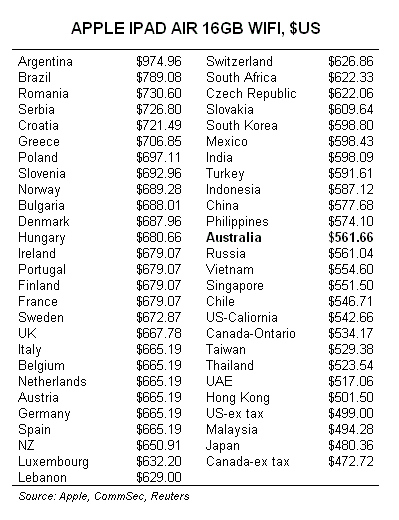











 Freshlyworded