Black people with cockney accents and London flatshares: A tribute of sorts to Clive James

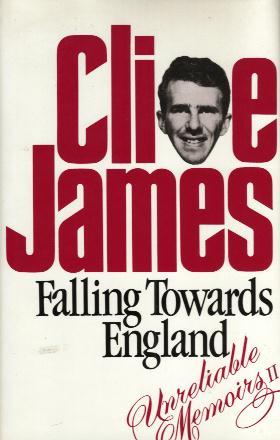
clive james bookI’ve started re-reading Clive James‘ second wonderful memoir “Falling Towards England” which recounts ‘our hero’s’ migration from Sydney to London in 1962.

I loved reading all of James’s hilarious, witty and erudite memoirs and it is a real treat to dip back in to the early year’s of one of Australia’s finest literary exports.

It is an endeavour tinged with sadness and nostalgia: sadness because Clive James has a terminal illness and because reading his memoir stirs up so many London memories for me.

I am only 40 or so pages into “Falling Towards England” where we find ‘our hero’ virtually penniless, rejected for numerous writing jobs, ill-prepared for the English winter and frequently surrounded by ill-mannered boorish South Africans, or ‘voortrekkers’ as he calls them who don’t like it when the ‘bleks’ talk back to white policemen on television.

James captures perfectly the harsh Afrikaner accent and the mentality of the neanderthals he was living with at the time:

“That’s what’s rewning Efrika,” said a voice from a winged chintz chair, ‘litting a keffir talk to them like thet.” Another chintz chair agreed. “Thet’s right,” it said. “They mist not be allowed to enswer beck.”

I remember with great clarity on my very first trip to London with my mother, aged 13 in 1987, when there was still an anti-apartheid protest moored permanently outside South Africa house on Trafalgar Square, walking into McDonald’s for the first time (that too a novelty) and hearing the black man in dreads behind the counter ask me what I wanted in a thick cockney English accent. I got the shock of my life.

“The bleks are not supposed to talk like thet,” is probably what raced through my naive South African head at the time.

Beyond that funny re-collection, Clive James’s depiction of flat sharing in the 196os  reminded me of my own early years in London (I was there from 2000 to 2004), when I lived above a kebab shop on Brent Road, Hendon.
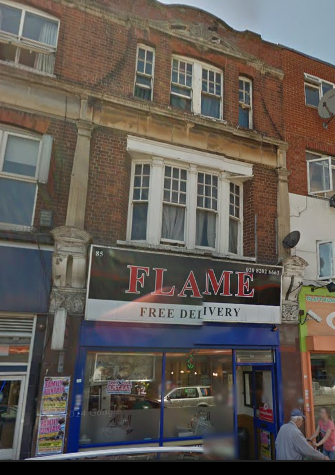
The top floor flat above "Flame" kebab shop was my home for three years

The top floor flat above “Flame” kebab shop was my home for three years

Of course, I didn’t have to feed money into a heater to generate some warmth as James did and my finances were not quite as dire as his – my first full time salary was £16,000 a year working as a ‘content developer’ for Accountancy Age on Broadwick Street, Soho.

I do though remember the barrenness of my little room with its pigeon-shit encrusted window that overlooked some miserable discount shops, a ‘caf’ where you could get breakfast for a few pounds and my local Tesco, where I witnessed numerous disputes between the staff and local yobbos, attempting their daily ritual of shoplifting bottle’s of Winkleigh’s White Lightning cider.

My landlord was a kindly, jovial Jewish man called Harold Schogger who ran the local bridge club on the floor below our third-floor flat. Coming home from work, I’d have to make my way past a posse of bride club players filling the air with a dense cloud of tobacco smoke (One later had a heart attack and died on the landing).

My first flatmates were as follows:

  • Andy and Dave, who both hailed from Rochdale, near Manchester in the North of England. Andy, a chubby, bearded fellow, fond of eating but not washing up and Dave, a quieter, intellectual type with the eyes of kindly badger, whose chief pre-occupation was smoking marijuana on a fairly continuous basis
  • Sagey, a lanky, pony-tailed Israeli, who spent large parts of the day and night in his lair (the biggest room in the flat) smoking dope, and shagging women (the moans reverberated through the passage walls). Sagey would sometimes invite me into his darkened den for a smoke and to watch a movie.  I would sit on a large poof in the cozy lounge area he had created next to his bed, getting deeply stoned, watching something or other on Sagey’s television.
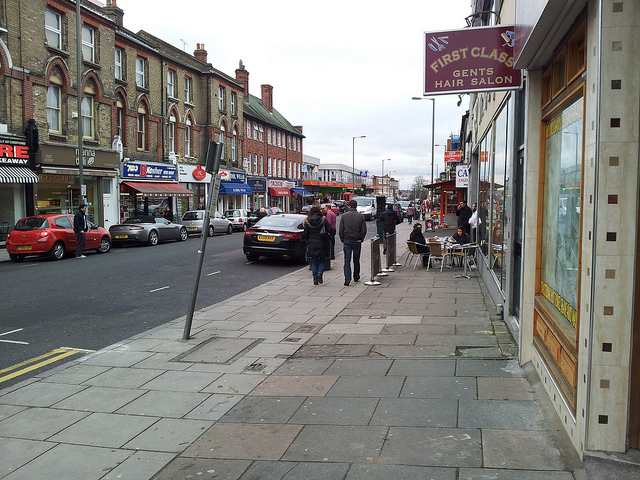
Brent Street Hendon, where I Lived above the kebab shop

Brent Street Hendon,

My evening activities home from work via the Northern Line began with concocting some kind of meal in our narrow little kitchen usually piled up to the ceiling with dirty plates, or grabbing a kebab from the Afghanistani  who ran the shop below our flat. Then I would sit with Andy or Dave watching something or other on television (the Frank Skinner show was a favourite) as they passed joint after joint around the pungent room.

I must confess here to mild theft – having asked Dave, for a bit of weed one evening, I discovered that he kept it in a drawer by his bed. Later, when my own stash ran low, I’d help myself to some of his when he’d left work for the day – never too much to arouse suspicion, but enough to get me “nicely toasted”. For this act of treachery, I do apologise to Dave, where-ever he may be these days (probably stoned somewhere).

My old landlord and bridge club mafioso, Harold Schogger

My old landlord and bridge club mafioso, Harold Schogger

Thus I spent much of my first two years in London in a weed-induced trance, often finding myself up past midnight flicking through the endless channels of Sky TV. Or else, taking the bus up Finchley Road to visit my friends in a share house in Golders Green.

Over three years, a whole stream of eclectic and eccentric characters came and went from the three bedroom flat above the kebab shop. There was:

  • Debbie,  curly-haired aspiring singer from Cape Town, who aroused the passions of the local drunks in the nearby pub, when she sang show tunes for them (and who rejected my advances on the living room couch)
  • Jacqui,  a lovely ‘older’ woman (she was in her 40s to my late-2os) with a high-pitched voice, red-cheeked face, who took up the violin with great passion
  • Joe, a googly-eyed school assistant, drug fiend and cyclist, fond of opium-dealing in our living room, whilst quietly building a North London property portfolio
  • A good-looking Spanish guy (his name has disappeared from memory) who received phone calls on our landline from Europe at all hours of the night and whom I distinctly remember hating.
  • Two Israeli girls, one fond of loud bonking (though not with me), the other…sleeping (she worked the 11pm to 7am shift at John Lewis)
  • and many others whom have disappeared in the marijuana haze.

I remember those flat-sharing days in much the same way as  Clive James recalls his formative months in London with poignancy, hilarity, shocking embarrasment and a great deal of nostalgia.

There was also plenty of rejection and a fair degree of loneliness too among those years.

I recall being turned down for half a dozen other flat-shares,  inviting places with big open plan lounges, people that dressed well and leafy gardens.

I remember those experiences like Clive James wrote them, where each incumbent resident “wants to interview you personally before okaying you for the shortlist, after which the final selection is by written examination”.

In the end, I think I got the room in the shabby flat above the kebab shop because no one else wanted it, but at the time it was a cause for major celebration: London, I had arrived!

The flat is no longer there, given way to some apartment development, but the bridge club has remained.

And the kebab shop, where I paid frequent late night visits drunk or stoned, is still there, serving its greasy fare.

Australia: a backwards country, going further backwards

Devolution_zps5c30acaaLast weekend, whilst driving in the Melbourne northern burbs, my wife’s phone rang.

It was friends of ours, recently back from a holiday in Europe and they had big news. They had gotten engaged in Paris.

They had been together for a number of years and we were delighted to hear they had tied the knot.

But then the realisation struck home that they cannot legally marry in this country, because Australia does not allow gay marriage –  they are a lesbian couple.

For a very brief period in December last year, it was legal for gay couples to wed in the ACT. Rather than embrace this bold move forward, the Commonwealth government successfully appealed the territory laws that had been in force for less than a week. No sooner were  gay couples saying “I do” then their marriage certificates were being gleefully stomped upon by conservative bureacrats.

This is the country we live in.

These are 17 countries where gay marriage is legal with Scotland the latest to the join the list of enlightened nations earlier this year.

First to allow gay marriage was Holland way back in 2000, the others are: England (2013), Wales (2013), France (2013), New Zealand (2013), Uruguay (2013), Denmark (2012), Argentina (2010), Portugal (2010), Iceland (2010), Sweden (2009), Norway (2009), South Africa (2006), Spain (2005), Canada (2005) and Belgium (2003).

Yes, even the country of my birth, South Africa, a developing country with many social issues, has recognised that people of the same-sex have the legal right to become husband and wife, but not in Australia. Prime minister Tony Abbott is vehemently opposed to gay marriage despite, his own sister Virginia being in a gay relationship.

Asylum seekers

This is not an isolated backwards step, Australia is moving backwards in many disturbing and insidious ways.

Our foreign minister, Scott Morrison recently drank champagne with his Cambodian colleagues after agreeing to send refugees that arrive by boat to Cambodia in a grubby “cash for people” deal that treats people like livestock.

Cambodia, one of the poorest and most corrupt countries in the world will take Australia’s unwanted refugees who are already living in secret squalor on the impoverished island of Nauru.

What will Cambodia get out of this – $40 million and the promise of more money if they take more people. At the same time, Australia has washed its hands clean of its commitment to provide a safe haven for genuine refugees in what Amnesty International has labelled “a new low in Australia’s deplorable and inhumane treatment of asylum seekers”.

This is just the tip of the iceberg: The 2014-15 Federal Budget, the first under Joe Hockey, cut Australia’s refugee and humanitarian program from 20,000 to 13,750 places and reduced its aid spending by $7.6 billion over five years.

Free speech squashed

Rather than enshrine freedom of speech as he had promised in opposition, Tony Abbott has done the opposite.

Journalists and bloggers now face up to 10 years in jail for doing their jobs, providing information about the secret activities of government organisations, even if their stories are in the public’s interest.  This is not all, the new national security laws also make it easier for security agencies to access personal computers and spy on Australians overseas, the very violations of individual privacy, that NSA whistleblower Edward Snowden revealed were happening on an industrial scale in the US, UK and Australia.

And while the government eventually backed away from moves by attorney General George Brandis’s love-child – plans to water down protections under the Racial Discrimination Act that would have made Australia a protected haven for Holocaust deniers and racists (legal to offend, insult, humiliate someone based on their race or ethnicity), the fact that they were drafted in the first place, speaks volumes about our retreat from enlightenment.

Other backwards movements

These are but three examples, there are many more:

Savage reductions in funding for impoverished aboriginal communities, scrapping of the two-year carbon tax, which actually worked to reduce carbon emissions  in exchange for support for the coal industry, money pulled from the national broadcaster the ABC forcing the likely cancellation of important investigative journalism programs, a $7 GP co-payment that will hurt the poorest in society. The list goes on.

It’s a depressing state of affairs for those who cherish Australia as a forward-thinking, first-world nation, that values multi-culturalism, basic human decency and a “fair go”.

As for my gay friends who are now engaged,  there’s always New Zealand as a wedding option – a country that’s not just beating us at rugby.

For a far more erudite article on Tony Abbott and his government, read David Marr’s excellent article in The Monthly here.

Twitter’s anonymous racist underbelly is a parody account.

********Spoiler alert: @ozprotectionistparty is a parody**************

If you ever want to pick up the mood among Australia’s racist underbelly,  then Twitter is a great place to start.

Some of the vilest guff comes out the mouths of anonymous twitter accounts, racist cowards not brave enough to sign their name to their bile.

Take for example I wrongly picked this fella:

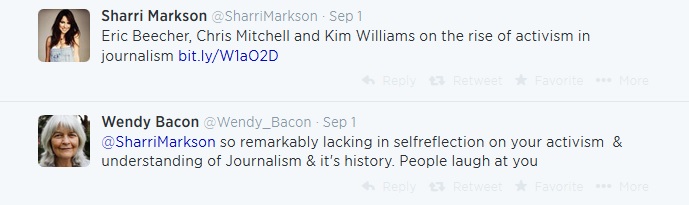
ozprotectpartyI recently came across his account as part of a Twitter war involving Wendy Bacon, an academic and journalist ( , Sharri Markson, media editor of The Australian () and News Corp ultra conservative columnist Miranda Devine ().

It was a classic lefty journalist criticising a News Corp editor, which descended into a slanging match.

The fuse seems to have been lit by Wendy Bacon. She tweeted in response to an article by Sharri Markson about how journalists that tweeted their own opinions (examples included Bacon herself, Crikey star writer Bernard Keane, former Channel Ten broadcaster Paul Bongiorno and journalist and blogger Margo Kingston) were putting journalism at risk.

sharri
It was a provocative tweet no doubt – Bacon was clearly incensed that her opinions had been cast as a threat to journalism.

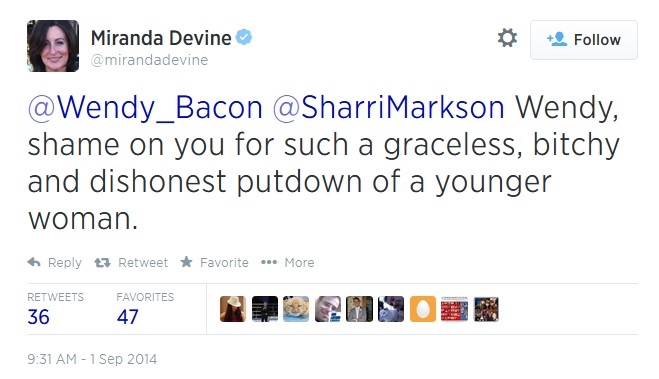
Miranda Devine leapt to Sharri Markson’s defence in typical fashion:

devineAnd then it all erupted as you can see with all the retweets and favourites.

I won’t go into all the comments – it was essentially a slanging match between ultra-conservative tweeters and left-leaning thinkers.

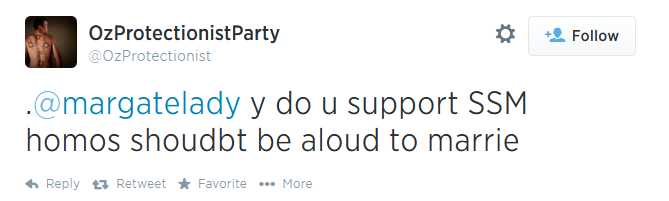
Amongst it all,  @ozProtectionistParty caught my eye with this bogan-esque comment:

ozprotect1Then I read through OzProtectionistParty’s Twitter feed. These are just a few highlights:

On refugees:

ozprotect2Homosexuals and same-sex marriage (SSM):

ozprotect3
Women:

ozprotect4Renewable energy

ozprotect5
And so it goes on…

The twitter account is a  parody – which I understand to be that he is actually mocking the right wing/racist elements in Australian society.

Otherwise and were it not for the spelling mistakes, it seemed would be an almost perfect synthesis of all the worst right-wing stereotypes – refugees are illegal queue jumpers, feminists are power-hungry bitches, students are bludgers – cloaked behind an anonymous Twitter handle.

Ten years ago, this fellow – were he real – would be spewing this stuff down at the pub with his mates rather than on the public forum that is Twitter.

There’s thousand of REAL PEOPLE out there who are not a parody like this account, barometers of what’s lurking beneath the surface of people you might stand next to on the train on the way into work or who are in front of you in the queue at Hungry Jacks.

Eager funnels for every right wing ideology and stereotype that comes out of the mouths of white/male/conservative/bigots.

Just hope you don’t bump into one of these REAL PEOPLE on a bus or train:

Back to print: Is the Saturday Paper any good?

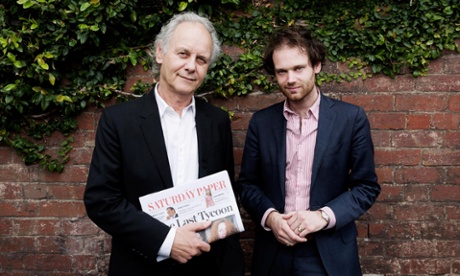
The_Saturday_Paper_-_Front_Cover_1_241_338_85_sThere were more than a few raised eyebrows (and conservative commentators choking on their muesli) when property developer and left-wing publisher Morry Schwartz launched The Saturday Paper roughly six months ago.

Schwartz, who also publishes features magazine The Monthly and long-form politics bible The Quarterly Essay (and in his spare time runs developer Pan Urban) said in March he saw an opportunity to enter the newspaper space with Fairfax and News Corp Australia “at their weakest”.

He said The Saturday Paper would target “readers like me”  meaning presumably forward thinking, inner city liberals with good jobs and good educations and that its launch fulfilled a 40 year ambition to have his own newspaper.

But is it any good?

Last week, I picked up a copy in Readings bookshop on Lygon Street, Carlton and ready it cover to cover.

Schwartz has hired an impressive stable of former ABC and Fairfax journalists including Mike Seccombe, who is the paper’s Sydney editor, Richard Ackland, its diarist and legal affairs editor and Helen Razor (Crikey among others) who is the paper’s television and gardening critic.

There’s also a whole bunch of “star” freelance writers including David Marr, Guy Rundle and ‘The Slap’ author Chris Tsiolkas.

As for the content, there was a lot to admire about the package of stories in the issue I read. Even if you’re political persuasions are right leaning, you’d find a number of articles of interest.

morry schwartz with erik jensen
The two front page articles were knock-outs.

The lead story was about the Essendon drugs saga and ensuing court room battle as told by chief correspondent  Martin Mckenzie-Murray. Schwartz has talked about “narrative” journalism and this was the first article I had read on the subject that actually told the story of how James Hird became the Essendon golden boy and his dramatic fall from grace. Having only come to Australia in 2004, I finally understood the hero-worship.

The second cover story was about the battle to usurp power from Sydney Lord Mayor Clover Moore. Written by Mike Seccombe, it’s the classic ‘People’ versus “Big Business’ tale with Moore pitched against right-wing adversaries including shock jock Alan Jones and ultra-conservative homophobe the Reverend Fred Niles. It’s a ripping yarn about power, influence and revenge.

Canberra journalist Chris Wallace provided thought-provoking analysis of the recent troubles of Federal Treasurer Joe Hockey, arguing convincingly that Hockey is part of a new breed of privileged Liberal politician, who unlike John Howard, are out of touch with the Australian public because they’ve never had a non-political job in their lives or ever known what its like to be a battler.

David Marr’s comment piece on asylum seeker rights – centred around a Pakistani shopkeeper thrown into detention following a negative ASIO assessment – was as expected, eloquent and powerful. Guy Rundle did a good job savaging the recent gaffs by government ministers.

Another standout was Chris Tsiolkas’s tribute to Robin Williams, which dispensed with the gushing praise, highlighting instead the many bad films Williams made and pointing the finger at Hollywood  for lacking the courage to give him roles that showcased his prodigious talent. It’s the kind of observation that alone justifies the $3.50 cover price.

Just to prove that The Saturday Paper is not just full of the “usual mawkish left-wing pieties” as The Australian’s editor, Chris Mitchell suggested it would be when it launched, there  was also a very interesting profile of Anthony Cappello, Australia’s most successful publisher of ultra conservative books.

Thankfully, not everything had a serious tone. Helen Razor wrote hilariously about the challenges and obsessions of those that grow their own tasty tomatoes  while basketball star Liz Campage made a good Q&A subject. There was a recipe for shakshouka and observations about the dish from chef Andrew McConnell plus book reviews and other bits and pieces. The cryptic crossword by Mungo MacCallum was beyond my abilities.

There are disappointments too.

Romy Ash’s on-set interview with actress Sigrid Thornton was pretentious, dull, waffly and full of self-important actorly observations that made you wince while Richard Ackland’s diary piece was too insidery and obscure to be of any interest to this humble reader.

Overall though, I’d say The Saturday Paper is definitely worth picking up on a Saturday morning to dip in and out of over coffee over the weekend. It was quite harshly judged when it launched in March, but editor Erik Jensen said it would take time to find its feet, and it appears to have done so (with plenty of high-end advertising thrown in too.)

Overall, I give The Saturday Paper 8/10 for the quality of the writing, choice and range of subjects and knowledge imparted  – or 6.5/10 if you’re a conservative reader.

Greed is not good: Our dangerous love affair with American-style capitalism

capitalism_a_love_story_xlgIn one of the early scenes of Michael Moore’s scathing 2009 documentary on free market corporate greed “Capitalism: A Love Story”, the filmmaker interviews a farmer and his wife, who are having their property repossessed.

It’s recurring image in the film, the sheriff knocks on the door, working class people are thrown out onto the street with their furniture, and the house is boarded up, later to be sold for a quarter of the price.

The farmer, his life packed into the back of a van, says he tried everything “except robbing a bank” to save his farm.

“I’m thinking about doing that. It’s one way someone can get their money back. They did it to me. I don’t know why I can’t do it to them,” he says.

As the camera pans back over the abandoned farm buildings, Moore narrates:

“This is the capitalism of taking and giving…mostly taking.”

Later, Moore questions how capitalism allows commercial airlines to pay pilots less than $20,000 a year forcing them take second jobs or apply for food stamps.

To which he answers: “I guess that’s the point of capitalism, it let’s you get away with anything.”

Australian-style capitalism

That’s the exact sentiment I felt when reading about the multi-million dollar handouts to executives at the scandal-ridden Commonwealth Bank financial planning division. People like retiring CBA banking executive Grahame Petersen (total pay $5.6 million), who oversaw the division responsible for the systematic destruction of customer retirement savings through investment in risky products recommended by the bank’s licensed financial planners in return for millions of dollars in commissions.

I thought that the retirees who had lost everything to this free market system that rewarded greed and deception could be forgiven from thinking about doing something similar to the American farmer: walking into a Commonwealth Bank branch and “asking for their money back”.

This is something Michael Moore does in the documentary in his typical sardonic style, walking up to the head office of Goldman Sachs in New York to perform a citizen’s arrest of chairman Lloyd Blankfein (2013 annual salary: US$23 million), after accusing the bank of “stealing’ US$170 billion of American taxpayer’s money to save it from collapse. Later he wraps police crime scene tape around the whole building.

henry paulsonAs Moore explains in the film, the bail out of the banks after the collapse of Lehman Brothers that sparked the Global Financial Crisis, was orchestrated by former Goldman Sachs CEO Henry ‘Hank’ Paulson (one of 25 people Time magazine blames for the crisis happening in the first place).

The then US Treasury Secretary cut a backroom deal that gave the banks $700 billion of US taxpayers money to keep them afloat. Paulson was apparently unaware of the irony that he had broken the basic law of capitalism – that you don’t ask the government for help, you either sink or swim on your own.

It seems this form of failed American style free-market capitalism – so brilliantly depicted in Moore’s film – is what the current Australian government wishes to mimic with its plans to increase the cost of car fuel, doctor’s visits and university education while Australia’s poorest paid workers earns a minimum wage that is the lowest in history relative to average full-time pay (currently $640.90 a week, or $16.87 an hour).

The 3% pay rise they got this year was more than double what the The Australian Chamber of Commerce and Industry – the powerful lobbying body, which represents big business, wanted. It suggested a 1.25% pay rise, less than half the projected cost-of-living increase of 2.7%.

Perhaps Treasurer Joe Hockey – a man who proves himself time and time again to be completely out of touch with most Australians – and his investment banking advisors should watch Moore’s documentary to see the longer term outcome of such policies in the US before and after the GFC: hundreds of thousands of job lay-offs, the poorest people unable to afford basic health care, the boarding up of whole suburbs and ruination of cities like Detroit and Cleveland.

Of course, there is also a message of hope at the end of Capitalism: A Love Story as Moore documents the fight back by ordinary Americans against the systemic free market failure (this appears to be happening in Australia too, at least in political opinion polls)

He tells the story of the employees of Chicago Republic Window and Door factory, who, having been told they will lose their jobs in three days time without being paid their wages lock themselves inside refusing to leave until they get what is theirs. The local community rallies around them providing food and encouragement. Then there’s the story of the Warren Evans, Sheriff of Wayne County, Detroit who decides to stop all home foreclosures, when he realises the hypocrisy of what is happening to working class homeowners after the US$700 billion hand-out to the banks.

More widely, Moore reports of how Barack Obama’s form of democratic socialism has been embraced by young American voters (33%), with only 37% favouring capitalism and the rest undecided.

As explained by Vermont independent senator Bernie Sanders, democratic socialism means “the function of government is to represent middle-income working people rather than just the wealthy or the powerful”.

He goes on to say that America “worships greed”

“We put on the front cover of magazines guys who have made  billions of dollars, rather than the cops, fireman, policeman and nurses, who are doing so much in the lives of people. We have to change our value system.”

Sound familiar?

—————————————————————————————————————————————————————

You can watch the whole documenatry ‘Capitalism: A Love Story’ for free on YouTube.

The economic (non)sense of hunting in Victoria

hunting fool

98 per cent of hunters in Victoria are blokes

This week, among the many silly press releases that arrived in my inbox, was one from the Victorian government, titled: “Hunting’s $439 million boost to Victoria”

It proceeded to explain how much recreational hunting is worth every year to the Victorian economy, how it supports the equivalent of 3,500 full-time jobs and that those who hunt (the 46,000 game licence holders in Victoria) contribute to local economies across the state as they buy “hunting and camping equipment, food, fuel,and other supplies related to their pursuits”.

Reading through the government’s PR spin, it became apparent that this was  really nothing more than a thinly disguised election year publicity stunt, designed to garner a few more votes from would-be rambos running around bushland shooting at things.

“The Victorian Government will invest $17.6 into game management over the next four years and the new Game Management Authority, an election commitment from the Coalition, comes into effect on July 1,” said Agriculture minister Peter Walsh in a pledge to the trigger-happy rifle brigade.

The economic benefits highlighted in the press release were based on a detailed 116 page report commissioned by the Victorian Department of Environment and Primary Industries (DEPI) and undertaken by three private consulting firms. RMCG, EconSearch and DBM Consultants.

The report followed some very bad press for the hunting fraternity and the government after the Box Flat duck massacre at the start of Duck hunting season. This was the illegal slaughter of 800 ducks by hunting louts in the state’s north west, their carcasses left to rot in the water. The victims included 104 freckled ducks, one of the world’s rarest duck species.

What’s really silly about the press release is the implied logic: that hunting is good because it makes economic sense:.

Such reasoning could be used to justify any number of socially abhorrent activities that make money but have virtually no societal benefits such as plundering wildernesss areas for mineral deposits or manufacturing illegal drugs like heroin or ice and selling them to addicts.

That hunting is an absurd blood sport offering little benefit to wider Victorian society (except allow the 46,000 licensed hunters to ruin the natural calm of he bush with gunshot and blood) is abundantly clear in the findings of the survey by the consultants in the same government report.

More than 90 per cent of the 1000 hunters surveyed said they “strongly agreed” with the statements that hunting “let them enjoy nature” and helped them “connect with nature”.

Perhaps they interpreted “connect” to mean the moment a bullet connects with deer or duck brain matter?

Even the economic benefits of hunting are minimal.

Hunting is in fact a tiny part of the Victorian economy and represents well under 5% of the $9 billion of revenue derived from tourism activities every year.

The $17.6 million set aside for game management could easily be directed to encourage economic and socially beneficial outdoor programs that support nature conservation and eco-tourism.

And hunting is not popular among the wider electorate: In a 2012 survey, more than three-quarters of Victorians opposed the shooting of native water birds, an activity which is being banned in NSW, Queensland and Western Australia.

In the UK, the cruel but traditional sport of fox hunting with hounds – favoured by rich landowners and Tories – has been banned since 2004. A survey this year found that more than 8 out 10 Britons supported the ban, after British prime minister David Cameron considered removing it.

The Australian (and Australia’s) propaganda war against boat people

boat peopleI was dismayed – no gutted – to read a story in The Australian newspaper last week.

The story ran under the headline “Lowy Institute poll shows strong support for asylum-seeker policies”.

It’s first paragraph said: “More than 70 per cent of Australians support the Abbott government’s Sovereign Borders Policy, including the idea that boats should be turned back when safe to do so.”

This information was correctly reported and seemed to confirm that, depressingly, most Australians have bought the propaganda – dished out regularly from both sides of politics about asylum seekers.

This is, that asylum seekers are queue jumpers, possibly terrorists and that if they want to come to this country, they should get in line and wait their turn – regardless of the circumstances in their home country. If they arrive by boat, they should be sent back to where they came from.

This sentiment was spelled out 13 years ago when former prime minister John Howard said in his election victory speech: “We will decide who comes here and the circumstances under which they come.”

He was referencing the Tampa affair, where a Norwegian freighter carrying rescued asylum seekers was denied access to Australia. This hard line attitude has been stamped into the heads of the voting public ever since.

But The Australian article conveniently forgot to mention another finding of the same Lowy Institute survey.

This was that the majority of Australians (57%) polled disagreed with the former Rudd government and current Liberal Party government policy that ‘no asylum seeker coming to Australia by boat should be allowed to settle in Australia’.

This statistic is nowhere to be found in Rowan Callick’s article – and which, if it were included, might have led to a different headline or at least told the full story.

Now, the margin of error in the poll was 3% so it could be that as many as 60% of Australians believe that asylum seekers who arrive by boat should be allowed to come and live in Australia, should there claims be genuine.

At worst 54% of Australians are opposed to the policy which is seeking to settle asylum seekers who arrive by boat on Papa New Guinea, Nauru or possibly even Cambodia in grubby cash-for-people deals.

So the end result is that I feel a little bit better about my country (of adoption) and my fellow countrymen.

But then again, reading numerous other articles and following the social media conversations, it is clear there are many Australians who feel like I do – that we are behaving abominably to the most desperate and needy in society.

For more balanced views, try:

Sadly though too many people appear to have been brainwashed following years of propaganda and believe – against all factual evidence – that asylum seekers arriving by boat are the first wave of potential invading hoards.

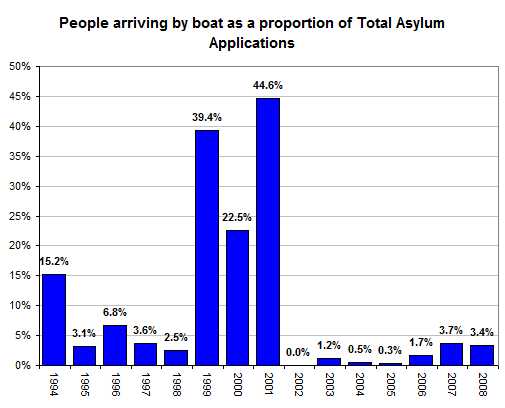
boatproportion

Source: Crikey.com.au

This is in no part due to the aforementioned article in The Australian, but also do to News Corp popular columnists like Andrew Bolt who regularly rounds of his tirades against Labor, the ABC, Fairfax, the Greens etc with thoughts like: “it is grossly irresponsible to allow thousands of illegal immigrants from countries very different from our own to crash our borders when we know it exposes Australians to extra risks they don’t want and never accepted.”

Or comments like this: ” Tens of thousands of ‘refugees’ would swarm each year through the Greens’ open door, more than we could safely accept, and the thousands rejected as refugees would not just go home.

All designed to stir up fear and hysteria of invading hoards and keeping John Howard’s 2001 message alive and well.

Reject the propaganda and form you own, educated view. Don’t be an ignorant fool.

(For more of my articles on this topic, go here.)

Drugs, sex and boredom: A review of “Scar Tissue” by Anthony Keidis

ScartissuebookAbout the most interesting revelation in the 460 odd pages of “Scar Tissue”, the autobiography of Red Hot Chilli Peppers frontman Anthony Kiedis,  occurs about 330 pages into this tedious, self-centered tale.

It’s when Keidis talks about the Chilli Peppers playing as the opening act for the Rolling Stones in the late 1990s.

He writes that opening for the Rolling Stones is a “shite job” despite the opportunity to play with the second greatest band after The Beatles:

“I can’t recommend it to anybody…the fact is the Rolling Stones audience today is lawyers and doctors and CPAs and contractors and real estate development people. This is a conservative wealthy group. No one is rocking out.”

He goes on to describe it as “like going to the Rolling Stones mall”, a “horrible” experience where you play as “85,000 wealthy, bored-out-of-their-minds fans are slowly finding their seats”.

Keidis talks in the same candid, straight-forward style to describe his journey from reckless teenager to petty thief, confirmed junkie and lead singer of one of the biggest rock-funk bands in the world.

It’s an honest, seemingly truthful recollection (as truthful as possible given the amount of drugs consumed along the way) but the problem is its repetitious nature, built on a cycle of drug binges, failed attempts to get clean, and more drug-taking, interspersed with accounts of chaotic relationships, typical rock ‘n roll sexual encounters and tour bus stories.

It’s the complete cliché: Sex, drugs and rock ‘n roll.

Sadly, there is very little revealed of the creative process – this mainly involves Keidis disappearing into a room by himself to write songs about his drug-fuelled personal experiences.

As a book about drug use and addiction it offers very little in the way of insight into the problem – apart from the obvious of it being very hard to give up. Many of the observations glamorize drug use, while others sound like the speech bubbles of a true stoner-idiot:

After fifty days of being sober, I thought, ‘That’s a nice number. I think I should honor that number’. I decided it was a good time to do drugs.

On a visit to New Zealand, he bemoans the fact that the country is too small to satifsy his drug requirements. Countless times he smuggles drugs onto planes undetected.

The only things to truly marvel is that Keidis somehow emerges out of his heroin/cocaine/crack/speed addiction and reckless to the point of almost suicidal lifestyle, not only alive, but rich and famous too (and still with that famous six-pack stomach).

Keidis, it seems, is the classic narcissistic celebrity who believes that if you throw in anecdotes about meeting the Dalai Lama, some syrupy thoughts about spirituality and the occasional bouts of healthy living and yoga exercise that you’re actually a decent guy.

Instead, he appears to lack basic humility even after surviving countless week-long drug binges in seedy motels, crossing paths with drug lords and avoiding arrest by police officers.

It got so bad that half-way through the book, I had to stop reading and put on a couple of Red Hot Chilli Peppers CDs to remind myself that they really are – as musicians – an incredibly original blend of funk, rap, rock and have produced countless great songs over the past  almost 30 years.

(For worthwhile, insightful accounts of heroin addiction read: Junkie by William S. Burroughs, Monkey Wrench by Helen Garner, In My Skin by Kate Holden or Trainspotting by Irvine Welsh – you can find reviews of all of these books here.)


Edward Snowden vs the NSA: who do you believe?

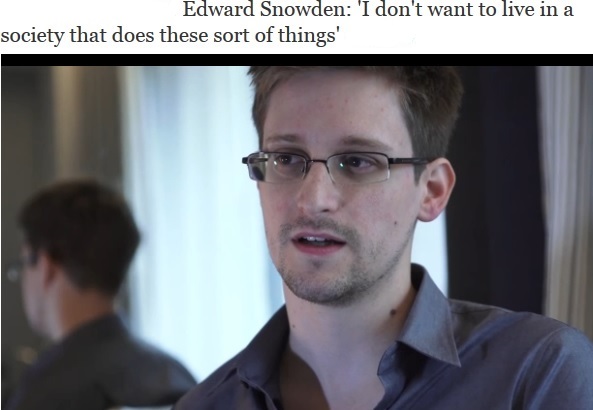
edward snowden2Conservatives, spy chiefs, President Obama, right-wing administrations, the Abbott government: they were all choking on their corn flakes when the Pulitzer Prize, the most prestigious award in journalism, was handed to the UK’s The Guardian  and the Washington Post for their articles about the surveillance activities of the National Security Agency (NSA) based on the leaks of Edward Snowden.

Even more galling for them would have been that the Pulitzer Prize was awarded in the category of “public service” for the newspapers’ “aggressive reporting to spark a debate about the relationship between the government and the public over issues of security and privacy” – since they consider Snowden to have done a great disservice to the public, even putting unnamed lives at risk.

It is hard to think of a figure that divides public opinion  more than Edward Snowden: “hero”, “whistleblower”, “traitor”, “treasonist”. These are the words used to describe the 30-year-old former Central Intelligence Agency (CIA) and NSA contractor, now in hiding in Russia.

The US government has charged him with espionage and revoked his passport, at the same time Norwegian parliamentarians Snorre Valen and Baard Vegar Solhjell have nominated Snowden for the Nobel Peace Prize.

Australia’s attorney general George Brandis called Snowden “criminally dishonest, treacherous and having put Australian lives at risk” in a speech in parliament. In response to Brandis, Greens Senator Scott Ludlam called Snowden a “whistleblower who I hold in highest regard”.

Where you stand on Edward Snowden defines your views on things like individual freedom, the right to privacy, the role and responsibility of government, access to information and democracy itself.

The Snowden leaks uncovered a hidden world of secret government activities in the US, UK and Australia including:

  • the bulk collection of phone records of US citizens by telecom Verizon including calls made to other countries, regardless of whether they are suspected of wrong-doing.
  • that the UK and US governments had access to user data held by Google, Facebook, Intel and others, including audio and video chats, photographs, e-mails, documents, and connection logs.
  • that the NSA monitored the phone conversations of 35 world leaders including German chancellor  Angela Merkel, – a supposed Western ally
  • That the Australian government listened in on the phone conversations of Indonesian president Susilo Bambang Yudhoyono’s and his wife.
  • that the NSA “spied on the staff of prominent human rights organisations” including Amnesty International and Human Rights Watch;
  • that there were programs like Prism or  XKeyscore, clandestine mass electronic surveillance data mining programs, which use sophisticated techniques to screen “trillions” of private communications.

These leaks highlighted the secret activities of the NSA, depicting it as a shadowy government organisation resembling “Big Brother” as described in George Orwell’s hugely influential 1949 novel “1984”. It was this book which coined the adjective “Orwellian” to mean official deception, secret surveillance, and manipulation.

It is not that surprising then that in the wake of the revelations about the NSA, sales of Orwell’s prophetic dystopian novel skyrocketed.

I regard Edward Snowden as a hero, an incredibly brave man who has sacrificed his own personal freedom to expose a government organisation obsessed with power, secrecy, data and control. Were it not for Snowden, the full extent of NSA activities and those of its UK and Australian counterparts would never been known.

But what of the other argument – the one that beats its fists against its chest proclaiming Snowden  a thief, traitor and criminal?

My own newspaper, the Australian Financial Review published an interview with General Keith Alexander, a spy and former head of the NSA, who not surprisingly slammed the Edward Snowden leaks.

This of course is the equivalent of asking the CEO of McDonald’s if he agreed that hamburgers were healthy.

According to General Alexander, the NSA is a “noble organisation that is “protecting our civil liberties and privacy” and that saves lives.

He says the very reports that won The Guardian and Washington Post the Pulitzer Prize are wrong and that it is a “fabrication” and “misperception” that the NSA is “listening into everyone’s calls, and reading everyone’s emails”.

General Alexander says the NSA has been “demonized” and painted as a “villain” by these very articles. when in fact the NSA is full of “honest, well-intentioned, hard-working, and patriotic people”.

The actions of Edward Snowden and the subsequent reports by The Guardian and the Washington Post, General Alexander says “have put so many lives at risk”.

The job of the NSA, General Alexander says, is to “stand watch” over our safety, which he says it does within legal means.

Of course he cannot actually tell us  the details of what the NSA is doing because that would compromise its role. In essence, we just have to trust him and the NSA.

Or if not him, then perhaps UK foreign minister William Hague who said in an interview that reports British intelligence agency Government Communications Headquarters (GCHQ) was gathering intelligence from phones and online sites “should not concern people who have nothing to hide” – a phrase that could have come straight out of an Orwell novel or perhaps the East German Stasi or KGB.

So do you believe General Alexander that the NSA is acting responsibly that the “overwhelming evidence falls in favour of the legality and legitimacy of what NSA has done”?

Or do you believe Edward Snowden, when he says the NSA is intent on “gathering intelligence where ever it can, by whatever means possible”?

There is of course a third view  – that you accept that the NSA  and other secretive government agencies are – as Snowden says – acting way beyond their remit, but in the name of protecting its citizens, that the end justifies the means.

But if you do, then you must also accept that your right to individual privacy is gone and that you are comfortable with the idea of a “Big Brother” watching over you as you type your email or make a phone call.

Perhaps it’s worth remember these chilling words of O’Brien, a member of the inner party who attempts to trick Winston Smith, the doomed hero of Orwell’s 1984:

There will be no loyalty, except loyalty towards the Party. There will be no love, except the love of Big Brother. There will be no laughter, except the laugh of triumph over a defeated enemy. There will be no art, no literature, no science. When we are omnipotent we shall have no more need of science. There will be no distinction between beauty and ugliness. There will be no curiosity, no enjoyment of the process of life. All competing pleasures will be destroyed. But always — do not forget this, Winston — always there will be the intoxication of power, constantly increasing and constantly growing subtler. Always, at every moment, there will be the thrill of victory, the sensation of trampling on an enemy who is helpless. If you want a picture of the future, imagine a boot stamping on a human face — for ever.’


A very grainy Penfolds grange confession

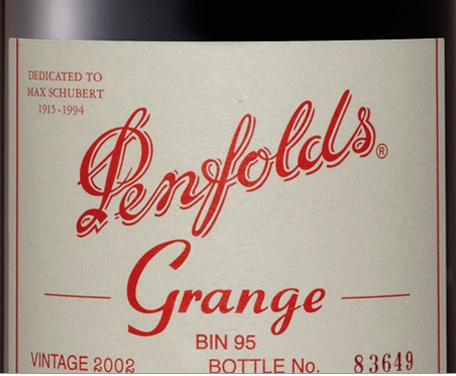
grangeI confess, I once accepted a bottle of Penfold’s Grange at a business lunch.

Unlike former NSW premier Barry O’Farrell I do distinctly remember the occasion and the circumstances of receiving the Grange.

It was in the winter of 2007, a year or so before the collapse of investment bank Lehman Brothers that ignited the US sub-prime mortgage crisis and the Global Financial Crisis (GFC), when money was still flowing like…err…fine wine.

The venue was La Grillade, an upmarket restaurant in Crow’s Nest on Sydney’s North Shore famous as much for its succulent steaks and extensive wine list as for being a favourite venue for the big wigs media execs from nearby Channel Nine.

“Let’s get a bottle of Grange” I remember the already sloshed media man proclaiming as he flashed an intoxicated grin around the room and his gold-plated corporate credit card.

There were four of us at the table at the back of the restaurant and large amounts of alcohol had already been consumed.

This was back in the days when the long, boozy lunch was still part of a journalist’s weekly repertoire, before concepts like “the 24 hour news cycle” and “social media’ ruined all that.

The group consisted of myself  (very drunk), my colleague at the same North Shore publishing company where we edited our respective mortgage broking titles (also drunk) and our hosts, the very cheery media man (pissed, loud and notoriously bad at holding his alcohol) and his client, a gold-watch-and-necklace-wearing businessmen of Eastern European extraction, a classic self-made Aussie battler, riding the wave of easy money.

It was one of those gray, Sydney winter’s days when the thought of spending the afternoon carving into a perfectly cooked steak in a cozy expensive restaurant with someone else footing the bill sounded like a good idea.

Our host’s line of work? He ran a mortgage broking outfit targeting credit-impaired borrowers via ads which ran on the horse racing channel – classy!

The point of it all? A big boozy lunch hopefully in return for a favourable article about our host’s mortgage business, a modus operandi not uncommon in the ethically challenged world of trade publishing.

The bottle of grange made its star appearance late in the proceedings. Plied with countless beers beforehand, it was wasteful gesture in the extreme. More so because not only was I unable to appreciate the expensive drop, but I distinctly recall leaving the table without finishing my glass or helping our hosts polish off the bottle (surely a worse crime than denying ever receiving the bottle in the first place, Barry?).

Even more bizarrely, the last thing we drank was Sambuca, a licorice-flavoured liquor, which would have washed out what little my taste buds remembered of the dark red Grange nectar.

So I have no recollection of how good it tasted. For all I know, it could have come out of a cask. Still relatively new to the excesses of corporate lunches (I would soon learn) I also knew nothing about this so-called mystical Grange. All I comprehended at the time was the price – about $1200.

As the sun sunk from view, the cheque was ordered and duly paid. We said our goodbyes amid back-slapping, laugher and nudges and winks from our hosts.

My colleague and I made our way grimly back in the cold to our St Leonard’s office, an uphill walk after an over-indulgent meal with expensive steaks sloshing uneasily amidst the alcohol in our stomachs. I confess I felt out of it.

The irony: neither of us wrote a word about our host and his mortgage broking company that advertised on the racing channel. Or about his office lined with sporting memorabilia. Or his desire to be a larger-than-life mortgage lender in the mould of Aussie John Symond.

Later in that same year I bumped into our host at another function, the Melbourne Cup. It was another boozy affair. Bob Downe was the host and did his “Kevin 07” impression. It was a different era.

Two years later with the financial crisis in full swing, I read on the NSW Fair Trading website of a mortgage broker that had narrowly avoided going to jail after being found guilty of taking advantage of his clients and pocketing huge commissions for each home loan he granted. His business was placed in the hands of administrators and was eventually wound-up.

It was our host and Penfolds Grange purveyor.

The latest edition of Penfolds Grange, the 2009 vintage, was recently released for sale.  According to Penfolds chief marketing officer Simon Marton the Barry O’Farrell fiasco increased its luxury cache. Wine experts say it’s still a good drop (you’d hope so at $785 a bottle) – but not of the quality of previous vintages.

Clearly, it’s also not in the same league ast the 1959 bottle that brought down a NSW Premier.

But is it any better than the 2003 vintage I drank six years ago at a long lunch in Crow’s Nest. I wish I could tell you.

(A further note to this sordid tale – the restaurant La Grillade didn’t fare so well either. It shut it’s doors in December 2011 after apparently losing the patronage of its media clientele. It re-opened under new management and still bears the same name. A marbled wagyu steak sets you back $55).