Travel journalism, junkets + dwindling media budgets: are you getting the true picture?

In 2010 my wife and I, newly married and kids-free, embarked on a dream back-packing trip around the world starting in Thailand and ending in the USA (with Malaysia, Singapore, East and West Europe, Morocco, India, Egypt, Turkey and Mexico in between).

When we returned to Australia, I was eager and hopeful of writing a few freelance travel pieces about some of the more exotic places we had visited for the travel sections of newspapers and travel magazines.

I submitted a number of story ideas and photographs but no editor would bite.

I was a bit disappointed but not entirely surprised since I’d submitted what I thought were interesting ideas in the past (a story about why tourists should visit my hometown of Johannesburg was one of them) but had received polite “no thank you’s”.

Since then I’ve read, with envy, the stories written by travel writers, some about the places I have visited and many other destinations I would love to saviour for myself one day.

However, what I have also noticed, with greater and greater frequency is that so many of them end with the following:

“The writer flew with…”

0r, “The writer was a guest of…”

Most pieces of travel journalism, I’ve discovered, are paid for or part paid-for by either an airline, resort or tourism bureau and it got me wondering what sort of impact this had on the objectivity of these “hosted” writers.

So I put the question to the Fiona Carruthers, editor of the Australian Financial Review’s Sophisticated Traveller magazine and to Susan Kurosawa, editor of The Weekend Australian’s Travel and Indulgence section.

Both are excellent publications with great photos and stories – but many of their articles are funded by what Carruthers calls “famils” – “travel familiarisation” trips, where the expense is borne by the person or organisation extending the invitation.

“Also known more cynically in the trade as “junkets,” Carruthers tells me.

She estimates that due to the expense (and no doubt dwindling budgets) about 85% of travel writing is paid for through these hosted visits.

“It’s a shame this is the case – I would dearly love for us to pay our own way – and sometimes we do or we pay part of the trip or media rates,” she says.

“But the problem is that most media organisations simply cannot afford to pay for these travel experiences and given travel is so popular, we don’t want to short change our readers by not offering travel content. So this is our compromise – and as I say, most media outlets compromise.”

So what does this compromise entail? Does it mean giving favourable coverage, not reporting on bad experiences and potentially giving readers a less than fair picture of a travel destination?

Is it just advertorial disguised as a travel review with out the advertorial “label”?

Both Carruthers and Kurosawa firmly deny this and maintain that objectivity is always maintained.

“Famils/hosted trips are not advertorial and the hosts know we are free to write whatever we like,” says Carruthers.

Kurosawa says The Australian responds to “invitations for selected trips”, but does not “actively seek hosting of any kind, whether from airlines, hotels, operators or national tourist offices”.

“We maintain our independence at all times and reserve the right to be critical where appropriate.”

Carruthers though does say that “most journos are keen to give a good write up in return for hospitality.

“And given the standard of travel is so high these days, nine times out of 10 any experience we do is fantastic”.

That so many hosted trips should result in a “fantastic” experience is not surprising, given that many involve luxury getaways, private lodges and top end of town hotels and restaurants.

But also, due to the hosted nature of journalist’s visits, resorts would have ample warning and all staff would surely be briefed, to provide these ‘special guests’ with extra special care and assistance.

One of the articles in the September issue of Sophisticated Traveller is about the Banyan Tree resort in the city of Lijiang, in China’s Yunnan province.

While Carruthers points out that the writers were critical of the resort’s food and the fact that is “very quiet at night and locked away behind high walls”, I do wonder if the fact that staff at the resort delivered “toasted sandwiches and warm glasses of milk” to the reviewer’s villa and “never tired of feeding the fish” with their three-year-old had anything to do with the fact that the writers Angus Grigg and Fiona Murray were journalists on a “famils” trip.

I have some personal experience of this phenomenon having undertaken a number of restaurant reviews at some of the Sydney’s finest eating establishments, when I edited a mortgage broking magazine. The meals were organised through a PR agency and were free (with unrestricted menu access).

What I recall most vividly, besides the mostly exquisite food, was staff going out of there way to be helpful.

On one occasion the maître d’ at a Surrey Hills restaurant i was reviewing offered to adjust the temperature because my wife had a cold.

There is of course, the option of making up your own mind about any resort, hotel or restaurant or airline by reading some of the reviews on traveller’s bible, Trip Advisor.

There are 485 reviews of the Banyan Tree resort in Lijiang on Trip Advisor.

None of these people stayed for free, but equally, it could be argued that because they have paid their own way, they could be motivated by spite to write something nasty or out of proportion to a bad experience.

Among the few critical reviews on Trip Advisor for the Banyan Tree Lijiang is one that occurred during a BMW event (when staff may not have been at their attentive best) and while another unhappy reviewer mentions that their booking was lost and they had to find proof their booking by finding it on their laptop.

Most agree with the Sophisticated Traveller writers.

In the case of the Banyan Tree Trip Advisor ranks it 6th out of 296 hotels in Lijian with 94% of 485 reviews rating the stay as either “excellent” or “very good”.

So what to make of articles that arise from a hosted visit?

I’d say take them mostly at face value (providing its a reputable publication), but with the tiniest pinch of salt.

As with most new experiences, having lower expectations usually results in a more enjoyable holiday – so best not to set the bar based on what you read.

Or, if you want top notch service, you could try hinting to the staff that you’re writing a review for a major publication.

This may result in an experience that matches the newspaper write-up.

This post was subsequently published in Crikey (subscription required)
The terrible boredom of the rich

For those of us who are not very rich, the idea of having great wealth is very appealing and the focus of many a day-dream along the lines of: “If I had $100 million I’d….”

No mortgage to worry about, no tightening of the chest everytime an envelope stamped with “your bill enclosed” arrives in the mailbox, no having to fight with the person next to you for the shared arm rest on economy flights, and on and on it goes.

But the thought occured to me that perhaps being very rich can also be very boring.

I was struck by the idea while attending a commercial property auction (I wrote this story about it) as I found myself sitting next to one of the bidders in the River Room at Crown Casino.

Without meaning to sound to mean-spirited, I’ll say the bidder looked like a toad with fat lips and fatter jowls and liverspots, though I may be embellishing.

Up for grabs was a petrol station on a busy road in the outer suburbs of Melbourne, a dull, but valuable piece of real estate.

Bidding started around the $5 million mark and the price rose rapidly in $100,000 jumps with my toady bidding friend lifting his hand every thirty seconds or so to up the ante.

When it reached $7 million, he stopped and simply said to his rival bidder, like he was ordering a drink beside the swimming pool, in a lazy, nasal drawl:

“He can have it.”

Like spending or not spending $7 million was like deciding whether to buy an ice-cream from the vendor on the beach or deciding between a cappucino and a latte.

But what if this is what life is really like for the super-rich?

Where things lose their value, no matter how much they cost, be they petrol stations, mega mansions, luxury cars, or overseas holidays – because if you’re super-rich you’ve already tried everything on the menu and there’s nothing left to buy.

And then it occured to me that maybe that’s the reason why billionaires keep on working until they’re one foot in the grave and seem never satisfied no matter how many zeroes are on their bank accounts.

And why they’re always trying to reduce their tax bill.

Or denying their children their inheritance.

Or just keep complaining about everything (and making cheap looking preachy videos).

Perhaps, we with less should appreciate that fact that a good bottle of red wine, a new car (or even a second-hand one), or a holiday one street up from the beach rather than on the beach can be celebrated and cherished.

Even if we drop dead the next day from worrying about the size of the gas bill…

Is a donkey vote the only option for Clive Palmer at the next federal election?

As coal mining billionaire Clive Palmer tucks into his next big breakfast on his private jet, I wonder if he is beginning to feel like something of a political outsider.

According to a report in the Sydney Morning Herald, Queensland’s richest man is currently deciding whether to retain his membership of the Liberal-National Party following his attacks on the Queensland State Government over its decision to increase mining royalties and his stoush with Federal Liberal leader Tony Abbot (over a number of things including asylum seekers and paid political lobbyists).

It’s all gone for sour for Clive Palmer and the Liberals after earlier plans for him to seek pre-selection in the Queensland seat of Kennedy and take on Bob Katter.

If he does part ways and ditches his long standing Liberal membership it will bring to an end many decades of support and lots of financial backing too.

But the question remains then, who will Palmer back politically?

Looking at the major political parties, there’s not much to entice Palmer:

There’s the Labor Party – no chance given Wayne Swan and his mining super tax and Julia Gillard’s carbon tax.

And the Greens? Let’s face it, there’s no way a coal mining magnate is going to ever get into bed with a party committed to the environment and renewable energy.

But even when it comes to the minority parties, there is little to entice Palmer.

There’s Bob Katter’s Australian Party, which you think might have some appeal given its opposition to the carbon tax, desire to protect state assets and wish to rebuild Palmer’s beloved Queensland.

Unfortunately earlier plans for Palmer to take on Katter in his seat of Kennedy as an LNP candidate resulted in Katter publicly ridiculing Palmer’s size and poor physical condition and suggesting he’d never survive the rigours of political warfare.

There’s the One Nation Party – unlikely given Palmer’s humanitarian views on refugees, Chinese business affiliations and desire to attract Asian big spenders to his growing hotel and resort empire.

What then? The Country Alliance? Family First? The Help End Marijuana Prohibition (HEMP) Party? The Sex Party? I think not.

The thought did cross my mind of a mining magnate coalition party with Australia’s other notable mining magnate and self-appointed “mother of the nation” Gina Rinehart.

But that’s unlikely after Rinehart suggested we all give up drinking, smoking and socialising and work a little harder (while earning less).

“I like the pub, I like going to the footy, I like socialising with friends,” was Palmer’s response to Rinehart’s unpopular suggestion.

Which really leaves Palmer with no other option but to either start up his very own political movement or do what many Australian might end up doing at the next federal election – given the current dissatisfaction with most political parties – and cast a donkey vote!

EE-ORRR-EE-ORRR

The “nonsense’ behind the Commonwealth Bank’s $270 million Storm payout

I never thought I’d find myself laughing (in a cynical fashion) at a press conference on a Friday evening just before clocking-off time for the weekend (I was grumbling when I picked up the phone).

But that’s what happened when I tuned in to listen to ASIC chief Greg Medcraft tell the media the Commonwealth Bank had done the “right thing” by agreeing to increase its payout to Storm Financial investors by $136 million taking the total compensation to around $270 million.

Briefly, Storm Financial provided bad financial advice to mom and dad investors on a variety of mortgage and other investment vehicles, the Commonwealth Bank provided them the money, then the GFC hit, Storm went bust and investors lost billions.

The agreement between the Commonwealth Bank and ASIC was reached “without any admission of liability” by the bank.

Enter Business Day journalist Paddy Manning who asked Medcraft if it were not a “nonsense” that the Commonwealth Bank was agreeing to pay out investors to the tune of $270 million, while at the same time admitting no fault.

Medcraft did not enter into a debate on this point – probably he was legally prevented from doing so – but I bet he privately agreed.

Which is also why I found myself laughing (cynically), because yes it really does sound absurd given the scale of the payout.

The use of the words “without any admission of liability” is a fairly common legal term and has been used by other organisations – from church groups to big businesses – to protect themselves from further financial claims.

It is usually always the outcome of a mediated solution with aim of bringing costly legal proceedings to an earlier end.

Essentially it’s like a plea bargain – privately you admit you’re guilty and stump up the money, but publicly you keep your reputation.

It also means the “guilty party” does not have to make any sort of apology, as this would, in effect, make the “without liability” clause null and void.

Most recently agricultural chemicals supplier Nufarm agreed to pay shareholders $43.5 over allegations the company failed to keep them informed of the impact of the declining glyphosate market on its business. Despite deny the allegations, Nufarm paid up without admitting liability.

In 2004, as reported by The Age, the Salesian Order of Catholic priests and brothers paid around $80,000 to a to a Melbourne man who launched a civil case against convicted paedophile Father Frank Klep “without any admission of liability”.

In 2005, retailer Barbeques Galore and a sister company surrendered about 900 BBQs for destruction and agreed to make payments for 2,200 they had already sold after legal action was threatened by Danish homewares firm Bodum, reported The Sun Herald. The agreement was made with “without admission of liability”.

And back in 1996 a Sydney hospital settled a case involving a woman who died soon after being admitted “without admission of liability”.

Clearly there are some benefits for those who seek compensation. They get an early payout and can get on with their lives, or at least try too.

As for the payee (or guilty party) – they get to draw a line under the whole affair.

For those Storm Financial investors who invested via a Commonwealth Bank loan they will have to be content with 55% of their money being repaid four years down the track.

But I wonder how many investors, would have hoped for a lot more – and an apology?

The job I’m now glad I never got at the Australian Jewish News

About 8 years ago, when I first came to Australia and was looking for a job, I applied for an editorial role at the Australian Jewish News (AJN).

Before the interview, I browsed a copy of the AJN to get my head around the content.

At the interview, I remember I was asked a lot of questions about my views on Israel and Zionism and very little about my writing experience.

Not surprisingly, I never got the job – though I remember babbling something meant to suggest I was on top of the subject matter; at the time I was rather desperate to find work.

My second acquaintance with the AJN was when I read Robert Magid column titled “Curb your compassion” of which much has been written.

(If you have not read it you can download a copy here.)

The opinion piece really made my blood boil, but I am grateful for one thing, I’m glad I never got that job.

Robert Magid has defended himself on the ABC’s Lateline program that he is not prejudiced, but it’s hard to believe when you read what he’s written.

He begins by talking about boat people – calling them illegal queue jumpers, but by the end of the article he’s talking about “extremists in the Muslim community”.

So it’s not really hard to read between the lines to get at the real message, which to my mind is:

“Keep the Muslims out.”

Sadly, Robert Magid is not alone in sharing this view.

Both in my native South Africa and in Australia, there are sadly a number people in the Jewish community, who hold vehemently anti-Muslim feelings and jump up and down, banging their fists, each time a new mosque is threatened to be built

(Thankfully many more are enlightened).

These are the same people who believe that any criticism of the Israeli government is a mask for anti-semitism.

These are the people – I kid you not – who believe that the BBC is anti-semitic.

Of course Robert Magid is right that many of those seeking asylum in Australian and arriving by boat are Muslims (like Tony Abbott he calls them “illegal” despite seeking asylum being a legal human right).

Many of them are the Hazaras of Afghanistan and Pakistan.

Hazaras are “a community who are easily distinguishable because of their Asiatic appearance” explains Hadi Zaher, an Afghan-Australian undergraduate student, in a recent  article for left-wing journal New Matilda.

Hadi Zaher goes on to write that members of the Hazara community “are the target of execution style killings and massacres by Taliban and Al-Qaida affiliated militants who have vowed to rid Pakistan of the presence of minorities such as Hazaras. The frequency of these attacks has gone from a few attacks a month to multiple attacks per week.

“The first victims of the attacks were lawyers, doctors, teachers, and public servants. Today, it’s the vegetable vendors, taxi drivers and passengers, students, labourers and the ordinary men, women and children who bear the brunt of the latest atrocities.”

Paragraphs you could easily transpose to the fate of the Jews murdered by the Nazis in the Second World War.

But according to Robert Magid “it is unconscionable to bring the holocaust into the discussion” about boat people, because European Jews “fled certain death”.

Perhaps, what he is really saying is that a Jewish life is more valuable than that of a Muslim refugee fleeing persecution?

Robert Magid is a very wealthy man.

Even if he did not publish such nonsense he would be easy fodder for anti-semites as he fits the caricature of the Jew with the bulging pockets of money.

But the truth of the matter is that having all this wealth and privilege and power and then so publicly expressing such prejudiced views will do more to cultivate anti-semitism than any propagation of the old stereotypes by those who did not need any encouragement.

And the greatest irony of all is that Robert Magid is himself the son of refugees.

Isador Magid – his father – came to Australia from China in 1951 as a refugee and became a highly successful property developer with a personal fortune of around $180 million.

But perhaps it would be unconscionable to mention that fact too.

Recalling a day spent at Auschwitz

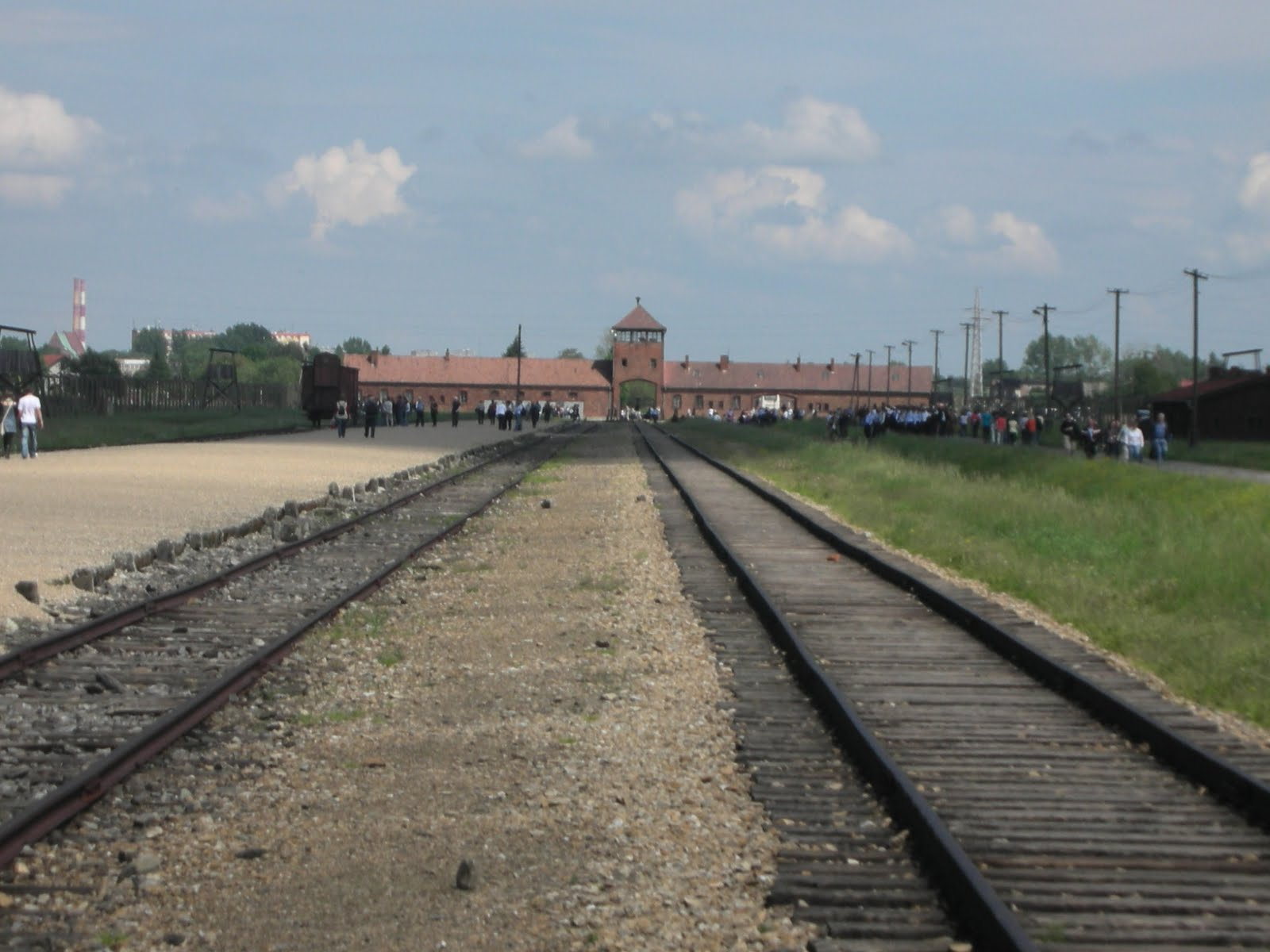
It’s a little over an hour by bus from Krakow, an unimaginably beautiful medieval city to the concentration camp of Auschwitz.

We travel in a claustrophic, airless mini-van, which picks up people along the route. No one says much.

By the time we reach the little town of Oswiecim (renamed “Auschwitz” by the Nazis) we have passed rolling hills and green Polish countryside, traversed and dippped through narrow valleys and stared at plain but pretty one-storey farm-houses with ducks and chickens pecking at the ground.

The min-van is packed to capacity and stifling hot when we disembark and some travellers have to bury their heads in their hands to fight off the travel-induced nauseau.

Incredibly, the town now bares the inscription: “Oswiecim: city of peace”.

The two camps of Auschwitz are joined by a free bus service.

We first go to Birkenau, the size of many dozens of football fields, fronted by the train tracks and famous red watchtower, though which so many of my ancestors passed through in cattle trucks into suffering and death.

Though I am not a practicing Jew, I did feel a strong connection with this place amid all the tourist buses and school kids to young to comprehend what really went on here 70 years ago.

It’s strange though to visit in summer.

While it was overcast in Krakow when we left in the morning, the sun has now come out and the clouds had parted.

Alongside the once electrified barbed wire-fence, there are purple and yellow flowers growing among the wild grass and there are shady trees that offer respite from the sun, and the possibility – were it anywhere else – for a picnic.

There’s even a pleasant little stream that trickes and babbles nearby.

But’s there’s nothing pleasant about Auschwitz, even though nature has reclaimed some of it.

The sheer size is overwhelming. It’s enormous.

At its peak there were 100,000 people living here under the most appalling conditions.

A lot of the dark, wooden barracks remain standing, what’s not there – the people shuffling in the snow, the guards shouting and laughing, corpses piled on on top of each other, the smoke – you can fill in from what you’ve seen in black and white newsreels and the movies.

Each of them housed as many as 1,000 people.

We wander into a barrack and listen to a guide tell a tour group that the prisoners were only allowed to go to the toilet twice a day and because there were so many of them, they only had about 40 seconds to use the latrine. Just one of many awful stories.

At the far end of the camp, at the end of the railway line, in front of a tall, swaying trees, are the remains of the gas chambers and crematoria. They were blown up by the Nazis just before the camp was liberated. Despite the heaps of rubble you can see the steps down which prisoners were led to the changing room where they were forced to strip before being led into the “showers”.

It’s nearly afternoon. We eat our lunch, but feel wierd about it. I guess its natural. There’s probably a restaurant somewhere.

We take the bus to the main camp.

Auschwitz main camp is a series of brick barracks originally built for the Polish army barracks houses the museum and is jam-packed with tour groups of all nationalities and languages. It’s annoying and frustrating as the tour groups take up all the space and you have no time to really contemplate what is before you.

In the dingy basement there are windowless cells where prisoners were tortured and sentenced to starve to death.

Above ground, the barracks house the famous collections of hair, glasses, tooth brushes and artficial limps in huge mountainous piles, behind glass.

Unlike the Dachau concentration camp on the outskirts of Munich, where the museum assaults you with information, here the information is relatively succint, leaving you to take in the exhibits, when you can avoid the tour groups and their noisy interpreters.

The walls of the barracks are lined with photos of prisoners admitted to Auschwitz including their date of arrival and death. Some lived only a few days, some a few months and some more than a year or two.

How to survive such a hell hole for a day let alone a year, I just cannot fathom.

Then I remember we had a school teacher, Dr Yageel, who was a holocaust survivor and had a tattoo on his shoulder bearing his prisoner number. I remember him to be a short man, with a beard and a lined, sorrowful face. I think he may have taught our class on a few occasions.

Incredibly, as a pupil at a Jewish day school, I never really thought about what he went through or took the time to chat to him.

I don’t recall any of my classmates, me included, paying him the kind of respect he deserved. I wish now I could shake his hand.

At one point I found myself humming the tunes of a song we sang at the jewish day school I attended in South Africa, a song that I had forgotten or buried deep in my memory…

Yerushalayim shel zahav
Ve-shel nehoshet ve-shel or
Ha-lo le-khol shirayikh
Ani kinnor

(Jerusalem of gold,
and of bronze, and of light

Behold I am a violin for all your songs.)

Recently I watched Schindler’s List.

The same song is played at the very end of the film as the real holocaust survivers, many of them now elderly, accompanied by the actors who played them in the film, lay stones on the grave of Oskar Schindler in Jersualem.

And then its time to go. Auschwitz the museum is closing. There’s the museum shop with books and post-cards as you exit and you can buy soft drinks, chocolates and crisps.

Then its back on the bus – a much larger one this time. The driver is a little crazy. He picks a fight with a speeding motorist and nearly has an accident cutting him off.

We arrive back in Krakow. It is not yet dark. It’s the Polish summer.

“I thought this was a kosher school, but I see it’s full of pigs” – memories of high school Afrikaans

Out of the blue, for no reason at all, I found myself recently thinking about my high school Afrikaans teacher, Mr H, a character from my school days in South Africa in the early 1990s.

Mr H was a short, little man with glasses, a thin moustache, balding and bloody terrifying – well that’s how I remember him – we’re talking 1990 or 1991!

His most famous line, one I will never forget until my dying day was yelled out one afternoon after lunch break, probably as we sat behind our desks listening to Mr H read out aloud, that old South African literary classic “Kringe in die bos” (Circles in the Forest) by Dalene Matthee.

Now, I should first point that we were all jewish kids at jewish day school in Johannesburg.

And I remember we had a double period at the end of the day, where we had to sit and listen to Mr H, in his posh Afrikaans read aloud, with dramatic pauses in all the right places, a story set in the Knysa forests about woodcutters and an elephant called “Old Foot”.

God help anyone who forgot their copy of “Kring in die bos” at home…God help anyone who did not prepare or do their homework.

Anyway, the words that leapt out of Mr H’s mouth one afternoon, in that dim classroom as we all probably thought about going home, or rugby, or girls or that new cartoon show, The Simpsons, and accompanied by the evilest look you can imagine were:

“I thought this was a kosher school, but I see its full of pigs!”

I don’t remember anyone laughing at the time, but we certainly laughed about it later. It was an outrageous thing to say and I wonder if it was a line he kept tucked in his back pocket for special occassions, because surely it could not just have come out fully formed like that.

Mr H was prone to quite a few outrageous one-liners, which I still remember quite vividly. One of his best lines and one said on a few occassions was:

“Barbare, morone, idiote”

Translation:

“Barbarians, morons, idiots”

Another, reserved for people who forgot their copies of ‘Kringe in die Bos’ or their homework:

“[insert classmates name]…do you want me to lick your arse for you too?”

Funny the things you remember from your school days!

My obsession with New York-style coffee

There’s a little Starbucks that’s opened across from Flinders Station, a tiny kiosk of a shop, and while I have, in the past, sworn off such establishments, I have found myself ordered my morning coffee there most mornings before work since it opened a few weeks ago.

Why go to Starbucks?

After all Australia is a country that takes its coffee-making extremely seriously, and some over here might even suggest – oh the blasphemy! – that Australian’s could teach Italians a thing or two about a good coffee, that’s after Italian immigrants taught us how to make it in the first place.

But since visiting New York last year and drinking a lot of cheap “drip” coffee , I am drawn to the brewed coffee they sell at Starbucks.

It’s cheap too – $2.90 for a “grande”, as opposed to the $5 I paid when I made the mistake of ordering a “large” cappucino in the little art deco kiosk in the underground arcade under Flinders Street. The barista behind the counter (tattoos, laid-back, shuffling along like he’s doing the moon walk, makes coffee like he was born in front of an espresso machine) did point out the large cup as if to make sure I really wanted it before nonchalantly asking that I hand over five bucks.

(It’s the kind of place, where people sort out their own change. While I was waiting for my drink, a guy stuck a $20 buck note under an empty coffee cup that serves as the till and helped himself to a $10 and $5 note – a little too la de da for me!)

But back to New York and drip coffee.

It’s a one dimensional drink, it has none of the richness and flavour of a proper Australian coffee (I am always amazed at the consistently good standard of coffee in even the most ordinary, dreary café in Melbourne).

Drip coffee is bland, boring, quite watery and invariably served so hot you peel off a layer of skin from the inside of your mouth when you drink it.

But drink it do – and as if I am Proust dipping Madeleine cake into tea – it all comes back to me.

I am sitting in a working class café, on a stool at a bench by the window looking out onto a grubby street in Brooklyn, eating the purplest blueberry bagel you could imagine, wrapped in wax paper.

The bread is chewy and warm and almost violet in colour, flowing with rivers of dark blueberry and topped with about a whole philadelphia-tub’s worth of cream cheese.

It was a sweet moment – the uncool, coolness of Brooklyn (liquor stores with the neon signs in the window, old ladies in scarves pulling their groceries in wire trolleys, old-fashioned bookshops, terrace housing, an air of decrepitude, but distinctly New Yorkan, with Manhattan off somewhere in the distance).

I savoured that bagel. Man did I savour it. Like I was De Niro in a Scorcese flick. Or maybe a character in a Woody Allen film, the neurotic jew about to see his analyst.

Sipping my coffee, biting chunks out of the bagel. browsing a pile of magazines at the window, looking out at Brooklynites passing by…

And so I find myself queuing outside Starbucks on the corner of Flinders and Elizabeth in downtown Melbourne.

There’s a little bit (a tiny, tiny bit) of New York in Melbourne. The yellow taxi cabs for one rushing by and occassionally hooting. People huddled against the cold. The underground subway behind me leading into the train station. The high-rise towers down Elizabeth Street and up towards the Paris end of Collins Street.

Three times they have got my order wrong at Starbucks. Twice they’ve told me they have run out of brewed coffee and yet I come back.

Carry my steaming mug of blandness across the street, remembering Brooklyn, the bagel and the coffee and how I felt.

Now if only I could find a decent bagel store.

If Twitter decided our next prime minister…

If the number of Twitter followers decided who should be Australia’s next prime minister, then Kevin Rudd would win in a landslide.

Currently K-Rudd has over 1.1 million Twitter followers making him by far the most popular tweeting politician in Australia, with four times as many followers as our prime minister, Julia Gillard.

And with over 5,000 tweets, Kevin Rudd is also the most active politician on the social media site.

Tony Abbott (our next prime minister it seems) has around 76,000 followers, a lot fewer than the 116,000 who follow his main Liberal (but far more enlightened) rival, Malcolm Turnbull.

Turnbull – the shadow communications minister – is also the second highest tweeter after Kevin Rudd.

It is interesting (and perhaps telling) that in both the case of the prime minister and leader of the opposition – they have less of an audience on Twitter than their main party rivals.

Interestingly opposition immigration minister Scott Morrison is third highest tweeter, but not many people appear interested in what he tweets – he has less than 8,000 followers.

Here’s the most followed (perhaps most popular) politicians on Twitter as of August 21 (more commentary underneath):

Politician Followers Tweets
  1. Kevin Rudd
1.143 million 5,092
  1. Julia Gillard
263,000 1,043
  1. Malcolm Turnbull
116,000 4,580
  1. Tony Abbott
76,000 841
  1. Joe Hockey
45,000 962
  1. Wayne Swan
21,000 770
  1. Bob Carr
18,000 742
  1. Julie Bishop
16,000 887
  1. Peter Garrett
14,000 690
  1. Bill Shorten
13,000 358
  1. Anthony Albanese
12,000 1,271
  1. Rob Oakeshott
11,000 428
  1. Barnaby Joyce
10,000 776
  1. Penny Wong
10,000 161
  1. Scott Morrison
7,900 3,296
  1. Greg Hunt
7,000 899
  1. Andrew Robb
6,900 553
  1. Chris Bowen
6,600 298
  1. Wyatt Roy*
6,500 278
  1. Bob Katter
5,800 136
  1. Simon Crean
4,800 270
  1. Eric Abetz
3,600 646

* If you are wondering who Wyatt Roy is, he is Australia’s youngest MP.

Of course it would be naïve of me to even suggest that the number of twitter followers correlates with a Federal election result.

But the observation can surely be made, that if you follow someone on Twitter you are interested in hearing what they have to say, whether you agree or not.

Secondly the number of Twitter followers you have must say something about the willingness of younger people to listen to what you have to say. In this regard, it appears the youth of Australia (many of whom may not yet be old enough to vote) appear to be more interested in what Gillard and Rudd have to say then Abbott and Hockey.

And thirdly, while it might not win you an election, few would argue that Twitter has now surpassed Facebook as the most influential social media platform – just think of how quickly an ill-thought out tweet can ruin a reputation.

Lastly, I should point out that Senator Stephen Conroy, Australia’s communications and broadband minister – and someone advocating for censorship of the internet via a government filer – does not have a twitter account as far as I can garner.

Conroy’s fake Twitter account – as the minister for censorship and facism has around 370 followers.

Other prominent politicians who are not on Twitter include Christopher Pyne and Defence Minister Stephen Smith.

Tony Abbott and asylum seekers: another demonization opportunity

There can be no doubt that Tony Abbott, if he is elected prime minister at the next federal elections will take a hardline, perhaps even extremist approach, to asylum seeks arriving by boat.

Indeed the opposition leader is tackling the issue of boat people in the same way he has gone about dealing with the carbon tax; by demonising the matter.

According to Abbott, asylum seekers arriving by boat (or any means bar holding a visa) are criminals.

Last week he was in conversation with ABC Melbourne 774’s Jon Faine – never one to step back in an argument.

This is the relevant bit in the debate, following Abbott’s conjecture that Nauru was “good policy”

Abbott: We’ve had 22,000 illegal arrivals, almost 400 illegal boats,”

Faine: They are not illegal. Tony Abbott, do I need to remind you that the use of words in this is critical? They are not illegal arrivals. There is nothing illegal about seeking asylum when you are a refugee.

Abbott: Well, I am making my point.

Faine: So am I. And it has been made to you before

Then Abbott tries to change tack and talk about “untold tragedies” and shift the blame to the government’s inability to adopt the Coalition’s policy, which he says they are now finally doing.

(You can listen to the whole interview here)

Let’s be clear – Abbott has certainly made it plain that he equates those that seek asylum by coming to Australia by boat as nothing more than criminals.

Here’s what he said about them in July in an interview on ABC Radio Perth:

“I don’t think it’s a very Christian thing to come in by the back door rather than the front door. And I’m all in favour of Australia having a healthy and compassionate refugee and humanitarian intake program. I think the people we accept should be coming the right way and not the wrong way. If you pay a people-smuggler, if you jump the queue, if you take yourself and your family on a leaky boat, that’s doing the wrong thing, not the right thing, and we shouldn’t encourage it.”

Essentially, this is just a re-hash of John Howard’s fiery assertion in 2001 at the height of his power that: “We will decide who comes here and under what circumstances they do.”

There’s an excellent rebuttal piece to Abbott in The Drum written by Julian Burnside, QC, a barrister and human rights advocate, who makes the point that there is “no queue when you run for your life”.

Burnside goes on to write: “The recent execution of an Afghan woman by the Taliban (another example of a very well-established pattern) gives some idea of why people seek asylum.

“A significant proportion of boat-people in the past 15 years have been Afghan Hazaras fleeing the Taliban.”

He then points out that firstly, the Australian embassy in Kabul is kept secret for security reasons, and then, even if a refugee could find it, (Burnside quotes from the Department of Foreign Affairs website) that the “Australian Embassy in Kabul has no visa function”.

So, there’s no front door for many refugees – only the backdoor (or the illegal route a Abbott prefers to call it)- even if that be on a dangerous, unseaworthy craft – it’s better than torture and persecution.

Burnside also points out, what should be bleeding obvious on both sides of politics, that these are people to whom “we owe a duty of protection according to our own laws, and according to the obligations we voluntarily undertook when we signed the Refugees Convention”.

Burnside also reminds us that Abbott, a well-known Christian who once trained to be a member of the clergy, is vilifying a group of people, many of whom are Muslims.

“It is inconceivable that he failed to notice that some people, hearing his comments about boat-people being “un-Christian”, would have understood him as criticizing boat-people because they are Muslim, not Christian,” says Burnside.

“It is a sad reflection of the depths to which political debate has fallen in this country that an avowed Christian could stoop to such shabby tactic.”

And it’s a sad reflection on our society that opinion polls point to Abbott winning power at the next election.

If they do, we’ll get the government we’ve voted for – conservative to the extreme and hell-bent on turning the clock backwards (even beyond the Howard-era compromise that’s being put in place) on refugees, the environment, labour relations and many other important issues.