Back to print: Is the Saturday Paper any good?

The_Saturday_Paper_-_Front_Cover_1_241_338_85_sThere were more than a few raised eyebrows (and conservative commentators choking on their muesli) when property developer and left-wing publisher Morry Schwartz launched The Saturday Paper roughly six months ago.

Schwartz, who also publishes features magazine The Monthly and long-form politics bible The Quarterly Essay (and in his spare time runs developer Pan Urban) said in March he saw an opportunity to enter the newspaper space with Fairfax and News Corp Australia “at their weakest”.

He said The Saturday Paper would target “readers like me”  meaning presumably forward thinking, inner city liberals with good jobs and good educations and that its launch fulfilled a 40 year ambition to have his own newspaper.

But is it any good?

Last week, I picked up a copy in Readings bookshop on Lygon Street, Carlton and ready it cover to cover.

Schwartz has hired an impressive stable of former ABC and Fairfax journalists including Mike Seccombe, who is the paper’s Sydney editor, Richard Ackland, its diarist and legal affairs editor and Helen Razor (Crikey among others) who is the paper’s television and gardening critic.

There’s also a whole bunch of “star” freelance writers including David Marr, Guy Rundle and ‘The Slap’ author Chris Tsiolkas.

As for the content, there was a lot to admire about the package of stories in the issue I read. Even if you’re political persuasions are right leaning, you’d find a number of articles of interest.

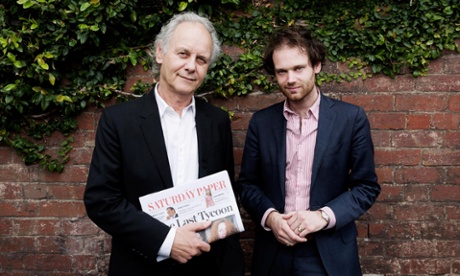
morry schwartz with erik jensen
The two front page articles were knock-outs.

The lead story was about the Essendon drugs saga and ensuing court room battle as told by chief correspondent  Martin Mckenzie-Murray. Schwartz has talked about “narrative” journalism and this was the first article I had read on the subject that actually told the story of how James Hird became the Essendon golden boy and his dramatic fall from grace. Having only come to Australia in 2004, I finally understood the hero-worship.

The second cover story was about the battle to usurp power from Sydney Lord Mayor Clover Moore. Written by Mike Seccombe, it’s the classic ‘People’ versus “Big Business’ tale with Moore pitched against right-wing adversaries including shock jock Alan Jones and ultra-conservative homophobe the Reverend Fred Niles. It’s a ripping yarn about power, influence and revenge.

Canberra journalist Chris Wallace provided thought-provoking analysis of the recent troubles of Federal Treasurer Joe Hockey, arguing convincingly that Hockey is part of a new breed of privileged Liberal politician, who unlike John Howard, are out of touch with the Australian public because they’ve never had a non-political job in their lives or ever known what its like to be a battler.

David Marr’s comment piece on asylum seeker rights – centred around a Pakistani shopkeeper thrown into detention following a negative ASIO assessment – was as expected, eloquent and powerful. Guy Rundle did a good job savaging the recent gaffs by government ministers.

Another standout was Chris Tsiolkas’s tribute to Robin Williams, which dispensed with the gushing praise, highlighting instead the many bad films Williams made and pointing the finger at Hollywood  for lacking the courage to give him roles that showcased his prodigious talent. It’s the kind of observation that alone justifies the $3.50 cover price.

Just to prove that The Saturday Paper is not just full of the “usual mawkish left-wing pieties” as The Australian’s editor, Chris Mitchell suggested it would be when it launched, there  was also a very interesting profile of Anthony Cappello, Australia’s most successful publisher of ultra conservative books.

Thankfully, not everything had a serious tone. Helen Razor wrote hilariously about the challenges and obsessions of those that grow their own tasty tomatoes  while basketball star Liz Campage made a good Q&A subject. There was a recipe for shakshouka and observations about the dish from chef Andrew McConnell plus book reviews and other bits and pieces. The cryptic crossword by Mungo MacCallum was beyond my abilities.

There are disappointments too.

Romy Ash’s on-set interview with actress Sigrid Thornton was pretentious, dull, waffly and full of self-important actorly observations that made you wince while Richard Ackland’s diary piece was too insidery and obscure to be of any interest to this humble reader.

Overall though, I’d say The Saturday Paper is definitely worth picking up on a Saturday morning to dip in and out of over coffee over the weekend. It was quite harshly judged when it launched in March, but editor Erik Jensen said it would take time to find its feet, and it appears to have done so (with plenty of high-end advertising thrown in too.)

Overall, I give The Saturday Paper 8/10 for the quality of the writing, choice and range of subjects and knowledge imparted  – or 6.5/10 if you’re a conservative reader.

Death by @Twitter: Do my tweets matter that much?

A strange thing happened to me on Twitter a little while ago.

It was at the time that the Australian Al Jazeera journalist Peter Greste was being sent to jail on outrageous, fabricated charges in Egypt and I tweeted something like:

I think the Abbott govt would have made more of an effort to help Peter Greste if he worked for News Corp.

The tweet was in bad taste, but I had blundered even further by being completely unaware that the verdict had just been handed out in a Cairo kangaroo court.

It stayed up a couple of hours while I was out at the movies.

When I returned, my Twitter notification box was lit up: half a dozen people had seen my remark and hurled abuse at me – via tweets calling me an insensitive so and so.

Others had retweeted their condemnation of my tweet. The wheels – I thought – were in motion.

For a moment, I was in a blind panic. Would I suffer the fate of Justine Sacco, the PR executive who tweeted about going  Africa and getting AIDS and become a social media sensation (for all the wrong reasons) and get sacked?

Justine SaccoWould #whereisLarry? start trending?

In a cold sweat, I frantically deleted the tweet and tweeted my apologies to the most incensed in the Twitter-sphere (Complete strangers actually).

We all made up – and life went on.

Looking back on it now, I can’t decide if I completely over-reacted or on the other hand – had defused a ticking time bomb.

I think perhaps the former: My tweet was not nearly provocative enough and it was neither racist, sexist or xenophobic, the kind of tweets that really land you in to trouble.

In fact, now I kind of wish I’d left it up – just to see what might have happened.

Andy Warhol famously predicted in 1968 that in the future, everyone would get their 15 minutes of fame. He probably never thought that so many people would achieve it via social media or reality TV?

Had I missed out on mine?

Greed is not good: Our dangerous love affair with American-style capitalism

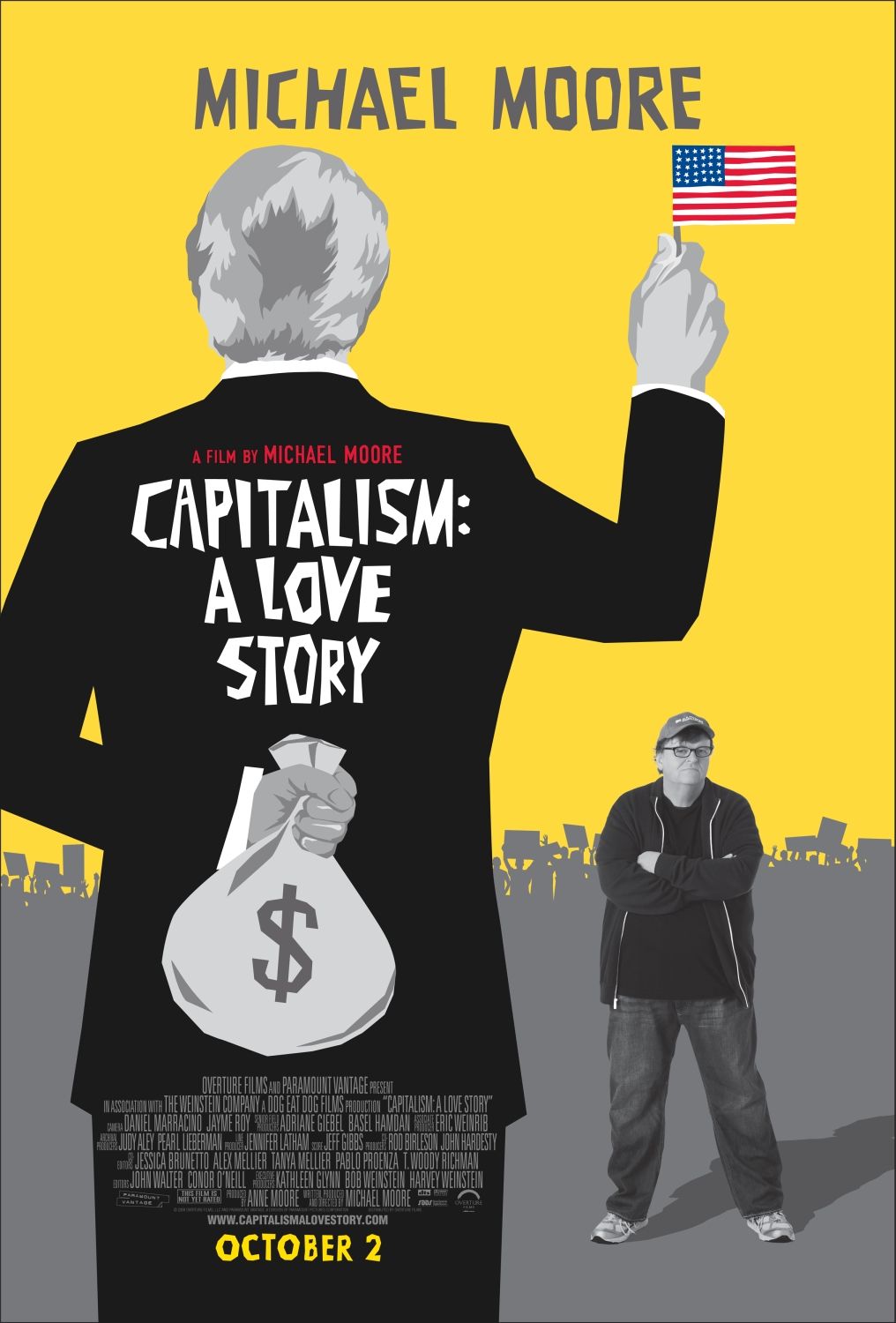
capitalism_a_love_story_xlgIn one of the early scenes of Michael Moore’s scathing 2009 documentary on free market corporate greed “Capitalism: A Love Story”, the filmmaker interviews a farmer and his wife, who are having their property repossessed.

It’s recurring image in the film, the sheriff knocks on the door, working class people are thrown out onto the street with their furniture, and the house is boarded up, later to be sold for a quarter of the price.

The farmer, his life packed into the back of a van, says he tried everything “except robbing a bank” to save his farm.

“I’m thinking about doing that. It’s one way someone can get their money back. They did it to me. I don’t know why I can’t do it to them,” he says.

As the camera pans back over the abandoned farm buildings, Moore narrates:

“This is the capitalism of taking and giving…mostly taking.”

Later, Moore questions how capitalism allows commercial airlines to pay pilots less than $20,000 a year forcing them take second jobs or apply for food stamps.

To which he answers: “I guess that’s the point of capitalism, it let’s you get away with anything.”

Australian-style capitalism

That’s the exact sentiment I felt when reading about the multi-million dollar handouts to executives at the scandal-ridden Commonwealth Bank financial planning division. People like retiring CBA banking executive Grahame Petersen (total pay $5.6 million), who oversaw the division responsible for the systematic destruction of customer retirement savings through investment in risky products recommended by the bank’s licensed financial planners in return for millions of dollars in commissions.

I thought that the retirees who had lost everything to this free market system that rewarded greed and deception could be forgiven from thinking about doing something similar to the American farmer: walking into a Commonwealth Bank branch and “asking for their money back”.

This is something Michael Moore does in the documentary in his typical sardonic style, walking up to the head office of Goldman Sachs in New York to perform a citizen’s arrest of chairman Lloyd Blankfein (2013 annual salary: US$23 million), after accusing the bank of “stealing’ US$170 billion of American taxpayer’s money to save it from collapse. Later he wraps police crime scene tape around the whole building.

henry paulsonAs Moore explains in the film, the bail out of the banks after the collapse of Lehman Brothers that sparked the Global Financial Crisis, was orchestrated by former Goldman Sachs CEO Henry ‘Hank’ Paulson (one of 25 people Time magazine blames for the crisis happening in the first place).

The then US Treasury Secretary cut a backroom deal that gave the banks $700 billion of US taxpayers money to keep them afloat. Paulson was apparently unaware of the irony that he had broken the basic law of capitalism – that you don’t ask the government for help, you either sink or swim on your own.

It seems this form of failed American style free-market capitalism – so brilliantly depicted in Moore’s film – is what the current Australian government wishes to mimic with its plans to increase the cost of car fuel, doctor’s visits and university education while Australia’s poorest paid workers earns a minimum wage that is the lowest in history relative to average full-time pay (currently $640.90 a week, or $16.87 an hour).

The 3% pay rise they got this year was more than double what the The Australian Chamber of Commerce and Industry – the powerful lobbying body, which represents big business, wanted. It suggested a 1.25% pay rise, less than half the projected cost-of-living increase of 2.7%.

Perhaps Treasurer Joe Hockey – a man who proves himself time and time again to be completely out of touch with most Australians – and his investment banking advisors should watch Moore’s documentary to see the longer term outcome of such policies in the US before and after the GFC: hundreds of thousands of job lay-offs, the poorest people unable to afford basic health care, the boarding up of whole suburbs and ruination of cities like Detroit and Cleveland.

Of course, there is also a message of hope at the end of Capitalism: A Love Story as Moore documents the fight back by ordinary Americans against the systemic free market failure (this appears to be happening in Australia too, at least in political opinion polls)

He tells the story of the employees of Chicago Republic Window and Door factory, who, having been told they will lose their jobs in three days time without being paid their wages lock themselves inside refusing to leave until they get what is theirs. The local community rallies around them providing food and encouragement. Then there’s the story of the Warren Evans, Sheriff of Wayne County, Detroit who decides to stop all home foreclosures, when he realises the hypocrisy of what is happening to working class homeowners after the US$700 billion hand-out to the banks.

More widely, Moore reports of how Barack Obama’s form of democratic socialism has been embraced by young American voters (33%), with only 37% favouring capitalism and the rest undecided.

As explained by Vermont independent senator Bernie Sanders, democratic socialism means “the function of government is to represent middle-income working people rather than just the wealthy or the powerful”.

He goes on to say that America “worships greed”

“We put on the front cover of magazines guys who have made  billions of dollars, rather than the cops, fireman, policeman and nurses, who are doing so much in the lives of people. We have to change our value system.”

Sound familiar?

—————————————————————————————————————————————————————

You can watch the whole documenatry ‘Capitalism: A Love Story’ for free on YouTube.

The many layers of my Jewish skin

Certain things remind me of my Jewish roots. Some bring me closer, other repel me. Make me want to run a mile.

Like watching Manny Wax talk about the sexual abuse he suffered at the hands of David Cyprus, a security guard at the Yeshiva College Melbourne, the subsequent community cover up and shameful treatment of Manny’s family by their supposed friends. These things repel. They push me away.

Then I see a man like Zephaniah Wax, Manny’s father, an orthodox Jew with a modern-day understanding of the world, who is kind, thoughtful and funny, whom I instantly admire and like, a man I would love to discuss the philosophies of life with over a meal.

He is nothing like the orthodox woman who tought me at cheder (Jewish studies I attended in the afternoon while I was at primary school) who told me I should try not associate with non-Jewish people. Or the awful history teacher at high school, who tried to make us learn to draw the map of Israel by heart. She repelled me as did the forced morning prayer, the constant yelling at kids who didn’t pray and the shovelling of religion and zionism down our throats.

The truth is being Jewish is complicated. It’s probably why Woody Allen depicts his characters – primarily New York jews – as guilt-ridden, questioning, uncomfortable people. Never quite at home in their own skins. I love those characters and identify with them.

My own admission is that I have willingly and easily slipped the yolk of my religion. I’ve married out the faith, I eat what I like, I never attend synagogue and don’t observe the sabbath or any of the festivals. I am very much a secular Jew.

But it wasn’t always this way.

It was my mother who instilled in me my Jewish identity. She got it from her father, my grandfather Harry, who died – on of all days – on the eve of Yom Kippur, the holiest day in the Jewish calendar, the Day of Atonement.

My grandfather Harry, far left - not quite how I remember him

My grandfather Harry, far left – not quite how I remember him

It shook me when he died on that very day. Having been told endlessly that Yom Kippur was the day when you were inscribed either in the book of life or the book of death, his passing felt huge and momentous. In my mind, I always pictured Yom Kippur as the hand of God writing names in one of two enormous, leather-bound books somewhere up above clouds. On the cover of one was written “LIFE” on the other “DEATH”.

Harry, who we called ‘Zayda’  (Yiddish for ‘Grandfather’) and his son, my Uncle Sydney, who we all called ‘Uncle Yoel’ were the religious centre of our extended family when we grew up in South Africa in the 1970s, 80s and 90s.

Zayda was a distant, but kind man with big watery eyes made huge behind thick glasses, a bald head always covered with a kippah and a bow-legged walk. He was an old man from my earliest memories. Zayda was the impetus for us observing the rituals of the Sabbath and the festivals. Before Passover, he would hide ‘chametz’ (pieces of bread) around the house and then we would walk behind him in the dark as he tried to remember where he hid them. Zaydah would hold a candle and a little shovel he’d made from cardboard and using a feather, sweep up the “unleavened bread” in ritual cleansing of the house of bread before it was filled with boxes of Matzoh. My sister, brother and I could hardly keep a straight face as we marched around the house searching for bread. My grandfather was never amused by our snorting. Many months later, we’d find stale pieces of bread on bookshelves or somewhere else Zaydah had forgotten about.

Like many Jews of his era, a favourite pastime was reading the obituaries in The Star newspaper in the afternoon to see who had died. This he did with a magnifying glass, hunched over the paper. Having come to South Africa from Russia where he ran a concession store on the mines, I think he had endured a tough life. He had a sad face and suffered the loss of wife Lily, my ‘bobba’ when she passed away suddenly many years before I was born.

I was very close to my Uncle Yoel  – a slim man with a neatly trimmed black beard, always full of ideas, patient, kind  and well liked by all who knew him. I used to go to his flat in Hillbrow (and inner city Johannesburg suburb that has since fallen on hard times), where we studied the portion of the Torah I was to read for my Bar Mitzvah. I’d come to his flat on Sunday mornings to study, but we also talked about cricket and other things.I am not quite sure what my Uncle did for a living, but for a long time he sold a course of motivational tapes from the ‘Success Motivation International‘  – SMI as I called it – that created a program for setting and achieving goals. He gave me a set of tapes and we would also sit in his flat planning my goals and how I would achieve them. One of them was to be a good Bar Mitzvah boy, which I achieved.

The author, his Bar Mitzvah, 1987

The author, his Bar Mitzvah, 1987

After my Uncle Yoel married his wife Esher – a native of Chicago with a big beaming smile who seemed to find everything I said funny – and started to have children they moved to a big house in Yeoville,  an predominantly orthodox Jewish neighbourhood of square brick houses and shady trees reminiscent back then of the Melbourne suburb of Balaclava with its kosher cafes, Jewish institutions and synagogues.

Here our family and my Uncle’s family would gather on Friday nights for the Shabbot (Sabbath) meal. We would sing songs in hebrew and say the prayers and then feast in the traditional Jewish way: by overeating. First would come the chopped liver piled high on challah (platted loaves of bread topped with sesame seeds) on to which I heaped horse-radish or mustard. This was followed by chicken soup, a broth that contained soft pieces of chicken, necks and stomachs and sometimes chicken feet followed by a main course of chicken or meat or both, roast vegetables, kugel (potato pudding) and salads. Dessert was non-dairy chocolate mousse which my mother made with something called Orley Whip, a staple of every Jewish household in Johannesburg.

A couple of years later my Uncle Yoel emigrated with his family to an othordox neighbourhood of Chicago. Over the years, as I have drifted further and further away from Judaism, we have sadly lost touch and lost that close bond we had when I was a young boy and teenager. The last time I saw him was at my brother’s wedding in Miami in 2010 and before that it had been many, many years since we had seen each other.

Over the years, I have shaken off layer upon layer of my Jewish skin.  But there are many layers.

I have remained – at heart – a proud, non-observant Jew.

My core Jewishness remains and deeper than traditional foods, the jokes, anxiety and guilt.

Sometimes I feel a longing to sit in  synagogue and sing some of the familiar Friday night songs. On the  odd occasion I get invited for a Friday night meal or to celebrate one of the festivals, it’s a special treat. Sometimes I find myself humming the tunes I used to sing in synagogue.

It was a sad, but also defiant moment on the ABC’s Compass show that aired the story of Manny Wax when Manny’s father Zephaniah and his wife are seen sitting alone at their vast dinner table, because their own family and community have cast them out.

It takes me back to those big Friday night dinners in Berea, that I remember now so clearly, but yhat are also so distant.

There’s the enormous meal before us. I’m calling on someone to pass me the ‘chrain’ (horse-radish) to spread on my chopped liver. There is herring and kichel (sweet Israeli crackers). The two families are gathered together. My Zayda is there eating slowly. He is very old and struggling to hear what everyone is talking about. My Uncle Yoel is discussing cricket or asking me about my week at school and the food keeps coming. The house is suffused with the smell of chicken and potato pudding. Wax drips down the shabbat candles, which flicker and burn on a silver tray. Later we ‘bench’ – sing prayers of thanks for our meal –  and make our way home by car through quiet Friday night streets of Yeoville and Observatory.

These were things that bound us together back then and are a layer that I keep beneath my skin.

To Rome with love (and a bit of hate)

to-rome-with-loveWoody Allen’s ‘To Rome with Love’ is a gorgeous tribute to the “eternal city” and a feast for the eyes.

The Coliseum, the Trevi Fountain, the Roman Forum, the Spanish Steps, quiet cobbled back streets and rooftop panoramas are the backdrops to four off-beat stories about people caught up in various adventures and mis-adventures in Rome.

While not a classic among the director’s huge body of work (no less than 50 movies), it is filled with enough classic “Woody Allen” moments to make it one I would recommend to fans.

There are plenty of trademark Annie Hall-style intellectual jokes delivered by Woody Allen’s character, Jerry an unhappily retired opera director, much to the exasperation of his wife Phyllis (played by the always brilliant Judy Davis):

Jerry: “I couldn’t be a communist. I could never share the bathroom”

And…

Jerry: “You know, you married a very bright guy. I got a 150/160 IQ.
Phyllis: You’re figuring it in euros, in dollars it’s much less

There are also some very funny moments as when Giancarlo (played by real Italian opera singer Fabio Armiliato) – the soon to be father-in-law of Jerry’s daughter Hayley  – is wheeled on stage in a production of the opera Pagliacci singing in a portable shower while he soaps himself (I am sure you can work out the reason for yourself).

to-rome-with-love-12

Jerry: I see New York. I see Vienna Opera House. I see Paris.
Phyllis: All in the shower?
Jerry: Yes. They love it that he sings in the shower. They identify. You know, he’s going to be the most popular opera singer in the world.
Phyllis: Certainly the cleanest.

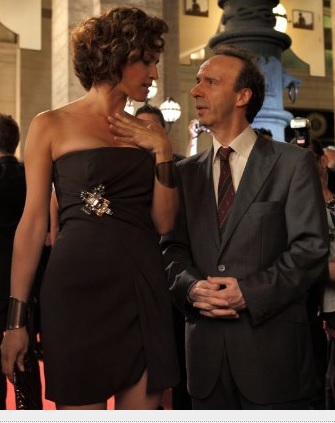
Like the more successful Midnight in Paris, elements of magical realism are interwoven in the story as when Leopoldo (played by the charismatic Italian Oscar winner Roberto Begnini) awakes one morning transformed into an instant celebrity (much like George Samsa in Kafka’s Metamorphosis, though a slightly more appealing predicament) hounded by the paparazzi:

Journalist: Good morning. We are at the home of  Mr. Leopoldo Pisanello. It’s half past seven, and Mr. Pisanello is shaving…an event that we document
from first to last gesture. Mr. Pisanello is having his hair cut. – Look, just a trim – He opted for only a trim.

begning

Roberto Begnini finds himself irresistable to beautiful Italian women

There’s also a sensational performance by Penelope Cruz as Anna a gorgeous, buxom prostitute and great cameos by Italian actors Rosa Di Brigida and Antonio Albanese among others.

Watching ‘To Rome with Love’ took me back to my last visit to the city, in 2010, when I was backpacking around the world with my wife.

I blogged on July 15 under the heading: “No roman holiday” –

“Rome is too bloody hot, too overcrowded with tourists and we can’t wait to leave”

Rome felt nothing like the care free, enchanting city depicted by Woody Allen.

Our few days in the “infernal city” had been a disaster from beginning to end starting from nearly getting run over by Italians in small cars as we hiked down a narrow road, in desperation, trying to find our budget hotel on the edge of town.

After that ordeal, we spent our days fighting our way through traffic jams of tourists at every famous site and on every crowded piazza. Even getting a simple scoop of gelato meant standing in a long line. Worse was the sun which pounded down relentlessly while Rome seemed to offer no shade or escape from the heat. Everything was too expensive, the subways and trains were like ovens and we felt like the only two fools in Rome without a penny to scratch between us. We were glad to leave.

This was nothing like my experience of Rome about eight years prior, when I visited with friends.

I was living in London at the time and money was less of an issue.

We hired a large rooftop flat with sweeping views over the city. We ate delicious pizza and pasta al fresco on big piazzas with the locals. We drank lots of Italian red wine, sipped cappuccinos and shots of Amaretto liquer and watched the sun sink below the white church domes from our mock-castle in the sky. At least that’s how I remember it!

We visited all the sites; stared up at the ceiling of the Sistine Chapel and explored countless old churches. We went walking along the Appian Way to find the ancient catacombs and took naps in parks in the afternoons.

I remembered getting lost outside the Altare della Patria, the white marble national monument known as the ‘wedding cake’ on our way to find some famous site just as Hayley (Alison Pill) does at the start of the movie, only for Michelangelo (Flavio Parenti) to show her the way.

When John (an architect played by Alec Baldwin) is drinking a glass of wine with his wife and friends on the piazza, I remembered sitting at an outside table in front of the Pantheon, ordering a ‘prosciutto’ pizza only for the waiter, confused by my poor pronunciation to bring me a ‘bruschetta’ – much to the amusement of my friends.

‘To Rome with Love’ is not Woody Allen’s greatest film or even a great one, but as a homage to Rome, it is practically flawless.

It reminded me of all the reasons I loved Rome the first time.

My great great grandfather: the adventurous Prussian soldier who loved a drink

OLYMPUS DIGITAL CAMERA

This is a picture of my great great grandfather Heinrich Gimkiewicz  (with impressive beard) and his wife Helene taken in Berlin in 1881.

I have come to know a little about Heinrich through a self-published book by a cousin, Keith Kaye, a urologist who lives in Minneapolis.

Keith translated and published the diary Heinrich kept while serving as a non-commissioned officer during the Franco-Prussian war, a largely forgotten but bloody dispute that took place in Western Europe between July 1870 and May 1871, won by Prussia thus unifying the various German states.

The diary was bequeathed to the University of the Witwatersrand in Johannesburg by Heinrich’s granddaughter Helga, It was here that I studied various degrees between 1992 and 1998, emerging, finally with a Bachelor of Arts in 1996 and a Post-Graduate Diploma in Management in 1998.

All that time, I had no idea a diary was kept by the University library detailing the daily marches, battles and ruminations of my distant paternal descendent.

When I began reading the translated diary entries I was at first bored. Heinrich details his movements from one town to the next, the long marches or train rides, complaints about the cold, waiting around for orders and details of the various civilian billets where he stayed in occupied French towns.

The names of towns and army commanders meant very little to me.

But as I read and persevered, I found Heinrich to grow more interesting and to see things in his personality that reminded me of myself.

It became apparent to me that my great great grandfather enjoyed a drink, preferably an alcoholic one (as I do) and sometimes drank until he was “tipsy”.

He writes of a stay in Rheims on November 12, 1870:

We stay here today, and so we try to get to know the town. Provisions are quite bad here, but there is lots of wine…

On November 16, in the hamlet of Coucy la Ville between La Fere and  Soissons:

It is quite nice here, there are lots of apples; the people make a pleasant drink out of them. It is available in quantity, and we like it very much, there being no wine.

And later, in Roumare on December 28:

I go and get my baggage, we prepare our meals and sit together until 10pm, having a good time. There is enough cider, each day we drink a considerable amount.

He was also fond of exploring the towns that he visited and had an appreciation of architecture, food and the hospitality and the customs of local French people, even if they were the ‘enemy’. However, unruly Frenchmen are not tolerated and one, he reluctantly admits to slapping.

He is also more than a little mischievous and I surmise – not always that honest  – with his diary entries – particularly when he visits a Rouen brothel:

It happens on February 16, towards the end of the war when he is billeted in the home of a cotton manufacturer. Heinrich writes that at 6.30pm he eats dinner with his landlord, “who is a very friendly man” then goes out again “this time on a less moral path”.

We want to have a look at a French brothel. There are many here. The first one is the Maison Stephan, which is high-class. The second one is a normal one. We return at 11pm.

No description is given of what he did for four hours, but we can guess. His fondness for the ladies reveals itself on a number of occasions with glowing descriptions of local landladys (one is”an aristocratic woman called Madam de Savers” who is “very friendly”) and the daughter of one of his landlords.

Rouen was a special place for Heinrich in the war. He writes of its bustling life after the armistice is declared and that “in all the places and in all the cafes it now becomes obvious  that this beautiful city belongs among the greatest in France”.

I would whole heartedly agree. My wife and I visited Rouen in the summer of 2010, staying in a little shoebox apartment above shops on the main road. Our landlord was a small, dark-skinned moustached man, who spoke not a word of English. We cooked tinned Cassoulet on a portable gas burner in the evening after exploring the exquisite, historic town in the day.

Now, I wonder, if I tread on the same cobbled stones as Heinrich did all those years ago as he explored the various districts and drunk in its cafes and restaurants.

Heinrich also writes intriguingly of the Yom Kippur service for Jewish soldiers, the holiest day in the Jewish calendar.

A proud Prussian man willing to die for his country, Heinrich could not have known that this war, which unified Germany, would create some of the circumstances that led to the First World War in 1914 and later the Second World War, where German Jews were betrayed and murdered in their millions by their homeland.

He writes of the Yom Kippur service in St Barbe on October 6:

…all in all there were 400 men of our denomination there.  It was Rabbi Blumenstein who came especially from Mannheim…it was moving. Most of us had probably never prayed as intensely as we did today.

My favourite extract – and where I feel a strong connection with my great great grand father – comes towards the end of the campaign, when Heinrich’s regiment reaches the town of Fecamp, on the Atlantic Ocean:

Now we are to see the ocean. We are led there one platoon after the other, it is a gorgeous view…with its huge waves…a clear difference from our eastern sea. This mighty sea with its waves which exist in such height only here, surrounded by high white chalk cliffs is really indescribable and unforgettable. This great view truly compensates for all our strains of the last days and we are grateful to our captain who kept his promise.

With the war over, Heinrich returned Berlin and married Helene 10 years later. They had four children.

The family move to South Africa in 1899 was most likely sparked by a wave of anti-Semitism surging through Europe at the time and the prospect of making one’s fortune amid the gold fields of the Witwatersrand.

Heinrich’s daughter Else would later marry an Austrian-born geologist and mining engineer called Bruno Schlesinger in 1907 and I would emerge into the world in 1973, a chubby child with a curly mop of hair to carry on the Schlesinger name.

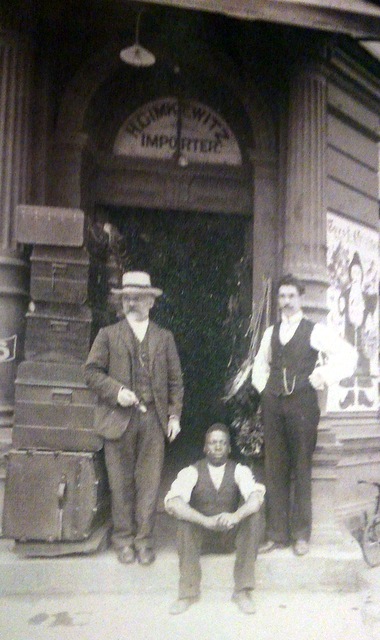
Heinrich ran a toy shop in  the centre of Johannesburg with merchandise imported from Germany. A photo outside the store shows him to be a dapper dresser in three-piece suit and hat, bearded with fob chain dangling from waist coat.

Heinrich, top left, in front of his Johannesburg toy shop

Heinrich, top left, in front of his Johannesburg toy shop

Sadly, anti-German feeling in 1915 following the sinking of the British ocean liner the Lusitania  forced Heinrich and his family into veritable hiding as mobs attacked anyone of German descent. Being unable to import German goods, he lost most of his customers.

Heinrich died in 1922 aged 75, 10 days after his wife Helene apparently of a broken heart. They are both buried in Johannesburg’s Brixton Cemetery.

– I think I would have enjoyed sharing a glass of wine with him. Or maybe some Cider.

Threshold to the Kingdom: Art, MH17 and sudden departures and arrivals

In November 2001 I visited the Whitechapel Art Gallery in the East End of London.

In a darkened room  I watched a video art installation called “Threshold to the Kingdom” by the acclaimed British artist Mark Wallinger

It showed the gates at an airport arrivals hall opening and closing in super slow motion as passengers emerged and made their way home after a long overseas flight.

In the background, rang out the 500-year-old chant of Allegri’s ‘Miserere mei, Deus‘ – a psalm about a man asking for God’s forgiveness written to be sung in the Sistine Chapel.

Their slow movements and the haunting music transformed the arriving passengers into poised, graceful dancers, as if each movement of arm and leg were in perfect rhythm.


(A 3 min excerpt of the 13 minute art work)

I remember being completely mesmerised,  in a state of Zen-like contemplation: I saw the passengers coming through the automatic gates as angels arriving into some earthly heaven, not one full of puffy white clouds and cherubs playing harps.

This  interpretation may sound strange, but it was only two months earlier that I had walked back to work in the West End and watched with sheer disbelief as jet planes crashed into the World Trade Centre towers in New York, bursting into balls of red and orange flame, obliterating lives in an instant.

In that darkened art gallery room, I thought of people that never arrived and those they left behind in airport arrival halls.

The recent shooting down of Malaysian Airlines MH 17  brought the memory of that London afternoon vividly back in my mind.

As I did back in 2001, I think now of all those bright, happy people, returning from family holidays or on their way to an exciting destination- and then gone in an instant, never to arrive at their final point of disembarkation.

Perhaps they have not disappeared, but have arrived someplace else. It is that feeling which “Threshold to the Kingdom” instilled in me so powerfully.

Daily Telegraph art critic Martin Gayford  wrote of the effect of the artwork:

 It gets its strange power from the conflation of Allegri’s soaringly spiritual music with the banal, anonymous setting of an international airport. Yes, the gates of heaven might be like this – ordinary, yet marvellous.

Reflecting on all the families and friends of the passengers of flight MH 17 dealing with their overwhelming, unbargained for grief, I remember “Threshold to the Kingdom” with ever greater poignancy.

It seems a fitting memorial to the victims of MH 17 as it was back then – in my mind – to the victims of 9/11.

———————————————————————————————–

The full, haunting version of Allegri’s ‘Miserere mei, Deus:

What’s to really like about Irvine Welsh’s Filfth?

filfth“Failure is much more interesting to me than success,” said Trainspotting author Irvine Welsh in a recent talk I attended in Melbourne

“I write about people who are going through a bad time, when things are falling apart. I try to show these characters grasping for the light switch,” he said in an attempt to explain the grim reality of many of his characters.

In the case of Scottish Detective Sergeant Bruce Robertson, the light switch might as well have been in Hawaii, in an abandoned, graffiti stained warehouse where the power has long been turned off.

He is beyond hope of redemption, right from the very first pages:

After two fruitless strikes I feel a surge of euphoria on my third as his head bursts open. His blood fairly skootches out…

Robertson its an utterley despicable character. A murderer, a rapist, a racist, a misogynist, a betrayer of his friends and family, a drug fiend, an alcoholic, a rabid consumer of pies, chips and deep fried food; a man with eczema-encrusted genitals that rise at the slightest whiff of sexual conquest, who retreats to the bathroom to give his itchy anus “a good clawing”.  Into the mix, throw in a distinct lack of interest in personal hygiene, fetishes that include erotic asphyxiation (strangulation sex) and a side interest in bestiality, and you get a pretty good picture of DS Bruce Robertson.

And yet it’s an enjoyable book to read mainly because Robertson is an entertaining, wise-cracking first person narrator who speaks directly to his reader without any sense of remorse, who plots the downfall of his work colleagues, friends and adversaries with Machiavellian cunning. One enjoys his scheming and plotting in the same manner as one enjoy Blackadder and his many “cunning plans”.

At the heart of it all is a man who hates everything but his own shadow, driven by a burning rage that will not cool:

I hate them all, that section of the working class who won’t do as they are told: criminals, spastics, niggers, strikers, thugs, I don’t fucking well care, it all adds up to one thing: something to smash.

Robertson is a voyeuristic release for every bad thought a (male) reader has ever had (and yet there are also female fans of this book).

There’s a guilty pleasure in allowing Robertson to enter your head, knowing that you can close the book and return to the real world where hopefully some sense of morality and decency remains.

Perhaps this is partly why Welsh wrote it, to get all his inner demons on the page to expunge the Bruce Robertson buried in his pysche. Either that, or it’s an opportunity to write about a character who remarks during a bout of sex with an Amsterdam prostitute:

I’ve given the pole a good greasing but she’s pretty tight. Once I get in though, it starts to slide up. I can tell that she’s in a bit of distress cause she’s making hissing noises and her back muscles are tensing, but it’s probably  just cause the fucking hoor’s loving every minute of it.

These type of graphic descriptions dominate the book in between heavy bouts of drinking, drug taking and “hooring”.

The female degradations inflicted by Robertson reminded me of a question a woman asked at the same talk Welsh gave in Melbourne. She asked him about his depiction of woman characters and whether there was something misogynistic about it?

At the time I scoffed at the question, but having read Filth, I’ve reconsidered.

Women are the chief focus of Robertson’s humiliations. They are reduced to play things without feelings or emotions. They are objects for his pleasure and derision most horrifyingly illustrated in a scene I won’t even dare to quote where Robertson drives a prostitute to an isolated farm to have sex with a sheep dog.

It was this scene where – out of sheer revulsion – I considered putting the book down.

Trainspotting was Welsh’s first book and I wager – though I have only read it and now Filth – his finest by a country mile. Trainsportting was  a brilliant depiction of the post-Thatcher generation lost to drugs. A modern classic.

Filth is almost pure literary pornography with an enigmatic villain unlike any created in fiction who engages in every possible depravity. There’s whiffs of Trainspotting in Robertson’s occasional hilarious commentary on Scottish football, tabloid journalism (Robertson is a big reader of The Sun – for the football and the girls on page 3) restaurant food and local politics. But it has little gravitas and nothing meaningful to say about the society that created such a monster as Bruce Robertson.

Yes, we learn something of Robertson’s motivations and inner psyche –  through a tapeworm in his bowels that speaks in Queen’s English. But in the end and upon reflection, I tend to agree with what The Observer book critic Alan Taylor wrote of the novel when he reviewed it in 1998:

“As an archetype, Robertson is over the top. Welsh slips so easily into degradation mode that pages slip by in wodges, a miasma of pornography that is mindnumbing…Welsh lets him sink so low he is not resuscitable. For such a man, the idea of redemption seems risible. His sin goes beyond breaking the law. Guilt, ultimately, is the least of his problems. He has committed the cardinal crime. He is a crushing bore.”


Peter Greste and my own bittersweet memories of Egypt

Having tea near Tahrir Square, Cairo - October 2010

Having tea near Tahrir Square, Cairo – October 2010

The recent wrongful conviction of Australian and Al Jazeera journalist Peter Greste and his two colleagues by a corrupt Egyptian court has stirred up memories of the week my wife and I spent in Egypt in 2010 as part of a round-the-world trip.

Before I turned to my own diaries to recall what I wrote about those days in Cairo and Alexandria in a hot October (just a few months before the start of the Arab Spring) I was moved by an re-collection of Cairo by a colleague at the Australian Financial Review, Tony Walker, who lived there as a foreign correspondent between 1983 and 1994.

Mr Walker reminisced:

My own memories drift back to my Cairo home at 19 Gabalaya Street, Zamalek on the Nile, where I lived securely and contentedly for 10 years surrounded by Egyptians who were my friends, including my assistants, Hoda and Shahira, my late ­tennis-playing friend, Eduard Malek, who was killed in a road accident in the office ­Mercedes I had bequeathed to him at the end of my assignment…In my apartment building resided some of Egypt’s foremost citizens, including Samia Gamal, the Arab world’s Margot ­Fonteyn of belly dancers, and Faten Hamama, the region’s Sophia Lauren and first wife of Omar Sharif.

Mr Walker described the case made against Mr Greste and his colleagues as a “judicial farce” and concluded, mournfully: “Egypt, I do not know you”.

Cairo, for anyone who has not visited is a manic place – perhaps the most manic in the world – crammed with 20 million or so people (no one seems to know exactly how many), packed with buildings new and ancient in a metropolis that never seems to end and roads clogged with cars, trucks and busses, where you cross at your own peril. Cairo has both crumbling majesty in its ancient monuments – the pyramids of Giza the most famous – bustling trade in the markets of Islamic Cairo and touch of the modern city in its efficient metro system, one of only two in Africa.

DSCN9258

Me, in Islamic Cairo, October 2010

But my abiding memory of Cairo was of playing the Western fools, with our map spread open on Tahrir Square trying to find our way to the Nile or the Egyptian Museum and caught out at every turn by scam artists and confidence tricksters.

We were scammed almost every day in Cairo – nothing of the amount to ruin our trip – but enough to leave a sour taste in our mouths when we flew off to a “sedate” (by comparison) Mumbai.

The opening remark in my journal on Wednesday, October 6th (our fourth day in Cairo) begins: “We awoke with the intention not to be scammed today.”

Of all the cons played on us – from the jovial family man Abdullah who “just happened” to bump into us after his hotel shift on the way to catch a bus to the pyramids and who steered us straight into the arms of US dollar charging camel ride purveyor, to the man who led us straight to his uncle’s perfume shop rather than where – as promised – the felucca boats departed on the banks of the Nile,  the saddest was perpetrated by a kindly looking old man with white beard and moustache (think the Egyptian Colonel Sanders), who caught me out on our second evening in Cairo, when I was walking on my own near Tahrir Square (my wife was still battling a cold and had stayed in the hotel room that evening).

A very expensive camel ride at the Pyramids of Giza

A very expensive camel ride at the Pyramids of Giza

I had just returned back to the centre of Cairo after having a wander around the dark lanes of Coptic Cairo (home to ancient ruins, churches and synagogues of Cairo’s Catholic and Jewish descendants dating back 1500 or more years) with its mud-brick homes. tiny convenience stores and less than friendly stares of the local children.

I emerged from Sadat Station looking for somewhere to eat when I was stopped by a portly, balding man with a white beard and glasses who asked me where I was from.

“Not a minute had passed and I found him walking alongside me as if we were old friends,” – I wrote in my journal. “He looked so innocent,” I added.

At one point during our walk he stopped to write my name out in Arabic. Later he told me he played the organ in the church and that he was a sculptor.

At some point, I told him I was hungry but could not find somewhere to eat:

Next minute I was tucking into chicken, rice and vegetables. He watched me and said little except to enquire if the food was any good. He later stepped outside to chat to the owner.

After the meal – all he had was a soft drink – nothing was paid in the restaurant and in my naivety as we left, I wondered if perhaps – out of the goodness of his christian heart – he had paid for me. I wrote:

As we walked on, he said I owed him 43 Egyptian pounds, not a king’s ransom, but double what the meal would have cost me anywhere else. When I gave him a 50 pound note, he then had the temerity to ask if he could keep the change. I said no, but he still short-changed me by 3 pounds.

I walked back glumly to my hotel to recount the story to my wife. I felt both stupid and sad.

Looking back at it now, in the wake of the Arab spring which promised so much for Egypt and its struggling people, I feel mostly sympathy for the little old man who conned me out of a few pounds.

I wonder what has happened to him and if he is still trying his routine on  unsuspecting tourists – if any still visit in the wake of 2013 military overthrow and the terrible situation of Peter Greste, his colleagues and thousands of others arrested, tortured and murdered.

One further incident remains fresh in mind –

It is of my wife and I running to catch a bus outside the Egyptian Museum guided by our new friend Abdullah urging us to jump on the rickety thing while it was still moving.

Along side was a man throwing his ten bags of groceries on to the steps of the bus before leaping on himself (buses in Cairo, we learnt slow down but don’t stop to let passengers on).

Safely on the bus, I found myself staring at a little kid – perhaps 12 – sitting in the ticket seller’s seat as we sped past Cairo University who demanded I buy a ticket from him.

Just before I handed over a few coins, Abdullah stopped me.

“He is not the ticket seller, just some kid.”

Having reassured us that he was our guardian, he then proceeded to scam us.

The strange, dangerous, addictive world of @Twitter

twitterA colleague at work tells me I’m the worst tweeter in the world.

I laugh and shrug, but agree he could be right  (some of the time).

Mostly, it’s to do with my inane comments on sport, particularly Australian Football, which I admit I know very little about.

Still that doesn’t stop me winding up my 1200 or so followers, some of whom are friends who support opposing teams to the high-flying Sydney Swans, the team I barrack for.

What can  I say, I like to wind people up by saying this coach couldn’t teach a primary school woodwork class or that full forward couldn’t hit a cow’s arse with a banjo – let alone guide the Sherrin through the middle posts.

My problem is that I occasionally tweet my private thought and let’s be honest everyone has some pretty dark or silly ideas running through their brains at one time or another (before Twitter came along in 2008 the worst you could do is send a text message while drunk or angry) .

Some tweets are so explosively bad, they have the potential to be disastrous.

This was famously illustrated last year when PR executive Justine Sacco tweeted to just 400 followers before boarding a long-haul flight from the US to South Africa:

Image

Twelve or so hours later, her racist remarks had been retweeted thousands of times – by people who had tens of thousands of followers creating a huge multiplier effect – and the Twitter-sphere was up in arms.

A hashtag #HasJustineLandedYet trended around the world and Ms Sacco found herself with 8000 unwanted “followers”.

Ms Sacco lost her job, her reputation was in tatters and she promptly vanished from Twitter and social media to lick her wounds (though amazingly someone has hired her again!)

Of course other more famous people have gotten into trouble for tweeting including fiery cricketer Dave Warner, who tweeted an expletive-ladden attack on cricket writers and was promptly fined by Cricket Australia and Hollywood actor Ashton Kutcher who tweeted to his 8 million followers his support for American college football coach Joe Paterno after he was sacked for not doing enough to prevent the abuse of children by his assistant coach Jerry Sandusky.

A bad tweet can end a career, ruin a reputation and cost a lot of money in legal fees – comedian Roseanne Barr was sued by the parents of George Zimmerman, the man who shot Trayvon Martin – after she tweeted their home address. The Zimmermans claimed Ms Barr incited a lynch mob. She later deleted the tweet but the damage was already done.

Undeniably, Twitter has incredible power.

While Facebook’s influence is arguably waning, Twitter is getting bigger and bigger (pop star Katy Perry has 54 million followers) and it has that incredible multiplier effect through retweets. Give a tweet time (as in the case of Justine Sacco) and the results can be tsunami-like.

Twitter’s power is its immediacy, punchiness (just 140 characters forcing people to condense their thoughts into bite size chunks) and ability to reach so many people.

Unlike Facebook, LinkedIn and others, where there is some level of privacy (messages can be restricted to friends and networks), Twitter is a free-for-all where everything is public.

It’s an addictive place where you can read the private thoughts of some of the world’s most powerful people  like right-wing media baron Rupert Murdoch  – @rupertmurdoch  – who actually writes his own rambling tweets.

It’s where you can interact with your favourite celebrities (who doesn’t like to brag about getting a reply from a favourite actor or a retweet or mention) and get involved in discussions on politics, sport, religion and every topic in between.

There’s a strange kind of pleasure when people from far-flung places respond to your tweets. For example, this exchange after I posted my thoughts on the book Birdsong by Sebastian Faulks, which I had just read. I got a reply from an actor appearing in the play of the novel in the UK.

Image

Twitter is a great place for sharing stories, thoughts, inspiration, recipes, photographs, anecdotes, jokes and grievances (nothing better than winding up a big corporation who can’t help themselves but responding to every criticism).

Twitter is where many of the biggest news stories are broken (I remember a colleague at work shouting out: “Someone has just tweeted that Oscar Pistorious has shot his girlfriend” before it became a huge worldwide story).

But you have to be careful what you write even if you are a humble journo hack like me.

A point I have to keep reminding myself every time I think I’ve thought up something witty to say and have my finger hovering over the “Tweet” button.

“Just remember Justine Sacco,” I tell myself.

Follow me @larryschles