Why you should drop the fear and visit Johannesburg

2212355983_74be3eec5f_zFor any ex-“Jo-burger” living in Melbourne, one can probably count the number of kind things said about Johannesburg on the palm of one’s hand, including comments from ex-South Africans.

For most it exists in the mind as crime-ridden, lawless place with rolling blackouts and road rage – and for those visiting South Africa, the only memory they may wish to have of Johannesburg will be of the ultra-modern airport and perhaps a short cab ride along the motorway – or via the Gautrain – to the safety of their hotel in the leafy suburbs of Rosebank or Sandton.

Most will no doubt wish to head straight out of “Jozi” or “eGoli” (as it is affectionately known by its six million plus residents) for Cape Town and its nearby wineries, the beaches and warm oceans of Kwazulu-Natal or the world-famous Kruger National Park Game Reserve. Anywhere, but hanging about in Jo’burg…

Not even die-hard Jo’burg fans such as myself would be foolish enough to argue that crime is not so bad – you only have to look at the ridiculously high walls and electrified cables which surround nearly all the homes or read the front page of any newspaper to know this is true.

But there is certainly a lot more to the city than tales drenched in blood.

The Johannesburg CBD skyline

The Johannesburg CBD skyline

The city, like South Africa itself is constantly changing and much is being done to shake off the cobwebs and re-energise Johannesburg in a very positive sense – meaning there is a lot to see for any tourists brave enough to venture beyond their hotel room.

The Apartheid Museum

Symbolic seperate black and white entrances to the Apartheid Musuem

Symbolic seperate black and white entrances to the Apartheid Musuem

First on any tourist itinerary should be a visit to the Apartheid Museum, situated just a short distance from the Gold Reef City Theme Park and Casino – (a gaudy monument to Johannesburg’s modern roots as site of the world’s biggest ever gold rush in 1886).

The museum was completed in 2001 and provides a totally exhaustive and engrossing history of the struggle to end what was a brutal, tyrannical and inhumane regime.

Upon entering the museum visitors are arbitrarily and symbolically classified as either “white” or “non-white”. Once classified, visitors may only enter the through the gates allocated to their race group. Much like the high, windowless concrete walls of Berlin’s holocaust memorial, such devices immediately transport one back into the dark day of Apartheid, setting the tone for the museum, which is designed to be as interactive as possible.

It’s an enormous exhibition full of photographs, video footage and installations detailing apartheid’s genesis, life under the regime, and the resistance struggle which took root in the 1960s and saw Nelson Mandela’s rise to power.

Give yourself at least four or five hours to explore – more if you are one of those people who likes to read every word and watch every video.

Constitutional Hill

Next stop on the political trail should be the Constitutional Hill complex near Hillbrow, seat of the Constitution Court, the highest court in the land, where South Africa’s constitution – considered the most democratic in the world – has its home.
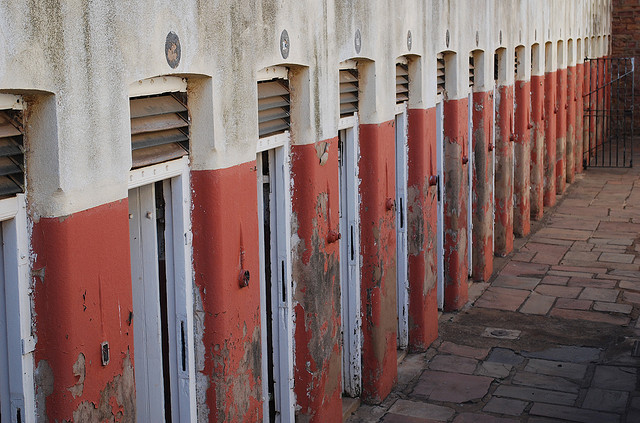
The old prison cells - home to Ghandi and Mandela at one point at Constitution Hill

The old prison cells – home to Ghandi and Mandela at one point at Constitution Hill

The complex is built on the site of the Old Fort, the notorious prison built originally by Boer leader Paul Kruger in a vain attempt to defend Johannesburg from the British.

Visitors to Constitutional Hill should sign up for a guided walking tour to get a real feel for the place. Local guides take visitors through cell blocks which housed every famous political prisoner the country produced including Nelson Mandela and Mahatma Ghandi.

Mandela’s cell has been recreated and besides the video footage on display it contains original letters written by Mandela – a qualified lawyer – written in elegant curved freehand, detailing his numerous requests from prison authorities for access to books, legal counsel and to see his family.

On the way visitors bypass the now empty and incredibly eerie cellblocks – like everything under apartheid, divided into white and black sections.

As the guides explain and visitors can see for themselves, Apartheid’s reach was limitless. The walk takes one passed notice boards which detail meal rations for prisoners (more meat and extra coffee and sugar for white prisoners, less for Indian prisoners and virtually no luxuries for black inmates).

But constitutional hill is also an uplifting experience culminating in a visit to the Constitutional Court itself. Decorated with paintings and sculptures by some of the country’s finest artists (the nearby art gallery is a must) the building has literally taken what was once a symbol of oppression and turned into a symbol of freedom – an entire wall of the court building is made from the bricks of a section of the old prison.

Ancient histories

For history that predates the arrival of the first Dutch settlers who moored at the Cape of Good Hope in 1652, say by a couple of hundred thousand years, another new permanent exhibition has sprung within an hours drive of the city. Called “Maropeng” or “The Cradle of Mankind” it remains one of the world’s great fossil sites and is rightly listed as a “World Heritage Site”.

Looking like a massive ant hill, and surrounded by ominous orange signs telling visitors to “Beware of snakes” (surely not likely to scare off any Australian tourist), the tour main walk way is lined with human and animal fossil finds which lead into the main building. Here a ride through an underground lake takes one to a massive exhibition hall where the “history of mankind” is put on display including some of its most famous fossil finds.

If that’s not enough, there is also an opportunity to visit the nearby cavernous Sterkfontein caves, complete with dripping “stalactites” and “stalagmites”.

Soweto

A painted old power silo near Soweto

A painted old power silo near Soweto

No visit to Johannesburg can ever be called complete without a visit to the adjacent township of Soweto. Gone are the days when no one ventured near the township unless they lived there, it’s now a major tourist magnet (and with good reason) with numerous tour companies offering full day tours.

For about $90 you can spend an entire day with a Soweto resident as he takes you in air-conditioned mini-bus on a dazzling tour of the South Western Townships.

Putting aside its significance as the centre of the anti-apartheid struggle, the following tidbit should be enough to pique your interest in paying Soweto a visit.

6268519080_0efa4845fe_zAll tours of the township will take you down Vilikazi Street, a dusty street, lined with mostly small, compact houses and unique in this aspect – it is the only street in the world where two Nobel Peace Prize winners lived – the country’s greatest leader and former president, the late Nelson Mandela, winner of the prize in 1993  and the enigmatic, Desmond Tutu, the much-loved retired archbishop of Cape Town, who won the prize in 1984.

The tours include a walking tour through traditional African markets – complete with an African witch doctor who can give you a remedy for making anyone of the opposite sex swoon at your feet, outdoor butcheries and once illegal drinking taverns called “Shebeens” where you can sample South African curries and semolina pudding, commonly known as “pap”.

Those brave enough can try dried Mopani worms (similar to Wichita grubs) washed down with Amazi, the traditional African “sour” beer.

244346804_b2a0a47fea_z

The Hector Pieterson memorial in Soweto

You will also visit the site of the Soweto Uprising of 1976, when students protested against being forced to study in Afrikaans, and where Hector Pieterson a 13-year-old schoolboy was gunned down by police and whose dead body (famously photographed by Sam Nzima) became a symbol of the evils of apartheid.

Multi-cultural shopping and dining

Not all the things touristy in nature in Johannesburg are about history.

Given that one Australian dollar buys you around Nine South African “Rands”, shopping in eGoli can be a real spending spree. The city is littered with mega-malls stocking the latest local and international brands. For those on the hunt for modern finery and expensive African crafts, the ultra-chick Sandton City Mall and Hyde Park Shopping centre in the city’s North are enormous palaces to consumerism, while for sheer ridiculousness, the Monte Casino resort is worth visiting. Besides housing an enormous array of slot machines (pokies) and poker tables, the shopping and eating mall is designed as a fully enclosed Italian village, complete with washing hanging on the line, fake pigeons and a twinkling ceiling, where it’s forever nighttime.

Fake Italian: inside gaudy Monte Casino

Fake Italian: inside gaudy Monte Casino

There are many adventures to be had in the City of Gold, all of which can be done relatively safely, provided you stick to basic rules like not walking down quiet streets alone at night, leaving your expensive jewellery at home and keeping gadgets out of sight.

Most importantly keep in mind that Johannesburg is a friendly, multi-cultural place filled with some of the loveliest, most hospitable and zany people you will ever meet.

So go on, next time you’re flying into Jo’burg – spend a few nights and explore!

I dare you!
Writing well really does pay according to a new survey

slide_272894_1944735_freeAs a journalist, there’s nothing more annoying than finding spelling mistakes or grammatical errors in your own work.

I confess that I always read my own stories first in the Australian Financial Review – the newspaper I write for – and feel gutted if there is a glaring error – spelling, punctation or grammar. Thankfully, it doesn’t happen too often.

Writers hold their own written work in high esteem, as they should, as it represents their personal brand.

Errors make you look stupid and can be downright embarrassing – or very funny if it’s not your own work.

A while back, a bestseller called “Eats, shoots and leaves” by British radio journalist Lynne Truss attempted to, very humouresly, highlight common punctuation mistakes and how they often change the meaning of a sentence. Her aim was to lift writing standards which have arguably gotten worse since publication of the book given the popularity of Twitter, Facebook and text messaging.(Embarrassingly, Truss made mistakes of her own, in her book).

You may scoff as you type out a garbled text message on your phone or dash off an unreadable tweet, but new research has found that there is a high correlation between how accurately you write and how well you do your job – and very importantly – the level of pay you earn.

Regardless of whether you are a salesman, lawyer, engineer or accountant – those who make fewer mistakes in their emails, reports and presentations are better regarded by those that employ them, and, they earn more money.

This came out of a study of  448 profiles on freelance jobs website Elance by Grammarly, a start-up proofreading web application that finds and explains in-depth grammar, spelling, and punctuation mistakes online.

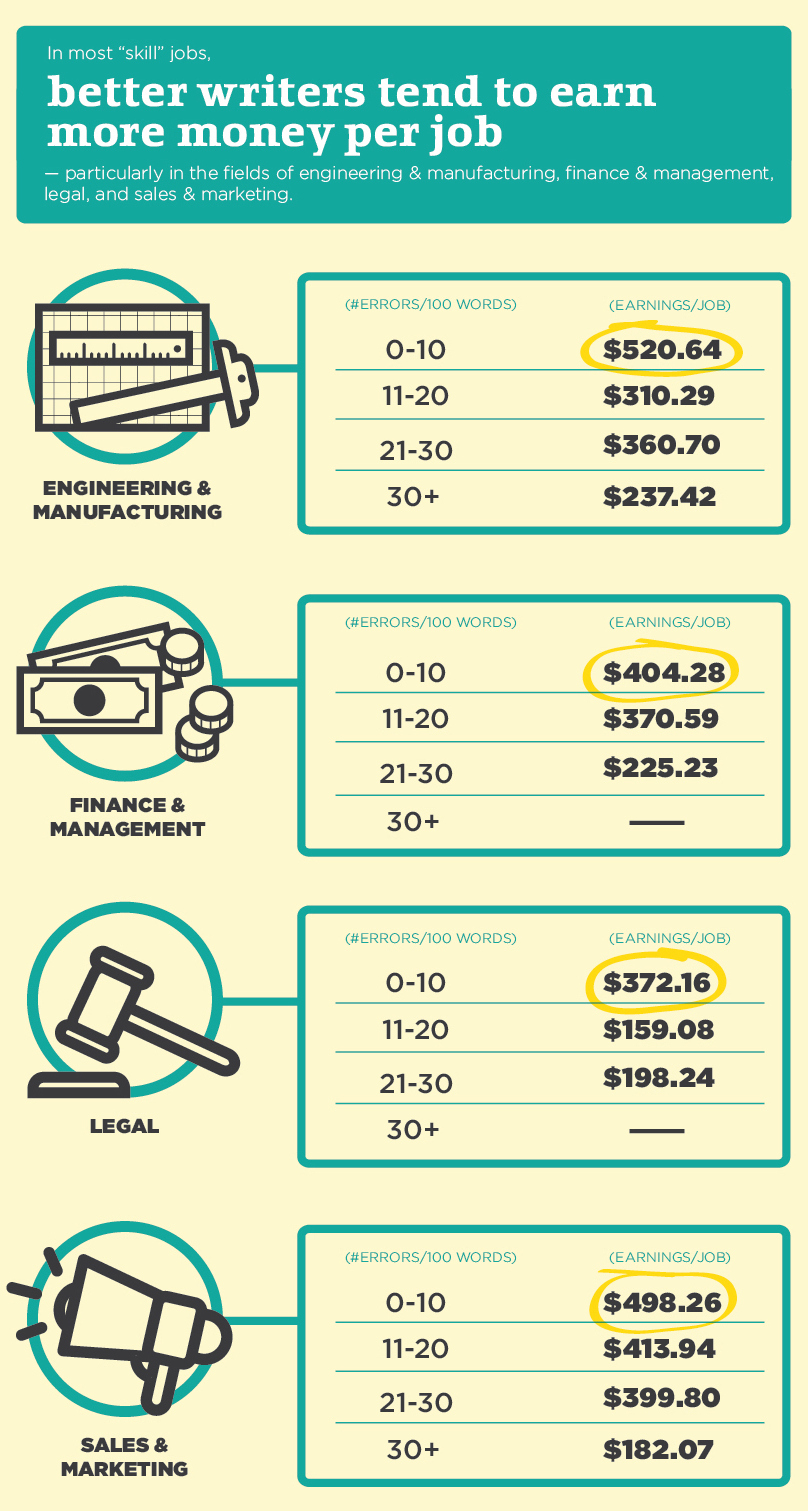
Grammarly found that an engineer who made 10 or fewer errors per 100 words written in their online profile earned on average $521 per project while an engineer who made 30 or more errors earned less than half that.

Similarly, lawyers who made less than 10 errors per 100 words earned $372 per job, while those that made three times as many errors earned only $198.

Overall, it found that freelancers who made the fewest mistakes received the highest reviews from their employers – those who made the most mistakes were rated much lower.

In short, accurate writing increases credibility, hireability and pay.

writing_skills_matter(1)-001

Grammarley survey: writing well pays better

Journalists and others that write for a living will be pleased to know that – according to the study – writers make the fewest mistakes, followed closely by those in admin and  legal roles.

While it was perhaps not surprising to find that IT professionals make more mistakes on average than any other professional – almost one in every five words – it was alarming to learn that those in leadership positions (in finance and management roles) are almost as bad.

Perhaps it explains why big companies all hire expensive public relations executives – to find and correct all those top management mistakes, before they become public relations disasters.

34d1609

Freshlyworded.com is also giving away one free premium access account to Grammarly. Just send your name and email to freshlyworded@gmail.com – The first email received will win the premium pass.

In memorium: the suburban video store

The joy of browsing for a movie...fading fast

The joy of browsing for a movie…fading fast

We watched a lot of DVDs on our recent family holiday on Phillip Island, courtesy of the local video store. We found Phillip Island Video Hire by chance, on the second evening of our holiday, while taking a stroll after dinner. Behind the counter, the spectacled, purple-haired proprietress, wearing a tie-dyed T-shirt saved us from a twentieth viewing of ‘The Shawshank Redemption’ (in video format!) and the ultimate horror, enduring Jar-Jar Binks again and ‘The Phantom Menace’. Our holiday home was a cozy little cottage with a wood-burning fireplace, a TV the size of a postage stamp, one of those technological relics – a combination video and DVD player – and a small pile of reject videos and dust-covered DVDs. Thank god for the local video store! In the evenings, once our little girl was sound asleep, we’d brew tea, bring out the Tim Tams and stretch out in the darkened lounge, illuminated by the flickering orange fire, and watch a movie. (Our selections included the excellent ‘Kill the Messenger‘, the very watchable ‘November Man‘ and Australian-made crime drama, Son of a Gun) While it’s perhaps not that surprising to find a video store still in operation in a coastal holiday town like  Phillip Island (alongside second-hand bookstores and surf shops) in the suburbs of Melbourne and around the world, video stores are dying out in their droves, losing customers to a plethora of cheap video streaming services (Stan, Presto, Netflix, iTunes to name a few) that deliver movies instantly to your home TV, illegal downloading and DVD piracy. Rising rents have also hurt. In the past six months, two local stores – a Blockbuster and a Video Ezy  – have closed in Niddrie, leaving our northern suburb without a video store. (For more stories on video store closures read here, here and here). In place of our local Blockbuster, there is now a giant Pet Warehouse (with DIY dog wash) while a little further down the main road, Video Ezy has been consumed by the neighbouring medical centre. Like the demise of newspapers, the internet or ‘technological progress’ has killed the suburban video store – what was once a fixture of every retail strip, high street and shopping complex alongside Chinese takeaways, bottle shops and pizza joints. More than that, it’s killed a tradition that I, as a child growing up in South Africa in the late seventies, eighties and nineties, remember fondly. In those day, a trip to the local corner video store in Germiston – a mining town about 20 minutes from Johannesburg –  was something to get excited about. It was a family outing!

betamax

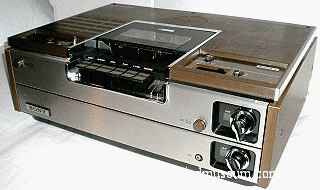
We had a Betamax player, similar to this

Our store, Cachet Video, rented out not just movies, but video players as well, firstly Betamax and later VHS players, decades before the arrival of DVDs. I remember, fondly, our top-loading bulky brown Betamax player with a remote control that connected to the machine by cord and which was at one point, the envy of our street. There was the fun of browsing and choosing and I loved turning over the age-restricted movies – when no one was looking – to see what scenes from the movie were on the back. The video store proprietor stood behind a counter in the corner, like the lord of home cinema (also the owner of the attached convenience store South Africans call a ‘cafe’), who would pull out a hand written card bearing our account information when the time came to exchange our empty boxes for actual movies. Having checked we still had credit, he would then disappear into a cavernous back room and return with the precious movies.

Where Cachet Video once stood, an iconic childhood memory

At one time ,the premises of Cachet Video, Germiston, South Africa

A rental transaction always concluding with my mother or father asking: “How many moves do we have left on our account?” Being a conservatively-minded family, my parents only allowed age appropriate selections, but I confess, that on holidays, when my parents were at work and my siblings were elsewhere, I’d race down to the video store on my maroon-coloured 24 speed bike, rent a movie like Police Academy or Revenge of the Nerds, where there was a guaranteed fabled topless scene. The proprietor looked me up and down – shaking his head, or so I imagined – but never said anything when I sheepishly handed over the video box. Then I’d race back to watch the film, fast forwarding to the ‘important scenes’ and then furiously cycle back to return the movie, before my parents returned home. Later in life, when slightly more mature (and having a car), I made many trips to Johannesburg video establishments like Video Spot on Jan Smuts Avenue, Hyde Park, with its vast collection of art house films and foreign movies to choose from.I remember what I thought at the time were ingenious arrangements of films by actor (Clint Eastwood, Robert De Niro, Al Pacino etc), director (Coppola, Spielberg, Scorcese, Allen etc) and franchise (The Godfather, James Bond etc).

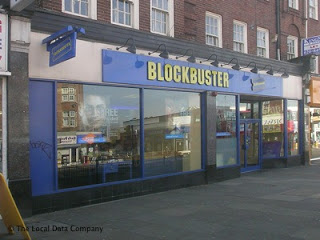
The Blockbuster store, Golders Green

The Blockbuster store, Golders Green

Later, living in London, there were numerous trips to the Blockbuster video store on Golders Green High Street  (now also closed). In the afternoon, we’d wonder down in a group to choose a weekend movie or two, stopping on the way back home at the local Turkish Shop for cheap wine, pita, dolmades, dips and snacks. On one occasion, we forgot to return a movie before going on holiday for three weeks – the Blockbuster bill was about 60 quid. Living in Sydney, my wife and I and often the dog walked up William Street, past the drunks and prostitutes to the video store in Darlinghurst to rent episodes of The Office and The Sopranos. In Melbourne, it was Blockbuster of Video Ezy (or Video Sleazy as some called it) where browsing the aisles for a movie became a regular weekend fixture, invariably accompanied by a Thai curry. Even in the comparatively boring Niddrie Blockbuster, there was always the $2 section of classics, where you could find an old Woody Allen or re-acquaint yourself with a Clint Eastwood early Western. And there were the familiar faces – the small Asian man who ran the shop (and dished out the fines) who was close to tears when it closed down, the geeky guy with the half-formed goatee often on the phone reminding customers their movie was due back three days ago and the nerdy film buff – plus the huge selection of American candy, merchandise and figurines. Now all that’s left are a couple of self-service kiosks where there’s invariably someone standing behind you sighing heavily, while you try to choose something from a pathetically inadequate collection. So, I shed a tear for the video stores of my youth, my adolescence, my adulthood and my fatherhood and raise a glass to the nerds, geeks, rude bastards and eccentrics who worked in those stores. In fitting tribute, the classic video shop scene from Clerks:

All hail The Waterboys

waterboysThe fact was I could not sell my spare Waterboys ticket.

“Who are The Waterboys?”

That was the common response I got when I told people I was going to their gig at the Melbourne Recital Centre this past Friday night and had a spare ticket.

“You know that song ‘The whole of the moon’” and then I would badly hum the tune.

“Oh yes THAT song” was the reply. Others had never heard of the band formed by Scotsman Mike Scott  in 1983.

It was about 14 years since I last saw them perform at a folk music festival in Finsbury Park, London, headlined by Neil Young and Crazy Horse, which also featured the late, great Gary Moore.

It poured with rain that day and my chief memory is dancing in the mud to classic Waterboy songs like ‘Fisherman’s Blues’, with its glorious, rollicking fiddle melody, the mournful ‘Bang the drum’ – surely one of the most beautiful songs ever written – and the storytelling charm of ‘A girl called Jonny’.

Mike-Scott

Waterboys singer-songwriter Mike Scott

Age has not diminished the Dylan-esque voice, guitar and piano playing, and showmanship of Scott (a folky Mick Jagger) nor the wonderful fiddle playing of Steve Wickham, (considered the best rock fiddle player in the world by many) who gives The Waterboys their distinctive folk sound.

It was wonderful hearing all these songs again third row from front in an auditorium designed with the acoustics for classical music concerts.

The band performed five or six songs from their latest album – Modern Blues (against the backdrop of the album’s cover, a giant ‘nature man seemingly conducting music from a field of lavendar) – beginning with the rocking ‘Destinies Entwined’ and creating that rich ‘wall of sound’ with organ, keyboards, fiddle and guitars, before moving into familiar storytelling mode with the ‘The girl who slept for Scotland’, the cheeky ‘Rosalind you married the wrong guy’ and ‘Nearest thing to hip’ about the demise of British shopping streets, where the cool shops have all been replaced by bland chain stores.

By the end of the near two hour set, many people were dancing in the aisles, cheering and stomping their feet.

And next to me was an empty seat, a missed chance to see one of the world’s best rock-folk bands in blistering form.

For a taste of what you missed, Fisherman’s Blues by The Waterboys

“Fisherman’s Blues”

I wish I was a fisherman
Tumblin’ on the seas
Far away from dry land
And its bitter memories
Casting out my sweet line
With abandonment and love
No ceiling bearin’ down on me
Save the starry sky above
With light in my head
You in my arms
Woo!

I wish I was the brakeman
On a hurtlin’ fevered train
Crashing a-headlong into the heartland
Like a cannon in the rain
With the beating of the sleepers
And the burnin’ of the coal
Counting the towns flashing by
In a night that’s full of soul
With light in my head
You in my arms
Woo!

Tomorrow I will be loosened
From bonds that hold me fast
That the chains all hung around me
Will fall away at last
And on that fine and fateful day
I will take thee in my hands
I will ride on the train
I will be the fisherman
With light in my head
You in my arms

Light in my head
You in my arms

Melburnians – enjoy the world’s best liveability while it lasts

traffic jam

Gridlock: where Melbourne is heading

Melburnians love to crow about Melbourne’s long-running status as the world’s most liveable city.

Melbourne has ranked top city in the world for the last four years in a row according to the Economist Intelligence Unit’s liveability survey – with Sydney a lowly seventh.

Melburnians rightly love to lord it over Sydneysiders and other global city dwellers, but I’m afraid our world’s best status is fading fast.

I could point to a hundred different articles (try this one on urbanisation by Fairfax economics writer Ross Gittins) or extensive research data to explain that we are building upwards at such a rate but without the necessary investment in transport infrastructure to get everyone to and from work, schools and the shops. 

My own daily commute into work is a good case study of the looming chaos that awaits. It begins with a short 15 minute bicycle ride from my home in Niddrie in the northern burbs to Essendon Station, where the Craigieburn line stutters along towards the city, 15 kilometres away.

What a year ago was a pleasant cycle down a quiet backstreet, where I could drift off into my own thoughts, is now a busy road packed with frustrated people-movers, utes, sedans and station wagons, who weave past me in desperation to avoid the gridlock on the main thoroughfare, Keilor Road.

Even this far out from the city, any vacant lot, deserted car yard or decrepid office building is giving way to an apartment block with dozens of units crammed on top. On the quieter streets, old houses have been bulldozed and replaced with three townhouses. 

 More people, more cars, same roads, same frequency of trains and trams. 

At Essendon Station, Rose Street is most days clogged with cars and buses while the train platform is just as crowded, heaving with already weary-looking fellow commuters.

melbourne platform

Flinders Station, Melbourne

There’s a collective groan as the citybound train pulls in and commuter’s faces stare back from inside carriages, pressed against the glass.

And that’s on a good day when there isn’t a dreary announcement about a train cancellation forcing two sets of commuters onto the same train, resulting in carriages packed so tightly you fear getting an itch you could never scratch.

Finally, twenty minutes later we pull into Southern Cross station. I extract my head from under a stranger’s armpit, apologise for inadvertently rubbing my backside against a pensioner’s bald head (hey, at least they got a seat), exhale, and make my way towards the escalators and the exit. Here a gang of transport Gestapo (train police) are usually standing by ready to spear tackle the elderly, children, mothers with babies and minority groups, should they have forgotten to swipe their Myki card.

Lucky for me I fit none of those categories.

queen liz

Fit for a queen? I think not!

Yet more fun awaits me later in the day when I hop onto a tram on Collins or Bourke Street for a meeting uptown – the geniuses who came up with the idea of free CBD trams seemingly did not factor in that every man, woman, child, homeless bum and confused tourist now chooses to take a tram rather than walk a city block.  Tempers flare as we all contort ourselves into weird shapes and postures. The tram driver, oblivious to the gang of drunk vagabonds that have boarded the train with shopping trolleys, four large dogs and a spicey pepperoni aroma, yells out that he won’t close the doors until we get off the steps.

Cursing under my breath, I decide to walk back to the office from my meeting…

Liveability my ass.

Melbourne’s crown is slipping as the city grinds towards eventual gridlock.

Anyone who takes a bus, train or tram – or is crazy enough to drive into work – can surely see that for themselves. The old cliched saying of “what goes up, must come down” applies when “up” means high rise apartments and “down” means liveability without investment in public transport

South Africa, cricket, the World Cup and the impossibility of victory

The coveted but elusive ICC Cricket World Cup trophy

The coveted but elusive ICC Cricket World Cup trophy

If South Africa beat Sri Lanka on Wednesday in their cricket World Cup quarterfinal, it would be our maiden knock-out victory in the game’s show piece tournament since we first competed in Australia in 1992.

I suppose most fellow South African cricket fanatics know that miserable little fact already.

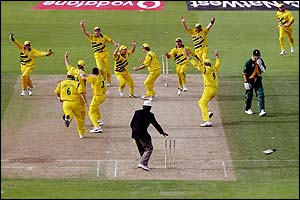
The closest we have come to winning a knockout game is the heart-breaking semi-final tie with Australia in 1999, a game we should have won  but where we lost our heads completely instead.

It’s arguably the worst moment in South African sport since re-admission in the early 1990s, and not in my humble view the greatest one day game of all time (Mine would be the record-breaker in 2006).

In truth, the cricket team has borne the brunt of the nation’s on-field sporting disasters (rugby, soccer, golf, athletics, swimming even rowing have all produced champion teams and athletes). Our World Cup cricket teams have promised so much, but delivering so little.

In fairness, it hasn’t all been about choking in knock-out games, South Africa’s run at World Cups has been ended by a mixture of bad luck and a lack of big match temperament.

brian mcmillan

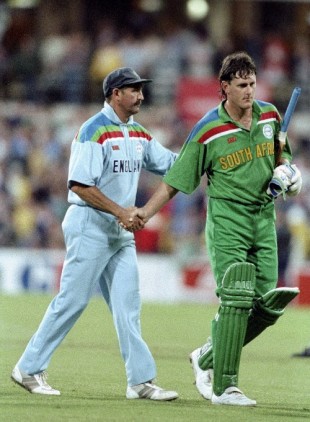
Losing in the first of many cruel fashions in 1992 against England

Perhaps if the rain had not intervened in the semi-final loss in 1992 to England (when a possible 22 runs off 13 balls became a silly 22 runs off 1 ball) we might have gone on to win the tournament on our first try. What a fairy tale win that would have been! And who knows how it might have changed our fortunes in later tournaments.

Instead, the ‘choker tag’ has steadily gained weight from the quarter-final loss to the West Indies in 1996 (after we were unbeaten in the group stages), the1999 tie/loss to Australia, the 2003 exit at the pool stages after miscalculating the run chase in our Sri Lankan game affected by rain), the 2007 big choke against Australia in the semi-finals and 2011 loss to a weak New Zealand team.

So here we are again – at the crossroads – ready to wear the choker tag again if we fail against a good but easily beatable Sri Lankan side, who are already playing up their superior psychological mindset through their coach, Marvan Atapattu:

“[Our better records in World Cups] is something that will work in their minds.”

Even if we do pull off a maiden knockout win, there’s still two more games and unbelievable pressure – the kind in which Australia, Sri Lanka and India have thrived but we have succumbed too like a mismatched boxing opponent.

South African captain AB De Villiers – arguably the best one day player in the world – has been boasting of the team’s status as the favourites – despite two bad performances against India and Pakistan in the group stage. He told ESPNCricinfo:

“I 100% believe we are the best team in the tournament here.Those two losses in the group stage did hurt us a bit but we are past that now. We know where we could have won those games and we weren’t that far off. We know we are very close… three games away from taking that World Cup home.”

Does he believe that? And more importantly does the team?

I have my doubts, this is a team peppered with great players (De Villiers, Dale Steyn, Hashim Amla to name three)  but it’s not played like a great side…well not yet anyway.

I would love to be proved wrong. Nothing would give me more satisfaction than watching the Proteas lift the coveted trophy – it would make up for a lot of years of hurt.

But my gut says otherwise. I’d be surprised if we beat Sri Lanka on Wednesday and even more surprised if we go all the way.

(My final prediction: Australia v New Zealand, Australia to win)

Andre Agassi’s odyssey and the death of flamboyant tennis

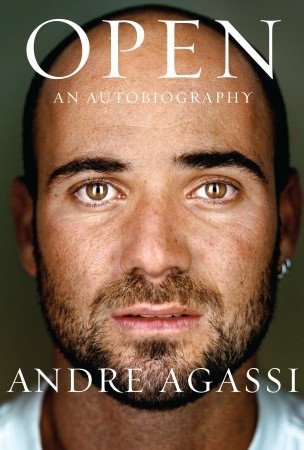
agassiReading Andre Agassi’s autobiography, Open, you realise how boring men’s tennis has become.

No wonder they are trying to re-invent the game with a new idiotic format, Fast 4 tennis.

Tennis players these days by and large remind me of Ivan Lendl, the gaunt Czech number one who dominated the game in the late 1980s winning eight grand slams. Lendl had the charisma of a can of tuna (the no name supermarket brand). Expressionless, machine-like, Lendl wore opponents down with relentless accuracy. (Jim Courier was another mind-numbingly boring player to watch and even worse, to hear these days as a commentator).

The current world number one, Novak Djokovic, is very much Lendl-like, and while we all admire Roger Federer as the greatest player of the modern game – Agassi calls him “the most regal player I have ever known” – flamboyant he is not. Ditto Andy Murray. Perhaps only Rafael Nadal in full flight has something to captivate the imagination.

Andre Agassi burst onto the tennis scene at about the same time Ivan Lendl was at his peak and as the game’s other great entertainer – Enfant terrible John McEnroe – was nearing the end of his career.

Complete with enormous hair (actually a hair piece because he was going bald), earrings, colourful outfits and the most amazing return of serve and ground strokes the game has ever seen, Agassi shook the tennis foundation to its core, reaching his first Grand Slam final at the French Open in 1990 aged just 19 and winning Wimbledon two year’s later, a tournament he admits to hating for its rules and snobbery.

Winning Wimbledon in 1992Agassi ended up winning just as many grand slams as Lendl, (he won all four majors, something Lendl never achieved) doing so in an era dominated by another machine-like competitor, Pete Sampras. Without Sampras to thwart him, Agassi could have won as many majors as Roger Federer.

All the more amazing his success, given that Andre Agassi hated playing tennis.

“I hate tennis most of all,” he tells his friend, the actor Kevin Costner soon after winning Wimbledon, in Open.

“Right, right. I guess it’s a grind. But you don’t actually hate tennis.” – Costner says. “I do,” Agassi replies.

This conversation repeats itself throughout the book, becoming almost its mantra.

Forced to practice for hours and hours under the Las Vegas sun by his mad Iranian father and later sent away to be force-fed tennis at the Nick Bollettieri academy, Agassi says he despised tennis.

The problem is, he wasn’t much good at doing anything else, so he stuck to it, becoming, against the odds, one of the all time greats.

One of the most enjoyable aspects of Open is the window Agassi gives into the world of professional tennis. The endless travel and hotel rooms. The dieting and fitness regimes. Overcoming injuries. Dealing with hostile sports journalists. Encountering rivals and finding ways to beat them. The physical and mental strain of competing and the agony of losing.

Of course there is also the joy of numerous come from behind victories, his most incredible being at the French Open in 1999 – a tournament which marked Agassi’s comeback from injury, disillusionment, dabbling with drugs and extracting himself from a soulless marriage to the actress, Brooke Shields. Agassi, ranked 141 in the world, fought back from two sets to love down against Russian battler Andrei Medvedev to win in five sets. Rousing himself from the jaws of defeat, Agassi writes brilliantly about how he started to win the mental battle after winning the third set:

He’s (Medvedev) has had too long to think about winning. He was five points away from winning. Five points, and its haunting him…

Open is a real ‘rags-to-riches-to-rags-to riches’ tale and Agassi tells it well, especially when he’s in the cauldron of the packed arena slogging it out, somehow finding the will to win. His battles with Pete Sampras in particular are riveting blow-by-blow accounts of epic encounters.

Agassi comes across asschmaltzy, painfully honest and very likeable – the same can not be said for Jimmy Connors (a pompous prick), his ex-wife Brooke Shields (a vacuous airhead) and to an extent Pete Sampras (the accountant of the tennis world).

His coach Brad Gilbert, who helped turn his career around, comes across as an eccentric genius.

Agassi’s pursuit of Steffi Graf – told with embarrassing relish – is quite comical, particularly, the numerous rebuffs, but the lashings of syrupy cards and flowers leave one feeling a tad ill. The same can be also be said of Agassi’s choice of inspirational music which includes Michael Bolton, Celine Dione and Kenny G and his brief dalliance with “finding God”.

Whatever his musical shortcomings or sugary sentimentalism, no one has since entertained quite like Andre Agassi, who played his last professional match – almost ten years ago – at the 2006 US Open.

And Open is one of the best accounts of a life of tennis you will ever read.

How to win cricket world cups: win the toss, bat first

ICC-Cricket-World-Cup-Trophy-2011

The illusive ICC World Cup Trophy

I never stayed till the end of the India v South Africa game on a steamy night at the MCG.

As the sixth wicket fell and the sea of orange, white and green Indian flags waved triumphantly in the packed arena, and as we (meaning South Africa) began our all familiar world cup capitulation, I got up and left.

India had scored over 300 and we were about 150/6 with 20 overs remaining. It was a hopeless situation, one South African fans are all too familiar with at world cups, particularly at the knock-out stages.

In five world cup knockout games South Africa have played since their debut in 1992, they have lost four and tied one (THAT game against Australia we should have won in 1999 before the greatest choke in the history of sport).

1999: snatching defeat from the jaws of victory

1999: snatching defeat from the jaws of victory

To win world cups is a mixture of skill, luck and nerve: we have plenty of the former and not much of the other two.

But if South Africa do – as expected – make the quarterfinals and then somehow win their way through to the final, this is the surest way to win the competition:

One
Win the toss

Two
Bat first

Three
Score at least 250

(If we lose the toss, bowl them out for under 150 or less)

Winning the toss is important, but only if you take advantage of it by choosing to bat.

In the 10 world cups played to date, seven have been won by the team batting first.

This is not all that surprising. Cricket is a game of nerves, of who blinks first.The pressure is so much greater batting second. Recovery is so much harder if you get off to a poor start, and if it’s a day/night game, conditions are usually tougher batting second under the lights.

That’s unless you’ve got only a small total to chase.

In 1996 Sri Lanka chased down 240 odd against Australia and in 1999, Australia only had to score 132 against Pakistan.

The only time a team has chased down a sizeable total and won the world cup was in 2011, when India chased down 274 set by Sri Lanka, winning with 10 balls to spare thanks to an MS Dhoni special.

The cardinal error though is to win the toss and choose to field. Only one team has done that and ended up on the winning side: Sri Lanka against Australia in 1996.

In the first three world cup finals won by West Indies twice and then Australia, on each occasion, the team that won the toss chose to field and lost the game. It happened again in 2003 when India won the toss, chose to field and Australia amassed 359/2.

So my message to AB De Villiers, if we somehow start playing well enough and make it through to the final is simple:

Make sure you win the bloody toss and for heaven’s sake, BAT FIRST (and then post 300 plus!)

I know, I know…

But, we are allowed to dream, aren’t we?

Dealing with my Twitter addiction or: please be kind and retweet

twitterHello world. My name is Larry Schlesinger and I am an addict.

It’s not crack cocaine, or alcohol or heroin or chocolate that I can’t get enough of.

I am addicted to Twitter. I make this confession openly and honestly and promise to change.

I realised I was addicted to Twitter – really realised – when I sat down on a Tuesday evening last week in front of the television to watch an episode of my favourite show, the UK detective drama Midsomer Murders. As the killer was unmasked by Detective Inspector Tom Barnaby of Causton CID, I was completely clueless as to how the great sleuth had reached this stunning conclusion (Who would have thought it was the priest with a limp in love with his brother’s ex-girlfriend?)

The truth was I had completely lost track of the plot, Christ, I didn’t even know who the main characters were anymore.

It was all because of Twitter.

It seemed impossible that I could go more than 15 minutes of a Midsomer murder (in some quaint flower-encrusted cottage) before, with sweaty palms and gritting teeth, I yanked my phone out of my pocket and ravenously checked the updates on my Twitter feed.

Had I missed something? An explosion? A plane crash? A new government crisis? Had Tony Abbott spontaneously combusted? Had someone cooked a hamburger all by themselves? Or remembered the name of their dead pet parrot? Or decided they liked the colour blue more than red?

How could I possibly go on watching Barnaby as he traipsed through the English countryside finding clues while all these important things were happening in the lives of others – some of whom I don’t even know?

And then the utter ludicrousness of it dawned on me.What the f-ck was I doing? Had I gone mad?

Yes, Twitter is without any doubt the most powerful social media device in the world bar none – I realised this the day someone at work yelled out: “Someone has just tweeted that Oscar Pistorious has been arrested for shooting his girlfriend” – but the addiction (and the envy: he has how many followers???) came much later.

Never mind breaking news about really significant events – where Twitter has its true power – I had to know the insignificant minutiae of everybody else’s lives – and tell my eager 1,500 or so followers all the boring crap about my own. Had it really come to this?

Of course I am not the only one addicted like a twit. There are millions of us updating the world about ourselves, 140 characters at time. We’ve all become experts at the “#” and “@”. We know what’s trending. We know who said what to whom.

Get on any train in Melbourne or Sydney or Paris or London, or a bus in Dar-es-Salaam of Caracas, or a camel in Morocco and there will be someone tweeting or retweeting or favouriting or replying.

The kind of crap you used to mutter to yourself on a lonely stretch of highway as the tumbleweeds drifted buy  – that’s what’s become breaking news in the Twit-o-sphere.

– I just saw a dog that looked like my grandpa. Better tweet that.
– What a beautiful row of palm trees. Better tweet that. Etc etc.

I am pleased to say I am dealing with my addiction, though temptation is the route of all smart phone evil.

For the last two days, there has been no Twitter and no inane tweeting after work. I’ve actually given my wife and my daughter my full attention between the hours of 6.30pm and 8.30pm. It’s been a struggle, my palms have been itchy, my fingers twitching, seeking out the phone I’ve stuck in a locked drawer, but I’ve managed…somehow.

Home in the evening has become a Twitter-free zone, especially as the bodies start dropping all of over Midsomer County, the deadliest county in England.

Baby steps, Baby steps…each day is a struggle, but I think it is getting easier.

I’m so pleased with myself, so delighted with my progress that I think I’ll celebrate. Yes, this is what I will do: I’ll compose a little congratulatory message to all my ‘friends’.

Exactly 140 characters.

The freshlyworded 2 minute review: ‘Compliance’ – a very disturbing experience

Compliance_Movie_PosterWhat’s being reviewed?

Compliance

What is it ?

A movie made in 2012.

What’s it about?

Based on a true story – or more accurately many true stories – Compliance is about a hoax phone call made to a fast food joint. The caller pretends to be a police officer and forces Sandra, the manager of the story to detain and strip search Becky, a pretty, blonde employee who works behind the counter. ‘Officer Daniels’ says Becky stole money from a customer and is being investigated for other crimes. He tells Becky she can either be stripped and searched in the back office of the restaurant or be taken to the police cells and locked up for the night. Later when the restaurant gets busy, Officer Daniels suggests that Sandra put a male in charge of watching over Becky, now naked, except for an apron…

If you only know one thing…

As unbelievable as it sounds, this film is an accurate depiction of real events at a McDonald’s in Mt Washington, Kentucky in 2004. It is one of about 70 hoax calls made across the USA where the caller duped managers of fast food outlets into strip-searching, humiliating and sexually abusing customers and staff. The caller was thought to be a 38-year-old prison warden, who was brought to trial but found not guilty by a jury due to lack of direct evidence. The caller used a disposable mobile phone and a pre-paid call card.

Is it any good?

Yes,I found it utterly engrossing and very disturbing. The acting is excellent and needs to be for the audience to accept the unlikely series of events that unfold. The acting is particularly good from Ann Dowd, who plays the do-good manager Sandra, Dreama Walker as Becky and Pat Healy as the creepy Officer Daniels.

What I liked most about it?

It’s voyeuristic quality, where it draws the viewer in and makes them almost complicit in the vile acts. It also makes you question, how you would behave in the same situation, from each character’s point of view. You want to watch and turn away. I also like the setting. The film is set almost entirely in a fast food restaurant called ChickWich on a snow winters day. The diabolical deeds go on in the back office while customers eat burgers and chips, drink sodas and socialise.

Famed film critic, Roger Ebert liked the film: “There is the uncomfortable realization that if a TSA agent (the person who screens you at a US airport) wanted to strip-search us at an airport, we might agree. Or would we? Would you?”

An interesting thing to ponder:

While you may balk at how easily Sandra, the store manager was sucked into the hoax or be disgusted at how Van, Sandra’s boyfriend followed orders, a famous 1960s experiment by behavioral scientist Stanley Milgram found that subjects would administer potentially lethal – so they believed – electric shocks to others even though they could hear their screams and pleadings through the wall. They did so because Milgram,  dressed in a white laboratory coat, stethoscope and clipboard, represented authority and most test subjects simply obeyed his orders.

How much time do you have to invest?

Compliance is just over an hour and twenty minutes long.

How do I watch to it?

If you’re living in Australia, you can watch Compliance for free on SBS on Demand (as of February 2015). Otherwise, search for it online. Here’s the official website.

Can you recommend something similar?

Happiness, a film made in 1998 by Todd Solondz filled with weirdos and perverts, plus a great performance by the late Philip Seymour Hoffman.