An Australia Day contemplation on becoming an Australian

australia dayA week ago, I rang up the Department of Immigration to enquire about a passport matter.

Whilst on the phone, I asked the woman on the end of the line if she could tell me when I would be eligible for Australian citizenship.

To my surprise, she told me it was mid-March…this year.

I’d expected to be told it would be a couple of years off.

Despite having lived here for over 8 years (and qualified enough in my eyes as my tax returns can attest) I know all too well that there are convoluted rules about how long you must be in the country on certain visas before you can, in the words of Peter Allen (or Qantas), “call Australia home”.

Forests in Tasmania have been decimated to supply the paperwork to complete previous visa applications: two for a work permits and one for my spouse visa.

But that of course is the Australian way.

Finding out about my upcoming dual citizenship opportunity has got me thinking a bit more about what it will mean to be an Australian, provided the spooks (ASIO) don’t deem me a security risk, and send me to the Ecuadorian embassy in London to join Julian Assange, or worse, Pretoria.

Should I pledge my allegiance to Dick Smith and only buy Australian-made products, even if they cost more?

Do I now support the Wallabies, the Kangaroos, the Baggy Greens, the Socceroos, the Olyroos, the Hockeyroos, the Boomers, the Diamonds, the Matildas, the Opals and the Koalas?

Do I have to shout for Lleyton Hewitt? Do I? Do I?

And must I call the mayor the “mare”?

So much to ponder!

Finding out about becoming an oke ‘Stralian has also coincided with the run up to Australia Day tomorrow (January 26) with the nation getting the day off on Monday.

I’ve always had mixed feelings about Australia Day.

My mind always seems to conjure up images of drunken yobbos, Australian flags draped over their shoulders like capes, stomping on cars and hurling abuse at anyone not white enough, as happened in Manly a couple of years back.

And I also tend to think of that famous Australian “pride” t-shirt. You know the one that says:

“This Is Australia – We eat meat, we drink beer and we speak f#ckin english!”

Losely translated it means:

“Unless you’re white, kindly f*ck off”

Strangely enough, this Howard-era slogan has not quite disappeared under the slightly left-leaning Labor government.

Instead, it’s morphed into:

“This is Australia: We  eat meat, we speak English, but if you have $5 million, we couldn’t give a f*ck”

Not quite as catchy I admit, but true.

The ‘$5 million, no English’ required refers to the new ‘Golden ticket’ visa – or the more official sounding Significant Investor Visa – the government is giving out to anyone who can stump up a wad of cash, no matter if they speak Martian.

At the same time, they’re deporting refugees who arrive by boat to remote island hell-holes or forcing them into poverty on the mainland, by not allowing them to work.

Which of course brings me to the issue of who I am going to vote for, since voting is compulsory (a strange phenomenon I have yet to get my head around) and there is an election coming up towards the end of the year.

I was never  a fan John Howard and Mr Speedo (Tony Abbott), Shrek (Joe Hockey) and Condeleeza Rice’s cousin-from-another-mother (Julie Bishop) hardly seem much better.

Perhaps if Malcolm Turnbull took charge I’d consider it. Or maybe I’ll have consider the Greens. I’ll have to do some reading.

On that note, I’ve been reading up about what Australia Day really is all about.

Officially, it serves to commemorate the arrival of the first British fleet of convict ships in 1788 and the laying of the foundations for modern day Australia.

But it seems to mean different things to different people, or nothing at all.

The white bogans in the far outer burbs, rusty cars parked on unkept lawns, pit-bulls at the ready, use the occasion to lament the days when Australian culture was whiter the washing washed in OMO.

The aborigines call it invasion day, and who can blame them.

The government talks about celebrating everything that’s great about Australia, but usually just end up in fisticuffs with the opposition, or as happened last year, with the prime minister being unceremoniously dragged off by her security personnel after Tony Abbott had fanned the flames of aboriginal anger.

As for new citizens-to-be like me?

We’re still trying to figure out the bloody rules to Australian football, ponder why football is called soccer and rugby football, and why that red-faced balding geezer who once coached the Wallabies is still on the radio.

Perhaps on Australia Day this year, I’ll just take inspiration from that marvellous Paul Hogan ad from the 1980s – you know the one where he talks about:

“The land  of wonder, the land down under“.

And throw a couple of shrimps on the barbie.

A tribute to Melbourne’s marvellous multiculturalism

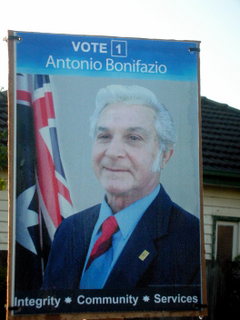
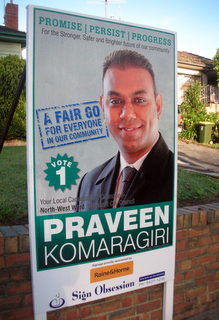
Spring in Oak Park, has been heralded, not just by the emergence of colourful blossoms on the trees, but by faces bearing even more colourful names like Bonafazio, Komaragiri, Yesilyurt, El-Halabi and Yildiz.

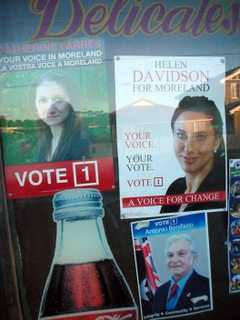
They’re all on posters stuck into front yards, on shop windows, along busy streets, in front of schools and businesses in preparation for Moreland Local Council elections on October 27.

Some are huge portraits printed professionally on glossy metal signs, with enormous faces smiling back at you and catchy slogans, while others are barely larger than a coffee table book.

“Your voice, your vote.”
“Promise, persist, progress.”
“A voice for change.”

Olive skins, shades of brown. And white. They are the sons and daughters of immigrants from Italy, Turkey, Lebanon and India. Some are immigrants themselves.

Like Antonio Bonifazio (pronounced Bo-ne-fa-zee-o), who I met for coffee at the McDonalds on Pascoe Vale Road.

He’s a 68-year-old retiree, with a full head of silver hair, silver side burns, a twinkle in his eye and a mischievous smile, which lights up his face when ever he tells me about the victories he has had over dodgy builders, lax council officials, car yard dealers and Essendon airport.

He arrived on a boat from Sicily in 1954 with his mother, just eight-years old.

“I was called a dago at school and was getting into fights because of it,” he tells me.

But he gave as good as he got, though it’s hard to believe, looking at this genial father of five and with grandchildren in the double-digits.

Though his early life in Australia was not easy -he left school at 14 and worked as trimmer at suitmaker John Sackvill to support his family and once, nearly cut his thumb off –  he later went to night school and became a motor mechanic and ran his own workshop, before retiring 10 years ago.

But rather than slow down, retirement has energised Bonifazio, who apart from gaining a degree of fame when he took on and won against electricity firm Jemena, over a $200 charge to remove a disconnected meter he never used. He has also become something of a local hero, acting on behalf of neighbours and friends in Oak Park, representing them at VCAT disputes with builders who he says are “out of control”.

To date he has been successful in forcing them to lower garages, re-locate drainage pipes and lower the heights of buildings so they don’t peer over neighbours properties.

He says the Moreland Council not enforcing VCAT rulings and letting builders “get away with things” is one of the reasons he standing for council – to make them accountable.

Another candidate for north-west ward is Oscar Yildiz who has been mayor of Moreland City since 2008.

He is of Turkish descent. His father migrated to Australia in the late 1960s; he was born and raised in Moreland.

“The Word Yildiz means “star”,” he tells me, “as in galaxy or pop”.

An educator by profession and a father of two girls, he says that multiculturalism means “sharing, embracing and living harmoniously with the many cultures, traditions, rand nationalities in this beautiful country of ours”.

In his incoming 2011 mayoral speech Yildiz said: “Almost half of the Moreland residents speak a language other than English at home. There are 132 different community languages spoken in this city.”

He is campaigning on a platform of delivering the best return for rate payers in terms of infrastructure, sport and recreation, better elderly and youth services, better maternal health care and an efficient and effective waste service.

I also caught up (over email) with Zeynep Yesilyurt, who arrived from Turkey with her parents and siblings in December of 1977, as a 6 ½ year old.

“The origins of my first name are Arabic – apparently it means precious jewel.  My surname Yesilyurt translates to Greenland,” she says.

She is married to an Italian-Australian and says they have blended all three cultures into their lives.

“However, one thing that I will always maintain is the importance of family and of course the love of Turkish music.”

She says multiculturalism means being able to maintain aspects of your culture, traditions and beliefs and live in harmony with other cultures.

“It is also about respecting people’s differences and not imposing your own values and beliefs on others,” she adds.

Her campaign for a council seat is based on getting rates reduced.

“I have had street stalls, visited senior citizens groups and door-knocked and the burning issue for many residents has been the excessive rate rises over the last few years.

“With the rise of cost of living, pensioners and families are struggling to keep up.  Rates are now a big chunk of people’s incomes.”

According to the 2011 census, 35% 0f Moreland residents were born outside of Australia.

Common languages spoken in Moreland homes include Greek, Italian, Mandarin, a variety of Indian dialects, Maltese, Croation,  French, Dutch, German, Japanese and Macedonian.

Other Moreland Council candidates include Praveen Komaragiri, who hails from Secunderabad, located in the Indian state of Andhra Pradesh north of Hyderabad.

Another is Catherine Farres, whose poster reads “La Vostra Voce a Moreland” in Italian – “Your voice in Moreland”.

Halil Kaya has Turkish ancestory. Milad El-Halabi hails from Lebanon.

Alesio Mulipola is from Samoa.

All these interesting faces smiling back at me. The cynics would say they’re just politicians, and who can trust pollies these days?

But I see a tribute to the best of Australia’s multi-cultural heritage, about what it means to have a “fair go” or a “fair shake of the sauce bottle” to quote former prime minister Kevin Rudd.

I wonder, what kind of dull, bland, boring country Australia would be if we’d not open our doors to these people standing at the coal face of Australian politics.

Why Alan Jones is talking to himself

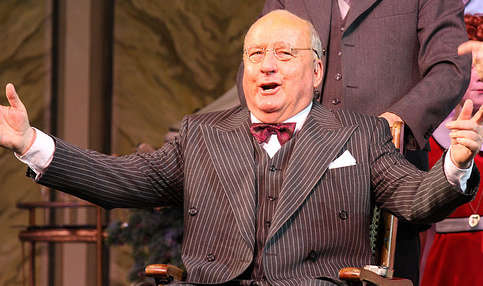
Alan Jones playing Franklin Roosevelt in AnnieThe first time I heard radio shock jock Alan Jones, I saw him as well.

It was soon after I arrived in Australia and was living in Sydney. It was September 2004.

This bald man with a round, red face and bulging eyes would appear on breakfast TV and rant on about something or other in a condescending tone, hardly seeming to take a breath. It would all be over in a couple minutes.

I found it vaguely amusing – knowing nothing at the time about who Alan Jones was or his place in Australian media and politics.

Over the years, I’ve gotten to know more about him, usually in relation to something disparaging he has said about women, the Labor party, minority groups, aborigines or  when he has bullied or and taunted someone on his show or in public (as was the case when he attempted to turn a rabid crowd outside parliament against Fairfax journalist Jacqueline Maley).

But I was also surprised to learn that he coached a successful Wallabies team in the mid 1980s to a famous Grand Slam in Europe and Bledisloe Cup win in New Zealand.

He spoke last year to Leigh Sales on the ABC 7.30 report about his opposition to Coal Seam Gas drilling and its impact on fertile farmland, a stance I support, but also defended his comments about throwing women like Prime Minister Julia Gillard into chaff bags and tossing them out to sea.

Asked how he picked his “issues” Jones explained:

“My listeners are my best researchers, so a lot of my issues are taken from the correspondence. I answer over 100 letters a day and I gain information from them.”

And who are these people who write into Jones’s show and inspire his campaigns?

I contacted 2GB and asked them to send me the media kit they send out to advertisers, which would, I thought, give information about the demographics of his listener audience.

But I never got a reply.

Then I came across a 2006 webpaper by Clive Hamilton of the Australian Institute titled “Who listens to Alan Jones?”

I emailed Clive Hamilton and asked him, if perhaps he had updated his study.

He replied: “I am not aware of any update of the information in the report, but I
doubt the analysis would have changed much. In fact, with the greater polarisation of politics what I said about Jones’s listeners is probably more true.”

With that in mind, I delved into Hamilton’s study, which is based on a range of sources and surveys including Roy Morgan research.

So who does listen to Alan Jones?

Firstly, they’re old.

“The typical Jones listener is an older Australian – 68% per cent are over 50,” says Hamilton in his report.

Secondly, they’re retiree-battlers.

According to Hamilton his listeners tend to be concentrated into two groups: “pensioners and others with incomes around the average”.

Thirdly, they are god-fearing.

“Only 10% of Jones listeners say they have no religious affiliation compared to 26% of other Australians”.

Fourthly, they vote for the Coalition.

75% of his listeners supported the ruling Coalition government at the time.

Fifthly, they’re disgruntled.

More than three quarters (77%) of his listeners believe that the fundamental values of Australian society are under threat compared to 66% of all Australians” and they believe that crime is getting worse.

As for the racist element, according to Hamilton’s report Alan Jones listeners are “less likely to believe that Aboriginal culture is an essential component of Australian society”.

Those with long memories may recall that in 1993 Alan Jones described the choice of aboriginal musician Mandawuy Yunupingu, the lead singer of Yothu Yindi as Australian of the Year as an ‘insult’ and claimed that Yunupingu only received the award because he is black.

And who can forget his comments that many claim incited the Cronulla riots including remarks like: “We don’t have Anglo-Saxon kids out there raping women in western Sydney”.

Delve further into the research and more conservative streaks emerge.

Only 13% of his listeners believe that gay couples should be allowed to adopt children (the national average in 2006 was 37%) and nearly 50% believe that homosexuality is immoral – findings that must surely sit uncomfortably with Jones, given questions over his own sexuality.

The research also finds that Alan Jones shows incredible favourable bias towards the Liberal and National Parties, while criticising almost every policy from Labor.

A bias that has clearly not shifted one iota between 2006 and October 2012, given the parade of Coalition politicians who appear regularly on his show.

Despite his audience representing a small, polarised section of Australian society, Alan Jones still seems to think that his audience represents the views of all Australians.

And that’s because they’re so much like him – just with smaller egos and a lot less money.

Perhaps one day he will acknowledge that who actually listens to his show are grumpy old white men living on the Western outskirts of Sydney, who ring in to his show to tell him the country is going to the dogs every time someone with a darker shade of skin colour or foreign accent moves into their neighbourhood.

But I doubt it.

Just recently he ran a poll on 2GB asking whether the massive irrigation farm, Cubbie Station in Queensland, should be sold to Chinese interests.

Not surprisingly, the vote was 99% against the sale.

I listened to a bit of the commentary that followed:

“Julia Gillard, Wayne Swan…they couldn’t care less,” said Jones.

“You’ve got dopes running Canberra,” he added.

And so thinking of an image that best sums up the Alan Jones listener audience, I thought of the poster for the movie “Being John Malkovich”.

You know the one with all the people holding up a cut-out of John Malkovich in front of their own faces.

Instead in this case it’s Alan Jones.

Is a donkey vote the only option for Clive Palmer at the next federal election?

As coal mining billionaire Clive Palmer tucks into his next big breakfast on his private jet, I wonder if he is beginning to feel like something of a political outsider.

According to a report in the Sydney Morning Herald, Queensland’s richest man is currently deciding whether to retain his membership of the Liberal-National Party following his attacks on the Queensland State Government over its decision to increase mining royalties and his stoush with Federal Liberal leader Tony Abbot (over a number of things including asylum seekers and paid political lobbyists).

It’s all gone for sour for Clive Palmer and the Liberals after earlier plans for him to seek pre-selection in the Queensland seat of Kennedy and take on Bob Katter.

If he does part ways and ditches his long standing Liberal membership it will bring to an end many decades of support and lots of financial backing too.

But the question remains then, who will Palmer back politically?

Looking at the major political parties, there’s not much to entice Palmer:

There’s the Labor Party – no chance given Wayne Swan and his mining super tax and Julia Gillard’s carbon tax.

And the Greens? Let’s face it, there’s no way a coal mining magnate is going to ever get into bed with a party committed to the environment and renewable energy.

But even when it comes to the minority parties, there is little to entice Palmer.

There’s Bob Katter’s Australian Party, which you think might have some appeal given its opposition to the carbon tax, desire to protect state assets and wish to rebuild Palmer’s beloved Queensland.

Unfortunately earlier plans for Palmer to take on Katter in his seat of Kennedy as an LNP candidate resulted in Katter publicly ridiculing Palmer’s size and poor physical condition and suggesting he’d never survive the rigours of political warfare.

There’s the One Nation Party – unlikely given Palmer’s humanitarian views on refugees, Chinese business affiliations and desire to attract Asian big spenders to his growing hotel and resort empire.

What then? The Country Alliance? Family First? The Help End Marijuana Prohibition (HEMP) Party? The Sex Party? I think not.

The thought did cross my mind of a mining magnate coalition party with Australia’s other notable mining magnate and self-appointed “mother of the nation” Gina Rinehart.

But that’s unlikely after Rinehart suggested we all give up drinking, smoking and socialising and work a little harder (while earning less).

“I like the pub, I like going to the footy, I like socialising with friends,” was Palmer’s response to Rinehart’s unpopular suggestion.

Which really leaves Palmer with no other option but to either start up his very own political movement or do what many Australian might end up doing at the next federal election – given the current dissatisfaction with most political parties – and cast a donkey vote!

EE-ORRR-EE-ORRR

The job I’m now glad I never got at the Australian Jewish News

About 8 years ago, when I first came to Australia and was looking for a job, I applied for an editorial role at the Australian Jewish News (AJN).

Before the interview, I browsed a copy of the AJN to get my head around the content.

At the interview, I remember I was asked a lot of questions about my views on Israel and Zionism and very little about my writing experience.

Not surprisingly, I never got the job – though I remember babbling something meant to suggest I was on top of the subject matter; at the time I was rather desperate to find work.

My second acquaintance with the AJN was when I read Robert Magid column titled “Curb your compassion” of which much has been written.

(If you have not read it you can download a copy here.)

The opinion piece really made my blood boil, but I am grateful for one thing, I’m glad I never got that job.

Robert Magid has defended himself on the ABC’s Lateline program that he is not prejudiced, but it’s hard to believe when you read what he’s written.

He begins by talking about boat people – calling them illegal queue jumpers, but by the end of the article he’s talking about “extremists in the Muslim community”.

So it’s not really hard to read between the lines to get at the real message, which to my mind is:

“Keep the Muslims out.”

Sadly, Robert Magid is not alone in sharing this view.

Both in my native South Africa and in Australia, there are sadly a number people in the Jewish community, who hold vehemently anti-Muslim feelings and jump up and down, banging their fists, each time a new mosque is threatened to be built

(Thankfully many more are enlightened).

These are the same people who believe that any criticism of the Israeli government is a mask for anti-semitism.

These are the people – I kid you not – who believe that the BBC is anti-semitic.

Of course Robert Magid is right that many of those seeking asylum in Australian and arriving by boat are Muslims (like Tony Abbott he calls them “illegal” despite seeking asylum being a legal human right).

Many of them are the Hazaras of Afghanistan and Pakistan.

Hazaras are “a community who are easily distinguishable because of their Asiatic appearance” explains Hadi Zaher, an Afghan-Australian undergraduate student, in a recent  article for left-wing journal New Matilda.

Hadi Zaher goes on to write that members of the Hazara community “are the target of execution style killings and massacres by Taliban and Al-Qaida affiliated militants who have vowed to rid Pakistan of the presence of minorities such as Hazaras. The frequency of these attacks has gone from a few attacks a month to multiple attacks per week.

“The first victims of the attacks were lawyers, doctors, teachers, and public servants. Today, it’s the vegetable vendors, taxi drivers and passengers, students, labourers and the ordinary men, women and children who bear the brunt of the latest atrocities.”

Paragraphs you could easily transpose to the fate of the Jews murdered by the Nazis in the Second World War.

But according to Robert Magid “it is unconscionable to bring the holocaust into the discussion” about boat people, because European Jews “fled certain death”.

Perhaps, what he is really saying is that a Jewish life is more valuable than that of a Muslim refugee fleeing persecution?

Robert Magid is a very wealthy man.

Even if he did not publish such nonsense he would be easy fodder for anti-semites as he fits the caricature of the Jew with the bulging pockets of money.

But the truth of the matter is that having all this wealth and privilege and power and then so publicly expressing such prejudiced views will do more to cultivate anti-semitism than any propagation of the old stereotypes by those who did not need any encouragement.

And the greatest irony of all is that Robert Magid is himself the son of refugees.

Isador Magid – his father – came to Australia from China in 1951 as a refugee and became a highly successful property developer with a personal fortune of around $180 million.

But perhaps it would be unconscionable to mention that fact too.

If Twitter decided our next prime minister…

If the number of Twitter followers decided who should be Australia’s next prime minister, then Kevin Rudd would win in a landslide.

Currently K-Rudd has over 1.1 million Twitter followers making him by far the most popular tweeting politician in Australia, with four times as many followers as our prime minister, Julia Gillard.

And with over 5,000 tweets, Kevin Rudd is also the most active politician on the social media site.

Tony Abbott (our next prime minister it seems) has around 76,000 followers, a lot fewer than the 116,000 who follow his main Liberal (but far more enlightened) rival, Malcolm Turnbull.

Turnbull – the shadow communications minister – is also the second highest tweeter after Kevin Rudd.

It is interesting (and perhaps telling) that in both the case of the prime minister and leader of the opposition – they have less of an audience on Twitter than their main party rivals.

Interestingly opposition immigration minister Scott Morrison is third highest tweeter, but not many people appear interested in what he tweets – he has less than 8,000 followers.

Here’s the most followed (perhaps most popular) politicians on Twitter as of August 21 (more commentary underneath):

Politician Followers Tweets
  1. Kevin Rudd
1.143 million 5,092
  1. Julia Gillard
263,000 1,043
  1. Malcolm Turnbull
116,000 4,580
  1. Tony Abbott
76,000 841
  1. Joe Hockey
45,000 962
  1. Wayne Swan
21,000 770
  1. Bob Carr
18,000 742
  1. Julie Bishop
16,000 887
  1. Peter Garrett
14,000 690
  1. Bill Shorten
13,000 358
  1. Anthony Albanese
12,000 1,271
  1. Rob Oakeshott
11,000 428
  1. Barnaby Joyce
10,000 776
  1. Penny Wong
10,000 161
  1. Scott Morrison
7,900 3,296
  1. Greg Hunt
7,000 899
  1. Andrew Robb
6,900 553
  1. Chris Bowen
6,600 298
  1. Wyatt Roy*
6,500 278
  1. Bob Katter
5,800 136
  1. Simon Crean
4,800 270
  1. Eric Abetz
3,600 646

* If you are wondering who Wyatt Roy is, he is Australia’s youngest MP.

Of course it would be naïve of me to even suggest that the number of twitter followers correlates with a Federal election result.

But the observation can surely be made, that if you follow someone on Twitter you are interested in hearing what they have to say, whether you agree or not.

Secondly the number of Twitter followers you have must say something about the willingness of younger people to listen to what you have to say. In this regard, it appears the youth of Australia (many of whom may not yet be old enough to vote) appear to be more interested in what Gillard and Rudd have to say then Abbott and Hockey.

And thirdly, while it might not win you an election, few would argue that Twitter has now surpassed Facebook as the most influential social media platform – just think of how quickly an ill-thought out tweet can ruin a reputation.

Lastly, I should point out that Senator Stephen Conroy, Australia’s communications and broadband minister – and someone advocating for censorship of the internet via a government filer – does not have a twitter account as far as I can garner.

Conroy’s fake Twitter account – as the minister for censorship and facism has around 370 followers.

Other prominent politicians who are not on Twitter include Christopher Pyne and Defence Minister Stephen Smith.

Tony Abbott and asylum seekers: another demonization opportunity

There can be no doubt that Tony Abbott, if he is elected prime minister at the next federal elections will take a hardline, perhaps even extremist approach, to asylum seeks arriving by boat.

Indeed the opposition leader is tackling the issue of boat people in the same way he has gone about dealing with the carbon tax; by demonising the matter.

According to Abbott, asylum seekers arriving by boat (or any means bar holding a visa) are criminals.

Last week he was in conversation with ABC Melbourne 774’s Jon Faine – never one to step back in an argument.

This is the relevant bit in the debate, following Abbott’s conjecture that Nauru was “good policy”

Abbott: We’ve had 22,000 illegal arrivals, almost 400 illegal boats,”

Faine: They are not illegal. Tony Abbott, do I need to remind you that the use of words in this is critical? They are not illegal arrivals. There is nothing illegal about seeking asylum when you are a refugee.

Abbott: Well, I am making my point.

Faine: So am I. And it has been made to you before

Then Abbott tries to change tack and talk about “untold tragedies” and shift the blame to the government’s inability to adopt the Coalition’s policy, which he says they are now finally doing.

(You can listen to the whole interview here)

Let’s be clear – Abbott has certainly made it plain that he equates those that seek asylum by coming to Australia by boat as nothing more than criminals.

Here’s what he said about them in July in an interview on ABC Radio Perth:

“I don’t think it’s a very Christian thing to come in by the back door rather than the front door. And I’m all in favour of Australia having a healthy and compassionate refugee and humanitarian intake program. I think the people we accept should be coming the right way and not the wrong way. If you pay a people-smuggler, if you jump the queue, if you take yourself and your family on a leaky boat, that’s doing the wrong thing, not the right thing, and we shouldn’t encourage it.”

Essentially, this is just a re-hash of John Howard’s fiery assertion in 2001 at the height of his power that: “We will decide who comes here and under what circumstances they do.”

There’s an excellent rebuttal piece to Abbott in The Drum written by Julian Burnside, QC, a barrister and human rights advocate, who makes the point that there is “no queue when you run for your life”.

Burnside goes on to write: “The recent execution of an Afghan woman by the Taliban (another example of a very well-established pattern) gives some idea of why people seek asylum.

“A significant proportion of boat-people in the past 15 years have been Afghan Hazaras fleeing the Taliban.”

He then points out that firstly, the Australian embassy in Kabul is kept secret for security reasons, and then, even if a refugee could find it, (Burnside quotes from the Department of Foreign Affairs website) that the “Australian Embassy in Kabul has no visa function”.

So, there’s no front door for many refugees – only the backdoor (or the illegal route a Abbott prefers to call it)- even if that be on a dangerous, unseaworthy craft – it’s better than torture and persecution.

Burnside also points out, what should be bleeding obvious on both sides of politics, that these are people to whom “we owe a duty of protection according to our own laws, and according to the obligations we voluntarily undertook when we signed the Refugees Convention”.

Burnside also reminds us that Abbott, a well-known Christian who once trained to be a member of the clergy, is vilifying a group of people, many of whom are Muslims.

“It is inconceivable that he failed to notice that some people, hearing his comments about boat-people being “un-Christian”, would have understood him as criticizing boat-people because they are Muslim, not Christian,” says Burnside.

“It is a sad reflection of the depths to which political debate has fallen in this country that an avowed Christian could stoop to such shabby tactic.”

And it’s a sad reflection on our society that opinion polls point to Abbott winning power at the next election.

If they do, we’ll get the government we’ve voted for – conservative to the extreme and hell-bent on turning the clock backwards (even beyond the Howard-era compromise that’s being put in place) on refugees, the environment, labour relations and many other important issues.

Why are we obsessed with boat people?

This article first appeared in Crikey (sister publication to the website I write for Property Observer) and behind the pay-wall. I’ve also included some of the comments my story generated underneath.

For all the eight years I have lived in Australia — I am now a permanent resident — I  have never understood the obsession we have with people who arrive by boat and the apparently desperate need for some sort of policy that “stops the boats”.

“Stop the boats” — these three words make me think of an invading horde, not a group of mostly desperate people taking extreme and dangerous (often life-threatening) measures to make a life in Australia.

There’s talk in the so-called expert asylum seeker proposal from Australian defence force chief Angus Houston of a “no advantage” policy for boat people. As if there really is some kind of “advantage” gained by arriving in a derelict craft across choppy seas to be placed in detention for an indefinite length of time with the hope of being granted the right to stay.

The only people who are advantaged are people such as me, who come to Australia with an education, skills, find a job, get a visa and are able to call Australia home and fit into society like the proverbial hand in a glove.

But I have never understood the near hysteria (raised to maximum pitch by the media) of so many people in this country opposed to people who arrive by boat. Governments seem to come and go based on how good they are at deterring boat arrivals just as much as by their ability to manage the economy and keep the unemployment rate down.

“Illegal” boat arrivals are a tiny “problem” that hardly makes a dent in the fabric of our society, except to give us the opportunity to expand our multicultural tapestry.

The recommendations in the asylum seeker report by Houston recommends increasing Australia’s intake to 27,000 within the next five years from current level of just 13,000.

Figures from the Department of Immigration reveal Australia received 168,000 new migrants through its various visa schemes in 2010-11 with 185,000 expected in this financial year. Up until July 9 this year 5459 people made the journey to Australia via boat, last year there were 4565 and in 2010 there 6555. Figures released yesterday by the Australian Bureau of Statistics put the number of humanitarian visas at less then 10,000 for 2009-2010.

So we are talking about less than 10% of all visas being granted on humanitarian grounds and less than 5% all migrants arriving in Australia via boat.

We are a rich country, with jobs for nearly everyone (an unemployment rate the envy of the First World) and a proud history of building out culture on the backs of waves of migrants from all parts of the world. If you visit a suburb such as Footscray in Melbourne, you’ll find east African restaurants, many of which would have been started by refugees, alongside the popular Vietnamese eateries.

Thankfully there are many humanitarians in this country who actually believe in the plight of desperate refugees, not an unrecognisable Labor government (on this issue anyway), who is intent on adopting any policy that may revive its fortunes in the polls, no matter how far its strays from its humanitarian principles.

As I understand it, Labor is in favour of circumventing our pledge on human rights under UN agreements to get the Malaysia people swap deal through — all in the name of politics, votes and power.

People swap — as if we’re trading gold, silver or cotton.

But at least I can understand the politics. I don’t get the core reason we are so obsessed with these desperate people, who make up a tiny proportion of new immigrants to Australia

Perhaps I have not been here long enough. Perhaps I am too much of a lefty. Perhaps I am soft.

People talk about refugees applying through the normal channels and not “jumping the queue”. As if they were standing in line for tickets to the grand final.

But what queue are we talking about? Do those displaced in countless domestic conflicts around the world come to a crossroads with two arrows — one pointing to the left saying “Persecution this way” and the other point to the right saying “Australian humanitarian visa this way”?

Anyone who thinks a refugee is taking the easy way out by jumping on a boat and “jumping the queue” should watch the film In this world by acclaimed British filmmaker Michael Winterbottom about Afghan refugees journey fleeing a Pakistani refugee camp for a better life in London to get a sense of what it really means to be a refugee.

It includes a scene of families couped up in a cargo container, with not enough air so that when the ship arrives at its destination in western Europe, most of the people are already dead.

Surely there is space for the tiny numbers of people who come by boat, without all the political game playing, which has been going on long before I landed on these shores.

Perhaps you can let in fewer of my kind in future and make room for those who don’t really have any choice.

Comments from Crikey readers.

  1. ELIZABETH THORNTON

Posted Thursday, 16 August 2012 at 2:05 pm | Permalink

That is silly Larry.You have not read the rules.

Media requires stimulation of tired brain cells.

Media inflicts great pain on anyone who introduces ethical discussion.

media run Australia mostly by courtesy of Rupert murdoch.

Murdoch plays with very nasty persons

Boat people are “Catchy”

Boat people make great pictures especially children.

Boat people sound like terrorists and often look like terrorists {Leaving aside certain Norwegians and Americans who are exceptions to the terrorist rules}

The war against the Axis of Evil has created an opportunity for all the Bigots and Racists to feel free to express their contempt of anyone not like them.

  1. TINMAN_AU

Posted Thursday, 16 August 2012 at 3:27 pm | Permalink

I don’t get why we don’t process these people at our embassy in whatever country they are in and then just fly them here once cleared.

Be a whole lot cheaper than the Naru thing…

  1. ARTY

Posted Thursday, 16 August 2012 at 4:07 pm | Permalink

Larry , you can get a response to your question if you can be satisfied with slogans and abuse.

Otherwise don’t bother waiting.

  1. MERLOT

Posted Thursday, 16 August 2012 at 6:00 pm | Permalink

Larry, the political game playing is because “stop the boats” means 3 completely different things to the 3 different parties with infinite variations in between.

For the Greens and your sense of the phrase – “stop the boats” means denying legitimate refugees the right to claim asylum on Australian soil

For the ALP “stop the boats” means a specific preventative measure to cut down the 500+ death toll from drowning.

For the Coalition “Stop the boats” means stopping refugees from coming by boat.

A pox on all 3 parties I say.

The ALP as the governing party should have negotiated with the Greens after the pattern of boat deaths became obvious instead of trying to wedge the coalition which was futile.

The Greens had a proven opportunity to pass the Malaysian solution with a sunset clause and an increased intake, but they chose to ignore the short term problem of people drowning because for them allowing Malaysia was like Meg Lees voting for the GST; political suicide.

The Coalition chose to oppose the ALP because in good faith they believe the John Howard solution worked, and cynically because they know that every day the issue is in the headlines is a good day for them.

It’s proven almost impossible for me to have a conversation with people about the need to stop people drowning now without being put into an anti-refugee box which I’m not since I support a liberal refugee intake policy. I find the discussions with the left exactly the same as trying the convince the right on the need for action on climate change; it’s like arguing with an immovable object and my motives get questioned. None of which particularly helps refugees who are now stuck with a ‘free range’ Nauru solution with no expiry date and no end in sight.

A pox on all 3 political parties AND their members who can’t differentiate between short term problems and long term solutions.

  1. ARTY

Posted Thursday, 16 August 2012 at 6:51 pm | Permalink

I am with you Merlot.

Even the simpliest conversation is impossible, unless it is a conversation with one’s self. With anyone else it soon descends into the the sickening fog of hatred.

What would Jesus do?

Weep.

  1. DAVID HAND

Posted Thursday, 16 August 2012 at 8:11 pm | Permalink

Larry,
You write a classic piece of left elite prose, that adds nothing. I can dig out a piece written by any luminary last year, the year bfore that or even earlier that puts out all the points you make. So I’m not sure why Crikey put this up for publication, apart from an editorial decision to campaign for the Greens.

The flaw in left elite thinking, as exemplified by you, is that you know better, that you are morally superior and that somehow the Australian public have been duped by some shock jock into being afraid of boat people.

Let me state this very simply so you can understand it. Middle Australia does not want the boats to come. I’ll repeat it so we are clear. They don’t want the boats to come. Your article sheds no light whatsoever on why that is. It rests on an elitiist view that it is some sort of irrational obsession. While the left continues to believe that, I will be assaulted almost daily by shrill, superior, self righteous and smug rants such as yours.

In contrast, both major parties know that adopting the Greens policy of on shore processing and letting anyone who turns up into the country is electoral death. Most people don’t want it.

You have no insight at all about why that is so. Here’s a possible insight. The entire basis of left elite thinking about who are actually on the boats is not what everyone else thinks. Most people think customers of people smugglers are like you. Oh, and like me. I’m an economic migrant too.

  1. COL CAMPEY

Posted Thursday, 16 August 2012 at 9:00 pm | Permalink

The refugees on boats issue is another addition to a long list of reasons why we’d be better off with non-partisan government. See
colflower.blogspot.com.au

  1. NOODLE BAR

Posted Friday, 17 August 2012 at 1:15 am | Permalink

I’m from middle Australia. Born here. I have never comprehended the whole “stop the boats” thing either. I did write a letter to the Government for Get Up suggesting that they be re-named “potential tax payers” and welcomed. Also pointed out that anything when applied to a group with “solution” in the title sounds somewhat final.

  1. KEVIN TYERMAN

Posted Friday, 17 August 2012 at 3:18 am | Permalink

David Hand responded:
Let me state this very simply so you can understand it. Middle Australia does not want the boats to come. I’ll repeat it so we are clear. They don’t want the boats to come. 

I am afraid that I am not an economic migrant – can you please define “Middle Australia “, and why you/they/whoever think it is “elitist” to be concerned by the needs of other humans in a much worse situation than themselves?

  1. CML

Posted Friday, 17 August 2012 at 3:23 am | Permalink

Good try Larry, but for once I agree with DH. The majority of
Australians do not want refugees, particularly of the boat variety,
coming willy-nilly to this country. I think its an equity thing, an
orderly process thing, whatever.
Having followed the asylum seeker “problem” for many years, I think
it is more a dislike of fundamentalist religious types, rather than anything
to do with racism. There are known religious groups who do not readily
integrate into western societies – witness what is happening in places
like France – and maybe many people here in Oz do not want to see
the same social problems erupt here.
There is also the so-called economic versus genuine refugee debate,
the security thing and the huge costs involved. Seems strange to me
that there are so few asylum seekers refused entry. Then we pay for it
later with people smugglers gaining entry along with those who
attempt terrorist attacks and those who preach jihad – or something
similar. Its a bit late to undo this kind of damage once these people
have gained citizenship (or permanent residency).
I think we can do all this stuff much better, and more carfully, than just
an open slather approach.

  1. DAVID HAND

Posted Friday, 17 August 2012 at 8:46 am | Permalink

Kevin,
“Middle Australia” is a loose description of Australian’s who are not rusted on Labor/Green supporters or Liberal/National supporters. They’re the people who reduced Labor to 7 seats in the last election. They are firmly in the coalition camp at the moment, giving Jilia’s government the most dismal polling in living memory. Some of them might shift a bit now as the boat people issue has become bi-partisan with Labor re-embracing much of coalition policy.

Being concerned about the needs of other humans is not elitist. Having a view that the majority of voters are too stupid to make up their own mind about an issue and labeling them as “hysterical” is elitist. The left has made its mind up that middle australia has been duped by shock jocks.

Larry here even believes that Labor has moved simply because of votes and power, missing completely the possibility that the Houston panel, by finding in favour of deterrence, may actually be promoting good policy and Julia has been handed a chance to back down and bow to the will of the people.

Don’t forget that one in twenty people who get on a boat drown. Greens policy perpetuates that outcome.

  1. DAVID HAND

Posted Friday, 17 August 2012 at 9:06 am | Permalink

Here’s a great example about what gives so many of us the shits. Front page of ttoday’s Australian. An asylum boat puts out a distress call. A container vessel is asked by Australian authorities to rescue them, the passengers are transferred off the “distressed” boat and the Indonesian crew promptly sail off to Indonesia in a boat that is suddenly not “distressed” any more.

We are being had.