Naming Rolf Harris and Sunil Tripathi: mainstream media’s troubled relationship with social media

Last weekend, The Saturday Age splashed this Facebook photo of Sunil Tripathi (below) a missing university student incorrectly identified by bloggers as a possible suspect in the Boston Marathon bombings across its front cover.

The story has been removed from The Age website, but can be read here in its online archives.

MissingStudentUpdate_Sangeeta-Tripathi

The photo of a smiling Tripathi was splashed on the front page of The Saturday Age below a now notorious grainy photo of the two suspects at the marathon just before the bombs went off:

0419-motives-Boston-bombing-suspects_full_600

The caption below Tripathi’s photo read: “Sunil Tripathi was reported missing by his family. He is pictured in a Facebook page set up to find the Brown University student. Sunil is reported to have been named on a police scanner as one of the suspects.”

At the very top of the same page, above the masthead, was another headline in large font and in bold:

Rolf Harris linked to UK sex abuse inquiry

The Australian entertainer’s arrest over sex crime allegations was a poorly guarded secret since November last year, with his name revealed by many bloggers.

The story that mentioned Sunil Tripathi, written by respected journalist Paul McGeough, a former editor of the Sydney Morning Herald now based in Washington D.C., detailed the events leading up to the capture and death of one of the suspects, while the other was still at large at the time.

McGeough wrote: “Police did not confirm the names being ascribed to the two men in the blogosphere – Suspect One as Mike Mulugeta and Suspect Two as Sunil Tripathi.” – contradicting what was said in the photo caption.

Tripathi had been named as a suspect on blogging aggregator news website, Reddit, after users said they thought they recognised him as the suspect wearing a white baseball cap.

That man turned out to be Dzhokhar Tsarnaev, now an alleged Chechen terrorist, who along with brother Tamerlan Tsarnaev, killed in a police gun fight after the bombing, are believed to be the sole perpetrators of the attack.

Sunil Tripahti and “Mike Mulugeta” (even less has been reported of him) had nothing to do with the Boston bombings.

Tragically, the body of Sunil Tripathi, missing since last month, was found in the Providence River on Friday (April 20), much to the anguish of his grief-stricken family.

A day after the Saturday Age story appeared, the following day’s Sunday Age ran with the correct story about the Tsarnaev brothers as the Boston bombers.

There was no mention at all of the misidentification of Sunil Tripathi.

At first I thought I’d mis-read the Saturday Age story, but pulling out the paper from the recycling bin, proved that I wasn’t going crazy.

So I emailed The Age‘s editor Andrew Holden to ask him if he could clear up the confusion.

I received a response from Steve Foley, The Age‘s news director, who confirmed that the newspaper did publish the two names (Tripathi and Mulugeta) “that were circulating on Friday evening (Saturday morning Australian time) in our first edition”.

“As we went to press the story was still unfolding at rapid speed. The updated story for our second edition of the Saturday paper did not mention them. By then it was being reported that two Chechens were the Boston bombing suspects,” said Foley

“On Saturday morning, by which time our coverage was all online, we acknowledged our error – stating that we had published incorrect information on Friday night.

“We aim to get it right, every time, and despite all precautions, lapses do occur,” he added.

As I mentioned earlier, the Fairfax print archives only references the first, erroneous story about Tripathi being a suspect.

Online, there is no mention of  Tripathi being incorrectly identified by the newspaper.

However, The Age and other Fairfax websites have since published two follow-up stories about Tripathi: one under the headline “Student wrongly named as Boston bomber found dead” and another is about Reddit apologising for the grief it caused the Tripathi family for naming their son as a suspect” “Reddit apologises for Boston online witch hunts”.

(This is the official Reddit apology)

Incredibly, neither of these stories acknowledge the fact that The Saturday Age, which has a readership of 227,000, splashed Tripathi’s name and photo across its front page in error, nor has an apology been issued either publicly or privately to the family of Sunil Tripathi for suggesting their son might be a terrorist.

Is this just arrogance on the part of Fairfax or does the media giant really believe it’s entirely the fault of Reddit users for suggesting Tripathi may have been Dzhokhar Tsarnaev?

I should point out that Fairfax was not the only mainstream media organisation to get this wrong.

According to The Australian‘s media writer Nick Leys, both Channel Nine and Channel Seven named Tripathi in their 6pm news bulletins, relying on the “blogosphere” as a reliable source.

“Journalists here and in the US threw the rule books out the window on Friday night choosing to use social media as a reliable source…journalists were blindly repeating those names with no reliable source….” wrote Leys in his Media Diary wrap last week.

This of course brings me back to the other heading on the front page of that ill-fated Saturday Age edition.

The story about Rolf Harris.

Why is that The Saturday Age found it acceptable to print Sunil Tripathi’s name and photograph based on entirely unverified accusations almost the moment they became known but waited six months to print Rolf Harris’s name, when it had been splashed across countless blogs?

Steve Foley did not respond to my questions about this issue so all I  can do is speculate.

Was it to give Rolf Harris the benefit of the doubt because he’s one of Australia’s most famous and much-loved entertainers? Was it because they feared a costly and embarrassing lawsuit if the arrest proved untrue?

Possibly both explanation are true.

So why wasn’t a young US student afforded the same duty of care?

And why has The Age not deemed it necessary to apologise to his family?

Time-poor journalists are sitting ducks for press release hoaxes – expect more

5756126865_90a674e31d_mThe hoax ANZ/Whitehaven Coal press release sent out by environmental activist Jonathan Moylan this week not only exposed the fragile mind-sets of nervous investors, but highlighted the challenges facing time-poor journalists in the internet age of the 24 hour news cycle.

As has been pointed out by many different commentators including Eric Johnstone from The Age, a little research, a little consideration, even a little time spent mulling the press release over, should have alerted journalists and editors that it was fake.

“The press release read like the real thing. However there were several red flags. Banks don’t usually go about advertising the fact they have pulled a financing facility. They leave that to the company,” Johnstone writes.

20130107_ANZ_divests_coal_hoax

The fake ANZ press release

Despite these red flags,  respected publications like News Limited’s Business Spectator, Fairfax’s metro papers and the Australian Financial Review all bought it hook, line and sinker.

And yet while everyone has been focusing on the impact a press release written in a forest by a 25-year-old translater with basic Photoshop skills and dodgy internet connection had on investors and share prices and possible breaches of the Corporations Act, the bigger story is one about the challenges facing journalists expected to bash out stories in the time it takes to sip a cup of coffee.

Spend time in any online newsroom (as I have done for the past 10 years) and you’ll instantly understand the pressure journalists are under to file copy.

“I need that copy in 10 minutes

“I need it in five minutes.”

“Just file what you have.”

These are the exclamations that ring in the ears of journalists every day uttered by anxious editors.

In the brave new media world, where commercial success is measured by number of ‘hits’, ‘unique browsers’, ‘tweets’ and ‘likes’, there is hardly any time for journalist to sit back and take a moment to think.

The day begins. You turn on computer, put fingers to your keyboard and write, write, write. The day disappears in a flash.

Government reports running to 300 pages must be digested in a few hours, sometimes less, meaning journalists must resort to reading the executive summary and skimming over huge amounts of information.

Intricate legal judgements, deep economic analysis, complex new government policy – its all about finding the story as you skim the paragraphs (keyword searches are especially useful).

And always there is the pressure of time.

Sure there were (and still are) tight deadlines in the past for those journalists working on daily newspapers (I have not worked on one myself) but more than likely – when lucrative print advertising funded newspapers and magazines – they were manageable and editorial teams were large and well resourced.

Today, if journalists want to wear the mantle of true investigative reporters, they must devote their own time, outside of work hours and sometimes their own money to put a deeply researched story together.

And many do.

Jonathan Moylan may have been surprised at the impact his quickly hashed media statement had – wiping $300 million of value off Whitehaven coal and incensing investors and embarrasing editors – but he shouldn’t be.

As an online journalist myself, I have been all to eager on a few occasions to write the story based on research or a press release, which while not a hoax, was based on incorrect information and if I had taken the time to consider the facts before me, would have realised that it clearly was a load of nonsense.

But, a juicy headline as concocted by Moylan, more likely while he rested against a tree and listened to the birds tweeting, would have been impossible to resist for journalists and editors thinking about readers, hits and revenue.

Certainly, at a glance, it looked convincing enough.

(Here’s a copy  of the scam press release and you can find numerous genuine ANZ press releases on their website if you want to make your own comparisons.)

Make no mistake, there will be others that will attempt similar guerrilla tactics, considering the enormous impact this hoax has had and the success of other stunts in the past (see this hoax involving Dow Chemicals, this one that caught out Harvey Norman and this recent one targeting MacMahon Holdings ).

Yes, journalists and editors will attempt to be more vigilant, but with the passing of time and the pressure to keep churning out story after story, their guards will slip and we will be easy pickings for activists, trouble-makers and those with more time on their hands than we have.

Grovelling 2Day FM radio DJs deserve little sympathy after TV apology stunt

964677-australia-britain-royals-mediaThere seems to be this perception in Australia, that to be truly absolved of anything you regret or are ashamed of in life, all you have to do is make an appearance on Channel 7’s Today Tonight or Channel 9’s A Current Affair – two of the most watched programs on Australian television.

This particularly applies to the sheltered world of Australian celebrities or media personalities, who see grovelling on prime-time TV as the equivalent of Catholic confession (often a paid Catholic confession at that!).

You tell a Current Affair’s Tracey Grimshaw you’re sorry and all is forgiven.

And it’s great because for one thing, you know you’re not going to be asked any real tough questions – all you have to do is shed a tear or two and you can get on with your life.

I am not a fan of right-wing UK tabloid The Daily Mail, but I think their columnist Richard Littlejohn was right on the money when he called Michael Christian and Mel Greig interview’s on these two shows “a self-indulgent, self-justifying sobfest”: that was “utterly nauseating”.

Just consider for a moment how both interviews begin.

Channel 7’s Today Tonight interview begins with the host Clare Brady, asking Mel and Michael if they feel up to doing the interview.

Immediately, we are expected to feel sorry for them (which is fair enough) but what about the poor woman who has killed herself and her family.

In both shows, you can count on one hand the number of times Jacintha Saldanha’s name is mentioned.

Yes Mel and Michael feel terrible about a prank that went horribly wrong, but Brady is happy to let them pass the buck when it comes to accepting some responsibility for their actions.

On both shows they are allowed to get away with claiming that the prank was a “team” decision when clearly it was someone’s idea and also someone’s decision higher up the food chain at radio station owner Austereo to allow the prank to be broadcast.

But no names are mentioned and no further questions are asked.

Tracey Grimshaw begins her expose by telling viewers that this interview is ‘unpaid” which tells you a lot about the credibility of the show before the interview has even begun.

Tracey also begins by telling us of an emotional Mel Greig before she’s even uttered a word.

The message is clear: “Come on Australia, get your tissues ready!”

She begins the interview exactly in the same manner as Clare Brady, asking the pair if they feel up to doing the interview.

And just like rival show Today Tonight, she then asks them whose idea it was to make the prank call –  and so the interview progresses.

In fact the interviews are so similar, you’d think they’d colluded on the questions before-hand.

Both presenters put on their best sympathetic, yet stern motherly faces, but avoids any tough questions.

Everything appears stage-managed, deliberate and designed to tug at the heart-strings.

I am sure both Mel and Michael feel genuine remorse, but even the tears shed on the shows have an air of staged theatricality, with the dramatic pauses and contrived helpless expressions.

And then there’s Mel’s response to Tracey’s question about when she heard the call.

“It was the worse call I ever got” is her reply and you can just hear the show’s producer saying to himself – “that’s the bit we’ll run in the promo”.

But there to comfort them in their time of trauma and need – as she has done with so many others in the past – is the mother figure of Tracey Grimshaw, the high priestess of television absolution.

Because let’s face it, if Mel and Michael really wanted to deliver a heart-felt apology, they would have penned a meaningful apology to Jacintha Saldanha’s family and not sought the prime time TV limelight.

But that would be un-Australian – instead we prefer: “Lights, camera, action…Tracey Grimshaw”.

Australian breakfast TV: a smorgasbord of the bland, boring and banal

a bowl of cornflakesBreakfast television in Australia is more boring than cornflakes, I think as munch on a far more interesting bowl of muesli, stewed fruit and skim milk on a morning when I decide that instead of blogging or checking emails before leaving for work, I’ll watch televsion.

I’ve blogged before about non-newsworthy stories that get front page scoops, but really the drivel they’re showing on Channel 7’s Sunrise this morning takes the cake.

I’m not making this up.

There’s a man, lets call him Jim (I forgot his name in the excitement of it all) who is telling host Sam Armytage about how he got a parking ticket overturned in Brisbane.

“I only parked for 40 minutes in a two-hour zone,” says Jim as we’re shown a shot of the offending Moreton Bay council, a square, white block of a building, oozing petty bureaucracy, with palm trees swaying outside in the ocean breeze.

And then Jim goes on to tell us breakfast-eaters about the whole saga, of how he had to go to the council offices, and wait, and then when he did speak to someone was told that he would have to take his case all the way through the appeal process.

But in the end he got his ticket revoked – a tale of bravery against the odds. Let’s give Jim a medal!

But that’s not all.

Jim is suing the council for wasting his time – “My time is valuable to me” he muses.

And so is mine I think as I wonder just how this little provincial tale made it onto national television at 7am in the morning.

It’s not just me who is bored, Sam Armytage looks bored too and annoyed, wondering if Jim will ever end his story.

Eventually she gets good old Jim to wrap it up – and the relief is palpable on her face.

The camera pans to David Koch – Kochie as we all know him – who seems to find Jim’s story most interesting.

“Good on you Jim,” he says, but then Kochie tells everyone that.

I switch channel to ABC News Breakfast.

Noooooooooooo!!!!!

It’s that regular morning spot where a fellow colleague at the ABC dissects the minutiae of the what’s in the day’s newspapers, in search of the most boring stories, commentary and analysis, which is then re-analysed and re-commented on by the guest and the hosts of the show.

It’s high-brow intellectual mumbo-jumbo, mental masturbation as Woody Allen would call it.

And it’s always the same stories. What Julia said. What Tony said. That Julie Bishop where’s the pants in the Liberal Party. The latest scandal. Etc Etc.

Everyone looks interested and fascinated by the analysis of analysis of the day’s newspapers, but I’m lost and can’t even follow the basic political plot.

Time to switch.

Channel 10 Breakfast.

Thankfully this is one of the last episodes as they’re just about to can the racist, sexist right-wing rants of host Paul Henry, a gerbil of a man if ever there was one. (The show ended this week).

And so its on to Channel 9’s Today program.

Karl Stefanovic, with his Tom Cruise-like grin is making all the ladies giggle and swoon.

Ho, ho, ho he’s so funny that Karl with his cheeky expressions, except when he puts on his serious face for those serious topics and then he reminds me of Ben Stiller’s “blue steel” stare in Zoolander.

Also on Channel Nine, entertainment reporter Richard “Dicky’ Wilkins is interviewing someone about the latest Hollywood blockbuster.

As with all his interviews, they go something like this:

Dicky: It’s a wonderful movie.
Celebrity: Thank you.
Dicky: Really wonderful.
Celebrity: Thanks. We were pleased
Dicky: That’s wonderful. So what’s your next project
Celebrity: A low budget foreign movie.
Dicky: Oh. Sorry I’ve only ever reviewed Hollywood blockbusters, budget $100 million minimum.
Celebrity: Oh
Dicky: Never mind. Still it’s wonderful nonetheless.
Celebrity: Thanks.
Dicky: So when are you coming to visit your fans in Australia?
Celebrity: Oh, I love coming to visit. We’ll be here soon.
Dicky: That’s wonderful. Wonderful.
Celebrity: Thanks
Dicky: That’s wonderful.

I grab for the remote.

End transmission.

The diverse blogging universe: five blogs worth following

One of the reasons why I started blogging was to connect with other like-minded bloggers expressing themselves online and in doing so discover great stories, ideas and photographs.

In the few months that I have posted on Freshlyworded, I have come across some sensational blogs full of witty, clever and insightful ideas and a passionate and committed collection of bloggers.

Freshlyworded, apart from being a blog about my opinions about a variety of topics, has no real theme. It’s kind of like the sitcom ‘Seinfeld’ – a blog about nothing (and everything).

But the majority of blogs I have come across and interacted with have a definite theme and I have enjoyed a number of these for a variety of different reasons.

The great thing about the internet and online tools like wordpress.com is that they make it so easy to create your own blog and start expressing yourself.

The challenge though is to stick to it – and write (or photograph) interestingly and creatively and to entice people to read on, to comment, to link, to ‘follow’ and to ‘like’. After all, everyone who blogs wants an audience otherwise, we’d just write a personal diary and keep it in the drawer beside our beds.

Among all the thousands of blogs out there, these are five that I have enjoyed over the last few months (in no particular order):

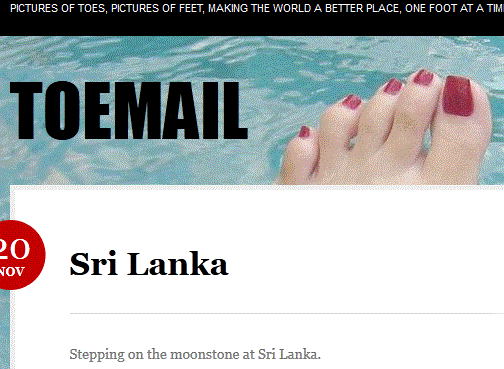
Blog: Toemail
Address: http://toemail.wordpress.com/
Bloggers: Quillan and Angela with submissions from readers from all over the world
Started: 2010

The jist: The blog asks people to send in photos containing a portion of their feet taken in some interesting part of the world. Sometimes the toe is incidental to the photo – the backdrop is what matters – or it is the centrepiece. But mainly it’s a blog about exotic and interesting places where people’s feet have walked. Photos come from all parts of the world, sometimes they are photos of real feet and sometimes they are the feet of statues and paintings. And there is often a touching or interesting story written about the photo too.

Check out: This post about a painting by Mexican artist Frida Kahlo taken in Mexico City.

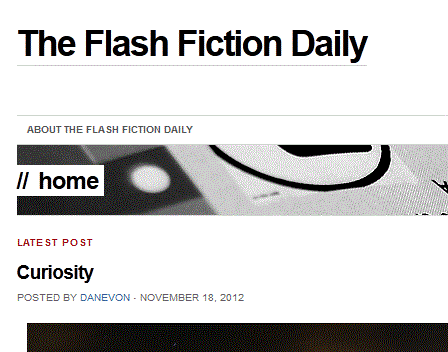
Blog: The flash fiction daily
Address: http://flashfictiondaily.com/
Blogger: Daniel Jevon
Started: October 2012

The jist: This blog is quite simply the embodiment of the phrase “truth is stranger than fiction. Every day Daniel Jevon writes a short story based on a true event or at least one reported as true in the newspapers. At the end of the story he provides a one line summary of what actually happened with a link back to the original article. It’s a clever idea and makes for some good ‘fiction’.

Check out: This short story called “A hate crime”.

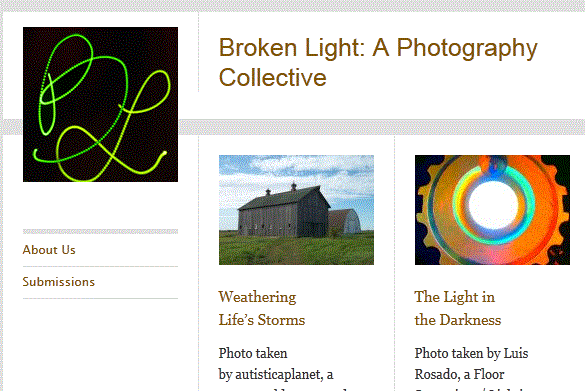
Blog: Broken light: a photography collective
Address: http://brokenlightcollective.wordpress.com
Bloggers: Run by a  “magazine and book photo editor in New York” with submissions from all around the world
Started: March 2012

The jist:  The blog acts as a place where people suffering from mental illness can express themselves through photography and words. Photographs can remind those struggling with these challenges of better, more hopeful times and also as a way to convey thoughts and feelings and what it’s like to be trapped inside your mind. The ultimate goal of the website is to have a gallery space dedicated exclusively to “displaying and selling works by artists who struggle with mental illnesses, as well as helping them to learn and grow by offering free photography classes and workshops”. The images are some startling, often moving and deeply felt.

Check out: This almost Hitchcokian-image taken by someone suffering from depression.

Blog: Ambling around Brisbane
Address: http://amblingaroundbrisbane.com/
Blogger: Paul Dean, an expat-Brit living in Brisbane, Australia

The jist: This is a blog about photography and words. Paul has a great eye for photos in a city setting, with many photos taken in and around Brisbane. He also stimulates thought and discussion with images selected from around the world. But it’s the photos in and around Brisbane that I really love – it’s a personal thing for me as I lived in Brisbane for just over a year. Paul has a knack for finding the beautiful, bizarre and poetic in the mundane.

Check out: These images of Brisbane architecture and this photo as part of one of his weekly photo challenge “Big”.

Blog: Think. Act. Ethics
Address: http://thinkactethics.wordpress.com/
Bloggers: Abbie, Magdelina, Marion and Sophie studying communications at Southampton Solent University

The jist: the blog is part of an ethics course being taken by the four university students. It raises ethical issues such as “Is torture ever justified” (such as when the information extracted can or could have saved lives) or “Do you agree the burqa should be banned?” The authors do a good job of highlighting both sides of the debate and make you re-consider your stance.

Check out:  This post on the topic of euthanasia.

A glimpse of the real Jimmy Savile -12 years ago

This, for me, is the moment, 12 years ago, that Jimmy Savile, revealed to the world that he was not one of Britain’s most-loved entertainers and charity fund-raisers, but an evil paedophile:

This is a still shot taken from a documentary by celebrated interviewer and documentary film maker Louis Theroux called “”When Louis met Jimmy” filmed in 2000.

In light of the hundreds of allegations of rape and abuse of children made against Savile, the ABC (Australian Broadcasting Corporation) re-broadcast the documentary.

(You can watch the whole thing on Daily Motion)

Apart from showing Savile to be completely eccentric (he had no stove in his flat, smokes a cigar while exercising on his treadmill, never has guests around, prefers sleeping in a minivan to his Highland cottage), manipulative (he turns a question from Theroux about a secret stash of alcohol into an accusation that he may not be a teetotaler) and disturbed (he turned his dead mother’s bedroom into a Norman Bates-like mausoleum complete with her dry-cleaned dresses hanging up in the closet and earlier tells the cameraman that while working as a dance hall manager in the 1950s he liked to “tie people up” that were causing trouble), there are many clues, which in hindsight, point to the hundreds of accusations that emerged a year after Savile’s death.

And so to this photo and the expression it captured.

It comes towards the end of a the hour-long documentary  as Theroux and Savile sit side-by-side on a train.

The discussion turns to Savile’s relationships with children.

Theroux asks Savile why he has said in the past that he hates children.

Savile’s response is that by saying he hates them: “it puts a lot of salacious tabloid people off the hunt”.

Theroux’s response is to ask Savile if this served to put and end to questions about “Is he or is he not a paedophile?”

“Yes,” says Savile. “How does anyone know whether I am or not? Nobody knows whether I am or not. I know I am not.”

Theroux says: “To be honest that makes you sound more suspicious.”

“Well that’s my policy,” Savile replies, shaking his head.

“And it’s worked a dream.”

After a moment’s thought, Theroux asks: “Why have you said in interviews you don’t have emotions?”

“Because if you say have emotions you have to explain them for two hours.”

Savile yawns and adds:

“The truth is I am very good at masking them.”

There is silence. The camera zooms in and crops Savile’s face.

And there’s THAT expression.

Savile looks towards the floor, his eyes lowered in shame and bewilderment.

Perhaps, at that moment he is remembering what he has done to all those innocent young people and who he really is – a sick, lonely old man.

Boned: Here’s another reason why newspapers are losing readers…

Having just completed the 14 km City2Sea race on Sunday I was given a copy of The Sunday Age for my troubles.

Sweaty and tired and looking forward to a big breakfast, I turned to the front page of the newspaper which had as its headline: “End transimssion” with a granny photo of Channel 10 newsreader Helen Kapalos.

Expecting a big story about a financial crisis or collapse – indeed perhaps the end of the TV network’s own transmission – I read on and found that the story was about Kapalos losing her job as part of network cutbacks.

Reading like a suspense novel plot, the story describes how “within minutes of bidding viewers a good weekend and walking off set, Kapalos was grabbed on the arm by the personal assistant of Ten’s head of news, Dermot O’Brien, and instructed not to leave the office”.

After a tense stand-off, Kapalos was allowed to return to her computer to retrieve her holiday booking – it just so happened her sacking occurred on the day she was due to fly out for a holiday in the US.

Now I don’t wish to make light of anybody losing their job – having been “boned” myself in the past I know how it feels  – but I have to ask: was a newsreader losing her job the biggest and most important story of the weekend in Melbourne or Australia or anywhere for that matter?

Was it the biggest story of the weekend and did it warrant front page courage?

I bet Kapalos herself was surprised to find news of her boneing (for overseas readers, “boneing” is an Australian term referring to getting fired) her photo splashed across the front-page of Melbourne’s only Sunday broadsheet newspaper.

It’s the kind of story that should have warranted a side column somewhere in the middle of the newspaper, not the front page or third page or even the fifth page.

Apart from Kapalos herself (who will surely be fielding many job offers on her return from her overseas holiday), and some of her fans who enjoyed watching her read out the day’s news items in her rather sultry, whispery voice (I didn’t mind her interrupting my Thursday night viewing of Law & Order with a news update) this is not a story that warranted the front-page splash it received.

Yes I know Channel 10 is in trouble (and that’s the bigger story) but it’s the network’s own fault really –  have you watched some of the dreck they have come out with lately: Being Lara Bingle, The Shire, Everybody Dance now? All of them rubbish. All them failures. All of them axed!

As for the story of Kapalos’s dismissal this was a just another example of how the TV networks operate- indeed anyone who has enjoyed a television show on the commercial networks only to see it suddenly “boned” from the schedule will know they are a ruthless bunch.

You could also read into the “misplacement” of this story as a sign that’s its not just the internet that’s too blame for newspapers’ falling readerships and advertising woes.

Is The Sunday Age a learned, high-brow broadsheet or is it re-making itself into another tabloid? Or perhaps it is having an identity crisis?

Surely, there had to be a bigger story on Sunday then Kapalos getting boned?

First of all it was Remembrance Day, so that might have warranted a front page  – after all there are Australian soliders involved in conflicts in Afghanistan and Iraq and risking their lives on a daily basis.

And there are many other local and national issues that would have deserved front-page priority.

Instead, The Sunday Age has gone for a front page story which (with the greatest respect) is what you’d expect on the front cover of the Herald Sun.

And I wouldn’t have a problem with it being on the front cover of the Herald Sun because those sorts of stories are its bread and butter- attention grabbing headlines about attractive news anchors being pulled aside after their last news broadcast and told to pack their bags.

The Sunday Age is a weighty newspaper and deserves weightier stories on its front page.

Is it any wonder its readership has fallen around 15% in the space of year!

Update to this story: As I predicted, Helen Kapalos is reportedly being courted by a host of TV networks since being boned by Channel 10, which only re-affirms what I wrote about this never being an important enough story to warrant the front page of a major newspaper.

Getting it right: Is the internet killing good journalism?

A story appeared on the front page of The Age (Melbourne’s only broadsheet newspaper) last week written by one of Australia’s most respected and well-known journalists, Adele Ferguson.

The story was about the death of the former chairman of a collapsed mortgage lender called Banksia, which has left thousands of small investors (families and pensioners) out of pocket with $660 million owed.

Ferguson reported that the Banksia chairman – Ian Hankin – had died in a head-on collision with a truck just three months before Banksia went bust.

“Ian Hankin, 59, died on August 8 when his BMW and a truck collided on the Western Highway at Burrumbeet, about 25 kilometres west of Ballarat.”

The story then went on to say that three weeks earlier, “on July 18, Hankin drove his Mercedes-Benz into the path of an oncoming truck on the Midland Highway near Scotsburn, 18 kilometres south of Ballarat”.

In the first crash Hanking escaped with minor injuries though the car was written-off.

Clearly, what was being implied was that Hankin had taken his own life after learning that Banksia was heading into financial failure and having failed the first time, he did a better job of it the second time.

Except, as was later pointed out by rival Melbourne newspaper the Herald Sun (owned by Rupert Murdoch) Hankin had stepped down from his role as chairman of Banksia three years ago and had no association with the company, making it highly unlikely his death and the previous collision was in anyway related to the mortgage lender’s sudden collapse on 25 October this year.

The chairman of Banksia is Peter Keating, who is very much alive.

The Age did print an update to the story, but only to add the word “former”  in front Ian Hankin’s title of ‘chairman’. (I have since discovered that The Age apologised to Ian Hankin’s family, but the story remains unchanged except for the addition of the extra word)

The error was reported in the media section of The Australian (another Murdoch-owned paper, but a broadsheet, with more gravitas than the Herald Sun) under the heading “Page one howler”

The Australian pointed out that “The Age ran a correction on Saturday on page two, one strangely lacking any apology to Hankin’s family who are understandably distraught.

“Journalists are not infallible. But the correction does appear buried and insubstantial given the size of the error,” The Australian went on to say.

Hankin’s colleagues at the law firm where he worked until his sudden death have spoken out against the insinuations in the article, though this hasn’t stopped controversial radio DJ Derryn Hinch (famous for naming convicted sex offenders on air against court orders) from labelling Hankin’s death a “coward’s exit” on his own website.

The Age’s error was indeed a bad one  (made worse by the lack of an apology)  and should have been avoided by some simple fact checking, something you would have thought would have been given extra priority, since the story was destined for the front page of the newspaper.

But this should all be put into the context of the challenges facing Fairfax – publisher of The Age and rival newspaper publisher Rupert Murdoch’s News Limited as well as other newspaper groups all round the world.

Fairfax is currently in the process of getting rid of 1,900 employees, many of them journalists, in an effort to cut costs and deal with a loss of print advertising revenue as readers shift to getting their knews online and via mobile devices (where advertising revenues are much smaller).

Fewer journalists mean fewer sub-editors checking articles before they go to print and less time spent by journalists themselves reasearching their articles.

Making things worse is the fact that Fairfax has outsourced most of its sub-editing to an external company called Pagemasters.

A sub-editor is not just a spelling and grammar checker. A good sub-editor understands the subject matter they are reading and the context and history behind the article.

A good sub-editor would have asked the question: Was Ian Hankin the chairman of Banksia at the time of his death?

These sorts of mistakes are likely to become more frequent as publishers scramble to find a way to scrape a profit.

In the online age of the 24 hour news cycle, smaller teams of journalists must produce more content at a faster rate with less time for research and few pairs of eyes to check facts and ask important questions.

Out of curiosity, I took a look at the jobs currently advertised on the New York Times media group website, publisher of the venerated New York Times, International Herald Tribune and Boston Globe.

There are currently 54 jobs advertised.

Not one of them is a journalism role.

The terrible boredom of the rich

For those of us who are not very rich, the idea of having great wealth is very appealing and the focus of many a day-dream along the lines of: “If I had $100 million I’d….”

No mortgage to worry about, no tightening of the chest everytime an envelope stamped with “your bill enclosed” arrives in the mailbox, no having to fight with the person next to you for the shared arm rest on economy flights, and on and on it goes.

But the thought occured to me that perhaps being very rich can also be very boring.

I was struck by the idea while attending a commercial property auction (I wrote this story about it) as I found myself sitting next to one of the bidders in the River Room at Crown Casino.

Without meaning to sound to mean-spirited, I’ll say the bidder looked like a toad with fat lips and fatter jowls and liverspots, though I may be embellishing.

Up for grabs was a petrol station on a busy road in the outer suburbs of Melbourne, a dull, but valuable piece of real estate.

Bidding started around the $5 million mark and the price rose rapidly in $100,000 jumps with my toady bidding friend lifting his hand every thirty seconds or so to up the ante.

When it reached $7 million, he stopped and simply said to his rival bidder, like he was ordering a drink beside the swimming pool, in a lazy, nasal drawl:

“He can have it.”

Like spending or not spending $7 million was like deciding whether to buy an ice-cream from the vendor on the beach or deciding between a cappucino and a latte.

But what if this is what life is really like for the super-rich?

Where things lose their value, no matter how much they cost, be they petrol stations, mega mansions, luxury cars, or overseas holidays – because if you’re super-rich you’ve already tried everything on the menu and there’s nothing left to buy.

And then it occured to me that maybe that’s the reason why billionaires keep on working until they’re one foot in the grave and seem never satisfied no matter how many zeroes are on their bank accounts.

And why they’re always trying to reduce their tax bill.

Or denying their children their inheritance.

Or just keep complaining about everything (and making cheap looking preachy videos).

Perhaps, we with less should appreciate that fact that a good bottle of red wine, a new car (or even a second-hand one), or a holiday one street up from the beach rather than on the beach can be celebrated and cherished.

Even if we drop dead the next day from worrying about the size of the gas bill…

The “nonsense’ behind the Commonwealth Bank’s $270 million Storm payout

I never thought I’d find myself laughing (in a cynical fashion) at a press conference on a Friday evening just before clocking-off time for the weekend (I was grumbling when I picked up the phone).

But that’s what happened when I tuned in to listen to ASIC chief Greg Medcraft tell the media the Commonwealth Bank had done the “right thing” by agreeing to increase its payout to Storm Financial investors by $136 million taking the total compensation to around $270 million.

Briefly, Storm Financial provided bad financial advice to mom and dad investors on a variety of mortgage and other investment vehicles, the Commonwealth Bank provided them the money, then the GFC hit, Storm went bust and investors lost billions.

The agreement between the Commonwealth Bank and ASIC was reached “without any admission of liability” by the bank.

Enter Business Day journalist Paddy Manning who asked Medcraft if it were not a “nonsense” that the Commonwealth Bank was agreeing to pay out investors to the tune of $270 million, while at the same time admitting no fault.

Medcraft did not enter into a debate on this point – probably he was legally prevented from doing so – but I bet he privately agreed.

Which is also why I found myself laughing (cynically), because yes it really does sound absurd given the scale of the payout.

The use of the words “without any admission of liability” is a fairly common legal term and has been used by other organisations – from church groups to big businesses – to protect themselves from further financial claims.

It is usually always the outcome of a mediated solution with aim of bringing costly legal proceedings to an earlier end.

Essentially it’s like a plea bargain – privately you admit you’re guilty and stump up the money, but publicly you keep your reputation.

It also means the “guilty party” does not have to make any sort of apology, as this would, in effect, make the “without liability” clause null and void.

Most recently agricultural chemicals supplier Nufarm agreed to pay shareholders $43.5 over allegations the company failed to keep them informed of the impact of the declining glyphosate market on its business. Despite deny the allegations, Nufarm paid up without admitting liability.

In 2004, as reported by The Age, the Salesian Order of Catholic priests and brothers paid around $80,000 to a to a Melbourne man who launched a civil case against convicted paedophile Father Frank Klep “without any admission of liability”.

In 2005, retailer Barbeques Galore and a sister company surrendered about 900 BBQs for destruction and agreed to make payments for 2,200 they had already sold after legal action was threatened by Danish homewares firm Bodum, reported The Sun Herald. The agreement was made with “without admission of liability”.

And back in 1996 a Sydney hospital settled a case involving a woman who died soon after being admitted “without admission of liability”.

Clearly there are some benefits for those who seek compensation. They get an early payout and can get on with their lives, or at least try too.

As for the payee (or guilty party) – they get to draw a line under the whole affair.

For those Storm Financial investors who invested via a Commonwealth Bank loan they will have to be content with 55% of their money being repaid four years down the track.

But I wonder how many investors, would have hoped for a lot more – and an apology?