Revisiting Serial: The 5 big reasons why Adnan Syed most likely did not kill Hae Min Lee

Like many of those who enjoy true crime podcasts, I got hooked after listening to the groundbreaking first season of Serial, which investigated the 1999 murder of Baltimore student Hae Min Lee, who was strangled and buried in Leakin Park on January 13, and the problematic conviction of he ex-boyfriend Adnan Syed.

Hae Min Lee was murdered in 1999

Released in 2014, the show hooked tens of millions of people as it delved deep into the baffling case, examining the evidence used to convict Syed and coming up with fresh leads, a possible alibi, new theories, controversies and inconsistencies.

Serial set the scene for an explosion of investigative true crime podcasts and became the template against which they would all be judged.

Serial also threw a huge spotlight on Syed’s conviction and the many doubts about the dubious testimony of his so-called friend and local drug dealer Jay Wilds which ultimately sent Syed to jail for life despite no hard evidence linking Syed to Lee’s murder. The podcast inspired a four-part HBO documentary that also argued for his innocence (along with numerous follow-up podcasts and blogs), paving the way for efforts by Syed’s legal team to secure a re-trial.

While that effort ultimately failed – in March 2019 the Maryland Court of Appeal quashed a decision by the state’s lower courts to grant him a new trial and in November 2019 the US Supreme Court declined to hear the case – doubts about his conviction have remained and the debate has raged for years online and on social media. Did Adnan Syed do it?

While it came out a few years ago,popular true crime podcast called Crime Junkie (which I have just discovered via a good friend) aired a special episode in April 2018, which in my opinion tips the scales firmly in favour of Adnan Syed’s innocence and highlights an appalling miscarriage of justice.

Called “What Serial Didn’t Tell You”, Crime Junkie host Ashley Flowers, with the help of her co-host Brit Prawat, pulls together all the extensive information published since Serial season one aired, drawn mainly from two other podcasts, Undisclosed and Truth and Justice as well as three blogs written by Rabia Chaudry (the lady who brought Adnan’s case to Serial host Sarah Koenig), lawyer Sarah Simpson and law professor Colin Miller, all three of whom are hosts of Undisclosed. She also read Chaudry’s best selling book Adnan’s Story.

“I tried to make that 30 minute thing with the top need to know facts [so that people can] have an informed discussion about Adnan’s case,” says Flowers at the start of the podcast.

Flowers then goes on to launch a concise and highly convincing argument for Syed’s innocence, or at the very least, the right to a new trial.

Without listening to all the podcasts, or reading the blogs and books Flowers researched to prepare the episode (I assume its accurate, Crime Junkie is a very popular and scrutinised podcast) I’ve summarized the main points she makes, plus added one of my own:

  1. The cellphone tower pings

Adnan Syed was convicted of murder largely because Jay Wild’s testimony of what happened and where on January 13, 1999. This timeline of events matched the locations of cell phone tower that pinged off Syed’s mobile phone every time it rang on that fateful day.

“Police created a map to show how the cell phone moved during the day based on its signal pinging of towers,” Flowers reminds listeners.

While there was a lot of controversy about this testimony – Wilds changed his story when the police and prosecutors realised they got the map wrong being just one example – it still dealt a body blow to Syed because two calls pinged off towers near Leakin Park at 7.09 and 7.16pm that prosecutors said proved Syed was there burying Lee’s body.

(You can read Jay Wild’s account of that day as told to The Intercept in December 2014.)

“They even got an expert to testify to this in court who said Adnan was where Jay said he was at the time they were burying Hae’s body,” says Flowers.

However, this expert did not see (most likely it was deliberately withheld) a fax cover sheet from telephone company AT&T which made the point that outgoing calls only are reliable for location status. Incoming calls – the ones Syed received on January 13, 1999 – are not considered reliable information for determining a location.

“The expert witness did not see this, and would have changed his testimony” says Flowers. This was one of the man arguments Syed’s lawyer Justin Brown used to get a new trial.

2. The State of Hae Min Lee’s body

While this cell tower information is startling, it does not prove conclusively that Syed was not in Leakin Park at the time Wild’s said they were there burying Lee’s body, only that the data cannot be relied upon.

More important – and damning of the conviction of Syed – is the state of Hae Min Lee’s body when it was discovered four weeks after her murder on February 9.

According to Flowers (and confirmed by medical examiner who undertook the autopsy), Lee had “full-fixed lividity” on the front of her body including her face, chest, stomach and legs.

Lividity or Livor Mortis is the settling of blood after death in gravity-dependent portions of the body, including in the organs. Blood settles after death in parts of the body closest to the ground, causing purplish-red blue discolouration.

Lividity happens pretty slowly, and can take 8-10 hours to occur, explained Flowers.

This meant Lee’s body had remained face down in the same position for that period and therefore she could not have been placed in the trunk of a car, as Jay Wilds, the state’s key witness had claimed when he picked Syed up around 4pm from Best Buy on the day of the murder.

In addition, because Lee was found on her right side, but she had full, fixed lividity on the front of her body, she could not have been buried flat in a shallow grave at Leakin park at around 7.30pm. Lee was last seen alive at around 2.15- 3pm, so at a minimum her body would have had to lie face down until 10.30 or 11pm, most likely even later.

“Nothing adds up,” says Flowers.

3. Hae Min Lee’s car

Hae Min Lee’s car – a Nissan Sentra – is a crucial piece of evidence as Jay Wild’s says that her body was in the boot before Syed drove it to Leakin Park with Wild’s following behind in Syed’s Honda Accord.

Later, according to Wild’s testimony Syed parked it in a lot behind some houses. The car was recovered on February 28, the same day Syed was arrested and charged with her murder.

Flowers notes that there was green grass growing under the car, and even inside the wheel well, which suggests the car was moved from somewhere else and that someone told Jay where the car was.

This is confirmed in pictures of Lee’s car, which you can easily find online showing clearly the grass growing underneath and the patch of dead grass next to it, indicating what should have happened over time.

“It highlights the fact again that Jay new nothing about what happened to Hae – his account is all made up. Jay’s story unfolds as police find new evidence not the other way round,” say Flowers.

And the question remains: who moved Lee’s car?

Hae Min Lee’s Car: the green grass can be seen clearly under the car

4. There is no evidence linking Adnan Syed to the crime scene (my own ‘research’)

The entire case made against Adnan Syed was based on Jay Wild’s testimony. There is in fact no physical evidence linking Syed to the crime scene, not a shred.

Furthermore, DNA testing carried out in 2019 of 12 pieces of evidence found on or around Hae Min Lee’s body found none of the them produced a DNA profile that was a match for Syed.

“This included a rope/wire found five inches from the body that yielded a DNA profile that is a match for some unknown person; and two hairs recovered from Hae’s body that are not the hairs of either Hae or Adnan,” writes law professor Colin Miller on his blog Evidence Prof.

5. Adnan Syed was the only person police investigated – there are other suspects

Says Flowers” “The cops looked into no one else a tenth as hard as they looked into Adnan” whose criminal record was pulled on February 3, 1999, before the anonymous tip came in to look at Syed as the most likely suspect.

Nobody else’s criminal record was pulled.

This included her current boyfriend at the time, “Don”, other people close to her. and a guy (Roy  Sharonnie Davis) who had murdered another 18-year-old girl who attended Woodlawn High a year ago (Jada Denita Lambert, an 18-year-old Woodlawn woman whose body was found in May 1998) and was not in jail at the time (Davis was convicted in 2002).

However while Davis was surely worth investigating, the Crime Junkie hosts say its most likely Lee was killed by someone she knew.

“Someone paged Hae that day to meet her, and kill her, but that pager was never found.” Flowers says.

Flowers also question the alibi given by Don, who could not be reached until 1.30am on January 14, and who said he was working at a LensCrafters store.

I’d rather not going into all the anomalies in his alibi, but you could read about them on the Crime Junkie podcast. However, I will just mention one, both Don’s mom and his stepmom worked in manager roles at the company and provided his alibi on the day Lee was murdered.

‘If the police had done their job; if they would have looked into anyone else as hard as Adnan they would have found this out,” says Flowers.

According to evidence collected as part of the trial, Lee was due to meet up with Don on the day she died. She also worked at Lenscrafters, though not at the same store Don was working at that night.

Of course none of this is absolute conclusive proof Syed had no involvement in Lee’s murder – bear in mind Wilds gave about five days of detailed testimony at both trials so it beggars belief he made it all up.

However, it does highlight that if Syed had a decent lawyer he almost certainly would not and should not have been convicted based on the evidence and testimony presented at the trial. Furthermore, being a non-white American clearly did not help his cause.

If you’re interested in find out more, I’d encourage listening to the whole Crime Junkie podcast in full and then, if you’re keen, taking a deep dive into the case. There’s a ton of information out there.

(This link has all the court transcripts to the 1999 mistrial and 2000 trial)

If not – and no judgement here, life is too short – remember this point made by Flowers: “Adnan has facts on his side, the State of Maryland only had Jay.”
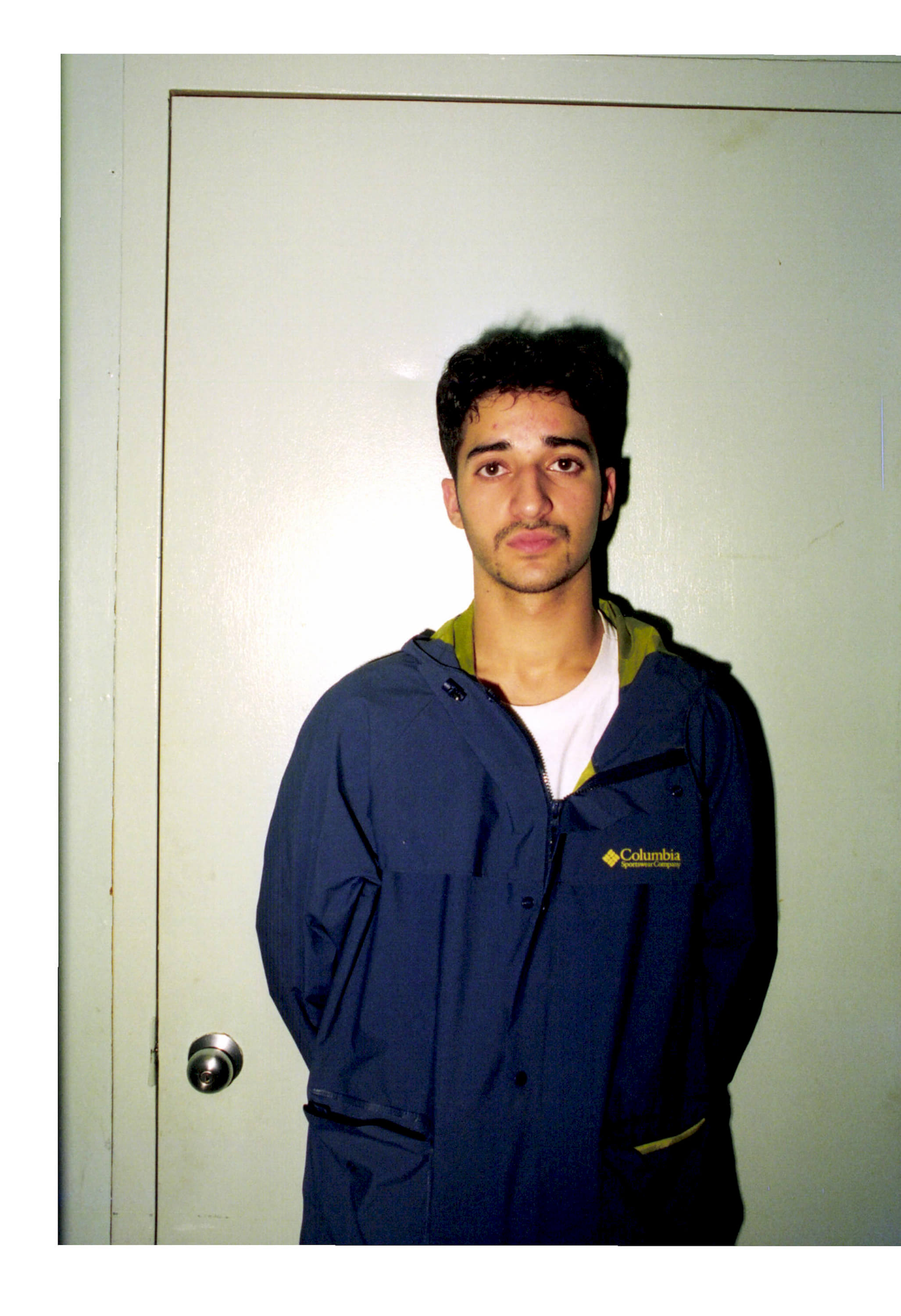
Adnan Syed, Arrest photo

The nine lives of the Yorkshire Ripper

Cats supposedly have nine lives, as the phrase goes, and so too did Peter Sutcliffe, the Yorkshire Ripper, who died in November last year from COVID aged 74, whilst serving  20 life terms at Frankland prison in County Durham.

I’ve just finishing watching the excellent four-part Netflix documentary ‘The Ripper’ which examines the series of horrifying murders committed by Sutcliffe, and the bungled attempts by the West Yorkshire police to capture him.

Incredibly, Sutcliffe, a married lorry driver from Bradford, was interviewed nine times by detectives, after his name came up in various lines of inquiry as a possible suspect. However, he was let go each time, despite some lower-ranking detectives and police officers reporting their suspicions.

A tragedy: many of these women may still be alive today had the police done their jobs properly

So often did police show up at his place of work to question him, that Sutcliffe earned the nickname ‘The Ripper’ among his truck-driving colleagues at Clark Transport – an irony, that would have seemed unbelievable were it included in the plotline of a crime novel.

As explained by Joan Smith, one of the few female journalists to report on the case, the all male senior detectives leading the investigation, blinded by their own sexist attitudes and sucked in by a hoax audio tape, dismissed Sutcliffe because he was recently married, had the wrong accent to the Geordie accent on the hoax tape and did not fit the supposed picture of a modern day Jack The Ripper maniac hunting down and slaying prostitutes.

As a result police also neglected to investigate other attacks on young woman at the time because they were not prostitutes or women of “loose morals”, and who because they survived these assaults, could have provided valuable information about their attacker and led to Sutcliffe’s capture many years earlier, saving the lives of many who later crossed his path.

Recalled retired West Yorkshire detective Andrew Laptew, one of the “stars” of the documentary with quiet fury: “I got the report typed up [about boots belonging to Sutcliffe that appeared to match footprints left at one of the crime scenes] and explained all the things that were bugging me. And the most startling thing was the Marilyn Moore photofit [based on an accurate description by Marilyn Moore who survived an attack by Sutcliffe]. It was a dead ringer for him

“Is he a Georgie,” Laptew was asked by his superior officer. “I said no. He’s from Bradford. But it’s an uncanny resemblance.

“Does he have a Geordie accent [to match the one on the audio tape]? I said no. He started effing and geffing. He said anyone who mentions effing photofits to me again will be doing traffic for the rest of their service.”

In the end it was only by sheer luck – Sutcliffe was arrested in January 1981 because he was driving a car that did not match its number plate – that led to his capture, confession and life imprisonment.

As with so many great true crime documentaries created by the streaming giants – ‘The Ripper’ was commissioned by Netflix – it takes viewers back in time through grainy, archival footage to Leeds, Manchester and Bradford of the mid-1970s where unemployment was rising as the great big factories were shut down, and as Margaret Thatcher became the first female British prime minister.

This footage is contrasted with crisp, present day interviews of families of victims, the now grey haired detectives who were on The Ripper taskforce and journalists like Joan Smith, as they look back on those terrible times, when an unknown killer terrorised the streets.

I found it compulsive viewing, so fascinating, seeing how a serial killer investigation back then relied on thousands of hand written index cards – so many in fact that the floor of the taskforce headquarters had to be reinforced to prevent it from collapsing – to create a database of suspects and evidence.

And yet for all the information gathering, and the many clues that should have pointed the way to a much earlier solving of the mystery, it was the bungling alpha male chief inspectors and their bureaucratic overlords, who made the key wrong assumptions about the case, that had the Ripper laughing in their faces for many years.

John Humble, who sent police the hoax letters claiming to be the Ripper (Humble mimicked phrases used in letters supposedly written to police in the 1880s by Jack the Ripper) and an infamous hoax audio tape was unmasked in 2005 and jailed in 2006 for perverting the course of justice.

“I remember listening to it and being incredibly puzzled because there was nothing on the tape that actually suggested it was genuine,” said Smith in November 2020, when Peter Sutcliffe died.

Julie Bindel, a feminist campaigner who was 18 and living in Leeds when Sutcliffe killed his 13th and final victim- Jacqueline Hill, a 20-year-old student – recalled how police denigrated the victims, some of whom were prostitutes, as being “fair game” despite many of them only doing what they did to support their families.

Bindel told The Guardian last year she remembered George Oldfield, who led the investigation, addressed the murderer on TV in 1979 saying: “There may be more pawns in this war before I catch you, but I will catch you.”

“That’s what women were to these detectives, said Bindel: disposable pawns.

But, says Smith, the Ripper investigation did force woman, who felt unsafe, to realise it was up to them to look after themselves, “because the police weren’t actually going to do it for us”.

“That was the beginning of women pushing back and say, No. Why shouldn’t we walk around at night at 2am without worrying that someone will attack us? So I think it changed women’s perception of how we live in this culture and it had a incredible radicalising effect on a whole generation of women.” Smith says.

The 13 women Sutcliffe was convicted of murdering were:

Wilma McCann, 28, from Chapeltown, Leeds, who was killed in October 1975.

Emily Jackson, 42, from Morley, Leeds. Killed on 20 January 1976.

Irene Richardson, 28, from Chapeltown, Leeds. Killed on 6 February 1977.

Patricia Atkinson, 32, from Manningham, Bradford. Killed on 24 April 1977.

Jayne MacDonald, 16, from Leeds. Killed on 26 June 1977.

Jean Jordan, 21, from Manchester, who died between 30 September and 11 October 1977.

Yvonne Pearson, 22, from Bradford. Killed between 20 January and 26 March 1978.

Helen Rytka, 18, from Huddersfield. Killed on 31 January 1978.

Vera Millward, 40, from Manchester. Killed on 16 May 1978.

Josephine Whitaker, 19, from Halifax. Killed on 4 April 1979.

Barbara Leach, 20. Killed while walking in Bradford on 1 September 1979.

Marguerite Walls, 47, from Leeds. Killed on 20 August 1980.

Jacqueline Hill, 20. Killed at Headingley on 16 November 1980.

Fear of flying

In December 1994, after I had just turned 21, I lost my wallet and about US$300 in cold, hard cash somewhere in the departure terminal at OR Tambo International airport (then called ‘Jan Smuts’) just hours before I boarded a flight for New York  and a dream solo adventure in the USA.

I remember saying goodbye to my parents, clearing passport control, and then while rummaging through my bulbous, black leather money belt, descending into a mad panic when I couldn’t find my wallet amongst my Thomas Cook travellers cheques and passport.

Heart beating feverishly, my anxiety building, I checked and re-checked my money belt, retraced my steps all the way back to the passport control kiosk I’d just passed through, but found nothing.

I was utterly forlorn. I would have wept, were it in my nature, but instead simply deflated quickly like a popped balloon.

The anticipated thrill of the trip – a birthday present I had chosen instead of having a party – and the excitement of traveling abroad had completely vanished, replaced instead with a dark cloud of guilt (what would I tell my parents?) and deep embarrassment (what a careless fool I was).

All that wasted money.

Later, as I sat dejectedly on the South African Airways jumbo jet waiting for take-off I realised what had most likely happened: I’d gone to a store in the airport to buy something to read on the plane (a South African Sports Illustrated magazine no doubt) and other nick nacks. After paying, instead of putting my wallet back into my money belt, I had mistakenly and carelessly slipped it between the money belt and my pants, where it had simply fallen to the ground.

Either that or it had been stolen by some brilliant pickpocket whose speciality was money belts. Either way, someone hit the jackpot at Jan Smuts that evening. I hope they spent it well.

After sitting forlornly on the plane for a number of hours, as it sped through the night sky on the long 18-hour journey to the ‘promised land’, I resolved that I couldn’t allow these unfortunate series of events to ruin a four week adventure. After all, they would mean wasting even more money.

Initially, I tried to work out a plan where I would somehow be so spend thrift on my travels that I would recoup the lost funds – this involved a journal of daily entries of savings made, drinking water instead of buying a Coke, that sort of thing- but that ‘brilliant idea’ did not last long.

Instead, I simply chose to forgive myself and went on my more or less merry way exploring the sights of New York, Chicago, San Francisco, Los Angeles and San Diego – minus US$300 in cash.

My carelessness was not though confined to losing my wallet.

Photo by Skitterphoto on Pexels.com

Arriving in the US in my jetlagged state, having forgotten about things like time zones, but eager to unburden myself, I’d rung my parents at some ungodly hour to tell them of my misfortune.

My father, fearing the worst when the telephone rang at that time, had sprinted down our passageway, forgetting in the dark there was a security door in the way  (a phenomenon of many Johannesburg homes, it separated the bedrooms from the rest of the house) and nearly knocked himself out trying to get to the phone in the entrance hall.

In the confusion of the corridor dash he’d presumably also forgotten that he might disturb a gang of burglars rifling through the display cabinets of my mother hand-me-down antiques and bric-a-brac. (We were, if my memory serves me true, actually burgled once while we slept in our beds snoring safely behind the locked security door).

Despite being on the receiving end of more stupidity on my part, my parents were exceedingly nice about all of their money I had lost and encouraged me to enjoy my holiday.

However, for years later I was reminded by my family, whenever I prepared to go overseas, to try not to lose all my money before even getting on the plane.

This long-running joke, that was never quite a joke, created I think, a kind of Pavlovian reaction in me: whenever I prepared to fly anywhere, an uncomfortable general anxiety surfaced in my gut accompanied by some irrational thoughts and somewhat obsessional behaviour.

Irrational – in that my anxiety about flying has manifested into a palpable fear of missing my flight.

To counter a myriad of possible, but unlikely scenarios that might befall me on the way to the airport – getting a flat tyre, getting stuck in traffic, the taxi I have booked not arriving, forgetting something and having to go back home – I like to leave for the airport many, many hours earlier than is necessary.

As I usually arrive, without incident, many, many hours earlier than necessary, this only feeds another nervous affectation – a need to constantly pat myself down, checking that I still have my wallet, passport, boarding pass and any other important documentation, and that they hadn’t dropped to the floor, been stolen or simply carelessly left behind.

You will at least be pleased to know (dear reader) that I have dispensed with the god-awful money belt. I prefer having my wallet and passport in the front pockets of my pants where I can reassuringly feel their presence.

As I have grown older and a bit more chilled, I have become a lot less anxious about the trip to the airport and departure lounges no longer generate quite as much stomach-churning action as they did in the past.

Somewhat wiser, or at least more experienced at life, I am able to acknowledge the irrational nature of my worries and doubt.

If anxiety does surface, I remind myself that if I miss my flight, the trip simply wasn’t meant to be or that the plane I never boarded will almost surely plummet into the ocean. It seems to work a treat.

Ironically, my wife and I backpacked around the world in 2010 and pretty much nothing went wrong.

We travelled through 26 or 27 countries, took dozens of flights, bus, train, ferry and boat trips and never missed any of them.

We never lost a single piece of luggage – our expensive Kathmandu backpacks always reappeared no matter whether they were thrown on the roofs of dusty buses in Marrakesh, loaded onto a plane in Delhi or squashed onto a boat in Kho Phi Phi – and we never lost a passport or wallet between us.

As for airports, we breezed through all of those without – miraculously – a penny unaccounted for.

Writing ‘philosophical drivel’ and the other crimes of a ‘Z list blogging cretin’

This week, out of nowhere, and for no obvious reason, I received a lengthy, rather unpleasant email from someone seemingly quite upset about something I’d written on this humble blog, and who it seemed had developed a profound dislike for me and my work.

As the email (which you can read in all its unedited glory below) was sent anonymously, there was no way for me to reply to ask what bothered my mystery correspondent.

As I read his ‘delightful’ note, I was struck by the strange irony of it all: here was someone who apparently “didn’t care what I had to say” but who had taken the time to write to me even if it was to suggest that I try film myself ”sniffing dog farts”.

I suppose I should be flattered – any feedback is better than none. Most of what I write on the blog goes largely unnoticed except for the occasional comment from my close friends and immediate family (Yes, mystery writer, my relatives still seem to tolerate me despite your claims to the contrary, though I will double-check).

As to your concern at my lack of accomplishments to date, I should clarify: I am perfectly fine with my lack – by your standards – of online success. I really am not trying to be a social media influencer or win anyone’s respect or approval.

It’s just a humble blog dear mystery friend, and though I may be a journalist in my professional life (yes a ‘real journalist’!) my online scribblings on freshlyworded.com are nothing more than a hobby, albeit one that I enjoy, a chance to write about the things that interest me and an escape from the property round I cover at The Australian Financial Review.

And so yes, I wholeheartedly agree with you, there are TikTok creators and YouTubers with more influence than me, and good luck to them.

As to the ‘philosophical drivel’ I spout and the ‘profound perspective” I can only pretend to have found, I can only but apologise if it has offended your own world view.

Take care (who ever and where ever you are).

Larry

Hi 🙂

Inbox

blahblahblahblah69blah <blahblahblahblah69blah@protonmail.com>Jun 15, 2021, 5:42 AM (3 days ago)
to me

Hahahahahaha you’ll never know who I am Larry but it brings me so much joy knowing how much of a loser you’ve turned out to be, it’d be one thing if you were a real journalist or had an enviable readership but no, just a Z list blogging cretin who writes about nobodies because that’s what you specialise in. I’ve seen Tik Tok creators and YouTubers with a mere few hundred fans who have more respect and influence than you. 

Here’s a thought why don’t you write an article about this email? You can bullshit for paragraphs about philosophical drivel and pretend to have some profound perspective. 

Just think if you were actually worth anything or if you were actually above average in anything then you’d have accomplished something by now, you’d have given your relatives something to brag about but…no 😦 just an embarassment who can’t even write about interesting people because your own lack of charisma and charm sucks the life out of anything you write. 

Poor poor Larry.

The funniest thing is I don’t even care what you have to say and won’t be using this email again so all you can do is nothing, which you’re good at! 

And if you’re curious lets just say I’m closer than you think and all of us couldn’t be happier or less surprised at what you’ve accomplished. (Nothing Larry, the answer is nothing) 

You could just film yourself sniffing a dogs farts and I think you’d be having the same impact on society. But hey who am I to judge, I’m sure you think you’re doing great.

Bye Larry! 👋

The bar was packed: last drinks in the age of Coronavirus

As the rest of the world went into lockdown a couple of weeks ago, I found myself, on a Saturday night, having a drink with my good mate Jonny at a bar on Carlisle Street, in Balaclava, a trendy, somewhat grungy inner southern suburb of Melbourne.

Half-jokingly, I’d set the wheels of the catch-up in motion, by suggesting we get together for a beer and a burger because it might be the last time we could do it “before the world ended”. It was also Jonny’s birthday later in the week.

At the time, New York and other major cities were already shutting down. Restaurants and bars were about to close in Manhattan and Italy was already a nation quarantined. But in Australia there were no real restrictions on daily life, except for a growing shortage of toilet paper, hand sanitizer and pasta.

70954832_10156240101736106_2804171567599190016_o

Packed no more: The Rooftop terrace at The Local Taphouse (Facebook)

‘Social distancing’ however was swiftly becoming a buzzword, but not on the rooftop terrace at The Local Taphouse on Carlisle Street at 8.30pm on Saturday, March 14.

The scene was busy, loud and convivial. People sat shoulder to shoulder at tables or stood in small, huddled groups near the bar, drinks in hand, conversing about their lives, telling stories, laughing and smiling.

Jonny and I ordered two large ciders (a craft cider, particularly tasty) and found some seats at an unoccupied table, where we sipped our delicious drinks and held our own conversation talking about our lives: our families, our jobs, gripes, the latest shows we’d watched, books read, podcasts listened to. 

Both of us, now past the mid-forties mark, reminisced about the old days back in South Africa as we always tend to do on these catch-ups and wondered, as we always do, where all the time had gone.

Around us the bar was still noisy and buzzing. We enjoyed a second round of drinks and continued our conversation.

Though I was immersed in the scene, part of its social fabric (part of the problem I guess), I couldn’t shake the feeling that this supposed normality was both strange and fleeting. It was as if the terrace of happy people existed on a different planet from the rest of society who were at home, worrying about a disaster about to unfold.

A couple of hours passed and then it was time for us to depart and return to our separate worlds of parental responsibilities.

I headed to the bathroom on the way out, where a bloke standing next to me at the urinal exchanged some sort of half-drunk pleasantry. Then, as I attempted to wash and dry my hands at the basin, I nearly collided  with two men who emerged simultaneously from the toilet cubicle looking rather sheepish after a spot of, I imagined, illicit drug-taking.

A minute later, Jonny and I emerged back on Carlisle Street and into the fresh night air. Drunken chatter wafted across the road from another pub a few shops down. Cars whizzed past and a couple waited, in intimate embrace, for the traffic lights to change.

We walked past a half-lit dessert cafe with a display window full of eclairs, pastries and cream-filled cakes.  Driving back along Carlisle Street to drop Jonny off first in a nearby Melbourne suburb we passed another busy bar full of banter, booze and music.

It was only on the long drive home along the Calder Freeway under the endless expanse of stars and black night sky, that it dawned on me that perhaps I should not have been so cavalier as all those social beings on the rooftop of The Local Taphouse, sipping their drinks, grinning, laughing and carefree. Then again, the party was only hours from ending. For everyone. The music was about to stop.

The next day, Sunday March 15, brought with it the first of the restrictions: all overseas arrivals must self-isolate for 14 days, all cruise ships banned from Australia, gatherings of over 500 people no longer allowed.

A week later all pubs, clubs, gyms, cinemas, casinos, restaurants and cafes (save for takeaway orders) were ordered to close their doors and indoor gatherings were reduced to 100 people (now cut to two people). A 1.5 m social distance from others should be maintained and all non-essential travel should stop, we were told.

And so the world as I knew it ended for us in Australia as it had already for many others in New York, Rome, Los Angeles and London –  and almost certain to never to return in the form it once was.

The Local Taphouse on Carlisle Street is now shuttered. The cider and beer taps are turned off, chairs are stacked on tables, the roof terrace empty and deathly quiet.

Just the ghosts of good times past remain as I try to conjure back the taste of that fruity cider.


The real meaning of ‘insouciance’

focus photo of brown sheep under blue sky

‘Insouciance’ is a fantastically pompous word whose meaning I can never remember, no matter how many times I look it up.

It one of those words that I have never heard spoken aloud – you’d sound like a bit of a dill if you threw it into a conversation (Go on, I dare you!) – but which keeps cropping up in the books I read.

This occurred most recently on page 261 of Behind the Scenes at the Museum by Kate Atkinson when the young narrator, Ruby Lennox, describes the family car being stuck behind “one particularly insouciant beast” on a drive down a country road in Scotland.

The insouciant beast in question is a sheep, part of a herd that the family are forced to navigate around frequently on their holiday.

Just what kind of sheep was this, I wondered? Lazy, evil, cunning, naughty, haughty? I had no idea. So I looked it up – again.

Insouciant, or the noun ‘insouciance’ pronounced IN-SU-SI-ENCE means “lighthearted unconcern” according to the Merrim Webster Dictionary” or a “casual lack of concern” according to the definition Google throws up.

The Cambridge Dictionary puts a bit more meat on the bone saying it means a “relaxed and happy way of behaving without feeling worried or guilty”, while the MacMillan Dictionary throws in a more specific circumstantial factor defining it as “not worrying about or paying attention to possible problems”.

My favourite definition comes from the Collins Dictionary which defines insouciance as a “lack of concern shown by someone about something which they might be expected to take more seriously”.

“He replied with characteristic insouciance: ‘So what?'” is the example this dictionary gives.

Synonyms include “apathy”, “nonchalance”, “indifference” and another little-used word “torpor”.

Of French origins, its fabulously pronounced AN-SOO-SAYN in the mother tongue and no doubt still used in conversation by chic Parisians, without sounding quite as silly as an English speaker would.

As for the “insouciant beast” on page 261 of my novel, I can only laugh when applying all these descriptions to the behaviour of a rather silly farm animal.

On the other hand , is does rather brilliantly describe the seemingly animalistic urge to not give a shit.

It also nicely describes the attitudes of quite a lot of people in high office, come to think of it.

#Fakenews and facts: Journalism in the age of Trump

Fake-NewsPresident Donald Trump, who has railed endlessly against the mainstream media’s criticisms of him through the popular mantra of FAKE NEWS recently turned to his attention to fellow Australian journalist Jonathan Swan, a former Fairfax Media colleague.

Swan, who previously covered Australian politics for the Sydney Morning Herald (an affiliate of my newspaper The Australian Financial Review) has made a name for himself in Washington writing for American news website, Axios and interviewing major White House players like Jared Kushner, the son-in-law and senior adviser to  President Trump.

Swan recently drew the wrath of the leader of the free world when he co-wrote an article on Axios this week that claimed President Trump wanted to “explore using nuclear weapons to stop hurricanes from hitting the United States”.

President Trump responded in characteristic fashion to a story that did not paint him in a very good light:

But Swan stood his ground, replying:

Axios doubled down on its defense of the story, with CEO and co-founder Jim Vandehei writing that the publisher stands solidly behind its reporting, which he said was “meticulously sourced”

“Since we published, additional sources have corroborated our account,” Vandehei added.

OLYMPUS DIGITAL CAMERA

Australian journo Jonathan Swan

Axios has as a key element of its ‘Manifesto’ – ‘Don’t sell BS’ and so stakes its reputation on always been accurate.


This of course is the personal manifesto of any good journalist working today (including myself) and has been so since Gutenberg invented the printing press.

But its especially true now as ‘serious journalism (for want of a better word) is upended by the ability for anyone to set up a website and claim to be an authority and respected source of ‘real’ news.

However, all journalists, even brilliant ones, make mistakes from time to time, perhaps more frequently now in the age of 24/7 news and social media.

I don’t know of any journalist, including myself, who has not made an error in a story, big or small. It’s part of the job.

800px-Donald_Trump_official_portrait

President Trump 

However, a genuine mistake should never been confused with  FAKE NEWS which has been around long before Donald Trump set foot in the Oval Office and made it his mantra.


The tag FAKE NEWS should only be applied to news stories that are not only plainly wrong, but deliberately written so by either including untruths, half-truths, fabricated information or made-up quotes, or by deliberately excluding important information.

A story can be plainly wrong, but not be FAKE NEWS. These stories are easy to spot because a correction, clarification, retraction and/or apology will follow.

However, in the era of Trump, the boundaries have been deliberately blurred.

Trump’s favourite FAKE NEWS targets like The New York Times, Washington Post and CNN are broadly regarded as good sources of objective news, while those he admires and promotes, like Fox News (most of the time) have less then stellar track records on truth and objectivity.

It also got me thinking (based on my own experiences and those of my colleagues) about the reasons journalists make mistakes..

These I suggest are the main reasons good journalists sometimes make bad mistakes:

  1. Making incorrect or dubious assumptions
  2. Misreading or misinterpreting a document or pertinent piece of information
  3. Not verifying information supposedly from a supposed trusted source
  4. Not properly understanding the subject matter.
  5. Relying on poor sources for tip-offs and comments
  6. Poor judgement
  7. Tiredness, being rushed for time (a by product of the age we write in)

Don’t be a twit: Be careful what you tweet (or even retweet)

retweetI recently had a stark reminder of the potentially costly dangers lurking on social media.
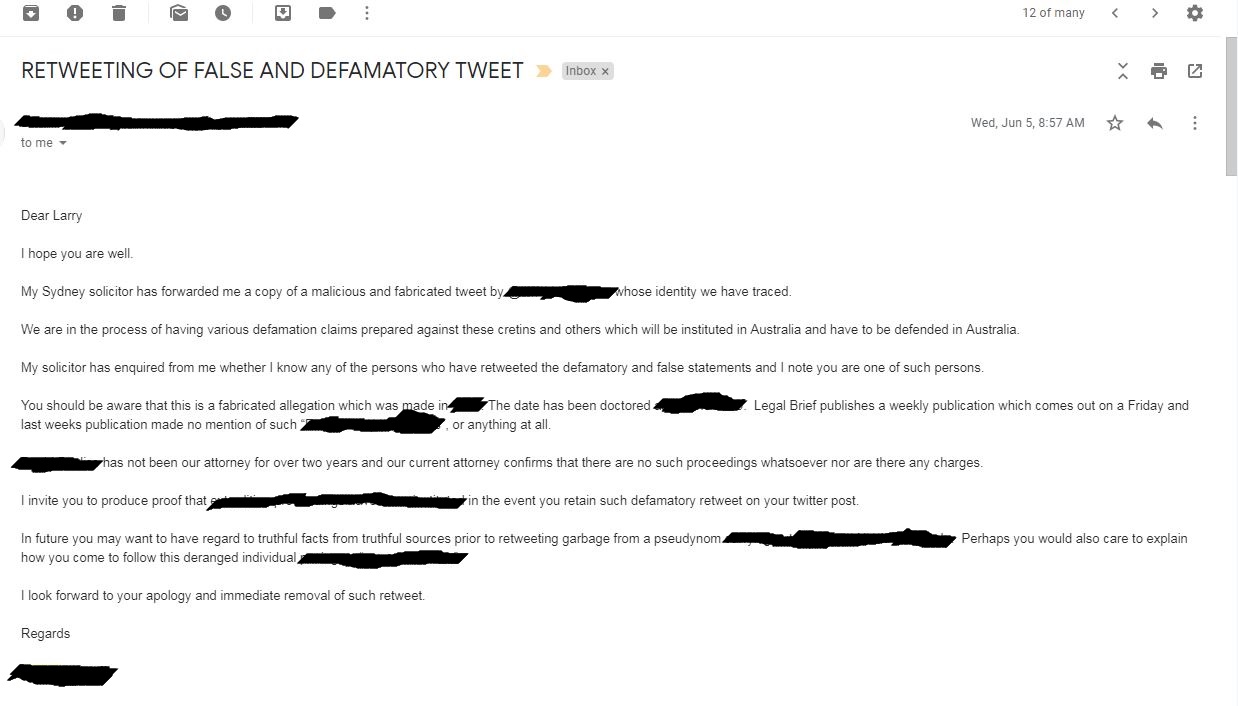
It wasn’t even something I’d posted myself on Twitter, but just a simple and stupid retweet which brought the threat of legal action rushing into my inbox the next morning.

“RETWEETING A FALSE AND DEFAMATORY TWEET” the headline of the email read.

It was then explained to me, by the subject of the tweet, that the person who posted the original information – an anonymous person – had made an allegedly “fabricated allegation”.

Having been identified as one of the handful of people who had retweeted the provocative tweet, I was then invited to “provide proof” of the material I had in effect republished through the simple click of a mouse.

“I look forward to your apology and immediate removal of such retweet” – the email ended by saying.

Of course I had no proof and nor did I wish to be sued so I hastily undid my retweet and wrote an apology to the person who had contacted me.

It was the obvious and sensible thing to do.

legal letter2

I have always been aware that you can be sued – and many have – for what you say on social media, and because of that I am quite careful not to put myself in the firing line.

But on this occasion my good sense deserted me, though I do recall a mental warning bell tinkling in the background at the moment I hovered over the retweet icon.

Thankfully, the aggrieved party was satisfied with my sincere apology and removal of the offending retweet, much to my relief and chagrin.

Now that the shock has worn off,  I am now deeply cognisant of what I tweet and retweet, post and share online. (What a strange world we live in!) and of course what I write on this blog.

In that regard, it still amazes me what people say about, and to one another on social media , often without hiding their identity at all.

It’s very brazen and defamatory stuff (most of which would never be uttered face-to-face in the ‘real world’) and carries with it the very real threat of a costly lawsuit should the subject of derision be upset enough to take action.

Indeed, there are many examples of people who have been sued, sacked or had their reputations damaged or destroyed by the things they have tweeted, posted and retweeted on the plethora of social media platforms that now dominate daily life.

Just type in “defamation + social media” into Google and you will find plenty of good reading material.

There is of course a very obvious reason why people sue others for what they say on social media and the word is ‘viral’. (Just ask this poor woman).

Information posted on these platforms can spread like wildfire via retweets, shares and likes. This phenomenon occurs everyday when unlikely tweets and posts start ‘trending’.

This point was highlighted by a judge in the first social media defamation case in Australia to proceed to full trial in 2013. In this case, the plaintiff – a high school music teacher – was awarded $105,000 in damages and costs after a former student at the school made false allegations about her on Twitter and Facebook.

District Court Judge Michael Elkaim remarked in his March 2014 judgement of Mickle v Farley that ” when defamatory publications are made on social media it is common knowledge that they spread”

“They are spread easily by the simple manipulation of mobile phones and computers. Their evil lies in the grapevine effect that stems from the use of this type of communication. I have taken that into account in the assessment of damages that I previously made,” the judge said.

This case, and many others around the world, should serve as a warning to anyone about the care one should take in how we represent ourselves online. Certainly tweeting or posting while drunk or mad with rage is not a good idea!

Even if you are rich and can afford a costly legal battle, there is also the potential damage to your reputation – just ask this famous billionaire.

Be careful what you tweet.


The anonymous Casefile host: the mystery solved?

casey

Incredibly, a year has passed since I first blogged about the identity of the Casefile host, after which he blocked me on Twitter.

During that time I have also blogged on the topic of doxxing, written about my favourite true crime podcasts (republished in the Financial Review) and most recently I provided those curious Casefile fans with a guide to solving the identity of the Casefile host for themselves.

Of course the reason WHY he chooses to remain the anonymous host of a hit podcast is an entirely different and perplexing mystery – but I think I might have finally solved it.

The reason I hadn’t worked it out earlier (it was staring me in the face a year ago) was that I did not realise the host (Brad) has a different surname to his father.

The host’s late father was a chief inspector in the NSW police.

I think the anonymous host may be sensitive about this connection given the content of his show, or perhaps his family is.

In addition it also explains his interest in true crime and why he chose to make a podcast about it.

The police connection could actually run a lot deeper – the host himself might have been a policeman at one time.

How do I know this?

At the funeral for his late dad, the host’s mother said Brad intended to follow in his father’s footsteps and become a police officer.

Whether he actually went on to become a policeman, I don’t know – but if it were the case, it would be another reason for his anonymity.

The police connection is certainly a more plausible explanation then the host just wanting to “stay out of the story and “let the facts speak for themselves”.

Case solved?

PS. An interesting aside, someone told me there’s a rather amusing Facebook post floating around about the Casefile host. To find it, simply log on to Facebook and search for “Casefile host”. 

The tyranny of the smartphone (and how I learnt to overcome it)

xperia_X2_Women_talking_on_phone_5There’s an ominous warning at my children’s aquatic centre in Gisborne, where they go for swimming lessons once a week.

Two photographs displayed side by side on a sign below the lifeguard’s station show a young child swimming happily underwater and next to the child a photo of a mobile phone.

The message under the gleefully swimming child reads “MAKE SURE YOU FOCUS ON THIS”, and under the mobile phone “NOT THIS”.

Ironically,  many of the intended recipients of this warning – parents who bring their children to swim at the centre – pay little attention to it because they’re so busy tapping away on their mobile devices.

It can take less than a minute for a child to drown – about how long it takes to read and reply to a text message or open a couple of apps.

I don’t of course take a high and mighty position on this worrying evolutionary behaviour – were it not for the fact that I swim with my kids when they have their lessons, I too might be at risk of doing the very same thing.

Indeed, up until relatively recently, I would say I was as addicted to my smartphone as anyone else.

Not only my wife, but my kids would notice my compulsion with constantly checking my phone for messages, or news, or fresh tweets.

In the 24 hour news cycle, amid the constant updates on social media as people share the minutiae of their lives or spout opinions on every possible topic of the day, the smartphone is the gift that keeps on giving.

Or should I say curse?

What kind of a society have we created whereby two people, in a seemingly loving relationship, can sit across from one another in a restaurant and not say a single word to each other, but instead have their heads glued to a little screen, their fingers typing away.

How we cling to our phones like safety blankets to shake off the boredom of living.

It’s the first thing anyone seems to do when they having nothing to do: they pull out their smartphone and start tapping away. I see it when I wait for my train in the mornings, and on the one hour train journey into work.

I see people scrolling through Facebook feeds whilst waiting at traffic lights and often incredibly, while they are driving their cars as they glance down into their laps.

One can only wonder how many people walk into traffic, trip over objects, fall down hills or end up in all sorts of embarrassing accidents because they were distracted by their phones. 

It must be in the millions every day.  According to statistics portal Statista, the number of smartphone users around the world has risen to 2.5 billion out of a global population of 7.7 billion (almost one in three people) and will hit 2.9 billion by 2020.

I remember well what happened in 2013 to a tourist visiting Melbourne who plunged off a pier into the icy waters of Port Phillip Bay whilst looking at Facebook on her phone. She was rescued by police, still clutching that very device.

I also found this viral video clip of a guy in downtown Oklahoma who stood and was bitten by a snake he stepped on, which he failed to notice – whilst texting on his phone.

There are many more examples you can find online.

No doubt such an embarrassing fate awaited me until, one day, whilst with my kids in the park, my attention constantly darting to my phone, an idea popped into my head from the cosmos.

The idea was this: I would abandon my iPhone and buy one of those old-style flip phones they market to older people with the big buttons (or I’d just buy one on eBay), and then the only things I would use my phone for – or could use it for -would be to make and receive phone calls and send text messages.

It would be like going back to a more simpler time, without the distraction of constant updates, when I could focus on the here and now, be with my family in body and mind, not just an empty vessel.

I almost leapt out of the metaphorical bath screaming “Eureka” at my brilliant plan – before reality set in.

What about the app I used to check the train timetable? What about the personal hotspot I used to connect to the internet to work whilst on the train?

And what – shock, gasp, horror – would I do without Google Maps to navigate my way to children’s parties, restaurants, meetings?

Turns out life would actually be a lot harder without my smartphone. And so I abandoned the idea.

But then, my wife – who has a knack for coming up with good ideas I seem incapable of considering – suggested I delete all the apps I didn’t need and keep only those that served a purpose.

And that’s exactly what I did. I deleted all my social media apps – Twitter, Facebook, LinkedIn. All my news apps – the ABC, BBC, Guardian – and all the other digital distractions I could do without.

That was about a month ago. I’ve survived the terminal event.

It hasn’t stopped me from still reaching for my phone for no reason other than to check for some new information, but with nothing much on their anymore, I tend to just put it away and the habit appears to be dissipating.

Am I smelling the proverbial roses a bit more now? Yes I’d say so. Do I notice things more like the country scenery that passes by me on the train? Yes. I do. And am I more present, actually listening to what my wife and kids have to say and actually responding in a meaningful way. I think so.

So  comrades, join the revolution and delete a few apps

Forget about what silly thought bubble someone is spouting on their Twitter feed about a topic they no nothing about, and rejoin the present world of the here and now a bit more.  It’s surprisingly nice.