An opinionated journalist's thoughts on media, film, books, sport, politics and the occasional rant. Or as William Burroughs put it: "A writer must write"
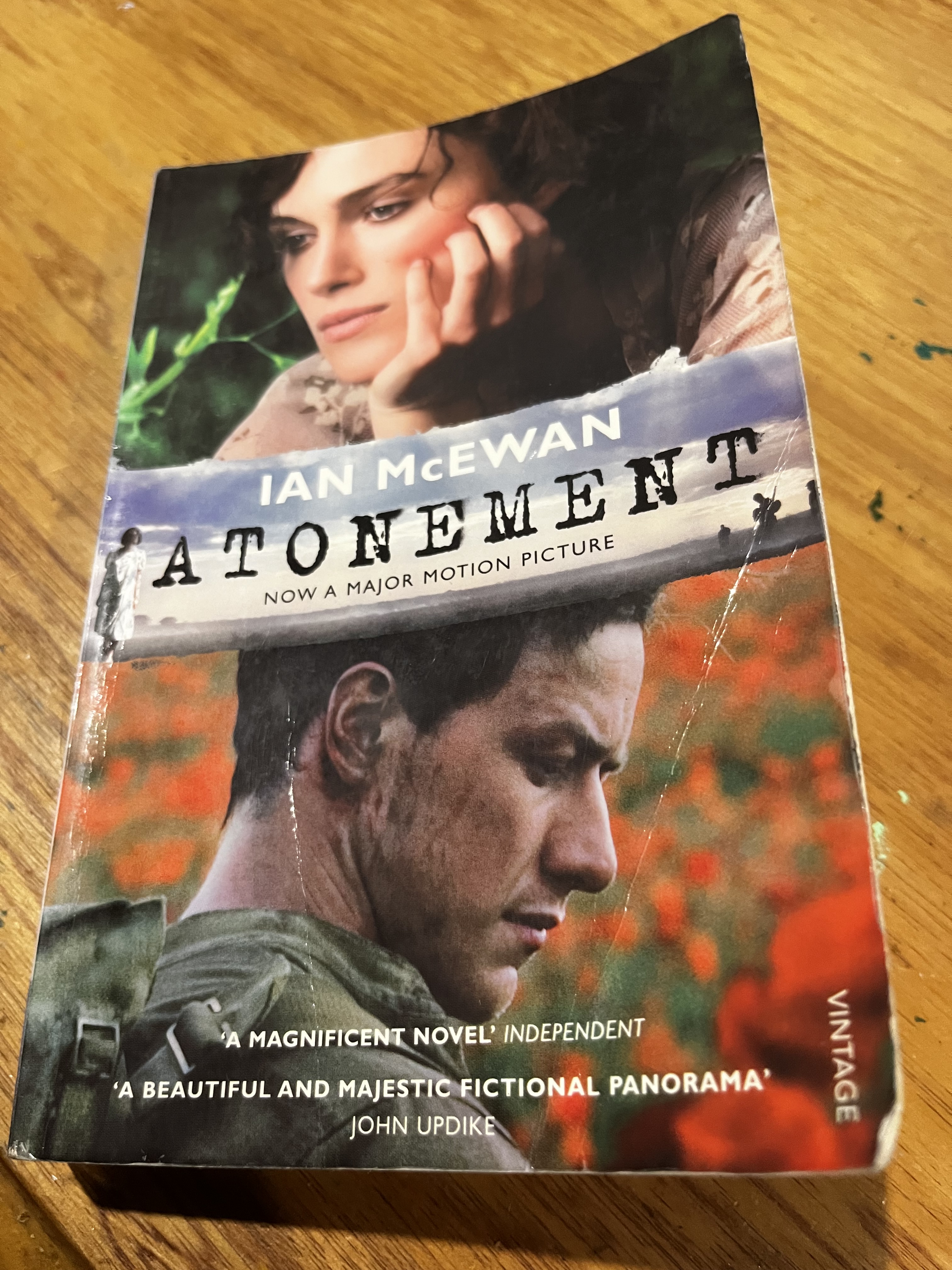
What a delight it was re-reading Ian McEwan’s masterful wartime novel Atonement.
And how equally delightful to re-watch the movie adaptation which came out six years later in 2007.
I thought I would be somewhat disappointed in the film, but while it condenses the storyline and isn’t able to really get inside the characters’ heads as deeply as the novel, director Joe Wright and screenwriter Christopher Hampton remain faithful to McEwan’s plot and story and know what to leave out and what must remain.
If I had to choose either the book or the movie, it would have to be the book though, simply because McEwan is a wonderful writer and storyteller and there is so much more to enjoy and ponder across its 371 pages than the 123 minutes of film time.
McEwan has that quite rare gift of being both a serious literary novelist (a Booker Prize winner no less, though not for Atonement, though it was shortlisted in 2021, losing to Peter Carey‘s The True History of the Kelly Gang). but also, being a popular and accessible writer who places the story at the centre of his efforts and who has achieved mainstream success.
In an interview in 2002, following publication of Atonement, McEwan spoke about his approach to writing and how he wants to welcome his reader in and make it impossible for them to not be able to turn back (no different, I suspect to the approach of Stephen King).
McEwan mentions a subplot within the novel, where the main character (Briony Tallis) submits a novella to a magazine and the editor replies that it is full of beautiful passages about how light reflects off stone and water, but you have to have “the backbone of a story”.
McEwan said in the same interview, that the idea behind Atonement was whether literary fiction could “do a love story” and the answer is, it most certainly can.
To summarise the plot briefly, Atonement begins in England in 1935, when thirteen-year-old aspiring writer Briony Tallis misinterprets a series of events between her older sister Cecilia and Robbie Turner, the son of the family’s housekeeper, leading her to falsely accuse Robbie of a crime he didn’t commit.
Her false testimony sends Robbie to prison and then to fight in World War II, tearing him apart from Cecilia, who chooses to estrange herself from her family in solidarity with him.
As the years pass, through the war and beyond, Briony grapples with guilt over what she did as a child, eventually becoming a novelist herself and attempting, through her writing, to atone for the damage her lie caused to the two lovers’ lives.
The novel ends with surprising and devastating twist as the reader is confronted with brutal reality (within a fictional story), versus the happier ending Briony plays out in her mind and on the page.
To return to McEwan’s writing. It would not be unfair to call him one of the finest writers of his generation. An example of his precise, imaginative prose is on display when McEwan describes how Emily Tallis, the withdrawn mother of Briony and Cecilia, experiences the onset of a migraine.
We find Emily lying still and silent in her darkened room. McEwan writes of her migraine beginning to build as “illuminated points in her vision, little pinpricks, as though the worn fabric of her visible world was being held up against a far brighter light”.
Then McEwan describes the approaching migraine as heaviness in the right corner of Emily’s brain, “the inert body weight of some curled and sleeping animal” that she must not provoke lest “the knifing pains would obliterate all thought”.
McEwan carries on this metaphor of the migraine as some lurking animal, indifferent to Emily’s misery and that her only hope lies in keeping still in the darkness. It’s just one example of his brilliant, precise writing and how it can conjure up something intangible and convey the terror of an approaching period of pain.
This is just one example of how the book triumphs over the movie, which does not have the scope or length of time to take the viewer into that metaphor – indeed there is no reference to Emily’s malady in the film – and many others that McEwan effortlessly teases out in his marvellous prose.
The strength of the movie lies in its strong cast: Saoirse Ronan as the 13-year-old precocious Briony is exceptional, as are Keira Knightley as Cecilia, James McAvoy as Robbie and Benedict Cumberbatch as the sleazy chocolate tycoon Paul Marshall, to name just a few.
The script by the legendary screenwriter Christopher Hampton retains the most important elements of the book and dialogue, the locations and sets are immaculate (the hellish scenes on the beaches of Dunkirk before the 1944 evacuation are sensational) and the cinematography and directing keep the story moving forward, whilst providing the opportunity for character development.
It’s actually quite a challenging novel to turn into a movie, because there are these leaps of faith that the reader must make (McEwan has the time and skill to explain for instance how Briony misinterpreted the events leading up to Robbie’s arrest) but Hampton and Wright create a sense of believability via skillful writing and clever uses of light and shadow to create confusion.
For anyone wanting to revisit this story, I recommend reading McEwan’s wonderful novel first and then kicking back with a bowl of popcorn and enjoying the excellent, but limited movie adaptation.
Copyright: Columbia Records or the artist. Low-res version used for review purposes only
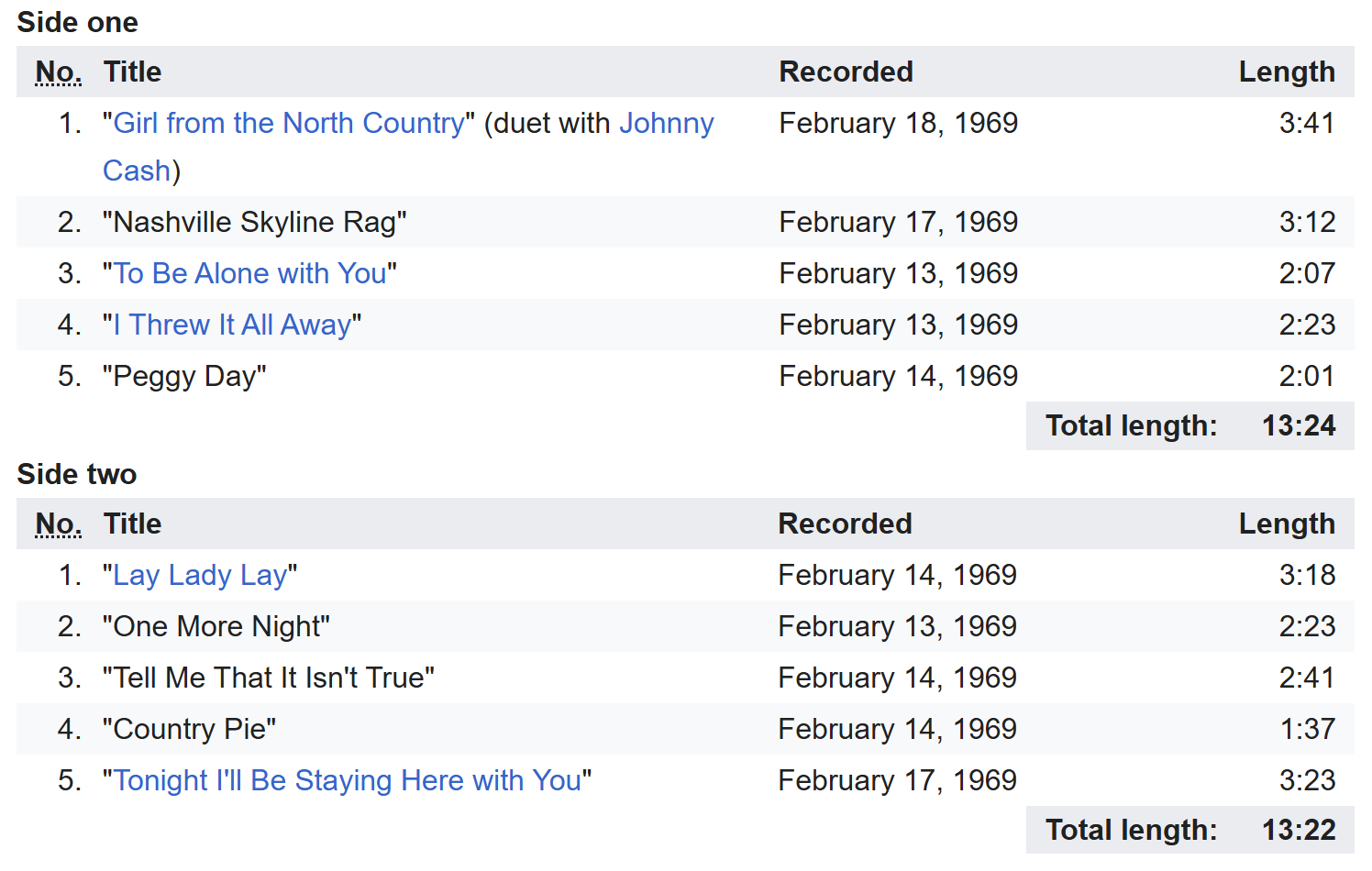
Title: Nashville Skyline (1969)
Length: 26min, 46s
Number of songs: 10
Best tracks: Girl from the North Country, I Threw it All Away, Lay Lady Lay, Tell Me That it isn’t True
If I could choose just one track: I Threw it All Away
Freshlyworded rating: 8/10
While running for less than 27 minutes and including only 10 tracks, there is plenty to like about this folksy, country and blues-infused album that includes a collaboration with the great Johnny Cash.
The really noteworthy thing about Nashville Skyline is Dylan’s new singing voice, which is almost unrecognisable from his usually rough-edged and conversational tone that includes stretching of words and bending of syllables.
Instead, we hear Dylan as a melodic-sounding crooner, a style that does in fact suit a lot of the romantic and sentimental tracks on the album. In truth, I have heard this sweeter voice before, on the track “Lay, Lady Lay” which was part of the three-CD Biograph compilation that first got me hooked on Dylan. The song always struck me as a bit odd just because it didn’t sound like Dylan at all. I didn’t realise there was a whole set of tracks that he sings in this unusual style, until I listened to this album.
Not only is his voice different, but the songs themselves are more straightforward in composition, with a clean-cut 1950s or 1960s feel to them and are largely devoid of complex poetic imagery.
Who would have thought that someone who wrote lyrics like: “Once upon a time you dressed so fine/Threw the bums a dime in your prime, didn’t you?” in ‘Like a Rolling Stone” would write a song like “I Threw it All Away” and lyrics like “Love is all there is, it makes the world go ’round” followed by “Love and only love, it can’t be denied”.
But the song has a raw honesty about it, and though the lines on paper appear cheesy and overly sentimental, it is actually a beautiful song (a new hidden gem for me) and my favourite track on the album.
I also really enjoyed Dylan’s duet with Johnny Cash, ‘Girl from the North Country’, which opens the album. When you think of great voices in modern music, Cash’s deep baritone is among the most distinctive and beautiful in the business. Dylan’s crooner voice combines well with Cash on this track, where the pair reminisce with a feeling of sadness and longing about a woman who “once was a true love of mine”.
An interesting inclusion on the album, is ‘Nashville Skyline Rag, a lively ragtime ditty without any words that has echoes of Dueling Banjos made famous in the movie Deliverance. It’s followed by “To Be Alone with You”, a simple, but catchy pop-like song about Dylan being with one he loves.
“Peggy Day” is straight out of the 1950s. It’s a playful song where Dylan sings of “wanting to spend the night with Peggy Day” and how “Peggy night’ makes his “future feel so bright”.
The most famous song on the album is the aforementioned “Lay Lady Lay” another love song that is slow and mesmeric (aided by a twanging steel guitar), with sexual undertones and he asks his love to spend the night in his “big brass bed”. It turned into a surprise hit I have learned, peaking at Number 7 on the Billboard Hot 100 in 1969 and was a favourite track of Madonna.
“One More Night” is very much a country-style love song with Dylan lamenting about spending another night with the woman he loves and featuring the almost excruciating cliched line “Oh, I miss my darling so” alongside gospel undertones in the repeated phrase: “Tonight no light will shine on me.”
I really loved “Tell Me That It Isn’t True” a song about Dylan’s fears about losing the woman he loves to a dark and handsome rival and pleading with her tell to tell that it’s not true. It’s a catchy tune with a sweetness and tenderness to it.
The album ends with yet another love song. “Tonight I’ll be Staying Here with You” is about woman he so devoted to that he throws all his plans out the window to remain with her. Incorporating a lot of jazzy piano, it seems a fitting closing song, as if Dylan has learnt his lesson and is not going to blow his chance at love and romance this time.
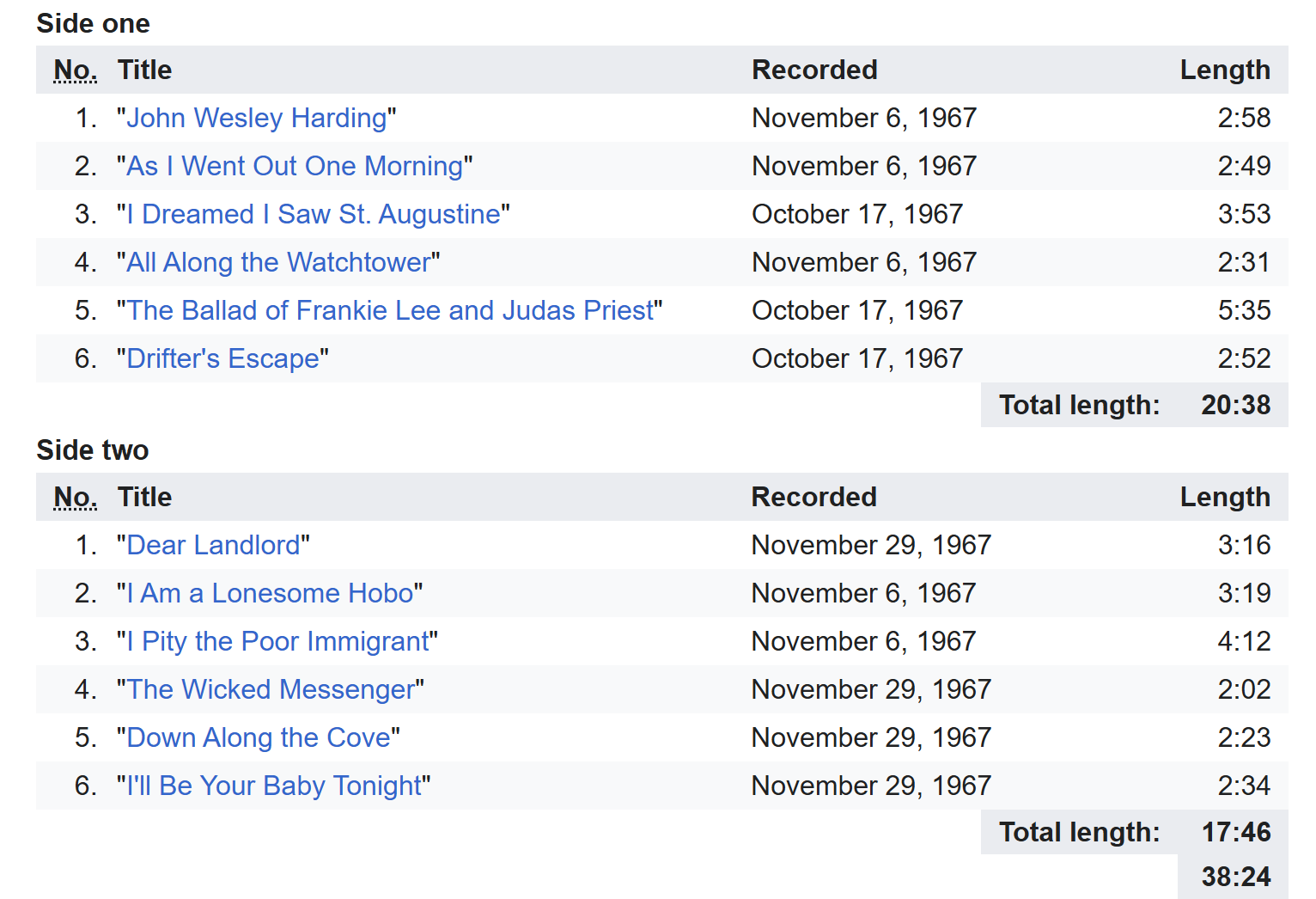
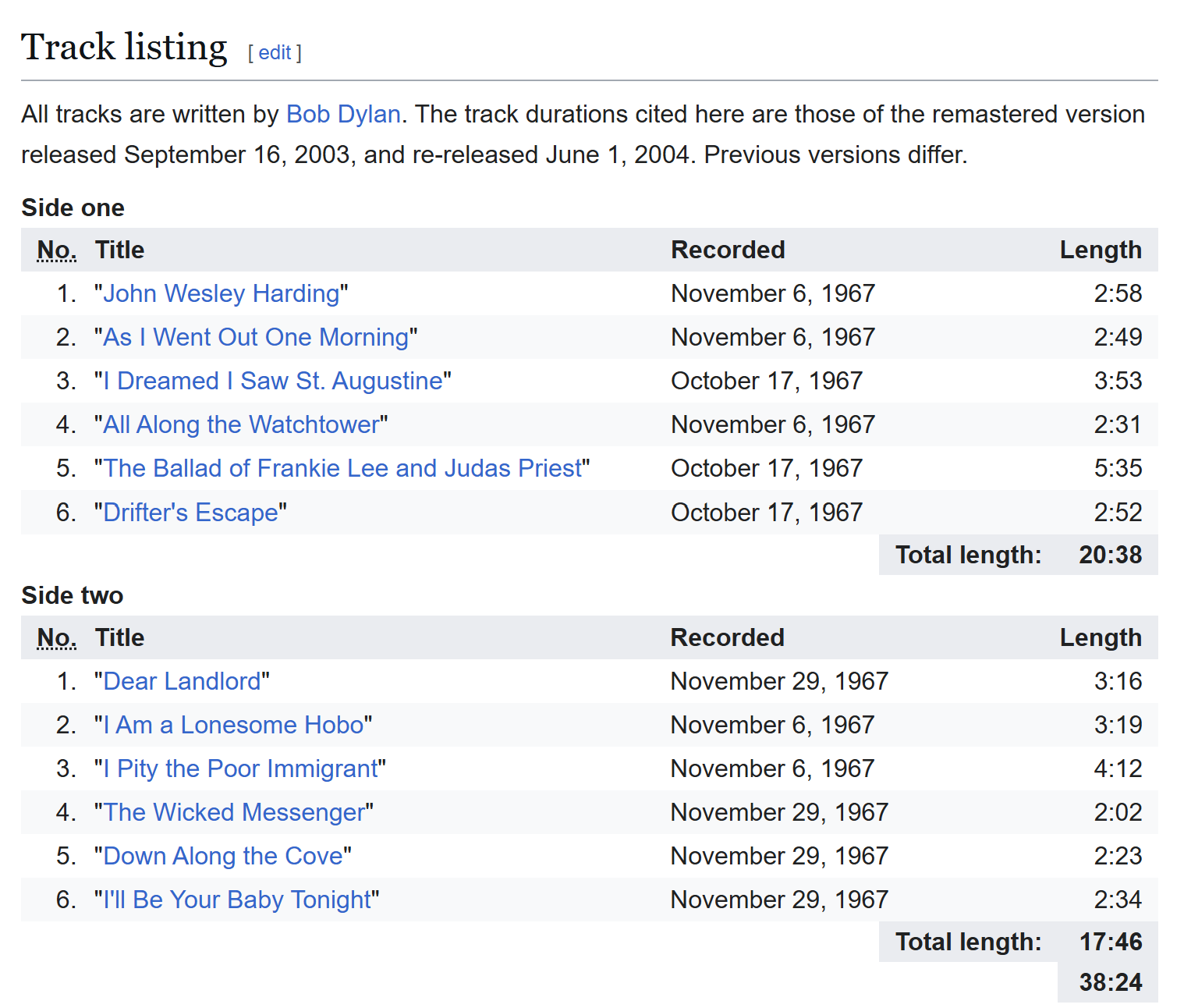
Best tracks: John Wesley Harding, As I Went Out One Morning, All Along the Watchtower, Dear Landlord, I’ll be Your Baby Tonight
If I could choose just one track: Dear Landlord
Freshlyworded rating: 8.5/10
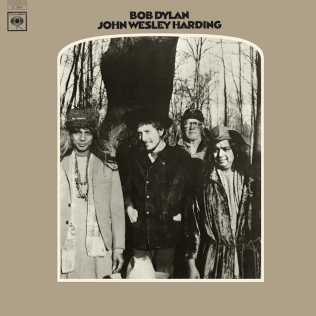
Copyright: Columbia Records or the artist. Low-res version used for review purposes only
Bob Dylan’s 8th studio album runs for less than 40 minutes – the shortest of the albums he had recorded by then – but is full of great storytelling songs.
After a number of albums full of blues, rock and even pop, this album marks a return to Dylan’s folky, semi-acoustic roots. It also includes some exceptional harmonica playing that brings a poignant tone to many of the songs.
The album, which has a gentle, rambling feel to it, draws out tales of eccentric and colourful characters that seem rooted in the old West like the gunfighter and lawyer, John Wesley Harding, whose story kicks off the album and gives it it’s name.
A kind of Robin Hood figure, Dylan sings that Harding is a “friend to the poor” but who “traveled with a gun in every hand”. Sticking with the theme of quintessential American characters, Dylans sings about the “Lonesome Hobo” who was once prosperous, but who was brought down by “petty jealousies”.
One of my favourite songs on the album is ‘As I Went Out One Morning” where the narrator falls for “fairest damsel that ever did walk in chains”. It evokes the cotton fields and slavery of the Deep South
The album also features three songs widely regarded as Dylan classics: the medieval-themed “All Along the Watchtower” featuring the Joker and Thief. It’s a song famously covered by Jimi Hendrix and featured in the opening scenes of one of my favourite movie Withnail & I. U2 also did a rather forgettable version. For me, Dylan’s original version is the best and I just love the mysterious and poetic lyrics including lines like:
Businessmen, they drink my wine, plowmen dig my earth None of them along the line know what any of it is worth”
The other famous tracks are the wonderfully pleading “Dear Landlord” which though I have struggled to make sense of its meaning is my favourite song out of the 16. The other classic is the very sweet, love song “I’ll be Your Baby Tonight” which has a bluesy undertone and great lines like:
Kick your shoes off, do not fear Bring that bottle over here I’ll be your baby tonight
I also loved the slow and moving “I Dreamed I Saw St Augustine”. Perhaps the most interesting song on the album (also the longest) is “The Ballad of Frankie Lee and Judas Priest” which has no chorus but presents as a kind of moral fable with biblical undertones about a simple man (Frankie Lee) led astray and to his doom by the cunning Judas (and by Lee’s own moral failings). It’s sung in Dylan’s distinctive manner of over-emphasising certain words.
Overall, I really loved this album. The songwriting is superb, the harmonica adds depth, resonance and poignancy and the simpler, semi-acoustic sound makes it a perfect backdrop to a country stroll or whilst staring into a crackling fire.
John Wesley Harding is another classic album you should definitely listen to a couple of times!
Not many though would know that he spent much of his youth on the mean streets of San Blas, an impoverished, heroin-riddled suburb of Madrid whilst his missionary parents set up a church dedicated to helping junkies get clean and live productive meaningful lives.
Jonathan and his three brothers – David, Peter and Timothy – were just young boys when the family moved to Spain from the US in 1983 and his and their experiences are chronicled in an honest and unflinching memoir he published this year called “Shooting Up”.
The book is subtitled “A Memoir of Love, Loss, and Addiction”, which is a good summary of the main themes eloquently and painfully described by Tepper: love for his family, the people of San Blas, the rehabilitated addicts that became his “brothers and sisters”; loss for all the lives destroyed by drugs and AIDS, and addiction for the steely grip of heroin on the local community and those who chose to free themselves of it.
In keeping with the last of these themes, Tepper’s memoir begins with he and his brothers out looking for “yonkis” (junkies) to hand leaflets to as their parents sought out those in the community in need of care.
“Give them to anyone who looks like a heroin addict. Come back empty handed,” [my father] told us, “You’ll get an ice-cream of whatever flavour you want if you do.”
While these initial efforts to find “yonkis” ready to be healed resulted mostly in failure, and even the threat of violence, over time, the Tepper family won over the trust of many in the local addict community. With their support, Elliott and Mary created Betel, a free rehabilitation program that has since grown into a global movement (100 cities in 19 countries) that’s saved and transformed the lives of hundreds of thousands of people battling addiction and homelessness. (There’s even a Betel branch on the outskirts of Melbourne, Betel Shalom in Lilydale in the Yarra Valley).
To supplement the limited financial support they received from donations, the Teppers can up with an ingenious plan to open a store selling restored furniture. The derelict furniture would be repaired by recovering addicts, providing a rewarding and meaningful activity to direct their attention away from their cravings.
Tepper spent many hours in the crowded shop and on the football field, forming life-changing bonds with recovering addicts like Raul Casto, who is one of the central characters in the memoir. Once a streetwise, tough guy, Raul became like a brother to young Jonathan, and who would preach to the local community from the church pulpit.
The love Tepper has for Betel’s inspirational leaders become deep grief when the AIDs epidemic ravaged the local community. Because of needle sharing, the virus was passed on to almost every addict that made their way into the Betel program, and each loss was devastating to Jonathan and his family.
Tepper describes visiting the sick and dying at the imposing and foreboding Ramon y Cajal Hospital, and there are so many painful farewells. Tepper also writes about another intensely personal tragedy, the death of his younger brother Timothy in an automobile accident whilst the brothers and their father were on a road trip back in the US.
It’s a devastating moment which also produces some of Tepper’s best writing as he describes the inner turmoil, suicidal grief and immense sadness that engulfed him upon returning to Madrid without Timothy.
Despite chronicling so much grief and loss, Tepper’s elegantly written memoir is also a celebration of people who lived live full of purpose and meaning, even though they were cruelly cut short. It’s also a tribute to the determination and devotion of his parents, and the deep bond of four brothers who forged new identities in a strange place and time. I highly recommend it.
Jonathan Tepper kindly sent me a copy of his book, and after I finished it, agreed to a short interview:
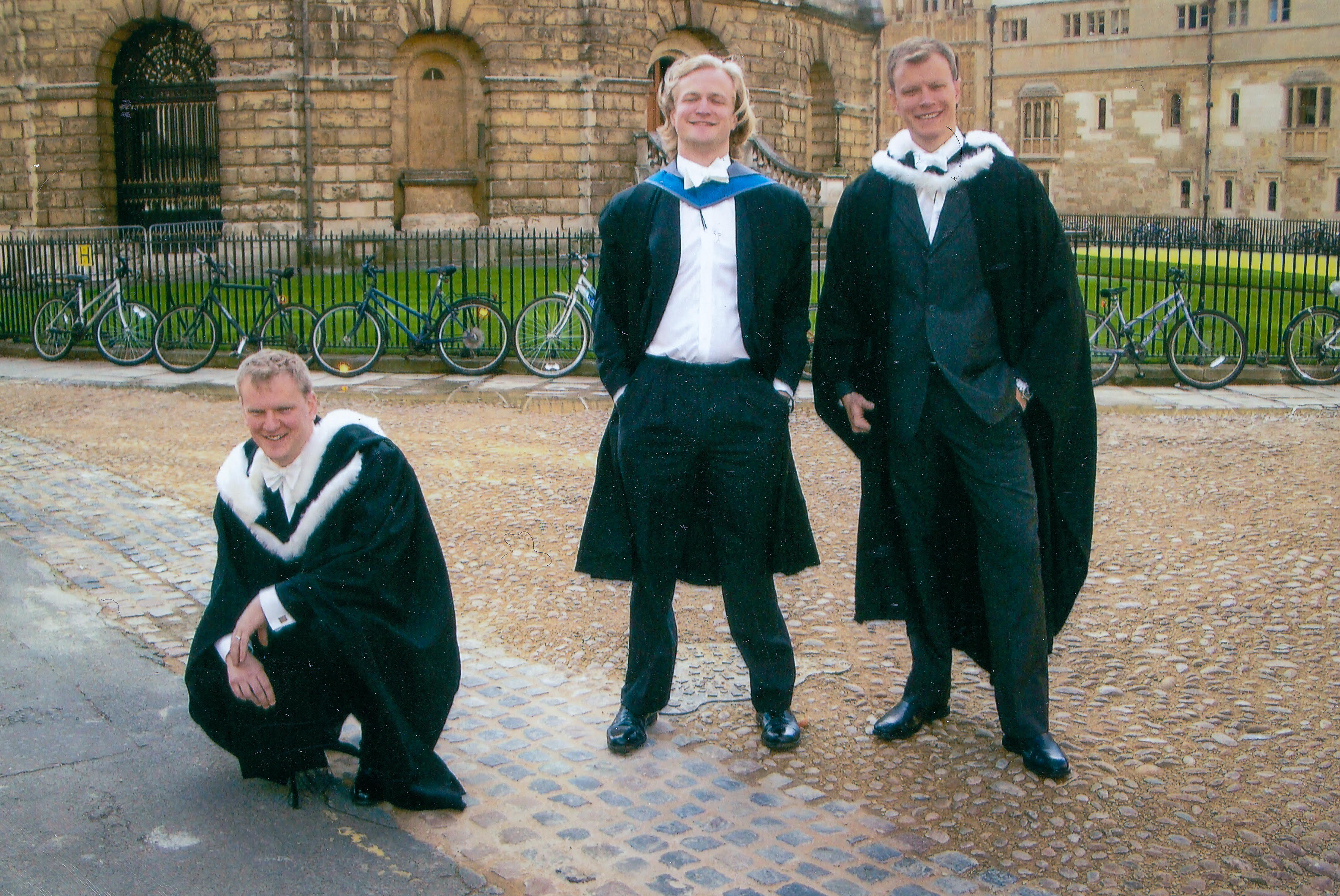
Jonathan (centre) with his brothers Peter (left) and David (right) taken at their Oxford University graduation.
You wrote the memoir between 2005 and 2008 but only published it this year, how challenging was it to get it edited and finished and what kept you going?
I started writing this, believe it or not, about 20 years ago. At the time I was working as analyst at SAC Capital and living on the Upper West Side. One weekend I went to Barnes and Noble on 82nd Street and saw this book with a beautiful cover by Bruce Davidson titled Flying Over 96th Street, Memoir of an East Harlem White Boy. I picked it up and the prose was beautiful. It was a story of a blond-haired, blue-eyed boy. His parents had moved him to East Harlem in the 1950s, and he grew up in the 50s and 60s during the Civil Rights era.
I wrote the manuscript but put it away when it got a few rejections. At the same time, I was very busy starting two companies and then my own investment fund and felt I did not have time to edit it further or get it published.
In 2022 a, great mentor of mine in London who’s a retired fund manager, was talking about his parents and I mentioned Shooting Up. And he said I should really get this published before my father dies. My father’s now 79. He had a minor stroke last year, but he’s still working, helping people, running the drug rehab center. Fortunately, by 2022 I had already written three books, and my literary agent was able to get a contract with Little Brown [for Shooting Up]. I’m glad it is finally out.
What did you enjoy most about writing the memoir and what were the hardest aspects?
The most enjoyable part was interviewing family and friends and reconnecting with people I had lost touch with. I had my own memories, but I wanted to double check them. I reconnected with the head doctor of the infectious diseases ward at Ramon y Cajal hospital. We both felt we had lived through something unique and extraordinary.
Raul Casto is one of Shooting Up’s main characters and was like an older brother to me. In fact I’m still very close to his wife Jenny and his daughters. In 1995 when Raul died his daughters were aged three and five and I had gone off to college. However, I didn’t realise that because they were so young they didn’t have many memories of him. So when I gave them the final draft of the book, his daughters sent me beautiful notes telling me that they felt the book had brought their father closer to them. Without a doubt that was the best part of the entire project.
The hardest aspect was writing chapters about the lives and deaths of family and friends who were so dear. Readers tell me they have had to put the book down at times. I certainly did when I was writing it.
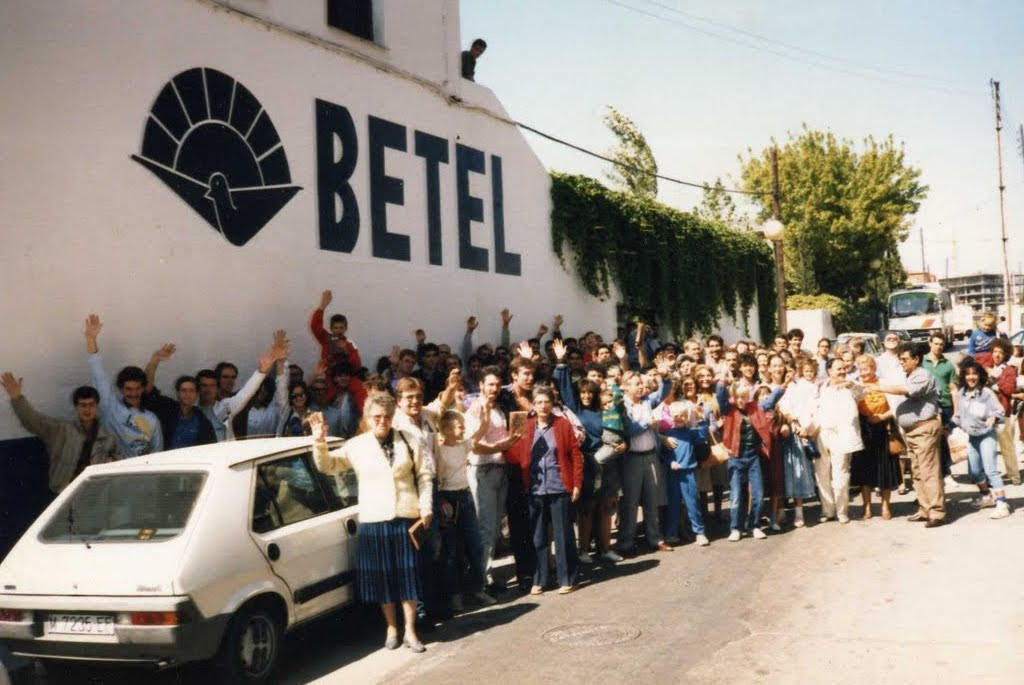
Betel Church after it was repaired in 1988
What feedback have you received from your family, friends and people within Betel who have read the book?
My brothers, mother and father read an early draft of Shooting Up, which was not as good as the final draft, and said they liked it. My mother loved it and thought it was full of hope, which captured the spirit of Betel through my eyes. Also, my father liked it too. Certainly, there’s quite a lot of painful and honest things about the whole family, about each brother and myself included. However, my brother David told me it was very sad yet very beautiful and thanked me for writing it.
Meanwhile, my father half jokingly said he thought I was too hard on him because he comes across as a bit of a charismatic visionary figure but also a disciplinarian. For example, I call him the autocrat of the breakfast table. But he said he thought I told the story as it was and from the inside.
Jonathan explained of this photo: “This isn’t a great photo, but it is the last photo of Timothy, I believe. It was a few days before the accident in July 1991. He’s with my father and some people from a church that supported my family. He was such a great kid.”
What about people in the business, finance and property community? Were they surprised to learn about your upbringing on the tough streets of San Blas and the work of your parents?
Now that the book is out, I have received many emails from people who only know me through investing. They’re surprised by my background or maybe they knew I grew up in Madrid but had no idea what an odd childhood I had. I think it has been a surprise [to them]. Most of my close friends knew, and a few have even come to Madrid to visit Betel, the drug rehab center.
In the book, you describe your parents’ unflinching faith in God and the missionary work they did whilst you had your own doubts and frustrations. What is your relationship with religion these days?
I’m not a pastor, preacher or theologian. I’ve followed my own route and gone into entrepreneurial activities and investing. However, at Oxford I attended St Aldate’s and in London I attended Holy Trinity Brompton. I think the faith my parent had was beautiful, and they did an extraordinary thing showing love and compassion to those in need for decades. I admire them.
A lot of the book deals with death and grief. How do you think being exposed to so much of both influenced how you view the world as an adult?
In the book I have a quote from my father. He wrote in his newsletter back to supporters in the US that, “AIDS breaks your heart. It makes you compassionate and softens you.” One thing Raúl said was that with AIDS you had to live a life of quality and not quantity. The virus made me realize that every day counted and we had to love people as much as possible. We really didn’t know how long they would survive, and we went to the hospitals as often as we could so they would know they were not alone. Death was never far, and it made life more vivid and more precious. I grew up very quickly and was mature beyond my years in some ways, and still immature in others.
While AIDS is a major part of the book, we didn’t obsess about the virus or AIDS, and almost everyone got on with life and helping others. The leaders in Betel didn’t want AIDS to define them. When the “cocktail” of drugs that stopped AIDS in its tracks appeared in 1995, everyone got on with their lives. What we had lived through only hit me years later at the 20th anniversary of Betel when they had a slideshow as a memorial of all the friends we had lost. Everyone was in tears as we remembered our friends, and I realized we had lived through something extraordinary we didn’t talk about enough. I wanted the book to be a memorial to all the friends we lost. I hope readers get to the end of the book and feel they know them and traveled with them on a journey.
Raul, a recovered addict who became one of the leaders at Betel and close personal friend of Jonathan and his family. He sadly died in 1995, aged just 37
When did you last return to Madrid and what is it like going back now?
When I lived in London I went to Madrid once a month, but now that I live in The Bahamas, I probably go every three or four months. I last went a few months ago, and I’ll go next month. My father lives in an apartment in the headquarters of Betel, and it is his life. When I’m back, I’m surrounded by people I grew up with who spend their lives helping others. The city has changed enormously and is much wealthier, cleaner, and more developed than what I grew up with as a child in the 1980s and 1990s. But you can still find shantytowns and drug dealing in the periphery of Madrid.
What advice would you give to anyone thinking about writing a memoir?
Firstly, I think in order to be a good writer, you have to be a good reader. Read great literature but also read classic memoirs or autobiographical sketches that have stood the test of time. Some of the books I most enjoyed most were The Diving Bell and the Butterfly, A Moveable Feast, Borrowed Time, Empire of the Sun, Just Kids, and The First Man.
Secondly, read books on writing and storytelling like Story by Robert McKee, Nobody Wants to Read Your Sh*t by Steven Pressfield and others. The Art of Memoir by Mary Karr is very good.
Do you have plans to write another book? If so, what would it be about?
Shooting Up was a labor of love and a memorial to friends and family. It was unique, and I don’t have another memoir in me. My day job is running an investment fund named Prevatt Capital, which is my mother’s maiden name. I spend my time with my two-year-old son and wife and visiting friends. I occasionally write investing books because some topics are of particular interest, and writing is a way of researching them and thinking about them deeply. In 2018 I wrote The Myth of Capitalism: Monopolies and the Death of Competition. That came from my research on the rise of industrial concentration and monopolies in the American economy.
One book I’m working on with a friend who is a humanities professor and avid investor is an introduction to personal investing. We hope it will be useful for laymen and professionals. We both agreed that there was no one book we’d give to someone wanting to learn about how they should start investing. There were half a dozen books, each one with its own angle. But we wanted to write a great book that could be of use to a sophisticated wealthy person and a young college person starting their personal journey. Wiley will publish it.
Jonathan Tepper with his late brother Timothy
Playing football and going to the Santiago Bernabeu stadium to watch Real Madrid play was a big part of your childhood in Madrid. Do you still enjoy the game and who will you be supporting at the World Cup, USA or Spain?
I am not religious about following Real Madrid, but I have watched most of their Champions League games when they played in recent years. I do watch some league games. It is a much more commercial world than the Real Madrid I grew up with. Before much of the team was Spanish and came up through the junior teams like Emilio Butragueño, Michel, Martin Vazquez, etc. Now they’re all imported big signings and superstars.
I’m a cultural mutt, a mongrel. I’ll support Spain and the US. I lived in London for 20 years and became British, so I’ll support England too. I hope they don’t play each other. I hope they all do well.
Reflecting back on your Aussie property price collapse predictions, which did not eventuate (Sydney house prices have nearly doubled since 2016, while Melbourne values are up nearly 50%, official data shows) what do you think you got wrong?
[Report co-author John Hempton and I] have been amazed that [Australian house] prices have never corrected. My guess is that is because of negative gearing. Even when it is uneconomical to own speculative housing stock, there are tax benefits that help out or even overcome the losses. As that changes, I’m sure it will change the calculus. The other thing that I didn’t get right is that the government has had very high net migration, so it has increased demand while supply hasn’t kept pace, so it has helped with high property prices. But Aussie price/income ratios are crazy compared to most countries.
*All photo supplied and reproduced with the permission of Jonathan Tepper.
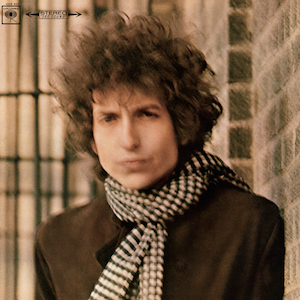
Album cover reproduced for review purposes. Copyright: Columbia Records or the graphic artist.
Title: Blonde on Blonde (1966)
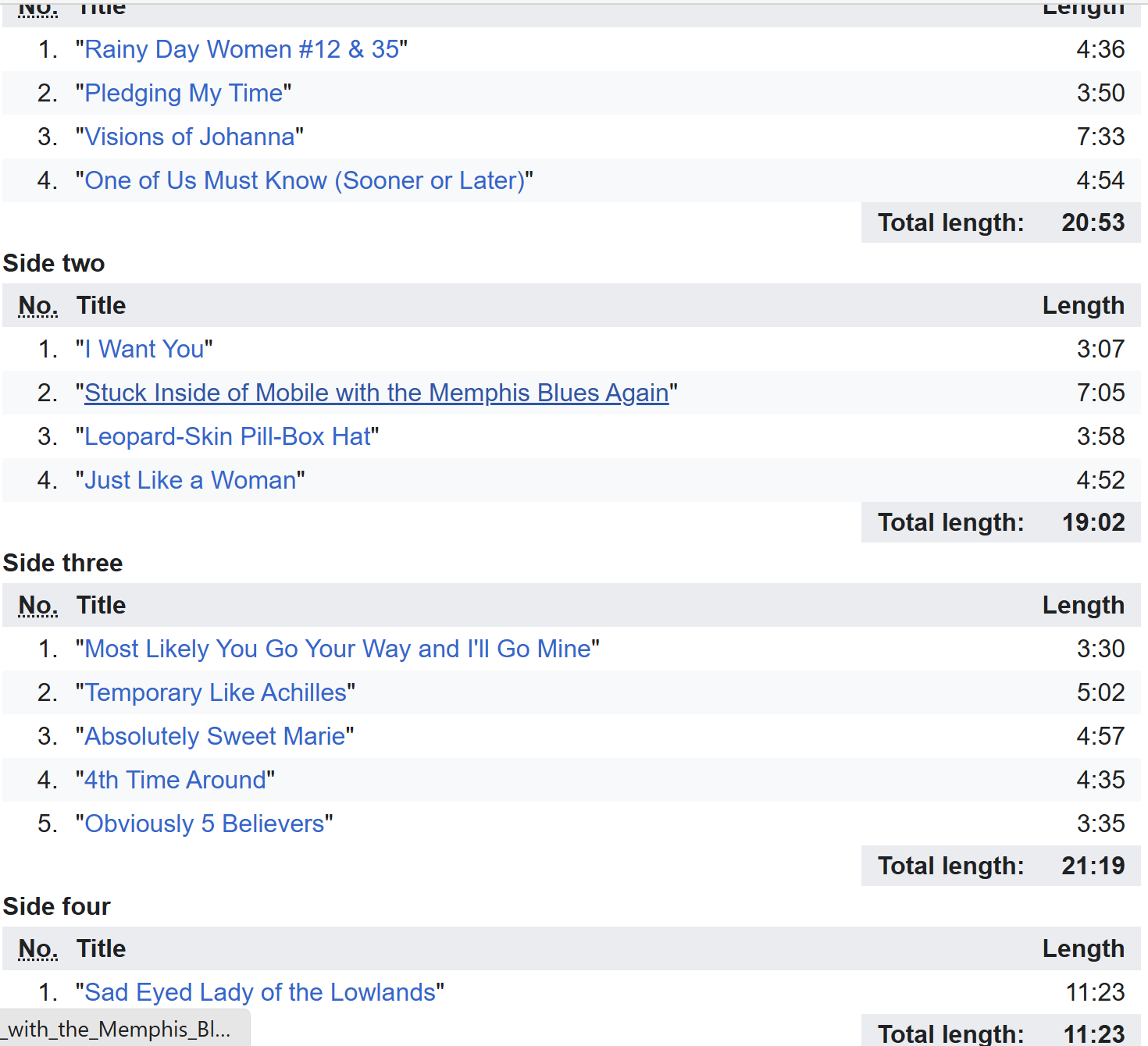
Length: 1hr 12 min and 37sec
Number of songs: 14
Best tracks: Visions of Johanna, One of Us Must Know, Stuck Inside of Mobile with the Memphis Blues Again, I Want You, Mostly You Go Your Way and I’ll Go Mine, Absolutely Sweet Marie, Temporary Like Achilles, 4th Time Around, Obviously 5 Believers, Sad Eyed Lady of the Lowlands
If I could choose just one track: Visions of Johanna
Freshlyworded rating: 9/10
By the sheer number of songs I have chosen as my “Best tracks”, it must be fairly obvious that I think Blonde on Blonde is another great album by the maestro. It’s also Dylan’s longest to date running for nearly 73 min with 14 tracks.
Blonde on Blonde was his seventh studio album, and it’s incredible to think that he was still just 25 years old when he recorded it. Saying that, when you listen to a lot of his songs, including my favourite track on the album, the haunting and beautiful “Visions of Johanna” it’s hard to believe you are listing to such a young man. I seem to always picture Dylan more as he looks now (he turned 85 last month). He sings from a place of wisdom and experience decades beyond his years.
The album begins with a raucous-sounding, honky-tonk track that bears absolutely no resemblance to its title “Rainy Day Women #12 & 35.” It’s a song I would expect to hear walking into a noisy saloon. There is hooting and laughter in the background with the lyrics returning to the theme of “getting stoned” perhaps an allusion to smoking pot and the emerging hippie movement. Dylan seems to have fun singing this song and it’s certainly a lot of fun to listen to as well.
There’s a lot of blues on this album, and Dylan really kicks into Blues-mode with the slow and soulful “Pledging My Time”. There’s some fantastic harmonica playing on this song as there is throughout the album. He is one of the best on the harmonica.
Then comes one of his masterpiece tracks, ‘Visions of Johanna”. I just love this song and have listened to it multiple times including out of sequence and on its own. It kicks off with Dylan on the harmonica and is filled with stunning and complex poetry, with verses like
In the empty lot where the ladies play blindman’s bluff with the key chain And the all-night girls they whisper of escapades out on the “D” train We can hear the night watchman click his flashlight Ask himself if it’s him or them that’s really insane
I also love the lines: But Mona Lisa musta had the highway blues/ You can tell by the way she smiles
This is constant feature of Dylan’s songs, especially the long poetic ones, him drawing in elements from art, fiction, popular culture, current affairs. He has this ability to absorb and process so much going on around him and then translate it into song.
I can’t claim to know exactly what is going on in this song, it just works on so many levels, the words and the music are paired perfectly.
I also really loved “One of Us must Know which looks back at a relationship, and has an uplifting feel courtesy of the melody and backing band as well as being very moving with lines like:
When I saw you say “goodbye” to your friend and smile I thought that it was well understood That you’d be comin’ back in a little while I didn’t know that you were sayin’ “goodbye” for good
‘I Want You” is a pretty famous Dylan track. It has a lighter, almost pop-like sound and some absolutely terrific lyrics. As with all Dylan songs, there’s a lot of dense imagery and deeper meaning buried behind the lustful lyrics.
I love the way the song starts, the writing has an effortless, flowing quality
The guilty undertaker sighs The lonesome organ grinder cries The silver saxophones say I should refuse you The cracked bells and washed-out horns Blow into my face with scorn, but it’s Not that way, I wasn’t born to lose you
The undiscovered gem for me on this album is “Stuck Inside of Mobile with the Memphis Blues Again”. It’s a long track, running over nine verses, but is sung at a rollicking pace before slowing down with the plaintiff refrain:
Oh, Mama, can this really be the end To be stuck inside of Mobile With the Memphis blues again
Whilst trapped in Mobile (a town in Alabama in the American South), Dylan recounts strange and disturbing encounters with a cast of eclectic characters including a ragman who won’t talk, a senator showing off his guns, a preacher “with twenty pounds of headlines stapled to his chest” and Shakespeare “in the alley with his pointed shoes and his bells”
The one song I have a slight problem with on the album is “Just Like a Woman”. It’s a pretty famous track, but lines like:
She takes just like a woman, yes, she does She makes love just like a woman, yes, she does And she aches just like a woman But she breaks just like a little girl
are difficult to listen to and no doubt drew allegations of sexism and misogyny. Funnily enough, despite finding this song somewhat unpleasant and distasteful, I found myself humming it on a few occasions. It does have an underlying beauty to it, just a pity about the words (or am I reading too much into it?)
The album then switches direction entirely with “Most Likely You Go Your Way and I’ll Go Mine”, a real stomping bluesy track despite it being another tale of the end of a relationship. He certainly does mine his romantic relationships for musical and poetic inspiration. At the same time, he never resorts to cheesy line or is overly sentimental.
“Temporary Like Achilles” is a really great, slow-moving blues track about love spurned by a hard woman who Dylan questions may have a heart “made out of stone, or is it lime, or is it just solid rock?”
Dylan picks up the tempo with the almost pop-like “Absolutely Sweet Marie” which has some rather obvious sexual connotations with the singer “beating on his trumpet” and having “the fever down in his pockets”
My God, “4th Time Around” is a beautiful song that brings Dylan back to his folksy roots. The song is about the narrator’s twisted, sparring relationship with a tough, no-nonsense woman who tells him, “Don’t get cute” “, The song follows the duelling nature of their relationship The harmonic playing towards the end is sensational.
The penultimate song, “Obviously Five Believers” is a fast-paced roadhouse blues track about a lonely guy yearning for his lover to return, whilst trying to make it on his own.
Then the album slows way down “for Sad Eyed Lady of the Lowlands”, another undiscovered gem. Dylan’s voice takes on a more gravely tone and the song is fill of highly poetic imagery relaying how he feels about the subject of the song, understood to be Dylan’s wife of the time, Sara Lownds. Running to over 11 minutes, it’s one of those Dylan tracks that just sucks you right in – in an almost hypnotic way.
With your holy medallion which your fingertips fold And your saintlike face and your ghostlike soul Oh, who among them do you think could destroy you?
It’s a great end to a fantastic album, that really shows the depth of Dylan’s musical range (blues, pop, folk, honky tonk, fast and slow paced) and his songwriting abilities
Album cover reproduced for review purposes. Copyright: Columbia Records or the graphic artist.
Title: Highway 61 Revisited (1965)
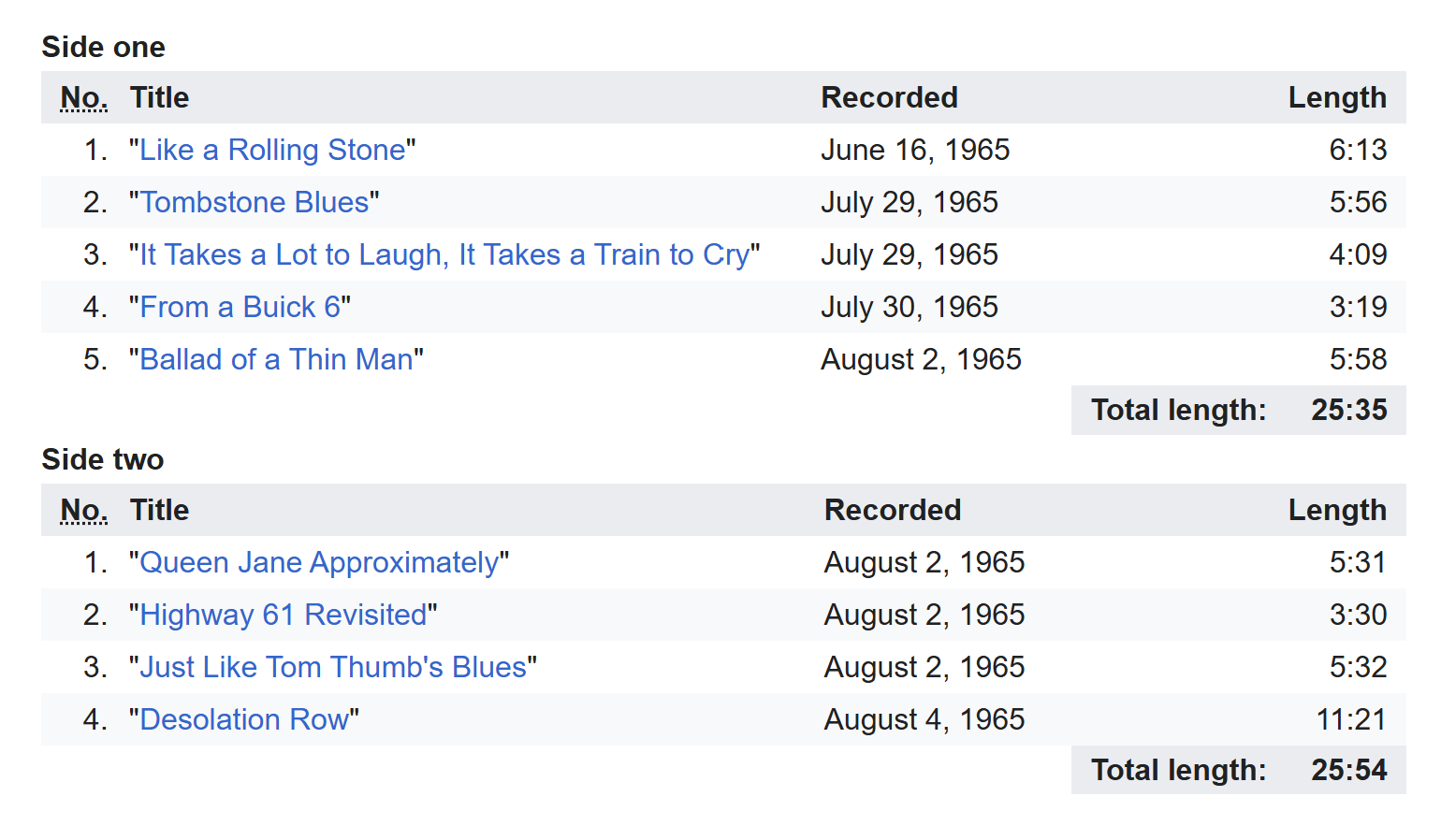
Length: 51min 26sec
Number of songs: 9
Best tracks: Like a Rolling Stone, Tombstone Blues, Ballad of a Thin Man, Queen Jane Approximately, Highway 61 Revisited, Desolation Row
If I could choose just one track: Ballad of a Thin Man
Freshlyworded rating: 9.5/10
If Album 5, Bringing it all Back Home, stunned and outraged Dylan’s traditional folk, acoustic fan base with his foray into the electric guitar, his next album, released the same year was his great full throttle embrace of not just the electric guitar, but a much bigger, bolder sound.
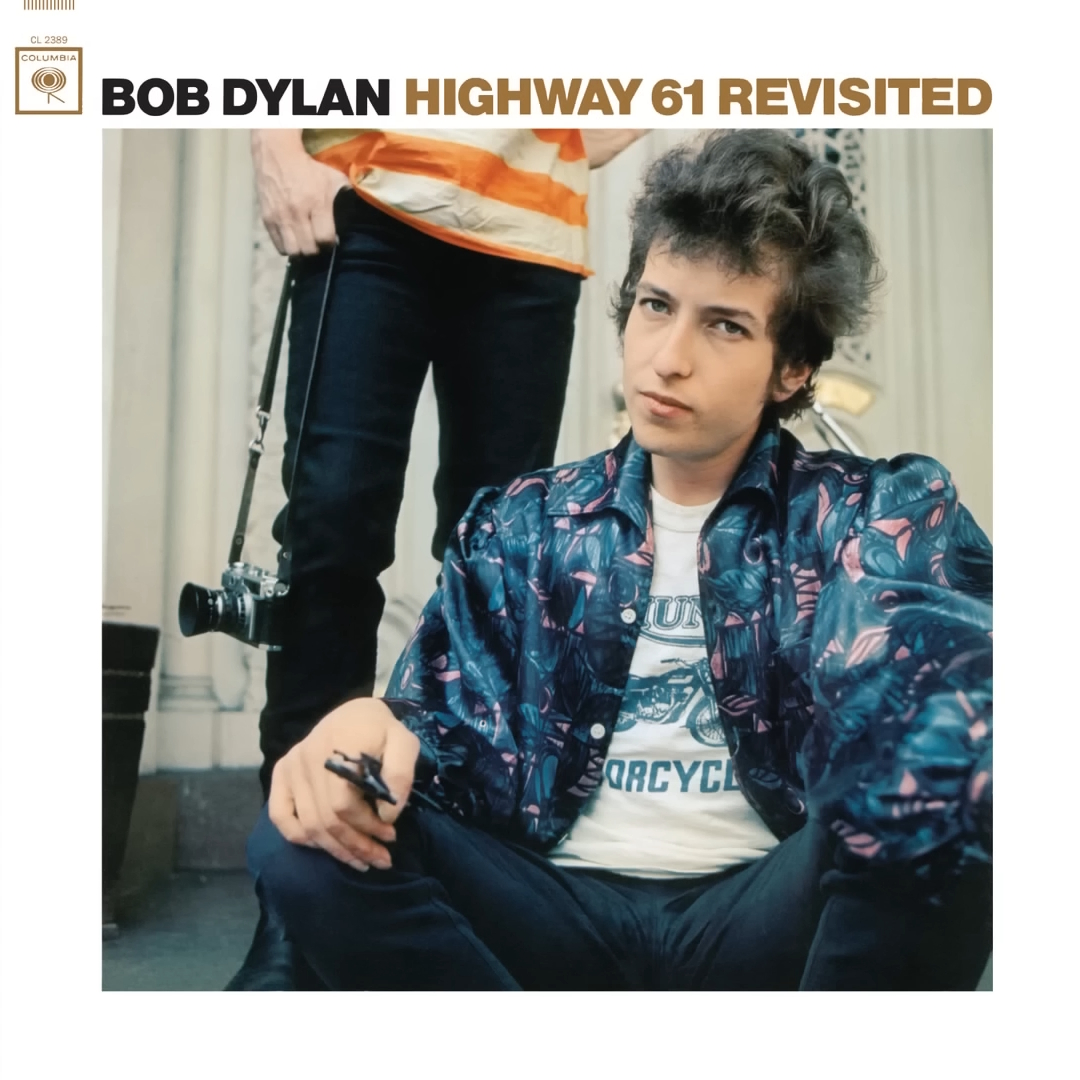
Highway 61 Revised showcased Bob Dylan the rockstar, a transformation that he appears to be communicating in the iconic album cover featuring Dylan siting on the steps of an apartment building in a white Triumph motorcycle t-shirt under a shiny, patterned dress shirt, his head cocked to the side looking directly at the camera. Behind him, the cut-off figure of a photographer, a symbol of Dylan’s growing celebrity status.
The album itself is an absolutely knockout, a powerhouse of rock and blues, sprinkled with elements of pop and even surf sounds. The album is Dylan’s great reinvention of himself and further evidence -if any was needed – of his status, even then at just 24 years of age as of one of the greatest artists of the 20th century.
I think I listened to this album more times than any of the previous five – I never seem to grow tired of it. Every one of the nine songs are great.
It begins with two absolute classics. “Like a Rolling Stone” and “Tombstone Blues”.
The former is one Dylan’s most famous and brilliant songs, a romping, rollicking song about arrogant people being cut down to size and then being lost and aimless “with no direction home/like a complete unknown/like a rolling stone”. This sentiment may have also expressed Dylan’s feelings about himself, perhaps being tossed about by the forces of celebrity and fame. “Like a Rolling Stone”.
You used to laugh about Everybody that was hangin’ out Now you don’t talk so loud Now you don’t seem so proud About having to be scrounging for your next meal
‘Like a Rolling Stone’ just powers up the album from the very moment the melody of sound hits your ears. Despite its subject matter, it creates this real joyful feeling as you listen.
The second track, ‘Tombstone Blues’ is a fast-paced rock ‘n roll song filled with vivid imagery, black humour and references to famous historical figures like Jack the Ripper “who sits at the head of the chamber of commerce”, John the Baptist, Ma Rainey and Beethoven. Each verse ends with the catchy chorus (slightly altered each time):
Mama’s in the fact’ry She ain’t got no shoes Daddy’s in the alley He’s lookin’ for the fuse I’m in the streets With the tombstone blues
I have to confess, that until I read the lyrics, I thought Dylan was singing “Daddy’s in the Alley, He’s looking for food” and that it was a reference to falling onto hard times.
After the opening two powerhouse tracks, Dylan slows it all down with the very bluesy “It Takes a Lot to Laugh, It Takes a Train to Cry”, another example of the sheer range of Dylan’s musical repertoire. There’s more blues sounds to come, but at a faster lick with “From a Buick 6” which has a real raucous quality to it. There’s a lot going on musically including an organ, which made me think of the music by The Doors.
The next track, “Ballad of a Thin Man”, is one of my favourite Dylan songs. Even though the album has classic tracks such as “Like a Rolling Stone” and “Tombstone Blues”, for me this is the standout song, and another hidden gem I have discovered whilst making my way through Dylan’s studio albums in chronological order.
It’s a brooding, melancholic and haunting song which features Dylan on piano (do his talents ever end?) accompanied by a spooky organ. Each verse seems to taunt someone (perhaps the establishment or the mainstream media?) trying to understand the emerging counter-cultural movement, and ends with the refrain: “Because something is happening here, but you don’t know what it is Do you, Mr. Jones?
Mr Jones think he is very smart because he has read “every one of F. Scott Fitzgerald’s book” and understands the working class because “He has many contacts among the lumberjacks” but remains confused and alone.
The song has so many great lines and verses, but my favourite has to be:
But nobody has any respect, anyway they already expect you to all give a check To tax-deductible charity organizations
The title track “Highway 61 Revisited” begins with a sharp whistle that sets up the high tempo song. It’s a great rock ‘n roll track with heaps of energy and vivid imagery. Each verse is a little problem that’s solved on Highway 61, the 1400 km legendary highway running from Minnesota to New Orleans with strong connections to Blues music culture.
Dylan slows down the pace and strikes a darker tone with the bluesy “Just like Tom Thumb’s Blues” and the album ends with a return to his acoustic, folksy roots with the 11-minute epic “Desolation Row”.
This a great song to listen to whilst strolling down a county road (as I did on many occasions). It’s gloomy and melancholic. It’s draws in all sorts of references, from fairy tales (Cinderella “sweeping up”), Hollywood (Better Davis), the bible (Cain & Abel), classic literature (The Hunchback of Notre Dame), famous poets (Ezra Pound and T. S. Eliot “Fighting in the captain’s tower”) and science (the electric violin-playing Albert Einstein). I haven’t thought long and hard about the meaning of the surreal lyrics (that’s another project entirely) but just enjoyed the vivid imagery, poetic lyricism and moodiness of the song.
The last verse is particularly poignant and hints Dylan’s mistrust of insincere people and his ability to cut right down to the bone:
Yes, I received your letter yesterday (About the time the doorknob broke) When you asked how I was doing Was that some kind of joke? All these people that you mention Yes, I know them, they’re quite lame I had to rearrange their faces And give them all another name Right now I can’t read too good Don’t send me no more letters no Not unless you mail them From Desolation Row
It’s a great end to an absolute knockout of an album. One of the all-time greats.
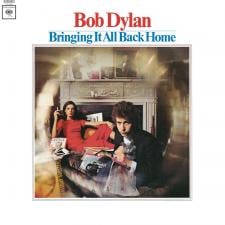
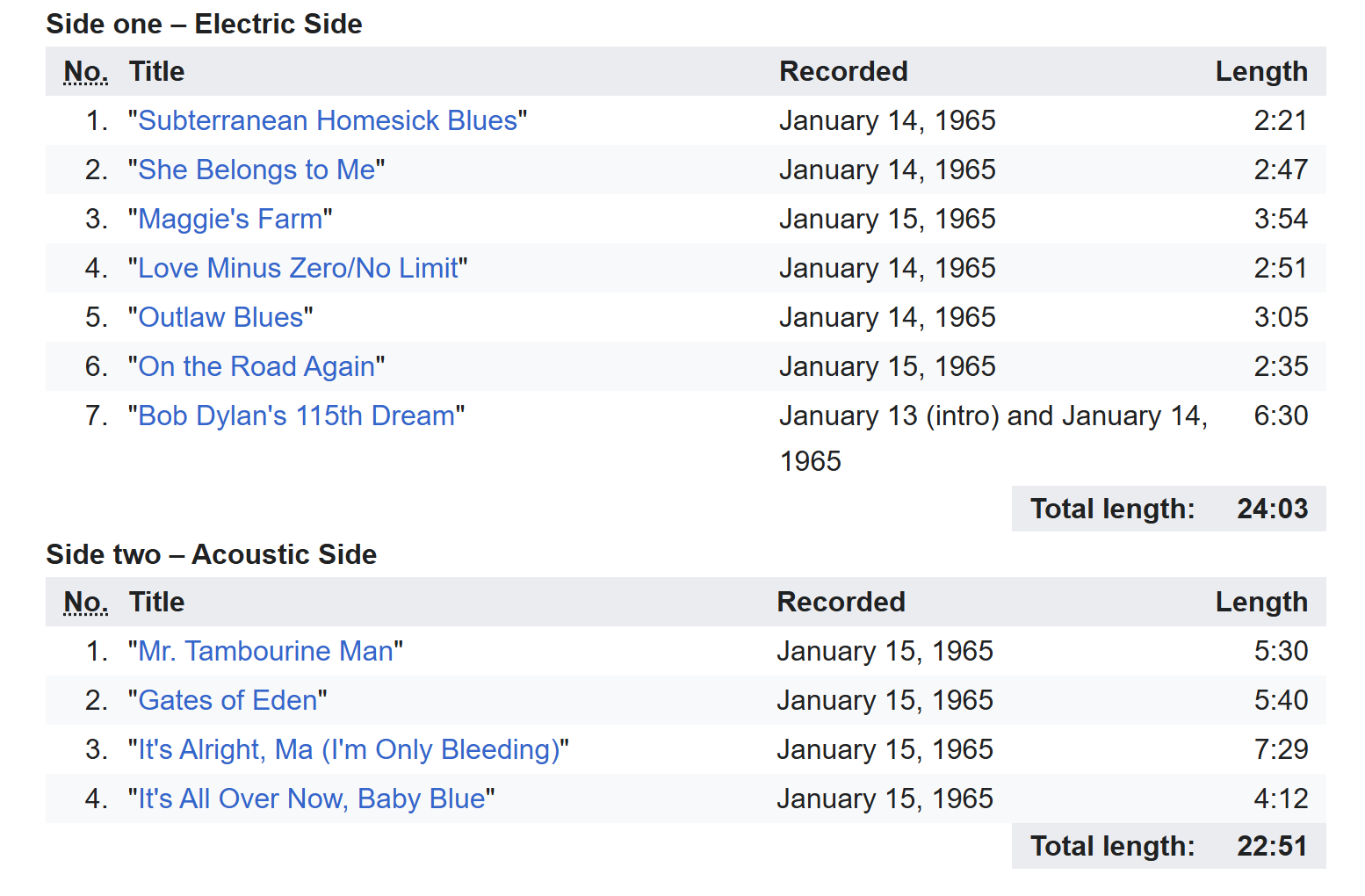
Best tracks: Subterranean Homesick Blues, Maggie’s Farm, Mr Tambourine Man, Gates of Eden, It’s Alright Ma (I’m Only Bleeding), It’s All Over Now Baby Blue, On the Road Again, Bob Dylan’s 115th Dream
If I could choose just one track: Mr Tambourine Man
Freshlyworded rating: 9/10
This album sparked a huge amount of controversy when it was released in March 1965, as it was the first time Dylan incorporated electronic instruments and a host of session musicians.
1965 was also the first time Dylan played an electric guitar at a live gig. This occurred at the Newport Folk Festival in Rhode Island in July of that year where he was both cheered and booed.
No doubt the booing was a result of Dylan being viewed as folk hero firmly embedded in the old ways of storytelling with just an acoustic guitar and his faithful harmonica.
But honestly, this confected outrage pails into insignificance when you listen to what is one of his best albums. And he was still just 24!
The album includes a number of classic Dylan tracks, most notably one of his most covered songs, ‘Mr Tambourine Man’. While The Byrds had a number one hit with their folk-rock/big band recording of the song, which is great in its own way, I prefer the Dylan version. It’s a very moving, poetic song with mesmerising lyrics and surrealist quality to it.
I mean has anyone written lyric as beautiful as this, the final stanza of the song:
And take me disappearing through the smoke rings of my mind Down the foggy ruins of time Far past the frozen leaves The haunted frightened trees Out to the windy beach Far from the twisted reach of crazy sorrow Yes, to dance beneath the diamond sky With one hand waving free Silhouetted by the sea Circled by the circus sands With all memory and fate Driven deep beneath the waves Let me forget about today until tomorrow
I think Dylan’s strained, expressive style of singing is a perfect companion for this song. Funnily enough, I was listening to a radio show recently where the hosts were discussing cover versions of classic songs that were better than the original, and one of the hosts joked: “Every cover of a Bob Dylan song.” I bristled at that as I love all his original versions of songs like ‘Blowin in the Wind’, ‘The Times They are a Changin’ as well as his version of the traditional folk ballad, ‘House of the Rising Sun’ (rather than the more famous version by The Animals).
Anyway, I would put ‘Mr Tambourine Man’ on my list of Top 10 Greatest Dylan songs any day of the week.
The album itself is full of gems. It kicks off with a famous track ‘Subterranean Homesick Blues’, a fast-paced, word-play song that’s unlike any other song he’d recorded at that time. It begins with those famous lines:
Johnny’s in the basement Mixing up the medicine I’m on the pavement Thinking about the government
And ends with one of my favourite Dylan rhymes:
The pump don’t work ’Cause the vandals took the handles
It was also one of the first songs to be promoted via a music video. It shows a very young, almost disinterested looking Dylan flipping through a series of cards featuring words from the song. In the background, you can see beat poet Allen Ginsberg in conversation with folk singer Bob Neuwirth.
The album features a great collection of Blues-style tracks including the classic “Maggie’s Farm” (the song that created all the controversy at the Newport Folk Festival) which is about worker exploitation and has lines like:
Well, he hands you a nickel He hands you a dime He asks you with a grin If you’re havin’ a good time Then he fines you every time you slam the door…
There are two great stomping, rip roaring blues tracks ‘On the Road Again’ and ‘Outlaw Blues’ and then a lengthy track titled ‘Bob Dylan’s 115th Dream’, one of his great, crazy narrative songs that as the title suggests has a very dream-like quality.
Dylan sings in the first person, a shipmate aboard the Mayflower (the ship that brought English pilgrims to America shores) captained by “Captain Arab” (a variation on Captain Ahab from Moby Dick) who gives up the hunt for the white whale when he spots land and “calls it America”. The song follows the narrator on this crazy, surreal adventure to the Bowery slums of New York, where he is “thrown in jail for carrying harpoons”, escapes a restaurant “exploding with boiling flat” and ends with Dylan back on a ship heading out of the bay where…
I saw three ships a-sailin’ they were all heading my way I asked the captain what his name was And how come he didn’t drive a truck He said his name was Columbus I just said, “Good luck”
It really entertaining song in the same vein as ‘Motorpsycho Nitemare’ featured on ‘his fourth album, ‘Another Side of Bob Dylan’.
The final three tracks are all classics. ‘Gates of Eden’ is one of those undiscovered gems I have unearthed in making my way through the albums in order. It’s a brooding and surreal song that showcases Dylan’s genius as a mystical poet. The rhythm and ebb and flow of the song combine powerfully with the lyrics, which create a sense of foreboding and gloom.
‘It’s Alright Ma (I’m only Bleeding)’ is an epic, depressing masterpiece about the corruption and materialism of society, and the many other things wrong with the world. Again, the word play turned into song is brilliantly executed with the emotional refrain of a son to his mother: “It’s alright ma”. It reminded me a fair bit of the songs of Rodriguez in the way the lyrics are almost read before the refrain (perhaps Rodriguez was influenced by this very song). It also shows Dylan’s nack for the eye-catching, though-provoking phrases such as “That he not busy being born is busy dying” and…
Although the masters make the rules For the wise men and the fools I got nothing, Ma, to live up to
The album ends with the beautiful, melancholy song “It’s all over now, Baby Blue”, a song about the inevitability of having to move on. It’s filled with so many great lines. Not surprisingly, it’s been covered by many other artists.
It’s a song which like so many on this album showcases Dylan’s never properly acknowledged great, emotive and quite beautiful singing voice. It is also an album where his skills as a poet come to the fore.
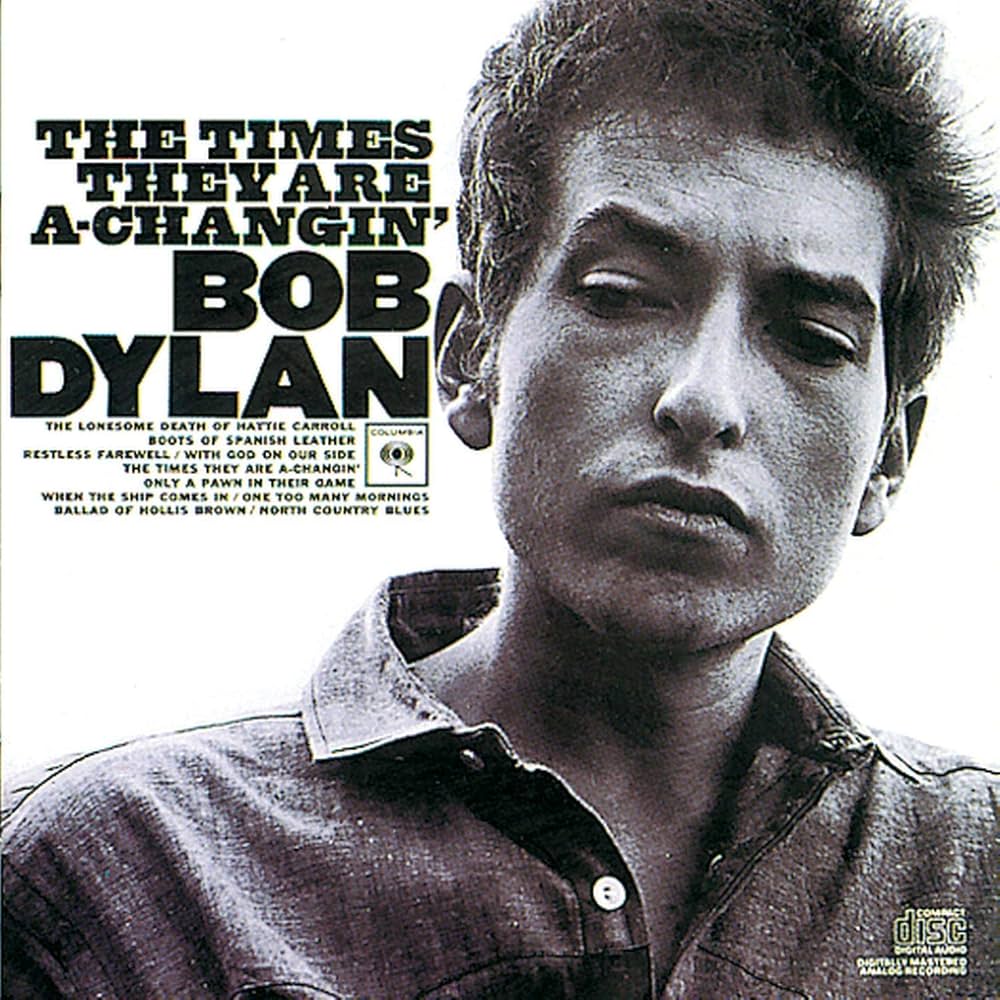
Album cover, copyright Columbia Records. Low-res version reproduced under Fair Use for review purposes
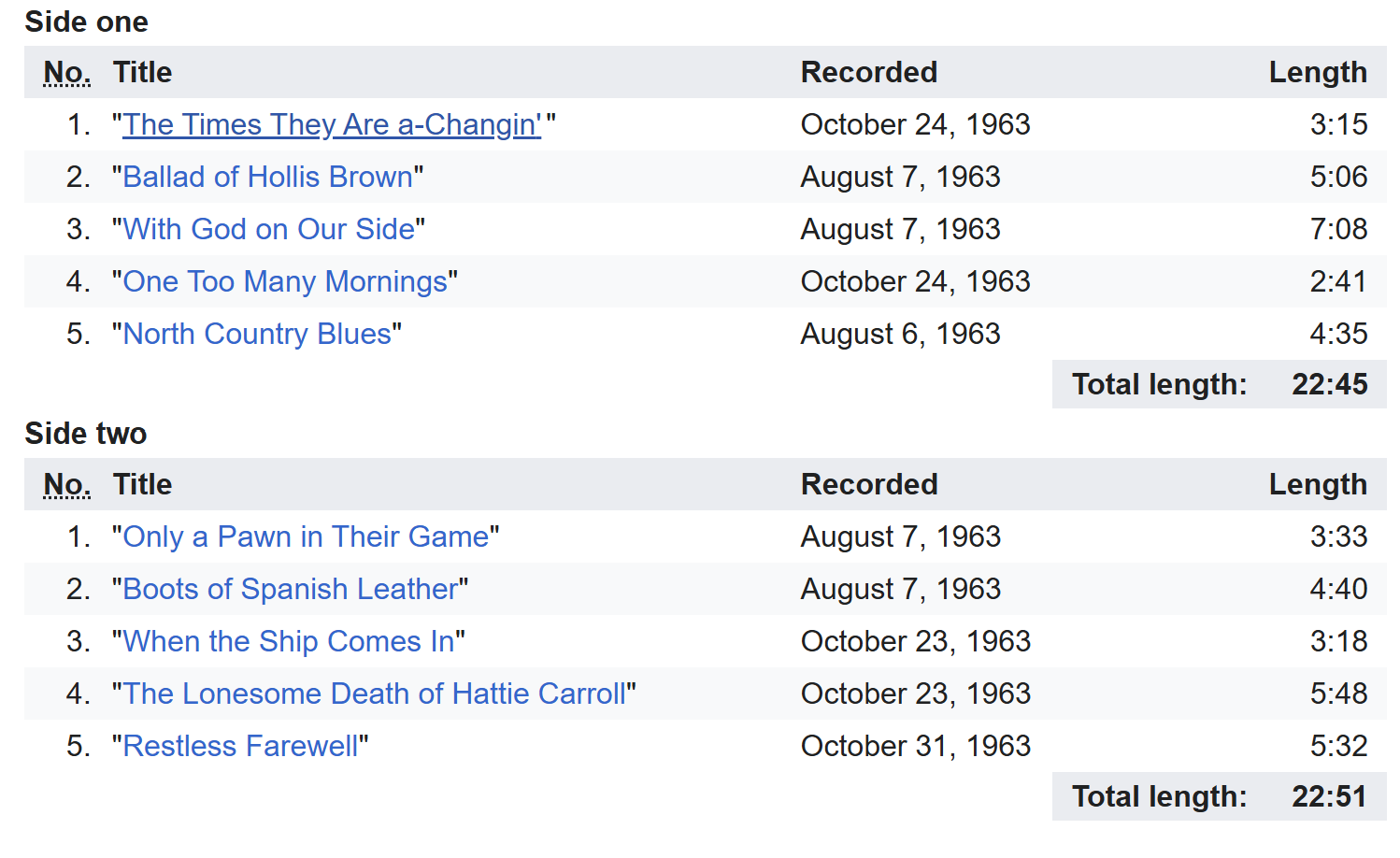
Title: The Times They are a-Changin’
Length: 45min, 36s
Number of songs: 10
Best tracks: The Times They are a-Changin’, Ballad of Hollis Brown, With God on our Side, North Country Blues, Boots of Spanish Leather, When the Ship Comes in, The Lonesome Death of Hattie Carroll
If I had to choose just one track: The Lonesome Death of Hattie Carroll
Freshlyworded rating: 9/10
Thoughts:
While the title track from this album is rightfully one of Bob Dylan’s most famous and revered songs, for me the hero track and an absolute masterpiece on this album (and surely among his best songs ever) is “The Lonesome Death of Hattie Carroll”.
Running just under six minutes, Dylan tells the story of the murder of Hattie Carroll, an African American barmaid, killed in a drunken rage in a Baltimore Hotel in February 1963 by 24-year-old Wiliam Zatzinger, a wealthy, white tobacco grower – and the injustice fuelled by racism that followed.
The song is a perfect combination of vivid poetry, acoustic guitar and Dylan’s plaintive, soulful voice.
Dylan wrote the song just six months after Carroll was murdered and it no doubt struck a chord among the civil rights movement at the time. Every sentence of the song is wonderful.
Zantzinger killed Hattie Carroll, Dylan sings: “With a cane that he twirled around his diamond ring finger” and after his arrest “Reacted to his deed with a shrug of his shoulders”.
He contrasts the Zantzinger’s wealth and high society connections with Carroll’s role as a servant “Who carried the dishes and took out the garbage”.
A few months later, “in the courtroom of honor” Dylans sings of the judge who “Stared at the person who killed for no reason” and then in a devastating line “handed out strongly for penalty and repentance William Zantzinger with a six-month sentence”.
As he tells the story of Hattie Carroll’s murder Dylan sings the repeated refrain: “But you who philosophize, disgrace and criticize all fears Take the rag away from your face, now ain’t the time for your tears.”
After singing how Zantzinger literally got away with murder, Dylan ends the song with: Oh, but you who philosophize, disgrace and criticize all fears. Bury the rag deep in your face for now’s the time for your tears“.
Just brilliant!
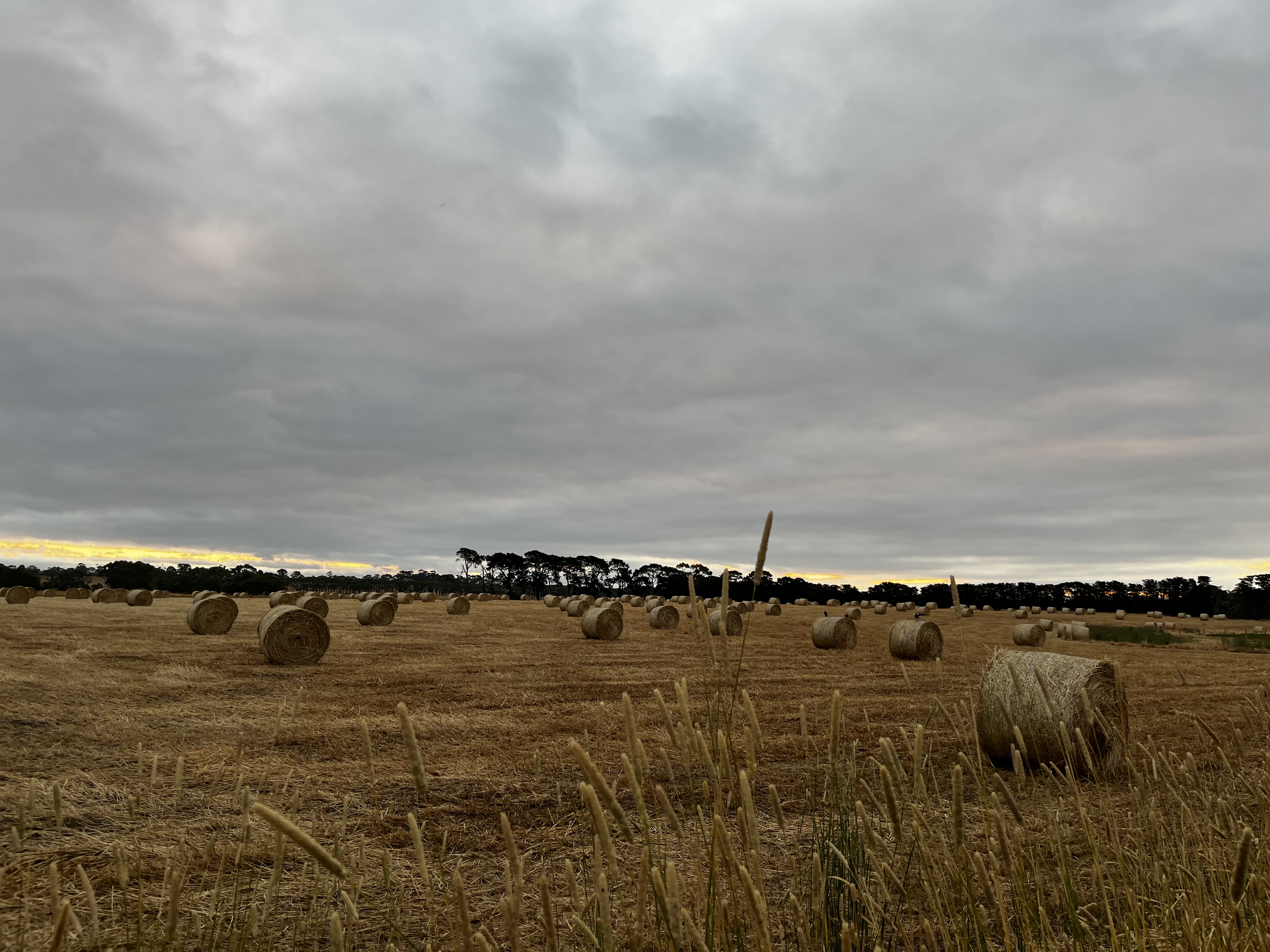
I listened to this song and all the other nine tracks of this album whilst walking my dog along quiet country roads and sleepy suburban streets in Lancefield north of Melbourne (where I live) and on holiday in Birregurra, a small town in the Otways region of Victoria. Both were the perfect backdrop for letting the wonderful storytelling songs of this album seep deep into my bones.
Hay bales in a field in Birregurra, Victoria
Alongside the Lonesome Death of Hattie Carroll, I of course loved The Times They Are-a-Changing, a universal anthem about profound change that’s coming to society. At the time it was recorded, this change was the civil rights and anti-war movement but it’s wonderful lyrics still inspire people today who are pushing for change amid the punishing regimes governing the world:
Come mothers and fathers Throughout the land And don’t criticize What you can’t understand Your sons and your daughters Are beyond your command Your old road is rapidly agin’ Please get out of the new one If you can’t lend your hand For the times they are a-changin’
I also loved another haunting, narrative song, “Ballad of Hollis Brown” which tells the story of a poverty-stricken South Dakota farmer and the events leading up to a desperate act.
“With God on Our Side’ is a song that like “The Times They are a-Changing” reverberates loudly today, with its mockery of how believing in God justifies acts of war and America’s superior moral position.
“North Country Blues” is a wonderfully melodic, yet dark song sung in the first person about growing up in an iron ore mining town, where the work eventually dries up and the mine is closed
“Only a Pawn in their Game” is another powerful political song about the murder of a civil rights activist Medgar Evars, while another favourite track of mine on the album is the very catchy “When the Ship Comes in” which has a happy and triumphant feel to it.
The slow and contemplative “Restless Farewell” is a fitting end to a brilliant album, and also a great way to end an evening country stroll.
For me, this is Dylan’s best album of the three I have listened to and reviewed so far. Incredible that he was only 22 and 23 when he wrote and recorded all these amazing tracks.
There have been dozens of books written about the history of modern Australia since the arrival of the first fleet of English convicts to Sydney Cove in 1788.
The latest book hot off the shelves is Australia A History by former Prime Minister Tony Abbott.
I haven’t read it yet but have been delving into the story of European settlement via a much older book, which I bought for $2 at a book sale at the Athenaeum Library on Collins Street in the Melbourne CBD.
Seeped in history (the Athenaeum Library is one of Melbourne oldest cultural institutions), it seemed an appropriate place to pick up a copy of The Penguin Bicentennial History of Australia by the late historian John Molony.
Published in 1987, it traces the 200 years (199 to be exact) since the arrival of the first fleet and finishes with the prime ministership of Bob Hawke and the success of Paul Hogan‘s Crocodile Dundee.
While it obviously misses out on everything that happened in Australia from 1988 onwards, I found it to be a really good summary – in less than 400 pages – of the key events that shaped the fledgling nation since those first majestic-looking e ships, laden with convicts, sailed through the Sydney Heads towards what is now Circular Quay.
Molony, who wrote many history books, was Emeritus Professor of History at the Australian National University. He died in 2018 at the ripe old age of 91, meaning he was alive for 61 of the 200 years encapsulated in the book.
Interestingly, I was midway through the book, when I happened to be in Sydney and visiting Gap Park in Watson’s Bay. Here you can stand at the edge of a cliff face that plunges into the turbulent Tasman Sea below (an infamous Sydney suicide spot) and look out over the Sydney Heads, the series of headlands that market the entrance to Sydney Harbour.
It is through this 2km wide entrance that the 11 ships carrying 732 convicts sailed through and made anchor at Sydney Cove, now known as Circular Quay.
As Molony describes it rather movingly in the opening chapter of his book:
High summer saw a fleet of eleven ships take up moorings at a small cove in a noble and extensive harbour on the eastern coastline of the southern continent. A few dark-skinned people of the Cadigal band, whose ancestral home that place had been for age upon age, watched closely from nearby scrub. The date was 26 January 1788 and the newcomers called the cove after an English public servant named Sydney…The modern history of the world’s oldest continent had commenced with the coming of a new people.
(In fact, as Molony’s book explains, the fleet first made shore first at what is now Botany Bay (where Sydney Airport is) but due to the “infertility of the soil” and a lack of fresh water, it was quickly discarded, and the weary travellers travelled a few miles to the north to the “finest harbour in the world”
237 years later, as I looked out over the Heads towards the sparkling Sydney skyline, I was filled with a sense of awe imagining these wooden ships, laden with their weary human cargo, making their way into a vast and primitive land, with not a single structure in sight.
And what did the weary English convicts, after a gruelling eight-month voyage from the docks of Portsmouth, make of what would be for most their permanent home?
No doubt they were filled with dread and fear (as were their aboriginal onlookers) and a longing to return the urban environment of England; the busy streets filled with people and buildings.
Gap Park, with a spectacular view over the Sydney Heads
Over the next 406 pages, Molony tells the story of the birth of modern, mostly white Australia. There’s a lot to get through, but he does a good job describing in an entertaining, easy-to-read manner the key events and colonial personalities that shaped what became the Australia we are familiar with today.
Looking out over the ocean towards a city of some 5.5 million people, with the Manhattan skyline of its Central Business District, the modern wonders of the Harbour Bridge and Opera House and the densely populated suburbs around the harbour, it is a stunning visual reminder of the pace of development that occurred over a relatively short period of time.
And to think that nothing was here, not a single building was standing 237 years ago, whilst Europe and the colonial parent (the British empire) were full of teeming metropolises.
In many respects it’s a miracle that Australia thrived at all. As Molony describes it, the early years of the colony of New South Wales was full of great hardship and suffering: starvation loomed as crops failed and desperate convicts dreamt of escape. In one instance, a group of convicts headed off into the bush, believing they could walk to China. For nearly all Australia would be a life sentence.
At first it was a primitive existence, with public hangings becoming a common occurrence. The first person hanged in the colony was a 17-year-old boy named Thomas Barrett, for stealing.
But slowly, as Molony describes it, an agricultural-based economy is established, centred around the production of fine wool and wheat (a sector which still thrives to this day). Amid the search for arable farmland, the colony expanded into Parramatta and then other regions of the country. Tasmania developed a whaling industry, Melbourne, Brisbane and Adelaide were founded and settlers travelled west to establish Perth.
Then came a momentous event: the Victorian Gold rush, which turned Melbourne into “Marvelous Melbourne” and brought settlers from all over the colony, and abroad to make their fortune. This included the Chinese, who were the subject of a well-entrenched colonial racism. At its height- as I learnt – Victoria accounted for 40% of the world’s gold production.
Another defining moment, and one where Australia lost its innocence, was the Great War in which thousands of young Australian men lost their lives or came back injured and shell shock. The horrific, but courageous battle of Gallipoli that left nearly 9,000 diggers dead.
Molony writes of the end of the war:
It was Anzac Day, 25 April, the day of the landing at Gallipoli, that overshadowed memory and made all new and vital in significance for it was seen as the day on which the nation had shaken off the bonds of subservience and Australians had come to know themselves. [Prime minister] Billy Hughes saw it a little differently. To him victory in the war meant national safety, liberty and the safeguarding of the White Australia policy. Despite some signs to the contrary, Hughes was still convinced that Australians were ‘more British than the people of Great Britain’.
This long adherence to the White Australia policy, one borne out of British racism and fear of invasion from the East, is remarkable given how Australia changed into a successful, and vibrant multi-cultural society (notwithstanding the recent re-emergence of a wave of anti-immigrant feeling fuelled by a cost of living and housing crisis).
For so long Australia had been a land only for Europeans, and it took visionaries like Gough Whitlam to dismantle its final elements and welcome Asian and people of colour to our shores. Even so, by the 1980s, after nearly 200 years of European settlement, “the new nation [of about 16 million] was still predominantly white, spoke mainly English of the Australian variety, owed allegiance to the English Queen and observed laws derived from British sources”.
What I wanted to get out of the book, was a well-rounded understanding of the making of Australia, and Molony’s did a good job of that.
While it impossible to include in detail everything that happened over 200 years, I felt the story he told captured all the important elements without too much politicising, and with some sympathy for the plight of the aboriginal people, whose suffering was immense.
Most striking is his portrayal of the pace of development, how Australia so quickly build up its cities and towns, established a civil and well-functioning society that very early on and to this day, is among the greatest places to live in a troubled world.
It may be an old book, but the Penguin Bicentennial History of Australia is a great place to start for anyone wanting to learn the history of the country of their birth or – as in my case – of their adopted homeland.
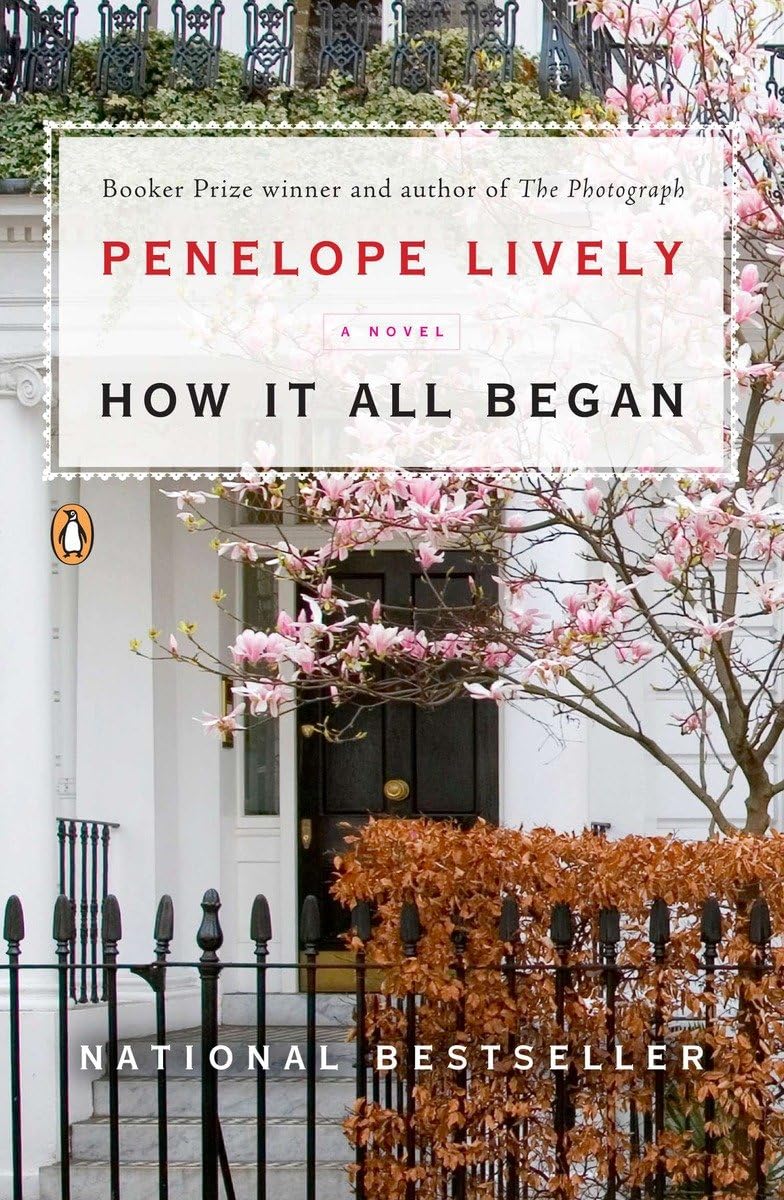
How it All Began by Penelope Lively begins violently with the mugging of retired and widowed schoolteacher Charlotte Rainford on a London street and then follows the lives of the people impacted by this random event: those both close to Charlotte like her adult daughter Rose and people she has never met like Marion, an interior designer and Jeremy, an antiques dealer.
Forced to recuperate at her daughter’s house, Charlotte introduces Anton, an Eastern European migrant into Rose’s life when she agrees to tutor him at her temporary home. Caught in a loveless marriage to dull Gerry, Rose develops strong feelings for Anton, who is funny, charming and sincere.
Meanwhile, in another part of London, the lives of retired diplomat and historian Lord Peters and his niece, Marion, are set on different courses by the mugging of Charlotte.
Rose works as the personal secretary to Lord Henry Peters. When she is unable to accompany him to give a lecture in Manchester because she has to take her mother to a doctor’s appoint, he asks his niece Marion to accompany him instead.
Without Rose by his side, Lord Peters forgets his lecture notes, and he gives an embarrassing performance that has him questioning his own relevance and embarking on a bizarre television project. Marion finds herself seated next to a charming, wealthy businessman, who at first seems to be the saviour of her struggling interior design business, but who turns out to be a conman.
Charlotte’s mugging also exposes an affair Marion is having with Jeremy, a self-centred married man who runs his own failing antiques business. Marion sends Jeremy at text message to say she cannot make a rendezvous, but it ends up being read by Jeremy’s wife, Stella. Stella engages a lawyer and files for divorce.
While this may sound like the makings of a rather gimmicky work of fiction, Lively, who is now well into her nineties and is a Booker Prize winner (1987 for Moon Tiger), does a great job of elegantly orchestrating events and drawing the reader into the heads of the characters as they navigate the unexpected challenges they must now navigate. The novel moves almost cinematically from one storyline to the next added by Lively’s beautiful prose and well-rounded characters.
Reading the book made me think of my own life and how random events that seemed inconsequential at the time, have had a profound impact on the trajectory of my life. An unexpected conversation, a chance encounter, a phone call missed or answered, an opportunity taken or not taken. All these things have set our lives on unplanned pathways. But more so, they have impacted the lives of others, people we know and those we will never know.
While I have not read any of her other books, I have read that the role of chance and “haphazard what-might-have-beens” (to quote a New York Times review) is a theme explored in other novels by Penelope Lively.
“Thus have various lives collided,” Lively writes in How it all Began, “the human version of a motorway shunt, and the rogue white van that slammed on the brakes is miles away now, impervious, offstage, enjoying a fry-up at the next service station. Just as our mugger does not come into this story, not now, anyway — job done, damage complete, he (or she) is now superfluous.”
The butterfly effect, the notion that seemingly trivial events can set off chain reactions and generate unexpected consequences is a powerful concept and explored to great effect in How it All Began.
(It would also make a rather excellent television series, if well adapted.)