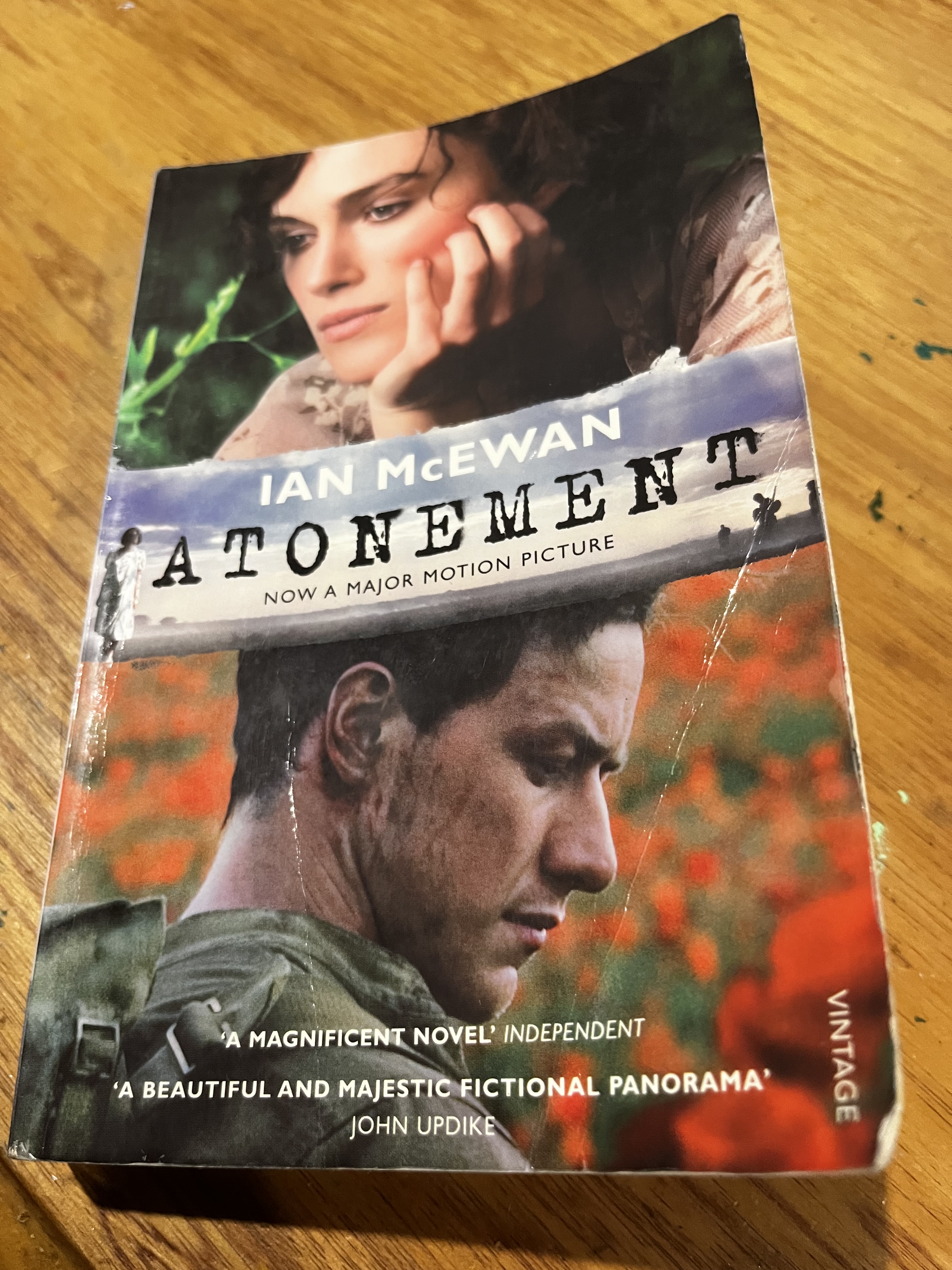
What a delight it was re-reading Ian McEwan’s masterful wartime novel Atonement.
And how equally delightful to re-watch the movie adaptation which came out six years later in 2007.
I thought I would be somewhat disappointed in the film, but while it condenses the storyline and isn’t able to really get inside the characters’ heads as deeply as the novel, director Joe Wright and screenwriter Christopher Hampton remain faithful to McEwan’s plot and story and know what to leave out and what must remain.
If I had to choose either the book or the movie, it would have to be the book though, simply because McEwan is a wonderful writer and storyteller and there is so much more to enjoy and ponder across its 371 pages than the 123 minutes of film time.
McEwan has that quite rare gift of being both a serious literary novelist (a Booker Prize winner no less, though not for Atonement, though it was shortlisted in 2021, losing to Peter Carey‘s The True History of the Kelly Gang). but also, being a popular and accessible writer who places the story at the centre of his efforts and who has achieved mainstream success.
In an interview in 2002, following publication of Atonement, McEwan spoke about his approach to writing and how he wants to welcome his reader in and make it impossible for them to not be able to turn back (no different, I suspect to the approach of Stephen King).
McEwan mentions a subplot within the novel, where the main character (Briony Tallis) submits a novella to a magazine and the editor replies that it is full of beautiful passages about how light reflects off stone and water, but you have to have “the backbone of a story”.
McEwan said in the same interview, that the idea behind Atonement was whether literary fiction could “do a love story” and the answer is, it most certainly can.
To summarise the plot briefly, Atonement begins in England in 1935, when thirteen-year-old aspiring writer Briony Tallis misinterprets a series of events between her older sister Cecilia and Robbie Turner, the son of the family’s housekeeper, leading her to falsely accuse Robbie of a crime he didn’t commit.
Her false testimony sends Robbie to prison and then to fight in World War II, tearing him apart from Cecilia, who chooses to estrange herself from her family in solidarity with him.
As the years pass, through the war and beyond, Briony grapples with guilt over what she did as a child, eventually becoming a novelist herself and attempting, through her writing, to atone for the damage her lie caused to the two lovers’ lives.
The novel ends with surprising and devastating twist as the reader is confronted with brutal reality (within a fictional story), versus the happier ending Briony plays out in her mind and on the page.
To return to McEwan’s writing. It would not be unfair to call him one of the finest writers of his generation. An example of his precise, imaginative prose is on display when McEwan describes how Emily Tallis, the withdrawn mother of Briony and Cecilia, experiences the onset of a migraine.
We find Emily lying still and silent in her darkened room. McEwan writes of her migraine beginning to build as “illuminated points in her vision, little pinpricks, as though the worn fabric of her visible world was being held up against a far brighter light”.
Then McEwan describes the approaching migraine as heaviness in the right corner of Emily’s brain, “the inert body weight of some curled and sleeping animal” that she must not provoke lest “the knifing pains would obliterate all thought”.
McEwan carries on this metaphor of the migraine as some lurking animal, indifferent to Emily’s misery and that her only hope lies in keeping still in the darkness. It’s just one example of his brilliant, precise writing and how it can conjure up something intangible and convey the terror of an approaching period of pain.
This is just one example of how the book triumphs over the movie, which does not have the scope or length of time to take the viewer into that metaphor – indeed there is no reference to Emily’s malady in the film – and many others that McEwan effortlessly teases out in his marvellous prose.
The strength of the movie lies in its strong cast: Saoirse Ronan as the 13-year-old precocious Briony is exceptional, as are Keira Knightley as Cecilia, James McAvoy as Robbie and Benedict Cumberbatch as the sleazy chocolate tycoon Paul Marshall, to name just a few.
The script by the legendary screenwriter Christopher Hampton retains the most important elements of the book and dialogue, the locations and sets are immaculate (the hellish scenes on the beaches of Dunkirk before the 1944 evacuation are sensational) and the cinematography and directing keep the story moving forward, whilst providing the opportunity for character development.
It’s actually quite a challenging novel to turn into a movie, because there are these leaps of faith that the reader must make (McEwan has the time and skill to explain for instance how Briony misinterpreted the events leading up to Robbie’s arrest) but Hampton and Wright create a sense of believability via skillful writing and clever uses of light and shadow to create confusion.
For anyone wanting to revisit this story, I recommend reading McEwan’s wonderful novel first and then kicking back with a bowl of popcorn and enjoying the excellent, but limited movie adaptation.