An opinionated journalist's thoughts on media, film, books, sport, politics and the occasional rant. Or as William Burroughs put it: "A writer must write"
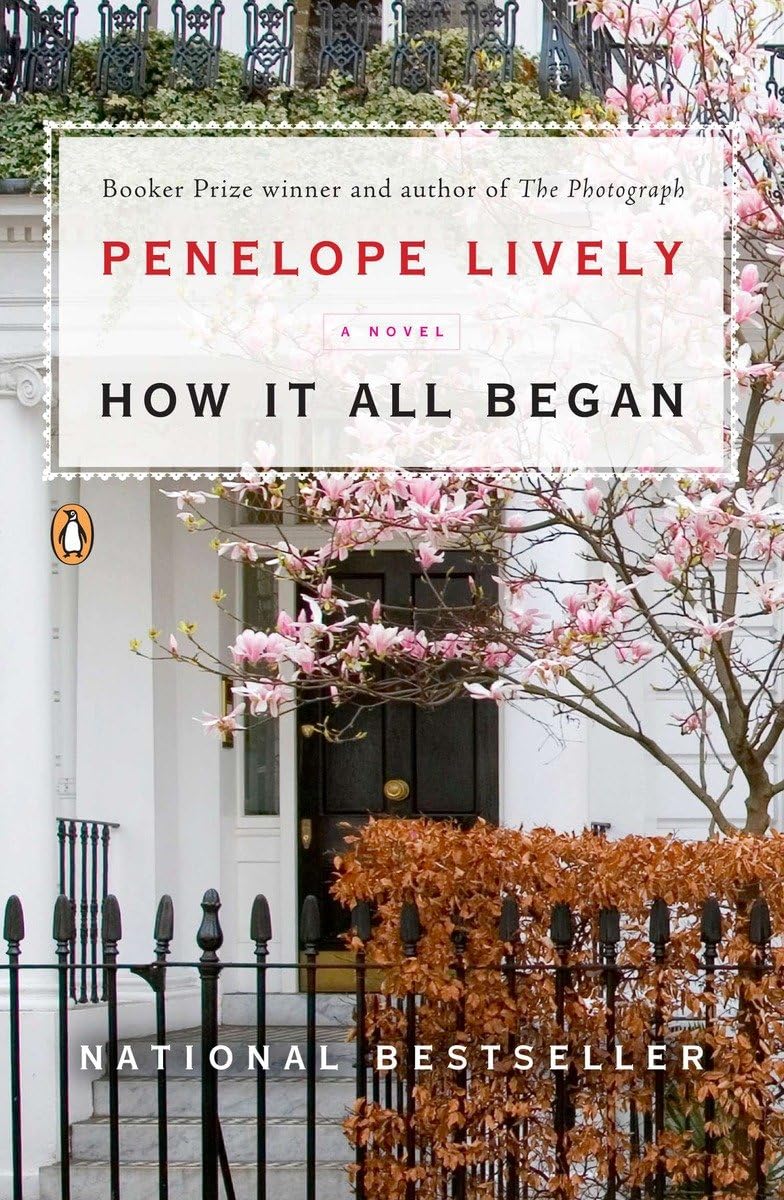
How it All Began by Penelope Lively begins violently with the mugging of retired and widowed schoolteacher Charlotte Rainford on a London street and then follows the lives of the people impacted by this random event: those both close to Charlotte like her adult daughter Rose and people she has never met like Marion, an interior designer and Jeremy, an antiques dealer.
Forced to recuperate at her daughter’s house, Charlotte introduces Anton, an Eastern European migrant into Rose’s life when she agrees to tutor him at her temporary home. Caught in a loveless marriage to dull Gerry, Rose develops strong feelings for Anton, who is funny, charming and sincere.
Meanwhile, in another part of London, the lives of retired diplomat and historian Lord Peters and his niece, Marion, are set on different courses by the mugging of Charlotte.
Rose works as the personal secretary to Lord Henry Peters. When she is unable to accompany him to give a lecture in Manchester because she has to take her mother to a doctor’s appoint, he asks his niece Marion to accompany him instead.
Without Rose by his side, Lord Peters forgets his lecture notes, and he gives an embarrassing performance that has him questioning his own relevance and embarking on a bizarre television project. Marion finds herself seated next to a charming, wealthy businessman, who at first seems to be the saviour of her struggling interior design business, but who turns out to be a conman.
Charlotte’s mugging also exposes an affair Marion is having with Jeremy, a self-centred married man who runs his own failing antiques business. Marion sends Jeremy at text message to say she cannot make a rendezvous, but it ends up being read by Jeremy’s wife, Stella. Stella engages a lawyer and files for divorce.
While this may sound like the makings of a rather gimmicky work of fiction, Lively, who is now well into her nineties and is a Booker Prize winner (1987 for Moon Tiger), does a great job of elegantly orchestrating events and drawing the reader into the heads of the characters as they navigate the unexpected challenges they must now navigate. The novel moves almost cinematically from one storyline to the next added by Lively’s beautiful prose and well-rounded characters.
Reading the book made me think of my own life and how random events that seemed inconsequential at the time, have had a profound impact on the trajectory of my life. An unexpected conversation, a chance encounter, a phone call missed or answered, an opportunity taken or not taken. All these things have set our lives on unplanned pathways. But more so, they have impacted the lives of others, people we know and those we will never know.
While I have not read any of her other books, I have read that the role of chance and “haphazard what-might-have-beens” (to quote a New York Times review) is a theme explored in other novels by Penelope Lively.
“Thus have various lives collided,” Lively writes in How it all Began, “the human version of a motorway shunt, and the rogue white van that slammed on the brakes is miles away now, impervious, offstage, enjoying a fry-up at the next service station. Just as our mugger does not come into this story, not now, anyway — job done, damage complete, he (or she) is now superfluous.”
The butterfly effect, the notion that seemingly trivial events can set off chain reactions and generate unexpected consequences is a powerful concept and explored to great effect in How it All Began.
(It would also make a rather excellent television series, if well adapted.)
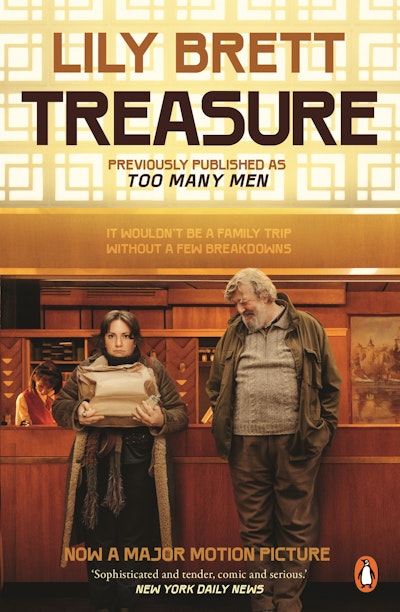
I’m nearing the end of Lily Brett’s semi-autobiographical novel Too Many Men, or as it has been re-titled Treasure in keeping with the movie adaption starring Stephen Fry and Lena Dunham.
It’s the story of Ruth Rothwax (Lily Brett), a 43-year-old thrice-divorced owner of a letter writing business who travels from her home in Manhattan to meet her 81-year-old father Edek (Max), a holocaust survivor to accompany her on a trip around Poland visiting the ghettos of Warsaw, Lodz and Krakow and culminating in a trip to Auschwitz and the nearby death camp of Birkenau.
Edek, who survived the hells of the Lodz ghetto and Birkenau has travelled from Melbourne where he lives alone. His wife Rooshka, an Auschwitz survivor, died in her sixties from cancer. Ruth moved to New York many years ago.
The pair are close but frequently argue. Ruth is wracked with guilt and worry about her father (Is this trip too much for him?) while Edek, who has an enormous appetite, berates her for “eating like a bird” and being rude to Poles they meet on their travels.
Having visited the Lodz apartment where Edek and Rooshka lived before being march to the ghetto, they make their way to Krakow and then to Auschwitz. Here, Ruth becomes physically sick after they visit the very barracks where Edek “lived” during his barbaric imprisonment. The whole visit is a terrible ordeal for her as she struggles to comes to terms with the suffering of so many people and the fact that her own parents were subject to the degradation and humiliation within the grounds she walks. On her arrival she weeps as she sees the famous sign “Arbeit Macht Frei” (“Work makes you free”) that tricked arrivals into thinking they were being sent to a work camp. Ruth is enraged by a group of school kids eating snacks and fighting with each other, and in the taxi ride from Krakow to the Auschwitz she repeatedly corrects the cab driver for referring to their destination as the “Auschwitz Museum”.
‘It’s a death camp,” she tells the taxi driver over and over again.
Ruth is angered by the cleanliness and order of Auschwitz, the huge numbers of tourists and the lack of a visceral sense of the horrendous suffering enduring within its walls.
Ruth wished the visitors to these blocks could experience something of the atmosphere of degradation and humiliation and inhumanity that had existed. How could you feel people’s anguish and terror in centrally heated, newly painted barracks? But maybe nothing could ever replicate a fraction of the atmosphere, a fraction of the events that took place.
Nobody would come here, she thought, if this place was still covered in shit and piss and lice and rats and vomit and ash and decomposing corpses. The car park wouldn’t be full of tourists coaches. People wouldn’t be looking at the photographs and other exhibits on display in these rooms. These renovations were probably necessary. She had to stop being so judgemental, she told herself.
Ruth and Edek’s trip to Auschwitz made me think back to my own visit in May 2010, as part of a round-the-world backpacking trip I did with my wife after we got married.
I remembered the small minivan we took from Krakow to the death camp, a journey of about an hour through pretty countryside. I remember wandering the grounds of Auschwitz and seeing the rooms with the giant piles of shoes, glasses, hair and artificial limbs behind glass. I remember thinking I should feel more, or should be in shock, but perhaps like Ruth, I found it all too “neat” and “cleaned up”, too much like a museum rather than the remains of a slaughterhouse that treated people like insects to be squashed underfoot.
Then I decided to re-read the blog entry I wrote from the day of our visit, which I posted on our online travel journal.
How does one describe a visit to Auschwitz? A journey to the gates of hell perhaps? A place of unimaginable suffering and brutality? Probably all are insufficent. Yesterday we spent the day visiting Auschwitz and the nearby camp of Birkenau (Auschwitz 2). It’s a little over an hour by bus from Krakow. We travelled in this strange mini-van, posing as a municipal bus, which picked up people along the route so that by the time we reached the little town of Oswiecim (renamed Auschwitz by the Nazis. Incredibly, the town now bares the inscription, Oswiecim: city of peace) it was packed to capacity and stifling hot. It was a pretty unpleasant ride, (despite the very pretty Polish countryside we passed), but it did make me think of all these people crammed into those windowless cattle cars and though nothing at all like the horror of those cramped conditions, it felt quite appropriate to not be comfortable.
The two camps are joined by a free bus service. We first went to Birkenau. Beyond the famous main entrance and watch tower, through which the trains passed, the most overwhelming thing is the sheer size. It’s enormous. At its peak there were 100,000 people living here under the most appalling conditions. Each of the barracks housed as many as 1,000 people. We listened to a guide tell a tour group that the prisoners were only allowed to go to the toilet twice a day and because there were so many, they only had about 40 seconds to use the latrine. Just one of many awful stories.
(In the scene from the book, Ruth and Edek examine the crude toilet block comprised of concrete benches in parallel lines with holes cut out of them the size of dinner plates. Thirty-four circles, inches apart from each other so that the prisoners could not help but touch each other while they urinated and defecated. Everyone sick with diarrhea, the holes below filling up almost to the top, the stench unimaginable. Then she starts vomiting down one of these holes and cannot stop.)
My blog entry continues:
A lot of the barracks are still standing (where they are not, you can see the foundations so it is easy to get a sense of the scale). At the far end of the camp, at the end of the railway line, are the remains of the gas chambers and crematoria. They were blown up by the Nazis just before the camp was liberated. Despite the heaps of rubble, you can see the steps down which prisoners were led, the changing room where they were forced to strip before being led into the “showers”.,
Auschwitz main camp houses the museum in the brick barracks (it was formerly Polish army barracks) where prisoners were held. Unlike Dachau, where the museum assaulted you with information, here it is relatively succinct, leaving you to take in the exhibits. One of the barracks contains huge displays of what was taken from those before they were gassed: mountains of hair shaved off prisoners (the Nazis sold the hair to textile firms), spectacles, shoes, toothbrushes, and artificial limbs. There are piles and piles of these things, and this probably just a fraction of what was found.
The walls of the barracks were lined with photos of prisoners admitted to Auschwitz including their date of arrival and death. Some lived only a few days, some a few months and some more than a year or two. How to survive such a hell hole for a day let alone a year, I just cannot fathom.
(In the book, Ruth and Edek visit Auschwitz on a “dull, grey wet day” and is relieved not to visit it in the sunshine. But we were there in Spring…}
It turned out to be a very sunny day. There were purple and yellow flowers growing among the grass and shady trees that offered respite. But the overwhelming sensation for me was incomprehension, sadness and anger. Though as many of you may know I am not a practicing Jew, I did feel a strong connection with all those who were lost.
At one point I found myself humming the tunes of Jewish songs we sang at King David High School, songs that I had forgotten or buried deep in my memory. Then I remembered we had a school teacher, Dr Yageel, who was a holocaust survivor from Auschwitz and had a tattoo on his shoulder bearing his prisoner number. I remember him to be a short man, with a beard and a lined face. I think he may have taught our class on a few occasions. I never really thought about what he went through or took the time to chat to him. I recall thinking of him as a survivor as if he were an ex-football player or someone who had climbed a mountain. What I mean is, I don’t recall me or anyone else at school for that matter paying him the kind of respect he deserved. I wish now I could shake his hand.
What an absolute joy and pleasure it is to read the Inspector Morse novels written by the late, great Colin Dexter.
I absolutely adored the television series and the wonderful portrayal of the curmudgeonly chief inspector by the imperial John Thaw, but the novels are marvelous in their own right.
(In 2016, I read my first Inspector Morse novel The Wench is Dead (the eighth book in the series), a rather unusual book as Morse is recovering in hospital and spends his time solving a Victorian murder mystery dating back to 1859. You can read my review here).
Having first watched the TV series and then delved into the books (it really should have been the other way round), it’s impossible not to imagine John Thaw as Morse and Kevin Whateley as his lanky, Geordie crime-solving sidekick Seargeant Robbie Lewis.
In the Daughters of Cain, Morse and Lewis investigate the murder of Oxford academic Dr Felix McClure, found stabbed to death in his North Oxford flat, the murder weapon nowhere to be found. Suspicion falls on three woman – his wife, his stepdaughter and his wife’s friend (all with motive) – and it’s up to Morse and Lewis to correctly identify the killer.
In the Jewel that Was Ours, American tourist Lauran Stratton is found dead of an apparent heart attack in her unlocked room at the Randolph Hotel. Later a precious jewel that she was to donate to an Oxford museum is found missing from her handbag. Stratton is part of a tour group of American retirees visiting historic cities of England. It falls to Morse and Lewis to unearth who among the group of unmerry travellers committed the robbery and why.
Interestingly, The Jewel that Was Ours is the only one of 13 Morse novels, which was first a Colin Dexter screenplay (filmed with the title The Wolvercote Tongue) and then later novelised.
In Last Bus to Woodstock a young woman is found murdered in the parking lot of the Black Prince, a pub on the outskirts of Oxford, after accepting a ride from a stranger. Suspicion falls on the young, devious man who discovered the body and a philandering Oxford don. Amid his investigations, Morse falls in love with a young nurse and gets to know, admire and berate Seargeant Lewis.
I loved the slowly unravelling pace of the feature length TV episodes – a much more realistic depiction of how crimes are solved in real life I suspect – and this kind of meticulous unravelling of characters and motives occurs in a similar fashion in the books.
Of course, Dexter throws in plenty of red herrings – and even the great Inspector Morse comes to the wrong conclusions from time to time. In The Jewel that was Ours, Morse is convinced he has identified the killer, who he arrests at a train station and drags into an interrogation room, only to realise that he has made a blunder.
I love the fact that he is both a brilliant man, but also far from perfect. He is easily seduced by a beautiful woman, frequently drinks too much, can fly into a rage with little provocation, but is also compassionate, kind and empathetic. He is also very funny, in a mostly cynical way:
In this comic scene from The Daughters of Cain, Morse is talking to Ellie, a young woman he has become infatuated with).
“Don’t you ever eat?” demanded Ellie, wiping her mouth on the sleeve of her blouse, and draining her third glass of red wine. “Not very often, at meal-times no.” “A fella needs his calories, though. Got to keep his strength up – if you know what I mean.” “I usually take my calories in liquid form at lunchtime.” “Funny, isn’t it? You bein’ a copper and all that – and then drinking all the beer you do.” “Don’t worry I am the only person in Oxford who gets more sober the more he drinks.” “How do you manage that?” “Years of practice. I don’t recommend it though.”
All three novels were adapted into episodes for the television series, but I could only vaguely remember the plot twists, and so the identity murderer came as a complete surprise in each book.
But even if I had remembered the plots, the great thing about the Morse novels is the wonderful writing of Dexter. He really is a joy to read.
Dexter is master of delving into the personalities of his main suspects and of taking us into the mind of the brilliant Morse and the not-to-be-underestimated Lewis. He is also brilliant at his meticulous descriptions of crime scenes, painting vivid pictures in the mind of the reader.
“The body had been found in a hunched-up, foetal posture, with both hands clutching the lower abdomen and the eyes screwed tightly closed as if McClure had died in the throes of some excruciating pain,” is how Dexter describes the deceased murder victim in The Daughters of Cain.
Interestingly, there is very little physical description of Morse in the first novel. Instead, he comes to light through his personality and mannerisms.
Morse makes his first ever appearance on page 15 of Last Bus to Woodstock after he arrives at the crime scene in the courtyard of the pub.
“Five minutes later, a second police car arrived, and eyes turned to the lightly built, dark-haired man who alighted.”
The hard-working Lewis is already there, having arrived with “commendable promptitude”,
“[Morse] knew Sergeant Lewis only slightly but soon found himself pleasurably impressed by the man’s level-headed competence.”
“‘Lewis, I want you to work with me on this case,’ the Seargeant looked straight at Morse and into the hard, grey eyes. He heard himself say he would be delighted.”
And so, begins one of the great fictional crime-solving partnerships, one that would spawn another 12 novels (published from 1975 to 1999), a television series of 33 feature length episodes (from 1987 to 2000) and two TV spin-offs,Lewis(42 feature-length episodes from 2006 to 2015) and Endeavour, featuring the young Inspector Morse (36 feature-length episodes from 2012 to 2023).
(I have watched every episode of Lewis and thought it an excellent sequel to Inspector Morse, but I have not watched any Endeavour, though I hear it is possibly the best of the three.)
That’s an incredible amount of television viewing created out of a rather old-fashioned, curmudgeonly, middle-aged detective,
Colin Dexter, who makes a Hitchcockian cameo in almost every episode of Morse (he died in 2017) began writing mystery novels during a family holiday in 1972 after a career as a classics teacher was cut short by the onset of deafness
He claims that when he first started writing the crime novels, he had little idea of what Morse was actually like. “I’ve never had a very good visual imagination. I never had anyone in mind,” he said in an interview with The Strand Magazine in 2013.
“The only thing that was really important to me about Morse was that he was very sensitive and rather vulnerable,”
Dexter also revealed that much of the things that bring pleasure to his otherwise grumpy detective hero, are things that Dexter himself enjoyed: classic English literature, classical music, cryptic crossword puzzles and real ale.
“People don’t realise this. The greatest things in [Morse’s] life were [A.E] Houseman and Wagner. These were the things he would go home and listen to and talk about and that was me I suppose, but that’s about as far as it went. I never even wrote plots for my books. I always made sure that before I started writing a story I knew exactly how it was going to end. I never had any idea about what was going to happen in the middle but I knew where it was heading,” Dexter said.
While each of the four novels I have read so far are classics of British crime fiction, with meticulously clever plots and sub-plots and wonderfully engaging characters, it is Morse himself who is central to everything. Brilliant, sad, hilarious and tragic, he is a marvel.
Now to find and read the remaining Morse novels (they are devilishly hard to find!)
It’s been a couple of months since – aged 50 – I finished reading the Harry Potter series, and I have been meaning to jot down some thoughts ever since.
Credit: By Daniel Ogren – Flickr
The reminder to put pen to paper, if you can forgive that rather useless and inappropriate cliché, came from an unlikely source: the columnist and writer, Clementine Ford.
Scrolling through my Instagram feed, I came across a three-year-old post from Ford in which she attempted to tear JK Rowling to shreds. Ford labelled her books “badly written” fiction and attacked “Joanne” for making her hero a boy wizard, where a girl (Hermione) does mostly all his homework for him, but gets no credit for it. Even more outrageous, Ford says, Hermione has no female friends, is overshadowed by all the boy characters and that all the female characters are “parodies of womanhood”.
Ford then gets stuck into her real issue with JK Rowling, the author’s controversial views on transgender people. Ford calls Rowling a “fucking scumbug” for harassing transwoman and suggests “Joanne” open up her “stupid fucking” castle and invite all her transphobic friends to live with her inside.
Ford’s disgust builds to a crescendo where she wonders how in the space of 25 years Rowling went from charming children’s worldwide to become one of her most sinister fictional character’s the cruel, toad-like Minister for Magic Dolores Umbridge who torments and tortures Harry Potter at Hogwarts.
This reference to one of JK Rowling’s most famous characters (and in my opinion one of the best written and fiendish across the series) made me wonder if Ford, who had just turned 40 at the time of the post, had not secretly enjoyed reading the books when she was younger, before finding herself disgusted by the controversy over Rowling’s views on womanhood and her alleged attacks against the transgender community.
Did JK Rowling become a bad writer and the Harry Potter story an unworthy cultural phenomenon because the author launched herself into the culture wars via posts on social media?
The answer is obviously no. JK Rowling is not a bad writer and her holding abhorrent views (to some) does not make her one.
Of course you may decide to boycott her books because of the things she says online, but it would be hard to argue that Harry Potter is not a great deal of fun to read. These are books that have entertained and delighted readers of all ages since the first in the series,Harry Potter and the Philosopher’s Stone came out in 1997.
Reading all seven books as I approached turning 50 and really enjoying them was something I had not expected.
I started reading the series because my daughter, Edie (12) was huge fan of all things Harry Potter and I thought it would be a great way for us to bond. After I finished each book, we’d watch the corresponding movie and discuss our thoughts of the big screen adaptation, the actors chosen to play the fictional characters, the bits in the books the films left out but that should have been kept in, the way the filmmakers had created the magical scenes and if the movies were any good. Mostly I enjoyed the films, but they were not a patch on the books (And there is now a HBO TV series in the works that we are told will be a more faithful rendition of the novels, with a full season devoted to each book).
For someone who reads “serious fiction’ and hardly anything in the fantasy genre, I was surprised at how much I enjoyed the novels. Whatever you think of Rowling’s views on gender, only a cynic would argue that Rowling is not a fabulous storyteller with the ability conjure up a complete magical world with a huge cast of living and breathing characters that have become cultural icons in their own right: Harry, Hermione, Ron, Hagrid, Malfoy, Professors Dumbledore, McGonagall and Snape (to name just few).
I also loved how the novels shifted between the fabulous wizarding world with its potions, ancient books and magic spells and the mundane “muggle” (human/non-magic) world inhabited by the wonderfully awful Dursleys (Harry’s relatives and tormentors).
But rather than write a lengthy review of each Harry Potter book – who needs another one of those? – my thoughts turned to the author and the culture wars she has sparked with her views on transgender issues and her strident defense of womanhood.
The controversy started back in 2020, when Rowling (rather petulantly in my view) took issue with an online article on Devex (a news organisation covering global development) about menstruation that did not in its opening pars mention woman, but instead used the gender neutral “people”. Later it refers to the 1.8 billion people who menstruate as “girls, women, and gender non-binary persons”.
Rowling responded to the controversy by saying: “If sex isn’t real, there’s no same-sex attraction. If sex isn’t real, the lived reality of women globally is erased. I know and love trans people, but erasing the concept of sex removes the ability of many to meaningfully discuss their lives. It isn’t hate to speak the truth,” she tweeted.
Rowling argues that she has been empathetic to trans people “for decades” and that feeling kinship for woman and believing that sex (or gender) is real, does not translate into hate for the transgender community.
She goes on to say: “I respect every trans person’s right to live any way that feels authentic and comfortable to them. I’d march with you if you were discriminated against on the basis of being trans. At the same time, my life has been shaped by being female. I do not believe it’s hateful to say so.”
Following the avalanche of abuse she suffered because of her social media posts, Rowling penned an article on her website explaining in great detail her position, her concerns for young people who may regret transitioning, her affection and acceptance of transgender people and her views on trans activists. whom she says are “doing demonstrable harm in seeking to erode ‘woman’ as a political and biological class”.
“I stand alongside the brave women and men, gay, straight and trans, who’re standing up for freedom of speech and thought, and for the rights and safety of some of the most vulnerable in our society: young gay kids, fragile teenagers, and women who’re reliant on and wish to retain their single sex spaces,” she writes.
As a survivor of domestic abuse and sexual assault, Rowling ask that the empathy for trans people “be extended to the many millions of women whose sole crime is wanting their concerns to be heard without receiving threats and abuse”.
However, she has received the harshest condemnation from some in the trans community for suggesting that some people, especially younger people may be “persuaded” to transition to “escape womanhood” or to find a more caring community, rather than because they suffer from gender dysphoria, a medical condition referring to the distress a person feels at one’s biological or assigned gender at birth.
“The more of their accounts of gender dysphoria I’ve read, with their insightful descriptions of anxiety, dissociation, eating disorders, self-harm and self-hatred, the more I’ve wondered whether, if I’d been born 30 years later, I too might have tried to transition,” Rowling writes. “The allure of escaping womanhood would have been huge. I struggled with severe OCD as a teenager. If I’d found community and sympathy online that I couldn’t find in my immediate environment, I believe I could have been persuaded to turn myself into the son my father had openly said he’d have preferred.”
Any position that questions the validity of a trans person’s existence will be condemned by many in that community, regardless of the reasons or concerns of those stating that opinion. It is, for many, a cardinal, unforgivable sin.
“I want to be very clear here: I know transition will be a solution for some gender dysphoric people, although I’m also aware through extensive research that studies have consistently shown that between 60-90% of gender dysphoric teens will grow out of their dysphoria.” she writes.
“I spoke up about the importance of sex and have been paying the price ever since. I was transphobic, I was a cunt, a bitch, a TERF, I deserved cancelling, punching and death. You are Voldemort said one person, clearly feeling this was the only language I’d understand,” Rowling says.
Despite, these attacks, she has refused to back down, donating money to campaigns opposed to the stalled Scottish gender recognition Bill. She’s also dared authorities in Scotland to arrest her after calling a number of transgender women “men” – in apparent defiance of a new Scottish Hate Crime law which came into effect in April this year and which creates a “new crime of stirring up hatred against someone based on their disability, race, religion, sexual orientation transgender identity. (No action was taken against Rowling).
Has Rowling been treated harshly? Or has she deserved the condemnation she has endured by many?
Weighing things up in my mind, I would argue that she is not transphobic (as she has publicly stated) but certainly opposed to some forms of trans-activism where, in Rowling’s view it erases the idea of womanhood.
I feel she is entitled to this view and don’t feel there is as any legitimate reason to cancel Rowling or to stop encouraging young and old people to read her books.
You may feel the need to analyse the characters in her novels and their motives in light of her views on gender, and come to all sorts of conclusions about the author’s motivations or alleged prejudices, but let’s be honest, Harry Potter is not high-brow fiction. I don’t actually think its worthy of deep analysis. These are not books that need to be studying at University in the way that I studied the novels of Margaret Atwood or JM Coetzee or EM Forster.
JK Rowling’s Harry Potter books are simply brilliant adventure and fantasy stories and can be enjoyed as such without the need to read the subtext.
Reflecting on the all the controversy reminded me think of another famous children’s author, who has been vilified, partially re-written but thankfully never cancelled for their controversial views.
I’m referring Roald Dahl, who sold 300 million books and wrote some of the most beloved stories of all time: Charlie and the Chocolate Factory, James and the Giant Peach, The Witches, Matilda and Fantastic Mr Fox to name just a few.
These books entertained and delighted me as a child and have been enjoyed with glee by my kids, both in the original written form and as movie and TV adaptations.
On the scale of unpalatable views, Dahl certainly trumps Rowling by some distance.
He was a well known and unapologetic anti-Semite who in an interview in 1983 said there is a “trait in the Jewish character that does provoke animosity, maybe it’s a kind of lack of generosity towards non-Jews”.
We do not have to love the artist to love and admire their art.
Rowling and Dahl inspire the imagination. They delight their readers. They celebrate bravery in the face of evil. They encourage adventure. And yes, you can take great offence in some of the characters in their books, or the motivations for creating them, but that should always be a personal choice, not a movement.
It was both refreshing and a relief to read that even a great writer like Kazuo Ishiguro, winner of both the Booker Prize and the Nobel Prize, did not think that highly of his strange detective novel “When We Were Orphans”.
It’s a very odd, disjointed and at times completely baffling book, with periods of rather logical storytelling following by very strange Kafkaesque episodes where things seemingly simple and straightforward – like travelling a short distance from one place to another – take on these long, slow, nightmarish journeys that never seem to end.
Not that there are not a lot of very interesting and enjoyable aspects to When We Were Orphans, plus there is that wonderfully precise and elegant prose of Ishiguro to keep you reading during the bemusing bits.
To summarise the plot, the book tells the story of Christopher Banks, who after being orphaned in Shanghai as a young boy in the early 1930s (when both his mother and father disappear from the city’s International Settlement in sinister circumstances), returns to England where he is educated and becomes a famous crime-solving detective.
Determined not be to be “diverted by the more superficial priorities of London life” Banks nonetheless falls for the charms of enigmatic socialite Sarah Hemmings – an orphan like himself – whilst becoming something of a minor celebrity for his ability to unravel cases.
The book weaves between Banks’ case solving pursuits in the English countryside, his intermingling in the upper echelons of London society, and with memories and flashbacks of his adventurous Shanghai childhood in the sheltered International Settlement. Here he remembers the times spent playing with his Japanese friend and neighbour Akira, with whom he forms a deep almost brotherly bond.
Banks also returns to recollections of the grand colonial mansion he lived in as a young boy and the events that led to first his father’s sudden disappearance and then soon after that of his feisty mother – a beauty in an “older, Victorian tradition, “handsome” rather than pretty.
Christopher’s father worked for a European shipping company called Butterfield and Swire, which was (according to the author) secretly involved in the flourishing Opium trade. Butterfield and Swire was a real company that transformed into a global multinational. Swire unsuccessfully sued Ishiguro in an attempt to get him to change the book, which implied the company turned millions into addicts and made vast profits in the process.
Before Banks’s father disappeared on his way to work, his mother had become vocal and outspoken about the activities of the company he worked for.
“Are you not ashamed to be in service of such a company?” he remember hearing his mother yell at his father. “How can your conscience rest while you owe your existence to such ungodly wealth?”
Twenty years later, and after having adopted an orphaned child Jennifer as his own daughter, Banks decides to return to Shanghai in 1937 at the outbreak of the Second Sino-Japanese War (and as a great war looms across Europe) to solve the most important mystery of his life: his parents disappearance. He believes grandiosely that solving this crime will have far-reaching repercussions including averting the coming world war catastrophe.
In Shanghai, mingling among the snobbish expat community, at dinner parties, the war appears to be just over the horizon and drawing nearer. Ishiguro builds up an oppressive atmosphere as machine gun fire and explosions are heard not far away.
“Another thunderous explosion had rocked the room, provoking a few ironic cheers. I then noticed a little way in front of me, some French windows had opened and people had pushed out to the balcony.
“Don’t worry Mr Banks,” a young man said, grasping my elbow. “There’s no chance of any of that coming over here.”
A tram runs through Shanghai’s International Settlement.
Against the backdrop of the looming onset of war, Banks somehow believes that his parents are still locked up in a house in Shanghai by an opium warlord, despite 20 years having passed since their disappearance. He eventually locates the house he believes they are being held captive in and then the book descends into this Kafka-esque nightmare, where the house Banks believes his parents are in can be sighted through the bombed out ruins, but reaching it appears a never-ending hellish journey.
“Then I came upon a hole in a wall through which I could see only pitch blackness, but from which came the most overwhelming stink of excrement. I knew that to keep on course I should climb through into that room, but I could not bear the idea and kept walking. This fastidiousness cost me dear, for I did not another opening for some time, and thereafter, I had the impression of drifting further and further off my route.”
In his review of the novel, the Pulitizer Prize winning literary critic Michiko Kakutani wrote that ‘When We Were Orphans “has moments of enormous power, [but] it lacks the virtuosic control of language and tone that made ”Remains of the Day” such a tour de force.
“Indeed the reader is left with the impression that instead of envisioning – and rendering – a coherent new novel, Mr. Ishiguro simply ran the notion of a detective story through the word processing program of his earlier novels, then patched together the output into the ragged, if occasionally brilliant, story we hold in our hands.”
Certainly, I learnt a bit about life in Shanghai before the war, and the strange existence of the “International Settlement”. Also, I knew little about the Sino-Japanese War, which ran for eight years between 1937 and 1945 and was one of the most bloodiest in history.
But the novel itself, was a strange mishmash of a personal story set within historical events given an almost surrealist makeover that never really jelled for me (unlike the Remains of the Day, which so elegantly meshes the blind devotion of a loyal butler to an aristocratic employer wishing to promote Nazi appeasement.).
“When Banks goes back to Shanghai, we’re really not quite sure if it’s the real Shanghai or some mixture of memory and speculation,” said Ishiguro in an interview about the book.
Like the hero of his novel in ‘A Dry White Season’, Ben Du Toit, the late South African novelist Andre Brink was considered a “veraaier” (traitor) by his own Afrikaaner people by taking the side of those fighting against the National Party’s evil apartheid regime.
The novel, which jolted me back in time with a dose of dark nostalgia, tells the story of Du Toit, a middle-class suburban school teacher who finds himself pitted against the apartheid machine, and its “special branch” or “security branch police, when he begins investigating the deaths of Gordon NcGubene, a gardener at the school where he teaches, and Gordon’s young activist son Jonathan.
Prior to his fateful decision to pay a visit to John Vorster Square, the notorious Johannesburg police headquarters, to politely inquire about what happened to Gordon on the initial naïve belief that it was all a “mistake”, Du Toit was comfortably ensconced in his suburban home and the routines of white Afrikaaner family life.
His desire to “help” Black South Africans is well-meaning, but cast within the “master-servant” apartheid dynamic – the Du Toits have been paying Jonathan’s school fees provided he stays out of trouble and does well academically. This rids them of their guilt at being part of the oppressive system, without ever really taking a stand or getting involved in the struggle for equality.
This is a position I knew well from my own experiences growing up in South Africa in the 1980s, where I was surrounded by quasi-liberal adults doing “well meaning” gestures for the Blacks that cleaned their houses or bathed their children, but who were happy not to rock the boat and enjoy luxuries that came with being white and privileged.
Ben’s apolitical but good-hearted position starts to shift when first Jonathan dies in police custody in the cells of John Vorster Square, and then later his father Gordon, when Gordon persists in trying to find out what happened to his son and where he was buried, marking him as a troublemaker in the eyes of Special Branch.
Ben’s change into becoming a veraaier is fueled by an inquest which shows the judges to be in cahoots with the police after they find Gordon to have committed suicide. Soon after the trial he meets young, liberal journalist Melanie Brewer, who through stories of her own terrible experiences, encourages him into the light.
“And now it was inside of him, it was happening, the sudden loosening like a flock of pigeons freed from a cage…he allowed it to flow from him spontaneously, all the years he’d cooped up inside of him. His childhood on the Free State farm, and the terrible drought, after which they had lost everything…He told her about Gordon, about Jonathan…and his visit to John Vorster Square.”
While Melanie becomes his confidant and ally, Ben’s growing activism does not resonate with his more conservative wife Susan, who as the novel progresses grows more and more agitated and fearful as her husband becomes obsessed with proving Gordon was murdered by Special Branch, and did not as they claim – and the court found – kill himself.
These subtle, but inexorable shifts in character, which Brink writes so well, plays out in an early scene when Susan implores Ben, lost in troubled thoughts in his study, to come to bed. According to Susan, all Ben needs is a good night’s rest to rid him of his worries.
But Ben resists, even at the “subtle promise of her breasts and belly” seen between the loose folds of her house coat.
“After she had gone out he could hear the gentle dripping of the gutters again. The small and intimate wet sounds of the departed rain.
“Tomorrow he would go to John Vorster Square himself, he thought. He would talk to them personally. In a way he owed it to Gordon. It was little enough. A brief conversation to correct a misunderstanding. For what else could it be but a regrettable, reparable mistake.”
The visit to John Vorster Square takes Ben into the belly of the apartheid beast, and under the radar of cruel Afrikaner men like Captain Stolz, a gleeful torturer of black men considered “terrorists” in the eyes of the Apartheid state.
Ben’s obsession with discovering the truth takes him to the “other” Johannesburg: the impoverished sprawling township of Soweto, a world he scarcely thought about until his political conversion.
Ben becomes acquainted with the larger-than-life township character, Stanley, who moonlights as a taxi driver whilst arranging clandestine resistance meetings in the townships and on trips across the border. As Stanley educates him on the terrible things being done to Black South Africans and as Ben grows closer to the journalist Emily Bruwer, he starts to drift away from his wife and family and the comfortable middle-class life he once enjoyed.
Similarly, Andre Brink, through his writing, pitted himself against his birthright that of a descendent of 18th Century Dutch settlers, who became the Afrikaaner boers (farmers) and later the National Party that developed the inhumane policies of segregation.
The 1960 Sharpeville massacre, when more than 50 black people protesting peacefully against Apartheid laws were murdered by the South African police, opened Brink’s eyes to the monstrous policies of his “people” and set in motion novels like ‘A Dry White Season’ which pitted good against evil and those who seek and tell the truth versus those who lie and distort.
“No Afrikaans writer has yet tried to offer a serious political challenge to the system … We have no one with enough guts, it seems, to say ‘no’,” said Brink in 1970, nine years before he finished “A Dry White Season”, his most famous book.
“All I know is that I must do something,” Ben Du Toit tells the young Reverend Bester in the novel, echoing Brink’s belief that as a writer he must tell the truth.
By comparison to the other South African literary heavyweights – J.M. Coetzee, Damon Galgut (read my reviews of his novels here) and Nadine Gordimer among them who were more allegorical in their novels, Brink writes in a far more journalistic style and employs the techniques of reportage. In his retelling of the life of Ben Du Toit, his re-birth as a seeker of the truth is mostly told through diary entries handed down to someone else.
It’s a powerful book about the price one must pay for taking a stand, but also the liberation of the soul that comes with doing it. Brink’s message is universal and just as potent today amid the dark forces shaping the world.
(Make sure you read the book before you watch the Hollywood movie, which in my opinion is a vastly inferior interpretation of Brink’s work. This is despite an impressive cast including Donald Sutherland, Susan Sarandon, Marlon Brando and Zakes Mokae)
If there was a poll of the finest writers of the 20th Century, surely Christopher Isherwood would be near the very top of that list.
Over the last few months I’ve had the pleasure of reading three of his novels, starting with the highly autobiographical Goodbye to Berlin, which inspired the hit movie Cabaret and which I have already reviewed on this blog,
It’s been a delight to read such a lyrical and psychological writer, who with a few beautifully formed sentences can bring a scene to life in the reader’s mind and recreate the inner mental workings of his protagonists.
This ability to penetrate deep into the psyche of his characters is evident in A Single Man, a short novel that chronicles the final day in the life of George, a severely depressed gay college professor mourning the loss of his lover Jim.
It’s set in suburban Los Angeles in 1964. Isherwood, who was also gay, emigrated to the US and moved to California in 1939, to escape the more repressive society in his native England.
The extremely compact timeline for the book allows Isherwood to really focus on the inner workings of George’s depressed, but also buzzing mind as he navigates the challenges of the day and deals with his grief and the people and places that trigger memories of Jim.
The opening of the book is quite startling, and reveals another strength of Isherwood’s writing: his creativity. It begins with George waking up in a discombobulated state – an “it” trying to identify the “I” – as he looks at his tired and sad self in the mirror.
“What it sees there isn’t so much a face, as the expression of a predicament. Here’s what it has done to itself, here’s the mess it has somehow got itself into during its fifty-eight years, expressed in terms of a dull, harassed state, a coarsening nose, a mouth dragged down by the corners into a grimace as if at the sourness of its own toxins, cheeks sagging from their anchors of muscle, a throat hanging limp in tiny wrinkly folds.”
It’s just one example of Isherwood’s marvelous descriptive powers and the poetry of his writing.
By the the time the “it” has gotten dressed, spent some time on the toilet from where he observes the quiet suburban streets and some of his neighbours below and eaten some breakfast, George is himself again and ready to set off on the first challenge of the day: the commute to the work.
Throughout the novel, there is a sense that George is trying to swim back to the surface of the here and now, to reconnect with people and the world, even as memories of the past and what he has lost drag him back down.
On his way to teach an English class at a community college, George’s thoughts drift elsewhere as he drives along Los Angeles’s busy highways on auto-pilot.
“And now as he drives, it is as if some autohypnosis exerts itself. We see the face relax, the shoulders unhunch themselves, the body ease itself back into the seat. The reflexes are taking over…”
As he is now free to direct his attention elsewhere, George engages in a fantasy that involves unleashing a virus against homophobes, and then going on a killing spree. Then his vengeful daydream is ended by his arrival at the campus as he “rapidly puts on the psychological make-up for this role [of well-liked, suave English professor] he must play”.
Amid all the despair, and the sense of hopelessness, there is also fleeting pleasure and the meaningfulness it means to George.
There is the homo-erotic pleasure of watching two young men playing tennis in the heat, the “exhilarating” pleasure of watching the students in his class smile back at him with those “bright young eyes”, the pleasure of conversation with a young, male student called Kenny (with whom he is infatuated), the pleasure of revenge, when visits the dying Doris, with whom the late Jim had an affair, and the simple pleasure of companionship and getting drunk when George changes his mind and decides to accept a dinner invitation from his friend Charley, a single mother and fellow Brit.
In a sense then, George’s story is life-affirming: through the veil of immense grief we can still find space to enjoy those moments that give life a quite rich meaning.
“I am alive” George says to himself as he drives back from visiting Doris to a workout at the gym.
“And life-energy surges hotly through him, and delight and appetite. How good to be in a body – even this old beat-up carcass – that still has warm blood and live semen and rich marrow and wholesome flesh.”
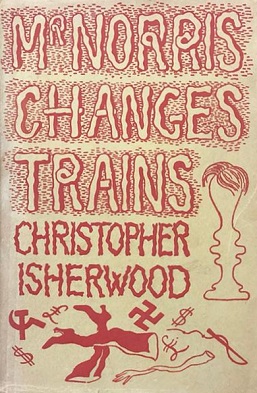
Mr Norris Changes Trains is a more traditional plot-driven suspense novel, but still showcases Isherwood’s ability to create fascinating characters that intrigue and beguile the reader.
Set mainly in Berlin, it tells story of the friendship between a young English tutor called William Bradshaw (the story’s narrator, and a kind of fictional alter ego for Isherwood whose full name was Christopher William Bradshaw Isherwood) and Arthur Norris, a charming and rather posh older gent fond of using phrases like “My dear old boy”.
The pair meet on a train travelling from the Netherlands to Berlin when William encounters Arthur in a highly agitated state as they await the arrival of immigration officials and surmises that Arthur is mostly like a smuggler.
William soon learns that Arthur is entangled in all sorts of shady and clandestine activities amid the backdrop of a looming war in Europe
Like Isherwood’s ‘Goodbye to Berlin’ much of the action unfolds as Berlin finds itself at the crossroads of two great epochs: the end of its famous decadent, free-spirited and Golden era of music, art and cinema and the rise of brutal fascism under dictator Adolf Hitler’s Nazi movement.
Bradshaw, who earns his living as a tutor, is drawn into Arthur’s exciting and dangerous world attending rowdy communist party gatherings, bearing witness to his strange business dealings (where Arthur is threatening by his evil business associate Schmidt) and joining Arthur’s bohemian entourage at Berlin’s rowdy bars and night clubs.
On one occasion Norris disappears from the party, and Bradshaw, goes in search for him only to find him engaged in a sado-masochist ritual, which he at first mistakes for Arthur (whom he can hear crying out “Nein, Nein! Mercy!”) being robbed.
“The first person I saw was Anni. She was standing in the middle of the room. Arthur cringed on the floor at her feet. He had removed several more of his garments, and was now dressed lightly, but with perfect decency, in a suite of mauve silk underwear, a rubber abdominal belt, and a pair of socks. In one hand he held a brush, and in the other a yellow shoe rag.
Olga towered behind him brandishing a leather whip. ‘You call that that clean, you swine,’ she called in a terrible voice. ‘Do them again this minute. And if I find a speck of dirt I’ll thrash you till you can’t sit down for a week. As she spoke she gave Arthur a smart cut across the buttocks. He uttered a squeal of pain and pleasure and began to brush and polish Anni’s boots with feverish haste.
Both comical and shocking, it’s one of the many delightfully entertaining episodes in the book that Bradshaw describes without judgement as he drawn deeper into Arthur’s intrigues, plots and plans.
Arthur Norris as I have since found out is based on Gerald Bernard Francis Hamilton, whose friends included Winston Churchill, the American actress Tallulah Bankhead and the notorious occultist Aleister Crowley, who was his landlord in London in the 1930s. Hamilton, who became known as “the wickedest man in Europe” – was a “fixer” for notorious communist Willi Munzenburg and someone who sold secrets for a living.
Hamilton was also imprisoned for bankruptcy and indecency. According to an article in The Spectator magazine, Hamilton lived a “long and disgraceful life” where everything he did was for money, rather than for political reasons.
Regardless of the nature of his clandestine activities, Hamilton clearly cast a spell over Isherwood who turned him into the more genial, but still Machiavellian wig-wearing conman Arthur Norris.
The novel was a critical and commercial success, but Isherwood later condemned it at making light of the suffering of the people he depicted in it.
Whether or not this is fair critique, is largely irrelevant in my mind as you can, like me, read ‘Mr Norris Changes Trains’ as if it were purely historical fiction and revel in the curiously fascinating character of Mr Norris and his affect on a young, naïve English tutor.
It reminded me of the British noir classic, The Third Man by Orson Welles. ‘No doubt Mr Norris Changes Trains’ would make a brilliant movie in the right hands.
I’ve read many of Bukowski’s brilliantly irreverent novels – written in a parsed down, forthright and highly entertaining style – and Women is by far the most graphic, indeed almost pornographic in its depiction of Chinaski’s innumerable sexual encounters.
(“I got down there and began licking…the cl*t came out but it wasn’t exactly pink, it was a purplish pink,” is how he describes one of these episodes.)
The semi-autobiographical novel (one can only assume some of his sexual exploits are exaggerated, though perhaps not the prodigious drinking) begins with Chinaski, 50, telling the reader that he has not had sex for four years.
“I had no women friends. I looked at them as I passed them on the street or wherever I saw them, but I looked without yearning, with a sense of futility.”
This drought is then broken by a period of romping that would have made Don Juan proud. It begins with half-crazed divorced mother of two Lydia Vance (the fictional version of Bukowski’s real-life girlfriend, the sculptor and playwright Linda King), whom Chinaski meets at a poetry reading:
She put both hands on the edge of the table, bent over and looked at me. She had long brown hair, quite long, a prominent nose and one eye didn’t quite match the other. But she projected vitality – you knew that she was there. I could feel vibrations running between us.
Woman, Charles Bukowski
Their relationship is full of wild sex, described in intimate detail by Chinaski – “I heard her breathing heavily, then she moaned” – and violent breakups due to his excessive drinking, visits to the racetrack, and infidelities, none of which he apologises for. Chinaski is who he is and the world can go to hell if they don’t like it.
“I walked into the bedroom with just my shorts on. I was conscious of my white belly lolling out over the shorts. But I made no effort to suck in my gut…”
At face value, Women is simply a recollection of Chinaski’s (or Bukowski’s) various relationships with women. These include Lydia, but also brief encounters with star struck fans who are seemingly served up on a platter to the horniest 50-year-old in LA.
It’s also a daily tally of his prodigious alcohol consumption of mostly cheap wine and beer. In between all the boozing and bonking – “Fucking was the best cure for hangovers. It got all the parts ticking again” – we accompany Chinaski on his often hilarious trips to college campuses around the country where he gives readings.
But as with all his writing, Bukowski manages to convey something more profound and meaningful than the sum of his adventures across bedrooms, bars and college campuses.
It is to champion the other side of Los Angeles in the words of his biographer Barry Miles: “Not the LA of ranch homes in the Hollywood Hills with the breathtaking views…” but the LA of tarnished dreams, of dead end jobs, of hookers and workers in the sex industry, of beaten down, damaged and dysfunctional people”.
Miles adds: “Bukowski loved the corner bars, the tawdry fast-food outlets, the sex shops and brothels, the graffiti on the walls…”
Sure Chinaski is the hero of the story, but he is no superman in a cape. He is very much the Bukoswki you see in those grainy black and white poetry readings on YouTube. a disheveled anti-hero with a pockmarked face who says what he thinks, never holds back and for whom nothing is ever taboo.
Chinaski in Women is very much a mirror – if perhaps a distorted and exaggerated one – of Bukowski at the height of his powers and fame: when after decades of struggle, eking out a living and working dead end jobs, he had finally established himself as a figurehead in American literature: the dirty old man of American letters.
Chinaski is not searching for some deeper meaning to life, or for the woman of his dreams. Life is simply about the experiences that happen to him – whether its winning big at the track or walking away broke, having a raging hardon or being unable to perform in the sack because he drank too much, talking to prostitutes or college professors – everything finds its way, uncensored into the book.
And while Chinaski is vulgar, and driven by his baser urges, he can also be sweet and loving. He is not a manipulator, nor does he pretend to be anyone else. And he despises pretentious, fake people.
Most importantly – and perhaps a key reason why I enjoy his books so much – is the poetic nature of his writing: short, descriptive sentences that hit their mark without ever saying too little or too much (a style that would have impressed George Orwell).
If you are a fan of Bukowski other books, or a writer like Raymond Carver who though not as vulgar, employed a similar parsed down style of storytelling, you should definitely give Women a read. (Just don’t leave the book anywhere near young children!)
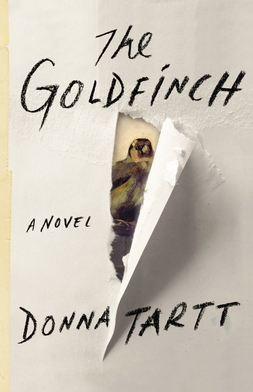
The Goldfinch is the third novel by American writer Donna Tartt, considered by many to be a literary genius.
Tartt’s two other books areThe Secret History, an “inverted detective story” about a college murder, which was published to huge acclaim in 1992 when she was just 29.
This was followed byThe Little Friend a mystery adventure novel set in Mississippi in the early 1970s that appeared in book stores in 2002.
The Goldfinch – an epic novel spanning 864 pages – was published in 2013.
By that you can tell that Tartt, who is now 58, painstakingly completed a book about once every 10 years (and we should expect no.4 soon!).
It also suggests an astonishing level of self-confidence and cerebral stamina – you really have to believe in what you are doing to keep going on with the same story and characters for a decade!
“A beautifully written coming-of-age novel with exquisitely drawn characters that follows a grieving boy’s entanglement with a small famous painting that has eluded destruction, a book that stimulates the mind and touches the heart,” said the Pulitzer Prize judges of The Goldfinch.
It’s a pretty good summary of the novel, which begins in a hotel room in Amsterdam as 27-year-old Theodore Decker’s fever-ridden thoughts return to a fateful stormy morning in Manhattan 14 years ago and the last few hours he spent with is beloved mother.
When a storm descends on them, they seek shelter in the Metropolitan Museum of Art, where a terrorist bomb kills his mother a short while later.
Tartt’s description of the violent explosion and its aftermath are exquisite as she brings the terrible chaos and destruction to life on the page as if the reader is also there. Buried in the rubble, Theo finds himself in a “ragged white cave” with “swags and tatters dangling from the ceiling” and as the ground “tumbled and bucked up with heaps of a gray substance like moon rock”. It is descriptive writing at its finest.
Just as powerful and heart-wrenching are the scenes where Theo makes his way back to their empty, darkened apartment, to wait in vain for his mother, “her coffee cup, green glass from the flea market, with lipstick print on the rim” a reminder of her terrible absence.
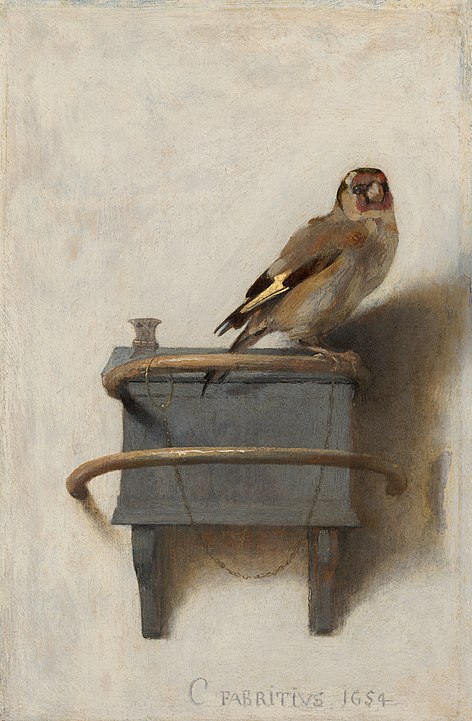
The painting is of a “yellow finch, against a plain, pale ground, chained to a perch by its twig of an ankle”. Just before they were separated, Theo’s mother told him this little painting was “just about the first painting” she ever loved. There is also another parallel: Fabritius also died tragically young, caught in an explosion at the gunpowder magazine in Delft in Southern Holland.
I stepped back, to get a better look. It was a direct and matter-of-fact little creature, with nothing sentimental about it; and something about the neat, compact way it tucked down inside itself – its brightness, its alert watchful expression -made me think of pictures I’d seen of my mother when she was small: a dark-capped finch with steady eyes.
The Gold Finch
The intriguing little painting, which uses an art technique called “Trompe l’oeil” (French for ‘deceive the eye’) to create the illusion that depicted objects exist in three dimensions, becomes a kind of living and breathing character in the life of Theodore Decker as he navigates his way as a lost young boy through adolescence into adulthood.
The painting connects him to the last conversation he had with his mother, and so he holds onto it tight over the next 14 years, keeping it hidden as first he lives with the Barbours, the wealthy, dysfunctional family of his bullied school friend Andy, before his absent father – a failed actor who mistreated his mother – appears on the scene with his girlfriend Xanadu and whisks Theo away to a housing estate on the outskirts of Las Vegas.
Here he experiences the vast desert skies and becomes best friends with another of Tartt’s marvelous creations. a delinquent, enigmatic Ukrainian boy called Boris who entertains Theo with tales of his time in Humpty Doo in Australia’s Northern Territory and introduces him to alcohol and drugs.
The Goldfinch by Fabritius
Written in the first person, Tartt’s ability to get inside the head of a guilt-ridden 14-year-old boy dealing with the monumental loss of his mother and his bumpy journey towards adulthood is truly remarkable.
Thankfully though at 864 pages The Goldfinch is not just the story about a boy and his obsession with a painting that reminds him of his mother.
It also focuses in on relationships, and how we need people to get us through trauma, be it the muddled advice of Boris, or Hobbie, the quiet and patient Greenwich Village antique furniture dealer and restorer who becomes a pseudo father figure and mentor to Theo, when he makes it back to New York, after yet more traumatic events.
The Goldfinch may be long, but like Hanya Yanagihara’s epic, “A Little Life” it’s never dull. Each adventure is part of Theo’s journey towards lifting himself out of despair and to the realisation that “maybe even if we are not always glad to be here, it’s our task to immerse ourselves anyway”.
It has been my custom, on this humble blog, to write reviews (often quite badly, but perhaps sometimes entertainingly) of the books I have read.
I’ve gathered them in one spot on the Freshlyworded virtual bookshelf, mostly for my own nostalgic pleasure, to peruse from time to time and to remind me of what I have read over the years. At worst, its fantastically eclectic mix of genres, themes and styles.
I hope it might also provide some recommendations for friends and strangers who may be looking for a tome to entertain them, and perhaps an escape from Netflix etc.
As, I have fallen far behind on the books I have read and not yet reviewed, I’ve decided to gather mini reviews of the last four books I have read – Oscar Wilde’s The Picture of Dorian Gray, David Sedaris’s The Best of Me, Paul Auster’s Moon Palace and Esther Freud’s Hideous Kinky in one handy blog post, sparing my dear reader the lengthy, waffling and rambling diatribes I tend to succumb to when writing reviews.
While it’s hard to find too many commonalities across the four books – Wilde and Auster’s are novels of exquisite imagination set in big cities (London and New York), while Sedaris and Freud’s works are highly autobiographical and deeply observational stories – I can confidently say that all are the product of wonderfully entertaining storytellers that bring characters to life on the page through their precise and elegant writing.
The Picture of Dorian Gray by Oscar Wilde
Oscar Wilde, who famously said “Books are well written, or badly written. That is all” penned one of the best works of Victorian Gothic fiction, The Picture of Dorian Gray, in 1890.
An absolutely wicked and very dark tale about how vanity and the pursuit of pleasure can destroy the soul, it was an absolute pleasure to read it for the second or maybe third time. From the very first page, where we meet the artist Basil Hallward painting the portrait of young, beautiful Dorian Gray in a stately London home, Wilde transports you to upper class world of Victorian England.
Wilde depicts the inner moral decline of Gray, who succumbs to the “new hedonism” promoted by the aristocratic Lord Henry, and goes from a innocent “young Adonis” to a cruel, murderer frightened of his own shadow. While Gray retains his youthful looks, the painting hidden up in the attic of his Mayfair townhouse grows hideous, depicting the corruption of his soul.
An aspect I loved about Wilde’s book is that the “monster” of the gothic tale is handsome young man, with evil growing inside him, rather than the real monsters that inhabit Bram Stoker’s Dracula or Mary Shelley’s Frankenstein. Forget the numerous film adaptions of the book, and read’s Wilde’s brilliant, dark novel.
Rating: 9/10
The Best of Me by David Sedaris
I was pretty late discovering the wonderful writing of David Sedaris, whose celebrated short stories, fables and accounts of his own life have turned him into one of America’s most celebrated humorist and best selling authors.
A friend lent me a copy of a collection of his stores, Holidays on Ice, published in 1997, that included a retelling of his experiences working as a Christmas Elf in Macy’s Department store in New York
Then I came across Sedaris via the great Radio Show/Podcast This American Life. In one episode he read aloud his story about the death of his sister Tiffany, who committed suicide after a troubled life (Now we are five). In another episode, host Ira Glass meets with Sedaris in Paris, where the writer had lived for two years with his boyfriend Hugh. Sedaris takes Glass on an eventful tour of Paris sharing anecdotes of misadventures with the French language and the dangers of buying the wrong butter
Sedaris narrates his own stories with a delightful weariness in his mid-Western voice. He has an almost magical ability to write as if he is confiding only to his reader.
The Best of Me is an anthology of favourite works hand-picked by Sedaris. It begins with a delightfully wicked tale entitled “Glen’s Homophobia Newsletter Vol. 3 No. 2” where Glen (perhaps Sedaris’s alter-ego) describes his brief and doomed friendship with the attractive male cashier at Dave’s Kwik shop. It’s both very funny and unsettling, descriptions which apply to a lot of the stories contained in The Best of Me.
While I enjoyed some of his fable-like fictional stories like Christmas Means Giving, where rivaling super-rich neighbours try to outdo each other’s charitable acts in the most hideous fashion, my favourite stories are the one Sedaris tells about seminal moments in his own life particularly those about his family. Sedaris grew up with five siblings, including the actress and comedian Amy Sedaris.
Sedaris combines both tenderness and great humour in his writing, which is never overly sentimental or lecturing, but always insightful whether it be about relationships, politics, culture or identity.
Many of his stories explore the relationship with his father, who treated him with disdain and unkindly in his youth, but who softened into someone almost likeable as he aged.
To get a taste of Sedaris’s unique voice, you can listen to him narrate the story of his father’s final days in the achingly poignant Unbuttoned via the New Yorker magazine website. Unbuttoned is one of the stories contained in the anthology.
You can also read online – Dentists without Borders – which was first published in The New Yorker in 2012.
You can also listen to him read Now we are five and Americans in Paris on This American Life and dozens of other episodes featuring his stories and essays.
While his writing is a platform to explore his own upbringing, identity, phobias and personality, Sedaris has this amazing ability to make the reader feel good about being alive in a world of contradictions and craziness.
Rating: 8/10
Moon Palace by Paul Auster
I hadn’t realised how many Paul Auster books I had read until I browsed my bookshelf at home, after reading his work of magical realism Moon Palace.
Here I found Mr Vertigo (1994), The Book of Illusions (2002) and Oracle Night (2003).
I also know of Auster through two screenplays he wrote for the movies Smoke, and its follow-up Blue in the Face, both starring Harvey Keitel, who plays the owner of a Brooklyn cigar shop.
Though I don’t remember all the plots in detail, I have a clear memory of the sheer pleasure in reading those books and the sweetness of the movies, especially Smoke.
Auster, is one of the modern greats of American Literature, and has been touted as a potential recipient of the Nobel Prize of Literature. Were he to win it, he would be one of the most accessible and worthy recipients (the prize is often in my opinion given to writers no one has heard of (Abdulrazak Gurnah in 2021?) apart from university professors of English literature.
Auster is a wonderful storyteller and masterful creator of characters, that often draw on his own personal history. Many of characters reappear in his books, at different ages and stages of their lives.
Moon Palace is narrated in Holden Caufield-like fashion by the introverted, intense and tortured orphan Marco Stanley Fogg. It begins with Fogg nearly starving to death in his sparse New York apartment after deciding to “live dangerously” and simply live off the proceeds of the mountain of books he has inherited from his late Uncle Victor. Later he finds love in the arms of the beautiful and kind Kitty Wu and then a live-in job reading and carrying out chores for a blind old, wheel chair-bound man called Thomas Effing in his large Manhattan apartment.
Along the way, all sorts of strange and seemingly unlikely (but believable in the hands of Auster) coincidences take place throughout Marco’s epic, modern odyssey that take him from streets of New York to the sparse wilderness of the American Mid-West and that bring him closer to knowing his back story and finding his identity.
As with other Auster books, there are “stories within stories” as the reader is swept down portals of time and memory. If you’re looking to make a start on the oeuvre (yep, fancy word – look it up!) of Auster, magical and mystical Moon Palace is a good place to start.
Rating: 8/10
Hideous Kinky by Esther Freud
I thought I’d be a bit more enthralled by Esther Freud’s autobiographical tale about her stint living in Morocco with her aimless mother Julia and older sister Bella. (Freud is the daughter of the legendary portrait painter Lucian Freud and the great granddaughter of the founder of psychoanalysis Sigmund Freud).
I picked the book at random from my gigantic 1001 Books You should Read Before You Die and was looking forward to reading it as I’d travelled through Morocco with my wife when we backpacked in 2010 and been entranced by its ancient and bustling cities with their overflowing markets, maze-like laneways and lively squares like the incredible Jemaa el-Fnaa, the main square and marketplace in Marrakesh.
Indeed we stayed in just the kind of cheap hotel Lucy, the six-year-old narrator stays in with her mother and sister (the wonderfully named Hotel Moulay Idriss) close to the Jemma el-Fnaa.
Lucy precociously narrates the family’s adventures across the country, the curious sights she sees in the markets, squares and festivals, the relationships forged with local characters like Bilal (her mother’s Moroccan lover and a father figure for her kids) and the eccentric expats they meet, like the wealthy “prince” Luigi Mancini. The children seem to have a supernatural power to to know which adults to trust, a fortunate quality given their mother is often absent, in spirit if not sometimes physically.
The family are constantly having to find ways to make ends meet as they wait for money to arrive, making dolls to sell in the market, or a few pieces of fruit they have gathered. One “holiday” has them sleeping outdoors on a beach for days.
Esther Freud’s beautiful descriptions transported me back to my time in Morocco, especially Marrakesh, which was wonderful. The novel is magical in parts, but I was also quite bored at times by all the wondering about and waiting around. Perhaps I need to read it again (It’s only 186 pages). I’d also like to watch the movie starring Kate Winslet.










 Freshlyworded