
The Bob Dylan Project: Album 9 – Nashville Skyline

Copyright: Columbia Records or the artist. Low-res version used for review purposes only

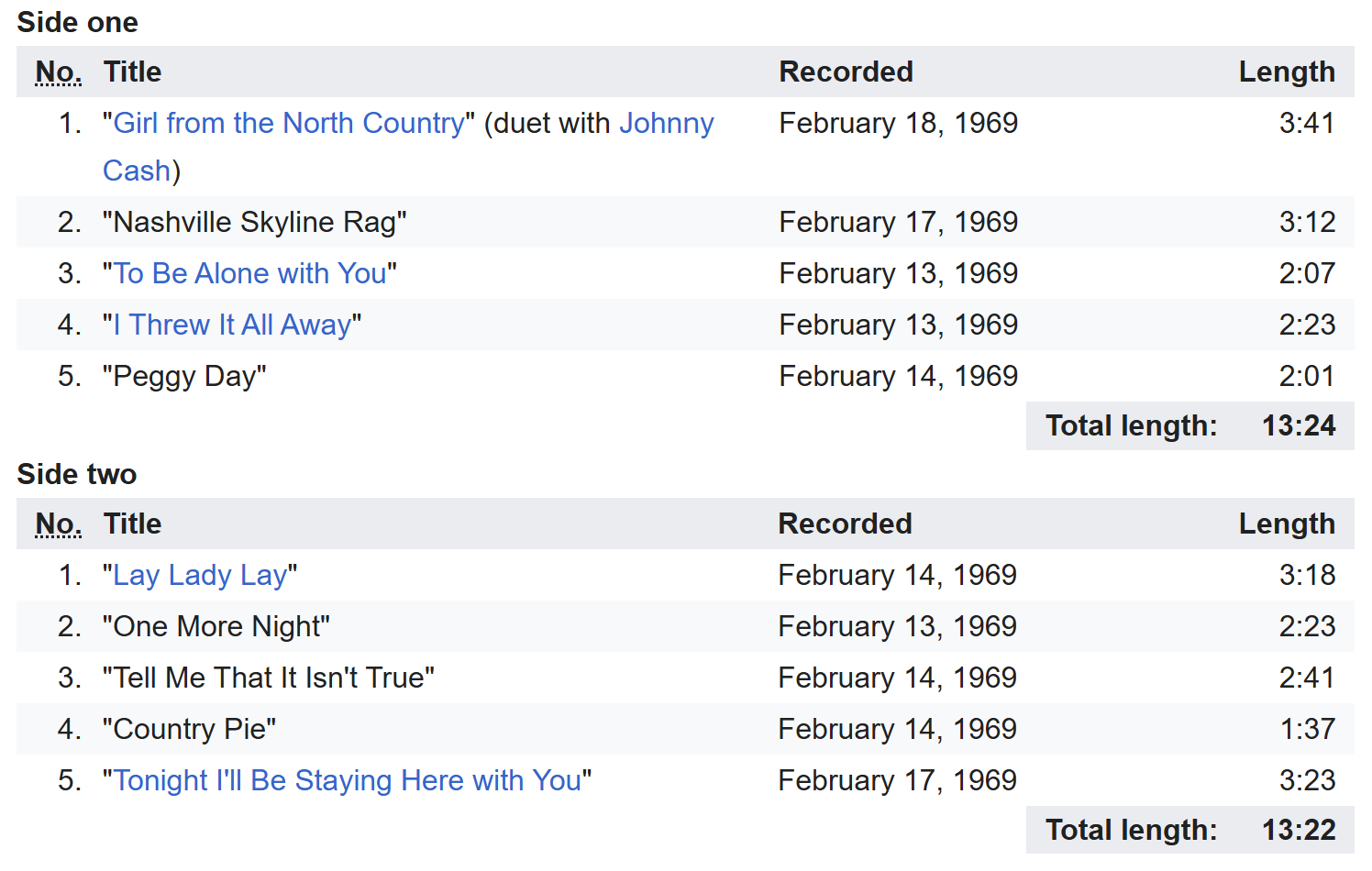
Title: Nashville Skyline (1969)

Length: 26min, 46s

Number of songs: 10

Best tracks: Girl from the North Country, I Threw it All Away, Lay Lady Lay, Tell Me That it isn’t True

If I could choose just one track: I Threw it All Away

Freshlyworded rating: 8/10

While running for less than 27 minutes and including only 10 tracks, there is plenty to like about this folksy, country and blues-infused album that includes a collaboration with the great Johnny Cash.

The really noteworthy thing about Nashville Skyline is Dylan’s new singing voice, which is almost unrecognisable from his usually rough-edged and conversational tone that includes stretching of words and bending of syllables.

Instead, we hear Dylan as a melodic-sounding crooner, a style that does in fact suit a lot of the romantic and sentimental tracks on the album. In truth, I have heard this sweeter voice before, on the track “Lay, Lady Lay” which was part of the three-CD Biograph compilation that first got me hooked on Dylan. The song always struck me as a bit odd just because it didn’t sound like Dylan at all. I didn’t realise there was a whole set of tracks that he sings in this unusual style, until I listened to this album.

Not only is his voice different, but the songs themselves are more straightforward in composition, with a clean-cut 1950s or 1960s feel to them and are largely devoid of complex poetic imagery.

Who would have thought that someone who wrote lyrics like: “Once upon a time you dressed so fine/Threw the bums a dime in your prime, didn’t you?” in ‘Like a Rolling Stone” would write a song like “I Threw it All Away” and lyrics like “Love is all there is, it makes the world go ’round” followed by “Love and only love, it can’t be denied”.

But the song has a raw honesty about it, and though the lines on paper appear cheesy and overly sentimental, it is actually a beautiful song (a new hidden gem for me) and my favourite track on the album.

I also really enjoyed Dylan’s duet with Johnny Cash, ‘Girl from the North Country’, which opens the album. When you think of great voices in modern music, Cash’s deep baritone is among the most distinctive and beautiful in the business. Dylan’s crooner voice combines well with Cash on this track, where the pair reminisce with a feeling of sadness and longing about a woman who “once was a true love of mine”.

An interesting inclusion on the album, is ‘Nashville Skyline Rag, a lively ragtime ditty without any words that has echoes of Dueling Banjos made famous in the movie Deliverance. It’s followed by “To Be Alone with You”, a simple, but catchy pop-like song about Dylan being with one he loves.

“Peggy Day” is straight out of the 1950s. It’s a playful song where Dylan sings of “wanting to spend the night with Peggy Day” and how “Peggy night’ makes his “future feel so bright”.

The most famous song on the album is the aforementioned “Lay Lady Lay” another love song that is slow and mesmeric (aided by a twanging steel guitar), with sexual undertones and he asks his love to spend the night in his “big brass bed”. It turned into a surprise hit I have learned, peaking at Number 7 on the Billboard Hot 100 in 1969 and was a favourite track of Madonna.

“One More Night” is very much a country-style love song with Dylan lamenting about spending another night with the woman he loves and featuring the almost excruciating cliched line “Oh, I miss my darling so” alongside gospel undertones in the repeated phrase: “Tonight no light will shine on me.”

I really loved “Tell Me That It Isn’t True” a song about Dylan’s fears about losing the woman he loves to a dark and handsome rival and pleading with her tell to tell that it’s not true. It’s a catchy tune with a sweetness and tenderness to it.

The album ends with yet another love song. “Tonight I’ll be Staying Here with You” is about woman he so devoted to that he throws all his plans out the window to remain with her. Incorporating a lot of jazzy piano, it seems a fitting closing song, as if Dylan has learnt his lesson and is not going to blow his chance at love and romance this time.
The Bob Dylan project: Album 3: The Times They are a-Changin’

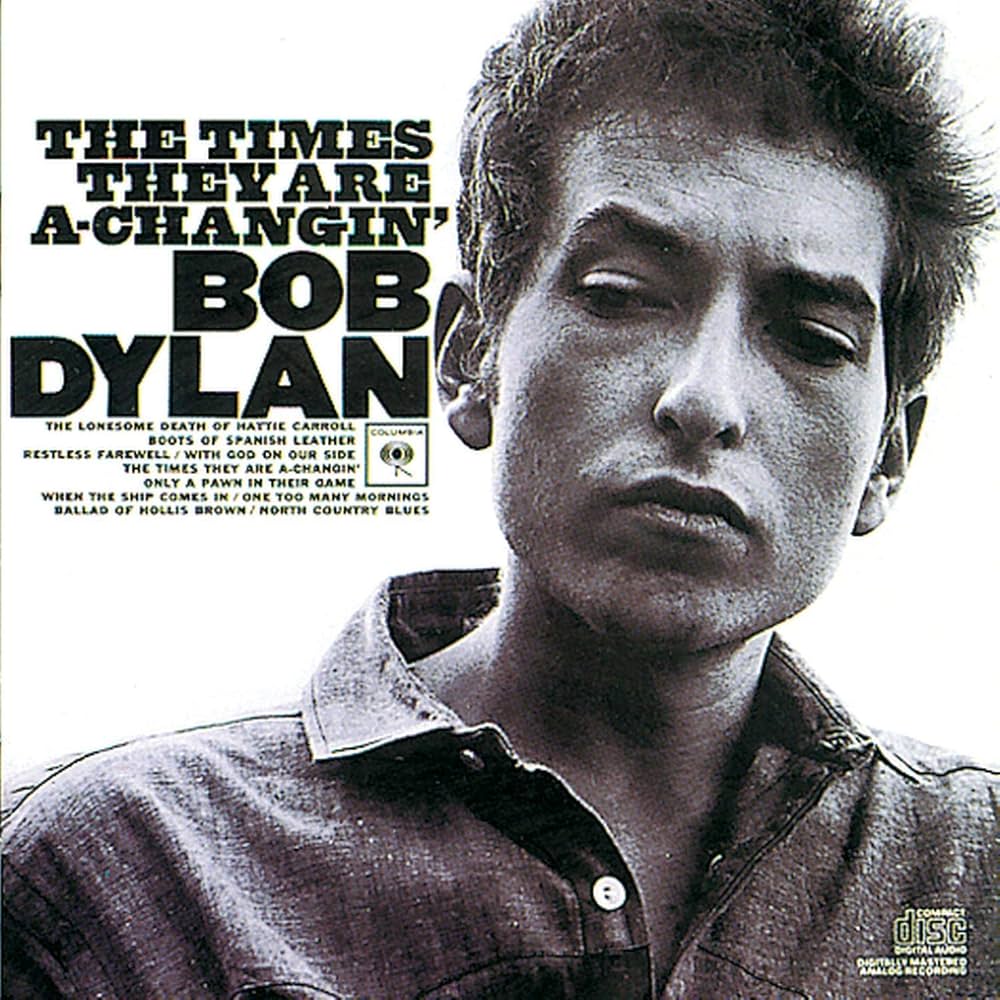
Album cover, copyright Columbia Records. Low-res version reproduced under Fair Use for review purposes

Title: The Times They are a-Changin’

Length: 45min, 36s

Number of songs: 10

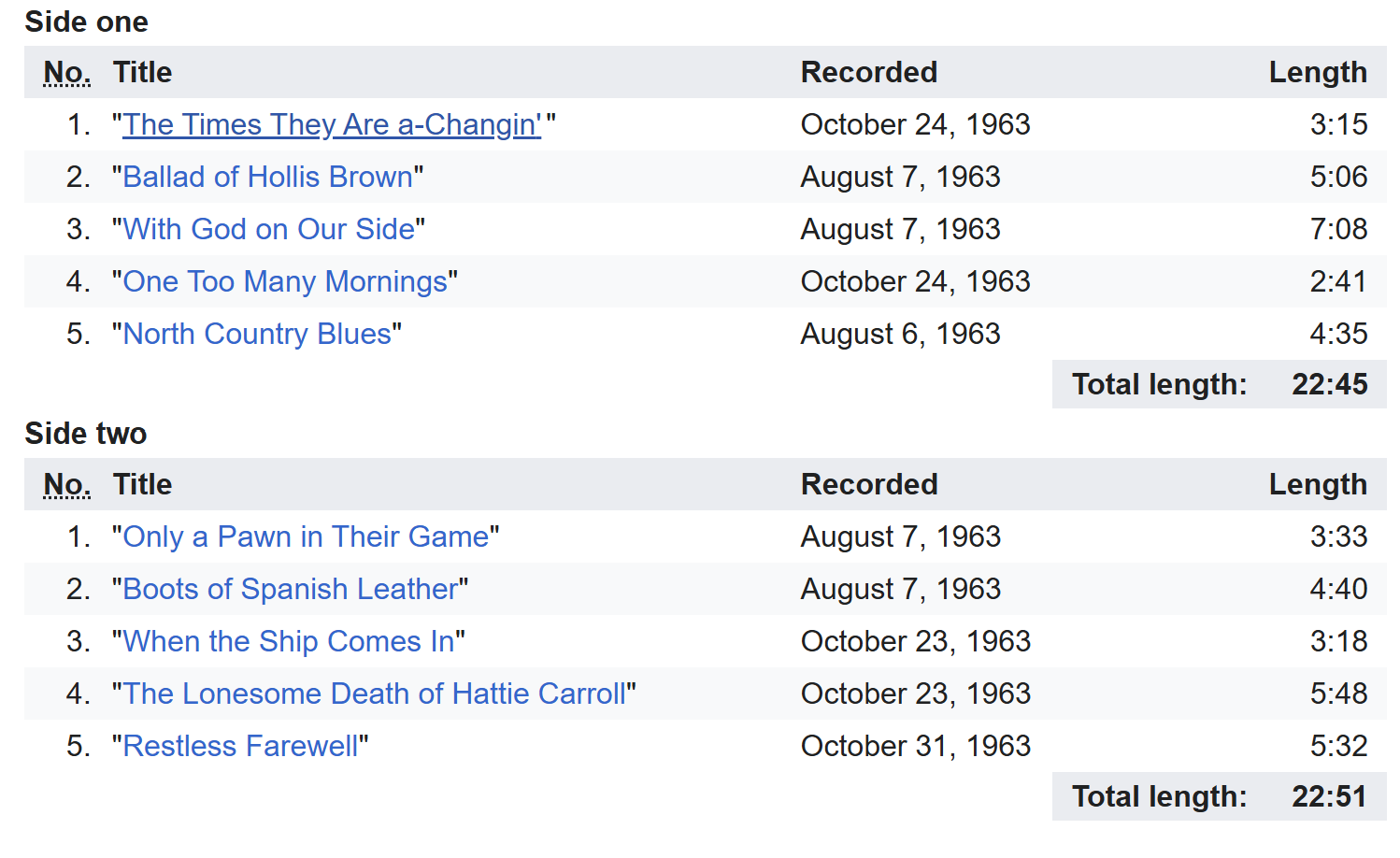
Best tracks: The Times They are a-Changin’, Ballad of Hollis Brown, With God on our Side, North Country Blues, Boots of Spanish Leather, When the Ship Comes in, The Lonesome Death of Hattie Carroll

If I had to choose just one track: The Lonesome Death of Hattie Carroll

Freshlyworded rating: 9/10

Thoughts:

While the title track from this album is rightfully one of Bob Dylan’s most famous and revered songs, for me the hero track and an absolute masterpiece on this album (and surely among his best songs ever) is “The Lonesome Death of Hattie Carroll”.

Running just under six minutes, Dylan tells the story of the murder of Hattie Carroll, an African American barmaid, killed in a drunken rage in a Baltimore Hotel in February 1963 by 24-year-old Wiliam Zatzinger, a wealthy, white tobacco grower – and the injustice fuelled by racism that followed.

The song is a perfect combination of vivid poetry, acoustic guitar and Dylan’s plaintive, soulful voice.

Dylan wrote the song just six months after Carroll was murdered and it no doubt struck a chord among the civil rights movement at the time. Every sentence of the song is wonderful.

Zantzinger killed Hattie Carroll, Dylan sings: “With a cane that he twirled around his diamond ring finger” and after his arrest “Reacted to his deed with a shrug of his shoulders”.

He contrasts the Zantzinger’s wealth and high society connections with Carroll’s role as a servant “Who carried the dishes and took out the garbage”.

A few months later, “in the courtroom of honor” Dylans sings of the judge who “Stared at the person who killed for no reason” and then in a devastating line “handed out strongly for penalty and repentance William Zantzinger with a six-month sentence”.

As he tells the story of Hattie Carroll’s murder Dylan sings the repeated refrain: “But you who philosophize, disgrace and criticize all fears Take the rag away from your face, now ain’t the time for your tears.”

After singing how Zantzinger literally got away with murder, Dylan ends the song with: Oh, but you who philosophize, disgrace and criticize all fears. Bury the rag deep in your face for now’s the time for your tears“.

Just brilliant!

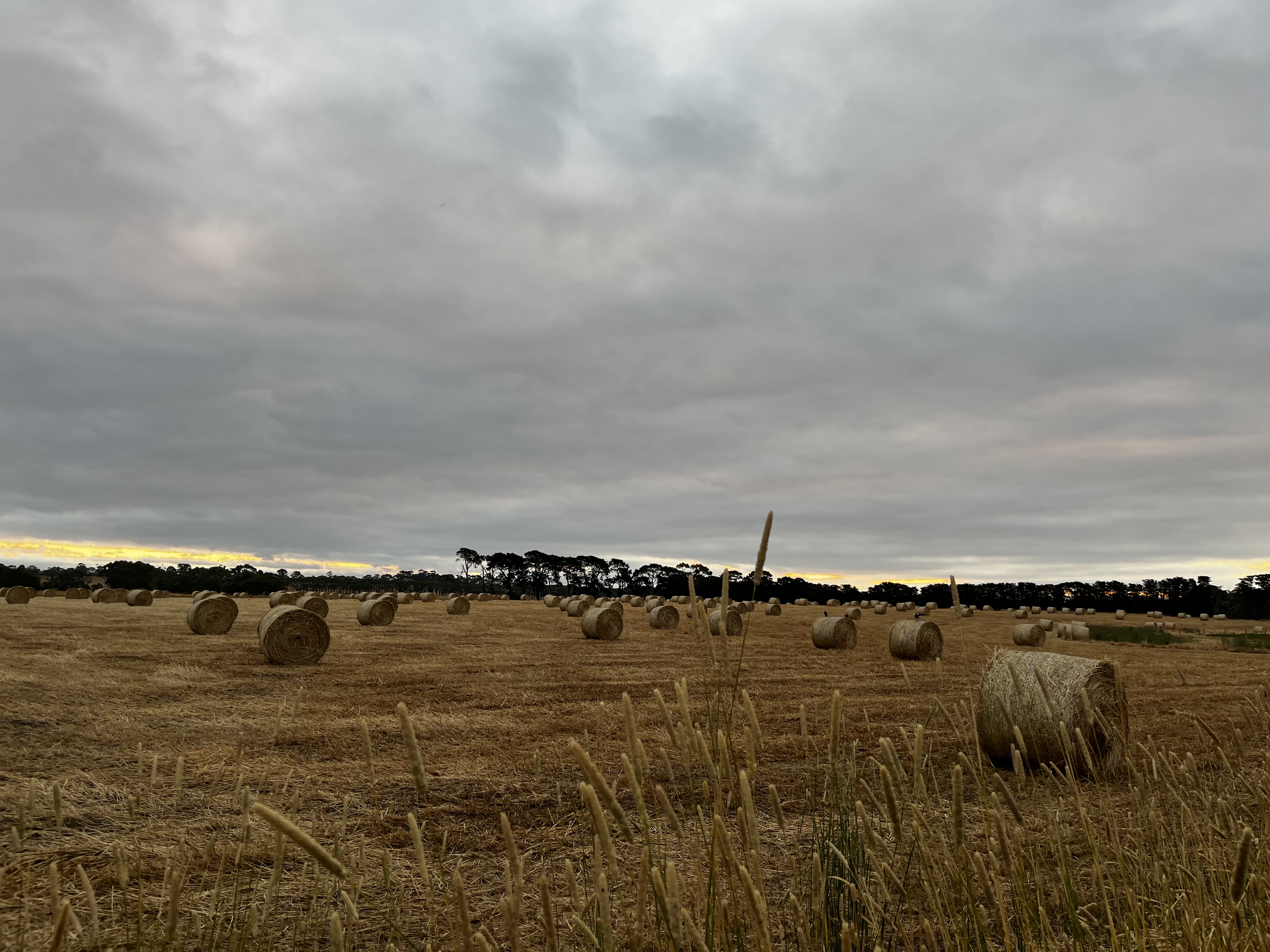
I listened to this song and all the other nine tracks of this album whilst walking my dog along quiet country roads and sleepy suburban streets in Lancefield north of Melbourne (where I live) and on holiday in Birregurra, a small town in the Otways region of Victoria. Both were the perfect backdrop for letting the wonderful storytelling songs of this album seep deep into my bones.

Hay bales in a field in Birregurra, Victoria

Alongside the Lonesome Death of Hattie Carroll, I of course loved The Times They Are-a-Changing, a universal anthem about profound change that’s coming to society. At the time it was recorded, this change was the civil rights and anti-war movement but it’s wonderful lyrics still inspire people today who are pushing for change amid the punishing regimes governing the world:

Come mothers and fathers
Throughout the land
And don’t criticize
What you can’t understand
Your sons and your daughters
Are beyond your command
Your old road is rapidly agin’
Please get out of the new one
If you can’t lend your hand
For the times they are a-changin’

I also loved another haunting, narrative song, “Ballad of Hollis Brown” which tells the story of a poverty-stricken South Dakota farmer and the events leading up to a desperate act.

“With God on Our Side’ is a song that like “The Times They are a-Changing” reverberates loudly today, with its mockery of how believing in God justifies acts of war and America’s superior moral position.

“North Country Blues” is a wonderfully melodic, yet dark song sung in the first person about growing up in an iron ore mining town, where the work eventually dries up and the mine is closed

“Only a Pawn in their Game” is another powerful political song about the murder of a civil rights activist Medgar Evars, while another favourite track of mine on the album is the very catchy “When the Ship Comes in” which has a happy and triumphant feel to it.

The slow and contemplative “Restless Farewell” is a fitting end to a brilliant album, and also a great way to end an evening country stroll.

For me, this is Dylan’s best album of the three I have listened to and reviewed so far. Incredible that he was only 22 and 23 when he wrote and recorded all these amazing tracks.