Not Wikipedia worthy: The story of Jennifer and Jordan Nash

wikipedia

One Saturday morning in July, I received a call from Jennifer Nash, a single mother living in Logan City, south-east Queensland.

She asked if I would consider writing an article about her son, Jordan Nash, to  be posted on Wikipedia, the free user-sourced internet encyclopedia. She hoped a Wikipedia article would draw attention to his sad story.

jordan nash

Jordan Nash, as a young school kid

I said I thought I could help.

Her story tumbled out over the phone: she was at war with the Queensland government and the Federal Government since Jordan  – who has learning difficulties – was removed from school almost 10 years ago.

Jennifer claimed she’d been bullied, mistreated, harassed, ignored, hit with a $28,000 court bill and been the victim of judicial corruption because a court transcript – which proved she had been bullied and mistreated – had been “edited”.

Over the next few months I spent many hours on the phone with Jennifer, an exhausted, but determined and sincere woman, as she described what had been done to her.

Much of her and Jordan’s story appeared on unofficial media sites – essentially citizen journalism or blogging sites like Independent Australia  – but some of it did make it into the mainstream media.

In March 2011, WIN Television reported her address to former Queensland state premier Anna Bligh at a community forum at Toowoomba, where she said, quite eloquently, that “this soul crushing travesty of justice cannot be allowed to be covered up any longer”.

Last year she appeared in the  Brisbane Times, which incorrectly reported that she’d called then prime minister Julia Gillard “white trash” at a community cabinet meeting at Redbank Plains outside of Brisbane. The story, later corrected by the online newspaper, was that she had in fact told the prime minister “We are not white trash” as she explained to radio presenter Gary Hardgrave on radio station 4BC

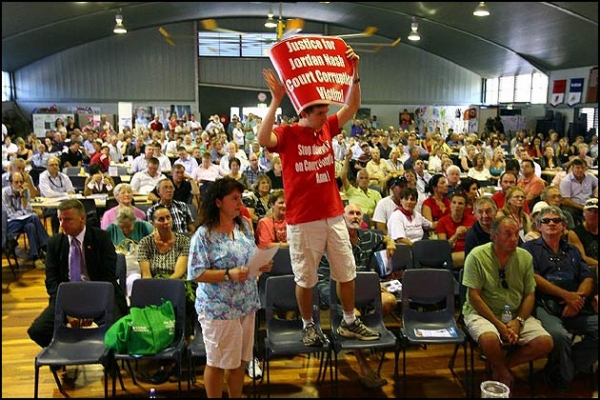
Jennifer and Jordan Nash speaking out at a community cabinet

Jennifer and Jordan Nash speaking out at a community cabinet

Her battle reached the upper echelons of power this year, when both her and Jordan were  banned from attending a federal government community cabinet in Rockhampton by Jamie Fox, a government secretary working within the cabinet of then prime minister, Kevin Rudd, who was due to speak at the event.

Asked why she’d been banned, Jamie Fox responded via email that following checks by “security agencies” the government had been advised by the Attorney-General’s Department and the state police that she had a “history of disrupting public events” at other community cabinets and would not be permitted to attend.

“I am responsible for organising community cabinet meetings and this decision is taken on my authority,” wrote Fox.

Jamie Fox's email to Jennifer Nash

Jamie Fox’s email to Jennifer Nash

Just what had a single mother without any financial or political muscle done for the Australian government to ban her from airing her views in a forum seemingly open to all?

The answer: stand up on a chair and demand justice for her and her son.

Hardly the sought of behaviour I thought to warrant a security crackdown or a sneering email from one of Kevin Rudd’s flacks.

In late August, I submitted the story of Jennifer and Jordan Nash to Wikipedia.

It was rejected by someone called “Sionk” who wrote:

This submission’s references do not adequately evidence the subject’s notability

Sionk also remarked:

Maybe there has been extensive news coverage of Jordan Nash, but there isn’t any presented here. The way this is written is also problematic, Wikipedia isn’t the place to make lengthy, one-sided (and poorly sourced) legal arguments.

Essentially, what Sionk was saying was that Jordan Nash was not worthy of  a Wikipedia article because his case had not been reported in the mainstream press and he was not someone of note.

I explained to Jennifer that no matter how many times I re-wrote it, I did not think her story would make it onto the pages of Wikipedia for the reasons above.

Every now and then I do a search for “Jordan Nash” wondering if Jennifer has managed to convince Wikipedia editors they should publish her story. But there’s still no entry.

Interestingly, many of the people who she accuses of mistreating her do have Wikipedia entries such as Queensland state member for Logan, Michael Pucci, who Jennifer says refused to help her, Supreme Court justice Jean Dalton, who dismissed Jennifer’s initial complaint at the Queensland Anti-Discrimination Tribunal (QADT) and former minister for education, Cameron Dick who dismissed further investigation into claims the court transcripts had been edited.

There’s some consolation for Jennifer. At least Jamie Fox, the government flack who barred her from the forum, doesn’t get a Wikipedia page.

(If you’d like to read more about Jennifer’s case, Independent Australia  provides a fairly comprehensive summary).

Your word is your worth: why journalists shouldn’t write for free

6861197374_17a9d96b5eAbout six years ago, having been made redundant from a role in Brisbane I applied for a number of journalism jobs in Sydney.

One of these was to write for Lawyer’s Weekly. Part of the application process was to write an article for the publication about the implementation of Basel 2 banking reforms on the legal profession (Yes, a very dry topic I know). I spent a great deal of time researching the topic and did a number of interviews before filing a story.

For whatever reason, I never got the job. However the editor at the time – a fidgety Englishman – said Lawyer’s Weekly would publish my article and pay me $100 or thereabouts for my 1,500 word story – or less than 10 cents a word.

I was outraged. I remember I wrote an angry email to the editor, demanding better compensation for my time and effort. He refused to budge. I later received a copy of the edition of the trade mag with my article splashed across two pages and a check for $1o0. It didn’t seem like a fair trade.

I sold the very same article (slightly re-jigged) to an education group I was doing freelance work for at the time, Tribeca Learning (now part of the Kaplan professional training group) for about $1,500 and gave Lawyer’s Weekly the one-fingered salute (figuratively).

It was immensely satisfying.

The issue of journalists, writers and photographers not being paid for their work has come to the boil over the past few weeks in a series of exchanges between my current employer (Fairfax) and former employer (Private Media).

Fairfax’s The Age newspaper had highlighted that Private Media does not pay bloggers for their posts on subscription news and analysis website Crikey and that it had no contributor budget for arts website  offshoot the Daily Review. Instead, it rewards bloggers on a system based on the number of hits the post receives. (I should point out that contributors and those commissioned to write for Crikey are paid, but the rate is to my understanding, pitiful).

The Age’s Ben Butler explained the pay per hits policy for Crikey bloggers:

Blog entries that get 25,000 page views a month earned a ”bonus” of $193.50, those with 50,000 hits $387 and so on, with the system topping out at $4000 for a post ticking past the 500,000 mark.

Critics of the policy included freelance writer Byron Bache who launched an online protest on his blog supported by a number of writers, including former Crikey journalist Amber Jamieson. Bache wrote:

It is ethically reprehensible for a company to expand and actually stop paying the people who produce its product. A company which asks its readers to pay for content doesn’t feel the same obligation when it comes to its writers.

He also pointed out that the Daily Review’s two full-time staff were being paid a reported $100,000+ a year and that it was a distinctly commercial venture i.e. one designed to make a profit and provide a return to shareholders in Private Media.

I should point out that Crikey is a terrific and valuable website with about 18,000 paying subscribers. Blogs are not behind the paywall so readership could in theory be quite high. However, I would argue that few if any stories have ever reached anywhere near 500,000 hits to secure the $4,000 payment and that even reaching 50,000 hits ($387) would mark an article or blog as incredibly successful. So the possibility of getting paid anything meaningful is virtually zero.

The feud between The Age and Crikey/The Daily Review played out over a number of days in The Age’s gossipy CBD column with headings like “Putting the free back into freelance”,  and “Crikey! Writers want to get paid”.

In response, Crikey decided it should publish an explanation of its editorial policies under the rather mushy heading “three cheers for our writers” with an “unreserved apology” for not being open about it’s payment policy plus a link to this policy.

A few days later, Bethanie Blanchard, a Crikey literary blogger, wrote what was clearly a difficult column for her  in the Sunday Age (but for which she was paid for) criticising the Daily Review for not paying freelance writers for what is a commercial venture.

Blanchard admitted that it was “deeply troubling personally to criticise a company we [freelancers] have been incredibly proud to write for” but that there were places were writers could and should write for free to test themselves and fail, such as student newspapers, street press and emerging journals, but not the Daily Review, a “commercial venture”.

I should at this point own up.  I have in fact written for Crikey for free on a number of occasions and happily did so. I never thought to ask for payment since I was a fairly well-paid full-time member of Private Media’s staff and nor did I expect it. I was just pleased to appear in a publication I highly respect (I should also mention that I was paid very fairly for a series of ebooks I wrote for Property Observer outside of work hours).

But writing for Crikey for free was my choice. I certainly wasn’t asked to do so.

It’s a different story if writer’s are approached to contribute to a publication and expected to work for nothing beyond the euphemistic “exposure” or for the possibility of payment if they reach an impossible readership target.

The ABC’s Media Watch highlighted the offer of ‘exposure rather than payment’ recently in an excellent expose on Tennis Australia inviting freelance photographers to take photos of tennis players ahead of the Australian Open without payment in what is a $200 million revenue generating enterprise, paying $33 million in prize money at the Grand Slam event.

Another publication under fire is ‘mommy blogging’ website Mamamia which does not pay bloggers or anyone apart from a handful of its staff, but which appears to be a highly successful commercial venture given the high media profile of founder Mia Freedman.

mamamia

Let’s be clear. Offering ‘exposure’ is fine for people who are marketing themselves and for whom journalism is not their bread and butter. There are many people who will happily write for free such as mortgage brokers, investment gurus, entreprenuers and real estate agents with their columns serving as a free advertisements.

But if you’re a journalist, photographer or artist who values their craft, you should expect to be compensated fairly for your efforts.

It is also understandable that as the newspaper and publishing industry undergoes its biggest upheaval since the invention of the printing press that new ventures should look to cut costs where possible and stay lean and nimble.

But it is unacceptable to expect people who spend many hours researching, interviewing and crafting stories and who have families to support and mortgages to pay to expect nothing in return but a pat on the back.

Prize-winning author Anna Funder has also weighed into the debate, likening wealthy media companies expecting her to work for nothing but “exposure ” as to suggest she is “running some sort of porn site”.

“That’s a very quick race to the bottom,” she told the first national writers’ congress.

Like everybody else in society, we are doing something useful, something that has value. It has a kind of political value of speaking truth to power, it has an aesthetic value of giving pleasure and delight. And we deserve to be paid. We also deserve to be able to function in the world as human beings with children and mortgages – and they cost money.

Here, here! I say.

What reading ‘All the President’s Men’ can teach journalists

all the presidents men“All the President’s Men” – Carl Bernstein and Bob Woodward’s account of how they uncovered and reported the Watergate Scandal in 1972 and 1973 in the Washington Post and brought down President Nixon and his goons – should be compulsory reading for any journalist wanting tips on how to break a big story. It’s practically a ‘how to’ manual on investigative journalism.

I don’t know if they still make journalists like Bernstein and Woodward, but even in the digital age, where research and information is just a search term away, the techniques, tricks and cunning they employed still apply. Truly great stories don’t come from Google.

I should be upfront and say, that I did not find ‘All the President’s Men’ an easy book to read.

Firstly there are the sheer number of characters and the very convoluted plot. In the inside introductory pages of my paperback edition there is a list of 51 people – presidential staff, advisers, aids, campaign directors, lawyers, editors and prosecutors – who were the main players in the scandal. I found I had to constantly turn back to the beginning of the book to remind myself of who each person was as the plot diverged into a myriad different strands.

This may sound harsh, given Bernstein and Woodward’s reporting (and others on the paper) helped the Washington Post win the Pulitzer Prize for Public Service in 1973, but it’s also not incredibly well written. Perhaps writing a 300 page book gave crack newspaper reporters – accustomed to writing 500 – 1000 word articles – too much leeway to tell their story. There’s too much information crammed into paragraphs and too many minor incidents that get in the way of the overall plot – a good, tight edit would have done marvels to the finished work.

That being said, it does provide some incredible insights into how these two brave, foolhardy, and belligerent reporters dug down the deepest of rabbit holes to uncover the truth.

Married journos need not apply

The first thing that’s apparent is the long and strange hours Bernstein and Woodward put in to crack the story. Neither of them were married at the time or in relationships, nor did they have children. This made it easier for them to work late into the night in the offices of the Washington Post, or drive out to the outlying suburbs of Washington or jet off to Miami or Los Angeles to track down and interview people and give up their weekends in pursuit of a story.

Anyone journalist today married or in a relationship would find it impossible to put in the hours they did – they would either end up divorced or entirely burnt out, or both.

Woodward famously would head out well after midnight to meet up with “Deep Throat” (later revealed to be the FBI’ no.2 man Mark Felt) in deserted car basements to verify information or seek help with stories.

Both journalists also had no qualms about ringing up legendary Washington Post executive editor Ben Bradlee at 2am and asking if they could come over to discuss an idea or situation.

Hit the phones relentlessly. Put in the hard yards.

In the book, Woodward and Bernstein recount countless hours spent calling people on long lists, hoping to come across someone in the White House, Justice Department or some friend of a friend willing to share confidential information with them.

bernstein and woodward

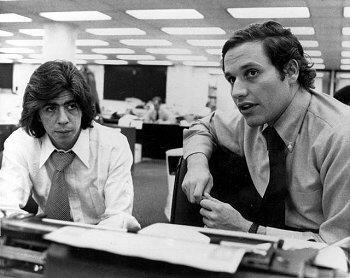
Carl Bernstein and Bob Woodward at the offices of the Washington Post in 1972

By beginning at the top of a list and working their way through it, Woodward Bernstein would eventually find someone willing to speak to them. Sometimes they’d spend the whole day just telephoning people in the hope of finding a useful contact. In this way, they built up an incredible network of insiders. This is how they worked:

Each kept a separate master list of telephone numbers. The numbers were called at least twice a week. Eventually, the combined totals of names on their lists swelled to several hundred, yet fewer than 50 were duplicated.

Think laterally, be creative

Bernstein and Woodward were very savvy and had to be because the might of President Nixon, his ‘men’ and the CIA were out to prevent the ties between Watergate and the White House cover-up ever being revealed.

Sometimes they crossed the line and veered into the murky borders of the unethical or illegal – for instance, when they contacted members of the grand jury investigating Watergate who weren’t supposed to talk to the press or on one occasion, Bernstein not identifying himself as Washington Post reporter.

oct10_72

One of Woodward and Bernstein’s scoops on Watergate

(Read the actual newspaper article here.)

On another occasion, they met with chief prosecutor Earl Silbert in his fastidiously tidy office. Bernstein noticed a piece of paper on his desk that had as its letterhead the name of the company where bugging equipment for Watergate had been purchased. He used this information to write a story and was severely admonished by Silbert who called his methods “sneaky, outrageous and dishonest”. Bernstein apologised, but saw it differently:

Bernstein had learnt years before that the ability to read upside down could be a useful reportorial skill…

The point is that no opportunity was passed up. Every lead, idea or suggestion was followed up.

Get people to talk

Bernstein were masters at getting people to talk. One way, was to get themselves inside the house of a person they knew had good information, but was reluctant or too scared to speak and then find ways of staying and chatting. In one rather comical episode, they kept on ordering cup after cup of coffee in an attempt to prolong a conversation with the wife of an important person caught up in the conspiracy.

They write:

The trick was getting inside somebody’s apartment or house. There, a conversation could be pursued, consciences could be appealed to, there the reporters could try to establish themselves as human beings

Be daring out and outrageous

Bernstein and Woodward pulled some outrageous stunts and came close to going to jail.

My  favourite one is towards the end of the book.

Following a day in court where the Watergate defendants are being tried, Bernstein and Woodward along with a couple of other reporters notice three of the defendants and their lawyer trying to hail a cab. Bernstein races down as they file into the cab and

…uninvited got in anyway, piling in on top of them as the door slammed.

But it doesn’t end here:

Bernstein arrived back in the office late Saturday (he had gotten into the cab on a Friday afternoon). He had gone to the airport with Rothblatt and his clients, bought a ticket on a flight one of them was taking, edged his way in by offering to carry a suitcase and engaging in friendly banter, and slipped into the adjoining seat. Bernstein did not have to press the man too hard to turn the conversation to the trial. The story came out in a restful flow of conversation as the jet engines surged peacefully in the background.

Talk about outrageous, but this was the way Bernstein and Woodward operated.

Not all their ideas paid of – and a couple almost sunk them.

They misread what they thought were confirmations from sources on at least two occasions (one involved a source agreeing to hang up after 10 seconds if the story read out to them was entirely true. The source hung up but misunderstood the instructions) with spectacular results. But most of the time they got the story.

Every word matters

Every word mattered to Bernstein and Woodward and to their editors. The lead (opening paragraph) had to be perfect and they would fight over words and phrases and re-write and re-write as deadlines approached. This, of course, would be a problem in today’s 24 hour news cycle, where posting stories quickly as well as accurately is the challenge.

However, the digital age has not dampened the importance of writing well and being able to tell an engrossing story in a few hundred perfectly chosen words, as Bernstein and Woodward did back then. The importance of ‘words’ is revealed in this revelation:

The two fought openly. Sometimes they battled for fifteen minutes over a single word or sentence. Nuances were critically important, the emphasis had to be just right…sooner or later however, (usually later) the story was hammered out.

And let’s not forget the end result of their endeavours, the resignation of President Richard Nixon

Train, planes, buses and toilets: the global giant that covers the world

DSC_0467

Had the train station become a bank branch?

That’s sort of how it felt walking through Melbourne’s Southern Cross Station every morning on my way to work this week.

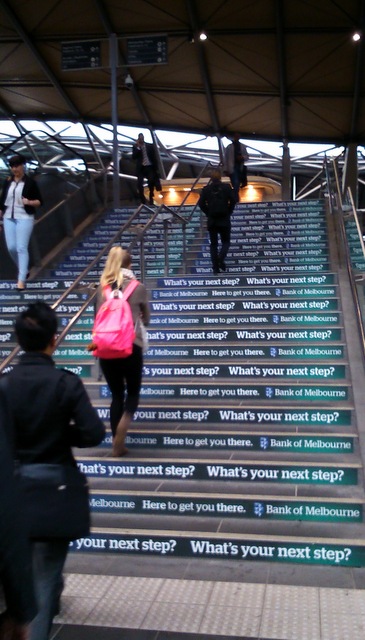
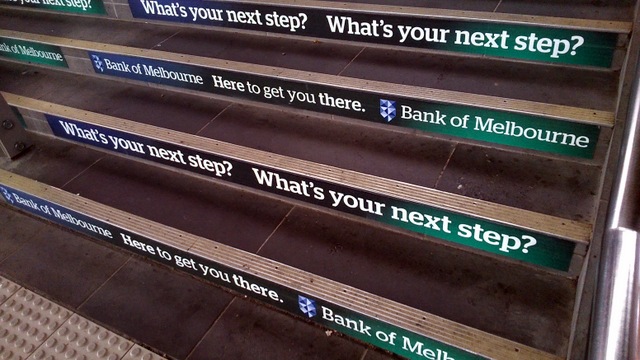
Ascending the escalator from the platform I’d see enormous Bank of Melbourne posters dangling from the steel girders high above the tracks and a Bank of Melbourne billboard on the wall as I reached the mezzanine level. All space not occupied by a retailing brand bore the bank’s purple colours, logo and name including the fencing around the tracks, the staircase, more billboards at the main entrance on the busy corner of Collins and Spencer and even a Bank of Melbourne ad just below the roof a couple of stories up.

DSC_0473

The only thing that was missing was the Bank of Melbourne itself. For if you were hoping to deposit a cheque, open an account of apply for a home loan at the Bank of Melbourne you’d be out of luck.

DSC_0471

In addition to the advertising blitz, Bank of Melbourne was giving away free coffee in Bank of Melbourne cups served by baristas in Bank of Melbourne t-shirts. The only thing that didn’t bear  its logo were the sachets of sugar and sweetener.

DSC_0460

I duly queued up. The coffee was crap and the bean grinder broke down – I’ll avoid the temptation to draw comparisons with bank service in this country and instead ponder what’s actually going on.

DSC_0463-1I went to the website of Southern Cross Station and clicked on the button marked “Advertising“. The page contained this message:

If you would like to advertise your business or services at Southern Cross Station, contact JC Decaux.

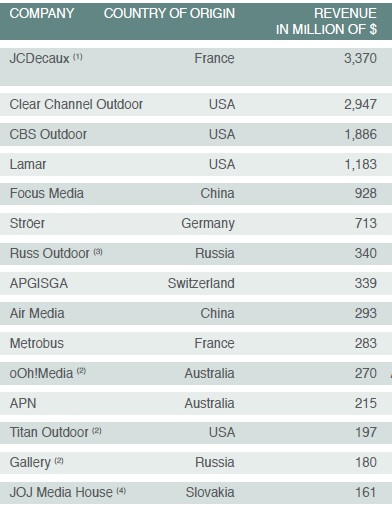
Just who is JCDecaux? It’s a French-based global ‘outdoor’ advertising giant specialising in selling advertising space across three divisions: transport, billboards and street furniture. In 2012 it earned nearly $3.8 billion revenue. It employs over 10,000 people and is the largest outdoor advertising agency in the world. The second biggest is a US company called Clear Channel Outdoor with revenues of $3.16 billion.

In Australia’s JCDecaux’s main local competitors are: oOh!Media, the world’s 11th biggest agency and APN (12th biggest), which has two subsidiaries – Adshel and Buspak.

advertisers

Source: JCDecaus Annual Report (US dollars)

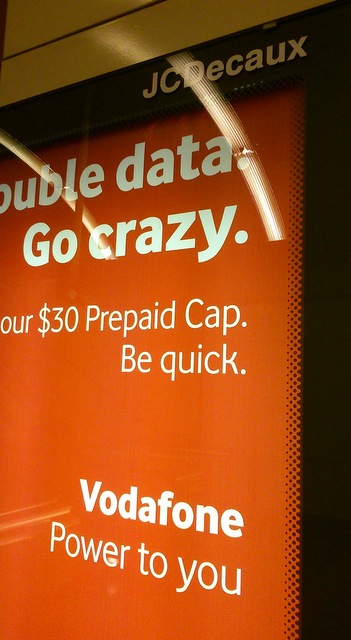
Australians see all of these company names everyday. Guaranteed. You may not notice them – the intention is not to promote them but the ad itself – but they will be somewhere on the billboard or poster. Like this one:

DSC_0491Unlike the dominant forms of advertising – television and radio – outdoor advertising is almost subliminal, somewhat Orwellian.

Your eye registers the ad as you rush past it in the station, at the airport, while you’re waiting for a bus. Perhaps you even stop to ponder it, but more often than not you barely even notice. Next thing, you’re craving a hamburger even though you just ate or a new mobile phone, despite their being the latest model in your pocket. More than likely, you’ve been influenced by a piece of outdoor advertising you barely even noticed, but processed sub-consciously.

The JCDecaux annual report provides some fascinating insights into the ubiquitous-ness of outdoor advertising and its ‘out there, but not really there’ dichotomy.

For example, did you know that street furniture advertising products include all of these: bus shelters, public toilets (blokes, you know the ones when you’re having a slash), self-service bicycle schemes, kiosks for flowers or newspapers, public trash bins, benches, citylight panels, public information panels, streetlights, street signage, bicycle racks and shelters, recycling bins for glass, batteries or paper, electronic message boards and interactive computer terminals.

Transport advertising covers major airports, metros, trains, buses, trams and
other mass transit systems, as well as express train terminals serving international airports around the world.

Nice Airport, France

Nice Airport, France

JCDecaux’s billboard advertising includes the M4 Tower, the UK’s tallest
purpose-built advertising structure at 28.5 meters tall, as high
as a seven-storey building on the main highway to Heathrow Airport from London.

How does JCDecaux  and Clear Channel get access to these public spaces? Generally it negotiates an agreement with city authorities and either pays them a fee or a percentage of the revenue they earn from the ads they sell.

According to JCDecaux’s annual report, the outdoor advertising market is worth around $35 billion annually across the globe, about 9% of the total global advertising market, which is worth around $500 billion.

A relatively small part of the market, but highly influential, highly influencing and somewhat sly and invasive.

Something to think about the next time you get a strange craving or find yourself staring at one of these, while urinating in the airport toilet:

mtv-urinals

Yes darling, even Stephen Fry can be boring

stephen fryIf there’s a game show, a documentary, a movie or television series featuring Stephen Fry I’m likely to watch it. He’s always immensely interesting, devilishly charming and gives off the aura of an incredibly knowledgeable and worldly man.

Which is why his autobiography “The Fry Chronicles” was such a disappointment and dare I say it, thoroughly boring in large parts.

Perhaps all the very best bits were either in his first chronicle “Moab was my washpot” and covering the first 20 years of his life, which I have not yet read (but have read good things about) – or in his yet to come third volume, likely to begin with his addiction to cocaine.

“The Fry Chronicles” ostensibly covers the years from his time at Cambridge to the success of the musical “Me and my girl” on Broadway, for which he revised the story and dialogue (otherwise known as ‘the book’).

I was expecting to learn something of the inner workings of Stephen Fry’s mind (what makes him tick), his battle with manic depression and various addictions, and where he gets his ideas from – all the elements that make up a good biography – but none of them get any fair treatment. His depression is considered not worthy of his readers, while his addictions to sugar, cigarettes and gadgets are only glossed over. The very last few section of the book – just a paragraph – come under the heading “C” – for cocaine. And then it ends.

It’s not just that he leaves out the juicy bits, but that much of the book is plodding and dull, especially as he narrates the steps he took to achieve success: writing and performing sketches for various Cambridge shows and revues, getting hired to write for Granada TV (now called ITV Granada), the BBC, his friendships with Emma Thomson, Ben Elton, Rowan Atkinson and of course, Hugh Laurie. It’s all either too gushing – or worse, apologetic (he’s especially sorry for having money and spending it on frivolous, expensive gadgets).

Now to be fair, there are some brilliant anecdotes, recollections and insights thrown in amongst “I did this….then I did that…then I met him…then the money starting rolling in” narration that goes on page after page.

One of the most intriguing is Fry’s recount of a visit by Alistair Cooke, the famous journalist and broadcaster and founder of the Cambridge Mummers, the university’s first theatre group open to both sexes. Fry invited Cooke as guest of honour to the 50th anniversary celebration of the Mummers.

Cooke (as remembered by Fry) tells of being on a walking tour through Germany in the 1930s with a friend and coming to a “perfect beer garden”. Later, while they enjoy their beverages, a stage is set up, chairs are laid out and soon the garden is full. An ambulance arrives, then a procession of open top Mercedes limousines. A small man gets out to address the crowd. He speaks. Women duly faint. After he finishes speaking, the little man walks down the aisle and his elbow barges against Cooke’s shoulder, who has leant out to see the intriguing man depart.

“Entschuldigen Sie, meine Herr” (Excuse me, sir”) the little man says to Cooke.

Cooke says in his speech:

“For some years afterwards, whenever he came on in the cinema newsreels as his fame spread, I would say to the girl next to me: “Hitler once apologised to me and called me sir.”

There are many other gems scattered throughout the book and some very funny lines my favourite being  when Fry meets the actress Miriam Margoyles (now an Australian citizen) who introduced herself by saying:

“How do you do? I’m Mir…” She stopped and plucked at her tongue with her thumb and forefinger, “Miriam Margoyles. Sorry about that. I was licking my girlfriend out last night and I’ve still got some c-nt hairs in my mouth.”

Unless you’re a prude you’d have to agree that’s hilarious.

Sadly there is not enough of this in the book and too much apologising from Fry: for getting gigs when he thought he did not have the talent, when the money came rolling in and he spent, spent, spent; and for all the good fortune that came his way.

He’s either flattered by offers of work from famous people (Ben Elton, Rowan Atkinson etc) or flattering others and defending their reputations for brilliance, particularly Ben Elton for some reason.

He spends too much time gushing over the obviously incredibly talented Rowan Atkinson and Emma Thompson and not enough revealing his inner workings, his thoughts on the new wave of comedy that swept over Britain from the likes of Rick Mayall, Adrian Edmondsen and Alexei Sayle and too much timed worrying that no one will find his form of “sketch” comedy funny anymore.

Fry highlights all his privilege and wealth, continually apologizes for having it, and then goes on to describe scenes such as when he and Ben Elton visit some swanky private conservative club called “The Carlton” where the joke is on the old crusty Tory members (there’s a bust of Margaret Thatcher there) because they don’t know who they have let in. The thing is Fry appears more Tory than Labour.

Sadly, an utterly boring account of what has been a remarkable life.

Perhaps Stephen Fry should plead: General ignorance and have another go.

Welcome to Australia: please turn your watches back 30 years

ilove80sMy cousin Maureen loves telling the story of how she flew to New Zealand in the 1980s and upon landing in Auckland, the pilot announced over the intercom:

“Welcome to New Zealand, please turn your watches back 30 years.”

It was a great line and always made me laugh.

But now it’s no so funny as I suspect Qantas may be forced to play the same message to new arrivals to our shores given the changes that are afoot since the new Abbott government placed Australia “under new management”.

It’s a man’s world

Our new prime minister surrounded himself with his attractive daughters, his wife and other powerful women in an attempt to appeal to female voters during the election campaign, but now that he’s won office its men in grey suits who are running the country. The feisty Julie Bishop is the only woman in cabinet, the rest are all grumpy old men, intent on returning Australia to the conservative values of the king of grumpy old men, John Howard.

Of course the corridors of female power are not assisted by the like of dowdy old Bronwyn Bishop, the Liberal member for Mackellar and someone with the fashion sense of Margaret Thatcher, who said it wasn’t Mr Abbott’s fault he could choose only one women in his cabinet (and just six out of 42 in his ministry), because he had to choose on merit, meaning no other women were good enough to be placed in senior leadership roles.

Give the environment a good kicking

Another swift act the new government was to kick out former Chief Climate Commissioner, Professor Tim Flannery and disband the Climate Commission, an organisation set up as an “independent and reliable source of information about the science of climate change”. Click on any link on the Climate Commission home page and you get this short message:

The Climate Commission ceased operation in September 2013.

With this single act, the new government broadcast its message loud and clear:

We don’t believe in climate change. We’re not interested in the environment.

What it means is that a lot more of Australia’s natural vegetation and eco-systems will fall by the way side to assist the mining industry. Prime minister Abbott is taking his cues from the ultra-conservative Queensland government, demanding that more farmland be given over to coal seam gas exploration. This at a time when even the rapidly industrialising Chinese economy is looking to reduce its carbon footprint alongside that of the US.

The new age of secrecy

Perhaps, most shocking in an age when government’s are being urged to be more transparent and open, that the new government should seek the pull the wool over its own citizen’s eyes. This was most evident in new “go back to where you came from” immigration minister Scott Morrison’s pledge that “there will be no information about whether [asylum seeker] boats are turned around”

scott morrison

Scott Morrison, a “Pik Botha” of his era

“That goes to operational matters that, whether they affect current or future operational activity, you will not be getting commentary from this podium or that podium either way on those matters,” said Mr Morrison in garbled politco-speak that could have come straight out of the mouth of apartheid-era South African foreign minister Pik Botha.

But let’s not kid ourselves – Mr Morrison is no lovable rogue. Old Pik at least had some dour charisma and was happy to give something back under Nelson Mandela.

Mr Morrison has gone to war with asylum seekers and “lefties” who seek to give them a fair go.

These are but three examples in just a few weeks of government, and no doubt more will come (One more example: The Abbott government is attempting to block the ACT government from legalising gay marriage).

Yes, we have a government that’s united. But in what common cause?

To set us on a course for barren shores?

Are we, in the words of Withnail as a nation: “drifting into the arena of the unwell, making an enemy of our own future”?

Withnail, drifting into the arena of the unwell

Withnail, drifting into the arena of the unwell

“What we need is harmony, fresh air, stuff like that,” Withnail goes on to say.

But I fear the air will become clogged with the foulest of fumes.

Are thinner politicians more electable?

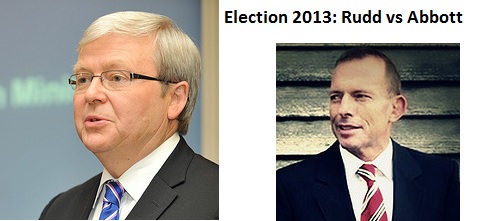
rudd v abbottOf all the guff that has been written about this upcoming election – and there has been a lot – an article from Brisbane’s The Courier Mail caught my attention focusing on the fact that prime minister Kevin Rudd is packing on the pounds apparently under the stress of losing his short-lived grip on power.

The story, written by Hannah Davies, had as its headline: ‘Moon-faced PM ‘comfort eating’ as the stress of the Federal Election campaign takes its toll.

The story quotes a number of nutritionist and dietician who comment on the prime minister’s fuller face and apparent appetite for pizza and beer with the insinuation that he’s becoming less able to govern by virtue of his weight gain.

They even give him free advice such a that he opt for “nuts and a fruit basket”.

Hannah Davies even went so far as to ask the PM’s spokesperson whether he was “comfort eating”. A ridiculous, irrelevant question you’d think given the broader issues being faced – she might as well also have asked if he was spending more time on the couch eating potato chips!

Anyway, it does raise an interesting point about appearances.

Contrast Kevin Rudd’s apparent podginess (It’s easy to find an unflattering photo of someone constantly be photographed, hence my use of the word “apparent”) with the superfit appearance of Tony Abbott and its easy for a conservative Rupert Murdoch-owned paper like the Courier Mail to suggest, subtely that gaining weight is a sign perhaps of bad personal management, bad habits and an inability to lead.

It’s interesting that the two other high-profile politicians to lose a lot of weight are both on the conservative side of politics: shadow treasurer Joe Hockey, whose is a shadow of the huggable bear of a man he once was and NSW premier Barry O’Farrell, whose weight has bounced up and down like a yo-yo over the last 15 years, but is now almost unhealthily gaunt.

O’Farrell explained in an interview to the Daily Telegraph in December last year that he lost the weight by challenging himself after the 2003 election to go to the gym every day for a week, a pledge he has stuck to for nine years.

Joe Hockey admits to having some help via gastric bypass surgery over the Christmas break followed up by with dieting and exercise.

He says its because he wants to be around to see his grandchildren grow up and was also tired of being called “Sloppy Joe” by former Treasurer Wayne Swan.

It’s surely no coincidence though that Joe Hockey has lost his weight in an election year.

Slimmer and fitter apparently makes you a better leader, thinker and decision maker in the eyes of many while adding a few pounds is a sign that you’ve lost your mojo.

This, of course, is baloney.

Yes, losing weight is good for your health and overall sense of wellbeing and people who lose weight are to be commended.

But fat people that suddenly become thin do not suddenly develop more brain cells, a better moral and ethical belief system and a greater sense of what’s right and wrong.

Being fat never bothered Winston Churchill, nor did it stop him defeating a far skinnier Adolf Hitler.

And there’s no indication that billionaire mining magnate Clive Palmer intends to shed any pounds as he seeks a political role.

Yes you may live longer and feel better about yourself, but let’s not confuse this with character, decency and moral strength.

After all Vladimir Putin and George W. Bush – two leaders who both puffed out their chests in front of the camera – are hardly the model of political astuteness.

On with the circus!

Of Federal Elections and fruity flyers…

conspiracy theoryIf anything evenly vaguely interesting happens to me in my life that causes me to write my memoirs, I will be sure to include some ‘rules” for living.

One of these will most likely be:

“If someone hands you a flyer outside a train station or on the street, always take it.”

For the entertainment value anyway.

The corollary to this rule would be:

“Never believe anything you read on a flyer handed out outside a train station or on the street.”

Today, as I headed out of Southern Cross Station and across Spencer Street to work, an innocuous enough chap handed me a one page flyer from the ‘Citizens Electoral Council of Australia’- or ‘CEC’.

The CEC purports to be a political movement, with a post box address in Coburg, not far from where I live and a 1800 number.

The headline of the flyer reads:

“Only Glass-Steagall can head off planned bankers’ coup, genocide!”

This is the first paragraph (you can read the whole document on the CEC website:

“A faction of the British Crown-led City of London-centred ‘Money Power’ has announced its immediate intention to pull the plug on the unpayable global debt bubble by ending “quantitive Easing” and to instead sieze depositors’ bank accounts en mass (‘bail in’ vs ‘bail out’), while ramming through the genocidal austerity measures against the great masses of the population in Europe, the United States and Australia/New Zealand…”

Make any sense to you?

All I can gather is that someone in London is going to do something nasty and seize the money I have in the bank.

Further on I read

The 24 June Bank of International Settlements (BIS) annual report calls for an end to the Bernanke-led quantitive Easing policy and instead demands a regime of Hitlerian levels of vicious austerity….siphoning off the people’s bank accounts to keep selected banks afloat.”

Bankers. Genocide. Hitler. Stealing money. I sense a theme.

Further on in the flyer, there are mentions of a “plot”, a “drive towards outright fascism”, another mention of fascism and a couple more mentions of “Hitler-style austerity”.

The pamphlet mentions another flyer handed out by  the LaRouche Political Action Committee (LPAC) “headed by US statesman and economist Lyndon H. La Rouche Jr, who is fond of talking in terms of “quaddrillions of dollars” (how much is that I wonder?) and mentioning dead German dictators in his call to action.

According to Wikipedia, and not mentioned in the flyer is that LaRouche was “sentenced to 15 years’ imprisonment in 1988 for conspiracy to commit mail fraud and tax code violations, and was released in 1994 on parole”.

The Wikipedia entry  is worth a ready for one of the most colourful descriptions of personality you will ever read and for this photo, that LaRouche allegedly campaigned under, complete with painted on Hitler moustache:

800px-Obama_Hitler_political_sign

Anyway, it appears that the CEC has looked beyond these small misgivings and joined LaRouche’s cult-like following.

It certainly appears to be absorbing the ways of its master.

Here’s an extract from the history and philosophy section of the CEC website:

“A major contributing factor to the present economic collapse, is the anti-human, bestial policies represented by the rock-drug-sex counterculture which took off in the 1960s.”

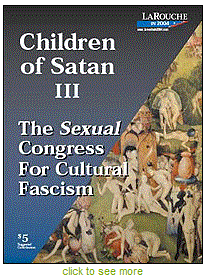
For more information, perhaps by this handy guide on the CEC website for just $5:

children of satanBut back to the bowel-loosening headline in the flyer handed out to me.

headline

What is Glass-Steagall and what does it have to do with Australia?

Well it refers to a 1933 Act of the US Congress, following the onset of the Great Depression, that created the separation of investment and commercial banking activities.

The act was repealed in 1999 and the global financial crisis followed in 2007.

To prevent fascism and genocide, the CEC want it brought back around the world and in Australia to prevent Australia’s four major banks from collapsing due to them “dangerously exposing themselves to the global financial system, including through nearly $20 trillion in derivatives speculation”.

There is clearly some truth buried within this ridiculous statement about reckless mortgage lending and speculation by banks in the US and around the world that caused the banking system to almost collapse.

But to suggest that Australia’s major banks – among the most conservative and profitable in the world – would speculate $20 trillion in derivatives is to believe that Peter Pan truly existed.

Consider that the total size of the Australian economy is around $1.5 trillion (the 12th biggest in the world) and the Big Four banks have a market capitalisation of around $330 billion and you realise that there is no possible way they could ever invest 13 times the size of the Australian economy in high-risk schemes.

Back on planet earth, I prefer the more considered thoughts of Reserve Bank governor Glenn Stevens, who suggested in a speech today that while challenges lie ahead for the Australian economy we are still a “lucky” country with low unemployment and where households remain cautious, continue to save and act prudently.

Still, if you’re in the mood for a bit of silly, old-fashioned conspiracy theories and scare-mongering, pick up a flyer the next time you’re in the CBD.

And watch out for those fascist bankers!

The enigma, the ego, the cult and the noble idealism of Julian Assange

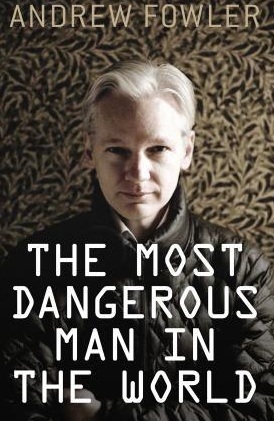
julian assangeI finished reading “The Most Dangerous Man in the World” just as the trial of US soldier Bradley Manning began in Maryland.

The Most Dangerous Man in the World” is a biography of Wikileaks founder Julian Assange written by ABC journalist Andrew Fowler.

It tells the story of how Assange went from being a teenage hacker in Melbourne to one the most influential and controversial figures in the world.

You could certainly not get too more different characters than Manning and Assange and yet both are now inextricably linked together by their idealism and bravery.

Bradley Manning is by all accounts, a shy, introverted, ultimately decent gay man, who somehow found himself thrust into the intelligence operations of the war in Iraq, and who is responsible for the biggest leak of classified military and diplomatic documents in history.

Assange, portrayed in Fowler’s book as an almost Robin Hood like character – stealing the secrets from the richest most powerful nation on earth to give to the world – but also with the touch of Keyser Soyze about him, able to manipulate politicians and journalists, a seducer of women and at times as secretive as the secret organisations he seeks to expose.

While Fowler clearly admires Assange for what he has achieved, he is no sycophant and leaves the reader to make up their own minds about the enigma and cult of Julian Assange.

How you view Assange and Manning depends on whether you believe governments have the right to keep secrets or whether you believe in the idea of a more transparent and open society.

I am one of those people who believe Julian Assange and Bradley Manning are heroes for revealing the many thousands of innocent civilian deaths at the hands of the US government and its allies, most graphically and famously revealed in the “Collateral Murder” leaked Apache helicopter video showing innocent Iraqis, including children, being killed by 30mm gunfire.

Fowler reveals how the actions of WikiLeaks have shifted events on the world stage. For example, tweets of a WikiLeaks story about the corrupt dictatorship of Tunisian leader Zine el Abidine Ben Ali lead to his overthrow and political exile.

“WikiLeaks was a brilliant example of what has been known for some time: the power of information from a legitimate source, disseminated via social networking systems, to threaten the power of a state and its institutions,” Fowler writes.

Similarly the overthrow of Egyptian dictator Hosni Mubarak as part of the Arab Spring after 30 years of an abusive reign (and with the support of the US government), was also spurred on by WikiLeaks documents showing his brutal methods of silencing opposition.

Still, there are those who call Julian Assange and Bradley Manning traitors and guilty of the highest form of treason for revealing highly classified military documents.

Indeed if Manning is found guilty of high treason (aiding the enemy) he faces spending the rest of life in jail while Assange – now under the protection of the Equadorian embassy in London – faces an uncertain future depending on what steps the US government and its intelligence agencies, supported by other countries including Australia, take to prosecute and silence him.

While the US Constitution’s first amendment enshrines free speech and freedom of the press, the US government has argued that 260,000 or so leaked documents WikiLeaks has on its servers, compromises its national security, puts its operatives at personal risk as well as endangers its relationships with other countries. In short they say it is high treason.

Equally, in the eyes of the current Labor Australian government, Assange is a criminal, despite having the support (according to Fowler’s book) of a large portion of the Australian public and which will be tested if Assange is able to run for a seat in the Australian Senate in September.

Assange is now firmly back in the spotlight with the Manning trial underway.

In a post on WikiLeaks, he says Manning is simply on trial for “telling the truth” and that the US has violated its own laws in its treatment of Manning, including that he has been locked up in a “cage” for 23 out of 24 hours, “deprived of his glasses, sleep, blankets and clothes, and prevented from exercising” and held since May 2010 while awaiting trial.

Assange appears to have won favour again with the New York Times, a newspaper that according to Fowler’s book both supported the work of WikiLeaks and Assange, but also despised him for his manner, his ego and his ability to play one media organisation against another to achieve his own aims and outcomes.

Assange has penned for the New York Times a savage review of a book called “The New Digital Age” written by Google executive chairman and former CEO Eric Schmidt and head of Google Ideas, Jared Cohen in which he accuses Google of going from “an expression of independent Californian graduate student culture” to having “thrown its lot in with traditional Washington power elements, from the State Department to the National Security Agency”.

The article reveals Assange to be a gifted writer, highly articulate and persuasive. He would make an excellent analytical journalist.

Assange accuses Google of acting like an imperialist power, enforcing its digital views on life and business on the world, whether they want it or not. Google, according to Assange, has become a political animal with sinister overtones.

Google’s world vision, he says “heralds the death of privacy for most people and shifts the world toward authoritarianism” – the antithesis of the goals of WikiLeaks, which are a more transparent government but with the privacy of its citizens safeguarded.

It is hard to distinguish between WikiLeaks and Julian Assange.

Though there is a team of people behind WikiLeaks from donors to programmers to activists, Assange is its driving force, its voice and spokesperson.

Fowler’s book reveals Assange to be a difficult person to work with; starting out as a charmer and drawing like-minded people to his noble pursuit of truth like German technology activist Daniel Domscheit Berg and Icelandic politician and activist Birgitta Jónsdóttir and then putting them offsides by unpredictable and secretive behaviour, a hidden agenda and making decisions without consulting with them.

WikiLeaks is the Julian Assange show.

Holed up in the Ecuadorian embassy in London , Assange recently gave an interview to Sydney University politics professor John Keane for The Conversation academic website.

Keane’s interview is more sycophantic then Fowler’s book, but we do get a glimpse of a man who while complaining of the boredom of his “cell” clearly revels in his role as spokesperson for “truth” and appears likeable, still idealistic, but also in the end a realist when it comes to his present situation.

“True democracy is the resistance of people armed with truth against lies,” Assange tells Keane.

In an editorial ahead of the Bradley Manning trial on WikiLeaks, Assange asserts that the dice are already loaded against the soldier, describing it as a “show trial” where “24 prosecution witnesses will give secret testimony in closed session”.

“This is not justice; never could this be justice.” Assange writes.

“Bradley Manning is accused of being a whistleblower, a good man, who cared for others and who followed higher orders. Bradley Manning is effectively accused of conspiracy to commit journalism.”

In the end its does not matter whether you like Julian Assange or not – Fowler’s book lets readers make up their own mind.

What is important are his ideals, which are decidedly noble and good.

“In the end it is not Bradley Manning who is on trial. His trial ended long ago. The defendant now, and for the next 12 weeks, is the United States. A runaway military, whose misdeeds have been laid bare, and a secretive government at war with the public. They sit in the docks. We are called to serve as jurists. We must not turn away,” writes Assange with masterful elegance.

The Guardian Australia: you won’t find it @ www.theguardian.com.au

For the four-and-a-half years I lived in London, The Guardian was the newspaper to read for quality investigative journalism as well as for its famous spelling mistake howlers.

the guardian

Writing for Accountancy Age magazine in Soho, I’d read the business sections of The Guardian, alongside the other broadsheets (the Financial Times, The Independent and Daily Telegraph) for possible story ideas in the morning and then, like everyone else, would seek out The Sun and The Mirror in the afternoon for the salacious gossip, page 3 girls and Premier League football stories.

Lately there has been extensive coverage of the launch of a digital Australian edition of The Guardian (announced in January) with news of top Fairfax journalists like David Marr and Lenore Taylor jumping on board with the site to be edited by The Guardian’s deputy editor Katharine Viner.

A colleague of mine at Private Media, Oliver Milman, will be joining the Guardian Australia as a Melbourne-based environment reporter alongside other new signings of journalistic talent announced this week.

They’ve already leased offices for journalists and other staff in Surry Hills, Sydney, so it’s clearly a serious venture for a publication, which is the fourth biggest newspaper website in the world with a monthly audience of 30.8 million users behind Mail Online (45.3m monthly readers), the NY Times‘s (44.8m) and USA Today (34.6m) according to National Readership Surveys September 2012 figures.

So, eager to find out more, I searched for ‘The Guardian Australia‘ on Google.

The first result was this page (below), with picture of a koala bear and a billabong and a host of stories, videos and commentary about Australian issues:

guardian australia

This, I know, is not the new Guardian Australia edition, but the long-running Australia page of The Guardian UK with the giveaway being The Guardian store offers in pounds while the Guardian jobs section are all British roles:

guardian jobs

So I clicked on the third link  on my Google search –  www.theguardian.com.au which sounded like the most likely address for the new digital Guardian Australia edition.

google search

And bingo, I came across a  newspaper website full of Australian stories with a masthead in similar font to that used by The Guardian.

guardian fairfax

So was this The Guardian Australia edition?

Clearly not, since it says its owned by Fairfax.

When I clicked on the “About Us” page, the confusion abated. It reads: “The Guardian provides the latest news from the Swan Hill region, northern Victoria and NSW Riverina.”

This is another Guardian Australia – a regional newspaper dating back to 1888.

Perhaps its only coincidence the fonts are so similar, but it surely must have caught the attention of those in corridors of power at Fairfax, and not just because they’ve got the URL, but also the Facebook address: www.facebook.com/GuardianAU.

As luck would have it, Twitter suggested I follow Lenore Taylor, the recently appointed political editor of The Guardian Australia edition and so I did and duly asked her what form the new publication would take:

lenore tayler

“Frontage” – is a new term I’d never heard before, but I assumed it meant something on The Guardian‘s front page, so that’s where I went.

After a little bit of a look around, I came across this button at the top of the website, which allows you to choose between the UK and Guardian US version:

us version

So presumably, at some point when it all goes live, there will be an extra item added to this menu bar with the word “Australia” and when you click on it there will be an Australian version, similar in format to the current American edition:

guardian US

Website address issues aside, it’s going to be interesting to see how The Guardian performs in Australia.

As someone pointed out  to me, it’s going to go from being a UK publication writing about Australia for British readers to one written by Australians for Australian readers, with a UK editor.

This it has done somewhat successfully with its US edition, which now has around 8 million viewers a month.

But it’s been a bumpy ride for The Guardian US, which first launched in 2007 as  GuardianAmerica.com, then folded back into the UK edition in 2009, with staff laid off, before launching its US edition (or ‘frontage’ to use Lenore Taylor’s term) in September last year, also accessible via the URL: http://www.guardiannews.com.

While no doubt the journalism produced  by The Guardian Australia will be of the highest calibre, it will face challenges from a host of established left-wing publications like Crikey.com.au, The Global Mail (founded no less than by BRW Rich Lister Graeme Wood, the primary investor in The Guardian Australia), the ABC’s online presence and Fairfax’s own stable of publications, to name just a few.

Which means making money from The Guardian Australia will be an even bigger challenge.

The Guardian Media group has been the exact opposite of a cash cow of late  reporting huge losses in recent years (£75 million loss in the  12 months to August 2012) as it tries to transition its business model to one that taps into its huge online audience, a difficult task that neither Fairfax nor News Limited nor any media organisation have yet fully realised.

And it has another challenge.

As Crikey writer Guy Rundle pointed out, The Guardian has a reputation for being the worst of the UK newspapers when it comes to writing stores with an anti-Australia slant.

It’s reporting on the Ashes and British Lions tours later this year will be fascinating to say the least – if you can find the website!