Kafka-esque, but not his best: Reading Kazuo Ishiguro’s ‘When We Were Orphans’

It was both refreshing and a relief to read that even a great writer like Kazuo Ishiguro, winner of both the Booker Prize and the Nobel Prize, did not think that highly of his strange detective novel “When We Were Orphans”.

“It’s not my best book,” Ishiguro said after it was shortlisted for the 2000 Booker Prize.

Having demolished Ishiguro’s The Remains of the Day in a single reading many years ago (as near perfect a novel as you will ever come to read, accompanied by a fine motion picture adaptation) it is not hard to see why he made this observation.

It’s a very odd, disjointed and at times completely baffling book, with periods of rather logical storytelling following by very strange Kafkaesque episodes where things seemingly simple and straightforward – like travelling a short distance from one place to another – take on these long, slow, nightmarish journeys that never seem to end.

Not that there are not a lot of very interesting and enjoyable aspects to When We Were Orphans, plus there is that wonderfully precise and elegant prose of Ishiguro to keep you reading during the bemusing bits.

To summarise the plot, the book tells the story of Christopher Banks, who after being orphaned in Shanghai as a young boy in the early 1930s (when both his mother and father disappear from the city’s International Settlement in sinister circumstances), returns to England where he is educated and becomes a famous crime-solving detective.

Determined not be to be “diverted by the more superficial priorities of London life” Banks nonetheless falls for the charms of enigmatic socialite Sarah Hemmings – an orphan like himself – whilst becoming something of a minor celebrity for his ability to unravel cases.

The book weaves between Banks’ case solving pursuits in the English countryside, his intermingling in the upper echelons of London society, and with memories and flashbacks of his adventurous Shanghai childhood in the sheltered International Settlement. Here he remembers the times spent playing with his Japanese friend and neighbour Akira, with whom he forms a deep almost brotherly bond.

Banks also returns to recollections of the grand colonial mansion he lived in as a young boy and the events that led to first his father’s sudden disappearance and then soon after that of his feisty mother – a beauty in an “older, Victorian tradition, “handsome” rather than pretty.

Christopher’s father worked for a European shipping company called Butterfield and Swire, which was (according to the author) secretly involved in the flourishing Opium trade. Butterfield and Swire was a real company that transformed into a global multinational. Swire unsuccessfully sued Ishiguro in an attempt to get him to change the book, which implied the company turned millions into addicts and made vast profits in the process.

Before Banks’s father disappeared on his way to work, his mother had become vocal and outspoken about the activities of the company he worked for.

“Are you not ashamed to be in service of such a company?” he remember hearing his mother yell at his father. “How can your conscience rest while you owe your existence to such ungodly wealth?”

Twenty years later, and after having adopted an orphaned child Jennifer as his own daughter, Banks decides to return to Shanghai in 1937 at the outbreak of the Second Sino-Japanese War (and as a great war looms across Europe)Β to solve the most important mystery of his life: his parents disappearance. He believes grandiosely that solving this crime will have far-reaching repercussions including averting the coming world war catastrophe.

In Shanghai, mingling among the snobbish expat community, at dinner parties, the war appears to be just over the horizon and drawing nearer. Ishiguro builds up an oppressive atmosphere as machine gun fire and explosions are heard not far away.

“Another thunderous explosion had rocked the room, provoking a few ironic cheers. I then noticed a little way in front of me, some French windows had opened and people had pushed out to the balcony.

“Don’t worry Mr Banks,” a young man said, grasping my elbow. “There’s no chance of any of that coming over here.”

A tram runs through Shanghai’s International Settlement.

Against the backdrop of the looming onset of war, Banks somehow believes that his parents are still locked up in a house in Shanghai by an opium warlord, despite 20 years having passed since their disappearance. He eventually locates the house he believes they are being held captive in and then the book descends into this Kafka-esque nightmare, where the house Banks believes his parents are in can be sighted through the bombed out ruins, but reaching it appears a never-ending hellish journey.

“Then I came upon a hole in a wall through which I could see only pitch blackness, but from which came the most overwhelming stink of excrement. I knew that to keep on course I should climb through into that room, but I could not bear the idea and kept walking. This fastidiousness cost me dear, for I did not another opening for some time, and thereafter, I had the impression of drifting further and further off my route.”

In his review of the novel, the Pulitizer Prize winning literary critic Michiko Kakutani wrote that ‘When We Were Orphans “has moments of enormous power, [but] it lacks the virtuosic control of language and tone that made ”Remains of the Day” such a tour de force.

“Indeed the reader is left with the impression that instead of envisioning – and rendering – a coherent new novel, Mr. Ishiguro simply ran the notion of a detective story through the word processing program of his earlier novels, then patched together the output into the ragged, if occasionally brilliant, story we hold in our hands.”

Certainly, I learnt a bit about life in Shanghai before the war, and the strange existence of the “International Settlement”. Also, I knew little about the Sino-Japanese War, which ran for eight years between 1937 and 1945 and was one of the most bloodiest in history.

But the novel itself, was a strange mishmash of a personal story set within historical events given an almost surrealist makeover that never really jelled for me (unlike the Remains of the Day, which so elegantly meshes the blind devotion of a loyal butler to an aristocratic employer wishing to promote Nazi appeasement.).

“When Banks goes back to Shanghai, we’re really not quite sure if it’s the real Shanghai or some mixture of memory and speculation,” said Ishiguro in an interview about the book.

It certainly baffled me.

Booze, sex and philosophy from the gutter: Reading Charles Bukowski’s ‘Women’

“I never pump up my vulgarity. I wait for it to arrive on its own terms,” says Henry ‘Hank’ Chinaski the fictional alter-ego of legendary boozehound writer and Β “laureateΒ of American lowlife” (as Time magazine dubbed him) Charles Bukowski in his 1978 novel “Women”.

I’ve read many of Bukowski’s brilliantly irreverent novels – written in a parsed down, forthright and highly entertaining style – and Women is by far the most graphic, indeed almost pornographic in its depiction of Chinaski’s innumerable sexual encounters.

(“I got down there and began licking…the cl*t came out but it wasn’t exactly pink, it was a purplish pink,” is how he describes one of these episodes.)

The semi-autobiographical novel (one can only assume some of his sexual exploits are exaggerated, though perhaps not the prodigious drinking) begins with Chinaski, 50, telling the reader that he has not had sex for four years.

“I had no women friends. I looked at them as I passed them on the street or wherever I saw them, but I looked without yearning, with a sense of futility.”

This drought is then broken by a period of romping that would have made Don Juan proud. It begins with half-crazed divorced mother of two Lydia Vance (the fictional version of Bukowski’s real-life girlfriend, the sculptor and playwright Linda King), whom Chinaski meets at a poetry reading:

She put both hands on the edge of the table, bent over and looked at me. She had long brown hair, quite long, a prominent nose and one eye didn’t quite match the other. But she projected vitality – you knew that she was there. I could feel vibrations running between us.

Woman, Charles Bukowski

Their relationship is full of wild sex, described in intimate detail by Chinaski – “I heard her breathing heavily, then she moaned” – and violent breakups due to his excessive drinking, visits to the racetrack, and infidelities, none of which he apologises for. Chinaski is who he is and the world can go to hell if they don’t like it.

“I walked into the bedroom with just my shorts on. I was conscious of my white belly lolling out over the shorts. But I made no effort to suck in my gut…”

At face value, Women is simply a recollection of Chinaski’s (or Bukowski’s) various relationships with women. These include Lydia, but also brief encounters with star struck fans who are seemingly served up on a platter to the horniest 50-year-old in LA.

It’s also a daily tally of his prodigious alcohol consumption of mostly cheap wine and beer. In between all the boozing and bonking – “Fucking was the best cure for hangovers. It got all the parts ticking again” – we accompany Chinaski on his often hilarious trips to college campuses around the country where he gives readings.

But as with all his writing, Bukowski manages to convey something more profound and meaningful than the sum of his adventures across bedrooms, bars and college campuses.

It is to champion the other side of Los Angeles in the words of his biographer Barry Miles: “Not the LA of ranch homes in the Hollywood Hills with the breathtaking views…” but the LA of tarnished dreams, of dead end jobs, of hookers and workers in the sex industry, of beaten down, damaged and dysfunctional people”.

Miles adds: “Bukowski loved the corner bars, the tawdry fast-food outlets, the sex shops and brothels, the graffiti on the walls…”

Sure Chinaski is the hero of the story, but he is no superman in a cape. He is very much the Bukoswki you see in those grainy black and white poetry readings on YouTube. a disheveled anti-hero with a pockmarked face who says what he thinks, never holds back and for whom nothing is ever taboo.

Chinaski in Women is very much a mirror – if perhaps a distorted and exaggerated one – of Bukowski at the height of his powers and fame: when after decades of struggle, eking out a living and working dead end jobs, he had finally established himself as a figurehead in American literature: the dirty old man of American letters.

Chinaski is not searching for some deeper meaning to life, or for the woman of his dreams. Life is simply about the experiences that happen to him – whether its winning big at the track or walking away broke, having a raging hardon or being unable to perform in the sack because he drank too much, talking to prostitutes or college professors – everything finds its way, uncensored into the book.

And while Chinaski is vulgar, and driven by his baser urges, he can also be sweet and loving. He is not a manipulator, nor does he pretend to be anyone else. And he despises pretentious, fake people.

Most importantly – and perhaps a key reason why I enjoy his books so much – is the poetic nature of his writing: short, descriptive sentences that hit their mark without ever saying too little or too much (a style that would have impressed George Orwell).

If you are a fan of Bukowski other books, or a writer like Raymond Carver who though not as vulgar, employed a similar parsed down style of storytelling, you should definitely give Women a read. (Just don’t leave the book anywhere near young children!)

The Sense of Ending: in praise of the concise novel

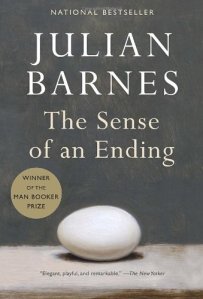
51hhJ8IdqyLDisappearing into Julian Barnes’s 2011 Booker prize-winning novel, The Sense of an Ending was so pleasurable an experience that I read his short 163 page novella twice.

This is rare for me. I don’t read many books more than once. They have to really intrigue and beguile me to encourage a second reading.

So I can add The Sense of An Ending to a narrow list of twice or even thrice-read books that includes JD Salinger’s Catcher in the Rye, the George Orwell novels Coming up for Air, 1984 and Keep the Aspidistra Flying and E.M. Forster’s A Passage to India.

In each book, I found a central character whose view of the world I identified with, or with whom I made a connection in some meaningful way, or whose life I wanted to step into, even for just a little while: a chance to be angst-ridden teenage rebel and narrator of Catcher in the Rye, Holden Caulfield wondering the streets of Manhattan, having conversations with nuns and prostitutes, or rotund London insurance salesman George Bowling in Coming up for Air who escapes to the country town of his youth, before the bombs of WW2 fall, or idealistic, starving and self-destructive poet, Gordon Comstock in Keep the Aspidistra Flying.

In The Sense of an Ending I instantly liked and identified with Tony Webster, the 60-year-old divorced former arts administrator who has succeeded in living a life of little bother or regret, who does not fantasise “a markedly different life from the one that has been mine”.

Webster has accepted a modestly successful and peacable existence in a small London flat with his affairs neatly in order. He’s even on good terms with his ex-wife Margaret.

I’ve made my will; and my dealings with daughter, son-in-law, grandchildren and ex-wife, are, if less than perfect, at least settled. Or as I have persuaded myself. I’ve achieved a state of peaceableness or peacefulness. Because I get on with things. I don’t like mess and I don’t like leaving a mess.

But then he is forced to re-evaluate things – love, friendship, memory, the decisions he made and their consequences – when he receives an unexpected bequest from a woman he’d met only once, 40 years earlier.

She is Sarah Ford, the recently deceased mother of his college girlfriend, Veronica, who has bequeathed him Β£500 as well as the diary of his erudite, brilliant school friend, Adrian Finn, who committed suicide while at college and whose passing was described in the Cambridge Evening News under the headline: “Tragic Death of Promising Young Man”.

Adrian dated Veronica soon after Tony’s relationship with her ended. Having parted ways angrily via a dreadful, hurtful letter Tony, went travelling and in the days before email and mobile phones, only found out about his friends death many weeks later, when he returned home.

Tony’s mother wonders if Adrian killed himself “because he was too clever”. Tony comes to the conclusion that Adrian, who had great powers of reason and an amazing intellect, had come to the logical conclusion that he should end his life.

But then comes the promise of the diary, a way into his deceased friend’s mind and for Tony, who doesn’t like loose ends, the prospect of a definitive answer: a way to make sense of Adrian’s ending.

The only problem is his still very angry ex-girlfriend Veronica: she has the diary and won’t give it to him.

Instead she feeds him an extract with a complex maths equation that Tony must unravel.

In doing so he confronts his own decision to accept the path of an uneventful, non-confrontational life with no loose ends or complications, he begins to unravel the mystery of himself.

If this doesn’t quite explain why I like Tony so much (people who know me might say he and I have a lot in common)  then I think this observation in a review of the book in the New York Times explains it rather well:

Barnes’s unreliable narrator is a mystery to himself, which makes the novel one unbroken, sizzling, satisfying fuse. Its puzzle of past causes is decoded by a man who is himself a puzzle.