‘Treasure’ vs ‘Too Many Men’: how a mediocre movie butchered Lily Brett’s great novel

It’s incredible just how much of Lily Brett‘s wonderful novel Too Many Men director and co-screenwriter Julia von Heinz changed in her movie adaption. This included changing the title to Treasure, removing a key character and adding unnecessary elements to the story and its main protagonists.

To summarise briefly, the book and movie tell the story of fortysomething Jewess Ruth Rothwax who accompanies her elderly, but sprightly father Edek on a trip around Poland, where he grew up, to learn about his childhood and that of her late mother Rooshka before the war and the terrible events that followed, including being forced into the Lodz ghetto and then sent to Auschwitz.

The pair love each other but spend a large part of their time together in Poland annoyed at their travelling companion’s strange habits and obsessions. Edek complains that Ruth eats “like a bird” and needs to find a husband, while she worries about his unhealthy eating choices and propensity to run everywhere. While Edek has an overarching cheerfulness about his personality, despite everything he has endured, Ruther is frequently anxious and easily upset.
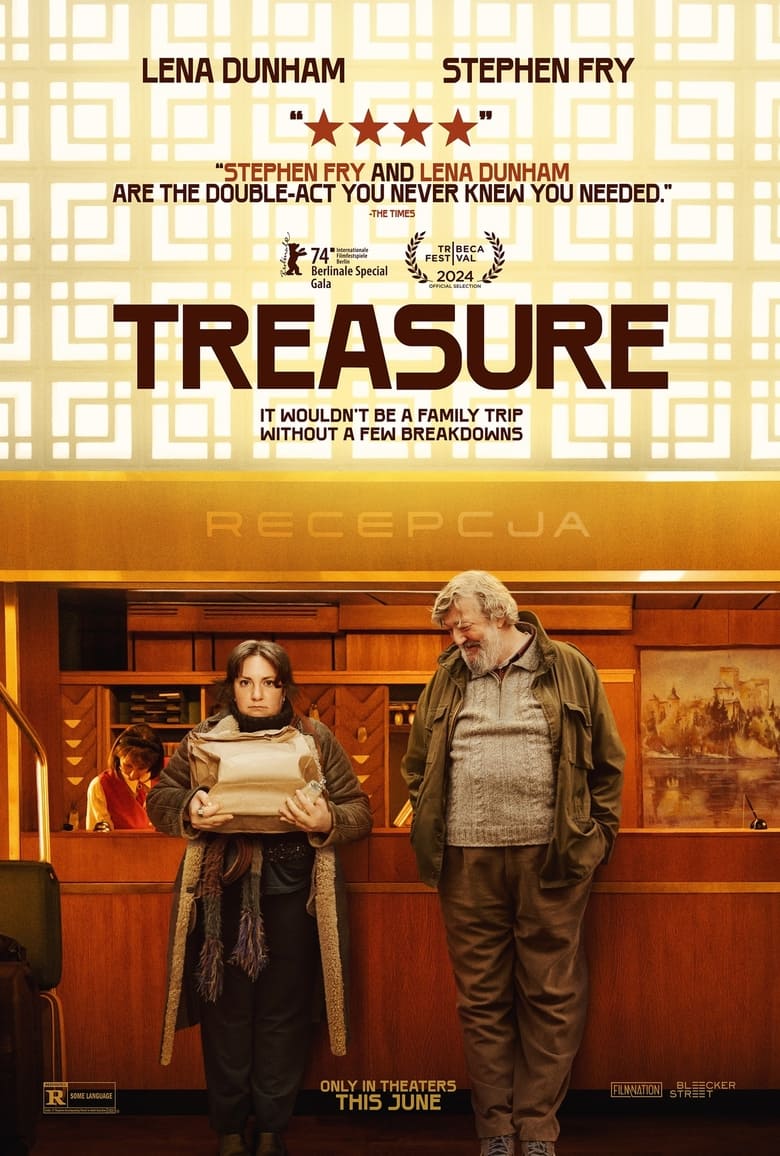
I watched the movie after reading the book and really wished I hadn’t.

Perversely, people who haven’t read the book will probably enjoy the movie more than those that have read it given there is less to be disappointed about.

Strangely, the author, Lily Brett, who based a large part of the novel on her own life, is a fan of the movie, unless she was just being nice or doing her bit to promote it.

โ€œI do feel happy with it. I think itโ€™s a beautiful movie,” she told The Australian Jewish News in July 2024

While the basics of the plot have been retained – in both the movie and the book, Ruth and Edek travel around Poland visiting old landmarks and dealing with each other’s eccentricities – so many elements that seem important to me and you would think to Brett (given so much of the novel is autobiographical) have been unnecessarily changed.

The literary Ruth (like the author Brett) is an Australian expat living in New York while her father Edek lives alone in Melbourne. In the book, he travels halfway around the world to meet his daughter to accompany her on her Poland trip.

In the movie, both Ruth and Edek are Americans living in New York. Their Australianness is completely removed despite it being the place where Lily Brett’s parents moved to after the war and where they made a new life.

In the novel, Ruth is a successful businesswoman who runs a professional writing service in Manhattan. This comes up frequently in the novel as she contemplates how she should compose various letters, whilst taking calls from her assistant Max at all hours of the night. In the movie, Ruth is simply a journalist eking out a living. In the book, Ruth has endless amounts of money, in the movie she is not quite so wealthy.

In the novel, food is such an important element: Edek stacks his plate high at breakfast buffets, he eat Perogi and Polish pastries and they dine out an awful “Jewish-themed” restaurant in Krakow. In the movie virtually none of this is retained. Instead, Ruth travels around Poland with a suitcase full of muesli-like ingredients which she brings to every meal. In the book, she merely chooses the healthiest options from the buffet.

Heinz also embellishes Ruth’s character with unnecessary eccentricities: she has a penchant for privately guzzling chocolate, is a secret smoker and has an odd need to self-mutilate. None of these behaviours are in the book.

I realise novels have to be condensed into a relatively short period time, but why change important details like this? It removes a lot of authenticity from the film, which is not assisted by the leaden and plodding acting of Lena Dunham who is sadly badly miscast in the film. Stephen Fry is surprisingly good as Edek.

Another major disappointment was the omissions of a character that appears to Ruth whilst she is in Poland. It’s a brilliant piece of magical realism – Ruth hears the voice of a famous old Nazi stuck in purgatory. She then begins conversing with him (in her head) whilst walking the streets of Warsaw and Lodz. She naturally despises him, whilst he tries to justify his actions as merely following orders. Why this aspect of the novel was left out of the film leaves me gobsmacked.

There are some elements of the book the movie does well mostly visual: the grainy, grey and depressing depiction of Poland in the early 1990s is just as I imagined it in the book as are the gaudy interiors of hotels, apartments and airports.

But pivotal moments in the novel (which depict Brett’s own travels with her father) such as the visit to Auschwitz, which should have been given great prominence in the movie are reduced to a few short scenes with very little emotional power. And there is virtually no explanation given to the great climax of the novel: the dig in the backyard of Edek’s childhood apartment block to find a buried memento.

I was incredibly moved by Brett’s wonderful autobiographical novel, but deeply disappointed by the film adaption. Perhaps it should never have been made.
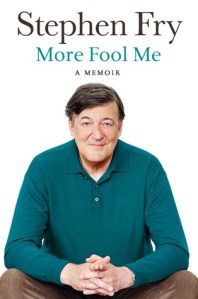
More fool me: Stephen Fry’s “coke years”

22662908One of the most interesting and surprising things you will learn about Stephen Fry, if you read his third autobiography “More Fool Me” is the extent of his cocaine addiction.

Or perhaps you’d wonder how he managed to snort so much marching powder up his snoz, given how crooked it is.

As you read through the book, which traces some of his most successful and creative years in the late 1980s and early 1990s –ย working with Hugh Laurie on Jeeves & Wooster, starring in Blackadder,ย  hosting royal variety shows and writing the novel The Hippopotamus and countless essays, reviews and speeches – you realise that cocaine is Fry’s special friend.

On page 69 of my soft-back edition, Fry lists all the places he has snorted cocaine during his 15 years of addiction. They include Buckingham Palace, Windsor Castle, The House of Lords,ย  The House of Commons, Fortnum & Masons and of course, the BBC Television Centre in London.

Fry is forever heading off to the exclusive, members-onlyย Groucho Club in Soho in London’s West End (often on foot as he lived nearby) to meet up with his dealer “Jethro” for a cocaine top-up. He is incredibly candid about some of the stupid and embarrassing stuff he has doneย whilst consuming or afterย partaking ofย the drug.

In one episode, he gets involved in a competition to snort a massive line of coke on a table in a restaurant. He gets to the end and promptly vomits furiously. In other episode, having drunk too much and snorted too much he lurches out the window of the Groucho Club and spews down onto the pavement outside.

It’s not the kind of thing you’d expect from Fry, one of England’s great literary and artistic treasures – more the behaviour of a bad boy rock ‘n roll star. But as you read you realise that Fry is quite the contradiction – a mix of erudite, literary brilliance mixed with too much alcohol, aforementioned cocaine and a fondness for wearing leather and riding motorbikes.

In one amusing episode set in the Groucho Club, Fry bumps into an angry, swearingย Manchurian who turns up to be Oasis’sย Liam Gallagher,ย  in anotherย he befriends Damon Albarnย from Blur at the Club bar, whom he finds most charming.ย  He seems to know, bump into or meet every single interesting person living in England at the time.

Fryย writes about his cocaine use,ย  with both embarrassment –ย part of a habit of his ofย forever apologising for being rich and successful – and with an undercurrent (I am sorry to say) of boastfulness.

And while he professes that the details of his cocaine habit should not be seen as an encouragement to others, when you throw in all the celebrity parties, dinners, film premiers in Leicester Square, hobnobbing with the rich and famous amidย all the endless line snorting (and prodigious sums of money spend on it) its hard to seeย his habit asย anything other than part and parcel of being rich, famous and successful. Which no doubt it was back then, and still, I assume is for many in the “it” crowd.

The fascinating thing about this memoir, as with The Fry Chroniclesย (a lesser work which I reviewed on this blog covering his university years) is the warts-and-all account of a period of his life that despite his wild behaviour, was incredibly creative, productive and successful. Might he have achieved more if sober more often?

More Fool Me book has a strange, uneveness to it – the first part being rambling memoir that spends too much time recapping what happened in the previous book, while the second half is merely a republishing of his diary during a hectic few months when he was finishing his novel, The Hippopotamus – itย really gives the reader an over-the-shoulder view of what it was like to be Stephen Fry as he soared towards becoming an English icon.

Indeed his status as a trueย English national treasure isย sealed by a scene in the book where Prince Charles and the late Princess Diana casually pop in for tea at Fry’s country home one autumn evening.

In his customary self-effacing manner, Fry does not believe the visit will actually happen, until the royal carriage is on its way.

Then its a mad scramble to prepare tea, cakes, toast and crumpets, followed by a cozy afternoon chat with the royals which only ends when Lady Di explain that she has to get home to watchย the latest episode of her favourite soap opera.

Its in scenes like this and throughout the book that Fry comes across as warm, funny, sincere and ย kind – a cuddly bear of a man also capable of ingesting large amounts of coke and alcohol whilst still being able to write a word-perfect article for a major newspaper the following day.

Most impressively, he can look at himself in the mirror and be honest about what he sees.

But among all the excitement of the West Endย life he led then, there is also a profound sense of loneliness as he returns, home, alone – often drunk.

In that respect, it is reassuring to know that he has found a life partner – his husband Elliott – especially with the latest news that he is battling prostate cancer.

Thankfully too – as he reminds readers often in the book – heย no longer has a cocaine habit.


Yes darling, even Stephen Fry can be boring

stephen fryIf there’s a game show, a documentary, a movie or television series featuring Stephen Fry I’m likely to watch it. He’s always immensely interesting, devilishly charming and gives off the aura of an incredibly knowledgeable and worldly man.

Which is why his autobiography “The Fry Chronicles” was such a disappointment and dare I say it, thoroughly boring in large parts.

Perhaps all the very best bits were either in his first chronicle “Moab was my washpot” and covering the first 20 years of his life, which I have not yet read (but have read good things about) – or in his yet to come third volume, likely to begin with his addiction to cocaine.

“The Fry Chronicles” ostensibly covers the years from his time at Cambridge to the success of the musical “Me and my girl” on Broadway, for which he revised the story and dialogue (otherwise known as ‘the book’).

I was expecting to learn something of the inner workings of Stephen Fry’s mind (what makes him tick), his battle with manic depression and various addictions, and where he gets his ideas from – all the elements that make up a good biography – but none of them get any fair treatment. His depression is considered not worthy of his readers, while his addictions to sugar, cigarettes and gadgets are only glossed over. The very last few section of the book – just a paragraph – come under the heading “C” – for cocaine. And then it ends.

It’s not just that he leaves out the juicy bits, but that much of the book is plodding and dull, especially as he narrates the steps he took to achieve success: writing and performing sketches for various Cambridge shows and revues, getting hired to write for Granada TV (now called ITV Granada), the BBC, his friendships with Emma Thomson, Ben Elton, Rowan Atkinson and of course, Hugh Laurie. It’s all either too gushing – or worse, apologetic (he’s especially sorry for having money and spending it on frivolous, expensive gadgets).

Now to be fair, there are some brilliant anecdotes, recollections and insights thrown in amongst “I did this….then I did that…then I met him…then the money starting rolling in” narration that goes on page after page.

One of the most intriguing is Fry’s recount of a visit by Alistair Cooke, the famous journalist and broadcaster and founder of the Cambridge Mummers, the university’s first theatre group open to both sexes. Fry invited Cooke as guest of honour to the 50th anniversary celebration of the Mummers.

Cooke (as remembered by Fry) tells of being on a walking tour through Germany in the 1930s with a friend and coming to a “perfect beer garden”. Later, while they enjoy their beverages, a stage is set up, chairs are laid out and soon the garden is full. An ambulance arrives, then a procession of open top Mercedes limousines. A small man gets out to address the crowd. He speaks. Women duly faint. After he finishes speaking, the little man walks down the aisle and his elbow barges against Cooke’s shoulder, who has leant out to see the intriguing man depart.

“Entschuldigen Sie, meine Herr” (Excuse me, sir”)ย the little man says to Cooke.

Cooke says in his speech:

“For some years afterwards, whenever he came on in the cinema newsreels as his fame spread, I would say to the girl next to me: “Hitler once apologised to me and called me sir.”

There are many other gems scattered throughout the book and some very funny lines my favourite beingย  when Fry meets the actress Miriam Margoyles (now an Australian citizen) who introduced herself by saying:

“How do you do? I’m Mir…” She stopped and plucked at her tongue with her thumb and forefinger, “Miriam Margoyles. Sorry about that. I was licking my girlfriend out last night and I’ve still got some c-nt hairs in my mouth.”

Unless you’re a prude you’d have to agree that’s hilarious.

Sadly there is not enough of this in the book and too much apologising from Fry: for getting gigs when he thought he did not have the talent, when the money came rolling in and he spent, spent, spent; and for all the good fortune that came his way.

He’s either flattered by offers of work from famous people (Ben Elton, Rowan Atkinson etc) or flattering others and defending their reputations for brilliance, particularly Ben Elton for some reason.

He spends too much time gushing over the obviously incredibly talented Rowan Atkinson and Emma Thompson and not enough revealing his inner workings, his thoughts on the new wave of comedy that swept over Britain from the likes of Rick Mayall, Adrian Edmondsen and Alexei Sayle and too much timed worrying that no one will find his form of “sketch” comedy funny anymore.

Fry highlights all his privilege and wealth, continually apologizes for having it, and then goes on to describe scenes such as when he and Ben Elton visit some swanky private conservative club called “The Carlton” where the joke is on the old crusty Tory members (there’s a bust of Margaret Thatcher there) because they don’t know who they have let in. The thing is Fry appears more Tory than Labour.

Sadly, an utterly boring account of what has been a remarkable life.

Perhaps Stephen Fry should plead: General ignorance and have another go.