Fighting the apartheid machine: reading Andre Brink’s classic ‘A Dry White Season’

Like the hero of his novel in ‘A Dry White Season’, Ben Du Toit, the late South African novelist Andre Brink was considered a “veraaier” (traitor) by his own Afrikaaner people by taking the side of those fighting against the National Party’s evil apartheid regime.

The novel, which jolted me back in time with a dose of dark nostalgia, tells the story of Du Toit, a middle-class suburban school teacher who finds himself pitted against the apartheid machine, and its “special branch” or “security branch police, when he begins investigating the deaths of Gordon NcGubene, a gardener at the school where he teaches, and Gordon’s young activist son Jonathan.

Prior to his fateful decision to pay a visit to John Vorster Square, the notorious Johannesburg police headquarters, to politely inquire about what happened to Gordon on the initial naïve belief that it was all a “mistake”, Du Toit was comfortably ensconced in his suburban home and the routines of white Afrikaaner family life.

His desire to “help” Black South Africans is well-meaning, but cast within the “master-servant” apartheid dynamic – the Du Toits have been paying Jonathan’s school fees provided he stays out of trouble and does well academically. This rids them of their guilt at being part of the oppressive system, without ever really taking a stand or getting involved in the struggle for equality.

This is a position I knew well from my own experiences growing up in South Africa in the 1980s, where I was surrounded by quasi-liberal adults doing “well meaning” gestures for the Blacks that cleaned their houses or bathed their children, but who were happy not to rock the boat and enjoy luxuries that came with being white and privileged.

Ben’s apolitical but good-hearted position starts to shift when first Jonathan dies in police custody in the cells of John Vorster Square, and then later his father Gordon, when Gordon persists in trying to find out what happened to his son and where he was buried, marking him as a troublemaker in the eyes of Special Branch.

Ben’s change into becoming a veraaier is fueled by an inquest which shows the judges to be in cahoots with the police after they find Gordon to have committed suicide. Soon after the trial he meets young, liberal journalist Melanie Brewer, who through stories of her own terrible experiences, encourages him into the light.

“And now it was inside of him, it was happening, the sudden loosening like a flock of pigeons freed from a cage…he allowed it to flow from him spontaneously, all the years he’d cooped up inside of him. His childhood on the Free State farm, and the terrible drought, after which they had lost everything…He told her about Gordon, about Jonathan…and his visit to John Vorster Square.”

While Melanie becomes his confidant and ally, Ben’s growing activism does not resonate with his more conservative wife Susan, who as the novel progresses grows more and more agitated and fearful as her husband becomes obsessed with proving Gordon was murdered by Special Branch, and did not as they claim – and the court found – kill himself.

These subtle, but inexorable shifts in character, which Brink writes so well, plays out in an early scene when Susan implores Ben, lost in troubled thoughts in his study, to come to bed. According to Susan, all Ben needs is a good night’s rest to rid him of his worries.

But Ben resists, even at the “subtle promise of her breasts and belly” seen between the loose folds of her house coat.

“After she had gone out he could hear the gentle dripping of the gutters again. The small and intimate wet sounds of the departed rain.

“Tomorrow he would go to John Vorster Square himself, he thought. He would talk to them personally. In a way he owed it to Gordon. It was little enough. A brief conversation to correct a misunderstanding. For what else could it be but a regrettable, reparable mistake.”

The visit to John Vorster Square takes Ben into the belly of the apartheid beast, and under the radar of cruel Afrikaner men like Captain Stolz, a gleeful torturer of black men considered “terrorists” in the eyes of the Apartheid state.

Ben’s obsession with discovering the truth takes him to the “other” Johannesburg: the impoverished sprawling township of Soweto, a world he scarcely thought about until his political conversion.

Ben becomes acquainted with the larger-than-life township character, Stanley, who moonlights as a taxi driver whilst arranging clandestine resistance meetings in the townships and on trips across the border. As Stanley educates him on the terrible things being done to Black South Africans and as Ben grows closer to the journalist Emily Bruwer, he starts to drift away from his wife and family and the comfortable middle-class life he once enjoyed.

Similarly, Andre Brink, through his writing, pitted himself against his birthright that of a descendent of 18th Century Dutch settlers, who became the Afrikaaner boers (farmers) and later the National Party that developed the inhumane policies of segregation.

The 1960 Sharpeville massacre, when more than 50 black people protesting peacefully against Apartheid laws were murdered by the South African police, opened Brink’s eyes to the monstrous policies of his “people” and set in motion novels like ‘A Dry White Season’ which pitted good against evil and those who seek and tell the truth versus those who lie and distort.

“No Afrikaans writer has yet tried to offer a serious political challenge to the system … We have no one with enough guts, it seems, to say ‘no’,” said Brink in 1970, nine years before he finished “A Dry White Season”, his most famous book.

“All I know is that I must do something,” Ben Du Toit tells the young Reverend Bester in the novel, echoing Brink’s belief that as a writer he must tell the truth.

By comparison to the other South African literary heavyweights – J.M. Coetzee, Damon Galgut (read my reviews of his novels here) and Nadine Gordimer among them who were more allegorical in their novels, Brink writes in a far more journalistic style and employs the techniques of reportage. In his retelling of the life of Ben Du Toit, his re-birth as a seeker of the truth is mostly told through diary entries handed down to someone else.

It’s a powerful book about the price one must pay for taking a stand, but also the liberation of the soul that comes with doing it. Brink’s message is universal and just as potent today amid the dark forces shaping the world.

(Make sure you read the book before you watch the Hollywood movie, which in my opinion is a vastly inferior interpretation of Brink’s work. This is despite an impressive cast including Donald Sutherland, Susan Sarandon, Marlon Brando and Zakes Mokae)

Why you should drop the fear and visit Johannesburg

2212355983_74be3eec5f_zFor any ex-“Jo-burger” living in Melbourne, one can probably count the number of kind things said about Johannesburg on the palm of one’s hand, including comments from ex-South Africans.

For most it exists in the mind as crime-ridden, lawless place with rolling blackouts and road rage – and for those visiting South Africa, the only memory they may wish to have of Johannesburg will be of the ultra-modern airport and perhaps a short cab ride along the motorway – or via the Gautrain – to the safety of their hotel in the leafy suburbs of Rosebank or Sandton.

Most will no doubt wish to head straight out of “Jozi” or “eGoli” (as it is affectionately known by its six million plus residents) for Cape Town and its nearby wineries, the beaches and warm oceans of Kwazulu-Natal or the world-famous Kruger National Park Game Reserve. Anywhere, but hanging about in Jo’burg…

Not even die-hard Jo’burg fans such as myself would be foolish enough to argue that crime is not so bad – you only have to look at the ridiculously high walls and electrified cables which surround nearly all the homes or read the front page of any newspaper to know this is true.

But there is certainly a lot more to the city than tales drenched in blood.

The Johannesburg CBD skyline

The Johannesburg CBD skyline

The city, like South Africa itself is constantly changing and much is being done to shake off the cobwebs and re-energise Johannesburg in a very positive sense – meaning there is a lot to see for any tourists brave enough to venture beyond their hotel room.

The Apartheid Museum

Symbolic seperate black and white entrances to the Apartheid Musuem

Symbolic seperate black and white entrances to the Apartheid Musuem

First on any tourist itinerary should be a visit to the Apartheid Museum, situated just a short distance from the Gold Reef City Theme Park and Casino – (a gaudy monument to Johannesburg’s modern roots as site of the world’s biggest ever gold rush in 1886).

The museum was completed in 2001 and provides a totally exhaustive and engrossing history of the struggle to end what was a brutal, tyrannical and inhumane regime.

Upon entering the museum visitors are arbitrarily and symbolically classified as either “white” or “non-white”. Once classified, visitors may only enter the through the gates allocated to their race group. Much like the high, windowless concrete walls of Berlin’s holocaust memorial, such devices immediately transport one back into the dark day of Apartheid, setting the tone for the museum, which is designed to be as interactive as possible.

It’s an enormous exhibition full of photographs, video footage and installations detailing apartheid’s genesis, life under the regime, and the resistance struggle which took root in the 1960s and saw Nelson Mandela’s rise to power.

Give yourself at least four or five hours to explore – more if you are one of those people who likes to read every word and watch every video.

Constitutional Hill

Next stop on the political trail should be the Constitutional Hill complex near Hillbrow, seat of the Constitution Court, the highest court in the land, where South Africa’s constitution – considered the most democratic in the world – has its home.

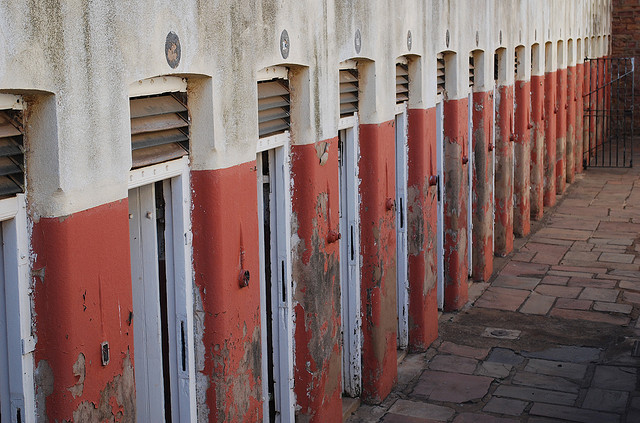
The old prison cells - home to Ghandi and Mandela at one point at Constitution Hill

The old prison cells – home to Ghandi and Mandela at one point at Constitution Hill

The complex is built on the site of the Old Fort, the notorious prison built originally by Boer leader Paul Kruger in a vain attempt to defend Johannesburg from the British.

Visitors to Constitutional Hill should sign up for a guided walking tour to get a real feel for the place. Local guides take visitors through cell blocks which housed every famous political prisoner the country produced including Nelson Mandela and Mahatma Ghandi.

Mandela’s cell has been recreated and besides the video footage on display it contains original letters written by Mandela – a qualified lawyer – written in elegant curved freehand, detailing his numerous requests from prison authorities for access to books, legal counsel and to see his family.

On the way visitors bypass the now empty and incredibly eerie cellblocks – like everything under apartheid, divided into white and black sections.

As the guides explain and visitors can see for themselves, Apartheid’s reach was limitless. The walk takes one passed notice boards which detail meal rations for prisoners (more meat and extra coffee and sugar for white prisoners, less for Indian prisoners and virtually no luxuries for black inmates).

But constitutional hill is also an uplifting experience culminating in a visit to the Constitutional Court itself. Decorated with paintings and sculptures by some of the country’s finest artists (the nearby art gallery is a must) the building has literally taken what was once a symbol of oppression and turned into a symbol of freedom – an entire wall of the court building is made from the bricks of a section of the old prison.

Ancient histories

For history that predates the arrival of the first Dutch settlers who moored at the Cape of Good Hope in 1652, say by a couple of hundred thousand years, another new permanent exhibition has sprung within an hours drive of the city. Called “Maropeng” or “The Cradle of Mankind” it remains one of the world’s great fossil sites and is rightly listed as a “World Heritage Site”.

Looking like a massive ant hill, and surrounded by ominous orange signs telling visitors to “Beware of snakes” (surely not likely to scare off any Australian tourist), the tour main walk way is lined with human and animal fossil finds which lead into the main building. Here a ride through an underground lake takes one to a massive exhibition hall where the “history of mankind” is put on display including some of its most famous fossil finds.

If that’s not enough, there is also an opportunity to visit the nearby cavernous Sterkfontein caves, complete with dripping “stalactites” and “stalagmites”.

Soweto

A painted old power silo near Soweto

A painted old power silo near Soweto

No visit to Johannesburg can ever be called complete without a visit to the adjacent township of Soweto. Gone are the days when no one ventured near the township unless they lived there, it’s now a major tourist magnet (and with good reason) with numerous tour companies offering full day tours.

For about $90 you can spend an entire day with a Soweto resident as he takes you in air-conditioned mini-bus on a dazzling tour of the South Western Townships.

Putting aside its significance as the centre of the anti-apartheid struggle, the following tidbit should be enough to pique your interest in paying Soweto a visit.

6268519080_0efa4845fe_zAll tours of the township will take you down Vilikazi Street, a dusty street, lined with mostly small, compact houses and unique in this aspect – it is the only street in the world where two Nobel Peace Prize winners lived – the country’s greatest leader and former president, the late Nelson Mandela, winner of the prize in 1993  and the enigmatic, Desmond Tutu, the much-loved retired archbishop of Cape Town, who won the prize in 1984.

The tours include a walking tour through traditional African markets – complete with an African witch doctor who can give you a remedy for making anyone of the opposite sex swoon at your feet, outdoor butcheries and once illegal drinking taverns called “Shebeens” where you can sample South African curries and semolina pudding, commonly known as “pap”.

Those brave enough can try dried Mopani worms (similar to Wichita grubs) washed down with Amazi, the traditional African “sour” beer.

244346804_b2a0a47fea_z

The Hector Pieterson memorial in Soweto

You will also visit the site of the Soweto Uprising of 1976, when students protested against being forced to study in Afrikaans, and where Hector Pieterson a 13-year-old schoolboy was gunned down by police and whose dead body (famously photographed by Sam Nzima) became a symbol of the evils of apartheid.

Multi-cultural shopping and dining

Not all the things touristy in nature in Johannesburg are about history.

Given that one Australian dollar buys you around Nine South African “Rands”, shopping in eGoli can be a real spending spree. The city is littered with mega-malls stocking the latest local and international brands. For those on the hunt for modern finery and expensive African crafts, the ultra-chick Sandton City Mall and Hyde Park Shopping centre in the city’s North are enormous palaces to consumerism, while for sheer ridiculousness, the Monte Casino resort is worth visiting. Besides housing an enormous array of slot machines (pokies) and poker tables, the shopping and eating mall is designed as a fully enclosed Italian village, complete with washing hanging on the line, fake pigeons and a twinkling ceiling, where it’s forever nighttime.

Fake Italian: inside gaudy Monte Casino

Fake Italian: inside gaudy Monte Casino

There are many adventures to be had in the City of Gold, all of which can be done relatively safely, provided you stick to basic rules like not walking down quiet streets alone at night, leaving your expensive jewellery at home and keeping gadgets out of sight.

Most importantly keep in mind that Johannesburg is a friendly, multi-cultural place filled with some of the loveliest, most hospitable and zany people you will ever meet.

So go on, next time you’re flying into Jo’burg – spend a few nights and explore!

I dare you!