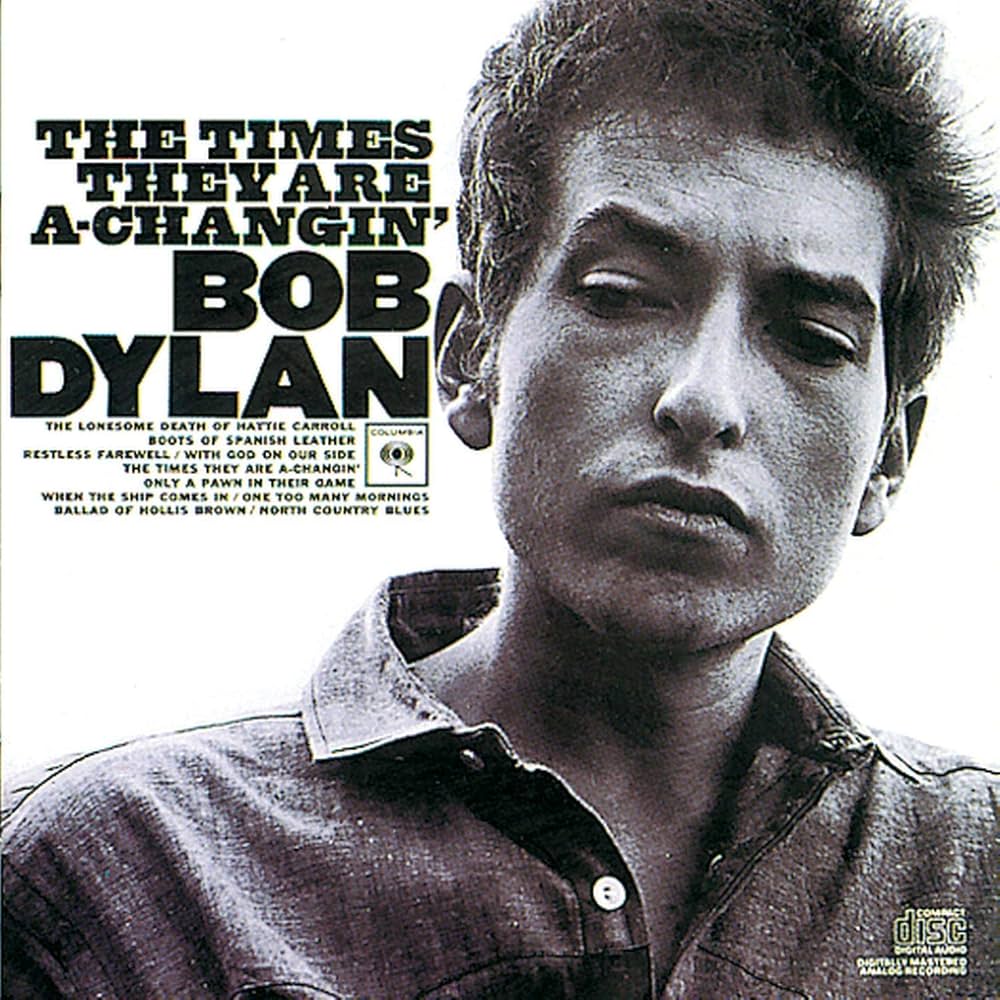
The Bob Dylan project: Album 3: The Times They are a-Changin’

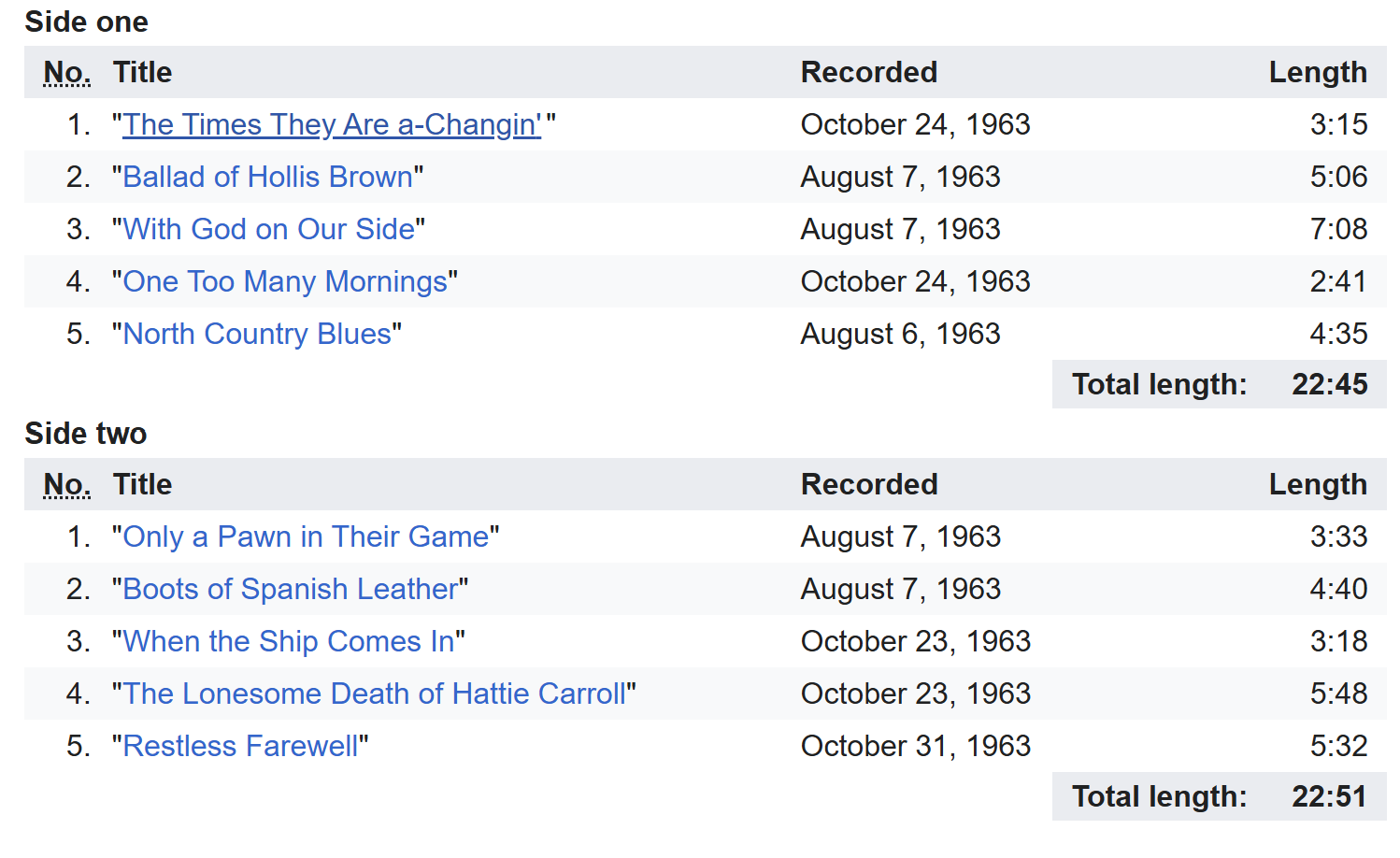
Title: The Times They are a-Changin’

Length: 45min, 36s

Number of songs: 10

Best tracks: The Times They are a-Changin’, Ballad of Hollis Brown, With God on our Side, North Country Blues, Boots of Spanish Leather, When the Ship Comes in, The Lonesome Death of Hattie Carroll

If I had to choose just one track: The Lonesome Death of Hattie Carroll

Freshlyworded rating: 9/10

Thoughts:

While the title track from this album is rightfully one of Bob Dylan’s most famous and revered songs, for me the hero track and an absolute masterpiece on this album (and surely among his best songs ever) is “The Lonesome Death of Hattie Carroll”.

Running just under six minutes, Dylan tells the story of the murder of Hattie Carroll, an African American barmaid, killed in a drunken rage in a Baltimore Hotel in February 1963 by 24-year-old Wiliam Zatzinger, a wealthy, white tobacco grower – and the injustice fuelled by racism that followed.

The song is a perfect combination of vivid poetry, acoustic guitar and Dylan’s plaintive, soulful voice.

Dylan wrote the song just six months after Carroll was murdered and it no doubt struck a chord among the civil rights movement at the time. Every sentence of the song is wonderful.

Zantzinger killed Hattie Carroll, Dylan sings: “With a cane that he twirled around his diamond ring finger” and after his arrest “Reacted to his deed with a shrug of his shoulders”.

He contrasts the Zantzinger’s wealth and high society connections with Carroll’s role as a servant “Who carried the dishes and took out the garbage”.

A few months later, “in the courtroom of honor” Dylans sings of the judge who “Stared at the person who killed for no reason” and then in a devastating line “handed out strongly for penalty and repentance William Zantzinger with a six-month sentence”.

As he tells the story of Hattie Carroll’s murder Dylan sings the repeated refrain: “But you who philosophize, disgrace and criticize all fears Take the rag away from your face, now ain’t the time for your tears.”

After singing how Zantzinger literally got away with murder, Dylan ends the song with: Oh, but you who philosophize, disgrace and criticize all fears. Bury the rag deep in your face for now’s the time for your tears“.

Just brilliant!

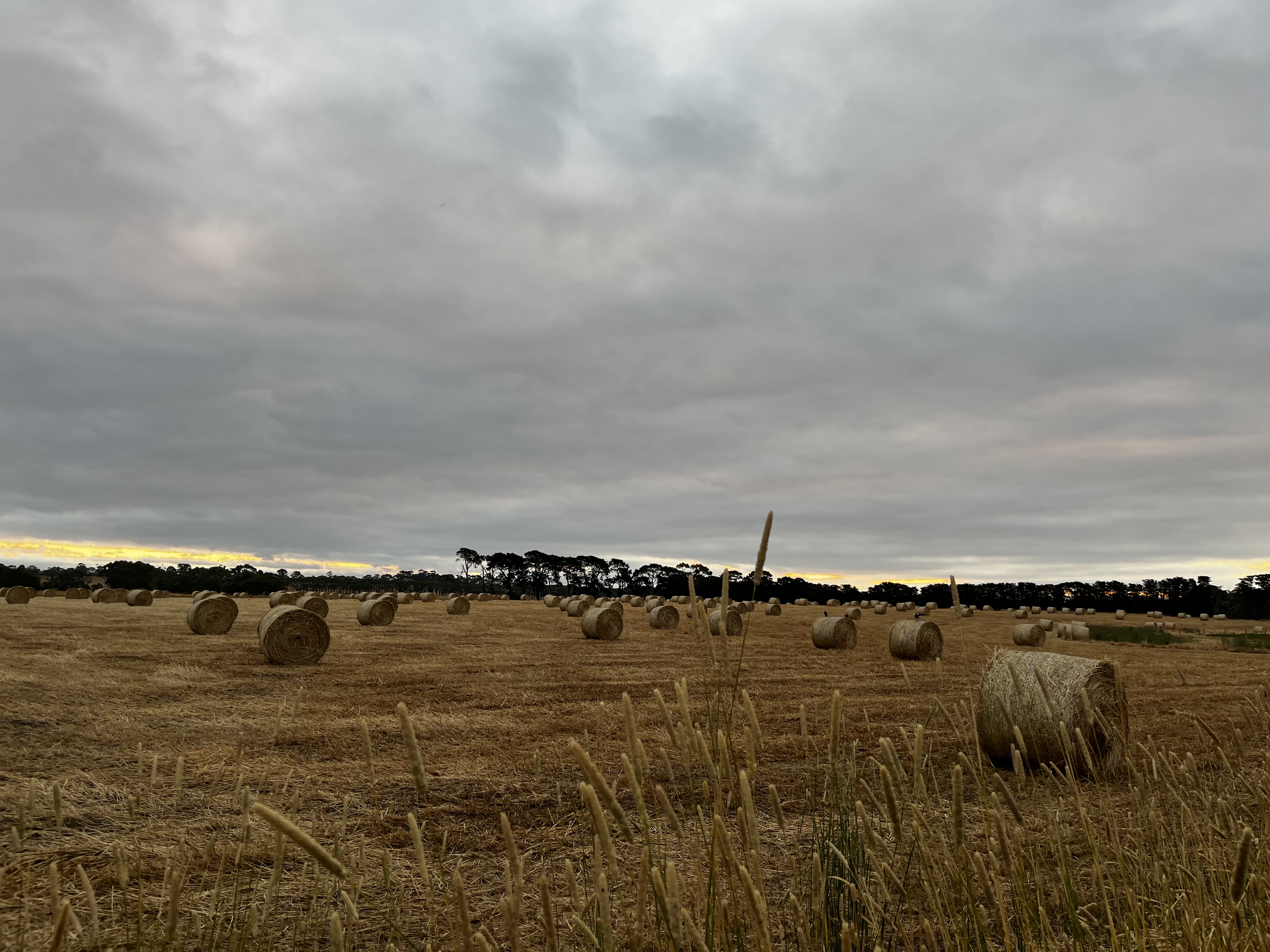
I listened to this song and all the other nine tracks of this album whilst walking my dog along quiet country roads and sleepy suburban streets in Lancefield north of Melbourne (where I live) and on holiday in Birregurra, a small town in the Otways region of Victoria. Both were the perfect backdrop for letting the wonderful storytelling songs of this album seep deep into my bones.

Hay bales in a field in Birregurra, Victoria

Alongside the Lonesome Death of Hattie Carroll, I of course loved The Times They Are-a-Changing, a universal anthem about profound change that’s coming to society. At the time it was recorded, this change was the civil rights and anti-war movement but it’s wonderful lyrics still inspire people today who are pushing for change amid the punishing regimes governing the world:

Come mothers and fathers
Throughout the land
And don’t criticize
What you can’t understand
Your sons and your daughters
Are beyond your command
Your old road is rapidly agin’
Please get out of the new one
If you can’t lend your hand
For the times they are a-changin’

I also loved another haunting, narrative song, “Ballad of Hollis Brown” which tells the story of a poverty-stricken South Dakota farmer and the events leading up to a desperate act.

“With God on Our Side’ is a song that like “The Times They are a-Changing” reverberates loudly today, with its mockery of how believing in God justifies acts of war and America’s superior moral position.

“North Country Blues” is a wonderfully melodic, yet dark song sung in the first person about growing up in an iron ore mining town, where the work eventually dries up and the mine is closed

“Only a Pawn in their Game” is another powerful political song about the murder of a civil rights activist Medgar Evars, while another favourite track of mine on the album is the very catchy “When the Ship Comes in” which has a happy and triumphant feel to it.

The slow and contemplative “Restless Farewell” is a fitting end to a brilliant album, and also a great way to end an evening country stroll.

For me, this is Dylan’s best album of the three I have listened to and reviewed so far. Incredible that he was only 22 and 23 when he wrote and recorded all these amazing tracks.


The Bob Dylan project: Album 1, Bob Dylan (1962)

I came up with the idea to listen and review every single Bob Dylan studio album out of the blue, on New Year’s Eve, 2025. (I guess you could call it a kind of New Year’s resolution).

It seemed like a cool and interesting project, and one that I could do easily with that great modern invention: Spotify.

Imagine having to buy or borrow the 40 albums that the prolific Dylan recorded over the past 63-odd years. It would be quite the task and bloody expensive too.

Why Bob Dylan? I, like millions of other people, have long admired his incredible songwriting, guitar playing and unique singing style.

As a child and then as a teenager I’d heard of Bob Dylan and some of his most famous signature tracks (“Like a Rolling Stone”, “Blowin’ in the Wind”) but I only really got into his music when I purchased a three-CD boxed collection called “Biograph” which had 53 tracks recorded between 1961 and 1981. It introduced me to a much wider collection of Dylan songs, many of which became some of my favourites: “The Groom’s Still Waiting at the Altar“, “Tangled Up in Blue“, “Senor“, “Solid Rock” and “Blind Willie McTell“.

I have since listened to a lot of Dylan albums (at least a dozen) and some of my favourites are “Blood on the Tracks“, “Desire” and “Street Legal“.

But there are so many albums and songs of his I have never heard, so why not take a deep dive into his enormous catalogue and see what other gems I can discover.

A couple of important things to mention. I’ve deliberately not read other reviews of the albums I have listened to before writing my own. I didn’t want to be swayed by the opinions of others. These are purely my opinions and impressions after hearing the album.

However, I have looked up the songs to see if Dylan wrote them himself, to read the lyrics and to do a bit of research about some of them.

So here it goes. Number 1 of 40, Bob Dylan’s first album.

Bob Dylan (1962)

An autographed copy of Bob Dylan’s debut Album

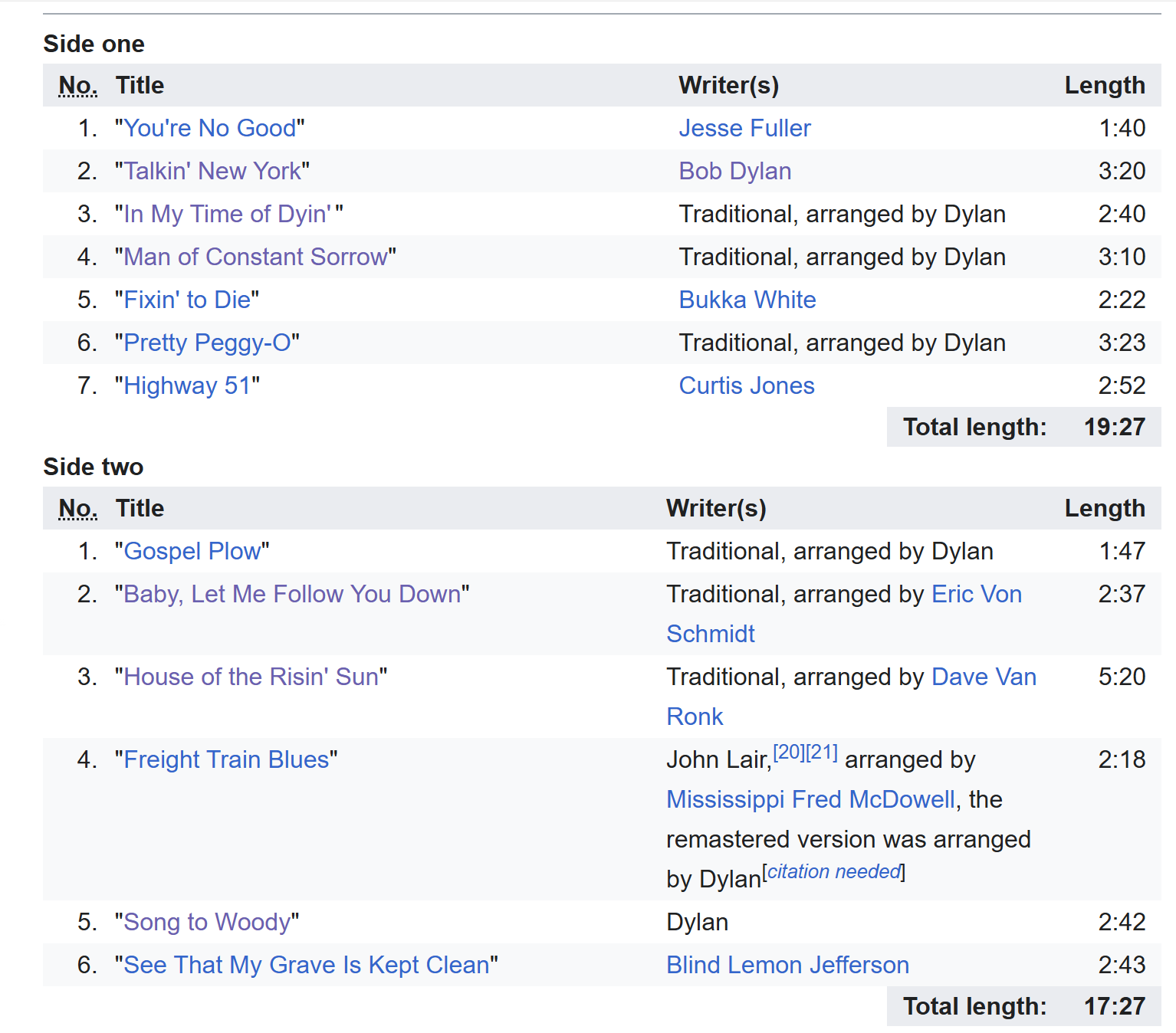
Length: 36min, 54 sec

Number of songs: 13

Best tracks: All of them, but top picks: The House of the Rising Sun, Baby Let me Follow You Down, In My Time of Dying, Talkin New York

If I had to choose choose just one track: Baby Let me Follow You Down

Freshlyworded rating: 9/10

Thoughts:

Released after Dylan had begun to make his name as a folk singer in New York’s Greenwich Village art, music and poetry scene; his unbelievable debut album was simply titled Bob Dylan. He was 20 or 21 when he recorded it.

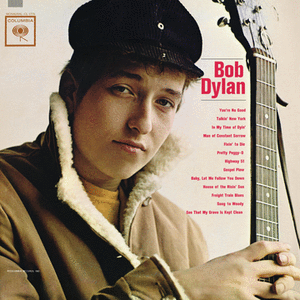
The album cover features a fresh-faced (one could almost say baby-faced) Dylan his fingers clasping the neck of his acoustic guitar. He’s wearing a winter jacket with the collar turned up, yellow sweatshirt underneath and a black cap. He stares at the camera in a rather contemplative, serene pose.

I’d give this album 10/10 but have stuck with 9/10 because nothing in life is perfect. Also, to my surprise, Dylan only wrote two of the songs on the album. They are “Talking New York” about his arrival in New York from Minnesota and trying to make it in Greenwich Village. It was the first song Dylan ever wrote and recorded and showcases his songwriting and storytelling abilities. It really takes the listener back to that time, when Bob Dylan was just a young kid with a guitar and (excuse the corniness) ” a dream”.

I walked down there and ended up
In one of them coffee-houses on the block
I get on the stage to sing and play
Man there said, “Come back some other day
You sound like a hillbilly
We want folksingers here”

The other song he wrote for the album was a “Song to Woody” which was a tribute to his idol, folk singer Woody Guthrie.

It includes Dylan’s amazing version of the classic American folk song “Man of Constant Sorrow” (a great version also made its way into the Coen Brother’s movie O Brother, Where Art Thou?) and an American gospel song written by Blind Willie Johnson “In My Time of Dying”.

Other standouts are Dylan’s soulful and foreboding version of “The House of the Rising Sun” and one of my favourite Dylan songs, his rendition of traditional folk song, “Baby, Let Me Follow You Down” where he begins the recording telling listeners that he first heard sung by blues guitarist Eric Von Schmidt in the “green pastures of Harvard University”.

Listening to this album, it make sense why many fans were outraged when Dylan started playing the electric guitar, given how deeply he was initially embedded in folk music.

If you’re looking to get into Dylan, there is not better place to start then his sensational debut album.