My happy Bar Mitzvah photographs, taken in 1987 in the foyer of the once grand Germiston synagogue on the East Rand near Johannesburg, captured a rare moment in time when my grandfather Rolf was in the same room as his ex-wife, my petite, and glamourous grandmother Nella.
I am in the middle, smiling like a cherub, my beaming parents (Ian and Cecile) on either side. On my left, wearing a white suit and a gentle smile is my grandfather, while in between my mother and my Zaida Harry, staring back rather demurely at the camera in a stylish outfit and black beret, is Nella.
I remember the day as a joyous and successful one, me singing my parashah from the Torah on the Bimah, while my family watched on proudly, then later, the sweets, as was tradition then, raining down from the women’s section of the synagogue above to celebrate my symbolic entrance into adulthood. A catered luncheon followed after in the hall at the back of the synagogue with all the South African Jewish delicacies on offer (mock crayfish, chopped herring, gefilte fish, bagels and lox). I made a half decent speech which got a few laughs, then came singing and dancing with my family and friends.

I was at the time, and for many years after, unaware that my grandmother had not spoken to my grandfather in over 30 years, after he divorced her to marry an Afrikaans lady called Elizabeth, with whom he’d had an affair.
There was an obvious clue to this secret – whenever my grandfather, whom we called “Grampie” came to visit us (armed always with a large bag of sweets and chocolates) my grandmother would hastily retreat to her bedroom and not come out until he had left.
This practice continued until my grandfather passed away suddenly in 1988, when I was 15.
He’d fallen in the rain, whilst doing a delivery for the charity Meals on Wheels in Johannesburg, been taken to hospital by my mother and passed away completely unexpectedly from suspected congenital heart failure, though the exact cause of his death remains something of a mystery.
He was cremated and his ashes placed in a wall of remembrance at West Park cemetery in Emmerentia in Johannesburg’s northern suburbs. My grandmother Nella, who passed in 1997, is also buried at West Park.
My grandfather had met Elizabeth at the boiler suit-making factory in downtown Johannesburg that was owned by my grandmother’s wealthy family, the Grevlers. He was a director (courtesy of the largesse shown to him by “Big Uncle” Isaac Grevler) while Elizabeth, whose first name was actually Johanna, worked in the factory.
After he admitted his affair, divorced my grandmother and married Elizabeth, my grandmother never spoke to him again or forgave him for his betrayal. For the rest of her life she held onto that “terrible thing done to her”. A beautiful woman who in her younger days looked like a 1930s movie star, she dated other men after her divorce, but sadly never established a serious romantic relationship again.

“I don’t blame my mom…she was a woman with very high self-esteem, and [the affair] completely dashed her. Nobody got divorced at that time. I was the only kid in my class whose parents got divorced,” my Uncle Colin (their older son) tells me on a Zoom call from his home in Alamo in California.
Growing up I never knew anything about this family saga; I had no idea my grandfather was married to someone else, and lived a life entirely outside the sphere of our fairly observant Jewish life with its festivals and Shabbat dinners.
I have strong and vivid memories of my grandmother, who lived with us for many years after giving up her flat on the edge of Hillbrow. She was a well-travelled woman of refined taste who loved her grandkids dearly. My memories of my grandfather are more fleeting as we saw him less frequently. Looking through old photos reminds me of his soft and sweet demeanour.
“He was pretty tough as a father. I think he tried to be like his dad (my adventuring great grandfather Bruno) who was a tough bloke,” recalls Colin.
Two of Colin’s strong memories of his father – before his parents got divorced – are of the very pleasant Sunday drives the family took to visit the many tea gardens in Johannesburg and, riding on his father’s back as a small boy when Rolf would get down on all fours.
Less pleasant, were memories of the whippings he received from his father’s cane.
Made out of “flexible material” Rolf had obtained it through his volunteer work for St John’s Brigade, known today as St John’s Ambulance.
One particular memory of that cane has long remained vivid in Colin’s memory.
“We had a huge oak tree outside our house at14 Rutland Road, Parkwood (a leafy, old inner Joburg suburb) and I used to love climbing trees.
“I don’t know what had happened, but something had happened and I knew that my father was going to punish me. So I climbed up the oak tree, right to the top where the branches were pretty thin. It was a big tree,” says Colin.

“My father was down below, and getting really quite agitated, telling me to come down, saying ‘you are going to fall. Don’t be silly’
“And I said to him” ‘I’m not coming down, because if I do, you are going to whip me with that cane.
“He said: ‘No, no, I won’t do that. Please come down.”
“So after saying that for a while, I did come down…and guess what happened?
What? I asked him, but guessing the answer: “He whipped me.” said Colin.
However, Colin says my grandfather’s toughness mellowed later in life, after having some kind of a quasi nervous breakdown, most likely to do with the guilt he felt about his affair and its impact on his family.
After about 16 years of no contact at all, my uncle re-established his relationship with my grandfather after returning from the UK and USA, where he’d completed his PhD in Chemical Engineering.
“When I cam back, I decided that if my mother did not want to talk to her ex-husband that was her business, but he was still my father and I wanted to have a relationship with him.
“I discovered that he had changed completely. I think he had either had a nervous breakdown or got very close to having one. It was caused by guilt. He felt enormously guilty that he had abandoned [my brother] Ian and me because of his behaviour.
“It was very strange, it was like our roles had been reversed, I was actually trying to reassure him.
“He liked to eat hot mielie meal for breakfast (cornmeal) and I would tell him. When you wake up at 4am, do something: make hot mielie meal, listen to the radio, read a book, don’t just lie in bed with all these negative thoughts.”
After a while – with the help of his eldest son – my grandfather pulled out of his depression, turning, according to Colin into “the kindest, sweetest guy you could imagine”.
“He was 180 degrees different from the way he had been growing up, and we became great friends.”
One of the things my grandfather and uncle did together, along with my cousin David (Colin’s son) was build a mirror dinghy, a small sailing boat, that I distinctly remember checking out when we visited our cousins at their home in Parkmore in the 1980s.
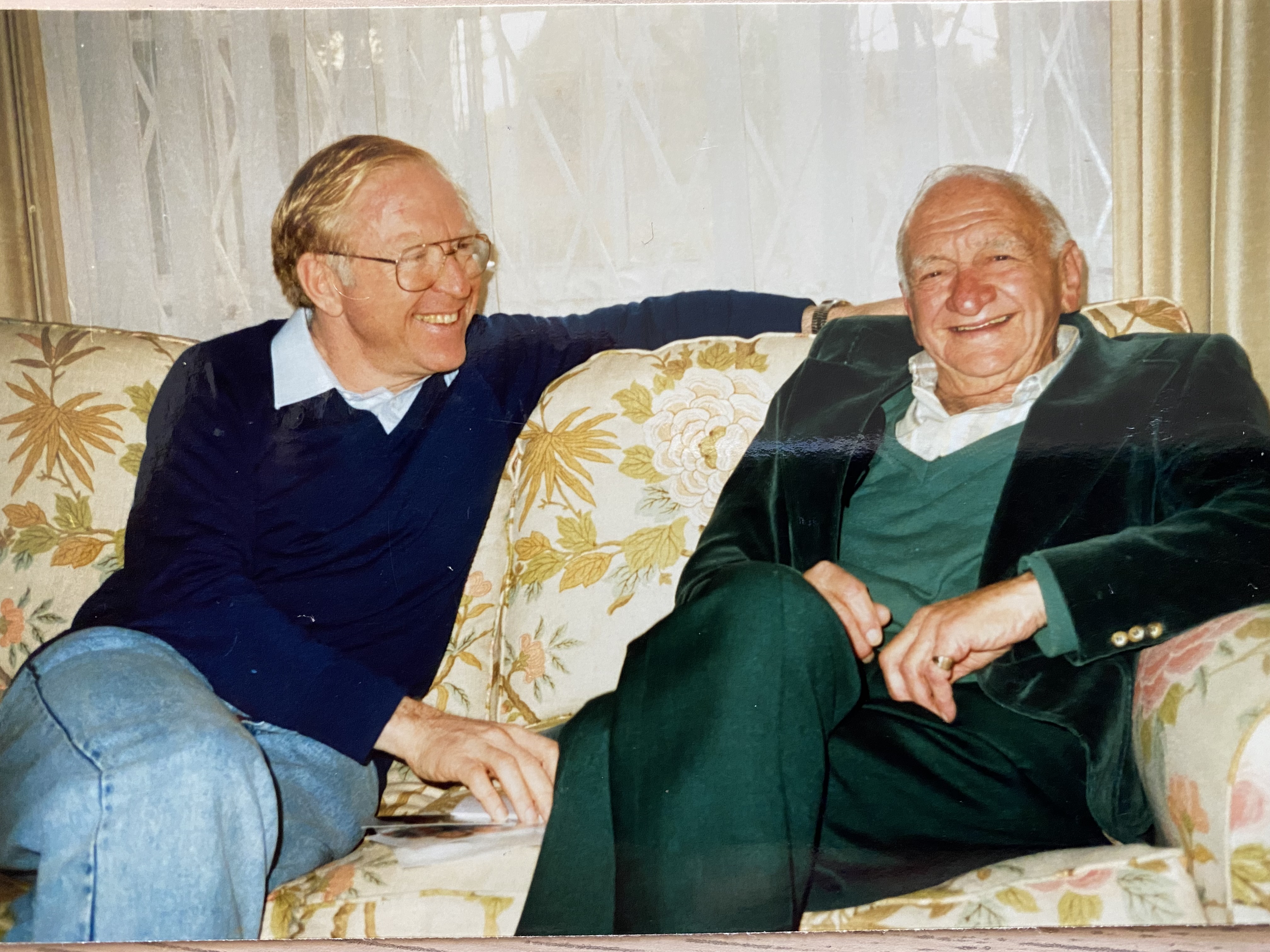

“David, my dad and I would work on building this dinghy. And when it was finished, on the weekends, we would take it to various dams like Emmerentia Dam and sail it. It was a very nice bonding experience working on that boat together,” says Colin.
He also showed me a sign, that his dad made for him after he took a job as a salesman for a sign-making company.
“We’ were talking about procrastinating and doing things, and he made this sign for me, which I have on my desk,” says Colin.
Made out of bright yellow plastic with red letters, it says simply: “TODAY”.

My last memory of my grandfather Rolf is him sitting atop a hill watching me play in a school cricket match in Linksfield, Johannesburg, perhaps not long before he passed away. I remember distinctly his small figure in long pants and a dark blazer in the distance, and my sense of surprise and pleasure at seeing him there.
The last time I saw my grandmother was in July 1997, before I headed off to the USA for six months to work at a summer camp in Wisconsin.
By then she was in her late 80s and quite frail.
At the time she lived with us in our Linksfield home. Her bedroom was right next to mine at the back of the house and she would often call out in her quiet, wavering voice: “Larry” to ask a favour. I often drove her to and from visits to her friends in their apartments around Johannesburg. Though I sometimes complained about having to do these errands, I miss those trips and ferrying her around the suburbs. She was always very grateful; we had a close bond.
In her younger and more independent days, my grandmother had a flat in Killarney – an old Johannesburg suburb packed with apartment buildings (hers was a white Art Deco block called Daventry Court) and old Jewish people. I remember her flat filled with dainty trinkets and old, dark wooden furniture and there was a dark green Peugeot 404 (a gift from Colin) parked in her garage.
I distinctly remember riding up the old musty elevator, and walking along the outdoor passageway to her flat door, and her warmth and delight at seeing me and my brother and sister when we came to visit.
She died while I was in the USA in 1997 and like my grandfather’s passing I never attended her funeral.




 Freshlyworded