The horror and futility of war: Reading ‘All Quiet on the Western Front’

Before watching the award-winning Netflix movie ‘All Quiet on the Western Front‘ I decided to first read the famous book by the German writer Erich Maria Remarque, which was published in 1929.

There’d been some criticism of the film – German critics had panned it for turning a beloved literary classic into an Oscars spectacle, while historians had slammed its apparent historical inaccuracy – but beside that, I wanted to take in the story in its original form (and use my own imagination), before watching the latest on screen adaptation.

Interestingly, the book’s famous and oft-used title (usually quoted without the irony) was coined by an Australian soldier and Oxford scholar Arthur ‘AW’ Wheen who fought in the Great War and who was awarded three military medals for bravery.

The original German title ‘Im Westen nichts Neues’ translates as ‘Nothing New on the Western Front’. But Wheen, who went on to translate a number of Remarque’s novels, was so profoundly moved by the story that he coined the more poetic English title. This along with his well-received translation of the book played a key role in its enduring success and hallowed status nearly 100 years after being published as one of the great First World War novels.

An often times mentally grueling read, Remarque condenses all the horror, tragedy and futility of the Great War into just over 200 pages of terse, diary-style entries narrated by the brave and philosophical young German soldier Paul Baumer.

Paul, just 19-years-old but already a veteran of the conflict, is part of a close-knit group of five school friends – Tjaden, Muller, Kropp and Leer – and their 40-year-old leader, “shrewd, cunning, and hard-bitten” Stanislaus ‘Kat’ Katczinsky who are stationed a few miles from the front, where the sounds of gunfire and bombs never stops rumbling.

It is 1918, and the soldiers pray that the war will end soon, that the rumours of Germany’s surrender will come true, and that they shall survive.

One of the great strengths of the novel is the way Remarque combines both the horrors of the trenches with the more mundane, but also poignant experiences of a soldier’s life to give a fully rendered impression of those times.

Away from the battlefield, we join Paul and his friends as they enjoy the simple pleasure of receiving mail, sharing extra rations or stretching out in a grassy meadow where they find joy in “wonderfully care-free hours” as bumble bees drown out the ominous rumbles from the front.

These are the quiet moments when their youthfulness resurfaces and these battle-hardened soldiers can be, hopeful men again. Not knowing when they shall meet their end, they immerse themselves in the brief respite and try to forget about the return to front where they will once again become part of the terrifying war machine.

Remarque, who was a war veteran himself, was able to draw on the horrific scenes he witnessed whilst fighting in the trenches to put the reader right there among the mud, rats, mustard gas and wounded, dead and dying.

Remarque’s novel takes you right into the horror of the trenches.

We see men living with their skulls blown open; we see soldiers run with their two feet cut off, they stagger on their splintered stumps into the next shell-hole… we see men without mouths, without jaws, without faces; we find one man who has held the artery of his arm in his teeth for two hours in order not to bleed to death. The sun goes down, night comes, the shells whine, life is at an end.

In another horrific scene, Baumer writes of the terrible screams of horses injured by bombs and gunfire, the belly of one “ripped open the guts trail out” as it rises to its feet but then falls over, tripping on its own intestines.

“Torches light up the confusion. Everyone yells and curses and slaughters. The madness and despair of many hours unloads itself in this outburst. Faces are distorted, arms strike out, the beasts scream; we just stop in time to avoid attacking one another.”

If the horror of the book was not enough, midway through reading descriptions like this, I felt compelled to look on YouTube for archived footage of the viscous battles Remarque was writing about.

One video segment depicted the total chaos on the battlefield, as mortar bombs exploded, bodies crumbled and soldiers fired at one another, then charged with bayonets that sliced into bellies. Because of the jerky motions, the scene felt almost cartoonish.

I also came across a scene of soldiers making their way through the nightmare landscape of barren hills and deep craters. Shot from behind them, it showed one soldier advancing on foot, with another behind him who appeared to be crawling. Only he wasn’t crawling I soon realised, most of his lower body had been blown away and he was dragging himself along the ground by what remained of his torso. (The video is titled “Verdun is a human slaughterhouse“).

It was utterly horrific, and just so incredibly sad. I wished I’d never seen it. But it did highlight that there was no hyperbole in the descriptions of Remarque’s young narrator, Paul. While All Quiet on the Western Front is a fictional story, the experiences endured by Paul and his comrades are accurate and true.

The power of Remarque’s storytelling is that he not only manages to capture these unimaginably awful things that happen in the trenches and among the craters and barbed wire entwined battlefields, but the mental anguish of those caught up in the fighting and the futility of it all.

This is brought most horribly to life in a devastating episode where Paul is forced to kill a French soldier who falls into a pit he is hiding in after taking cover from the incessant shelling and relentless machine gun fire.

Paul watches as the soldier’s young life slowly seeps away in front of his eyes.

Paul starts to question why this young man, whom he discovers had a wife and child, had to die. They are a similar age and in another time might have been friends.

He ends up making a futile vow to write to the dead soldier’s wife after finding a picture of her and their daughter in his wallet.

“Comrade,” I say to the dead man, but I say it calmly, “to-day you, to-morrow me. But if I come out of it, comrade, I will fight
against this, that has struck us both down; from you, taken life–and from me–? Life also. I promise you, comrade. It shall never happen again.”

Paul is the philosophical voice and conscience of the millions of young men, who if not killed, were traumatised beyond hope from the things they did in the fight for survival.

For me the most moving and tragic episode, and which illuminates the mental devastation of the war on young soldiers are the scenes when Paul is given a 17 day leave pass and journeys back to his home village, to see his family.

Remarque captures so perfectly the feeling of both being at home among your loved ones, but also that terrible realisation of having left everything you once knew far behind, of being utterly and irrevocably changed and of never ever being able to make that journey back to what life once was.

I imagined leave would be different from this. Indeed, it was different a year ago. It is I of course that have changed in the interval. There lies a gulf between that time and to-day. At that time I still knew nothing about the war, we had only been in quiet sectors. But now I see that I have been crushed without knowing it. I find I do not belong here any more, it is a foreign world.

Finishing the book, I realised I knew so little about the First World War, especially when compared with Second one that broke out just 20 years later.

The reasons for the Great War, as I have since read are so much more complicated.The famous assassination of Archduke Franz Ferdinand in Sarajevo merely the spark that lit the fuse.

Industrialisation, power struggles, inequality between nations and inbred racial hatred all played apart in the greatest ever mobilisation of millions of young men to fight and die in the trenches.

This was a war where armies were so large and so easily replenished that no one could ever really win, resulting in loss of life so huge and horrors so terrible they are hard to fathom, even as new atrocities emerge in the Ukraine war, fueled by similar forces: power, greed and hatred.

All Quiet on the Western Front is Erich Maria Remarque’s poetic and visceral reminder that there are no real victors in war, only victims.

Will the new movie do justice to that message? (I’ll report back).

Goodbye to Berlin, the autobiographical novel that inspired ‘Cabaret’ and warned of the Nazis

Goodbye to Berlin was the first book I read written by the celebrated English-American novelist and diarist Christopher Isherwood.

Published in 1939, at the outbreak of the Second World War, it was the inspiration for the Bob Fosse movie ‘Cabaret’ , released in 1972, and starring Liza Minnelli as the flamboyant night club singer Sally Bowles. (Isherwood also wrote A Single Man made into the 2009 movie by Tom Ford starring Colin Firth).

The highly autobiographical novel is set in Berlin in the early 1930s as the city’s famed reputation for art, music, design, drink and decadence had begun to fade, as economic ruin started to descend on everyday lives, and as Nazi violence starts to assert itself on the streets whilst Hitler began his march to become Fuhrer.

Beginning in Autumn 1930, we find Isherwood living in a “large, dingy flat” above a busy street of shops, where prostitutes gather beneath his window. The flat is owned by Fräulein Schroeder, who was once fairly well off but like so many other Germans has fallen on hard times.

She calls Isherwood “Herr Issyvoo” and takes a keen interest in his life, and that of her other lodgers.

Such is her poor financial situation, that Frl Schroeder has had to take in five lodgers, leaving her without a room of her own. Instead, she “sleeps in the living room, behind a screen, on a small sofa with broken springs”.

Frl Schroeder is just one of the many eccentric and colourful characters Isherwood brings to life on the page. Another is fellow lodger Frl Mayer, a musical hall yodler, actress, proud Bavarian and “ardent Nazi” whose natural enemy is Frau Glauterneck, the Galician Jewess who lives in the apartment below theirs.

Coming into the living room yesterday morning, I found Frl Schroeder and Frl Mayer lying flat on their stomachs with their ears pressed to the carpet. At intervals they exchanged grins of delight or joyfully pinched each other, with simultaneous exclamations of ssh

Goodbye to Berlin

Another is the flamboyant American singer and wannabee actress Sally Bowles whom Isherwood meets one evening, early in October, dressed in black silk, with a small cape over her shoulders “and a little cap like a page boy’s stuck jauntily on one side of her head”,

Isherwood notices her emerald green nails, her nicotine tainted hands and “very large brown eyes”.

Bowles was based on the 19-year-old cabaret singer Jean Ross. Whimsical, flamboyant, stylish, promiscuous and dreamy (and not overly talented despite her ambitions), she is symbolic of the free-spirited Jazz Age in Berlin that flourished in Weimar-era Germany before the Nazis snuffed it out.

Isherwood is immediately drawn to Bowles, and she to him; their platonic friendship a sharp contrast to Bowles’ many lovers.

It is not hard to understand why Isherwood moved to Berlin. A gay man from a wealthy and conservative family from the north west of England, he would have found the German city’s plethora of gay bars, cabaret and experimental theatre alluring alongside its acceptance of homosexuality.

But he arrived there as this tolerance and acceptance was about to crushed by the Nazi regime, and as anti-semitism and intolerance becomes part of the chatter of everyday Germans looking for scapegoats for their economic woes.

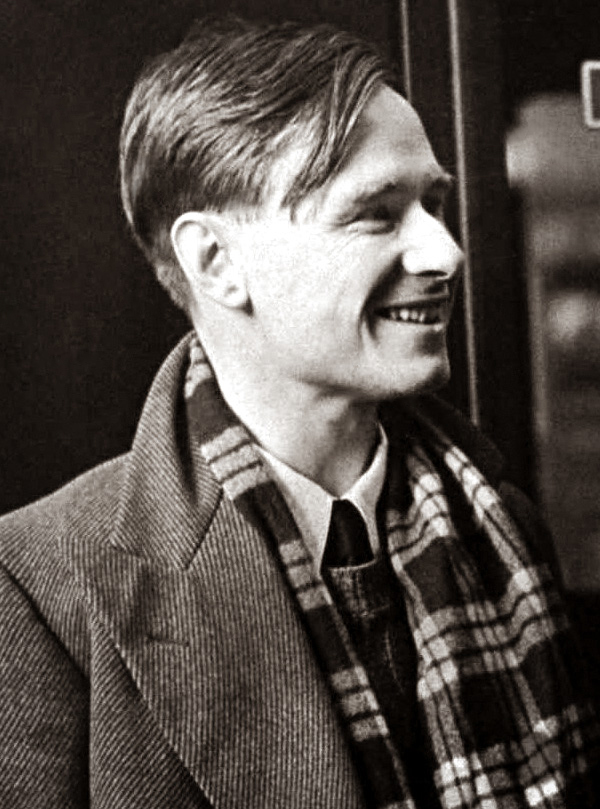
Christopher Isherwood – taken in 1938

Indeed many of the people Isherwood formed close relationships with during his time in Berlin, would have been prime targets for the Gestapo such as the gay couple Otto and Peter, who we find the author living with in a beach house on Rügen Island in the summer of 1931.

There are perpetual little rows going on between Peter and Otto, yet I cannot say I find living with them actually unpleasant

Goodbye to Berlin

Then there are the Landauers, a wealthy Jewish family, who own a Berlin department store. Isherwood befriends their precocious 18-year-old daughter Natalia, whom he accompanies on outings where they discuss art and literature He also forms a friendship with their cousin Bernard, a gay man, and a target for the Nazis.

Indeed Isherwood himself would have been in great personal danger had he chosen to remain in Berlin after the Nazis rose to power. He fled Berlin in May 1933 spent some time back in London and China, before emigrating to the US in 1939 and living in California.

I enjoyed being taken into this now long gone, but exotic world that Isherwood brings so vividly to life with his stories and anecdotes. He was a gifted storyteller with an ear finely tuned to the nuances of speech and character and well worth checking out for those looking for a fly-on-the-wall journalistic literary experience, that warned of the horrors to come.

 “’Concentration camps,’ said the fat man, lighting a cigar. They get them in there, make them sign things… . Then their hearts fail’”

Goodbye to Berlin

The power of radio: a review of “All the Light We Cannot See” by Anthony Doerr

all-the-light-we-cannot-see All the Light We Cannot See is a historical novel by American author Anthony Doerr that won the 2015 Pulitzer Prize for Fiction.

Doerr, who lives in Boise, Idaho, tells the story of the coming of age of two children in the build up to and later outbreak of the Second World War in Western Europe.

There is the story of beautiful blind French girl Marie-Laure Leblanc who lives with her doting father in an apartment in Paris and loves reading, especially the adventure stories of Jules Verne.

Alongside her tale, Doerr narrates the story of  German boy Werner Pfenning, who grows up in an orphanage with his sister Jutta in a harsh coal mining town.

The war breaks out and Marie-Laure and her father flee Paris and the Nazis to live with her charismatic aunt Madame Manec and her reclusive uncle Etienne in their tall, narrow house in Saint-Malo, a walled French maritime town on the English Channel.

Over in Germany, Werner, a sensitive and kind boy, becomes old enough to be sent to work down the mines – a job which killed his father – but is saved from this fate by his ability to fix radios.

After skilfully repairing the radio of a Nazi commander’s girlfriend, Werner is selected to attend the elite Nazi academy, The National Political Institute of Education, where he receives formal training in electronics and helps create a gadget to locate enemy radio transmissions, but where he is also exposed to cruel Nazi ideology about the ‘master race’ and witnesses first hand its brutal methods.

Marie-Laure meanwhile must cope with the disappearance of her beloved father, who never returns from a trip to Paris, and learn to use the wooden model of Saint-Malo that he crafted for her, to help her navigate the streets of the walled town.

As the war heads towards it destructive conclusion and the Nazis invade Saint-Malo the two young characters are drawn closer and closer through the power of radio:  Werner, still only a teenager, has been drafted into the army, where his job as part of a truck unit that rumbles through the decimated countryside is to use the electronic device he helped design, to detect the locations of enemy radio transmissions (and eliminate the perpetrators); at the same time Marie-Laure collects bread from the local bakery with coded message for the French resistance baked into the loaves, that her uncle then reads out through a secret radio broadcast from the top floor attic of their home.

anthony doerr

Anthony Doerr

In an interview Anthony Doerr gave on Idaho Public Television he revealed that the title of the book, All the Light We Cannot See, referred to the invisible electro-magnetic waves that powered radio broadcasts during the Second World War and that today power things like mobile phones. (I thought it might refer the ability of a blind girl, to see the world vividly through her imagination).

Doerr says the idea to put radio at the heart of his story came to him about 10 years ago when he was on a train pulling into Penn Station in New York and a guy was getting more and more angry because his phone call kept dropping out.

“How did we get to the point that we took this technology for granted? …All this invisible light that carries messages. I felt we had forgotten what a magical thing that was,” he said.

In Europe during the war it was radio which had this magical power to connect people who were thousands of miles apart and which played a crucial role in the outcome of the war.

“When I was thinking about strategies for writing this book, all I knew was that I wanted to have a blind girl reading a book (Jules Verne’s 20,000 Leagues Under the Sea) over the radio to a boy,” Doerr says.

On a trip to France, he visited the beautiful town of Saint-Malo and says he was amazed to discover it had been practically flattened by American bombs and then restored almost brick by brick.

“I knew somehow the boy would be trapped and needing this radio transmission as some kind of life line,” Doerr said in the same interview.

He spent 10 painstaking years writing and crafting the complex book and was rewarded with it winning the Pulitzer Prize and becoming a huge commercial success.

While it is a brilliant story with many memorable characters and a powerful message about bravery and human decency in the face of terrible circumstances , I was a little disappointed with Doerr’s decision to write it in short chapters that not only move back and forwards between the lives of Marie-Laure and Werner , but also move back and forwards in time, between 1934 and the end of the war.

I found it created a disjointed rhythm and was sometimes confusing, requiring that I page back to see what period of time he was were referring to understand where I was in the sequence of events.

Also, at more than 500 pages, I felt it was unnessarily long and could have been even more powerful as a shorter book. While sometimes Doerr’s verbosity is warranted – he loves delving into how things work, the history of a minor event or character and delivering incredibly detailed descriptions – at times it feels overdone and rambling.

But, then again I am someone who likes the pared-down writing style of Hemingway, Orwell, Bukowski and Carver so maybe that’s just me. Others readers may love luxuriating in all the detail: after all it is an epic tail stretched out over a vast canvas, indeed it has major Hollywood film written all over it.

As a follow-up, if you have not yet read it yet, I suggest Australian writer Anna Funder’s All That I am, also set during the Second World War, about a group of German refugees who flee to London to escape the Nazis.


My great great grandfather: the adventurous Prussian soldier who loved a drink

OLYMPUS DIGITAL CAMERA

This is a picture of my great great grandfather Heinrich Gimkiewicz  (with impressive beard) and his wife Helene taken in Berlin in 1881.

I have come to know a little about Heinrich through a self-published book by a cousin, Keith Kaye, a urologist who lives in Minneapolis.

Keith translated and published the diary Heinrich kept while serving as a non-commissioned officer during the Franco-Prussian war, a largely forgotten but bloody dispute that took place in Western Europe between July 1870 and May 1871, won by Prussia thus unifying the various German states.

The diary was bequeathed to the University of the Witwatersrand in Johannesburg by Heinrich’s granddaughter Helga, It was here that I studied various degrees between 1992 and 1998, emerging, finally with a Bachelor of Arts in 1996 and a Post-Graduate Diploma in Management in 1998.

All that time, I had no idea a diary was kept by the University library detailing the daily marches, battles and ruminations of my distant paternal descendent.

When I began reading the translated diary entries I was at first bored. Heinrich details his movements from one town to the next, the long marches or train rides, complaints about the cold, waiting around for orders and details of the various civilian billets where he stayed in occupied French towns.

The names of towns and army commanders meant very little to me.

But as I read and persevered, I found Heinrich to grow more interesting and to see things in his personality that reminded me of myself.

It became apparent to me that my great great grandfather enjoyed a drink, preferably an alcoholic one (as I do) and sometimes drank until he was “tipsy”.

He writes of a stay in Rheims on November 12, 1870:

We stay here today, and so we try to get to know the town. Provisions are quite bad here, but there is lots of wine…

On November 16, in the hamlet of Coucy la Ville between La Fere and  Soissons:

It is quite nice here, there are lots of apples; the people make a pleasant drink out of them. It is available in quantity, and we like it very much, there being no wine.

And later, in Roumare on December 28:

I go and get my baggage, we prepare our meals and sit together until 10pm, having a good time. There is enough cider, each day we drink a considerable amount.

He was also fond of exploring the towns that he visited and had an appreciation of architecture, food and the hospitality and the customs of local French people, even if they were the ‘enemy’. However, unruly Frenchmen are not tolerated and one, he reluctantly admits to slapping.

He is also more than a little mischievous and I surmise – not always that honest  – with his diary entries – particularly when he visits a Rouen brothel:

It happens on February 16, towards the end of the war when he is billeted in the home of a cotton manufacturer. Heinrich writes that at 6.30pm he eats dinner with his landlord, “who is a very friendly man” then goes out again “this time on a less moral path”.

We want to have a look at a French brothel. There are many here. The first one is the Maison Stephan, which is high-class. The second one is a normal one. We return at 11pm.

No description is given of what he did for four hours, but we can guess. His fondness for the ladies reveals itself on a number of occasions with glowing descriptions of local landladys (one is”an aristocratic woman called Madam de Savers” who is “very friendly”) and the daughter of one of his landlords.

Rouen was a special place for Heinrich in the war. He writes of its bustling life after the armistice is declared and that “in all the places and in all the cafes it now becomes obvious  that this beautiful city belongs among the greatest in France”.

I would whole heartedly agree. My wife and I visited Rouen in the summer of 2010, staying in a little shoebox apartment above shops on the main road. Our landlord was a small, dark-skinned moustached man, who spoke not a word of English. We cooked tinned Cassoulet on a portable gas burner in the evening after exploring the exquisite, historic town in the day.

Now, I wonder, if I tread on the same cobbled stones as Heinrich did all those years ago as he explored the various districts and drunk in its cafes and restaurants.

Heinrich also writes intriguingly of the Yom Kippur service for Jewish soldiers, the holiest day in the Jewish calendar.

A proud Prussian man willing to die for his country, Heinrich could not have known that this war, which unified Germany, would create some of the circumstances that led to the First World War in 1914 and later the Second World War, where German Jews were betrayed and murdered in their millions by their homeland.

He writes of the Yom Kippur service in St Barbe on October 6:

…all in all there were 400 men of our denomination there.  It was Rabbi Blumenstein who came especially from Mannheim…it was moving. Most of us had probably never prayed as intensely as we did today.

My favourite extract – and where I feel a strong connection with my great great grand father – comes towards the end of the campaign, when Heinrich’s regiment reaches the town of Fecamp, on the Atlantic Ocean:

Now we are to see the ocean. We are led there one platoon after the other, it is a gorgeous view…with its huge waves…a clear difference from our eastern sea. This mighty sea with its waves which exist in such height only here, surrounded by high white chalk cliffs is really indescribable and unforgettable. This great view truly compensates for all our strains of the last days and we are grateful to our captain who kept his promise.

With the war over, Heinrich returned Berlin and married Helene 10 years later. They had four children.

The family move to South Africa in 1899 was most likely sparked by a wave of anti-Semitism surging through Europe at the time and the prospect of making one’s fortune amid the gold fields of the Witwatersrand.

Heinrich’s daughter Else would later marry an Austrian-born geologist and mining engineer called Bruno Schlesinger in 1907 and I would emerge into the world in 1973, a chubby child with a curly mop of hair to carry on the Schlesinger name.

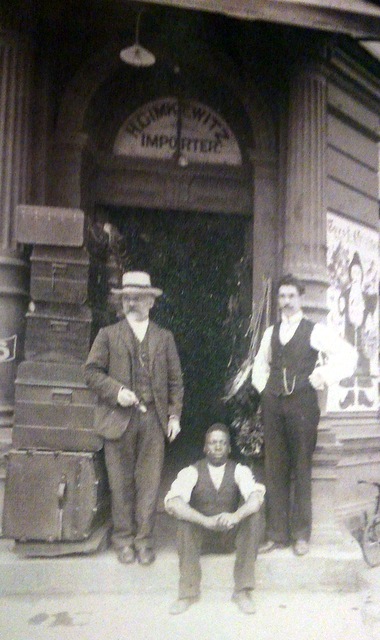
Heinrich ran a toy shop in  the centre of Johannesburg with merchandise imported from Germany. A photo outside the store shows him to be a dapper dresser in three-piece suit and hat, bearded with fob chain dangling from waist coat.

Heinrich, top left, in front of his Johannesburg toy shop

Heinrich, top left, in front of his Johannesburg toy shop

Sadly, anti-German feeling in 1915 following the sinking of the British ocean liner the Lusitania  forced Heinrich and his family into veritable hiding as mobs attacked anyone of German descent. Being unable to import German goods, he lost most of his customers.

Heinrich died in 1922 aged 75, 10 days after his wife Helene apparently of a broken heart. They are both buried in Johannesburg’s Brixton Cemetery.

– I think I would have enjoyed sharing a glass of wine with him. Or maybe some Cider.