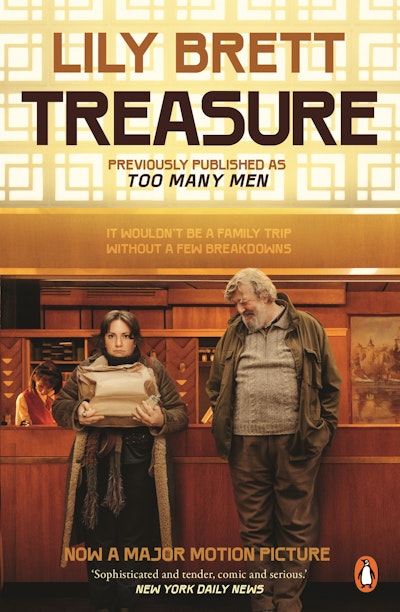
I’m nearing the end of Lily Brett’s semi-autobiographical novel Too Many Men, or as it has been re-titled Treasure in keeping with the movie adaption starring Stephen Fry and Lena Dunham.
It’s the story of Ruth Rothwax (Lily Brett), a 43-year-old thrice-divorced owner of a letter writing business who travels from her home in Manhattan to meet her 81-year-old father Edek (Max), a holocaust survivor to accompany her on a trip around Poland visiting the ghettos of Warsaw, Lodz and Krakow and culminating in a trip to Auschwitz and the nearby death camp of Birkenau.
Edek, who survived the hells of the Lodz ghetto and Birkenau has travelled from Melbourne where he lives alone. His wife Rooshka, an Auschwitz survivor, died in her sixties from cancer. Ruth moved to New York many years ago.
The pair are close but frequently argue. Ruth is wracked with guilt and worry about her father (Is this trip too much for him?) while Edek, who has an enormous appetite, berates her for “eating like a bird” and being rude to Poles they meet on their travels.
Having visited the Lodz apartment where Edek and Rooshka lived before being march to the ghetto, they make their way to Krakow and then to Auschwitz. Here, Ruth becomes physically sick after they visit the very barracks where Edek “lived” during his barbaric imprisonment. The whole visit is a terrible ordeal for her as she struggles to comes to terms with the suffering of so many people and the fact that her own parents were subject to the degradation and humiliation within the grounds she walks. On her arrival she weeps as she sees the famous sign “Arbeit Macht Frei” (“Work makes you free”) that tricked arrivals into thinking they were being sent to a work camp. Ruth is enraged by a group of school kids eating snacks and fighting with each other, and in the taxi ride from Krakow to the Auschwitz she repeatedly corrects the cab driver for referring to their destination as the “Auschwitz Museum”.
‘It’s a death camp,” she tells the taxi driver over and over again.
Ruth is angered by the cleanliness and order of Auschwitz, the huge numbers of tourists and the lack of a visceral sense of the horrendous suffering enduring within its walls.
Ruth wished the visitors to these blocks could experience something of the atmosphere of degradation and humiliation and inhumanity that had existed. How could you feel people’s anguish and terror in centrally heated, newly painted barracks? But maybe nothing could ever replicate a fraction of the atmosphere, a fraction of the events that took place.
Nobody would come here, she thought, if this place was still covered in shit and piss and lice and rats and vomit and ash and decomposing corpses. The car park wouldn’t be full of tourists coaches. People wouldn’t be looking at the photographs and other exhibits on display in these rooms. These renovations were probably necessary. She had to stop being so judgemental, she told herself.
Ruth and Edek’s trip to Auschwitz made me think back to my own visit in May 2010, as part of a round-the-world backpacking trip I did with my wife after we got married.

I remembered the small minivan we took from Krakow to the death camp, a journey of about an hour through pretty countryside. I remember wandering the grounds of Auschwitz and seeing the rooms with the giant piles of shoes, glasses, hair and artificial limbs behind glass. I remember thinking I should feel more, or should be in shock, but perhaps like Ruth, I found it all too “neat” and “cleaned up”, too much like a museum rather than the remains of a slaughterhouse that treated people like insects to be squashed underfoot.
Then I decided to re-read the blog entry I wrote from the day of our visit, which I posted on our online travel journal.
How does one describe a visit to Auschwitz? A journey to the gates of hell perhaps? A place of unimaginable suffering and brutality? Probably all are insufficent. Yesterday we spent the day visiting Auschwitz and the nearby camp of Birkenau (Auschwitz 2). It’s a little over an hour by bus from Krakow. We travelled in this strange mini-van, posing as a municipal bus, which picked up people along the route so that by the time we reached the little town of Oswiecim (renamed Auschwitz by the Nazis. Incredibly, the town now bares the inscription, Oswiecim: city of peace) it was packed to capacity and stifling hot. It was a pretty unpleasant ride, (despite the very pretty Polish countryside we passed), but it did make me think of all these people crammed into those windowless cattle cars and though nothing at all like the horror of those cramped conditions, it felt quite appropriate to not be comfortable.
The two camps are joined by a free bus service. We first went to Birkenau. Beyond the famous main entrance and watch tower, through which the trains passed, the most overwhelming thing is the sheer size. It’s enormous. At its peak there were 100,000 people living here under the most appalling conditions. Each of the barracks housed as many as 1,000 people. We listened to a guide tell a tour group that the prisoners were only allowed to go to the toilet twice a day and because there were so many, they only had about 40 seconds to use the latrine. Just one of many awful stories.

(In the scene from the book, Ruth and Edek examine the crude toilet block comprised of concrete benches in parallel lines with holes cut out of them the size of dinner plates. Thirty-four circles, inches apart from each other so that the prisoners could not help but touch each other while they urinated and defecated. Everyone sick with diarrhea, the holes below filling up almost to the top, the stench unimaginable. Then she starts vomiting down one of these holes and cannot stop.)
My blog entry continues:
A lot of the barracks are still standing (where they are not, you can see the foundations so it is easy to get a sense of the scale). At the far end of the camp, at the end of the railway line, are the remains of the gas chambers and crematoria. They were blown up by the Nazis just before the camp was liberated. Despite the heaps of rubble, you can see the steps down which prisoners were led, the changing room where they were forced to strip before being led into the “showers”.,
Auschwitz main camp houses the museum in the brick barracks (it was formerly Polish army barracks) where prisoners were held. Unlike Dachau, where the museum assaulted you with information, here it is relatively succinct, leaving you to take in the exhibits. One of the barracks contains huge displays of what was taken from those before they were gassed: mountains of hair shaved off prisoners (the Nazis sold the hair to textile firms), spectacles, shoes, toothbrushes, and artificial limbs. There are piles and piles of these things, and this probably just a fraction of what was found.
The walls of the barracks were lined with photos of prisoners admitted to Auschwitz including their date of arrival and death. Some lived only a few days, some a few months and some more than a year or two. How to survive such a hell hole for a day let alone a year, I just cannot fathom.
(In the book, Ruth and Edek visit Auschwitz on a “dull, grey wet day” and is relieved not to visit it in the sunshine. But we were there in Spring…}
It turned out to be a very sunny day. There were purple and yellow flowers growing among the grass and shady trees that offered respite. But the overwhelming sensation for me was incomprehension, sadness and anger. Though as many of you may know I am not a practicing Jew, I did feel a strong connection with all those who were lost.

At one point I found myself humming the tunes of Jewish songs we sang at King David High School, songs that I had forgotten or buried deep in my memory. Then I remembered we had a school teacher, Dr Yageel, who was a holocaust survivor from Auschwitz and had a tattoo on his shoulder bearing his prisoner number. I remember him to be a short man, with a beard and a lined face. I think he may have taught our class on a few occasions. I never really thought about what he went through or took the time to chat to him. I recall thinking of him as a survivor as if he were an ex-football player or someone who had climbed a mountain. What I mean is, I don’t recall me or anyone else at school for that matter paying him the kind of respect he deserved. I wish now I could shake his hand.
 Freshlyworded