Confessions of a cricket tragic

This article first appeared in the Australian Financial Review
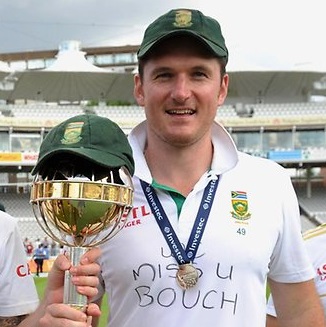
Retired skipper Graeme Smith with the Test mace, signifying South Africa's number one ranking

Retired skipper Graeme Smith with the Test mace, signifying South Africa’s number one ranking

To be a South African cricket supporter residing in Australia is to be a true cricket tragic.

As we slid to another home series defeat against Australia in Cape Town, I dashed off a tweet about the last Test side to beat the Baggy Greens at home, a team know as the “Invincibles” which white-washed Bill Lawry’s tourists 4-0 way back in 1970. A colleague replied: “Oh come on, Larry, nostalgia is the last refuge.”

Perhaps he was right. Perhaps it was a foolhardy attempt to prop up my spirits after yet another home series failure against the old foe; the only blight on an exceptional record that has seen South Africa rank as the No. 1 Test side in world cricket for many years and unbeaten in 14 Test series dating back to 2009.

No defeat hurts more than to lose against Australia (the 1999 World Cup semi-final still haunts me), no victory is more sweetly savoured.

When we finally did win a Test series against Australia in 2009, away from home, and then again 2012, also away from home, it was indeed a sweet moment for a biltong-eating expat like myself.

But a home Test series win against Australia has eluded us in seven attempts since we returned to world cricket in 1992 with just two draws and five defeats.

Back in 1970, just prior to being cast into the sporting wildness, South Africa was a dominant side with a host of superstars in the making. Top of the pile was Graeme Pollock, considered by many to be the finest left-handed batsman the game has produced. In a career of just 23 Tests, Pollock scored 2256 runs at an average of almost 61. I was lucky enough to see Graeme Pollock bat in the early 1980s, when he was approaching 40 and in the twilight of his career. It was at the “Bull ring” – the Wanderers Stadium in Johannesburg, where Pollock would come into bat at number 4 for provincial side Transvaal, known then as the “Mean Machine” and packed with star players including West Indians Alvin Kallichirran and Sylvester Clarke (relics of earlier “rebel” tours). The side was captained by the handlebar-moustached all rounder Clive Rice, whose rich talents sadly coincided with our period of isolation, meaning he never played a single official Test. I’d sit there with my dad in the wooden seats, long before they knocked down the old grandstand, eating a chicken mayo sandwich, binoculars trained on the pitch, watching the bowlers run in.

When it was his turn to bat, Pollock would lazily stroll to the wicket Viv Richards-style and take his guard nonchalantly. When in form, he was a sight to behold, able to clip a fast bowler off his toes for six with just a flick of his bat. I still have his signature in a little green autograph book I kept as a lad. Others in that 1970 Test side that never got the opportunity to fulfil their burgeoning talents included opening batsman Barry Richards, who scored 508 runs against Australia at an average of 72 (in what was to be his only Test series), all rounder Mike Procter, who picked up an incredible 26 wickets at 14 a piece and captain Ali Bacher, whose record against Australia was seven wins from eight matches (he was also part of the team  that beat Australia 3-1 in a home series in 1966-67, captained by Peter van der Merwe).

Softly spoken, calm and diplomatic Ali Bacher was a constantly on television. As our leading cricket administrator, he organised the rebel tours in the 1980s that kept cricket alive during isolation and in 1992 led the country back into world cricket. Of course,  I remember everything back then – the smell of boerewors wafting up from braais (barbeques) around the stadium; the colourful match programs packed with statistics about my heroes; walking across the field to inspect the pitch with my dad during the lunch break – from the viewpoint of a privileged white upbringing.

I was too young and naive to understand the country’s cruel reality: that apartheid robbed generations of black, Indian and mixed-race South Africans of participating in the game.

Thankfully, that’s all changed and our team is a now a better reflection of the ‘‘rainbow nation”, with players of colour like Hashim Amla, Vernon Philander and Alviro Peterson all households names. Just last month, a junior South African side packed with players of all colours beat Pakistan to win the under 19 World Cup. Perhaps they will one day guide us to a home series win against Australia. A World Cup win would be nice too.

Sorry ladies, cricket remains still (sadly) a true gentlemen’s game

empty cricket standsThis morning, over coffee in a cafe outside Flinders Station they were showing the recent cricket World Cup Final between Australia and the West Indies.

I should clarify. It was the Women’s world cup final, which took place in Mumbai a city with a population of around 20 million and millions of cricket-mad fans – I know because when I visited a couple of years ago and told people I was a South African living in Australia, people would shout out the names of cricket players they idolised at me:

“Jonty Rhodes. Great fielder.”

“Herschelle Gibbs. I love Gibbs”

“Riiiicky Ponting”

But sipping my coffee and watching highlights of the game I noticed one glaringly obvious thing.

The stands were almost completely empty. Rows and rows of empty seats in a the Brabourne Stadium, one of India’s smallest cricket stadiums that only holds 20,000 people.

No one was watching the game in Mumbai and no one appeared to care.

According to one report I read, there were at most 1,000 people at the game with police officers outnumbering spectators by two to one.

This in one of India’s biggest cities, in a country that’s apparently cricket mad.

Just yesterday I’d read a story in The Age by sports writer Peter Hanlon suggesting that women’s cricket had come of age and they were now viewed as true professionals.

It had as its headline: “Sitting up and taking notice of women’s cricket”

Hanlon wrote of the game being broadcast live on Foxtel with ball-by-ball commentary on BBC radio.

But I doubt if apart from the family and friends of the Australian and West Indies cricket teams and a small collective of women who play the game, if anyone listened of watched as Australia raced to a comprehensive win.

They say cricket is the ‘gentlemen’s game’ and generally mean in the sense that you should play it in the spirit of fairness and good cheer. But it has a far more literal meaning.

As for this apparent rise in the profile of the women’s version of the gentleman’s’ game, it’s a theory that sails way over the stumps.

Mixed emotions surely for Mickey Arthur as Australia lose to South Africa

Mickey Arthur with JP Duminy

Mickey Arthur, photographed when coach of South Africa in 2009.

I cannot help but wonder how Australian coach Mickey Arthur felt after South Africa beat Australia in the final test match to lose the series and their shot at toppling the South Africans as the No. 1 ranked test side in world cricket.

Arthur of course is a South African and about as South African as they come. He’s a ‘Vaalie’ – born on the highlands of the old Transvaal – and played all his provincial cricket in South Africa for the Free State and Griqualand West.

He was appointed coach of the South African team in 2005 and the last time he visited Australia (in a professional sense) just four years ago he coached them to arguably their greatest ever test series win – and their first ever series victory against Australia – since being re-admitted into world cricket in 1991.

Having fallen out with the South African cricket authorities in 2010, he coached Western Australia for a season and was then appointed Australia’s first foreign-born coach in November last year.

Now I am not for one moment suggesting that Arthur is not a thorough professional and has not given it his all as Australian coach – and let’s be honest they  outplayed South Africa in the first two tests and could easily have been No.1 in the world at the end of this series had it not been for FaF Du Plessis’s heroics in the second test – but I find it hard to imagine that Mickey Arthur did not take some pleasure in watching his old team and the players he coached just a few season ago win against the odds against the country of his birth’s greatest sporting rivals.

I have lived in Australia for over eight years, my daughter is Australian and my wife holds and Australian passport and yet I cannot bring myself to support the Australian cricket team or the Wallabies.

In fact I am sure they will put on my grave one day – “He died a Bok fan.”

You see the thing is this, when you grow up in South Africa, beating Australia in any sport (even lawn bowls and darts) is considered the ultimate victory.

Rivalries run very deep between the two sporting nations, and not least because there is a great deal of respect for Australia’s sporting prowess.

South Africans consider Australia one of the great sporting nations – especially when it comes to cricket – and while we have managed to beat all the other teams on a regular basis, beating the Baggy Greens has been tough – this win is only our second ever Test series triumph since re-admission.11187061_24c0790592

I found these two comments on the Supersport website (the equivalent of Fox Sports in South Africa) at the bottom of a story about the latest series win:

“South Africa clobbered Australia. It was so easy, it was scary!”

“Amazing always good to thrash the ozzies.”

Personally, I remember waking up in the early hours of the morning or watching through the night games played against Australia through the 1990s – mostly on the losing side, occasionally a much-savoured win.

The truth is being a South African cricket fan is being the ultimate sporting tragic.

A lot of times it’s been an exercise in heartache – primarily when it comes to World Cups, when we have conjured up defeats from the jaws of victory, and must live with the scars of the 1999 World Cup semi-final tie that will go down as the greatest choke in our rich sporting history, plus the sad saga of Hansie Cronje.

There are many South African expats living in Perth, Sydney and Melbourne who say they support the Australian cricket team and the Wallabies, but I have yet to meet any that I believed with any conviction.

Equally there are South Africans who have lived here many decades who still support the Proteas and Springboks and that I suspect will be me too.

It’s not that I have some deep-seated animosity to the Baggy Greens or the Wallabies, it’s just in my blood.

And it’s also surely in the blood of Mickey Arthur – who is more South African than me.

And though he will surely deny it, I am sure he did take some pleasure out of watching the team he coached to their greatest win four years ago win again this week.

After all, he’s only human!

(And the same I am sure can be said for Robbie Deans, New Zealand-born and raised coach of the Wallabies).