
The Asian Cup of rogue nations

afc-asian-cup-1420749072-2318216It struck me – with the force of a Tim Cahill wonder strike – that there was something decidedly wrong with the 2015 Asian Cup.

North Korea. Iran. Saudi Arabia. All run by brutal dictatorial regimes, all with appalling human rights records, but allowed to compete in an international sporting event.

Has the world gone mad? Have we lost our moral compass?

I ask from the perspective of a South African who remembers our isolation from world sport, forced to live off a diet of local competitions and the occasional ‘rebel’ cricket or rugby side visit.

Of course, it was quite right that we were banned, given our cruel apartheid policies, though there were some who argued that sport and politics should be kept separate and that we shouldn’t punish individuals, many of whom opposed the government’s policy of separation, from competing internationally.

Certainly, there were many great South African sportsmen and women denied their opportunity on the world stage, barred from competing at  Olympic and Commonwealth Games and from cricket, rugby and soccer world cups.

We had a world-beating cricket team in 1970 (thrashing Australia 4-0 at home) before we were kicked out of world sport, champion rugby and soccer players, swimmers and athletes.

But, I got a real shock when I saw North Korea arrive in Australia to take part in the tournament, a ridiculous charade, given they refused to give media conferences or engage with the public and thankfully were bundled out in the group stages. Clearly instructions came straight from mad dictator Kim Jong-un and his henchmen on how to behave in a foreign country, a rare treat for the lucky few who were able to travel outside of their home country. The rest stay home and starve.

Iran’s another shocker. “The Islamic Republic of Iran is a jihadist theocracy that has dragged Iran into economic depression while executing, imprisoning and intimidating its domestic opponents” wrote the Sydney Morning Herald’s Paul Sheehan recently. Iran is more dangerous than the Islamic State, he added.

Iran’s people are beaten, imprisoned, tortured…but its team is allowed to compete in the Asian Cup. Even the players over here play with fear in their hearts: during the tournament players were warned not to be photographed with young female fans.

As for Saudi Arabia, being a Jew I wouldn’t be allowed into the country (not that I have any plans to visit). Saudi Arabia is by all reports a brutal, repressive place, with medieval laws. The penalty for homosexuality is death. The penalty for blasphemy is death.  Commit adultery and the punishment is to be stoned to death. Steal and you lose a hand. State your opinion in a blog and you get flogged.

So, I ask again, has the world lost its moral compass?

Do we now turn a blind eye now to every human rights violation in the name of sport and entertainment?

Or have we finally decided that sport and politics should not mix. If so, a lot of South African sportsmen and women deserve an apology.

Would you like to ‘go large?’ ‘Super Size Me’ and McDonald’s a decade on

super-size-meHere’s an old joke. A man walks into a McDonald’s…

He order a quarter pounder with cheese meal.

Before he has time to lay a $10 note on the table, the fresh-eyed young lady behind the counter asks: “Would you like to ‘go large?”

Doesn’t she just mean ‘super size’? he wonders to himself. Sensibly, he declines the upgrade.

A minute late, his meal is on a tray in front of him…

It’s just over 10 years since Morgan Spurlock made Super Size Me (the film was released in September 2004), a low-budget documentary about the fast food industry, where he nearly killed himself eating a McDonald’s meal three times a day for a month, and where he forced himself to ‘super-size’ his meal whenever it was offered.

I watched Super Size Me for the first time recently (it aired late one night) and thought it a very engaging, thought-provoking and entertaining film, if you can stomach watching a young bloke quickly push his previously fit and healthy body toward’s ruination to prove a point about the evils of the fast food industry.

The film was made for just $65,000 and grossed almost $12 million. Made two year’s after Michael Moore’s groundbreaking Bowling for Columbine, it cemented documentary film-making as a mainstream film genre, earned an Academy Award Nomination and dozens of other film prizes.

Anyone who remembers the film will remember that famously gross scene, when Spurlock eats a double quarter-pounder supersize meal about the size of his car steering wheel and then, soon after, vomits it all up out the window of his car.

Morgan Spurlock: My arms… I feel like I’ve got some McSweats goin’. My arms got the McTwitches going in here from all the sugar that’s going in my body right now. I’m feeling a little McCrazy.

Over the course of the film Spurlock develops numerous medical conditions – high cholesterol, strange bodily sensations, depression and finally fast food addiction with his team of doctors and specialists flabbergasted at the decline of his health.

super-size-me-1

Not only did Spurlock show how unhealthy McDonald’s food is – very high in fat, salt and sugar – but also how the fast food industry had gained control of America’s lucrative high school lunch menus and how it spends billions of marketing dollars every year to virtually brainwash young kids into consuming its products via its catchy advertising, bright colours and cheap meals.

Morgan Spurlock: In 2001, on direct media advertising…McDonald’s spent US$1.4 bn worldwide…[By comparison] In its peak year the [US] Five-a-Day Vegetable Campaigns total advertising budget in all media was a lowly $2m.

At the end of the film, and thankfully not dead, Spurlock declares a victory of sorts with McDonald’s announcing an end to its super size offer.

Or has it? It was me who ordered that McDonalds meal. Was there anything really different in principle (yes the quantities may be a little smaller) between “going large” and super-sizing’?

Over the years some things have changed. McDonald’s has introduced healthier menu items like salads, water and yoghurts, while in 2012 it started including kilojoule labelling in all its restaurants.

But deep down, it’s the same philosophy driving the company: greasy burgers, made cheap, sold in their millions.

If it had changed, the woman behind the counter would have asked if I wanted a salad or fries with my burger (as is a healthier option). Instead, she asked me: “Would I like to go large?”

Of course I am an adult and can make an educated choice, children are far more impressionable and McDonald’s is fighting harder than ever for it’s new generation of customers.

It continues to promote its ‘Happy Meals‘ complete with toys and popular movie tie-ins. (In its PR spin it makes the ridiculous claim that toys are “a response to the desire of parents for their child’s Mcdonald’s experience to be a fun and special occasion”.)

McDonald’s also continues to sponsor local youth sports events including athletics, rugby league, union, AFL, soccer and netball.

In Melbourne, my home town, McDonald’s has kept its restaurant contract with the government’s Royal Children’s Hospital and will also have a restaurant in the new Monash Hospital, when it opens in 2017.

It also has the backing of the recently appointed Labor Victorian government with premier Daniel Andrews – a former health minister no less – defending the company from suggestions that its hospitals should perhaps consider a healthier food offering.

Mr Andrews told people – including parents, doctors and nutritionists – to “get over themselves” and said McDonald’s at the children’s hospital was “here to stay”.

McDonald’s will argue that it gives millions of dollars to sports programs, children’s charities and community events and that it creates jobs, which is true.

But what it gets back is billions of dollars in revenue –  the fast food giant has about 20 per cent of the $17 billion Australian market – and millions of new customers, many of whom are young and impressionable.

This in a country with one of he highest rates of obesity in the world – double what it was 20 years – it seems we are losing far more than we are gaining.

As for the end to McDonald’s super sizing, which Morgan Spurlock proclaimed a decade ago was a direct result of the popularity of his film, it seems a pretty hollow victory now.

(Admission: the author does occasionally eat fast food, including McDonald’s. I usually wish I hadn’t).

Freshlyworded online bites: Five hand-picked yarns to enjoy this week

media bitesJanuary 15 edition (inaugural edition)

The internet is a vast, limitless place and very distracting.The worst thing you can do is waste your time reading drivel like this or this

Every week freshlyworded.com scours the internet for five worthy reads and shares them with you, completely free of charge.

The only criteria are that they be interesting/startling/enlightening (or preferably all three), that I have read them myself, that they are not behind a pay wall and that they can be enjoyed in the time it takes to drink a good cappuccino (sometimes quite slowly).

This week’s five are:

1. A Craigslist ‘Missed Connection’ Lure (New York Times)
“It all felt so sweet, strange and surreal. And impossibly romantic.”

– Finding ‘true love’ on Craiglist isn’t as easy as you think by Rosemary Counter (@RosemaryCounter).

2. Reconciling faith with political power (The Age)
“Others, including myself, are puzzled that the most Catholic Coalition Cabinet in Australia’s history can be so cruel in slashing our aid program – the lowest  in our history.”

– Being Christian at home does not mean being kind in public office writes Tim Costello. (@TimCostello)

3. Laughing at the Establishment in Thailand ( Time Magazine)
“The Bangkok Post dubbed Winyu Wongsurawat’s frenetic style ‘Jon Stewart on crack,'”.

– How a satirist is taking on Thailand’s military junta via a hugely popular YouTube show by Charlie Campbell. (@CharlieCamp6ell)

4. Selma’ Distorts History by Airbrushing Out Jewish Contributions to Civil Rights (The Jewish Daily Forward)
“The black-Jewish relationship is complex, with many changes over time, but the historical record is clear.”

– A new film about the 1965 Civil Rights processes omits the role played by Jewish leaders writes Leida Snow. (@LeidaSnow)

5. RJ Mitte: ‘Nothing I do will ever compare with Breaking Bad’ (The Guardian)
“When Mitte read the character summary for Walt Jr seven years ago, it came as a welcome shock. “The breakdown pretty much described me,” he says, still slightly amazed by his luck. “Dark hair, big eyebrows, cerebral palsy … I was like, ‘I have this covered.’”.

– RJ Mitte, the actor who played Walt Jr in Breaking Bad talks about his acting and how he overcame his disability by Homa Khaleeli. (@homakhaleeli)

If you have a worthy yarn, send a link to freshlyworded@gmail.com and I will review for possible inclusion.

The story of how an apartheid pariah became a $66 billion media Goliath

ecommerceIf you were asked to name the world’s ­fastest-growing e-commerce company behind Alibaba and Amazon, it’s a pretty sure bet that names like eBay and Japanese giant Rakuten would spring to mind.

But the answer – as measured by ­year-on-year growth in monthly average desktop visits – is South African ­company Naspers.

Few Australians would have heard of Naspers, or know of its roots as a publisher founded to provide a voice for nationalistic Afrikaners after the Boer War defeat. But it just might ­provide a ­perfect example of how a ­modern media company can adapt to the digital world.

naspers graph

Source: Naspers 2015 interim results

Before it began re-inventing itself as an internet, e-commerce and pay ­tel­evision business in the early 1990s, Naspers (short for Nasionale Pers, ­Afrikaans for “National Press”) was a strong supporter of white minority rule and cruel ­apartheid policies.

Its first newspaper was Die Burger (The Citizen) and the paper’s first editor, Daniel François Malan, was a clergyman and ultra-conservative politician. In 1948, Malan led the National Party to victory over the more moderate United Party in white-only parliamentary elections, becoming prime minister. Later he would lay the framework for apartheid.

These policies were supported by Naspers until the release of Nelson ­Mandela in 1990.

Koos Bekker

But it was only in 1997 that Naspers sought to publicly sever its ties with the past (though you won’t find any mention of this in the history section of its website). That was also the year it appointed Koos Bekker, a graduate of Columbia University as chief executive.

Bekker, who had pioneered pay ­TV in South Africa (now called DSTV), led the ­company into the digital age.

In 2001, Naspers made its most sig­nificant ­investment when it paid just $US32 million ($39 million) for a 46 per cent stake in China’s Tencent ­Holdings, which was at the time the ­operator of unprofitable instant messaging ­platform QQ.

Today, Naspers has a market ­capitalisation of around $US66 billion, thanks mainly to its 34 per cent stake in Tencent, which has grown into a Hong Kong-listed mass media giant through mobile chatting applications like WeChat, which has more than 470 million subscribers.

Dozens of e-commerce investments

Off the back of this, Naspers has invested in dozens of other e-commerce and internet ventures targeted at ­emerging markets like India, Russia, ­eastern Europe and Latin America, with fast-growing populations and ­rising internet use.

Naspers has a 29 per cent stake in ­Russian online portal mail.ru, and owns global online classifieds business OLX, which receives 11 billion monthly page views, and online payment system PayU.

Of the $US6.5 billion in revenue Naspers raked in for the six months to September 2014, more than half came from its online investments and activities, with pay TV responsible for a third.

The company still prints newspapers, although print accounted for just 10 per cent of total revenue.

Chinese internet censorship

While the story of Naspers’ ­re-invention is the stuff of legend and the envy of struggling media companies the world over, questions have been asked of its role in policing China’s harsh online ­censorship regime on behalf of Tencent.

China was recently ranked third worst country in the world for internet freedom by US independent watchdog Freedom House.

Naspers chief executive Bob Van Dijk , who replaced Koos Bekker in February 2014 when he retired, has responded only by saying that Naspers complies with the laws of the countries in which it operates.

This prompted South African Sunday Times business columnist Rob Rose to note: “When the Chinese government says it fancies trawling through your ­servers, you probably lift your skirt.”

None of this is likely to trouble Naspers’ biggest shareholder, the South African government – through the Public ­Investment Corporation – which recently inked a free trade agreement with China.

As for Bekker, he elected to receive Naspers stock options rather draw a ­salary, leaving him with a $US2.5 billion fortune (the Naspers share price has risen more than fifty-fold since 2001).

No wonder the expression “You never lose with Koos” has become popular in South African business circles.

A version of this article first appeared on afr.com

A haunting monument to Nelson Mandela’s struggle and sacrifice

Driving through the green and rolling Natal Midlands and trying to find a roadside sculpture, we got lost and ended up in a small rural village.

There were goats and chickens about and small brick houses that lined the bumpy country road.

An African man was mowing the lawn outside his house in the overcast, misty morning.

This image – of a black man mowing his own garden – struck me with some force. As a child I’d only known black men that mowed the lawn of white folks. We called them “garden boys” even though they were grown men.

It was a small reminder of how much has changed in South Africa in the last 20 years and also a reminder of my sheltered, privileged upbringing in a white, Jewish home.

We eventually found the right road and reached the ‘Capture Site’ marked by a poster with the words “Mandela” imprinted alongside photos of the great man depicting him during various stages of his life, from young tribesman to elderly world’s statesman.

OLYMPUS DIGITAL CAMERA

It was on this ordinary piece of road, three kilometres outside the town of Howick, on August 5, 1962 that Nelson Mandela, posing as a chauffeur for the impeccably dressed Cecil Williams, (a freedom fighter and theatre director), and on the run for 17 months, was finally captured by the apartheid police.

For the next 27 years, following his trial and conviction, he would disappear from public view.

The actual monument to this pivotal moment in the democratic struggle can be seen from the roadside, but not really seen at all.

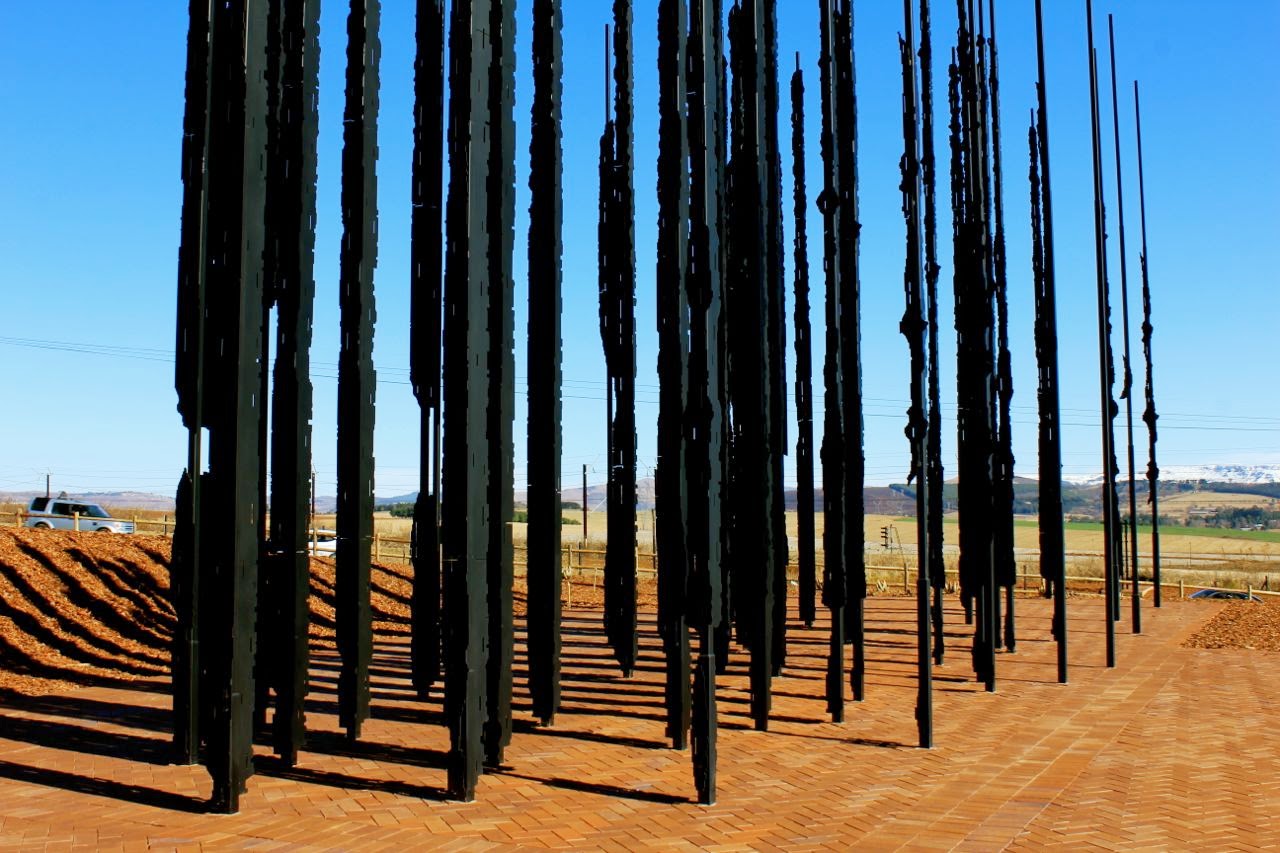
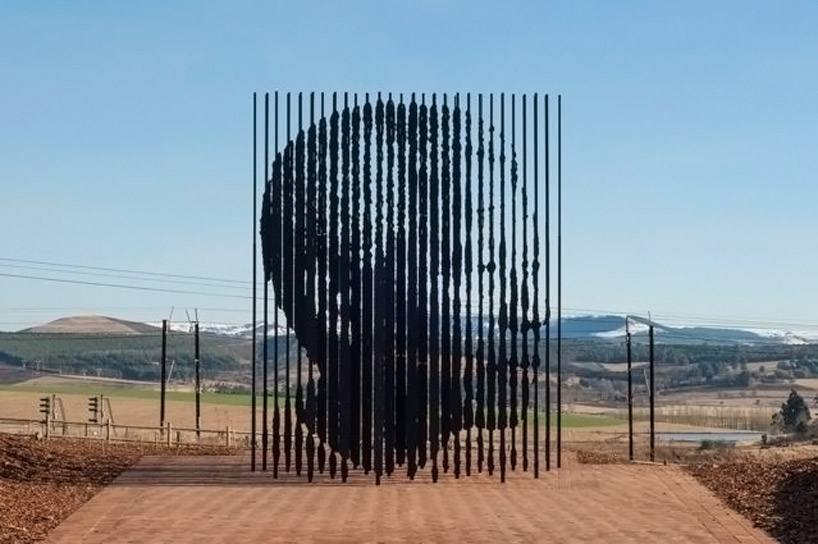
All you see is a seemingly abstract arrangement of 50 steel columns designed by South African artist Marco Cianfanelli.

Marco-Cianfanelli-Nelson-Mandela-Capture-Monument

We park the car and walk down the red-brick walkway towards the steel columns, the rolling hills a backdrop. A car passes behind every now and then, a reminder of events 52 years ago.

On that fateful day in August 1962, the Austin Westminster Mandela was driving was stopped and he was asked by the police if he was indeed Nelson Mandela.

“I am David Motsamayi,” Mandela replied, using the alias he acquired on his travels to Morocco and Ethiopia.

Later, after some questioning, Sergeant Vorster of the Pietermaritzburg police said:”Ag. You’re Nelson Mandela and this is Cecil Williams  and you are under arrest!

Mandela would recall that earlier he had seen a Ford V-8 filled with white people shoot past and that “in that instant I knew that my life on the run was over; my seventeen months of ‘freedom’ were about to end.”

About 35 metres from the steel columns, an optical illusion occurs, the distinctive profile of an elderly Nelson Mandela emerges, looking out contemplatively towards the green hills.

Behind him, you can see the spot where he was captured.

mandela21

While the 50 steel columns mark the 50 years from the time of Mandela’s capture to the sculpture’s completion in 2012, Marco Cianfanelli says they represent much more:

[They] suggest the idea of many making the whole; of solidarity. it points to an irony as the political act of Mandela’s incarceration cemented his status as an icon of struggle, which helped ferment the groundswell of resistance, solidarity and uprising, bringing about political change and democracy.

It is a wonderful tribute to the moment of Mandela’s capture and its significance in the struggle to free the country from the shackles of apartheid.

OLYMPUS DIGITAL CAMERA
It’s one of many beautiful and powerful reminders: museums, monuments, institutions that have sprung up since 1994 to keep the story alive of the struggle, of what was sacrificed, what was painfully endured and why.

Having spent some time gazing at the face of Mandela, we returned to the car park and had lunch in the tea rooms. An old friend, who lives nearby, joined us for lunch.

She told us that on the day Mandela died – just over a year ago on December 5, 2013 – she went with a young friend to place flowers at the monument. Many others who live nearby, had done the same.

“A few years back, when it was under construction,” she said, “locals were up in arms. The government was spending all this money and all you saw were these steel poles.”

The visit to the Capture Site was one of the last things we did in South Africa. We flew back to Melbourne a few days later after a wonderful holiday.

Of all the things we saw and did over almost four weeks – some inspiring, some depressing – the Capture Site memorial reminded me of the country’s incredible ability to tell stories, to make the past come alive for future generations and of its creativity and spirit.

Footnote, travels through apartheid history

I recommend the following for anyone visiting South Africa who is interested in exploring its history and democratic evolution:

the Apartheid Museum, which tells the story of inhumane racial policy of separation and degradation and the freedom that was eventually won,

– the Hector Peterson Museum and Memorial in Soweto which pays tribute to the students who died in the 1976 riots against forced education in Afrikaans,

Constitution Hill in Hillbrow, a former fort and jail where Mandela and Ghandi were imprisoned and now the home of South Africa’s highest court, the Constitutional Court and

Liliesleaf Farm in leafy Rivonia, the secret headquarters for the resistance movement in the 1960s.


Travels through literature, alcohol and America: A review of ‘The Trip to Echo Spring’ by Olivia Laing

The trip to echo springErnst Hemingway, F. Scott Fitzgerald, Tennessee Williams, John Cheever, John Berryman and Raymond Carver had at least two things in common: they are all giants of 20th Century American literature and…they were all confirmed, raging alcoholics.

These two commonalities are the basis for ‘The Trip to Echo Spring’ by English author Olivia Laing, a writer and book reviewer for The Guardian and The Observer newspapers.

The title of the book refers a line said by the sexually conflicted character Brick in Tennessee Williams’ great Southern play ‘Cat on a Hat Tin Roof‘.  He says it to indicate he is going to get a drink of whiskey: to numb the pain of his “mendacity”.

Laing sets out to explore how these six writers – whom she admired greatly and who shaped the course of American fiction – experienced, thought about, wrote about and dealt with their addiction to alcohol.

She does so by undertaking a physical trip across America in the Spring of 2011 starting in New York and staying in the Elysee, a hotel in Manhattan’s theatre district where Tennessee Williams spent his last days, and finishing in Port Angeles on the Strait of Juan de Fuca in the upper north corner of Washington State, where Raymond Carver lived the last years of his life  and wrote some of his best short stories while living with the poet Tess Gallagher.

In between, Laing heads down to New Orleans to sit at the hotel bar where Tennessee Williams came in for a drink and to pick up young men and to attend the annual Tennessee Williams Literary Festival, flies south-east to balmy Key West, Florida to visit Hemingway haunts, takes a train west to Baltimore and North Carolina to follow Fitzgerald’s own journey and then chugs out west to Illinois and Minneapolis, tracing the fatal path of the poet, John Berryman.

Amongst all this travel, are Laing’s reflections and contemplations of the alcoholic lives of these writers interwoven with meditative observations of the vast, constantly changing American landscape, mostly from her train window. She writes:

“In Alabama the earth was red and their was Wisteria in the trees. Somewhere deep in the country the train stopped in a pine forest. It was very quiet. A needle dropped lazily through the warm air. The woman beside me was on the phone…”

“Between Tuscaloosa [Alabama] and Meridian [Mississippi] we ran through uninterrupted miles of forest. The hills were covered in bone-grey timber, split and weather-worn into fantastic shapes. Then open country with cows grazing…

I awoke again at dawn. This time the world outside was white. North Dakota, flat as an ironed sheet.

The constant travel not only gives the book it’s part travel-guide feel, but also it’s momentum. Laing is not only on a journey to discover more about her literary heroes and their afflictions, but is also on a journey of self-discovery; making sense of a disjointed, dysfunctional upbringing and one washed through with alcohol. Her mother’s partner was a violent alcoholic.

One of the great strength of ‘The Trip to Echo Spring” and a sign of its success is that makes you want to go out and read (or re-read) the works of Williams, Hemingway, Cheever, Fitzgerald, Berryman and Carver, reminded as you are of their massive contribution to the world of literature despite the booze, blackouts, collapses, rehabilitations and relapses.

Raymond Carver

Raymond Carver

Just off the top of my head I could reel off a dozen books, plays and poetry collections I’ve now added to my “must read” list:

– The Glass Menagerie (Williams)
– Sweet Bird of Youth (Williams)
– For Whom the Bell Tolls (Hemingway)
Death in the Afternoon (Hemingway)
– Tender is the Night (Fitzgerald)
– The Great Gatsby (Fitzgerald – AGAIN!)
– Cathedral (Carver)
– Dream Songs (Berryman)
– Recovery (Berrryman)

Already, a copy of Cheever’s novel “Falconer” about a jailed heroin addict is waiting beside my bed and I’ve begun to read the opening scene of “A Streetcar Named Desire” from an old paperback that was tucked into the book shelf. And I am waiting for the opportunity to watch Cat on a Hot Tin Roof” starring Elizabeth Taylor and Paul Newman as Maggie and Brick.

Laing has great empathy for her heroes because of the writing they produced,  but she does not sentamentalise them, brush aside their faults or criticise their weaker efforts. Nor is their any glamorization of alcoholism:

[On Cheever’s drinking in 1966]: “…his drinking had passed well beyond normal measures now, even bearing in mind the norms of the time. When he wasn’t on location [filming his short story ‘The Swimmer’] he wrote in the early hours of the morning and by half past ten could be found twitching in the kitchen waiting for his family to disperse so he could administer the first self-soothing scoop of scotch or gin. If they didn’t leave quick enough he’d drive himself to the liquor store, where he’d buy a bottle, motor on to some pretty back street and sit there suckling, inevitably spilling a good slug down his chin.

All six writers were at times monstrous personalities, capable of inflicting great cruelty on their wives, children, lovers, friends and families: Raymond Carver almost killed his wife and was resentful of his own children, Tennessee Williams once defecated in a university hallway, John Cheever projected his closeted homosexuality into rage against his wife.

The book is rich with analysis of the works of fiction these writers produced as well as their non-fiction articles and memoirs. But she is no literary snob, relishing the opportunity to join a tour group visiting Hemingway’s home and museum in Key West or do a Tennessee Williams walk in New Orleans or enjoy meals with retired farmers on her train journeys.

The conclusions she reaches about these writers are not surprising – that they drank to deaden the pain of their childhood, their parents, their sexuality, their broken-ness, their perceived and real failures, while writing was a way to try to become whole again.

None,  apart from John Cheever, managed to stop drinking though they all tried. None lived into old age and two – Berryman and Hemingway –  died at their own hand.

But ultimately it is the journey that Laing takes you on through the minds and immense body of work of these giants of fiction that is the real joy

Not the destination.

Links:
An interview with the author, Olivia Laing  (Buzzfeed)
A review of The Trip to Echo Springs by The Times Literary Supplement
Olivia Laing’s personal website

Unhappy dick heads exhibiting passive-aggressive behaviour: a cyclist’s view of motorists

cycling“Bloody dick head”

Actually it sounded more like “Bludy deek hed” spat out from a scowling face hanging out the side of a white Camry as it hurtled past me.

The man, in a rage, was yelling at me and speeding up at the same time, admonishing me for cycling across the street in front of him, while at the same time trying his best to run me down.

In my opinion I’d judged things perfectly; I am not by any stretch of the imagination a reckless cyclist (unless being slow is considered dangerous), but the crazy, googly-eyed man in the white Camry decided I was and let me know it, shaking his fist like King Kong.

Only three time since June last year (when I began cycling again) have I nearly been run over, the other two times by motorists who didn’t see me as I sped down a hill in the dark.

This  was despite having two flashing lights attached to the front of my bike. In the one instant, having nearly driven into me, rather than apologize, the young bloke in a red Mazda started hurling insults my way: “Bloody dick head,” I yelled back, or words to that effect.

The other time, the young lady driver drove away sheepishly after I’d slammed on the breaks in the middle of the road, a hand raised meekly in front of her face, before speeding off.

But these near calamities have been rarities and I am thankful that most motorists are overly cautious around me, some to the point of driving on the wrong side of the road and straight towards oncoming traffic.

My general experience of cycling on a daily basis since June last year has been uneventful.

I’ve not yet encountered any psycho motorists who have deliberately tried to run me off the road, or over.  The most dangerous drivers appear to be the elderly, whose chief problem is seeing above the steering wheel or judging the width of the road or their car.

But riding on two wheels, propelled forward by your own sweat and toil while cars zoom past does give one an unusual perspective on those on four wheels.

If I can blunt: motorists are not a happy bunch, at least they don’t look happy when driving.

angry-motorist-wants-angry-joggerThey sit hunched over their steering wheels, they snarl and they grimace. There is a zealous, craven look in their eyes.

If Freud had ridden a bicycle, he might have gained great insights into the  passive-aggressive personality type.

It seems to defy common sense that motorists deliberately ram the bottom of their cars over speed humps, rather than slowdown.

And while they for the most part, avoid hitting me, I’ve noticed another passive-aggressive tendency: speeding up extravagantly when passing me and then looking back at me through the rear view mirror to perhaps check that a) I am still upright and b) to remind me (with a nod to George Orwell) that, four wheels are always better than two.

Of course, I probably look peculiar to motorists, a heavily bearded man in an ill-fitting helmet and business clothes peddling a noisy bike up a hill, occasionally cursing the pensioner flying past.

A little while ago, an elderly lady passed me while cycling up a hill appearing to whistle and hardly trying at all. I was infuriated and vowed to pass her.

As she disappeared further and further into the distant: a bobbing grey-haired speck in high vis yellow, I furiously pedaled cranking my way through the gears until my thighs threatened to seize up and my chest burned. She was probably sipping a cup of tea by the time I pushed my bike through gate red-faced.

And I can only wonder what another older woman hidden behind a rose-bush in her immaculate garden thought when I decided on afternoon on my way home that it was safe to raise my butt cheeks triumphantly off the saddle and  expel and noisy, violent fart.

Wearing gloves and holding a pair of pruning scissors, her head appeared from behind the tree, while her nose twitched the freshly scented air.

“Bloody dick head” perhaps she muttered under her breath.

Writing well: 10 useful tips for feature writing from the pages of the Wall Street Journal

art and craft ofA couple of months ago, a colleague, pressing me to get started on a feature for the Australian Financial Review, the newspaper I write for, suggested:

“Have a big glass of red wine and then just start writing.”

I should put some context around this. I don’t drink wine at work as a rule. I was going to function, where wine would be served. Then I would come back to the office.

My colleague’s rationale: it would free up my creativity.

I took his advice, and the end result was good, but the story certainly did not flow out of me like….fine red wine (perhaps the quality of wine ingested matters!)

Feature writing is challenging. There are many different things to pull together – people, events, themes, counter-arguments – and to do so well is as much technique as it is flair, talent or creativity.

My technique, until recently, was a stop-start approach of firstly trying to come up with the lead (the opening paragraphs) which usually involved numerous attempts, re-writes, teeth grinding, coffee break, chat with colleagues etc before finally making a start. Then I’ll write to the length required and then arduously work back, trying to create some kind of flow and rhythm and to give a point to it all.

But there are better, more structured ways to go about writing features (not that writing should be easy, good writing requires effort, sweat and toil).

I recently came across a useful book recommended to me by Michelle Griffin a very experienced journalist at The Age, who has also been my mentor the past 8 months.

She suggested I read: “The Wall Street Journal Guide to The Art and Craft of Feature Writing” by William E. Blundell, himself a journalist with the esteemed newspaper

It’s an old book, first printed in 1988, but you can get a newish reprint online. I bought a copy from the Book Depository and read it cover to cover, slowly, underlining parts on the way into work, trying to ingest some of Blundell’s tips, tools and techniques for telling better stories; after all isn’t that what feature writing really is?

As Blundell puts it: “We can learn a great deal from fiction and this book makes at least a modest start to connecting some techniques of fiction to the work we do.

The book is helpful on many levels, for example the opening chapters are about generating ideas and coming up with the raw materials for a good feature and I suggest reading it cover to cover.

What I found most useful where the practical tips for the writing process itself. These are 10 to keep in mind:

1. Write out your main theme statement

In a couple of simple, tightly written sentences express the story: its main developments, likely effects and reactions to them.

If writing a profile, the theme statement  should be the facets of the person, company or organisation you plans to focus on.

“Tack this main theme statement up where  you can see it. Let it guide your work. Let it reproach you, question you, when you stray too far,” Blundell writes, adding; “I consider the main theme statement the single most important bit of writing I do on any story.”

2. Have a plan

“The only important thing is that you have a plan, however loose and informal and use it to good effect”, says Blundell. Good writers, plan before they report and again before they write.

3. Readers love action

“The story that does not move, that just sits there stalled while people declaim, explain, elaborate and suck their thumbs is justly labeled by some editors as a MEGO – “My Eyes Glaze Over”,” writes Blundell.”The most desirable kind of movement is the unfurling of natural story progression.” To do this stories must shift the reader’s attention from “the abstract to the concrete, from the general to the particular, from the mural to the minature.”

Feature writers are storytellers. “We are in the drama business,” Blundell declares.

4. People with direct experience are better than ‘experts’

I think this is particularly useful as many journalists quote too easily from “certified somebodies” rather than “little people with direct experience”.

I heavily circled this paragraph: “The story is happening on streets where there are no PR men strewing palms in the reporter’s path, no computers disgorging blocks of seductive statistics and a lot of people who have nothing to gain from doing pirouettes for the press…we have to gather details and direct experiences that show the reader what we are talking about, that convince him of the truth of the sweeping assertions made by us and our desk people. Most of all we go there to convince ourselves.”

5. Skim read through all your material beforehand

Often, I don’t do this. I go back and forth looking for what to include in various documents. It’s an exhausting process and sucks up vast amounts of time.

Blundell’s advice: Skim through all interviews and documents. Read rapidly, not for mastery of detail, but for the sense of things. Put aside material that is irrelevant or weakly repetitive.

This will help refine and define your main theme statement and story plan.Blundell also suggests creating an indexing system where you group things in a logical manner. This may be vital for very long stories, but I find it overly complex. A couple of theme sub-heading and a few notes about what to include under each theme should do the job on shortish features.

6. Keep digressions short, return quickly to the action

Anything that is not action is digression: observations, quotes, explanations and descriptions. Blundell’s advice: Keep it short and sharp, or as he says it: “Hustle the reader over the lakes as rapidly as you can to get his vessel back into white water – story action.”

7. The lead is key, but can be left till later

The lead is what draws a reader in, gets him to make an investment of his time in your story right away. Blundell says a good lead intrigues, teases, gives you a reason for reading on. Many of the best leads he says have one quality: mystery.

The book is full of numerous examples of good and bad writing. I’ll just transpose one example he gives of a good lead:

“Crowded with 346 passengers and crew members, the Turkish Airlines DC-10 rose smoothly from Orly Airport in Paris bound for London. Terror came at 12,000 feet.”

Mystery is good, but not confusion or riddles. If mystery does not work for your story focus on urgency or telling the reader that something compelling is happening.

An anecdote or quote is a popular way to start a feature, but Blundell says it should be simple to understand and have relevance for the main theme of the story.

Often, the lead can be a retooling of the main theme statement, especially if you are struggling to come up with one.

However, don’t spend hours at the beginning of the writing process coming up with the lead, unless one comes naturally to mind. Write the main body of the story and come back to it later.

8. Don’t overuse numbers and statistics

Blundell’s advice – don’t overload readers with too many numbers.  Also, he says express them in their most simplest form, rounded-off, expressed pictorially (something “doubled” or “trebled”) or as ratios. Very large (or very small) numbers are better expressed in a way that can be visualised. E.g. “It was three times the size of New York City’s Central Park”

9. Choose your quotes carefully and sparingly

Too many people quoted in a story, not saying anything that is particularly interesting will drown out those who do have something worthwhile to say.

Blundell advises avoiding quotes that state the obvious (the writer should be brave enough to state these points themselves). He says good writers are merciless about who they include and exclude. A good quote should have: credibility, draw an emotional response, be trenchant (sharp, incisive, authentic) and add variety to your story.

10. Endings are important

Blundell suggests that good endings drive home the established theme and help readers remember all they have been told. He says there are three that seem to work well:

– Circling back: reminding the reader of the central message through “symbols, emotional responses, observations, even snippets of poetry”. It should be full of echoes and overtones of the body of the story.

– Looking ahead: “What might be useless speculation clogging up the middle of a piece can become evocative material at its end,” Blundell says.

-Spreading out: You end by giving the reader something new to think about. The ending makes the story bigger than it was before, something worth remembering.

These are just some of the tips I picked up from the book and have found useful.

Of course none of this matters if your idea is weak, ill-conceived, poorly researched, of little gravitas or just plain boring.

Every great story begins with a great idea.

Happy writing, storytellers.

The most dangerous animal: Was the Zodiac Killer Earl van Best?

zodiacA new book claims to have unmasked one of the most notorious serial killers, the Zodiac Killer who terrorized the San Francisco Bay Area in the 1960s and 70s, murdering at least seven people, terrorising the city and taunting the police and newspapers with cryptic notes and undecipherable cyphers and cryptograms.

It’s written by Louisiana businessman Gary L. Stewart and has the enticing title: “The most dangerous animal of all: Searching for my father and finding the Zodiac Killer.”

So enticing (the title refers to a letter the Zodiac wrote claiming ‘Man is the most dangerous animal of all’) that I picked up a copy and read it. And so have millions more, with the book earning a place on the coveted New York Times best-sellers list backed by a big name publisher, Harper Collins.  All of which lend kudos and credibility compared to the many alternative theories about who the Zodiac Killer may be.

Stewart tell the story of his father’s crimes in a “novelistic manner” and while it’s no ‘In Cold Blood’  events moves a long at a fair pace, and are neatly described with the help of journalist and crime writer Susan Mustafa.

The book begins in 2002 with Stewart, adopted at birth and now in his late 30s, the director of a Louisiana cleaning company, who receives a phone call from a woman called Judy, who says she is his birth mother.

They eventually meet in San Francisco, form a relationship and then the question about who his father was becomes something he must answer.

Judy is reluctant to tell him and for good reason. It later emerges that she fathered him at age 14 in 1962 after running away to Mexico City and later New Orleans with a manipulative, creepy man twice her age called Earl Van Best Junior or ‘Van’ as he was known. The case attracts media attention with the San Francisco papers calling it the “The Ice Cream Parlour Romance” because met Judy outside an ice-cream parlour when she got off the school bus.

ice-cream-romance

We are told the story of Earl’s early life as the son of a highly respected army minister, but later forced to live with his mother, Gertrude, a cold, unloving adultress whose only contribution to her son’s development is to teach him to play the organ.

As an alienated, unhappy young man, Stewart narrates his father’s obsession with  13 year old Judy, his various arrests and imprisonments, his numerous trips to Mexico to obtain antique books and manuscripts to sell in San Francisco, his mingling with Satanist Anton LaVey’s harem in Haight Ashbury and his violent, spontaneous crimes, cryptic notes and games with the police and newspapers.

Stewart recounts the various disturbing murders as they have been told so many times before in books, true crime documentaries and movies, but using the chilling words “my father” when referring to the horrific stabbings and shootings.

He later discovers that Earl Van Best died in Mexico City in the 1994, choking on his own vomit and visits his unmarked grave. Here he makes a startling confession:

“I loved this man in some inexplicable way. He was my father. We were bound together by some invisible, unbreakable rope.

Among Stewart’s reasons for thinking his father was the Zodiac are:

  • his resemblance to the police identi-kit of the Zodiac Killer
The police sketch of the Zodiac Killer and Earl Van Best

The police sketch of the Zodiac Killer and Earl Van Best

  • the army intelligence skills Van had learnt from his own father to create undecipherable ciphers
  • his cruelty and criminality
  • that his time and out of jail corresponded with the murders
  • that the name “Earl Van Best Jr” can be found in the ciphers
earl van best cipher

One of the Zodiac cyphers which Gary Stewart says reveals the Zodiac’s real name – Earl Van Best Jr

  • matches in the handwriting of ‘Van’ and the Zodiac letter, corroborated by a hand-writing analyst
  • a scar on his father’s finger that appears to match that of a fingerprint taken off the Zodiac Killer

The book is quite convincing, not least because you’d wonder why anyone would wish to assert that their father is a notorious serial killer, unless they were fairly certain. Of course, there is also the lure of some kind of celebrity and the royalties earned from publishing a best seller.

But the one key piece of  evidence tha would prove Stewart’s claim beyond doubt, namely DNA matching, is missing.

(It is DNA matching which appeared to prove that Jack the Ripper  was a Polish immigrant called Aaron Kominski but this has since been disputed to an alleged error by the scientist)

Stewart writes of the many years he has battled to have the partial  Zodiac Killer DNA (taken off a stamp affixed to one of the taunting letter he sent out) compared with his own DNA to prove his father was the serial killer.

He claims a San Francisco police cover up has prevented this from ever being tested. The reason for the cover-up: his mother Judy’s marriage to ground-breaking homicide detective and later deputy mayor of San Francisco Rotea Gilford (the first black man to achieve both those positions), who worked on the Zodiac case and who died in 1998.

The SFPD, Stewart suggests, has stalled the testing to protect Gilford’s name  were it to emerge that he married the teenage bride of the Zodiac Killer.

As with Jack the Ripper, a veritable community of amateur sleuths and conspiracy theorists exists to weigh up the evidence and suggest theories about who the Zodiac Killer really was.

The most comprehensive website is zodiackiller.com, which recently celebrated its 16th anniversary and claims to get 10 million hits a month. It’s run by Zodiac fanatic Tom Voigt. He gave Stewart’s book just one star in his review on Amazon.com, systematically dismissing any link Stewart has claimed between his father and the Zodiac Killer:

Stewart claims his father looks like the Zodiac – Voigt writes: “Open any high school yearbook from the 1960s and half of the males pictured will resemble the sketch of the Zodiac killer. It’s not “evidence” of guilt. Not impressed.”

Stewart says his father’s name is in the codes – Voigt’s response: “So is mine. So is yours. People have been finding what they were looking for in the codes for 45 years. This is nothing new. It’s not evidence” of guilt. Not impressed.”

(On this point, I have to confess, I have trouble understanding Stewart’s explanation for finding his father’s name in a Zodiac cryptogram.)

There are a dozen people who claim to know the identity of the Zodiac Killer. These include Dennis Kaufman who claimed that his stepfather Jack Tarrance was the Zodiac Killer, but whose claims were later discredited.

The most famous suspect is Arthur Leigh Allen a schoolteacher, named by former San Francisco Chronicle journalist Robert Graysmith in what is considered the best book on the murders, ‘Zodiac’.

Graysmith’s book formed the basis for the exceptionally disturbing and very good 2007 David Fincher movie. Arther Leaigh Allen denied all his life he was the Zodiac killer and his DNA was later found to not be a match for the partial DNA obtained from the stamp. (The DNA itself may be a red herring, as there is no proof the Zodiac Killer licked the stamp affixed to the envelope, something Stewart does admit to in his book.)

But Gary Stewart remains convinced that his father, Van, is the Zodiac as he writes at the end of the book:

 I have handed the SFPD their killer. I’ve given them motive, means, opportunity, a forensic handwriting match, identical scars, and my father’s name embedded throughout the Zodiac cyphers. And I have DNA profile of my father waiting for comparison.

The legion of Zodiac ‘experts’, disagree and why wouldn’t they, after all – what would they do, if the mystery was solved.

Black people with cockney accents and London flatshares: A tribute of sorts to Clive James

clive james bookI’ve started re-reading Clive James‘ second wonderful memoir “Falling Towards England” which recounts ‘our hero’s’ migration from Sydney to London in 1962.

I loved reading all of James’s hilarious, witty and erudite memoirs and it is a real treat to dip back in to the early year’s of one of Australia’s finest literary exports.

It is an endeavour tinged with sadness and nostalgia: sadness because Clive James has a terminal illness and because reading his memoir stirs up so many London memories for me.

I am only 40 or so pages into “Falling Towards England” where we find ‘our hero’ virtually penniless, rejected for numerous writing jobs, ill-prepared for the English winter and frequently surrounded by ill-mannered boorish South Africans, or ‘voortrekkers’ as he calls them who don’t like it when the ‘bleks’ talk back to white policemen on television.

James captures perfectly the harsh Afrikaner accent and the mentality of the neanderthals he was living with at the time:

“That’s what’s rewning Efrika,” said a voice from a winged chintz chair, ‘litting a keffir talk to them like thet.” Another chintz chair agreed. “Thet’s right,” it said. “They mist not be allowed to enswer beck.”

I remember with great clarity on my very first trip to London with my mother, aged 13 in 1987, when there was still an anti-apartheid protest moored permanently outside South Africa house on Trafalgar Square, walking into McDonald’s for the first time (that too a novelty) and hearing the black man in dreads behind the counter ask me what I wanted in a thick cockney English accent. I got the shock of my life.

“The bleks are not supposed to talk like thet,” is probably what raced through my naive South African head at the time.

Beyond that funny re-collection, Clive James’s depiction of flat sharing in the 196os  reminded me of my own early years in London (I was there from 2000 to 2004), when I lived above a kebab shop on Brent Road, Hendon.

The top floor flat above "Flame" kebab shop was my home for three years

The top floor flat above “Flame” kebab shop was my home for three years

Of course, I didn’t have to feed money into a heater to generate some warmth as James did and my finances were not quite as dire as his – my first full time salary was £16,000 a year working as a ‘content developer’ for Accountancy Age on Broadwick Street, Soho.

I do though remember the barrenness of my little room with its pigeon-shit encrusted window that overlooked some miserable discount shops, a ‘caf’ where you could get breakfast for a few pounds and my local Tesco, where I witnessed numerous disputes between the staff and local yobbos, attempting their daily ritual of shoplifting bottle’s of Winkleigh’s White Lightning cider.

My landlord was a kindly, jovial Jewish man called Harold Schogger who ran the local bridge club on the floor below our third-floor flat. Coming home from work, I’d have to make my way past a posse of bride club players filling the air with a dense cloud of tobacco smoke (One later had a heart attack and died on the landing).

My first flatmates were as follows:

  • Andy and Dave, who both hailed from Rochdale, near Manchester in the North of England. Andy, a chubby, bearded fellow, fond of eating but not washing up and Dave, a quieter, intellectual type with the eyes of kindly badger, whose chief pre-occupation was smoking marijuana on a fairly continuous basis
  • Sagey, a lanky, pony-tailed Israeli, who spent large parts of the day and night in his lair (the biggest room in the flat) smoking dope, and shagging women (the moans reverberated through the passage walls). Sagey would sometimes invite me into his darkened den for a smoke and to watch a movie.  I would sit on a large poof in the cozy lounge area he had created next to his bed, getting deeply stoned, watching something or other on Sagey’s television.
Brent Street Hendon, where I Lived above the kebab shop

Brent Street Hendon,

My evening activities home from work via the Northern Line began with concocting some kind of meal in our narrow little kitchen usually piled up to the ceiling with dirty plates, or grabbing a kebab from the Afghanistani  who ran the shop below our flat. Then I would sit with Andy or Dave watching something or other on television (the Frank Skinner show was a favourite) as they passed joint after joint around the pungent room.

I must confess here to mild theft – having asked Dave, for a bit of weed one evening, I discovered that he kept it in a drawer by his bed. Later, when my own stash ran low, I’d help myself to some of his when he’d left work for the day – never too much to arouse suspicion, but enough to get me “nicely toasted”. For this act of treachery, I do apologise to Dave, where-ever he may be these days (probably stoned somewhere).

My old landlord and bridge club mafioso, Harold Schogger

My old landlord and bridge club mafioso, Harold Schogger

Thus I spent much of my first two years in London in a weed-induced trance, often finding myself up past midnight flicking through the endless channels of Sky TV. Or else, taking the bus up Finchley Road to visit my friends in a share house in Golders Green.

Over three years, a whole stream of eclectic and eccentric characters came and went from the three bedroom flat above the kebab shop. There was:

  • Debbie,  curly-haired aspiring singer from Cape Town, who aroused the passions of the local drunks in the nearby pub, when she sang show tunes for them (and who rejected my advances on the living room couch)
  • Jacqui,  a lovely ‘older’ woman (she was in her 40s to my late-2os) with a high-pitched voice, red-cheeked face, who took up the violin with great passion
  • Joe, a googly-eyed school assistant, drug fiend and cyclist, fond of opium-dealing in our living room, whilst quietly building a North London property portfolio
  • A good-looking Spanish guy (his name has disappeared from memory) who received phone calls on our landline from Europe at all hours of the night and whom I distinctly remember hating.
  • Two Israeli girls, one fond of loud bonking (though not with me), the other…sleeping (she worked the 11pm to 7am shift at John Lewis)
  • and many others whom have disappeared in the marijuana haze.

I remember those flat-sharing days in much the same way as  Clive James recalls his formative months in London with poignancy, hilarity, shocking embarrasment and a great deal of nostalgia.

There was also plenty of rejection and a fair degree of loneliness too among those years.

I recall being turned down for half a dozen other flat-shares,  inviting places with big open plan lounges, people that dressed well and leafy gardens.

I remember those experiences like Clive James wrote them, where each incumbent resident “wants to interview you personally before okaying you for the shortlist, after which the final selection is by written examination”.

In the end, I think I got the room in the shabby flat above the kebab shop because no one else wanted it, but at the time it was a cause for major celebration: London, I had arrived!

The flat is no longer there, given way to some apartment development, but the bridge club has remained.

And the kebab shop, where I paid frequent late night visits drunk or stoned, is still there, serving its greasy fare.