It’s a little over an hour by bus from Krakow, an unimaginably beautiful medieval city to the concentration camp of Auschwitz.
We travel in a claustrophic, airless mini-van, which picks up people along the route. No one says much.
By the time we reach the little town of Oswiecim (renamed “Auschwitz” by the Nazis) we have passed rolling hills and green Polish countryside, traversed and dippped through narrow valleys and stared at plain but pretty one-storey farm-houses with ducks and chickens pecking at the ground.
The min-van is packed to capacity and stifling hot when we disembark and some travellers have to bury their heads in their hands to fight off the travel-induced nauseau.
Incredibly, the town now bares the inscription: “Oswiecim: city of peace”.
The two camps of Auschwitz are joined by a free bus service.
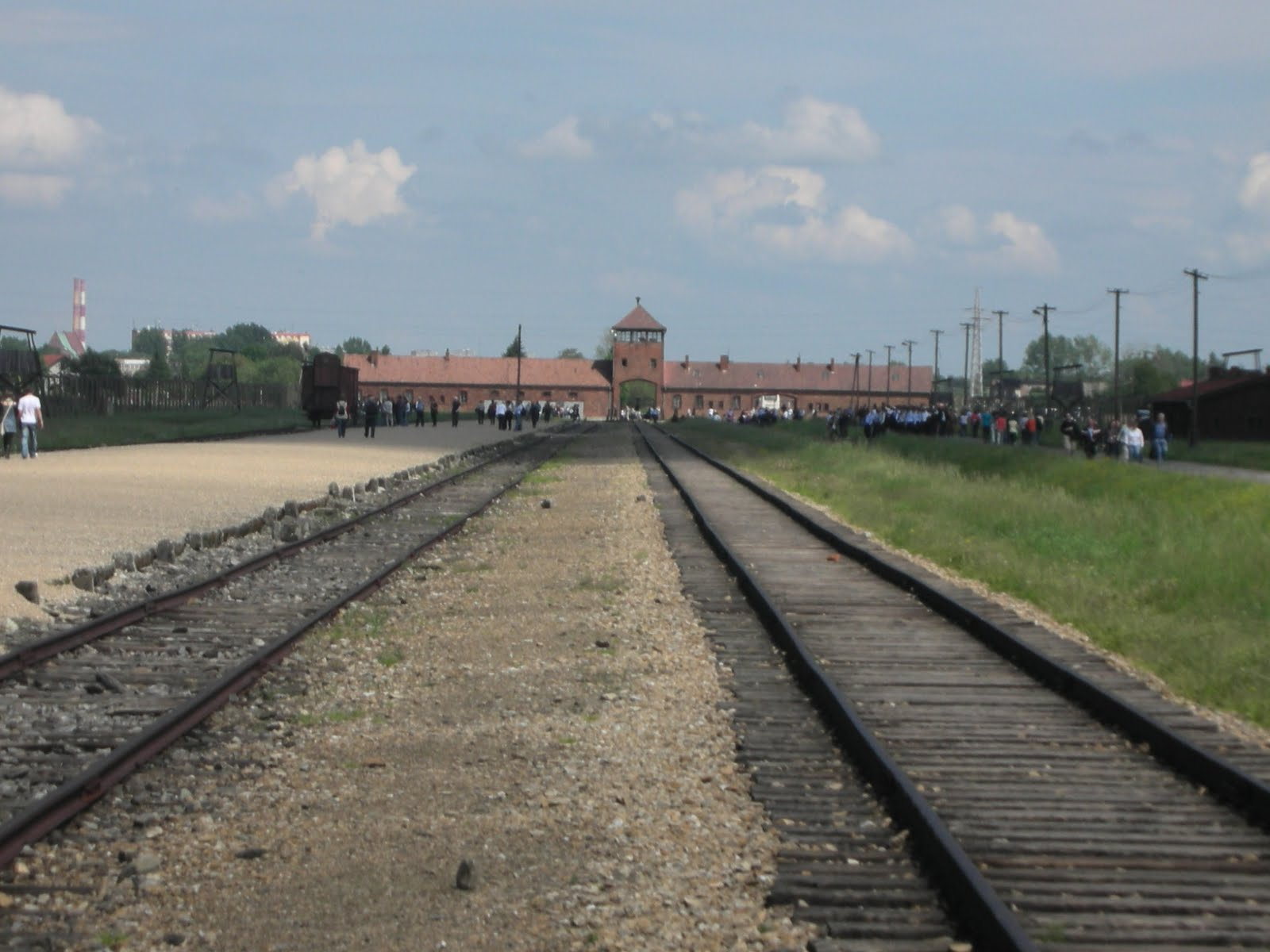
We first go to Birkenau, the size of many dozens of football fields, fronted by the train tracks and famous red watchtower, though which so many of my ancestors passed through in cattle trucks into suffering and death.
Though I am not a practicing Jew, I did feel a strong connection with this place amid all the tourist buses and school kids to young to comprehend what really went on here 70 years ago.
It’s strange though to visit in summer.
While it was overcast in Krakow when we left in the morning, the sun has now come out and the clouds had parted.
Alongside the once electrified barbed wire-fence, there are purple and yellow flowers growing among the wild grass and there are shady trees that offer respite from the sun, and the possibility – were it anywhere else – for a picnic.
There’s even a pleasant little stream that trickes and babbles nearby.
But’s there’s nothing pleasant about Auschwitz, even though nature has reclaimed some of it.
The sheer size is overwhelming. It’s enormous.
At its peak there were 100,000 people living here under the most appalling conditions.
A lot of the dark, wooden barracks remain standing, what’s not there – the people shuffling in the snow, the guards shouting and laughing, corpses piled on on top of each other, the smoke – you can fill in from what you’ve seen in black and white newsreels and the movies.
Each of them housed as many as 1,000 people.
We wander into a barrack and listen to a guide tell a tour group that the prisoners were only allowed to go to the toilet twice a day and because there were so many of them, they only had about 40 seconds to use the latrine. Just one of many awful stories.
At the far end of the camp, at the end of the railway line, in front of a tall, swaying trees, are the remains of the gas chambers and crematoria. They were blown up by the Nazis just before the camp was liberated. Despite the heaps of rubble you can see the steps down which prisoners were led to the changing room where they were forced to strip before being led into the “showers”.
It’s nearly afternoon. We eat our lunch, but feel wierd about it. I guess its natural. There’s probably a restaurant somewhere.
We take the bus to the main camp.
Auschwitz main camp is a series of brick barracks originally built for the Polish army barracks houses the museum and is jam-packed with tour groups of all nationalities and languages. It’s annoying and frustrating as the tour groups take up all the space and you have no time to really contemplate what is before you.
In the dingy basement there are windowless cells where prisoners were tortured and sentenced to starve to death.
Above ground, the barracks house the famous collections of hair, glasses, tooth brushes and artficial limps in huge mountainous piles, behind glass.
Unlike the Dachau concentration camp on the outskirts of Munich, where the museum assaults you with information, here the information is relatively succint, leaving you to take in the exhibits, when you can avoid the tour groups and their noisy interpreters.
The walls of the barracks are lined with photos of prisoners admitted to Auschwitz including their date of arrival and death. Some lived only a few days, some a few months and some more than a year or two.
How to survive such a hell hole for a day let alone a year, I just cannot fathom.
Then I remember we had a school teacher, Dr Yageel, who was a holocaust survivor and had a tattoo on his shoulder bearing his prisoner number. I remember him to be a short man, with a beard and a lined, sorrowful face. I think he may have taught our class on a few occasions.
Incredibly, as a pupil at a Jewish day school, I never really thought about what he went through or took the time to chat to him.
I don’t recall any of my classmates, me included, paying him the kind of respect he deserved. I wish now I could shake his hand.
At one point I found myself humming the tunes of a song we sang at the jewish day school I attended in South Africa, a song that I had forgotten or buried deep in my memory…
Yerushalayim shel zahav
Ve-shel nehoshet ve-shel or
Ha-lo le-khol shirayikh
Ani kinnor
(Jerusalem of gold,
and of bronze, and of light
Behold I am a violin for all your songs.)
Recently I watched Schindler’s List.
The same song is played at the very end of the film as the real holocaust survivers, many of them now elderly, accompanied by the actors who played them in the film, lay stones on the grave of Oskar Schindler in Jersualem.
And then its time to go. Auschwitz the museum is closing. There’s the museum shop with books and post-cards as you exit and you can buy soft drinks, chocolates and crisps.
Then its back on the bus – a much larger one this time. The driver is a little crazy. He picks a fight with a speeding motorist and nearly has an accident cutting him off.
We arrive back in Krakow. It is not yet dark. It’s the Polish summer.
 Freshlyworded