Jetstar’s air sickness bag: proudly brought to you by Buderim Ginger sweets

Advertising is everywhere these days.

I’m travelling on Jetstar from Melbourne to Queenstown, New Zealand.

The doors are closed. The cabin crew complete the formalities.

As we taxi and await our turn on the runway I undertake the pre-take off ritual of going through the seat pocket in front of me.

There’s the in-flight magazine with its features on far-flung destinations on the Jestar route, exercises to prevent deep-vein thrombosis, some duty-free shopping and the crossword and Sudoku that someone’s already filled in.

Then I pull out the familiar white paper bag, only it’s not.

At the very top: it reads as standard “If affected by motion sickness, please use this bag.”

But underneath there’s this in capital letters:

“FEELING  A LITTLE QUEASY? GET NAKED (WHEN YOU GET HOME!)”

Huh?

And on the left-hand side a photo of Buderim Ginger’s sweet ginger pieces (complete with naked venus)

On the right, there’s a story about the painter Boticelli painting the “Birth of Venus” and possibly starting his day with a bit of ginger in his cereal and then a history lesson about how Marco Polo brought ginger to Europe in 1293 and some handy hints on how to enjoy your ginger.

Image

I turn the bag over.

On the other side there’s a recipe for “MAKING DELICIOUS GINGER BEER AT HOME” using Buderim Ginger Refresher Cordial, which I am told is “the perfect summer drink” with soda water or “great with lemonade” or just plain “icy water”.

Image

There’s even a word search puzzle to do underneath with words including “ginger”, “refresher”, “Buderim”, “Australian” and “supermarket”

I mentally join the dots and create my own slogan:

“Need a refresher? Get your Australian Buderim Ginger cordial the next time you’re at the supermarket.”

Brilliant, I should be in advertising, or maybe even a guest panelist on the Gruen Transfer

And that’s not all, written down the one narrow side of the bag:  a recipe for making Buderim Ginger’s world famous scones and on the other side there’s eight interesting facts about ginger including that “In Merry olde England, ginger was called the royal spice…and rumour has that it cost more than gold”.

The paper bag now safely stowed back in the seat pocket (and not intended for use) I’ve yet to decide if this is all a stroke of marketing genius (given that ginger is used to treat nausea) or some sick joke on those already queasy by suggesting they remove all their clothes, eat a packet of sweets, think about baking some scones, drink a soda or perhaps do a word search puzzle.

But it does go to show how far the claws of advertising can stretch and perhaps its the marketing department at Jetstar that is the true genius for thinking of selling the space on the vomit bag in the first place (perhaps it was Buderim which approached them with the idea).

There’s advertising in movies (via product placement), there’s advertising, above men’s urinals when you’re peeing (do women have anything to look at I wonder?), there’s advertising on train windows and now Buderim has paid Jetstar to advertise their ginger beer to those suffering from motion sickness.

I never made it to the toilet during the flight, but I wonder if Jetstar toilet paper comes with product advertising?

If not might I suggest an ad for Inner Health Plus to relieve constipation with this slogan:

“If  your bowels are moving, taker Inner Health Plus to get them grooving.”

Train surfing: the latest (deadly) teen craze?

train surfingHave you ever heard of train surfing in Australia?

I was on the Craigieburn train from the city this week and three kids got on. They were probably around 15 or 16 years old.

As we approached Essendon station, one of the kids, the skinniest one, made his way to the door and then popped out onto the platfom.

“Are you going to surf this train Paco?” his two mates asked as he disappeared from view.

In between remarking on how crazy their mate Paco was, the two mates stuck their heads out the train at each station to check if he was presumably still hanging on to the roof of the train or had fallen off.

This was done with a mixture of admonishment and admiration as if they wished they were as crazy as Paco, but glad they weren’t nearly as brave.

This apparently is “train surfing” – climbing onto the roof of the train and “surfing” it while it moves.

As we headed towards Oak Park, a train coming in the opposite direction whizzed past at what felt like 200 km per hour.

Was Paco still hanging on or was he a bloody, mangled corpse lying on the tracks betwen Glenbervie and Strathmore?

His friends didn’t seem too bothered.

At Pascoe Vale station, one stop before I got off, Paco’s mates got off and wandered off down the platform, without Paco.

I got off the train at Oak Park and as the train left the station I waited for it to pass to see if Paco was still hanging on, no doubt grinning.

Put there was no Paco. Who knows where he was? Had he gotten off earlier? Was he ever surfin the train? Had he fallen off?

In May last year The Age newspaper reported the story of a teen who fell off a train on the Sandringham line, critically injuring himself, while train surfing with his mates.

In January, a teen died after being electrocuted after train-surfing. He was sitting on the roof of the train.

In 2004, a 14 year-old boy had both his legs amputated after falling off a train while train surfing in the UK.

There are a three basic requirements to be a train surfer:

Firstly, you have to be a complete idiot.

Secondly, you have to have friends who are also hopeless idiots as well.

Thirdly, you have to believe you’re invincible.

Snake-infested Australia: my own encounters with slithering creatures

23046917_a9950a839aAnyone reading news about Australia lately might be forgiven for thinking the country is overrun with snakes, that we are fighting them off on our way onto trains and planes, in hospitals and in our homes.

The stereotypical view of Australia as a dangerous place full of things that sting, bite and maim has been given an added twist recently with some truly bizarre snake-encounters that have made the news.

There was the story about an inquisitive three-year-old boy from North Queensland who found a nest of nine eggs in his backyard, put them in a plastic takeaway container in his cupboard, only for them to hatch as deadly brown snakes – poisonous from birth.

There’s this tale about a Tiger snake found in a hospital bed in Melbourne and most recently, this rather sad story about a scrub python – the largest snake in Australia – which was filmed at thousands of feet above sea-level in a life and death struggle on the wing of a Qantas aeroplane flying from Cairns to Port Moresby.

All these incidents have given me cause to reflect on my own encounters with snakes in Australia, of which I have had a few.

First, I should begin by saying that unless you live in the country or tropical Queensland (which is rather snake-infested), the chances of encountering a snake in the city or even the suburbs is pretty rare.

On a rainy night in the Valley…

That being said, I first crossed paths with what I believed to be a very large python one rainy night.

I was walking home from Fortitude Valley, the entertainment quarter of Brisbane down Brunswick Road, a steeply dipping road lined with shops, houses and apartments and it was pouring with rain.

Now on occasion, after one or two beers too many, I had mistakenly identified, late at night, fallen branches as would-be serpents, only to discover that they were nothing more dangerous than something to trip over.

However, on this night in question, as I walked through a section of shops and cafes – all closed and quiet, an enormous snake slithered a few metres in front of me, across the pavement and under a house converted into a shop – most houses in Brisbane are raised above the ground (they’re called Queenslanders) so they make a nice spot for a snake to find warmth and shelter.

Well I got quite a shock upon realising it really was a very big, very real, very live snake and that if I’d been a bit more drunk and a just a little bit more careless I could well have stood on it!

A snake in the eaves…

The two other encounters with snakes that are worth mentioning both occurred on a farm we were living on in the outskirts of Sydney near Hornsby on the North Shore.

It was a big old house with acres of land where my sister-in-law had horses and there were rabbits and colourful birds.

We spent most of our time in an enormous front room with floor to ceiling windows that looked out over the fields and the horses – it was quite an idyllic place really.

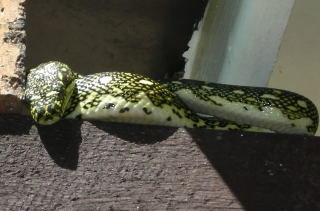
One morning, as we got up to go out for breakfast – it must have been the weekend – I closed the front door of our front room and noticed something green and glistening just underneath the roof.

This is what I saw:

snake

Looking down at us, its head resting just over  a wooden ledge, we all got the shock of our lives.

I remember  we called the wildlife number, who told us to ignore it after I described the appearance of the snake on the phone and then I rushed out and bought a book of  Australian snakes to identify the specifies.

It turned out to be a diamond-backed python, and it became a regular visitor on the farm. I would often see it winding its way through the vine leaves in front of the double doors of the front room.

On one occasion, the snake did so while we had a guest staying over who swore she would drive all the way back to Sydney (about an hour away) if she saw the dreaded snake.

Her back was facing the window and she had absolutely no idea the snake was only a metre or so behind her – though behind the doors.

I actually grew to really like the snake, it had beautiful markings and never ever bothered us, content with its position up in the roof (though later I learned, after we moved out, that it crawled into the house and over the sofa one night).

Snake in the car…

My last snake tale is a bit sad.

I had parked my car on the grass to clean it and then later driven to the supermarket to pick up groceries. I was driving a Toyota at the time, and not once in many years of owning had it not started.

Groceries in the boot of the car, the dogs in the backseat, I stuck the key in the ignition and turned it over.

The car spluttered but refused to start. I tried again. Something was not right.

Then a guy shouted out across the car park; something you’d only ever here in Australia:

“Mate, there’s a snake coming out of your car.”

I flung open the car, the dog ran off, and I saw a badly burned and mangled snake emerging from the bonnet.

It was pretty horrible. I got into a bit of a panic.

As the snake writhed in agony, people shouted at me to drive over it.

I grabbed the dog, threw him into the back of the car and drove off at high speed, wondering what sort of parallel universe I had just entered and hopefully left behind.

It was a weird f@cking day!

So those are my three major snake tales, though not my only encounters with these curious creatures.

I’ve encountered a python on a nature walk, a little green snake on the beach and recently saw an enormous snake on the side of the road as we drove from Sydney north to Taree over Christmas.

Funnily enough, while my friends in the UK warned me about getting bitten by snakes and spiders “on the arse” when I moved to Australia, the only thing that ever attacked me was a bird.

A ferocious magpie dive-bombed me once when I was living in Coogee, near the beach.

No one had thought to warn me about a little black and white bird that turns feral around Spring time.

Christmas on an Australian farm: a tale about long drops and kangaroos

470607_315598985195348_1001070626_o

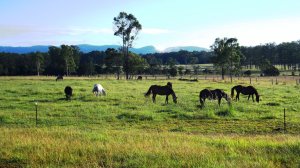
The farm near Taree, the blue-tinged mountains in the distance

We spent this Christmas on  a farm on the mid-north coast of New South Wales, not far from the town of Taree.

It is the farm of my sister-in-law and her husband. It is a beautiful piece of countryside – about 40 hectares – surrounded by lush green meadows and groves of trees with the flat-topped mountains of the Coorabakh National Park a hazy blue in the background.

The farmhouse is not yet finished meaning the toilet and shower facilities are outdoors.

The toilet is a long-drop raised up on a  wooden platform enclosed on three sides with a roof on top, affording the user with an unobstructed view of the meadows and blue-tinged hills in the distance.

The cursed long drop

The cursed long drop

I love the outdoors. The fresh smell in the air, the closeness to nature. Farm animals. Kookaburras and Rozellas in the trees. The general peace and quiet and distance from the mad rush of the city are all pleasing to my constitution.

But taking a crap in a make-shift loo in the great outdoors is not something I particularly enjoy.

Don’t get me wrong. I am a not  a prude and I am not one of those people who can only enjoy nature from the vantage point of a five-star lodge (though that would be nice).

But when it comes to sitting on a raised bucket with my pants down, my bowels go into lock down and the best I can manage is a couple of short blasts of the trumpet (if you’ll allow the metaphor).

Then I pull up my pants and exit stage left.

During my stay on the farm, this fruitless exercise was repeated a number of times, with me marching off to the wooden raised toilet, toilet paper roll in hand, only to return to the farmhouse a few minutes later with the same length of toilet paper in hand.

Well after two days of Christmas eating – and in keeping with tradition I over ate – the bare facts of physics dictated that something had to shift.

So I trundled up towards the ‘gallows’, climbed the wooden steps, dropped my pants and took my seat on the throne.

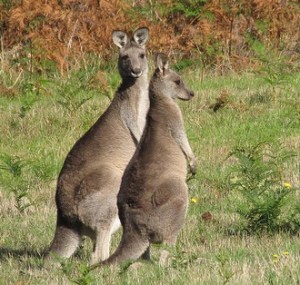
I won’t go into detailed descriptions of facial expressions or sounds, but it was an ultimately successful exercise and as I sat back to enjoy the moment I noticed, off in the distance, two kangaroos facing me at the edge of the meadow.

They appeared to be watching me intently, face on, with their ears perked up and front legs resting on their chests.kangaroos

I looked at the kangaroos.

They looked back at me.

We watched each other for a moment.

And then off they hopped, showing their distinctive body shapes in profile, their long tails curving upwards as they disappeared beyond the meadow, leaving me, pants still down at my ankles to enjoy the view entirely on my own.

Aah…the serenity.

Melbourne transport officers: the ‘Gestapo’ or the ‘Miami Vice’ experience

My wife and I now live in Melbourne, but a couple of years ago we were just visiting from Sydney on holiday.

We caught a tram from Essendon (a suburb north west of the Melbourne CBD) into the city for some sightseeing and lunch. My wife had a concession card because she was a student in Sydney at the time and so she bought a concession ticket on the tram. I bought a normal adult ticket.

The tram trundled on towards the city. A little while later two men got on and sat opposite us on the tram.

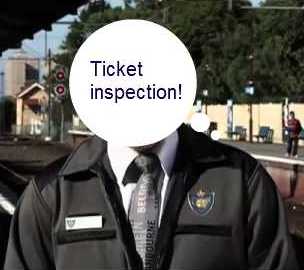
One of the men was bald or had a closely-shaved head, was wearing sun-glasses, a white t-shirt jeans and a zipped-up beige leather jacket looking as if he’d just finished shooting a scene from Miami Vice (you remember the 1980s cops show with Don Johnson).

He looked at us.

We looked at him.

The tram continued on its way.

A few minutes later, he nonchalantly unzipped his jacket to reveal an FBI-like badge dangling from his neck and announces to us and the tram: “Melbourne transport police – ticket inspection”.

We got into trouble because though my wife had a valid New South Wales student card it was not valid in Victoria (Australia’s different state rules are a topic for a whole separate blog post) so she was not actually entitled to a student discount on the fare.

We explained that we were visiting and were unaware that my wife was not allowed a student ticket.

Mr Miami Vice believed us and we got off with a warning rather than a hefty fine.

But the incident stuck in my head principally because of the demeanour and dress of the undercover ticket inspector, who had clearly watched too many cop shows.

He was a ridiculous caricature and I always laugh at the memory of him coolly unzipped his leather jacket to reveal his Melbourne transport officer badge.

As I mentioned earlier, we now live in Melbourne and I have come to experience, vicariously anyway, the other persona of the train and tram transport police.

They’re officially called “authorised officers” and employed by the Victorian government.

They wear uniforms and demeanours that remind me of the Gestapo or maybe the secret police of East Germany with a twist of a 1980s fashion faux pas thrown in as well.

Their jackets are made of grey plastic-like material with black trimming and they usually roam the trains in packs, wearing scowls.

If you live in Melbourne and ride the train or trams regularly, you will more than likely have encountered them.

Now I’ll say upfront that some of them are courteous and wear a smile, but many of them are surely picked for their menacing looks and deadly stares.

Like the secret police, they enjoy playing mind games by boarding the train, huddling at the entrance and doing nothing but looking across at the passengers until at some point (perhaps a signal transmitted directly to the brain) and they announce “ticket inspection, please have your tickets ready”.

Invariably there is someone who does not have a ticket.

Immediately they are surrounded by a group of ticket inspectors who begin the interrogation. Everyone looks, you can’t help yourself.

Then they escort the passenger off the train and as it pulls out the station you stare out the window and see the poor passenger surrounded by these figures in grey and black with notepads, glares and fingers pointing.

And there’s a part of you that wonders if these passengers will ever be seen or heard from again, especially if they refuse to comply or provide adequate proof of identification.

Perhaps it’s just coincidence, perhaps it’s the case the most people who fare evade are minorities with a darker shade of skin colour, but seems that if you’re a person of colour you’re more than likely to be hauled off the train by an authorised officer and asked to provide incontrovertible proof of who you are.

Not speaking english or being a teenager are too other reasons to be attract their attention.

Lately there have been a lot of inspections on the Craigieburn line – the line I ride every week day – sometimes during rush hour, but always once the train has emptied out and we’re heading into the suburbs.

Once a bald, nasty-looking inspector tried to put the fear of God into two teenage boys who were sitting with their skate-boards and baseball caps turned the wrong way round.

“How will you feel if I told your parents you got a $70 fine…” were the words I distinctly heard him utter with the kindness of a rattlesnake.

Scouring the internet I have come across some disturbing evidence which confirms that there certainly are some bad eggs in the ranks of Melbourne’s authorised officers.

I found an ABC news broadcast from 2010 showing authorised officers assaulting passengers in a bulletin called “Melbourne’s thuggish ticket inspectors”.

Digging further I found it was based on a damning report by the Victorian ombudsman, which found that in around 30,000 instances where infringement notices were issued, nearly half were withdrawn.

The report also provides a number of examples of what has happened to some commuters who have found themselves under attack from these rogue officers including this case:

Incident 1: 9 March 2010 – Ringwood Railway Station

On 9 March 2010 an authorised officer in plain clothes pushed two youths from a moving train onto the platform at the Ringwood Railway Station. This incident was anonymously reported to the department. The officer was part of a four person patrol. The officer resigned. Following a police investigation, the officer was charged with two counts of recklessly causing injury. File notes disclosed that the officer admitted in his pre-authorisation interview to having a speeding fine; obtaining a learner permit by making a false statement; obtaining an identity card by lying; and shoplifting.

You can watch what happened via this CCTV footage provided by the ombudsman.

There are numerous other examples in the report.

Anyway, you should know your rights if you end up in the hands of an authorised officer.

They are summarised here on the Public Transport Victoria website.

If you get hauled off the train, always ask to see their badge and ID and write down their names.

Make a note of any threats made against you and never hand over any money.

Always keep in mind that authorised officers are required under law to act with the “highest degree of integrity and professionalism” at all times”

This applies whether they are acting out a Miami Vice fantasy or dressed like a character from the Gestapo.

Doth my toes offend thee?

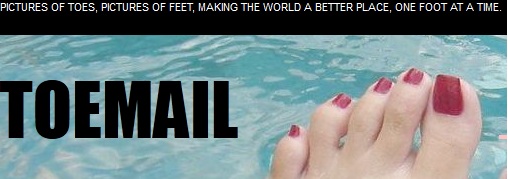
There’s this terrific blog called ‘toemail’. It’s a pretty simple concept. People send in photos that include their feet, taken in different parts of the world, and write a story about the picture, and they’re published on the blog.

In some cases people just send in the picture and let it do the talking, without any words of explanation.

The theme of the blog is: “Pictures of toes, pictures of feet, making the world a better place one foot at a time.”

There’s photos of people’s toes on deserted country roads in Canada, toes on trains travelling across the US, toes next to a coconut on a deserted tropical beach in Fiji.

People send in photos of works of art featuring toes and statues with toes and backpackers with toes walking down a street in Ljubljana, Slovenia.

In some pictures the foot is the centre piece of the photo such as this one taken with a gnarly tree in the background in Macedonia and in others the toe is just incidental to the photo or part of the story such as this wonderful photo of a man in sandles carrying a huge load on his head down the streets of Dhaka, Bangladesh.

And people get inventive and creative too, such as this photo of child’s school lunchbox with the sandwich shaped as feet.

So I thought I would get inventive too, sending in this photo (below) taken of my feet after a day spent walking the streets of Mumbai about two years ago:

I received a reply from the publishers of Toemail, to tell me that this picture would not be posted on the blog because: “close ups of dirty or injured feet we cannot post because it can be visually disturbing to someone who is opening the blog”.

So I’ve published it on my blog instead.

I agree it’s not the prettiest picture, but “visually disturbing” seemed a bit of a harsh description for a bit of mud and an uneven suntan.

Is anyone reading this now disturbed by this image?
Are you reaching for the sick bag?
Are your eyes offended?
Is it all too much?

If you’re not, here’s my little story about these feet:

On these muddy, sun-stained feet, the bearer walked along the bustling, congested, lively streets of Mumbai, passed old, grand crumbling colonial architecture from the days of British rule, through arcades lined with bookshops and restaurants where he ate delicious vegetarian thalis with the rice piled on a silver tray for about a dollar. These feet passed beggars and hustlers and lawyers with their wigs and briefcases and children dressed in clothes that looked straight out of the 1970s disco era.

These feet took respite in an air-conditioned department store with security guards glaring and later waited dutifully while his wife shopped for clothes along ‘fashion street’ a never-ending line of clothing stalls, each crammed with shorts and skirts and jeans and a man who could sell ice to eskimos.

These were the feet cut off in photographs taken by locals who wanted a picture of a pasty “white man” and his even pasiter white wife on their mantelpiece. These were the feet that walked along the famous Chowpati Beach, that rested on the sand as we looked out at the boats and the families talking and eating in little groups as the sun sank below the horizon, listening to the cries of the chai wallah and the ice-cream wallah and the man selling nuts in a cone.

These are the feet that climbed steep streets for a view of the bay of Mumbai with her fishing boats and bobbing litter and behind, the endless skyline of high-rises defining India’s richest city. These are the feet that walked through tropical gardens with plants sculptured into elephants and giraffes. That supported the bearer as he stopped to watch a school boy cricket match in the middle of the city, that rested in the cinema while locals danced in the aisles to a Bollywood movie.

And so I ask you again, doth my toes offend thee?

India’s sacred and spoiled cows

They say cows are sacred in India, but you only realise this when you go over there and see how these huge animals wander the streets, with an air of complete nonchalance. They walk at their own pace. They do as they please.

(In contrast, dogs do it tough in India. Many roam in packs and live like scavengers and by their wits, but the strays are skinny and frightened. It’s survival of the fittest – children often throw stones at them.)

My wife and I spent some time in the holy city of Pushkar with its lake, bathing ghats and troops of monkeys.

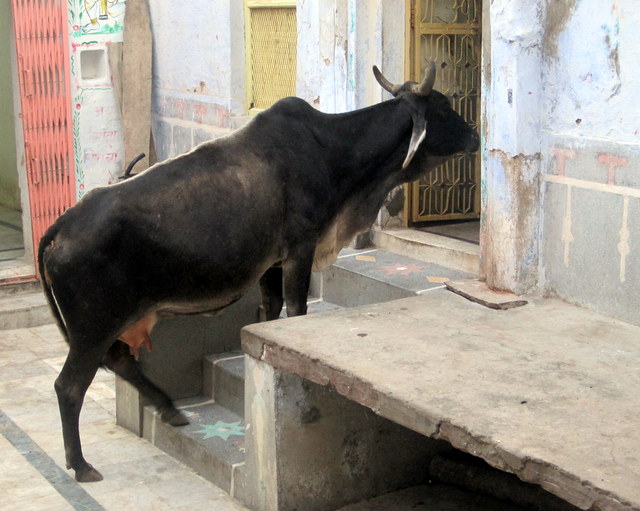
One afternoon, while strolling down a bumpy, narrow street lined with shops and homes, we came across this cow presumably looking for something to eat.

The locals feed them stale chipati (flat breads) and just about anything else they have lying around and the cows appear not too fussy. This is after all India, not the green fields of the English countryside.

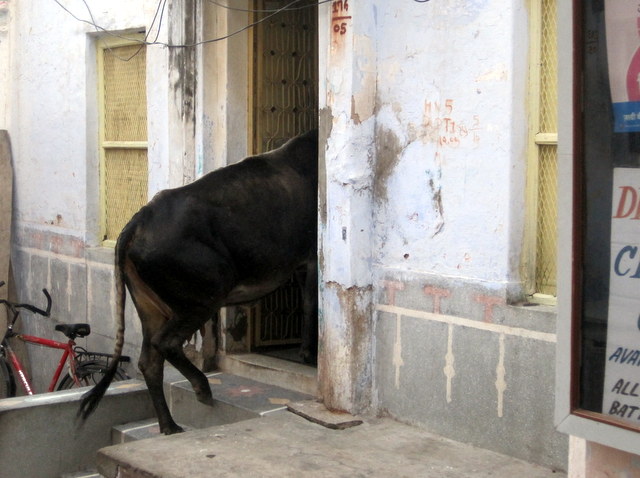
I recall that this cow was “escorted” out the building.

But this is by no means an isolated occurance.

Cows amble down laneways, sit on bridges, block traffic and head down the highway.

We saw one cow stroll down a packed traffic-congested road in chaotic Mumbai, changing lanes without indicating (not that motorists indicate in India for that matter!)

In Goa, there were more cows than people on some of the beaches,finding the soft sand and cool ocean breezes to their liking no doubt:

Ghandi had this to say about these animals:

“Cow protection is the gift of Hinduism to the world. And Hinduism will live so long as there are Hindus to protect the cow…… Hindus will be judged not by their tilaks (the religious mark on the forehead), not by the correct chanting of mantras, not by their pilgrimages, not by their most punctilious observances of caste rules, but their ability to protect the cow.”

An unexpected letter arrives from Spain

A letter arrived in the mail this week affixed with two colourful ‘Espana’ stamps and an two ink marks baring the words “Barcelona” and “Correos La Campania de Todos” (The Spanish post office).

The stamps cost 35 euro cents and 50 euro cents each.

The letter was addressed to “L Schlesinger” with my home address printed on top and began with an apology for this “unsolicited” correspondence.

“My name is Barrister Mateo Pinto of St. Mary of the Head 15, 28045, Madrid Spain. I got your contact information through the Australian public records while searching for the last name similar to my late client.”

His client, now deceased, was ‘Albert Schlesinger’, an oil magnate who lived in Spain for 28 years and who died along with his immediate family in an “auto car accident on the Damascus Highway in Syria in December 2004”.

The letter went on to detail how there was US$9.6 million unclaimed in a vault at the Madrid Central office and that he was seeking out a relative that shared the same last name as his client.

Having found me, he was willing to share the spoils – though 60:40 in his favour.

Still, I’d come out with a cool $5.76 million.

All I had to do to get the ball rolling was send him a fax or email, but he also provided a phone number though he suggested the first two means of correspondence for “time difference and confidentiality reasons”.

But I better hurry because, according to Barrister Mateo Pinto there is only “three months final notice from the safe keeping firm to present a beneficiary to the vault” or the money would be “forfeited to the Spanish authorities” – something that he “forbid happening”.

The letter was signed with an indecipherable signature and clearly a photocopy.

Obviously, this is a scam and not a very convincing one despite the effort to create authenticity with the posted letter and stamps (and perhaps also playing the part of the greedy lawyer by demanding a 60: 40 split in his favour).

I did some Google searches anyway to placate my curiosity.

The street address on the letter does not exist.

The only Albert Schlesinger of note I could locate died in San Francisco in 1993. His New York Times obituary says he was a civic leader and “founder of one of the largest automobile dealerships on the West Coast”.

There is no Damascus Road, in Syria, though there is one mentioned in the Bible.

And as for Barrister Mateo Pinto of St. Mary of the Head, there is an architect of that name residing in New York and a legal case in the Philippines involving a ‘Mateo Pinto’ who leased a fish pond, but that’s it.

Of course even without the help of Google, there are holes in the story as wide as the Grand Canyon.

For instance: why does he say he comes from Madrid, but posts the letter in Barcelona, on the other side of the country?

And what lawyer would look to give 40% of $9.6 million to someone he’d never met just because they shared the surname of their client?

I found many similar examples with almost the identical plot structure, including one on the Australian government’s SCAM watch website from a Spanish lawyer, whose client had died in a car accident with the recipient offered the  chance to share in $22 million, (though in this letter, the lawyer is more generous willing to share the spoils 50:50).

Does anyone actually fall for these silly scams?

Still, it got me thinking about the person who gone to the trouble of buying the stamps and posting this letter half way around the world in the hope that I’d reply and presumably end up handing over my bank details so that he can steal from me.

Somewhere, in Spain, probably Barcelona, there is a guy posting letters to all the Schlesingers he can locate in overseas phone directories.

Why did he pick Schlesinger? Well there are some very wealthy Schlesingers I believe, sadly I am not one of them, so perhaps that’s why he picked the name. Perhaps he’d also considered the more famous Oppenheimer, Getty or Rothschild surnames for the name of his fictitious client.

I imagine the scam artist hunched over a computer in some darkened flat in a non-descript suburb on the outskirts of Barcelona. The printer whirrs and buzzes as it prints out letter after letter. He bends down, picks up each letter and has a cursory look over it to check it’s printed correctly, folds it neatly and slips it into an envelope. He licks the stamps and presses them onto the envelope firmly. Later, when he has a big enough pile, he heads off late at night, walking along quiet streets, a cigarette dangling from his lips (don’t all villains smoke?) and drops the letters into the nearest mail box, looking around suspiciously as he does so in case someone has finally tracked him down. Then he disappears down a narrow lane, finds a cheap bar that stays open late, orders a beer, finds a seat in the corner, where he sips his cerveza, lights up another cigarette, puffs out a cloud of smoke and dreams up his next scam.

Or perhaps he’s some 16 year old nerd with pimples and a computer.

Better, faster: Has the modern age spoiled the romance of travel?

Have you ever pondered what it must have been like travelling across the world more than a century ago?

 When there were no aeroplanes, let alone long-distance flights or high-speed trains or even the ability to experience a faraway place through cinema, television or Google Streetview?

Take for instance a trip from London to Mandalay, Burma.

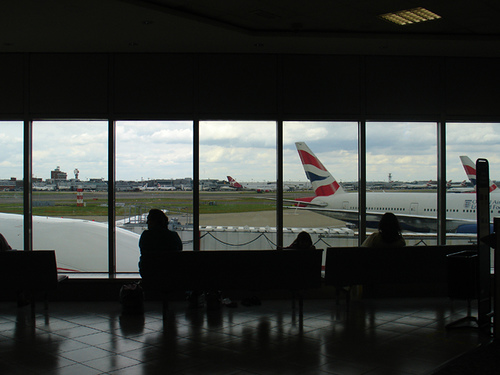
If you lived in Central London you’d take a cab, or catch the tube or take the Heathrow express to the airport.  Maybe it would take you 40 minutes. You’d check in, spend an hour or two perusing duty free, stocking up on magazines, flight remedies and sweets and then you’d be off.

Your Thai Airways flight departs just after midday on a Wednesday. After a stopover in Bangkok, where you have time for an overpriced green curry and a Chang beer, you board the plane again and touch down in Rangoon (Yangon) on Thursday around 9am.

 Its 700 kilometres north on the expressway to Mandalay.

You feel brave and a bit adventurous so you hire a car. En route you stop to visit an ancient pagoda and to take in the Shan hills in the distance. You arrive at your hotel in Mandalay just before 7pm.

It’s taken you a little more than a day and half to travel 11,000kms. You kick off your shoes, order a meal from room service, jet lag sets in and you drift off to sleep dreaming of pagodas, the London tube and football.

Rewind 126 years.

 It’s 1886.
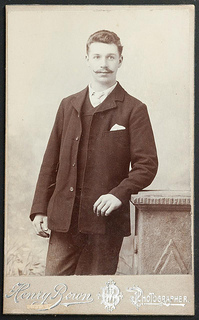
A London piano tuner named Edgar Drake sets out from London to a remote town in the Shan Hills of Eastern Burma to repair a piano belonging to surgeon-major and rogue British officer Anthony Carroll.

 The British empire is fighting for control of Burma.

Drake’s journey from London to the wilds of Burma begins on the 26 November.

A horse-drawn carriage picks him up in the early hours of the morning from his elegant terraced home in Fitzroy Square, Central London, a home he shares with his dutiful wife Katherine, not far from Regents Park.

The carriage drives him east to Royal Albert Dock (now London’s Docklands) on the Thames, a journey of about 11 kilometres.

Here he boards a waiting steam ship, belching smoke from its stack, which sets off up the Thames at about 17 knots (30 km/hr).

It travels all the way along the Thames until it reaches the Thames Estuary – a journey of about 60kms with Essex to the North and Kent to the South and then enters the cold North Sea.

It heads south through the English Channel and arrives in Calais, France a few hours later.

From here Drake takes a train 292 kilometres south to Paris, but he has no time to stroll the famous boulevards of the French capital as he boards another train for a 770 kilometre journey further south to the port city of Marseille on the Mediterranean coast of France.

It’s 1886 so the train travels around 100 km/hr at top speed reaching Marseille eight hours later.

In Marseille he boards another ship and heads across the Mediterranean telling Katherine in a letter: “How I wish you could see the beauty of these waters! They are a blue like none that I have seen before.”

The ship passes through the Strait of Bonifacio, which runs between the islands of Sardinia and Corsica, where Drake gets his first view of the Italian coastline. He passes Palermo and then Malta and arrives in Alexandria, Egypt five days after he left London. A blind Arab man called “the man with one story” tells a fantastical tale of being ship-wrecked in the desert, of tribes and tents and feasts.

The ship docks for a few hours and then heads east along the Egyptian coast to Port Said, where it enters the Suez Canal and travels south to the Red Sea

 Edgar Drake’s ship passes what is now the western shore of Saudi Arabia, crosses the straits of Bab al Mandab and drops anchor at Aden, a harbour “full of steamers destined for all over the world, in whose shadows tin Arab dhows darted beneath lateen sails”.

 Two days later, he passes the island of Elephanta, where the Hindu worship an “Elephant with Many Arms” and into the teeming harbour of Bombay (now Mumbai) where vessels of every size and description bob about. A carriage takes him to the railways station and to platforms full of people, “crowds such as he has never seen in London”.

The train takes him north east into the Indian interior. He passes Nashik, Bhusawal and Jabalpur – the names growing “stranger and more melodic”

When the train stops vendors descend at “wind-beaten, lonely stations” and thrust “pungent plates of curried meats, the sour smell of lime and betel, jewellery, fans, picture postcards of castles…”

Vendors hang onto the train as leaves until prised off by a policeman’s baton.

The train passes the holy city of Varanasi and they arrive in Calcutta, in West Bengal after three days, a journey of 2,200 kilometres.

Here he boards a ship for Rangoon (Yangon), travelling along the “muddly outflow of the Ganges and into the Bay of Bengal.

 Three days later the ship gets its first sighting of Burma, via a “lighthouse perched on a tall red stone tower” which guards against the reef, a graveyard for many passing ships; they pass buoys and head up the Rangoon River.
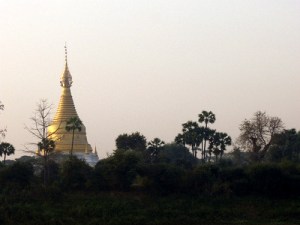
The ship winds its way around sandbanks and sharp bends, where Edgar gets his first sighting of the gold-painted Schwedagon pagoda capping a distant hill. Rising 99 metres into the air, it is the epicentre of Rangoon.

 He is a delayed in Rangoon for four days by British military bureaucracy – he goes hunting in the jungle with officers. There is an incident. A young Burmese villager is shot by mistake.

A few days later Edgar boards a teak ship to Prome (Pyay), and travels up the Rangoon River, a journey of around 350 kilometres passing the Pegu Hills –  a range of low mountains before the dense foliage changes to “thorny trees and toddy palms”

Here he goes sightseeing to the ruins of Pagan, the ancient capital of a kingdom that had ruled Burma for years.

 Up a dusty path he walks until he gets the “finest view in all Pagan”:

 “…a vast field of pagodas that stretch away from the river to the distant mountains, floating in the dust and smoke of burning rice fields”

 “What are those mountains?” Edgar asks a soldier

 “The Shan Hills, Mr Drake. Finally we can see them.”

 The next morning they arrive in Mandalay.

Delayed for many days in Mandalay because the town of Mae Lwin – his final destination – is under attack, he writes to Katherine:

 “I spend hours looking out at the Shan hills, trying to decide how to describe them for you…I wander the markets, following the flow of ox-carts and parasols along the rutted roads, or I sit by the river watching the fishermen, waiting for the steamer for Rangoon that would bring news of my departure or bring me home.”

 And here we leave piano tuner Edgar Drake, who will eventually journey through the jungle and hinterland of Burma to an uncertain fate, travelling first by elephant and then on foot.

You see Mae Lwin, does not really exist, nor does Edgar Drake.

 Both are a creation of Daniel Mason in his novel “The Piano Tuner”.

 But the journey itself is accurate.

 It is taken Drake and any other English gentlemen of that time many weeks from closing the front door of a London terrace to waking up in the pungent air of Mandalay, where woman have painted faces, called Thanaka that runs down their cheeks.

 It has been a journey of horse-drawn coaches, steamships, trains and river boats.

 He has seen many strange and wondrous things, watched the world change in front of his eyes.

And today, we hop on a plane, watch a movie, close our eyes, order another wine if we can’t sleep and wake up in a new world with all that is  it in between the start and the finish missed out.

To experience the world, we must slow ourselves down. Choose a slower mode of transport. Allow ourselves time.

But who has time to spare these days – even if we hold the latest iphone in our hand?

Travel journalism, junkets + dwindling media budgets: are you getting the true picture?

In 2010 my wife and I, newly married and kids-free, embarked on a dream back-packing trip around the world starting in Thailand and ending in the USA (with Malaysia, Singapore, East and West Europe, Morocco, India, Egypt, Turkey and Mexico in between).

When we returned to Australia, I was eager and hopeful of writing a few freelance travel pieces about some of the more exotic places we had visited for the travel sections of newspapers and travel magazines.

I submitted a number of story ideas and photographs but no editor would bite.

I was a bit disappointed but not entirely surprised since I’d submitted what I thought were interesting ideas in the past (a story about why tourists should visit my hometown of Johannesburg was one of them) but had received polite “no thank you’s”.

Since then I’ve read, with envy, the stories written by travel writers, some about the places I have visited and many other destinations I would love to saviour for myself one day.

However, what I have also noticed, with greater and greater frequency is that so many of them end with the following:

“The writer flew with…”

0r, “The writer was a guest of…”

Most pieces of travel journalism, I’ve discovered, are paid for or part paid-for by either an airline, resort or tourism bureau and it got me wondering what sort of impact this had on the objectivity of these “hosted” writers.

So I put the question to the Fiona Carruthers, editor of the Australian Financial Review’s Sophisticated Traveller magazine and to Susan Kurosawa, editor of The Weekend Australian’s Travel and Indulgence section.

Both are excellent publications with great photos and stories – but many of their articles are funded by what Carruthers calls “famils” – “travel familiarisation” trips, where the expense is borne by the person or organisation extending the invitation.

“Also known more cynically in the trade as “junkets,” Carruthers tells me.

She estimates that due to the expense (and no doubt dwindling budgets) about 85% of travel writing is paid for through these hosted visits.

“It’s a shame this is the case – I would dearly love for us to pay our own way – and sometimes we do or we pay part of the trip or media rates,” she says.

“But the problem is that most media organisations simply cannot afford to pay for these travel experiences and given travel is so popular, we don’t want to short change our readers by not offering travel content. So this is our compromise – and as I say, most media outlets compromise.”

So what does this compromise entail? Does it mean giving favourable coverage, not reporting on bad experiences and potentially giving readers a less than fair picture of a travel destination?

Is it just advertorial disguised as a travel review with out the advertorial “label”?

Both Carruthers and Kurosawa firmly deny this and maintain that objectivity is always maintained.

“Famils/hosted trips are not advertorial and the hosts know we are free to write whatever we like,” says Carruthers.

Kurosawa says The Australian responds to “invitations for selected trips”, but does not “actively seek hosting of any kind, whether from airlines, hotels, operators or national tourist offices”.

“We maintain our independence at all times and reserve the right to be critical where appropriate.”

Carruthers though does say that “most journos are keen to give a good write up in return for hospitality.

“And given the standard of travel is so high these days, nine times out of 10 any experience we do is fantastic”.

That so many hosted trips should result in a “fantastic” experience is not surprising, given that many involve luxury getaways, private lodges and top end of town hotels and restaurants.

But also, due to the hosted nature of journalist’s visits, resorts would have ample warning and all staff would surely be briefed, to provide these ‘special guests’ with extra special care and assistance.

One of the articles in the September issue of Sophisticated Traveller is about the Banyan Tree resort in the city of Lijiang, in China’s Yunnan province.

While Carruthers points out that the writers were critical of the resort’s food and the fact that is “very quiet at night and locked away behind high walls”, I do wonder if the fact that staff at the resort delivered “toasted sandwiches and warm glasses of milk” to the reviewer’s villa and “never tired of feeding the fish” with their three-year-old had anything to do with the fact that the writers Angus Grigg and Fiona Murray were journalists on a “famils” trip.

I have some personal experience of this phenomenon having undertaken a number of restaurant reviews at some of the Sydney’s finest eating establishments, when I edited a mortgage broking magazine. The meals were organised through a PR agency and were free (with unrestricted menu access).

What I recall most vividly, besides the mostly exquisite food, was staff going out of there way to be helpful.

On one occasion the maître d’ at a Surrey Hills restaurant i was reviewing offered to adjust the temperature because my wife had a cold.

There is of course, the option of making up your own mind about any resort, hotel or restaurant or airline by reading some of the reviews on traveller’s bible, Trip Advisor.

There are 485 reviews of the Banyan Tree resort in Lijiang on Trip Advisor.

None of these people stayed for free, but equally, it could be argued that because they have paid their own way, they could be motivated by spite to write something nasty or out of proportion to a bad experience.

Among the few critical reviews on Trip Advisor for the Banyan Tree Lijiang is one that occurred during a BMW event (when staff may not have been at their attentive best) and while another unhappy reviewer mentions that their booking was lost and they had to find proof their booking by finding it on their laptop.

Most agree with the Sophisticated Traveller writers.

In the case of the Banyan Tree Trip Advisor ranks it 6th out of 296 hotels in Lijian with 94% of 485 reviews rating the stay as either “excellent” or “very good”.

So what to make of articles that arise from a hosted visit?

I’d say take them mostly at face value (providing its a reputable publication), but with the tiniest pinch of salt.

As with most new experiences, having lower expectations usually results in a more enjoyable holiday – so best not to set the bar based on what you read.

Or, if you want top notch service, you could try hinting to the staff that you’re writing a review for a major publication.

This may result in an experience that matches the newspaper write-up.

This post was subsequently published in Crikey (subscription required)