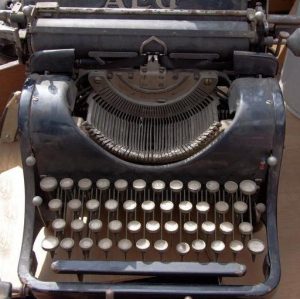
Why I won’t be voting on September 7

Electoral-Commission-Pic

I won’t be voting next weekend because I can’t. I’m not yet an Australian citizen.

When I found out in March, to my surprise, that I was eligible  to apply for citizenship, I was thrilled. Nine years of waiting. Four visas. Enough paperwork to fill a jumbo jet and the moment had finally arrived.

So I printed out the 84 page booklet Australian Citizenship: Our Common Bond” that tells you all you need to know about this great land to prepare for your citizenship test and read it cover to cover.

Then I downloaded all the forms that I would have to fill in.

I had this great idea that I’d write to all the different political parties asking why I should give them my valuable vote and then turn that into a story for this blog or maybe Crikey (the editor was keen, “a new citizen’s guide to Australian politics” or something like that was how I pitched it).

But then there came the complicated instructions that are standard with anything that has to do with the Department of Immigration. You read them, read them again, ponder them, but still you’re left scratching your head and perhaps heading for the liquor cabinet.

Once again there’s the obligatory police clearance? I must have gained police clearance half a dozen times now for my various visas, surely they know me better than my own mother? Then’s there’s finding people to sign statutory declarations and certifying documents and photocopying.

And remembering!

Once again, I must account for my movements over the past nine years into and out of Australia. Honestly, its all become a blur: who can remember every trip they’ve taken? To make matters worse I lost my previous passport and the one before that is in a box somewhere in my parent’s home in Johannesburg, which means there’s yet another form I have to fill in.

Further dampening my enthusiasm was news that I would have to send off two forms and $43 to the South African Department of Home Affairs if I wanted to have dual citizenship. Approval has to be gained first from South Africa before taking the oath in Australia or you lose your South African citizenship. And the time to process these two forms – three to six months!

So the end result is that the paperwork lies in yellow plastic folder on the big desk in the spare room waiting for me to summon up a degree of enthusiasm to fill in all the details and painstakingly try to sort out what documents I need and who needs to sign what.

It’s hardly the response I’d expected of myself  because the truth is I’ve always wanted to vote in this country. Becoming a permanent resident was a big deal (I even cherished my pale green Medicare card) and gaining citizenship is even more of a badge of honour.

Perhaps it has something to do with my arrival in Australia almost a decade ago, which happened to be just a few weeks before the 2004 election, the last federal poll won by glum John Howard and his cronies. My girlfriend at the time, her sisters, their partners and everyone else lined up to vote, while I milled about the polling station in some backwater country town eating a sausage roll and getting funny looks from the locals (He’s white, he looks Australian so why isn’t he voting?). If that wasn’t enough, we stopped the car to vote on our way to Canberra for the annual flower shower (the Floriade), a trip which included an obligatory visit to Parliament house and a walk past those solemn paintings of past prime ministers.

But now that the opportunity has come – and I probably could have voted in a week’s time if I’d made a big effort on the paperwork front – I could hardly care.

Who the hell would I vote for? There’s very little to inspire me among the neo-conservative Coalition, directionless and clueless Labor and the loopy Greens. There’s the smaller parties with their eccentric candidates so maybe I’d chose them and preference the bigger parties last, but then what would be the point? A protest vote perhaps?

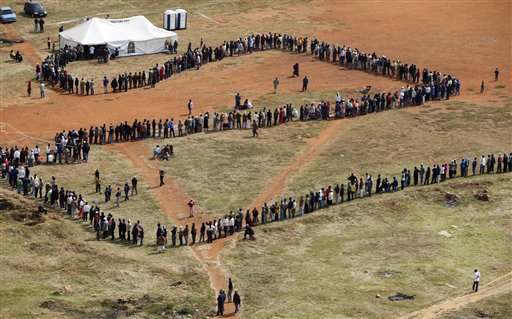
All quite different from when I voted for the first time in South Africa in 1994. That wonderful sunny autumn day when there was hope and belief and joy in the air and as the newspapers rang out “Vote, the beloved country” with photos of lines of people snaking endlessly down city streets, amongst the leafy suburbs and through country side and hilltops.
APTOPIX South Africa Elections

A queue of voters in South Africa, 1994

It was a glorious moment, history in the making, and one of my finest memories.

But there’s nothing to inspire me now, in fact its far more enjoyable watching the circus from the sidelines (so to speak).

The truth is, I’ll eventually find the time and energy to put all the paperwork together and put my application in because to steal from Peter Allen, I also want to call Australia home (in an official capacity).

Indeed, it will be a proud day when they hand me a tree, offer me a lamington and a tiny tub of Vegemite.

But as for voting, I’m happy to wait another three years.
Are thinner politicians more electable?

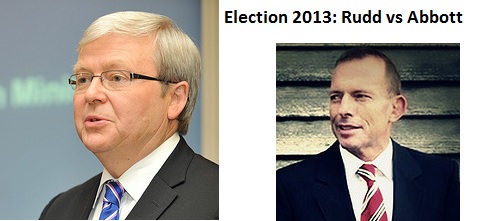
rudd v abbottOf all the guff that has been written about this upcoming election – and there has been a lot – an article from Brisbane’s The Courier Mail caught my attention focusing on the fact that prime minister Kevin Rudd is packing on the pounds apparently under the stress of losing his short-lived grip on power.

The story, written by Hannah Davies, had as its headline: ‘Moon-faced PM ‘comfort eating’ as the stress of the Federal Election campaign takes its toll.

The story quotes a number of nutritionist and dietician who comment on the prime minister’s fuller face and apparent appetite for pizza and beer with the insinuation that he’s becoming less able to govern by virtue of his weight gain.

They even give him free advice such a that he opt for “nuts and a fruit basket”.

Hannah Davies even went so far as to ask the PM’s spokesperson whether he was “comfort eating”. A ridiculous, irrelevant question you’d think given the broader issues being faced – she might as well also have asked if he was spending more time on the couch eating potato chips!

Anyway, it does raise an interesting point about appearances.

Contrast Kevin Rudd’s apparent podginess (It’s easy to find an unflattering photo of someone constantly be photographed, hence my use of the word “apparent”) with the superfit appearance of Tony Abbott and its easy for a conservative Rupert Murdoch-owned paper like the Courier Mail to suggest, subtely that gaining weight is a sign perhaps of bad personal management, bad habits and an inability to lead.

It’s interesting that the two other high-profile politicians to lose a lot of weight are both on the conservative side of politics: shadow treasurer Joe Hockey, whose is a shadow of the huggable bear of a man he once was and NSW premier Barry O’Farrell, whose weight has bounced up and down like a yo-yo over the last 15 years, but is now almost unhealthily gaunt.

O’Farrell explained in an interview to the Daily Telegraph in December last year that he lost the weight by challenging himself after the 2003 election to go to the gym every day for a week, a pledge he has stuck to for nine years.

Joe Hockey admits to having some help via gastric bypass surgery over the Christmas break followed up by with dieting and exercise.

He says its because he wants to be around to see his grandchildren grow up and was also tired of being called “Sloppy Joe” by former Treasurer Wayne Swan.

It’s surely no coincidence though that Joe Hockey has lost his weight in an election year.

Slimmer and fitter apparently makes you a better leader, thinker and decision maker in the eyes of many while adding a few pounds is a sign that you’ve lost your mojo.

This, of course, is baloney.

Yes, losing weight is good for your health and overall sense of wellbeing and people who lose weight are to be commended.

But fat people that suddenly become thin do not suddenly develop more brain cells, a better moral and ethical belief system and a greater sense of what’s right and wrong.

Being fat never bothered Winston Churchill, nor did it stop him defeating a far skinnier Adolf Hitler.

And there’s no indication that billionaire mining magnate Clive Palmer intends to shed any pounds as he seeks a political role.

Yes you may live longer and feel better about yourself, but let’s not confuse this with character, decency and moral strength.

After all Vladimir Putin and George W. Bush – two leaders who both puffed out their chests in front of the camera – are hardly the model of political astuteness.

On with the circus!

Reading Christopher Hitchens: A spanking from Margaret Thatcher and more profundity

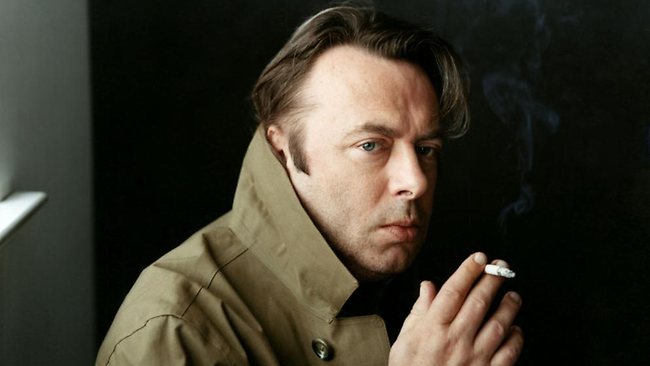
398303-christopher-hitchensI’ve just finished reading “Hitch-22” – the memoirs of the late, great Christopher Hitchens.

Some (a fair portion) of his narrative, I found difficult to grasp fully or to follow the argument to its conclusion, with sentences and paragraphs full of literary and political allusions and references which would require, if I had the time, plenty of background reading on my part.

But yet still it is engrossing, filled with wonderful little moments such as when he tells the story of how Margaret Thatcher (he swears this actually happened) made him bend over and smacked him on the backside with a rolled up pamphlet after he dared to disagree with her at a gathering in Westminster, before she became prime minister.

Not one to ever concede an argument, most notably with a women he admired awfully (not the other way round), I think Hitchens took the spanking just so that he could recount this remarkable anecdote.

There’s plenty of wit, charm, irreverence and cheekinesss in his writing (I wrote about his tips for drinking in an earlier post), but also a great deal of solemnity and painful personal recollections.

There’s bittersweet recounts of his mother, Yvonne, who never revealed her Jewish roots to her husband, Hitch’s distant, but proud father – “the commander” – and who died in a suicide pact with her lover in a bare hotel room in Athens.

Hitchens writes about his need to spend time each year in unstable countries, how he accidentally wandered into a dangerous part of Afghanistan, how he nearly got shot in Northern Ireland, his student protests, his philosophical and literary bouts with Martin Amis, Salman Rushdie, Ian McEwan, Susan Sontag and Edward Said to name just a few.

He also has the humility and flexibility of mind (a trait which he says separates the open-minded from the “totalitarian principle”) to admit that he held a wrong view about a situation – most notably, his opposition to the first Gulf War – and armed with better information, he has changed it.

There’s also a wonderful, incredibly poignant story retold from a Vanity Fair article about a man Hitch never got to meet – Mark Daily, a young American soldier who volunteered to fight in Iraq after being inspired by the articles he read written by Hitchens arguing there was a moral case for war (to remove the psychopathic tyrant Saddam Hussein) and who was killed in combat.

He writes of Daily:

“This is the boy who would not let others be bullied in school, who stuck up for his younger siblings, who was briefly a vegetarian and Green Party member because he couldn’t stand cruelty to animals or to the environment, a student who loudly defended Native American rights and who challenged a MySpace neo-Nazi in an online debate in which the swastika-displaying antagonist finally admitted that he needed to rethink things. If I give the impression of a slight nerd here I do an injustice. Everything that Mark wrote was imbued with a great spirit of humor and tough-mindedness.

Hitchens also writes lovingly that the country “lost an exceptional young citizen, whom I shall always wish I had had the chance to meet” who seemed to have “passed every test of young manhood, and to have been admired and loved and respected by old and young, male and female, family and friends”.

In this way, he shifts from strongly held ideological positions on religion, politics, war, the Middle East to tales of the people who shaped his life and gave him his richest experiences.

I came across a beautiful passage that made the hairs on the back of my neck bristle and really, really made me think and ponder the horror of it all.

Hitch writes about a survivor of the Rwandan genocide and the dangers of those who wish to wipe the slate clean – for a “tabula rasa” for their lives.

“I once spoke to someone who had survived the genocide in Rwanda; and she said to me there was nobody left on the face of the earth, either friend or relative who knew who she was.

“No one who remembered her girlhood and her early mischief and family lore; no simbling or boon companion who could tease her about that first romance; no lover or pal with whom to reminisce.

“All her birthdays, her exam results, illnesses, friendships, kinships – gone.

“She went on living but with a tabula rasa as her diary and calendar and notebook.

“I think of this every time I think of the callow ambition to ‘make a new start’ or to be ‘born again’.

“Do those who talk this way truly wished for the slate to be wiped?

“Genocide means not just mass killing, to the level of extermination, but mass obliteration to the verge of extinction.

“You wish to have one more reflection on what it is to have been made the object of a ‘clean sweep’?

“Girt by sea” and yet we fear an invasion of the desperate

“Our home is girt by sea”

So rings out the fourth line of the Australian anthem, Advance Australia Fair.

visa policy

“Girt” that awkward, uncomfortable word meaning “surrounded”.

But now the line is firmly planted in my head as the national debate about our hardline approach to asylum seekers continues.

I flicked on the radio last weekend and found myself tuning into a conversation on ABC Radio National (3RN) about the new immigration policy announced by our prime minister Kevin Rudd, which will see genuine asylum seekers settled in Papau New Guinea (PNG), a place he says is “an emerging economy with a strong future; a robust democracy which is also a signatory to the United Nations Refugees Convention”.

Not so says the government’s own travel advisory website, Smart Traveller, which has an “Exercise a high degree of caution” warning about PNG and has a list of things to be careful of that includes “high levels of serious crime”, public gatherings that may turn violent, “heightened risk of armed robbery and attack at well-attended shopping centres in urban areas” and an “increase in reported incidents of sexual assault, including gang rape [where] foreigners have been targeted”.

The list goes on and on making me wonder if the South African government should not have stepped in and offered my old town of Johannesburg as an alternative off-shore centre. It actually seems a lot safer and certainly offers better opportunities for economic advancement than PNG.

This apparent government contradiction on the merits of travelling to and residing in PNG fits in just about perfectly with our feverish, illogical, national obsession with asylum seekers who arrive by boats.

Indeed I have blogged about this very issue before – on Crikey.

This point was put most eloquently by professor Michelle Foster, director of the International Refugee Law Research Programme at Melbourne University, who said on the same radio program on 3RN that we have this strange fear of being invaded when in reality – surrounded or “girt” by water – it should be low down on our list of national fears.

Perhaps we should also consider some of the other lines of the anthem:

For those who’ve come across the seas
We’ve boundless plains to share;
With courage let us all combine
To Advance Australia Fair.

Sadly, the spirit encompassed in these words seem to have been forgotten or discarded when it comes to the most desperate in society seeking a new life on Australian shores.

The prime minister says we are punishing the “scourge of people smugglers” by effectively making their illegal trade null and void, but it is refugees who are being punished – banished to a strange island, rife with social problems, and according to this opinion piece in the Fairfax papers, where they will be left to fight for survival in squalid urban conditions, with no rights to own land due to their foreign-born status.

None of this makes any sense and must surely confound human rights advocates looking in from overseas who can only wonder what we mean by a “fair go”.

Asylum seekers are a small problem made huge by something in the national psyche that’s turned it into an enormous political minefield.

For those Australians who say these people will take their jobs – this is apparently the burning issue in the key Western Sydney electorate – consider the facts and do some research.

Official Department of Immigration figures show that 6,004 refugees came to Australia in 2011-12, less than 5% of the 190,000 economic migrants who arrived courtesy of ‘official’ migration programs.

So if anyone is going to take their jobs and jump queues it’s skilled migrants and their families, not refugees arriving by boat or any other means.

Indeed if you have $5 million to invest in Australian bonds or managed investment schemes, the Australian government will give you a visa to stay, without even the requirement that you learn the national language. Just hand over the dosh and the government will throw out the welcome mat, complete with a jar of vegemite and a bowl of lamingtons.

But for those who are the most desperate, who risk their lives on rickety boats, they will be dumped on an inhospitable island, one deemed by our own government to be dangerous and rife with crime to be forgotten.

Shameful!

(For more on this debate, these are some excellent opinion pieces worth reading from former Howard-era immigration minister Amanda Vandstone and Victoria Stead is a researcher at RMIT University’s Globalism Research Centre.)

Of Federal Elections and fruity flyers…

conspiracy theoryIf anything evenly vaguely interesting happens to me in my life that causes me to write my memoirs, I will be sure to include some ‘rules” for living.

One of these will most likely be:

“If someone hands you a flyer outside a train station or on the street, always take it.”

For the entertainment value anyway.

The corollary to this rule would be:

“Never believe anything you read on a flyer handed out outside a train station or on the street.”

Today, as I headed out of Southern Cross Station and across Spencer Street to work, an innocuous enough chap handed me a one page flyer from the ‘Citizens Electoral Council of Australia’- or ‘CEC’.

The CEC purports to be a political movement, with a post box address in Coburg, not far from where I live and a 1800 number.

The headline of the flyer reads:

“Only Glass-Steagall can head off planned bankers’ coup, genocide!”

This is the first paragraph (you can read the whole document on the CEC website:

“A faction of the British Crown-led City of London-centred ‘Money Power’ has announced its immediate intention to pull the plug on the unpayable global debt bubble by ending “quantitive Easing” and to instead sieze depositors’ bank accounts en mass (‘bail in’ vs ‘bail out’), while ramming through the genocidal austerity measures against the great masses of the population in Europe, the United States and Australia/New Zealand…”

Make any sense to you?

All I can gather is that someone in London is going to do something nasty and seize the money I have in the bank.

Further on I read

The 24 June Bank of International Settlements (BIS) annual report calls for an end to the Bernanke-led quantitive Easing policy and instead demands a regime of Hitlerian levels of vicious austerity….siphoning off the people’s bank accounts to keep selected banks afloat.”

Bankers. Genocide. Hitler. Stealing money. I sense a theme.

Further on in the flyer, there are mentions of a “plot”, a “drive towards outright fascism”, another mention of fascism and a couple more mentions of “Hitler-style austerity”.

The pamphlet mentions another flyer handed out by  the LaRouche Political Action Committee (LPAC) “headed by US statesman and economist Lyndon H. La Rouche Jr, who is fond of talking in terms of “quaddrillions of dollars” (how much is that I wonder?) and mentioning dead German dictators in his call to action.

According to Wikipedia, and not mentioned in the flyer is that LaRouche was “sentenced to 15 years’ imprisonment in 1988 for conspiracy to commit mail fraud and tax code violations, and was released in 1994 on parole”.

The Wikipedia entry  is worth a ready for one of the most colourful descriptions of personality you will ever read and for this photo, that LaRouche allegedly campaigned under, complete with painted on Hitler moustache:

800px-Obama_Hitler_political_sign

Anyway, it appears that the CEC has looked beyond these small misgivings and joined LaRouche’s cult-like following.

It certainly appears to be absorbing the ways of its master.

Here’s an extract from the history and philosophy section of the CEC website:

“A major contributing factor to the present economic collapse, is the anti-human, bestial policies represented by the rock-drug-sex counterculture which took off in the 1960s.”

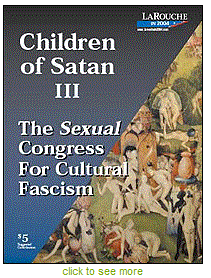
For more information, perhaps by this handy guide on the CEC website for just $5:

children of satanBut back to the bowel-loosening headline in the flyer handed out to me.

headline

What is Glass-Steagall and what does it have to do with Australia?

Well it refers to a 1933 Act of the US Congress, following the onset of the Great Depression, that created the separation of investment and commercial banking activities.

The act was repealed in 1999 and the global financial crisis followed in 2007.

To prevent fascism and genocide, the CEC want it brought back around the world and in Australia to prevent Australia’s four major banks from collapsing due to them “dangerously exposing themselves to the global financial system, including through nearly $20 trillion in derivatives speculation”.

There is clearly some truth buried within this ridiculous statement about reckless mortgage lending and speculation by banks in the US and around the world that caused the banking system to almost collapse.

But to suggest that Australia’s major banks – among the most conservative and profitable in the world – would speculate $20 trillion in derivatives is to believe that Peter Pan truly existed.

Consider that the total size of the Australian economy is around $1.5 trillion (the 12th biggest in the world) and the Big Four banks have a market capitalisation of around $330 billion and you realise that there is no possible way they could ever invest 13 times the size of the Australian economy in high-risk schemes.

Back on planet earth, I prefer the more considered thoughts of Reserve Bank governor Glenn Stevens, who suggested in a speech today that while challenges lie ahead for the Australian economy we are still a “lucky” country with low unemployment and where households remain cautious, continue to save and act prudently.

Still, if you’re in the mood for a bit of silly, old-fashioned conspiracy theories and scare-mongering, pick up a flyer the next time you’re in the CBD.

And watch out for those fascist bankers!

Tony Abbott as PM: a return to old Australian stereotypes?

tony abbottIt seems that barring a political calamity of some sort (or perhaps the return of Kevin Rudd), Tony Abbott will become our next and 28th prime minister in September.

Two article in the February issue of  The Monthly magazine, (which I picked up belatedly in the library), made me think more deeply about what sort of country we may become under a Coalition government with Abbott at the reins.

Journalist and broadcaster Mungo MacCallum writes that even though there have been desperate attempts to cast Abbott in a less misogynistic light, he remains “irredeemably macho”:

“He spent much of last year dressing up in hard hats and other tough-guy equipment and taking part in long-distance quad and pushbike rides.

“He has competed in an iron man contest. And he has started this year by inviting the media to photograph him in the guise of a fearless firefighter.

“However little it excites women, Abbott has remained determined to be seen in fluoro and lycra.”

The second article has nothing much to do about the current political climate in Australia, but does provide some insights into overseas perceptions of the country.

New Zealand-born writer and artist Nic Low, describes a trip he took with other Australian artists and writers to attend ‘Bookwallah’ in India – an international writing festival – where he travelled the vast country by train with Indian writers.

In Goa Low writes that the question is asked about attacks on Indian students in Melbourne while in Chennai racism rears its head with “a suggestion that Australia resembles apartheid-era South Africa”.

“Beyond polemics, the questions reveal a lingering stereotype of Australia. As [Australian writer Kirsty] Murray puts it ‘It’s an idea of Australia from a generation ago’.

Whatever the deep divisions in the current government, divisions that will likely see it ousted from power in September, the Labor government of the Gillard-Rudd era ushered in a new vision of Australia to the world.

With Rudd there was the historic apology to Aborigines and the ‘Stolen Generations’, acknowledgement of climate change, implementing a fairer industrial relations system and development of the National Broadband Network, that despite its criticism will serve Australia well in the years ahead.

Gillard, for her part, put the idea of Australia as an inherently male-dominated society in its place with her rise to be the country’ first female leader while also introducing policies like the National Disability Insurance Scheme and pushing through the contentious, but ultimately necessary carbon tax.

In short Rudd and Gillard, whatever their shortcomings (of which there are many), have ushered in a new, more progressive image of Australia to the world.

Sadly, what lies ahead is regression led by a macho, uber-male prime minister and his inner sanctum of mostly male ultra-conservatives.

As pointed out by Melbourne academic Leslie Cannold, Coalition hardliners Julie Bishop and Sophie Mirabella are the only two females out of 20 in Tony Abbott’s shadow cabinet compared with four (including Gillard) in the current Labor government.

Make no mistake, sexist views will be less harshly criticised and less harshly judged under a government led by a man, whose most famous piece of clothing is a speedo.

Even beyond the Coalition – just look for a moment at some of the other political candidates – conservative Queensland senator Bob Katter, whose trademark is a cowboy hat and mining magnate Clive Palmer, who is turning the Coolum Resort he owns on the Sunshine Coast into a monument to himself complete with a wall of framed portraits in the lobby and a new museum featuring a collection of his classic cars.

This evolving male chauvinistic attitude is most evident in the denigration of Julia Gillard as the election draws nearer.

Since the day she took office, most criticisms about Gillard have been about her sex: from the relentless derogatory comments from Alan Jones’s to the latest disgraces involving Perth shock-jock Howard Sattler incomprehensible questioning of Gillard’s partner Tim Mathiesen’s sexuality (would anyone dared or cared to have asked John Howard any questions relating to the health of his marriage?) and ‘menu-gate’ where Brisbane restaurateur Joe Richard, seemingly at the behest of Liberal National party candidate Mal Brough, drew up menu for a political fundraiser featuring among other things a dish called “Julia Gillard Kentucky Fried Quail – Small Breasts, Huge Thighs & A Big Red Box.”

Add to these the recent revelations (though not in any way ‘news’) of “demeaning, explicit and profane” emails sent by senior male army personnel denigrating women and I wonder if we are indeed quietly setting ourselves up in the word’s of The Age’s columnist Greg Baum: “…as a land of sexist, racist, bullying troglodytes”.

This mood was also picked up by Fairfax journalist Annabel Crabb when she wrote that ” in Australia, there are people who still think that ”jokes” about women’s lady-bits are funny, whether they are composed with reference to the Prime Minister, or circulated by army perves  and “journalists who think it’s OK to ask the Prime Minister, live on air, if she is in fact a gay man’s beard?”

This fetid atmosphere is only going to get worse when Abbott takes charge, a man who in his university days was apparently not averse to throwing a punch to make his point and intimidating student rivals, even if they be women.

Yes, the next government will undoubtedly speak as one united voice with Abbott at the helm, but what does that matter if the message it sends out is:

“Welcome to Australia. Please turn your watches back 10 years.”

A day in the life: a review of “In Every Face I Meet” by Justin Cartwright

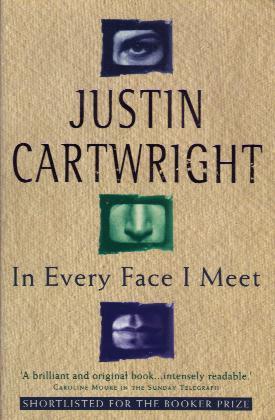
evryface“In Every Face I Meet” is a 1995 Booker Prize-shortlisted novel by Justin Cartwright that takes place over the course of a single, pivotal London day in February 1990 in the life of melancholic forty-something business executive Anthony Northleach.

Northleach, a former talented rugby player (he once trialed for England ‘B’), works for a failing company (what it does is never quite revealed), convinced that the imminent release of Nelson Mandela will fundamentally shift the trajectory of the world, Britain and his own sense of existentialism.

Much of the novel is the inner monologue of Northleach – he recalls, with detailed wonder and awe, a brilliant try scored by English rugby captain Will Carling in a weekend drubbing of the French, he remembers pivotal moments from his childhood in the kingdom of Swaziland, he ponders his marriage, a passionate affair he once had, and his friendship with his best mate and fellow former rugby player Mike, whose life is spinning out of control.

The secondary storyline is that of Chanelle, a crack-addict and prostitute living in a council estate and her black boyfriend/pimp Jason – sporting a medallion of Nelson Mandela around his neck – living on the outer fringes of London society in the final vestiges of Thatcherism.

Without giving too much away, the two worlds – Northleach’s and Chanelle and Jason’s – are on course for a horrifying collision, but what the novel is really about is Northleach’s longing for the past and his disappointment with the present.

It seems that Cartwright has honed in on the second difficult period in an adult male’s life, (the first being adolescence with all its clumsy fumblings and urges) that period from about 40 onwards when there is cause to reflect and ask the question: “Have I lived a purposeful life?”

And if not, “Is there still time to find some meaning?”

Indeed, the character of Northleach must contain parts of Cartwright himself – who was born and schooled in South Africa, the son of a left-wing newspaper editor, and who wrote the book in London, when he was in his late forties.

I have read “In Every Face I Meet” twice – once while travelling overseas in 2010 and now again, when it turned up in a crate of goods shipped over from South Africa.

What’s so enjoyable about reading the book is being inside Anthony Northleach’s head for one day of his life, following him from the office, where he muses about whether his dowdy secretary will ever make it to Thailand, then on the Tube into Soho for lunch in an Italian restaurant with Mike (bumping into Will Carling along the way) where he invites Mike to come with him on his odyssey to Cape Town and finally on his fateful drive home where he encounters Chanelle and Jason.

Northleach, despite his many failings, is immensely likeable with his sardonic political and philosophical commentary, and his honest reflectiveness.

He (and the novel itself) will particularly appeal to white South African-expats (be they in Britain, Australia or entrenched in any other “safe” country),  nearing or past forty that still have a strong sense nostalgia for the old country, especially if you were there at the time Mandela was freed and the inkling of a utopian “Rainbow nation” first emerged.

Indeed, the book was a gift from a South African expat colleague and friend who raved about it and was right when he said I would find it immensely enjoyable to read.

Looking back to February 1990 when Mandela took his first steps to freedom, they do feel like halcyon days, filled with hope and the prospect of something new and fresh, but also scary and uncertain. We certainly lived through history in the making.

Reflecting back on my own life as I fast approach forty – there is much about Northleach’s longings and existential angst that resonates with me.

The enigma, the ego, the cult and the noble idealism of Julian Assange

julian assangeI finished reading “The Most Dangerous Man in the World” just as the trial of US soldier Bradley Manning began in Maryland.

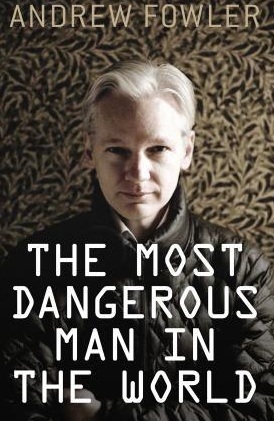
The Most Dangerous Man in the World” is a biography of Wikileaks founder Julian Assange written by ABC journalist Andrew Fowler.

It tells the story of how Assange went from being a teenage hacker in Melbourne to one the most influential and controversial figures in the world.

You could certainly not get too more different characters than Manning and Assange and yet both are now inextricably linked together by their idealism and bravery.

Bradley Manning is by all accounts, a shy, introverted, ultimately decent gay man, who somehow found himself thrust into the intelligence operations of the war in Iraq, and who is responsible for the biggest leak of classified military and diplomatic documents in history.

Assange, portrayed in Fowler’s book as an almost Robin Hood like character – stealing the secrets from the richest most powerful nation on earth to give to the world – but also with the touch of Keyser Soyze about him, able to manipulate politicians and journalists, a seducer of women and at times as secretive as the secret organisations he seeks to expose.

While Fowler clearly admires Assange for what he has achieved, he is no sycophant and leaves the reader to make up their own minds about the enigma and cult of Julian Assange.

How you view Assange and Manning depends on whether you believe governments have the right to keep secrets or whether you believe in the idea of a more transparent and open society.

I am one of those people who believe Julian Assange and Bradley Manning are heroes for revealing the many thousands of innocent civilian deaths at the hands of the US government and its allies, most graphically and famously revealed in the “Collateral Murder” leaked Apache helicopter video showing innocent Iraqis, including children, being killed by 30mm gunfire.

Fowler reveals how the actions of WikiLeaks have shifted events on the world stage. For example, tweets of a WikiLeaks story about the corrupt dictatorship of Tunisian leader Zine el Abidine Ben Ali lead to his overthrow and political exile.

“WikiLeaks was a brilliant example of what has been known for some time: the power of information from a legitimate source, disseminated via social networking systems, to threaten the power of a state and its institutions,” Fowler writes.

Similarly the overthrow of Egyptian dictator Hosni Mubarak as part of the Arab Spring after 30 years of an abusive reign (and with the support of the US government), was also spurred on by WikiLeaks documents showing his brutal methods of silencing opposition.

Still, there are those who call Julian Assange and Bradley Manning traitors and guilty of the highest form of treason for revealing highly classified military documents.

Indeed if Manning is found guilty of high treason (aiding the enemy) he faces spending the rest of life in jail while Assange – now under the protection of the Equadorian embassy in London – faces an uncertain future depending on what steps the US government and its intelligence agencies, supported by other countries including Australia, take to prosecute and silence him.

While the US Constitution’s first amendment enshrines free speech and freedom of the press, the US government has argued that 260,000 or so leaked documents WikiLeaks has on its servers, compromises its national security, puts its operatives at personal risk as well as endangers its relationships with other countries. In short they say it is high treason.

Equally, in the eyes of the current Labor Australian government, Assange is a criminal, despite having the support (according to Fowler’s book) of a large portion of the Australian public and which will be tested if Assange is able to run for a seat in the Australian Senate in September.

Assange is now firmly back in the spotlight with the Manning trial underway.

In a post on WikiLeaks, he says Manning is simply on trial for “telling the truth” and that the US has violated its own laws in its treatment of Manning, including that he has been locked up in a “cage” for 23 out of 24 hours, “deprived of his glasses, sleep, blankets and clothes, and prevented from exercising” and held since May 2010 while awaiting trial.

Assange appears to have won favour again with the New York Times, a newspaper that according to Fowler’s book both supported the work of WikiLeaks and Assange, but also despised him for his manner, his ego and his ability to play one media organisation against another to achieve his own aims and outcomes.

Assange has penned for the New York Times a savage review of a book called “The New Digital Age” written by Google executive chairman and former CEO Eric Schmidt and head of Google Ideas, Jared Cohen in which he accuses Google of going from “an expression of independent Californian graduate student culture” to having “thrown its lot in with traditional Washington power elements, from the State Department to the National Security Agency”.

The article reveals Assange to be a gifted writer, highly articulate and persuasive. He would make an excellent analytical journalist.

Assange accuses Google of acting like an imperialist power, enforcing its digital views on life and business on the world, whether they want it or not. Google, according to Assange, has become a political animal with sinister overtones.

Google’s world vision, he says “heralds the death of privacy for most people and shifts the world toward authoritarianism” – the antithesis of the goals of WikiLeaks, which are a more transparent government but with the privacy of its citizens safeguarded.

It is hard to distinguish between WikiLeaks and Julian Assange.

Though there is a team of people behind WikiLeaks from donors to programmers to activists, Assange is its driving force, its voice and spokesperson.

Fowler’s book reveals Assange to be a difficult person to work with; starting out as a charmer and drawing like-minded people to his noble pursuit of truth like German technology activist Daniel Domscheit Berg and Icelandic politician and activist Birgitta Jónsdóttir and then putting them offsides by unpredictable and secretive behaviour, a hidden agenda and making decisions without consulting with them.

WikiLeaks is the Julian Assange show.

Holed up in the Ecuadorian embassy in London , Assange recently gave an interview to Sydney University politics professor John Keane for The Conversation academic website.

Keane’s interview is more sycophantic then Fowler’s book, but we do get a glimpse of a man who while complaining of the boredom of his “cell” clearly revels in his role as spokesperson for “truth” and appears likeable, still idealistic, but also in the end a realist when it comes to his present situation.

“True democracy is the resistance of people armed with truth against lies,” Assange tells Keane.

In an editorial ahead of the Bradley Manning trial on WikiLeaks, Assange asserts that the dice are already loaded against the soldier, describing it as a “show trial” where “24 prosecution witnesses will give secret testimony in closed session”.

“This is not justice; never could this be justice.” Assange writes.

“Bradley Manning is accused of being a whistleblower, a good man, who cared for others and who followed higher orders. Bradley Manning is effectively accused of conspiracy to commit journalism.”

In the end its does not matter whether you like Julian Assange or not – Fowler’s book lets readers make up their own mind.

What is important are his ideals, which are decidedly noble and good.

“In the end it is not Bradley Manning who is on trial. His trial ended long ago. The defendant now, and for the next 12 weeks, is the United States. A runaway military, whose misdeeds have been laid bare, and a secretive government at war with the public. They sit in the docks. We are called to serve as jurists. We must not turn away,” writes Assange with masterful elegance.

Does speaking out against Israel by default equate to anti-semitism?

Israeli-flagDoes speaking out against the Israeli government mean you are by default an anti-semite?

I have been asking myself that question for more than two decades since finishing five years at a Jewish high school in 1991 where the idea of Israel’s saintliness was drummed into mine and my classmates’ heads with the force of an animal stun gun.

The question resurfaces every time someone of generally high standing is accused of being anti-semitic.

The latest in the firing line is Sydney University professor, Jake Lynch.

Professor Lynch is director of Sydney University’s Centre for Peace and Conflict Studies, and author of a number of academic works on “peace journalism”.

By his association with the Boycott, Divestment and Sanctions (BDS) campaign, professor Lynch has been accused of being “against jewish people” by shadow foreign affairs spokeswoman Julie Bishop, who has promised that should the Coalition win government, it would cut funding from  the Centre for Peace and Conflict Studies.

“Mr Lynch is free to raise funds from non-government sources if he requires money to fund his campaign against the state of Israel and Jewish people,” Julie Bishop told The Australian.

“A Coalition government would seek to withdraw funding to any academic institution that used taxpayer funds for an anti-semitic campaign,” she adds.

Bishop, who is not Jewish, makes the familiar leap from it being “a campaign against “Israel” to “against the Jewish people”.

Now, I for one do not support the boycott being promoted by the BDS campaign.

But it seems highly questionable that professor Lynch is “against the Jews” given his CV, academic credentials, published works and experience.

He has written for the respected independent online journal New Matilda and appeared on the ABC opinion program The Drum.

In addition, three Jewish academics have come out in support of professor Lynch’s and other people’s or organisations’ democratic rights to be critical of Israeli policies and actions without the threat of losing their funding.

“Andrew Benjamin, Michele Grossman and David Goodman variously described the policy outlined last week by Liberal deputy leader Julie Bishop as ‘outrageous’, ‘counter-productive’, ‘populist’, and as ‘an anti-democratic gesture par excellence,” reported The Australian.

(For professor Lynch’s own explanation for why he supports the BDS campaign, read his view on New Matilda  – interestingly, the word “Jew” or “Jewish” is not said once).

A look back through the archives reveals other similar examples where left-wing leaning people and organisations have been labelled ‘anti-semitic” for speaking their minds on Israeli politics.

In September 2010, Fairfax journalist and broadcaster Mike Carlton came under fire for an article he had written highly critical of the actions of Israeli forces in Gaza in May 2010.

In a follow up column a week later, he wrote of  the hundreds of angry emails he had received in response from the Jewish lobby, which he called a “ferocious beast”.

“Write just one sentence even mildly critical of Israel and it lunges from its lair, fangs bared, ” said Carlton.

Emails received apparently included:

‘How dare you insult Israel you over priviledged [sic] racist white moron, f— you and your stupid article. I wish I could smash your dumb face in.”

Carlton wrote in his follow up article a week later:

“I replied to Robert Goot (president of the Executive Council of Australian Jewry) ,that I am perfectly content with the existence of Israel as an independent Jewish homeland, and that I have no more regard for Hamas than I had for the psychopaths of my own ethnic background, the IRA.

“But nor, I said, would I be silenced about Israel’s cruel and unconscionable oppression of the people of Gaza. Enough. Shalom.”

A complaint of anti-semitism made against Carlton was dismissed by the Australian Press Council.

Last year Nobel prize-winning author Gunter Grass was labelled an anti-semite for a poem he wrote arguing against Germany delivering nuclear submarines to Israel.

For someone who grew up being told not to buy German cars or German appliances (though every parent of every kid I new at school drove a BMW or Mercedes), the ironies are too huge to even try to put in words.

And also last year, the Executive Council of Australian Jewry sought to halt promotion and DVD sales of the SBS series ‘The Promise’ about a young British woman retracing the footsteps of her grandfather, a soldier in the final years of the British Mandate in Palestine, labelling it Nazi propaganda and anti-semitic.

The truth, it seems, is that criticism of Israeli government policies inevitably leads to the cries that there is an underlying anti-Jewish agenda.

And it doesn’t even matter if you’re a Jew.

If you’re a Jew and you criticise Israel, then you are a “Jew-hating Jew”.

The most high-profile example of this was South African Judge Richard Goldstone,  who chaired the Goldstone Commission in The Hague prosecuting war crimes in Yugoslavia and Rwanda and released the controversial Goldstone Report.

He felt the full wrath of the small, but highly influential South African Jewish community, when the Goldstone report into the Gaza war of December 2008 and January 2009 was published, accusing the Israeli government, but also Hamas, of deliberately targeting civilians.

The backlash in South Africa was brutal and vindictive, aimed at inflicting maximum personal hurt and pain.

Leading the charge was the South African Zionist Federation, who threatened to picket the synagogue if Goldstone attended his own grandson’s bar mitzvah in Johannesburg.

As someone who remembers the importance of his own bar mitzvah (when you symbolically enter adulthood at age 13), it was the cruellest of threats.

In April 2011, Richard Goldstone wrote in the Washington Post that subsequent findings were that the Israeli government had not intentionally targeted civilians but also that “the purpose of the Goldstone Report was never to prove a foregone conclusion against Israel”.

To any sane individual, Richard Goldstone is not anti-semite.

But not to the South African Zionist lobby – a lobby I might point out is content to live outside of Israel – rather than join in those who actually live there day in and day out.

I can understand though where such views germinate from.

I spent five years at a Jewish day school in South Africa where the idea of Israel’s importance was heavily and relentlessly drummed into our heads, while at the same time no mention was made of our own privileged positions as white school kids in a private school in apartheid South Africa.

We had one particular history teacher, a very severe woman, who instructed us to learn to draw the Israeli map from memory.

I am not joking – Heaven forbid you could not manage the task!

Later, in adult life, I have found myself at dinner parties and where I have been told that institutions like the BBC and The Guardian newspaper – among the most respected media organisations in the world – are anti-semitic.

Instead, I was told to watch CNN for an unbiased (read: pro-Israeli) point of view.

So am I suggesting the BDS campaign is an entirely kosher operation with no bad elements tagged on to it.

Certainly not, that would be naive.

But equally, is it fair to tar anyone who forms a negative view on Israeli government policies as an anti-semite?

Like every government, the Israeli government is far from perfect.

Anyone who has followed the story of Mossad’s use of fake Australian and British passports to carry out a Hamas hit in January 2010 will know that there are some very sinister elements operating within the darker recesses of the Israeli government.

As there are in every government.

The funny thing is that within Israel, Jews protest openly against Israeli policies such as when 250,000 Israelis joined rallies against their government’s economic policies in September 2011 – and no one accuses them of being jew-hating jews.

As Stephen Pollard, editor of The Jewish Chronicle wrote in The Sunday Age a couple of years ago: “It shouldn’t need saying that protesting against the actions of the Israeli government is not the same as being anti-semitic.”

Surely the time has come to separate legitimate criticism of Israel with claims of anti-semitism.

Yes there are many anti-semitic agendas behind Israeli protests and anti-Israeli comments and these should be pointed out when the evidence overwhelmingly says so.

But jumping up hysterically  and shouting “anti-semite” every time a word is uttered in anger serves no purpose but to give more ammunition to the real bigots and jew-haters.

Israel holds itself up as an example of a democracy surrounding by states that are not.

Surely it’s time its defenders in the diaspora became a little more tolerant of free speech.

Train surfing: the latest (deadly) teen craze?

train surfingHave you ever heard of train surfing in Australia?

I was on the Craigieburn train from the city this week and three kids got on. They were probably around 15 or 16 years old.

As we approached Essendon station, one of the kids, the skinniest one, made his way to the door and then popped out onto the platfom.

“Are you going to surf this train Paco?” his two mates asked as he disappeared from view.

In between remarking on how crazy their mate Paco was, the two mates stuck their heads out the train at each station to check if he was presumably still hanging on to the roof of the train or had fallen off.

This was done with a mixture of admonishment and admiration as if they wished they were as crazy as Paco, but glad they weren’t nearly as brave.

This apparently is “train surfing” – climbing onto the roof of the train and “surfing” it while it moves.

As we headed towards Oak Park, a train coming in the opposite direction whizzed past at what felt like 200 km per hour.

Was Paco still hanging on or was he a bloody, mangled corpse lying on the tracks betwen Glenbervie and Strathmore?

His friends didn’t seem too bothered.

At Pascoe Vale station, one stop before I got off, Paco’s mates got off and wandered off down the platform, without Paco.

I got off the train at Oak Park and as the train left the station I waited for it to pass to see if Paco was still hanging on, no doubt grinning.

Put there was no Paco. Who knows where he was? Had he gotten off earlier? Was he ever surfin the train? Had he fallen off?

In May last year The Age newspaper reported the story of a teen who fell off a train on the Sandringham line, critically injuring himself, while train surfing with his mates.

In January, a teen died after being electrocuted after train-surfing. He was sitting on the roof of the train.

In 2004, a 14 year-old boy had both his legs amputated after falling off a train while train surfing in the UK.

There are a three basic requirements to be a train surfer:

Firstly, you have to be a complete idiot.

Secondly, you have to have friends who are also hopeless idiots as well.

Thirdly, you have to believe you’re invincible.