The brilliant wit and insight of Bill Bryson

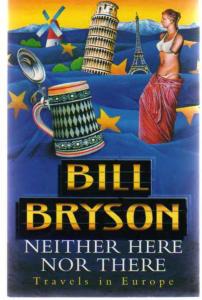
neither here nor thereNeither Here Nor There is a travel book by best-selling author Bill Bryson charting his 1990 trip around Europe and which I recently finished reading.

It had been a long time since I last read a Billy Bryson book, maybe 10 years or more. I went through a phase where I read heaps of them and enjoyed them immensely.

Then, recently, someone brought back a movie from one of those video dispensing kiosks that have sadly replaced Video Stores in our neighbourhood. It was called ‘A Walk in the Woods’ starring Robert Redford, Emma Thompson and Nick Nolte.

Robert Redford played Bill Bryson, Emma Thompson his wife and Nick Nolte, his one-time travel buddy Steven Katz. The film was a dramatisation of Bryson’s book of the same name where he set off, as an unfit, 60-something bloke to walk the 3,500 km Appalachian Trail from Georgia in the South all the way up to Maine on the East Coast (Bryson had returned to live in the US after two decades in England.

It turned out to be a mildly entertaining, somewhat charming buddy movie – Bryson and Katz begrudgingly reunited – trying to do the impossible. Combined with some breath-taking scenery and funny moments (like when Katz seduces a plump, local woman at the laundromat, only to be hunted later by her rifle-toting hill-billy husband) it inspired me to read Bryson again and conveniently I found a copy of Neither here nor There sitting on my shelf.

The travelogue begins with Bryson on a long, uncomfortable bus journey in Norway to see the Northern Lights in Hammerfest (which he does finally see and describe in all their wondrous, spooky glory after wandering the remote town for weeks). Then after returning to England to wait for the coming of Spring, he heads back to Europe to begin the journey proper.

Beginning in Paris,  Bryson travels east through Belgium, Germany, Holland, Denmark, Sweden, Italy, Switzerland, Liechtenstein, Austria, the former Yugoslavia , Bulgaria and finally Turkey.

The great thing about Bryson, and what I believe all great travel writers do is they make you want to pack your bags and do some travelling of your own – but not by telling you that everything you encounter in the world on your travels is wonderful, but by piquing your curiosity.

Bryson is a master at combining the typical sightseeing stuff – museums, cathedrals, art galleries – with the more quirky, unusual places. He wanders of the beaten track, to find a hidden park, an interesting pub or a ruin, throwing in dollops of fascinating history and hilarious and often embarrassing stories about himself
bill bryson

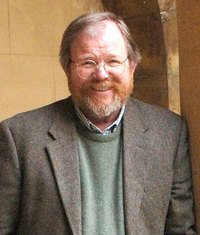
The author Bill Bryson

As a self-deprecating chronicler of his own misadventures, Bryson is in a class of his own. He is happy to share his misadventures with women, descriptions of his less than trim physique and personal style (he comes across as quite geeky) and his penchant for booze, cigarettes and ogling the more attractive specimens of the opposite sex.


He also spends a lot of time complaining about the price of hotels and getting angry when he finds a museum he desperately wanted to see closed or is left disappointed by a city or place he thought he would like.  All experiences I could relate to.

I spent four days wandering around Florence, trying to love it, but mostly failing…there was litter everywhere and gypsy beggars constantly importuning and Sengalese street vendors cluttering every sidewalk with their sunglasses and Louis Vuitton luggage.

Bryson’s greatest gift as a writer and storyteller is his very dry, very sardonic sense of humour, which must have been finely honed by his years living in the UK.  Indeed it’s hard to imagine he’s actually American.

He is a very funny writer, something incredible hard to achieve, and I found myself chuckling of even guffawing every couple of pages at some amusing anecdote about local customs or over the top description of a terrible meal, strange hotel or unexpected experience.

Here’s an excerpt from his visit to a sex shop in Hamburg and his musing on inflatable sex dolls:

I was fascinated. Who buys these things? Presumably the manufacturers wouldn’t include a vibrating anus or tits that get hot if the demand wasn’t there? So who’s clamouring for them? And how does one bring himself to make the purchase? Do you tell the person behind the counter it’s for a friend?

Later he muses about what would happen if friends popped over while you were entertaining your “vinyl” friend, thinking that perhaps you have to shove the doll up the chimney and hope no one asks about the extra place setting.

But then he reckons, maybe he is just being a prude. Maybe people discuss their dolls in bars and so he imagines a typical conversation:

“Did I tell you I traded up to an Arabian Nights Model 280. The eyes don’t move but the anus gives good action.”

Also in Hamburg he is perplexed at why gorgeous women grow armpit hair which makes it look as if they are wearing “brillo pads” under their arms, remarking that “I know people think its earthy, but so are turnips”.

But from these hilarious musings, he can shift into serious mode. Following a return visit to the Anne Frank house, he writes:

One picture I hadn’t seen transfixed me. It was a blurry photo of a German soldier taking aim with a rifle at a woman and the baby she was clutching as she cowered besides a trench of bodies. I couldn’t stop staring at it, trying to imagine what sort of person could do such a thing.

From the hilarious to the deadly serious, Bryson keeps you entertaining from the start to finish. Hardly for a moment are you ever bored. The book is full of movement: train journeys, city walks and tumbles down hillsides.

There’s also a certain pleasure in following the adventures of travel writer before the age of the smart phone (and Google maps) and online booking websites.

In an interview to promote a new book a few years back, Bryson said he was  lucky enough to get away with ditching his copy editing job on the London newspapers and becoming a full-time writer.

“Then it was wonderful – there’s no better way to make a living than being a travel writer,” he said.

This passion for travelling and writing about his travels, makes reading Bryson a great pleasure as well.

 

Why I won’t be voting in yet another Federal Election

voting in austDouble dissolution or not, I won’t be voting in this year’s Federal Election, which could happen on July 2.

Don’t worry, I won’t be getting a fine or a telling off from my in-laws because I have an iron-clad excuse: I don’t yet have my Australian citizenship despite pledging to get it at the last election in 2013 (and blogged about it).

Three years have passed and I have procrastinated and made no progress at all on the paperwork that must be filled in to get my Australian citizenship, passport and right  to vote.

I would like to call myself  Australian very much, but the process of becoming one overwhelms me.

Firstly, because I still have half my heart in Africa, I am determined to keep my South African citizenship. This involves applying to the South African Department of Home Affairs for the right to have Dual Citizenship. If I don’t, and get Australian citizenship, I lose my South African citizenship, part of my identity and part of my birthright.

Then there’s all the filling of lengthy forms required by the Australian Department of Immigration, plus statutory declarations, police checks and other hoops one must jump through. All of this takes take time and costs money.

I’ve been in the country since 2004, lived in Brisbane, Sydney and Melbourne, have two Australian children – can’t they just give me the damn  naturalisation certificate?

I recently had dinner with a woman who told me the government had just rung her up to say she had been given citizenship automatically and that she should come along to her ceremony. I was envious, if only it could be that easy for me.

But regardless of the effort required, you’d have thought I would have found a few quiet evenings over the past three years to fill out the forms and just got it over and done with.

I should be clamouring for my final stamp of Australian-ness. After 12 years Down Under, I’ve mastered the basics of Aussie Rules, know my flat white from my long black, developed a liking for a chicken parma and can sing along to my fair share of Paul Kelly and The Whitlams songs. Most importantly, I’ve made a good life here in a great and lucky country that has treated me exceptionally well.

The motivation should be there, if for any reason that my dark green South African passport that I still cherish, is a pretty useless travel document requiring that I get visas for so many places – Europe and the USA in particular – while an Australian passport would let me waltz right in.

I could say it’s because Australian politics or politicians don’t inspire me, which is partly true, but I’ve simply just put it in the “too hard” basket and gotten on with doing other things.

The truth is I would like someone to just give it to me on a silver platter: if only I could bowl a decent googly of swim like James Magnussen.

It’s funny how things come full circle: When I first came to Australia in 2004, there was also a Federal Election on, and I vivdly recall sitting outside a polling station somewhere outside of Canberra (we were on our way to the Floriade) like an outcast, eating my umpteenth lamington while my girlfriend and her family voted.

Sadly, she voted for John Howard which meant our relationship did not last (that wasn’t the only reason).

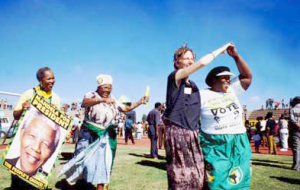
If I am being entirely honest, I am more than a bit disappointed with myself because I do feel that  I am missing out. I’ve only voted twice in my life and one of those days – the first democratic elections in South Africa in 1994 – was definitely one of the greatest in my life.

voting south africa

Voting in South Africa in 1994. Magic times

I wrote about the experience and on this blog describing the queues of multi-coloured people waiting patiently in line, rich white ‘madams’ and uneducated domestic workers all side by side awaiting their turn, the rainbow nation at work. It was a glorious moment in South Africa and the world and I was so lucky to be a part of it.

It’s not quite the rainbow nation over here, but it’s not that far off – so hopefully one day I will join the queues.

Let’s say I’ll aim for 2019. That’s almost do-able right?


Col Hahne and Nene King: two riches to rags stories

1991:FILE PICTURE OF NENE KING;EDTOR OF WOMAN'S DAY

Nene King in her heyday

When the sad decline of Australia’s former magazine publishing queen Nene King made headlines again in February, it brought back memories of a former life, when I edited a mortgage broking magazine in Sydney called Australian Broker.

It wasn’t Nene King who trigged memories of those days, but mention of the man she was suing in County Court, Colin Hahne, a friend and former housemate, whom she claimed defrauded her of $40,000 and took advantage of her generosity, and whom she had tried to sue for a far bigger amount in 2013. (In the end Hahne, 46, was cleared of all charges).

I remembered, in about 2006, the rather sensational story that broke across the mortgage  industry, and which we reported in our magazine, of the rise and fall of a ‘Col Hahne’ an award-winning mortgage broker, who founded GAL Home Loans, a service specifically tailored to servicing gay and lesbian people seeking mortgage finance.

Founded in Melbourne in 2000, and inspired by Hahne’s own experiences of homophobia growing up the country town of Wangaratta, GAL Home Loans became a massive success, spawning offices in Sydney, Geelong, Adelaide, Brisbane and Perth.

In 2003, Col Hahne picked up a string of industry awards at the Australian Mortgage Awards, including Best Brokerage and Sales Person of the Year, after personally writing $90m worth of home loans. He was also named Operator of the Year in 2005 by the Mortgage Industry Association of Australia (later renamed the MFAA), the peak industry body.

Col Hahne and his mortgage broking business was flying, finding a niche in a crowded industry and striking sponsorship deals with gay and lesbian orientated Sydney Mardi Gras, Midsumma Festivals and Pride March Victoria.

In a 2003 interview with The Star Observer, Sydney’s newspaper for the gay and lesbian community, Hahne said he felt overwhelmed at winning so many mortgage awards – “I didn’t think we had a hope,” he said, as he talked about his passion for giving back to the community:

“I just feel that the more you throw back at a community, the more they’ll support you and the better it is for everyone concerned,” he said.

hahne expelled photo

Col Hahne wining his MIAA award in 2005, expelled in 2006.

Then just as suddenly as his career had surged, it came to a crashing halt. In July 2006, GAL Home Loans and Col Hahne were expelled from the MFAA after an independent tribunal found GAL Home Loans had breached its code of practice.

The MFAA did not disclose the reasons for his expulsion, but it soon emerged that Hahne was being sued by the organisers of the Sydney Mardi Gras over an alleged breach of a three-year sponsorship deal.

GAL Home Loans collapsed in 2007 and a court-order to wind-up the company and appoint a liquidator was made in 2011.

So what became of Col Hahne? Was he the same Colin Hahne, who became a close friend of Nene King, whom she referred to as her ‘nephew’ and whom she lavished cars, watches and other gifts.

The answer is an unequivocal yes. They are the same person.

col hahne trial.jpg

Col Hahne leaving court in February this year

It appears that soon after his business collapsed, Col Hahne met Nene King when he began dating massage therapist Larry Sutcliffe, who smoked marijuana with King.

In her court testimony, King said Hahne told her how he had had 13 companies (the once high-flying mortgage broking businesses) which went bust and that he had no money. She agreed to let him move in with her and Mr Sutcliffe.

The couple moved into King’s Caulfied home in Melbourne South Eastern suburbs, where, according to reports she had lived as a recluse since 2003 having suffered the tragic loss of her husband Patrick Bowring to a suspected shark attack in 1996 and then battled a drug problem and depression.

The trio became a “family unit” as she showered the gay couple with expensive gifts, noting at the trial that Hahne had told her he was a “financial wizard”.

“She continued to pay all the bills for both men before her money started running out and she had to take out a mortgage on her home,” The Age reported.

“We became great friends and I trusted them totally,” King said at the 2013 trial.

Hahne was found not guilty of all 49 theft and deception-related charges, with the court accepting his explanation that he had an arrangement with Ms King to use her credit cards and always did so with her authority.

As the trial near its end, King, who was once the richest woman in publishing having turned around Woman’s Day and made Kerry Packer a small fortune yelled out at Hahne calling him a “ghastly liar”. Later, in an interview, she claimed she was broke.

As for Col Hahne, he left the courtroom after the trial making no comment disappearing into another life, with the media interest squarely focused on his much more famous former friend, the once wealthy and powerful “paper giant” (Made into an excellent ABC movie).

In the end, it was Nene King very sad riches to rags stories that got all the headlines. But  Col Hahne’s own rise and fall as a high-flying mortgage broker, is also worthy of telling, and just as intriguing.

Conversations with Holden Caulfield

catcher_in_the_rye_penguin_2I picked up my old paperback copy of JD Salinger‘s The Catcher in the Rye after watching the movie ‘The Killing of John Lennon’ about Mark David Chapman, the wayward young man who killed The Beatles singer and songwriter, and remains in jail.

It seemed a bit of sinister that I should choose to re-read this cult novel after watching a movie about an infamous murderer and murder, but the connection is an obvious one. 

Chapman shot Lennon in December 1980, outside the singer’s apartment in Manhattan, and famously took his inspiration to kill from The Catcher in the Rye and its narrator, 16-year-old angst-ridden rebel, Holden Caulfield.

In the movie, Chapman calls Lennon a ‘phoney’ – as Holden Caulfield calls so many people in the novel – because Lennon preached ‘no possessions’ (famously in his hit song ‘Imagine‘) and yet owned mansions and yachts and was immensely wealthy.

At his trial, when Chapman was asked if he had anything to say, he rose and read the passage from The Catcher in the Rye, when Holden tells his little sister, Phoebe, what he wants to do with his life:

Anyway, I keep picturing all these little kids playing some game in this big field of rye and all. Thousands of little kids, and nobody’s around – nobody big, I mean – except me. And I’m standing on the edge of some crazy cliff. What I have to do, I have to catch everybody if they start to go over the cliff – I mean if they’re running and they don’t look where they’re going I have to come out from somewhere and catch them. That’s all I do all day. I’d just be the catcher in the rye and all.

Picking up and re-reading The Catcher in the Rye, the exact same lemon yellow copy which I had read as a young man, was both a joy (it’s such an engaging, hilarious, thought-provoking and sad story), and also a rather unsettling experience. 

Mostly because, I  noticed all the passages and sections I had underlined about ‘phoneys’, and people “never noticing anything” and “girls driving you crazy” and “being a madman”. I realised that back then, I like Mark Chapman, was also a rather lost, somewhat bitter young man (thought without any murderous intentions I am certain) who had made a similar emotional connection with Holden Caulfield.

Holden’s inner monologue about the world and its endless disappointments, as he traipsed around New York, mirrored many of my own inner frustrations and torments at the time.

In fact it wasn’t just underlining that I had done, but I’d also engaged in conversations with Holden, writing responses to the things he said. In short, I was a bit of a “madman” myself.

 At one point I wrote: “Really Holden, I beg to differ with you. You are talking shit,” this in response to Holden saying “You don’t always have to get sexy to know a girl.”

In another note, I wrote simply  “Alicia Silverstone” alongside a passage in which Holden describes a girl he has a crush on, Jane Gallagher. 

 Holden observes that when Jane got excited when talking “her mouth sort of went in about fifty directions, her lips and all”. It must have been around the time the movie Clueless came out which made Silverstone, who had this sexy, pouty mouth,  a star and ever young man’s fantasy. 

Clearly, I really connected with Holden Caulfield back then, and to be entirely truthful more than 20 years on, I still find a lot of wisdom in some of his observations. 

Across the generations, millions of others have made a similar connection to their own feelings of adolescent loneliness and frustration about a world of phoneys: The Catcher in the Rye has sold 65 million copies since it was published in 1951 and according to Wikipedia, continues to sell 250,000 copies every year.

There’s so many passages in the book that just knock the lights out for me, not least his awkward ncounter with a young prostitute in his hotel room where he loses his nerve, and just wants to chat.

It really must have stunned readers back in the conservative 1950s with Holden’s frank observations about sex (“I’m probably the biggest sex maniac you ever saw.”), desire (“I was feeling pretty horny, I have to admit it.”), suicide (“I almost wished I was dead.”), death and depression (“I just felt blue as hell”).

Of course, a lot of Holden’s behaviour, thoughts and opinions are those of angst-ridden, affected adolescent, too intelligent for his own good, but at the same time there is also so much truth and poignancy in what he says about people and their phoneyness, be they teachers, priests, movie stars or members of his own family (“All mothers are slightly insane”).

 It’s hard to pick out a favourite passage because their are so many. But I f I had to choose one, It would be when Holden decides to pay a visit to the Natural History Museum, which he loved visiting on school trips because “it always felt like it was raining outside, even when it wasn’t” and where he’d eat candy and chew gum and a girl would hold his hand. 

He recalls his favourite exhibits,  the Indians in a war canoe “about as long as three goddam Cadillacs in a row” and the eskimos fishing through a hole in the ice.

Holden says you could return a hundred thousand times and nothing would be different, the eskimos would still be there, except you would be different in some way. 

 He then thinks about his kid sister Phoebe, and that she would visit the museum like he did as a school kid and she too would be different every time she visited.

It didn’t exactly depress me to think about it, but it didn’t make gay as hell, either. Certain things they should stay the way they are. You ought to be able to stick them in one of those big glass cases and just leave them alone. I know that’s impossible, but it’s too bad. Anyway, I kept thinking about all that while I walked.

There’s something so brutally true about this.

Don’t we all long for some things to never change? That our parents not grow old, that those we love not pass away or disappear from our lives.

Don’t we all want to be Catchers in the Rye?

What Atticus Finch can teach parents about raising children

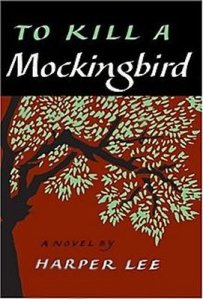
To_Kill_a_Mockingbird

Original cover of the book

I finally read To Kill a Mockingbird by Harper Lee.

I was rather ashamed that at age 42, I had not read the novel, first published in 1960, given its important and revered status in American and world literature.

For anyone who has not read it, I implore you to do so. It’s a wonderful novel, very readable and with a powerful message about the importance of tolerance and the evils of bigotry that has lost none of its power in world increasingly divided into “us” vs “them”.

Set in America’s racially divided deep south in the 1930s, it’s the story of Atticus Finch, a lawyer in the small rural town of Maycomb in the state of Alabama, who represents a clearly innocent black man, Tom Robinson, accused of the rape of a white woman.

The story is narrated by Atticus’s Tom Boyish young daughter ‘Scout’ or Jean Louise, who through her own coming-of-age, becomes a conduit for the reader’s own moral education.

To Kill a Mockingbird also includes one of modern fiction’s great minor characters, the ghost-like ‘Boo’ Arthur Radley (brilliantly portrayed by a very young  Robert Duvall in the Oscar-winning movie).

Having finished it, I wondered what I could say about a book that’s had so much said and written about it already.

What seemed obvious to me, the more I thought about it, was that you could read To Kill a Mockingbird as an excellent guide to parenting

After all, who really is Atticus Finch? Yes he’s the moral centre of the story, but he’s also just a single parent doing an amazing job raising two headstrong young children (Scout and her older brother Jem) into fair-minded, empathetic, non-judgemental and courageous human beings.

From my reading of To Kill a Mockingbird, I’ve picked out some of the special qualities that makes Atticus Finch such a iconic parent:

Atticus tries to see the world from his children’s point of view.

You never really understand a person until you consider things from his point of view … until you climb into his skin and walk around in it.

This is one of the most famous lines from the book. It happens early on in the novel in a conversation after dinner between Atticus and Scout.

Scout is upset because her teacher, Miss Caroline, has told her to stop reading with her father, because he has ‘taught her all wrong’.

Scout is in fact very advanced for her age and way ahead of her classmates, something which unhinges her teacher.

Atticus precedes this piece of advice by calling it a “simple trick” but if you learn it “you can get along with all kinds of folks”.

What an incredible thing to tell a young child (Scout is about six or seven at the time) and how different the world would be if every child grew up with the notion that they try and see things from the point of view of others.

So much unnecessary confrontation, bitterness and unhappiness could be avoided in life if our children understood this “simple trick”

Atticus has perfected the art of explaining things.

Atticus Finch is unquestionable master at being able to explain complicated concepts to Scout and Jem without dumbing them down so they become meaningless.

Instead he takes the time to make sure they really understand why people act they way they do.  Such as when Mr Cunningham, a poor local farmer, delivers fresh produce to their house. Atticus explains that this is the only way the Cunninghams can pay him for his legal services because “the [stock market] crash hit country folk the hardest”. He tells Scout:

Did you know that Dr Reynolds (the town physician) works the same way? He charges some folks a bushel of potatoes for delivery of a baby?

Atticus doesn’t answer his kids with platitudes

There is very little different in the way Atticus talks to his children and how he talks to adults. Put simply, he does not try and trick them with plausible, but distorted explanations or half-truths. This is how he explains it to his brother Jack:

Children are children, but they can spot an evasion quicker than adults and evasion simply muddles ’em.”

Atticus teaches his children to fight with their heads not their fists

gregory peck

A still from the movie: Gregory Peck (Atticus Finch) and Brock Peters (Tom Robinson)

Atticus Finch forbids Scout and Jem to fight the other children in school even when they call their father a “nigger lover” for defending Tom Robinson. He tells them to fight with their “heads” meaning they should not let their anger and emotions get the better of them.

You just hold your head high and keep those fists down. No matter what anybody says to you, don’t you let ‘em get your goat. Try fighting with your head for a change…it’s a good one, even if it does resist learning.

Atticus teaches his children to act according to their consciences.

Atticus explains that it is his duty to defend Tom Robinson because his conscience dictates that he must.  He expects his kids to do the same even if it means going against what the majority of the town’s white population believe is right. He tells Jem:

They’re certaintly entitled to think that [I’m wrong for defending Tom Robinson] and they’re entitled to full respect for their opinions. But before I can live with other folks I’ve got to live with myself. The one thing that doesn’t abide by majority rule is a person’s conscience.

Atticus is a beacon of calmness.

Even parenting books today tell you to not lose your cool with your kids. You get upset, they get upset.

Throughout the novel, Atticus Finch is a beacon of wise calmness, thoughtfulness and quiet contemplation, especially when it comes to talking to his children.

A good example is when Tom Robinson is transferred to the Maycomb county jail in the town square, Atticus stands guard outside, but armed with only a lamp for reading and a book – not a gun.

His adventurous children head out to find him and arrive at the courthouse at the same time as a lynch mob of farmers arrive to exact their own justice.

While clearly distraught, he calmly implores Jem to take his sister and their friend Dill home. Even when Jem refuses, Atticus never loses his temper or shows his anxiety.

But, Atticus is also a man of action when he needs to be

There’s a scene in the book, also captured in the movie, where Atticus is forced to shoot a rabid old dog called Tim Johnson who is hobbling down the street passed everyone’s home. Atticus reluctantly takes the rifle from sheriff Heck Tate who doesn’t have the self-belief to do it himself. To everyone’s amazement, Atticus shoots the dog stone cold dead in the street.

Miss Maudie Atkinson (the Finch’s neighbour) grinned wickedly. “Well now, Mis Jean,” she said, “still think your father can’t do anything? Still ashamed of him?”

“No,” I said, meekly.

Atticus teaches his children not to judge others based on ignorance

This is a powerful message Atticus teaches his children again and again in the book, and is also a key theme of the novel – that we should not judge people based on the ignorance passed on by others.

This message is brought powerfully home in the trial of Tom Robinson, who we learn is clearly a kind and decent man whose only crime was to help a lonely, ignorant white woman and then reject her advances.

(To Jem): There’s something in our world that makes men lose their heads – they couldn’t be fair if they tried. In our courts, when it’s a white man’s word against a black man’s, the white man always wins…as you grow older, you’ll see white men cheat black men every day of your life.

There are plenty more parenting tips you could pick up from Atticus Finch if you take the time to read the book, or perhaps re-read it as a parent – these are just a few that stood out for me.

harper lee and father

Harper Lee with her father

It’s worth noting too that Harper Lee, who never married or had kids, based the character of Atticus Finch on her father, Amasa Colman Lee, a lawyer and politican who defended two black men on murder charges (they were convicted and hanged) during his career.

Lee, the youngest child, would sit in her father’s lap – like Scout does in To Kill a Mockingbird – and read the newspaper with him.

However, like Atticus (who certainly has his faults, aloofness and stubborness among them) Lee’s father was a far from perfect man.

It emerged, to the horror of some fans, when Lee’s second novel, Go Set a Watchman was published, that Amasa Colman Lee was in fact a segrationist (though he apparently softened his views later in life and was quite forward-thinking considering where and when he grew up).

It’s a point worth remembering  – no one can be a perfect parent. We can only try to be.


Who really was Ben Zygier? Reading Rafael Epstein’s ‘Prisoner X’

prisoner x‘Prisoner X’ by journalist and ABC radio presenter Rafael Epstein investigates the life and death of Melbourne man Ben Zygier, who committed suicide in a top secret cell in Israel’s Ayalon Prison in  December 2010 and whose sensational story made headlines in Australia and around the wold.

In 2013, Zygier, a lawyer and father of two from a well-connected Melbourne Jewish family, was sensationally revealed on the ABC’s Foreign Correspondent programme to be’Prisoner X’ the Mossad agent who betrayed Israel.

My interest in reading Epstein’s excellent book came out of a conversation with a fellow journalist, Patrick Durkin (@patrickdurkin),  a former lawyer, who had done articles with Ben at the law firm Norton Rose in 2001.

Patrick mentioned that when news broke that Ben Zygier was ‘Prisoner X’ in early 2013, he had hastily written a story for the Australian Financial Review, the newspaper we both write for, titled “Prisoner X, My Melbourne lawyer friend”

It may have been written in haste, but it was deeply moving and renewed my interest in a story I had, for some reason, not followed in great detail when it made front page headlines.  Patrick wrote that the revelations of who Ben was sent a “shock wave” through his group of lawyer friends.

Ben had joined our group of 20-odd articled clerks halfway through the year. Most of us remember him as a serious young man who was largely aloof from the rest of our tight-knit group… News broken by ABC’s Foreign Correspondent of Ben’s jailing and death is as shocking as it is surreal. (Patrick Durkin)

Rafael Epstein also knew Ben Zygier, at a much earlier time in his life, and like Patrick struggled to digest how he ended up in such a predicament in solitary confinement in a maximum security Israeli jail.

Epstein was Ben’s mentor in a Zionist Youth Movement called Netzer in the late 1980s when he remembered Ben  as a “cheeky, warm, quietly spoken boy”.

I have a photo of Ben from this time…it is the same smile and blue eyes that stare out from the photo of Ben flashed around the world’s media two year’s after his death. (Prisoner X, Rafael Epstein)

Epstein’s motivation to write the book was to correct the impression created in the mainstream media that Ben was either a “zealot or a traiter” by shedding some light on who Ben really was and, also, to try and solve the mystery of what really happened.

According to Epstein’s carefully drawn picture – based on numerous interviews with people who knew him  – Ben Zygier was by all accounts  a well-liked, quick-witted, intelligent man who would have made a very good lawyer.

But unfortunately, he also had none of the traits necessary to become a master spy for Mossad, Israel’s revered and feared spy agency: he was emotionally unstable, his behaviour was sometimes unpredictable, he could be grandiose and boastful and crucially, he could not keep a secret.

prisoner_x_melbourne_021413_620px

Ben Zygier on the front page of The Age newspaper

One of the key revelations in the book is Epstein’s fervent belief that Ben’s downfall was not – as reported in the mainstream media – due to a rogue mission to the Middle East where his attempts to turn a Hezbollah agent into an Israeli double-agent, backfired sensationally.

Instead, Epstein claims, it was things Ben said to a mysterious Iranian man among Ben’s circle of friends at Monash University where he had returned to study in 2009 that led him to a solitary cell in Ayalon Prison.

According to Epstein, Ben’s fragile state of mind caused him to betray his secret life to the wrong person.

Ben’s mistake was a simple one and lacked the determination and intent that has been suggested in the media…put simply, Ben said too much to the wrong person at the wrong time. (Prisoner X, Rafael Epstein)

The other key insight from the book is that it provides a convincing case that Ben’s death was suicide, despite the initial suspicions when he was found hanged in a supposed suicide-proof cell. The truth appears to be that Ben died because responsibility for his care was mishandled by the security services and the prison officials, because no one did their jobs properly in ensuring his well being and because, by the end, Ben had lost all hope.

Indeed, a sense of profound and unnecessary tragedy is what rings most loudly in reading Epstein’s book; that Ben Zygier, who came from a well-connected and loving Jewish family, who had a loving wife and two kids, who was well educated, smart and likable, could have lived a successful and happy life.

Tragically, he chose the wrong path and was then encouraged further along it, by people who misjudged his character.

Of course there still remain all those unanswered questions: who exactly did Ben tell his secrets to? What were they and why did he become Israel’s most dangerous prisoner? These questions Epstein cannot answer, though not for lack of trying.

Predictably, after I finished reading Prisoner X, I watched the two riveting Foreign Correspondent documentaries (you can find them here) and read numerous articles published at the time about ‘Prisoner X’ and Ben Zygier searching for clues. But as one former spy put it on Foreign Correspondent, we are likely to ever know the full story.

I also had another chat with my colleague Patrick.

He told me that his old law friends had recently met for reunion drinks.Ben, he said, had inevitably come up in conversation as they reminisced about their days at Norton Rose.

According to Patrick,  the group remembered how Ben would be quiet and not really participating in the conversation, and then suddenly say something that grabbed everyone’s attention: like the time he told the group he had killed someone while serving in the Israeli army.

“That was Ben.”

The-headstone-of-Ben-Zygi-012

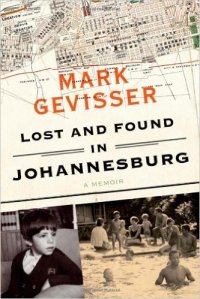
Deep inside Jo’burg: a review of ‘Lost and Found in Johannesburg’ by Mark Gevisser

lost and found in johannesburgLost and Found in Johannesburg: a Memoir‘ by South African journalist and political writer Mark Gevisser is one of the most engrossing and exciting books I have read about my home town, Johannesburg.

It is a vivid memoir of growing up in Johannesburg as a white, Jewish, gay man during the very darkest days of apartheid.

The memoir begins with Gevisser’s remembrance of his childhood in Sandton, one of Johannesburg’s elite northern suburbs and his obsession with maps.

Sitting in his father’s Mercedes Benz, he would play a game called ‘dispatcher’ where he would randomly look up someone in the Johannesburg phone directory and then using the Holmden’s Street Map of Greater Johannesburg, the map book of the time,  navigate an imaginary courier to their address.

On one occasion, he tries to navigate to Alexandra, the impoverished, densely populated black township neighbouring Sandton and finds that using the Holmden “there was simply no way through”:

Even now, I can recall my frustration at trying to get my courier to his destination in Alexandra: there was no way of steering him from page 77 across into page 75. Sandton simply ended at its eastern boundary, the Sandspruit stream, with no indication of how one might cross it, or even that page 75 was just on the other side.

This illogical and deliberate attempt by the map makers to separate white Johannesburg from its enslaved black population becomes the starting point for Gevisser to explore the artificial boundaries, restrictions and cruelties created by apartheid – and also how they were broken down.

One of the great pleasures of reading Lost and Found in Johannesburg is Gevisser’s inclusion of dozens of fascinating photographs, some from family albums, but also images of a lesser known side of Johannesburg (for people like me anyway, who had such sheltered childhoods).

A photo that stands out strongly is that taken in the 1960s of the suburban backyard swimming pool of Bram Fisher, the Afrikaner lawyer who would represent Nelson Mandela at his Treason Trial.

In it, we see a group of kids, both black and white “splashing about the pool, as one does in the suburbs on a summer’s afternoon”. This was of course during a time when the races were strictly segregated and yet Fischer and other liberal types flagrantly flouted these rules. Gevisser writes:

Through this poignant idealism, [Bram Fischer] seemed to be trying to reconcile being a white pool-owning South African with the egalitarian ideology to which he had given his life.

Other images depict that familiar, yet never-quite-understood relationship between white people and their black domestic workers. Gevisser includes a photo of himself as a boy in the arms of a black lady who stares back serenely as white children play around her. In another, taken on his parent’s wedding day, he describes the black man in the photograph, the chauffeur who stands to attention, only his cap and uniform visible among the celebrations.

These pictures depict the everyday divisions between master and servant we accepted as children, but hardly thought to question.

Who were these black people who took care of us as children, drove us around town and cooked our meals? What were their lives like? In his memoir, Gevisser seeks answers.

Reading the book and studying the photographs, I remember well, the  pungent smells of meat and mieliepap and the exotic aromas of balms and lotions that came from the rooms of our own domestic workers across the yard when I would visit occasionaly.

It’s one of many vivid memories Gevisser’s memoir stirred up.

Indeed, I spent much of the book, enveloped in a warm, but painful feeling of deep nostalgia, a credit to the quality of Gevisser’s prose, which flows mostly effortlessly throughout the book mixing memoir with history and geography and storytelling with journalism.

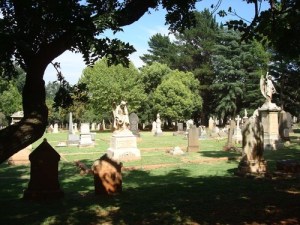
braamfonteing cemetery

The Old Cemetery at Braamfontein

But, Gevisser also describes places I never knew existed like the eerie underground archives at the Johannesburg Library, where Gevisser writes about the old underground mining maps that crumble in his hands, or the Old Cemetery at Braamfontein, where he is “seduced by the voluptuous beauty” of its paved pathways, low stone walls and mossy tombstones reminiscent of famous cemeteries like Highgate in London or Pere Lachaise in Paris.

It came as shock to me when I realised the Old Cemetery was across the road from where I parked my car almost every day, whilst attending Wits University in the 1990s.

the wilds

The Wilds, in the heart of Jo’burg

The other important place Gevisser explores (which I have never set foot in) is ‘The Wilds’ a 40 acre indigenous botanical gardens  wonderland plonked in the middle of the city that sadly became a no-go zone because of its reputation as the hideout of criminal gangs.

For Gevisser  it takes on a deeply personal and terrifying meaning, because it is from The Wilds that three men climb a fence on a summer’s evening in January 2012, and enter a fourth-floor apartment building where he is watching  television with his friends. Then a brutal, but all too familar attack unfolds at gunpoint.

He writes of the ordeal:

Something seemingly irrevocable changed that night in my relationship to Johannesburg, my home town, the place I lived for four decades, the place of this book.

It could easily have turned Gevisser, as such incidents have done to many other white and black South Africans who have been victims of its appalling crime rate, into a hater, and his memoir, a journey into bitterness.

But, it does not. In fact it does the opposite.

Gevisser’s journey to understand the elusive city of his birth – from its earliest foundations as a gold mining bonanza, through its decades of segregation, cruelty and political activism to its status as place of economic opportunity  – is a deeply compassionate one.

————————————————————-

For more on what’s interesting about Jo’burg, read my blog post: Why you should drop the fear and visit Johannesburg


99 Homes (and the devil): an interview with director Ramin Bahrani

still_241851Hollywood director Ramin Bahrani describes his acclaimed film, 99 Homes, about the post-GFC housing crisis and the millions of people forced out of their homes, as a ‘Faustian – deal with the devil’ – tale.

But it’s not Faustian in the sense that many movie-goers might interpret the central plot, that of evicted homeowner Dennis Nash (Andrew Garfield) who goes to work for the man who foreclosed his home, corrupt, gun-toting real estate broker Rick Carver (played by the enigmatic character actor Michael Shannon).

Rather, according to Bahrani, it’s the housing system itself which is Faustian, creating unscrupulous characters like Carver, who we see in the film manipulating government and banking rules at the expense of struggling home owners to make himself rich.

“[Carver] is not such a horrible person, he is just doing what he needs to do to survive,” Bahrani told me.

“The devil is the system. It is a corrupt system.”

Andrew Garfield and Michael Shannon playing opposing characters in 99 Homes.

The are of course parallels to Australia with its unscrupulous property spruikers and their get-rich-quick schemes, a housing and tax system that seemingly favours the cashed-up older generation of owners and investors at the expense of young buyers, and where tales of windowless apartments in high-rise towers and students living in tents or on bathroom floors abound.

According to Bahrani, this corruption extends beyond housing and into the wider financial and banking system, noting that both Australia (Malcolm Turnbull) and New Zealand  (John Key) have prime ministers who were former investment bankers.

“The banks were fined millions [in the wake of the financial crisis], but nobody went to jail. But if you stole a carton of orange juice, you would go to jail.

 still_241845.jpg

“The people who are responsible for bankrupting the world got away with it. Nothing has changed”.

To research the film, which opened in Australia this week (November 19), Bahrani spent many hours in foreclosure courts watching the corrupt system at work as families lost their homes in snap judgements that took less than a minute

“It’s not called the rocket docket for nothing,” he said.

One day in court he observed a Hispanic family that needed an interpreter. “The judge said he had no time for an interpreter and dismissed their case – they lost their home.”

But Bahrani says the film is not about picking sides.

Researching material for the film in 2012 and 2013, Bahrani witnessed both side of the brutal US foreclosure system: the middle-cass families living in motels and the school buses that would pick up their kids from these motels as part of their morning routes, but also the sheriffs and real estate brokers “terrified about who would be on the other side of the door, when they evicted them”.

He says he did not set out to deliver a sermon or pass judgement about the real estate industry or real estate brokers but instead wanted to explore both sides of home ownership – the home as a place of “safety, community and memory” or in the case of real estate agent Rick Carver just a commodity to be “bought and sold”.

For those in Australia fruitlessly or frustratingly pursuing the housing dream or, alternatively, enjoying the riches that housing investment can bring, the parallels in Bahrani’s movie are obvious.

This article first appeared on afr.com

How to be young and rich in Australia: be a man

How do you become young and filthy rich in Australia?

The short answer is: be a man.

Yes, be a tech whizz, a property tycoon, a retail visionary, a sports star, but most importantly, to steal a line from Canadian stand-up comedian Russell Peters, BE A MAN!

How do I know? The latest BRW Young Rich 2015, a compilation of the 100 richest Australians under 40, which came out in October, had just eight woman on it.

The all-male Top 10

2015-brw-young-rich1Source: BRW.com.au

Of those woman on the list, just four – singer Sia Furler, founder of financial counselling service My Budget, Tammy May, super model Miranda Kerr and golfing star Karrie Webb – have made their fortune entirely on their own.

The other women on the list have made their fortunes in partnerships with men: Erica Baxter through her marriage to billionaire James Packer, Erin Deering, through online bikini company Triangl founded with her husband Craig Ellis; Melanie Perkins, who set up online graphics software company Canva with Cliff Obrecht, and Michelle Strode, who co-founded technology company Invoice2go with her husband Chris.

So, making it on your own as a woman is even tougher. Having a bloke by your side helps.

I remarked about the lack of woman on the BRW list to a number of people and got pretty much the stock standard answer: woman don’t become ultra-wealthy because they are off having babies etc etc.

The truth is for all the talk in Australia about gender equality in the work place; not penalising women who want a career AND a family; lifting the proportion of women in senior position; and equal pay for men and women who do the same jobs – we still live in a very unequal business environment, where men earn the big dollars and women are expected to give it all up when they have children.

There are of course exceptions, the likes of former Westpac boss Gail Kelly, Mirvac CEO Susan Lloyd Hurwitz, and in government, deputy prime minister Julie Bishop.

But, mostly there remains the old-world misogynist view of women not rising too high in society, displayed most strikingly and distastefully in the 1423545120130attacks on Australia’s first female prime minister, Julia Gillard called a ‘bitch’, and  ‘witch’ by mostly middle-aged men in politics and the mainstream media. Julia Gillard was also judged by society – both men and women – for not having children, as if that was some kind of heinous crime, not merely a valid life choice for any woman.

This unequal belief system – that men should be the big earners, the stereotypical ‘providers’ – extends into all realms of Australian working life: I was flabbergasted to read recently that the basic contract for an Australian woman representing the national soccer team, the Matildas, is just $21,000 a year, two-thirds of the minimum wage.

This is a team, ranked 9th in the world, who beat Brazil at the World Cup this year and reached the knockout stages.

By contrast, regular members of the mens soccer team, the Socceroos, have each earn more than $200,000 so far this year, despite losing every game at the last World Cup and being ranked a lowly 65th in the world.

It’s does not surprise me at all that the Matildas have gone on strike, demanding fairer pay.

In the property industry, the sector I cover as a journalist, gender is a big, emotive issue.

Property has traditionally been a very blokey, boy’s club industry, though it’s true that efforts are being made to encourage more women into the industry, and also that there have been some notable successes in this endevour.

But still, the property industry remains dominated by outrageously wealthy men as can be seen by the number of young male property tycoons on the BRW Young Rich List  (I counted five) and the complete absence of any women property tycoons.

Supermodel Miranda Kerr

Supermodel Miranda Kerr

The other point about the type of women who make it onto the BRW Young Rich List needs to be made delicately.

In short, looks definitely matter.

This to me, only reinforces the “Crocodile Dundee” image of Australia as the land of “Bruces” and “Sheilas”, that was circulated around the world in the 1980s and later reinforced by cringeworthy iconic Australians like the late animal entertainer Steve Irwin famous for jumping on to the backs of wild animals in true Aussie macho style

While it is true that there is much that is progressive, modern fresh and exciting about Australia, it still retains a distinct air of male chauvinism and a strong underlying current of conservatism (gay marriage is another area of distinct inequality).

Real wealth and power in this country, remains in the hands of blokes, now, and, given the make-up of latest BRW Young Rich List with its tiny female representation, will remain in their hands in the future too.

My Orwellian odyssey: a descent into the fiction of George Orwell

George_Orwell_press_photoAs it happened, I was in the midst of reading “Burmese Days”, George Orwell’s very fine first novel about imperialism and prejudice set within a rural Burmese village during British rule, when the plans for “Operation Fortitude” were made public.

The press release, issued by Australian Border Force on the morning of Friday, August 28 detailed a sinister operation planned in Melbourne over the coming weekend when ABF officers would be patrolling the streets, scrutinizing everyone coming into the city centre and targeting “everything from anti-social behaviour to outstanding warrants”.

coming up for airMost ominously and invoking the dystopian world of Orwell’s 1984 with its constant surveillance and suspicion, the press release said that “ABF officers will be positioned at various locations around the CBD speaking with any individual we cross paths with.”

As the outrage at this trampling of individual rights (and suspicions of racial profiling) grew louder and louder, it seemed  everyone from Booker prize-winning novelist Richard Flanagan to protestors at hastily arranged gatherings were referencing Orwell or using the adjective ‘Orwellian’ to describe the planned paramilitary-style operation.

burmese daysGripped by it all, I finished reading Burmese Days and proceeded to re-read my tattered copy of Orwell’s Coming up for Air (1939) featuring my favourite Orwell anti-hero, the rotund, bald, bowler-hatted insurance salesman George Bowling who as the bomber planes fly overhead, casting shadows over London and bringing with them portents of the approaching descent into worldwide destruction and death, reminisces about his carefree youth and plans a return his countryside home town of Lower Binfield to seek out a legendary fishing spot.

keep the aspidstraNext up, I re-read Keep the Aspidistra Flying (1936) – also a tattered paperback on my bookshelf – about the idealistic London poet Gordon Comstock (brilliantly played by Richard E. Grant in the film version, A Merry War), who has forsaken a promising career as a copywriter in an advertising firm in order to escape the moneying world and all its artistic-destroying influences to write something that matters. We find Comstock virtually starving in his bleak bed sit in a men’s lodging house scrawling away at an epic poem he can’t seem to finish while bemoaning his poverty, which has ironically become an even greater destructive force to his writing than a well paid job as well as to his relationships and his sanity.

animal farmAfter that, I dived straight into Animal Farm (1945), Orwell’s political fairy tale about the failings of socialism set among the world of animals who overthrow their human masters only to become slaves under the control of the intelligent, cunning pigs who are “more equal than others”.

Finally, I ended my Orwellian odyssey with 1984 (written in 1949), Orwell’s dystopian masterpiece set in a futuristic London of enormous windowless government buildings, squalid tenements, always watching’ telescreens’ and posters of ‘Big Brother’, where timid revolutionary Winston Smith, an employee in the Ministry of Truth and his lover, Julie, battle the belligerent totalitarian state, its thought police, doublespeak ideology and hunger for eternal power.

1984_by_alcook-d4z39dhSo what was my Orwellian journey like?

Melancholic and depressing give the current state of the world.

As described in 1984 and Animal Farm, the loss of individual freedoms has occurred even in democratic countries like Australia, the USA and the UK, with their gag orders against speaking out against refugee abuse, surveillance and collection of meta-data and secret actions of spy agencies like the NSA and ASIO.

Imperialism and prejudice is alive and well

As in Burmese Days, which sets its modernistic central character,  35-year-old teak merchant John Flory against the bigotry within the walls of European Club, we find ourselves in an quasi-imperialist world where the richest, most powerful countries continue to oppress minority populations, invade sovereign countries at will and turn a blind eye to the consequences: thousands of displaced refugees.

“After all, natives were natives – interesting, no doubt, but finally only a ‘subject’ people, an inferior people, an inferior people with black faces” – from Burmese Days

Secondly, invigorating and wondrous. Orwell’s writing sparkles, glows and comes alive as you read it and follow the adventures and exploits of his characters. His manages to address weighty and universal themes by creating engaging characters, brilliantly plotted storylines and living, breathing places. He is a master craftsman, who true to his famous rules for writing knows that a few, carefully chosen words, expertly put together, can create vivid scenes that leaps out of the page:

In the deadly glare of the neon lights the pavements were densely crowded. Gordon threaded his way, a small shabby figure, with a pale face and unkempt hair – From Keep the Aspidistra Flying

Then there are his characters. I found myself happily inside the head of all of them, even the ones that are on the surface, unlovable like fat, unhappy George Bowling whom we find on the very first page of Coming Up for Air, locked in the bathroom of his home on a dreary London housing estate, plotting his escape from his wife and kids on a “beastly January morning”. After all, who doesn’t yearn – now and then – for a return to their youth, to a time when they were carefree and without adult responsibilities?

Similarly, I identified with the idealism of malnourished and unwashed poet Gordon Comstock in Keep the Aspidistra Flying, with his rallying against “money, money, always money” encapsulated in his distaste for the catchy slogans that hang from windswept, tattered advertising boards outside the secondhand bookshop he works in.

No doubt Gordon would find our advertising-saturated world with its sponsored content and brand placement even more nauseating as he would the greedy capitalism and worship of money that defines success today.

And then there is John Flory, the lonely, lost colonialist searching for companionship in Burmese Days who sees skin colour as a mystery to be explored and celebrated, but set against a world of cunning corruption and prejudice. One of the most tragic of Orwell’s characters, he is also one of his most loveable and most admirable.

Orwellian, as we understand it.

And then there is the sheer devastating power of 1984 and Animal Farm, whose much-discussed and debated themes of tyranny, oppression and the crushing of individualism find their reflection in the darker  actions of governments with their ‘Operation Fortitudes’, metadata laws and secrecy and in mega-corporations like Facebook and Google, now the most powerful players in the world of news, information and personal data.

Indeed, it is no surprise, that as I finished reading these five novels, I read also a review of anew theatrical version of 1984 running in Melbourne and the seemingly never ending articles about Orwell and the Orwellian – though I confess that Coming Up for Air and Keep the Aspidistra Flying are my two favourites.

Read them all!

play about 1984