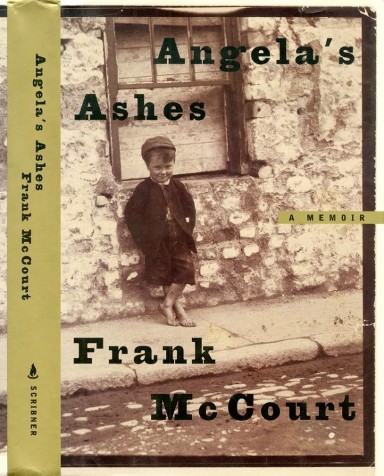
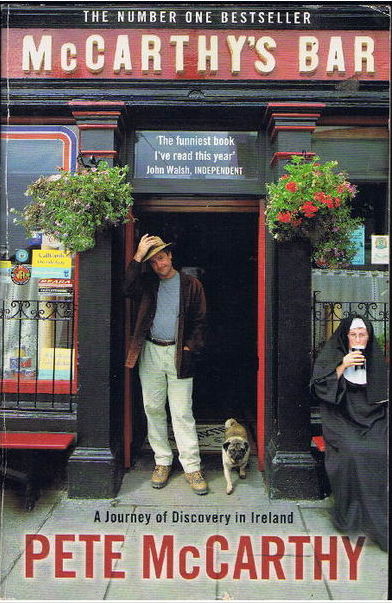
 There can surely be two no more disparate accounts of Ireland than Pete McCarthy’s meandering travelogue ‘McCarthy’s Bar’ and Frank McCourt’s classic memoir of a miserable childhood, ‘Angela’s Ashes’.
I read both books one after the other.
‘Angela’s Ashes’ won Frank McCourt the Pulitzer Prize while ‘McCarthy’s Bar’ won Peter McCarthy – already a successful television host of travel programs – a legion of new fans.
 Both made me laugh out loud as I read them on the train into work (as well as feel cringeful, sad and nostalgic).
They made me want to undertake my own Irish adventure, a place I have visited only once.
It was in 1990, when I was just 16 and Germany had won the World Cup (I remember a hand-written sign at Heathrow as we disembarked: Germany 1 – Argentina 0) when my family went there as part of a three-week UK and Ireland holiday.
We visited my Great Aunt Bertha and her husband, my Great Uncle Jack Weingreen, the only relative I know who gets a mention on Wikipedia.
It’s a short entry, but I am proud of it nonetheless:
Professor Jacob Weingreen (c. 1907 – April 11, 1995) was a professor of Hebrew in Trinity College, Dublin – School of religion and theology between 1939 and 1979. He excavated in Samaria and maintained contact with archaeologists who donated pieces to the Weingreen museum which was named after him. Professor Weingreen was the author of the Hebrew grammar textbook that is still recognized as the standard teaching work on the subject.
His wife Bertha, doesn’t get a mention in Wikipedia, but you’ll find information about her to if you look online:
The Holocaust Education Trust of Ireland writes:
Bertha came from South Africa where she taught English and Drama at a training college for ‘coloured’ teachers. In 1945, Jack and Bertha joined the Jewish Relief Unit which cared for the remnants of European Jewry who had survived the Nazi concentration camps. Bertha was Chief Welfare Officer responsible for all Jewish DPs (Displaced Persons) in the British Zone, and was stationed at the former military barracks at Bergen-Belsen.
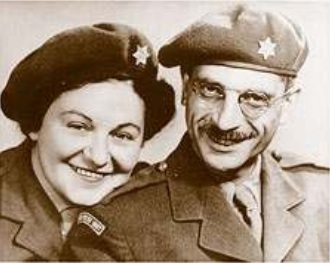
This is a picture of them taken presumably just after the war. (They returned to Dublin in 1947)
Reading Angela’s Ashes and McCarthy’s Bar, stirred up memories of our family visit to Ireland to see Jack and Bertha, when both were in their eighties and in the twilight years of their lives.
Ireland felt poor in 1990, but not as poor as it did for Frank McCourt.
Most of Angela’s Ashes (published 1996) is set in the poorest backwater lanes of Limerick, where the McCourt family lived in a squalid two-storey hovel in the 1940s. In winter, the ground floor would flood, so the family lived upstairs, which they called ‘Italy’ with a fireplace that kept them warm, surviving on fried bread and tea.
In ‘McCarthy’s Bar’ (published in 2000) Pete McCarthy journeys around Ireland in a beat-up blue Volvo he nicknames ‘The Tank’ observing the eighth rule of travel: ‘Never pass a bar that has your name on it’ while he ponders his identity (over a Guinness). With an Irish mother but an English father and memories of family holidays in Drimoleague, in county Cork, he tries to understand his strong sense of Irishness and whether he claim membership of the Irish race.
I also felt, growing up, that I could claim some part of Ireland for myself and recall often wearing a T-shirt with words emblazoned in emerald-green on the front: “I have Irish roots”, the letters decorated with leaves and roots and somewhere, I imagine, a four-leaf clover.
I loved telling anyone who would listen, that my Great Uncle Jack Weingreen wrote the definitive text-book on Hebrew Grammar. In fact, we had a copy of the textbook at home, should anyone question the legitimacy of my claims. Ironically, I was terrible at Hebrew at school, despite five years of conjugations and the implorings of my Israeli hebrew teachers, I can only remember a phrase or two.
In 1946, while Bertha and Jack were helping holocaust survivors rebuild their lives after the horrors of the war, Frank McCourt, aged just 16, was working as a delivery boy at Easons, delivering newspapers and magazines around Limerick. He’d survived a bout of diphtheria that almost claimed his life, an extreme case of conjunctivitis that almost took his eye sight, an alcoholic father who drank what little money they had before disappearing to England, the loss of three siblings and the shame of watching his mother beg for food to keep her children from starving. A few years later he would set sail for America and begin a new life, before writing his memoirs many years later.
When we visited Jack and Bertha at their home in Dublin, they were old, but charming and kind. Jack I remember as an older version of the army photo: a stooped, small, man with a moustache and glasses, always in a tie and tweed jacket who made us soup with kneidelach (dumplings). He smoked a pipe and snorted a lot, which made all of us laugh uncontrollably.
My memories of Bertha are less clear, though I remember large kind eyes.
We slept on the floor of their cluttered house, filled with the things they had accumulated from lives lived to the full. They had a long, rambling garden, grown wild and unruly. It had once, according to my grandmother Nella (Bertha’s sister) been a stunning, colourful garden that had won prizes and been featured in magazines.
We visited Trinity college with Uncle Jack, who proudly showed us round his alma mater and I remember eating a distinctly awful and drap lunch in a gloomy cafeteria.
In 1990 Ireland felt poor. The emergence of the “Celtic” tiger economy of Pete McCarthy’s travelogue (where Singapore noodles cost more than “in a Chinese shop off Leicester Square”) was five years away. I remember we visiting a friend of my mother’s, who lived in a very rundown house with bicycles and other things scattered in an overgrown backyard.
There are, it turns out, a lot of bars in Ireland called ‘McCarthy’s Bar’ and Pete McCarthy duly spends much of the book in pubs all across Ireland drinking Guinness and whiskey with the locals (some of whom are German and English expats) often accompanied by a toasted ham and cheese sandwich, reading excerpts from a 19th century travel journal – Irish Sketches – by William Makepeace Thackeray and pondering his identity with long-lost friends and relatives, drunks, bar tenders and tourists.
He travels through Ireland describing mountains of “biblical ruggedness” where bearded men “play harps”, remote islands reached by rickety cable cars, fields of green divided by stone walls where farm animals graze. He visits ancient standing stones and ruined medieval churches and abbeys, uncovers the tourist trappings in overpriced Killarney bed and breakfasts, shares a pint with Jimi Hendrix’s semi-retired bass guitarist Noel Redding, but doesn’t run into U2 guitarist ‘The Edge in Cong.
Finally he finds himself after countless adventures and misadventures in Lough Dergh in County Donegal, where he undertakes the 1,000 year old Christian pilgrimage, a three-day marathon of praying, walking, fasting and circling.
My own family Irish adventure culminated in an “Oirish” castle, where we stayed for a few days courtesy of a ‘Timeshare’ swap and which would have amused Pete McCarthy. It had an indoor swimming pool and the towers and crenallations of a castle, but that is all I remember.
It is the kind of holiday Frank McCourt could only have dreamed of. For the McCourt’s Christmas meant Frank going out with his brother Malachy in their threadbare clothes in the freezing Irish winter to hunt for coal discarded on the road so they could have enough fuel to start a fire and enjoy a Christmas dinner of boiled pig’s head and floury potatoes and tea.
My Great Uncle Jack and Aunt Bertha played an active role in Irish academic life and Dublin’s small jewish community for almost fifty years. Jack died in 1995 and Berth in 1999.
Our family holiday is my only memories of them.
Frank McCourt and Pete McCarthy have also both departed, both sadly from cancer. Peter McCarthy died in 2004, aged just 53 and Frank McCourt at 78 in 2008.
Their paths crossed briefly in 1998, while Frank McCourt was touring the world to promote Angela’s Ashes and while Pete McCarthy was travelling around Ireland in his blue Volvo on his own personal pilgrimage of identity.
It was a chance meeting.
McCarthy gave a ride to a Canadian hitch-hiker who said she was going to Castlebar in County Mayo to a “library to listen to a writer”. It turned out to be Frank McCourt.
McCarthy describes Frank McCourt as wearing s a blue jacket, red shirt and looking much younger than his sixty-nine years. He plucks up the courage to ask McCourt a question.
“Where do you feel you belong?” McCarthy asks.
“New York” Frank McCourt replies.
But before McCarthy can ask him if its possible to “truly belong in a land where you’ve never actually live” the talk is over.
Later, while Peter McCarthy is eating a very good and cheap meal of Singaporean noodles (the bill comes to a reasonable £12), Frank McCourt walks past the window.

 Freshlyworded