Reading Harry Potter at 50: should we cancel JK Rowling?

It’s been a couple of months since – aged 50 – I finished reading the Harry Potter series, and I have been meaning to jot down some thoughts ever since.

Credit: By Daniel Ogren – Flickr

The reminder to put pen to paper, if you can forgive that rather useless and inappropriate clichΓ©, came from an unlikely source: the columnist and writer, Clementine Ford.

Scrolling through my Instagram feed, I came across a three-year-old post from Ford in which she attempted to tear JK Rowling to shreds. Ford labelled her books “badly written” fiction and attacked “Joanne” for making her hero a boy wizard, where a girl (Hermione) does mostly all his homework for him, but gets no credit for it. Even more outrageous, Ford says, Hermione has no female friends, is overshadowed by all the boy characters and that all the female characters are “parodies of womanhood”.

Ford then gets stuck into her real issue with JK Rowling, the author’s controversial views on transgender people. Ford calls Rowling a “fucking scumbug” for harassing transwoman and suggests “Joanne” open up her “stupid fucking” castle and invite all her transphobic friends to live with her inside.

Ford’s disgust builds to a crescendo where she wonders how in the space of 25 years Rowling went from charming children’s worldwide to become one of her most sinister fictional character’s the cruel, toad-like Minister for Magic Dolores Umbridge who torments and tortures Harry Potter at Hogwarts.

This reference to one of JK Rowling’s most famous characters (and in my opinion one of the best written and fiendish across the series) made me wonder if Ford, who had just turned 40 at the time of the post, had not secretly enjoyed reading the books when she was younger, before finding herself disgusted by the controversy over Rowling’s views on womanhood and her alleged attacks against the transgender community.

Did JK Rowling become a bad writer and the Harry Potter story an unworthy cultural phenomenon because the author launched herself into the culture wars via posts on social media?

The answer is obviously no. JK Rowling is not a bad writer and her holding abhorrent views (to some) does not make her one.

Of course you may decide to boycott her books because of the things she says online, but it would be hard to argue that Harry Potter is not a great deal of fun to read. These are books that have entertained and delighted readers of all ages since the first in the series, Harry Potter and the Philosopher’s Stone came out in 1997.

Reading all seven books as I approached turning 50 and really enjoying them was something I had not expected.

I started reading the series because my daughter, Edie (12) was huge fan of all things Harry Potter and I thought it would be a great way for us to bond. After I finished each book, we’d watch the corresponding movie and discuss our thoughts of the big screen adaptation, the actors chosen to play the fictional characters, the bits in the books the films left out but that should have been kept in, the way the filmmakers had created the magical scenes and if the movies were any good. Mostly I enjoyed the films, but they were not a patch on the books (And there is now a HBO TV series in the works that we are told will be a more faithful rendition of the novels, with a full season devoted to each book).

For someone who reads “serious fiction’ and hardly anything in the fantasy genre, I was surprised at how much I enjoyed the novels. Whatever you think of Rowling’s views on gender, only a cynic would argue that Rowling is not a fabulous storyteller with the ability conjure up a complete magical world with a huge cast of living and breathing characters that have become cultural icons in their own right: Harry, Hermione, Ron, Hagrid, Malfoy, Professors Dumbledore, McGonagall and Snape (to name just few).

I also loved how the novels shifted between the fabulous wizarding world with its potions, ancient books and magic spells and the mundane “muggle” (human/non-magic) world inhabited by the wonderfully awful Dursleys (Harry’s relatives and tormentors).

But rather than write a lengthy review of each Harry Potter book – who needs another one of those? – my thoughts turned to the author and the culture wars she has sparked with her views on transgender issues and her strident defense of womanhood.

The controversy started back in 2020, when Rowling (rather petulantly in my view) took issue with an online article on Devex (a news organisation covering global development) about menstruation that did not in its opening pars mention woman, but instead used the gender neutral “people”. Later it refers to the 1.8 billion people who menstruate as “girls, women, and gender non-binary persons”.

Rowling responded to the controversy by saying: β€œIf sex isn’t real, there’s no same-sex attraction. If sex isn’t real, the lived reality of women globally is erased. I know and love trans people, but erasing the concept of sex removes the ability of many to meaningfully discuss their lives. It isn’t hate to speak the truth,” she tweeted.

Rowling argues that she has been empathetic to trans people “for decades” and that feeling kinship for woman and believing that sex (or gender) is real, does not translate into hate for the transgender community.

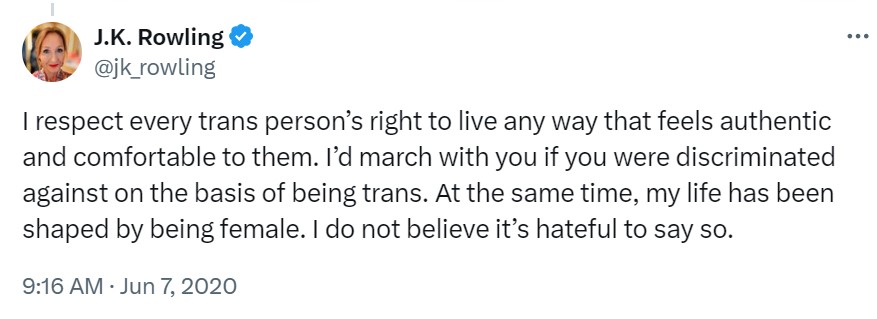
She goes on to say: β€œI respect every trans person’s right to live any way that feels authentic and comfortable to them. I’d march with you if you were discriminated against on the basis of being trans. At the same time, my life has been shaped by being female. I do not believe it’s hateful to say so.”
Following the avalanche of abuse she suffered because of her social media posts, Rowling penned an article on her website explaining in great detail her position, her concerns for young people who may regret transitioning, her affection and acceptance of transgender people and her views on trans activists. whom she says are “doing demonstrable harm in seeking to erode β€˜woman’ as a political and biological class”.

“I stand alongside the brave women and men, gay, straight and trans, who’re standing up for freedom of speech and thought, and for the rights and safety of some of the most vulnerable in our society: young gay kids, fragile teenagers, and women who’re reliant on and wish to retain their single sex spaces,” she writes.

As a survivor of domestic abuse and sexual assault, Rowling ask that the empathy for trans people “be extended to the many millions of women whose sole crime is wanting their concerns to be heard without receiving threats and abuse”.

However, she has received the harshest condemnation from some in the trans community for suggesting that some people, especially younger people may be “persuaded” to transition to “escape womanhood” or to find a more caring community, rather than because they suffer from gender dysphoria, a medical condition referring to the distress a person feels at one’s biological or assigned gender at birth.

“The more of their accounts of gender dysphoria I’ve read, with their insightful descriptions of anxiety, dissociation, eating disorders, self-harm and self-hatred, the more I’ve wondered whether, if I’d been born 30 years later, I too might have tried to transition,” Rowling writes. “The allure of escaping womanhood would have been huge. I struggled with severe OCD as a teenager. If I’d found community and sympathy online that I couldn’t find in my immediate environment, I believe I could have been persuaded to turn myself into the son my father had openly said he’d have preferred.”

Any position that questions the validity of a trans person’s existence will be condemned by many in that community, regardless of the reasons or concerns of those stating that opinion. It is, for many, a cardinal, unforgivable sin.

For her views, Rowling has been labelled by some a TERF’ – an acronym coined by trans activists, which stands for Trans-Exclusionary Radical Feminist, implying hostility towards transgender people, a label she vehemently rejects.

“I want to be very clear here: I know transition will be a solution for some gender dysphoric people, although I’m also aware through extensive research that studies have consistently shown that between 60-90% of gender dysphoric teens will grow out of their dysphoria.” she writes.

What triggered her speaking out she says, was the Scottish government proceeding with its “controversial gender recognition plans, which removed the medical diagnosis of gender dysphoria as a requirement to change gender legally and fast tracked the process for changing gender. For Rowling, this bill – which was passed by the Scottish Parliament in December 2022, but vetoed by the British government in January 2023 – put woman’s lives at risk (allowing in her view a man to call himself a woman and walk into a female-assigned toilet) and was a “destroyer of women’s rights”.

“I spoke up about the importance of sex and have been paying the price ever since. I was transphobic, I was a cunt, a bitch, a TERF, I deserved cancelling, punching and death. You are Voldemort said one person, clearly feeling this was the only language I’d understand,” Rowling says.

Despite, these attacks, she has refused to back down, donating money to campaigns opposed to the stalled Scottish gender recognition Bill. She’s also dared authorities in Scotland to arrest her after calling a number of transgender women “men” – in apparent defiance of a new Scottish Hate Crime law which came into effect in April this year and which creates a “new crime of stirring up hatred against someone based on their disability, race, religion, sexual orientation transgender identity. (No action was taken against Rowling).

Has Rowling been treated harshly? Or has she deserved the condemnation she has endured by many?

Weighing things up in my mind, I would argue that she is not transphobic (as she has publicly stated) but certainly opposed to some forms of trans-activism where, in Rowling’s view it erases the idea of womanhood.

I feel she is entitled to this view and don’t feel there is as any legitimate reason to cancel Rowling or to stop encouraging young and old people to read her books.

You may feel the need to analyse the characters in her novels and their motives in light of her views on gender, and come to all sorts of conclusions about the author’s motivations or alleged prejudices, but let’s be honest, Harry Potter is not high-brow fiction. I don’t actually think its worthy of deep analysis. These are not books that need to be studying at University in the way that I studied the novels of Margaret Atwood or JM Coetzee or EM Forster.

JK Rowling’s Harry Potter books are simply brilliant adventure and fantasy stories and can be enjoyed as such without the need to read the subtext.

Reflecting on the all the controversy reminded me think of another famous children’s author, who has been vilified, partially re-written but thankfully never cancelled for their controversial views.

I’m referring Roald Dahl, who sold 300 million books and wrote some of the most beloved stories of all time: Charlie and the Chocolate Factory, James and the Giant Peach, The Witches, Matilda and Fantastic Mr Fox to name just a few.

These books entertained and delighted me as a child and have been enjoyed with glee by my kids, both in the original written form and as movie and TV adaptations.

On the scale of unpalatable views, Dahl certainly trumps Rowling by some distance.

He was a well known and unapologetic anti-Semite who in an interview in 1983 said there is a “trait in the Jewish character that does provoke animosity, maybe it’s a kind of lack of generosity towards non-Jews”.

In 2020, Dahl’s own family apologised for his anti-semitism, but thankfully did not call for his books to be banned or burned.

That – in my opinion – is as it should be. And the same goes for the composer Richard Wagner (another anti-semite), or Pablo Picasso (a monstrous misogynist).

We do not have to love the artist to love and admire their art.

Rowling and Dahl inspire the imagination. They delight their readers. They celebrate bravery in the face of evil. They encourage adventure. And yes, you can take great offence in some of the characters in their books, or the motivations for creating them, but that should always be a personal choice, not a movement.

After all, you can always stop reading.

Life lessons aplenty in Bill Bailey’s guide to happiness

I’d dipped into a couple of chapters of much-loved British comedian Bill Bailey’s Remarkable Guide to Happiness when I get it as a present a year or so ago, but finally sat down to read it from start to finish whilst in between books a little while ago.

Bailey, who is best known for his appearance in cult comedy Black Books and for his multi-faceted stand-up shows, has long been a favourite comedian of mine. I was lucky enough to catch one of his live shows when he was on tour in Melbourne about five years ago.

Stuck at home and being unable to perform or go on tour, Bailey sat down to write a book of experiences and musings on the things that make him happy, and which he believes could make other people happy too.

“This book was written during the coronavirus pandemic, largely while we were in lockdown,” Bailey writes in the forward.

“During this unexpected quiet time at home, I finally got around to archiving my comedy shows and I was struck, firstly by how much longer my hair was back in the day, and secondly, by how much happiness has been a subject that I have explored in my sketches and gigs over many years, to the point that it appears as a constant thread running through it all.

He finishes off the forward by saying that this is book is not about telling people how to live their lives, but rather about sharing a “few accounts of fortuitous moments and remarkable times when I experienced something which felt to me like happiness”.

(I’ve since discovered his written a number of “remarkable” books (the word meaning: worthy of attention) about a range of subjects: including about British birds and the orchestra.)

Bailey’s famous self-deprecating humour and dry wit is a constant presence throughout the book, which consists of short, easy to digest chapters on a whole range of different activities he has undertaken over the years that have brought a sense of joy to his life.

These include a lot of things that anyone can do with just a little bit of money (playing a round of mini-golf, doing the “little things” like the ritual of brewing coffee), none at all (going for a walk in the woods, jogging, clearing out your wardrobe) or where you clearly need to have quite a bit of spare dosh (such as going swimming amid the glaciers of Iceland).

He combines many chapters with academic research he has found that reinforces the reason why an activity he has described might generate happiness from a scientific standpoint. And of course, there is plenty of good lashings of Bailey’s trademark acerbic humour and stories of his own adventures and failings.

On the sense of happiness created by tending for plants Bailey writes that “just being around greenery can lift our spirits…it is no surprise to me that studies show plants, and the care of plants that involves getting your hands into the soil can lower blood pressure and increase focus and alertness”.

To back up this claim, he adds: “An article published in Science World reveals that a mycobacterium found in plant soil can improve brain function, because it increases the production of serotonin in the brain, one of the ‘happy’ chemicals”.

Writing about the pleasure associated with showing “restraint” (even when there isn’t a ‘no’ option) Bailey describes a hilarious story about ordering food at the Los Angeles Zoo with his family.

The “modest purchase” of a sandwich, coffee and bottle of water entitled them to a free super-size upgrade: an enormous packet of crisps “the likes of which is not available to us in the UK”.

When he declined the chips, Corey, the young man serving them, was unable to compute this rejection telling the Bailey clan: “They’re free sir”.

Bailey replies: “Yes, I am aware of that, and it’s a kind offer, but we’re fine thank you.”

This back and forth continued between the bemused “but they’re free” Corey and Bailey until an old timer behind them in the queue grunted “Just take ’em!”

The “Billrus” by Bill Bailey

“So I took village-sized bag of crisps and gave them to an incredulous couple from Idaho.”

But in the age of “conspicuous consumption”, of that insidious phrase FOMO, Bailey concludes that saying no occasionally is not that hard, and is a “small act of self-care that might take you down a path to happiness”.

It’s these nuggets of wisdom and moments of clarity that can be found throughout the book, which is also endearingly illustrated with Bailey’s metaphorical pencil sketches and canny artworks by Joe Magee.

There are 36 chapters in the book. Each devoted to something that might make you a little happier, and most are not hard to try.

I’d add a 37th one, that Bailey is too modest to ever admit: the happiness evoked by watching one of his own comedy shows, an episode from Black Books, or the numerous clips you can find on YouTube.

A decade of newspaper writing: a look back over the years

When I was unexpectedly offered a job at The Australian Financial Review in July 2013 I jumped at the opportunity to write for the country’s top business newspaper.

Alongside this excitement, I also remember having this unsettling feeling that perhaps I was joining a national publication near the very end of the newspaper industry, certainly the print one.

Might I be one of the last print journalists hired by the AFR before everything went digital?

Nonetheless, I was thrilled to have an opportunity to join the workforce at Fairfax Media, one of Australia’s great publishing dynasties and to forge out a career in print media for as long as I could.

At the time I was approached by the AFR, I was working for an online publication called Property Observer (now part of urban.com.au), which had been launched two years prior by the former long serving Sydney Morning Herald property editor Jonathan Chancellor. It was part of an umbrella of brands owned by Eric Beecher’s Private Media (Others in the PM stable include well known news and opinion website Crikey).

Somehow my name had made its way to the decision-makers at the AFR – I am grateful to whom ever suggested me as a replacement for departing property writer Ben Wilmot (now commercial property editor at The Australian and whom I had the pleasure to meet for the first time in September).

I had an informal interview with Matthew Dunckley (then the AFR’s Melbourne bureau chief, now deputy editor of The Age) at a cafΓ© on Degraves Street, and after signing an employment contract a week or so later, and after seeing out my last few weeks at Property Observer, I flew up to Sydney for a week of training and induction, and to meet my new Sydney-based property colleagues on the newspaper.

I remember the chatter in the industry and in rival newspaper media columns at the time was all about when the Fairfax printing presses would stop rolling seven days a week while the company, helmed then by former AFR journalist and editor Greg Hywood, was in the throws of a massive and at times painful digital transformation that would result in a number of voluntary redundancy rounds in the immediate years after I joined.

(There was also talk at the time that mining billionaire Gina Rinehart – as she climbed up the share register – might buy Fairfax. But following a long battle with the Fairfax board and management, her interest in the company eventually petered out and she sold out of Fairfax in 2015).

Incredibly, on my very first day in the Sydney office (at the time Fairfax was based at Pyrmont) I sat next to veteran journalist and multi Walkley Award winner Pam Williams.

Pam’s blockbuster business book Killing Fairfax, which detailed how Fairfax Media had missed out on opportunities to invest in dotcom businesses like realestate.com.au and SEEK that would go on to be worth billions more than the 170-year-old media company had just been published complete with grinning photos of billionaires Lachlan Murdoch and James Packer on the cover.

I remember introducing myself to Pam and having a short conversation with her, whilst trying to get my head around the idea that she’d returned to the company she’d written so scathingly about in her book (which I read a few months later and reviewed on this blog). Later I would come to understand that this was part of what made Fairfax great; it’s unswerving belief in quality journalism, and Pam is certainly one of the best.

My first week in Sydney was spent learning how to use the antiquated publishing system known as Methode, meeting my boss Rob Harley, who was the paper’s long-serving and highly influential property editor, as well as many other journalists who would become friends and colleagues. I also wrote my very first article for the paper – a story about First Home Buyers – before flying back home to Victoria to join the paper’s Melbourne bureau and meet the journalists whom I would work alongside for many years.

The AFR occupied the Eastern corner of the third floor at 664 Collins Street opposite Southern Cross Station. On the other side of the floor was The Age, while upstairs were Fairfax’s radio stations including 3AW.

My first few weeks were spent meeting people in the property industry – agents, developers, investors – as I tried to build up a contact base and generate exclusive stories for the paper. There was back then and still is today a competitive, but highly collegiate mindset at the AFR, an attitude which helped me find my feet and carve out a niche of my own.

I’m somewhat embarrassed to say that for a little while after I joined the AFR I cut out and kept a folder of all my articles that appeared in the paper. It’s a practice I abandoned many years ago though I confess that I still get a kick out of seeing my name in print.

Initially it was quite hard getting scoops – we were a big property team in the early days – and being the newest member of a crew of crack reporters meant I had to find beats and niches that I could make my own.

At the same time as I was finding my feet and trying to show my value as part of the property team, Fairfax Media was trying to write the wrongs identified so glaringly in Pam Williams’ book and find new revenue opportunities in the digital world whilst print revenue continued to fall.

In 2014, Fairfax Media returned to profit and announced its move into video streaming on demand (to take on the likes of Netflix) via a joint venture with Nine Entertainment that would result in the launch of Stan.

The old Fairfax printing press (shaped like a rolled up newspaper) near Melbourne Airport. Now the HQ of Zagame luxury cars.

That year was particularly tough one for me personally as we lost our second child Raffy to stillbirth in February, but I was heartened by the outpouring of support from my colleagues at the AFR when I returned to work after a few weeks of compassionate leave.

“Everyone from the top of the newspaper down is thinking of you,” I distinctly remember Rob Harley telling me.

Later that year I went on my first and to date only junket (or famil as they prefer to call it) to Bali, where I flew business class for the first time and sat next to The Australian‘s legendary restaurant critic John Lethlean. John was great company on the flight, but I recall was distinctly unimpressed with the food, while I thought everything was fantastic.

I spent two nights at the new Double Six Hotel (the reason for the trip) with a gang of Aussie journos, eating out at a plethora of fancy restaurants, trying out spa treatments and being chauffeured around amid the chaos and congestion that was Seminyak.

In 2015, I was lucky enough to be accepted into a mentoring program offered at Fairfax, and was given great guidance by senior Age journalist Michelle Griffin, (now Federal Bureau chief at the Sydney Morning Herald). We’d catch up for coffee in the cafΓ© downstairs and focus on feature writing, which I always found challenging. Michelle was full of great tips and encouragement. These included suggesting I reading The Wall Street Journal’s The Art & Craft of Feature Writing by William Blundell.

Michelle is one of a number of highly experienced writers and editors who have provided advice, tips and encouragement over the years.

In August 2016 I interviewed the founder of British real estate disruptor Purplebricks, Michael Bruce when he came to Melbourne to launch the Australian business with a promise to revolutionise the way property is bought and sold through its fixed-fee model and online platform.

Over the next three years I reported in dozens of articles on the rise and fall of Purplebricks, which left Australian shores in 2019.

Covering the Purplebricks roller coaster journey Down Under was one of the highlights of my AFR journalism career (rumour has it my face was on a dart board at Purplebricks HQ in Sydney)

I should point out that soon after Purplebricks landed in Australia, our editor Rob Harley surprised everyone by announcing his decision to retire from the paper after an incredible 29 years. One of the most knowledgeable people in the industry and also one of its most influential and well-respected, Rob was a mentor to everyone on the team, and a generous sharer of his time and insights. (He continues to write for the Financial Review, penning a regular property column).

Upon Rob’s departure Matt Cranston took over as property editor for a couple of years before Nick Lenaghan took on the role when Matt took up a position as first economics editor in Canberra and then as the paper’s Washington correspondent. Both have been fine people to work alongside and like Rob, have been incredibly generous with sharing their knowledge and insight. (So too has been my property colleague Michael Bleby, whom I have worked alongside for most of the last 10 years. Michael lived for many years in South Africa, so we have that in common, plus a few words in Afrikaans.).

During those years of Purplebricks reporting, journalists at Fairfax and the AFR were undergoing their own rollercoaster ride as private equity firm TPG and a Canadian pension fund investor struck up talks to acquire the company.

Soon after, San Francisco-based private equity player Hellman & Friedman entered the takeover ring with a rival offer and it looked like we would all soon be working for new masters (noting with trepidation that private equity firms are notorious for cost cutting).

I remember also there was talk of the AFR being carved out of the company as a separate entity, perhaps through some sort of management buyout.

Thankfully (in my view), none of the takeover talks proceeded to binding offers and Fairfax moved on in July 2017 instead with plans to spin-off and float its online real estate listings business Domain.

Around this time I’d clocked up four years at the AFR, built up a solid contacts list and a half-decent reputation in the property sector for writing fair, balanced and interesting articles, occasionally with a bit of flair.

In June 2018, as traditional media companies fought back against the advertising power of Facebook and Google, Fairfax Media and Nine Entertainment revealed plans to merge their two businesses.

It turned out to be less of a merger and more of a takeover as the great Fairfax name was retired and we became, on December 7 of that year, Nine newspapers. On that same day Fairfax Media was delisted from the ASX, bringing about the end of one of the world’s great media dynasties stretching back 182 years to when John Fairfax purchased the Sydney Morning Herald in 1841.

While a lot of my colleagues were skeptical about the Nine merger/takeover and a potential loss of independence, I was excited about being part of a much larger media company that had not only newspapers, websites and radio stations, but also a clutch of commercial television channels.

In fact under the Nine banner very little has changed in how The Australian Financial Review has functioned. We remain fiercely independent, and most importantly the most-read business publication in the country. There is also (for me) a sense of security in being part of a true media giant. Indeed, those Fairfax redundancy rounds that were part of my first few years at the AFR have all disappeared replaced by expansion of our newsrooms.

In April 2019, we moved from the Collins Street end of Southern Cross Station to the Bourke Street end, occupying level 7 of the Nine building (a shiny glass-facaded Rubix cube-like structure) at 717 Bourke Street.

That I year I wrote my first “Lunch with the AFR” – a popular weekend paper feature where you sit down with an interesting subject and discuss their career. My subject was the property developer and adventurer Paul Hameister, conqueror of Everest, the Antarctic and the Amazon.

Our new office at 717 Bourke Street.

We had lunch at a trendy cafΓ© in upmarket Brighton and Paul entertained me with his daring mountaineering feats, savvy business dealings and sage advice. Spending quality time with people as successful and interesting as Paul has been a part of the job I’ve enjoyed immensely.

(It would be another four years before I did another “Lunch with the AFR” when I sat down with another industry titan pub baron and reality TV star Stuart Laundy. We had lunch at his family’s Woolloomoo Bay Hotel at Wolloomooloo Wharf in August. It turned into a very entertaining chat with a dealmaker and storyteller extraordinaire).

Also in 2019, I penned a long feature article about myself that ran in the long weekend Australia Day edition. It was the entertaining story of how the least likely Aussie of all time became an Australian citizen. The article originally ran on this blog, and got a spit and polish (with a great photo below) for the version that ran in the paper.

The pandemic hit in March 2020 and as the national lockdown took hold we all vacated the office, laptops under our arms.

The great work-from-home era had begun.

It was chaotic working from home, whilst dealing with two children requiring home schooling – sometimes I wonder how I managed.

Without a closed off home office, I just had to work among the chaos. I remember on one occasion I was interviewing the CEO of a major listed company and right in the middle of the interview two of my kids started yelling and going mental. I tried to dash to a quieter spot but the noise just followed me.

“Larry, what the heck is going on at your house?” the CEO asked.

Embarrassed, I apologised profusely, hang up the phone and called him back later. As time went on though, people became more accepting of the challenges of working from home whilst also home schooling. I also just adapted, became used to the constant disruption and soon it became the norm.

When things began opening up again and we trickled back into the office, it was almost exciting heading onto to the train for the 1 hour commute from our home in Gisborne in the Macedon Ranges to Melbourne. Seeing people face to face was a thrill for a while, so was a visit to a cafΓ©.

The pandemic and post pandemic years seemed to roll into each other – 2021, 2022 and finally 2023. It all seems a blur, probably because it was such a crazy, muddled time, when there seemed no clear division between work and home life.

Journalism is an industry well suited to remote working (I remember one colleague quietly relocated for a time to Noosa on the Sunshine Coast, but continued to write stories as though he were in Melbourne), and it can, in my opinion be an aid to productivity depending on the circumstances. Let’s not forget their are journalists who file in war zones and amid natural disasters.

The post pandemic years also brought a new skill to my repertoire – hosting interviews and discussions on stage at our annual property summit. This was at times nerve-wracking but also exhilarating speaking before an audience in the many hundreds, including many titans of the property industry.

Then in August this year, I suddenly found myself at the 10 year milestone. The years had flown by, and so much had happened both personally and professionally.

I’ve worked hard, but also been incredibly lucky to forge a career as a newspaper journalist amid all the seismic ructions that have reshaped how the industry functions.

Despite the minority who distrust the “mainstream media” and prefer their information from those shouting the loudest on social media, newspapers in Australia are still a very important part of the nation’s progressive democracy and a vital institution in holding those in power to account.

Long may the ride continue!

Kafka-esque, but not his best: Reading Kazuo Ishiguro’s ‘When We Were Orphans’

It was both refreshing and a relief to read that even a great writer like Kazuo Ishiguro, winner of both the Booker Prize and the Nobel Prize, did not think that highly of his strange detective novel “When We Were Orphans”.

“It’s not my best book,” Ishiguro said after it was shortlisted for the 2000 Booker Prize.

Having demolished Ishiguro’s The Remains of the Day in a single reading many years ago (as near perfect a novel as you will ever come to read, accompanied by a fine motion picture adaptation) it is not hard to see why he made this observation.

It’s a very odd, disjointed and at times completely baffling book, with periods of rather logical storytelling following by very strange Kafkaesque episodes where things seemingly simple and straightforward – like travelling a short distance from one place to another – take on these long, slow, nightmarish journeys that never seem to end.

Not that there are not a lot of very interesting and enjoyable aspects to When We Were Orphans, plus there is that wonderfully precise and elegant prose of Ishiguro to keep you reading during the bemusing bits.

To summarise the plot, the book tells the story of Christopher Banks, who after being orphaned in Shanghai as a young boy in the early 1930s (when both his mother and father disappear from the city’s International Settlement in sinister circumstances), returns to England where he is educated and becomes a famous crime-solving detective.

Determined not be to be “diverted by the more superficial priorities of London life” Banks nonetheless falls for the charms of enigmatic socialite Sarah Hemmings – an orphan like himself – whilst becoming something of a minor celebrity for his ability to unravel cases.

The book weaves between Banks’ case solving pursuits in the English countryside, his intermingling in the upper echelons of London society, and with memories and flashbacks of his adventurous Shanghai childhood in the sheltered International Settlement. Here he remembers the times spent playing with his Japanese friend and neighbour Akira, with whom he forms a deep almost brotherly bond.

Banks also returns to recollections of the grand colonial mansion he lived in as a young boy and the events that led to first his father’s sudden disappearance and then soon after that of his feisty mother – a beauty in an “older, Victorian tradition, “handsome” rather than pretty.

Christopher’s father worked for a European shipping company called Butterfield and Swire, which was (according to the author) secretly involved in the flourishing Opium trade. Butterfield and Swire was a real company that transformed into a global multinational. Swire unsuccessfully sued Ishiguro in an attempt to get him to change the book, which implied the company turned millions into addicts and made vast profits in the process.

Before Banks’s father disappeared on his way to work, his mother had become vocal and outspoken about the activities of the company he worked for.

“Are you not ashamed to be in service of such a company?” he remember hearing his mother yell at his father. “How can your conscience rest while you owe your existence to such ungodly wealth?”

Twenty years later, and after having adopted an orphaned child Jennifer as his own daughter, Banks decides to return to Shanghai in 1937 at the outbreak of the Second Sino-Japanese War (and as a great war looms across Europe)Β to solve the most important mystery of his life: his parents disappearance. He believes grandiosely that solving this crime will have far-reaching repercussions including averting the coming world war catastrophe.

In Shanghai, mingling among the snobbish expat community, at dinner parties, the war appears to be just over the horizon and drawing nearer. Ishiguro builds up an oppressive atmosphere as machine gun fire and explosions are heard not far away.

“Another thunderous explosion had rocked the room, provoking a few ironic cheers. I then noticed a little way in front of me, some French windows had opened and people had pushed out to the balcony.

“Don’t worry Mr Banks,” a young man said, grasping my elbow. “There’s no chance of any of that coming over here.”

A tram runs through Shanghai’s International Settlement.

Against the backdrop of the looming onset of war, Banks somehow believes that his parents are still locked up in a house in Shanghai by an opium warlord, despite 20 years having passed since their disappearance. He eventually locates the house he believes they are being held captive in and then the book descends into this Kafka-esque nightmare, where the house Banks believes his parents are in can be sighted through the bombed out ruins, but reaching it appears a never-ending hellish journey.

“Then I came upon a hole in a wall through which I could see only pitch blackness, but from which came the most overwhelming stink of excrement. I knew that to keep on course I should climb through into that room, but I could not bear the idea and kept walking. This fastidiousness cost me dear, for I did not another opening for some time, and thereafter, I had the impression of drifting further and further off my route.”

In his review of the novel, the Pulitizer Prize winning literary critic Michiko Kakutani wrote that ‘When We Were Orphans “has moments of enormous power, [but] it lacks the virtuosic control of language and tone that made ”Remains of the Day” such a tour de force.

“Indeed the reader is left with the impression that instead of envisioning – and rendering – a coherent new novel, Mr. Ishiguro simply ran the notion of a detective story through the word processing program of his earlier novels, then patched together the output into the ragged, if occasionally brilliant, story we hold in our hands.”

Certainly, I learnt a bit about life in Shanghai before the war, and the strange existence of the “International Settlement”. Also, I knew little about the Sino-Japanese War, which ran for eight years between 1937 and 1945 and was one of the most bloodiest in history.

But the novel itself, was a strange mishmash of a personal story set within historical events given an almost surrealist makeover that never really jelled for me (unlike the Remains of the Day, which so elegantly meshes the blind devotion of a loyal butler to an aristocratic employer wishing to promote Nazi appeasement.).

“When Banks goes back to Shanghai, we’re really not quite sure if it’s the real Shanghai or some mixture of memory and speculation,” said Ishiguro in an interview about the book.

It certainly baffled me.

Turning 50: The London memoirs of a weed-smoking vagabond and his flat above a kebab shop

In an effort to preserve memories as I approach the big Five Oh, I am writing things down, starting with some reminisces about my London years.

For most of the four years I lived and worked in the UK – an eventful period in my life stretching from July 2000 to September 2004 – I rented a room in a flat above busy Brent Street in Hendon, a somewhat grubby, but mostly affluent suburb near the top of the Northern Line, just two stops from the heart of Jewish London, Golders Green.

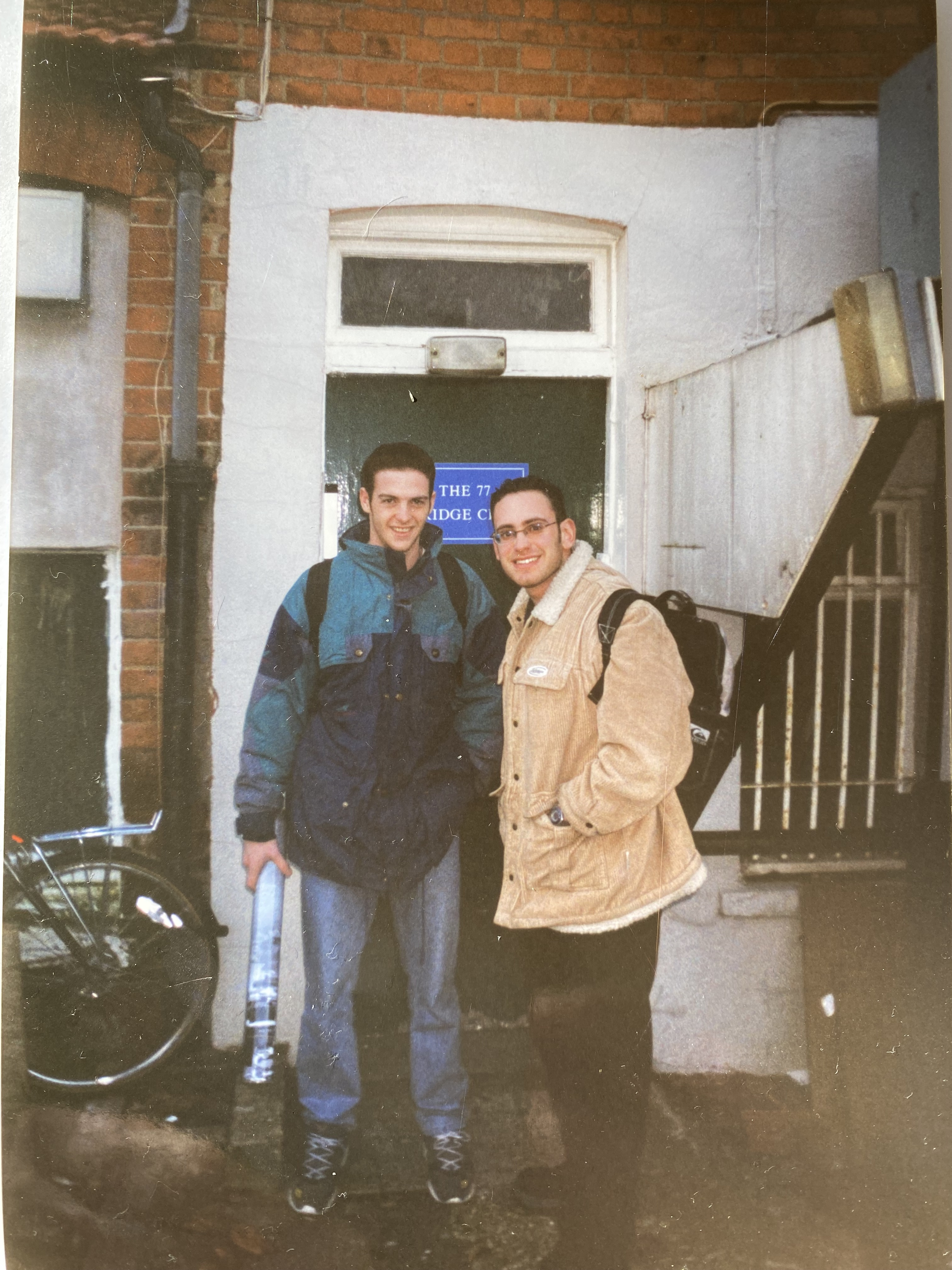
The flat was on the third floor of a red brick corner building that housed Harold Schogger’s Bridge Club on the second floor and a late night kebab shop on the ground floor. This I patronised rather frequently, especially after over-indulging in the strong weed that was being passed around upstairs.

The inconspicuous entrance to the flat was at the rear of the building partially hidden by a car park. You climbed a flight of stairs past the bridge club entrance, which would be crowded at times with chain-smoking bridge players, and then up another flight to the front door to our flat.

Harold Schogger, a short, cheerful chap with a mop of curly hair and glasses, who spoke in a middle class London accent, was also our landlord. He came round from time to time to do small maintenance jobs and collect our rent cheques, but otherwise we seldom saw him.

My brother (Dan) and friend Shaun Ellert in front of the door that led up to my Hendon flat.

As I remember it, the flat had a long passageway, off which jutted first a tiny toilet to the left and then to the right a large, not too unpleasant living room furnished with a comfy blue couch, red carpet, boxy television with Sky Box on top and small dining table in the far corner.

Moving back down the passage to the left was a narrow rather dreary kitchen with a window that looked down into an inner well of pigeon crap, used cutlery and discarded junk. Further down to the left was small bathroom with shower and basin which I used every day for almost four years yet can barely remember it. (I did shower regularly I promise! ) Then there were four bedrooms, the last at the end of an L shape as the passageway made a right turn.

My bedroom was in the farthest left corner of the flat with a window that opened up over the busy high street. There was an array of metal spikes outside designed to keep the pigeons away, while inside I had a single bed against one wall and a desk against the other. Presumably there was a cupboard, but I can’t remember. Like the rest of the flat, my room was rather grubby, exuding the sometimes pungent smells of bachelorhood.

My first flatmates were two fellow Jews, Andy and Dave, who hailed from Rochdale near Manchester and a mysterious, but friendly, tall, dark-skinned Israeli called Sagi, who went he wasn’t bonking some hot babe loudly through the night, would invite me into his room, to watch a movie and get completely stoned on his couch. It was strong marijuana and I can’t recall the titles of any movies we watched or if we had any conversations. But I did enjoy getting high in his room, and deeply appreciated his hospitality.

Andy, who was bearded and plumpish, and Dave, who was clean shaven a with wide-eyed look about him and mad love of Rochdale FC, were mostly to be found in the evening plonked on the blue living room couch, rolling a joint, eating greasy food and scrolling through endless channels on Sky TV. The joint was freely passed around, and I soon find myself getting “nicely toasted” on the couch as the night wore on. They were both nice guys, intelligent and far more worldly than me. They loved football and smoking dope. Most importantly, they were happy to have vagabond like me for a flat mate.

I moved into the Hendon flat after being rejected for about half a dozen other places around Golders Green that were advertised in that local free weekly working holidaymaker magazines like TNT. Before that, I ‘dossed’ in the Golders Green laundry of my best mate Jason and his South African friends’ house on Ridge Hill Road. I remember the oft-repeated mantra “Dosses have no rights” but everyone was very nice and I enjoyed the few months I lived there. I slept on a mattress propped up next to the washing machine in the laundry (which was behind the kitchen). Every night, the washing machine’s gentle rumblings and tumblings would lull me – like the sounds of a train’s wheels – to sleep (This tale of my “early days” in London was repeated often for tragi-comedic effect).

The living room with blue couch, red carpet was probably the nicest room in the flat

Eager for a hovel of my own, and after being rejected for numerous other places, I was delighted to have found this somewhat squalid little space in Hendon and unpretentious and friendly roommates always happy to pass the joint around.

I lived in that flat for almost four years, catching the Northern Line tube at Hendon Central into the West End, getting off most of the time at Tottenham Court Road Station, and emerging from that warren of tunnels and escalators into the stampede of humanity that was Oxford Street.

Here I would make my way towards Soho and the Wardour Street offices of a Dutch publishing company called VNU, where I worked as a journalist for Accountancy Age a weekly publication for accountants in the UK.

As dull as that may sound, those four years at Accountancy Age were extremely happy ones for me. I made some brilliant friends, discovered local Soho pubs like the John Snow and Star & Garter (this was at a time, when going to the pub for a pint at noon meant the end of the working day), bookshops, cafes and frequently spotted celebrities walking down its lanes and alleyways.

Paid a meagre wage (it improved over time) my most popular lunch time meal was a jacket potato with baked beans and cheese which cost me Β£2.50, a sandwich, drink and crisps deal from Boots or the more upmarket Pret a Manger franchise across from my office (where I once spotted Ewen McGregor in his bike leathers chomping on a coronation chicken sandwich).

Once a week Pizza Hut on Oxford Road had an all-you-can-eat special which I took full advantage of. Very occasionally, I got to sample some of London’s famous restaurants and upmarket bars, usually when work or someone else was paying.

Many summer lunchtimes were spent in bohemian Soho Square Gardens, a small oasis of green surrounded by film studio offices and book publishing houses like Bloomsbury (publisher of the Harry Potter series) where the pungent aroma of marijuana hovering above on summer days. Occasionally I’d wonder down to Trafalgar Square and browse a room or two at the National Gallery during my lunch break.

Though Soho was packed with sex shops and other naughty establishments, I never ventured into any of them (OK, maybe once or twice) mostly out of fear of being spotted by my work colleagues, or even worse bumping into them. But I did love to browse the huge Borders bookstore on Charing Cross Road and of course, that pantheon to books, Foyles.

But, I digress.

Regardless of how I spent my working day, more often than not it ended with an evening or late night Tube ride up the Northern Line back to Hendon Central and 5-10 min walk back to my flat above the kebab shop and Harold Schogger’s Bridge Club.

Over the near four years I Iived there, a lot of people came and went, some of whom like Andy, Dave and Sagi I remember clearly, other just blurred faces and forgotten names

There was an obnoxious and uppity Jewish bloke (maybe Aaron) who I got into an argument with (possibly over Israeli politics) and who left after he got engaged. There was also a quite attractive Israeli whom came with me on my yearly sojourn to the Edinburgh Festival. I can picture here clearly – pretty face, beauty mark, longish hair – but for the life of me cannot remember her name. I am sure it started with an “M”. Perhaps it will magically pop into my head one day. We shared digs at the festival, but my misguided ideas of romance, were cruelly rebuffed on the first night.

My parents and me on the blue couch. For some reason I vividly remember that painting I did.

Then there was Joe, a skinny, bespectacled bicycle-riding school teacher’s assistant with penchant for A-class drugs (opium, cocaine) and who was regularly visited by his dealer, a long bearded chap of Indian origin. Joe was also buying up property, providing regular updates of his acquisitions of London terraces. How he did all this – he was I guess one of these high-functioning drug addicts -I have no idea, but he was certainly highly intelligent, perhaps even genius level. He was also exceedingly nice and incredibly smart. If he’s not dead now (killed in some horrible cycling accident) I suspect Joe must be very wealthy.

I stayed in touch with lovely Jacqui (her surname was Langlois) for a long time after I left London, and we caught up when I came back for a holiday in 2005. She was quite a lot older than us (maybe in her 40s back then) and owned a flat in Brighton. She was very warm and sweet with a high-pitched sing-song voice. She worked in social services I think, but had wide-ranging interests including traditional Klezmer music. I remember her practicing her violin in her room. Perhaps she has improved by now.

Two of my flatmates, lovely people: Jacqui left and Hila right.

On at least one occasion, Jacqui was propositioned by one of the old chain-smoking bridge players that we regularly passed on the way to our flat, and while she was certainly in the market for a romantic partner, it was definitely not to be one of the geriatric card sharks . I remember she moved into Joe’s room when he left, and recall quite clearly the utter chaotic mess Joe left it in, papers and crap everywhere. It was so bad, that it reduced Jacqui to tears. We had lots of great chats on the couch in our lounge, and I invited her into my wider circle of friends and family. She was a dear, close friend for a while, one of those people that come into your life and leave a mark. I’ve often tried to look her up online, but cannot find anything (Jacqui, if by some miracle you discover this, get in touch!) and suspect she has avoided social media.

There were another Israeli girl I flat-shared with. Her name was Hila, she was short and cute. Hila worked crazy hours at one of the big department stores in the West End. She left late in the afternoon or early evening and returned in the early morning when the rest of us were waking. When she wasn’t working, we’d hang out. For a while we kept in touch after I moved to Australia, but sadly I have lost all trace of her.

I simply can never forget vivacious Debbie, from Cape Town. Cute, with curly blonde hair, Debbie aspired to be a singer and entertainer. She was a bit larger than life and had a warm and outgoing nature.

Another flatmate Debbie from Cape Town, in her Freddie Krueger jersey front left. Then clockwise: my sister Deena, brother-in-law Larren, brother Dan, friend Colette and me.

On one occasion I remember quite vividly she invited us to see her sing at the pub down the road. It was a real dive, dark and gloomy, but Debbie saw an opportunity to perform for an audience and she did not disappoint, belting out songs and playing her electric keyboard. She certainly was not shy, nor did it bother her the curious looks she got from the old pensioners in the crowd, sitting perplexed, whilst sipping their pints.

That covers just about everyone I can remember sharing the flat in Hendon above the kebab shop and Harold Schogger’s Bridge Club.

I certainly lived with an eclectic and interesting bunch of people, some real characters during what accounted for most of my time in London.

Dinner at the Hendon flat with good friends. L-R Colette, Jason, Claire and me

Then around December 2003, someone moved out of the house share up the road in Golders Green (where I had first stayed in the laundry as a dosser) and I grabbed my chance to move into a bigger room with my good friends Jason, Claire and Colette, and share the luxury of a garden.

The laundry was still there behind the kitchen, but my room was upstairs overlooking the road and those big semi-detached houses that lined the street on either side.

I’d literally moved up in the world. I was a vagabond no more.

Fighting the apartheid machine: reading Andre Brink’s classic ‘A Dry White Season’

Like the hero of his novel in ‘A Dry White Season’, Ben Du Toit, the late South African novelist Andre Brink was considered a “veraaier” (traitor) by his own Afrikaaner people by taking the side of those fighting against the National Party’s evil apartheid regime.

The novel, which jolted me back in time with a dose of dark nostalgia, tells the story of Du Toit, a middle-class suburban school teacher who finds himself pitted against the apartheid machine, and its “special branch” or “security branch police, when he begins investigating the deaths of Gordon NcGubene, a gardener at the school where he teaches, and Gordon’s young activist son Jonathan.

Prior to his fateful decision to pay a visit to John Vorster Square, the notorious Johannesburg police headquarters, to politely inquire about what happened to Gordon on the initial naΓ―ve belief that it was all a “mistake”, Du Toit was comfortably ensconced in his suburban home and the routines of white Afrikaaner family life.

His desire to “help” Black South Africans is well-meaning, but cast within the “master-servant” apartheid dynamic – the Du Toits have been paying Jonathan’s school fees provided he stays out of trouble and does well academically. This rids them of their guilt at being part of the oppressive system, without ever really taking a stand or getting involved in the struggle for equality.

This is a position I knew well from my own experiences growing up in South Africa in the 1980s, where I was surrounded by quasi-liberal adults doing “well meaning” gestures for the Blacks that cleaned their houses or bathed their children, but who were happy not to rock the boat and enjoy luxuries that came with being white and privileged.

Ben’s apolitical but good-hearted position starts to shift when first Jonathan dies in police custody in the cells of John Vorster Square, and then later his father Gordon, when Gordon persists in trying to find out what happened to his son and where he was buried, marking him as a troublemaker in the eyes of Special Branch.

Ben’s change into becoming a veraaier is fueled by an inquest which shows the judges to be in cahoots with the police after they find Gordon to have committed suicide. Soon after the trial he meets young, liberal journalist Melanie Brewer, who through stories of her own terrible experiences, encourages him into the light.

“And now it was inside of him, it was happening, the sudden loosening like a flock of pigeons freed from a cage…he allowed it to flow from him spontaneously, all the years he’d cooped up inside of him. His childhood on the Free State farm, and the terrible drought, after which they had lost everything…He told her about Gordon, about Jonathan…and his visit to John Vorster Square.”

While Melanie becomes his confidant and ally, Ben’s growing activism does not resonate with his more conservative wife Susan, who as the novel progresses grows more and more agitated and fearful as her husband becomes obsessed with proving Gordon was murdered by Special Branch, and did not as they claim – and the court found – kill himself.

These subtle, but inexorable shifts in character, which Brink writes so well, plays out in an early scene when Susan implores Ben, lost in troubled thoughts in his study, to come to bed. According to Susan, all Ben needs is a good night’s rest to rid him of his worries.

But Ben resists, even at the “subtle promise of her breasts and belly” seen between the loose folds of her house coat.

“After she had gone out he could hear the gentle dripping of the gutters again. The small and intimate wet sounds of the departed rain.

“Tomorrow he would go to John Vorster Square himself, he thought. He would talk to them personally. In a way he owed it to Gordon. It was little enough. A brief conversation to correct a misunderstanding. For what else could it be but a regrettable, reparable mistake.”

The visit to John Vorster Square takes Ben into the belly of the apartheid beast, and under the radar of cruel Afrikaner men like Captain Stolz, a gleeful torturer of black men considered “terrorists” in the eyes of the Apartheid state.

Ben’s obsession with discovering the truth takes him to the “other” Johannesburg: the impoverished sprawling township of Soweto, a world he scarcely thought about until his political conversion.

Ben becomes acquainted with the larger-than-life township character, Stanley, who moonlights as a taxi driver whilst arranging clandestine resistance meetings in the townships and on trips across the border. As Stanley educates him on the terrible things being done to Black South Africans and as Ben grows closer to the journalist Emily Bruwer, he starts to drift away from his wife and family and the comfortable middle-class life he once enjoyed.

Similarly, Andre Brink, through his writing, pitted himself against his birthright that of a descendent of 18th Century Dutch settlers, who became the Afrikaaner boers (farmers) and later the National Party that developed the inhumane policies of segregation.

The 1960 Sharpeville massacre, when more than 50 black people protesting peacefully against Apartheid laws were murdered by the South African police, opened Brink’s eyes to the monstrous policies of his “people” and set in motion novels like ‘A Dry White Season’ which pitted good against evil and those who seek and tell the truth versus those who lie and distort.

“No Afrikaans writer has yet tried to offer a serious political challenge to the system … We have no one with enough guts, it seems, to say β€˜no’,” said Brink in 1970, nine years before he finished “A Dry White Season”, his most famous book.

“All I know is that I must do something,” Ben Du Toit tells the young Reverend Bester in the novel, echoing Brink’s belief that as a writer he must tell the truth.

By comparison to the other South African literary heavyweights – J.M. Coetzee, Damon Galgut (read my reviews of his novels here) and Nadine Gordimer among them who were more allegorical in their novels, Brink writes in a far more journalistic style and employs the techniques of reportage. In his retelling of the life of Ben Du Toit, his re-birth as a seeker of the truth is mostly told through diary entries handed down to someone else.

It’s a powerful book about the price one must pay for taking a stand, but also the liberation of the soul that comes with doing it. Brink’s message is universal and just as potent today amid the dark forces shaping the world.

(Make sure you read the book before you watch the Hollywood movie, which in my opinion is a vastly inferior interpretation of Brink’s work. This is despite an impressive cast including Donald Sutherland, Susan Sarandon, Marlon Brando and Zakes Mokae)

The horror and futility of war: Reading ‘All Quiet on the Western Front’

Before watching the award-winning Netflix movie ‘All Quiet on the Western Front‘ I decided to first read the famous book by the German writer Erich Maria Remarque, which was published in 1929.

There’d been some criticism of the film – German critics had panned it for turning a beloved literary classic into an Oscars spectacle, while historians had slammed its apparent historical inaccuracy – but beside that, I wanted to take in the story in its original form (and use my own imagination), before watching the latest on screen adaptation.

Interestingly, the book’s famous and oft-used title (usually quoted without the irony) was coined by an Australian soldier and Oxford scholar Arthur ‘AW’ Wheen who fought in the Great War and who was awarded three military medals for bravery.

The original German title ‘Im Westen nichts Neues’ translates as ‘Nothing New on the Western Front’. But Wheen, who went on to translate a number of Remarque’s novels, was so profoundly moved by the story that he coined the more poetic English title. This along with his well-received translation of the book played a key role in its enduring success and hallowed status nearly 100 years after being published as one of the great First World War novels.

An often times mentally grueling read, Remarque condenses all the horror, tragedy and futility of the Great War into just over 200 pages of terse, diary-style entries narrated by the brave and philosophical young German soldier Paul Baumer.

Paul, just 19-years-old but already a veteran of the conflict, is part of a close-knit group of five school friends – Tjaden, Muller, Kropp and Leer – and their 40-year-old leader, “shrewd, cunning, and hard-bitten” Stanislaus ‘Kat’ Katczinsky who are stationed a few miles from the front, where the sounds of gunfire and bombs never stops rumbling.

It is 1918, and the soldiers pray that the war will end soon, that the rumours of Germany’s surrender will come true, and that they shall survive.

One of the great strengths of the novel is the way Remarque combines both the horrors of the trenches with the more mundane, but also poignant experiences of a soldier’s life to give a fully rendered impression of those times.

Away from the battlefield, we join Paul and his friends as they enjoy the simple pleasure of receiving mail, sharing extra rations or stretching out in a grassy meadow where they find joy in “wonderfully care-free hours” as bumble bees drown out the ominous rumbles from the front.

These are the quiet moments when their youthfulness resurfaces and these battle-hardened soldiers can be, hopeful men again. Not knowing when they shall meet their end, they immerse themselves in the brief respite and try to forget about the return to front where they will once again become part of the terrifying war machine.

Remarque, who was a war veteran himself, was able to draw on the horrific scenes he witnessed whilst fighting in the trenches to put the reader right there among the mud, rats, mustard gas and wounded, dead and dying.

Remarque’s novel takes you right into the horror of the trenches.

We see men living with their skulls blown open; we see soldiers run with their two feet cut off, they stagger on their splintered stumps into the next shell-hole… we see men without mouths, without jaws, without faces; we find one man who has held the artery of his arm in his teeth for two hours in order not to bleed to death. The sun goes down, night comes, the shells whine, life is at an end.

In another horrific scene, Baumer writes of the terrible screams of horses injured by bombs and gunfire, the belly of one “ripped open the guts trail out” as it rises to its feet but then falls over, tripping on its own intestines.

“Torches light up the confusion. Everyone yells and curses and slaughters. The madness and despair of many hours unloads itself in this outburst. Faces are distorted, arms strike out, the beasts scream; we just stop in time to avoid attacking one another.”

If the horror of the book was not enough, midway through reading descriptions like this, I felt compelled to look on YouTube for archived footage of the viscous battles Remarque was writing about.

One video segment depicted the total chaos on the battlefield, as mortar bombs exploded, bodies crumbled and soldiers fired at one another, then charged with bayonets that sliced into bellies. Because of the jerky motions, the scene felt almost cartoonish.

I also came across a scene of soldiers making their way through the nightmare landscape of barren hills and deep craters. Shot from behind them, it showed one soldier advancing on foot, with another behind him who appeared to be crawling. Only he wasn’t crawling I soon realised, most of his lower body had been blown away and he was dragging himself along the ground by what remained of his torso. (The video is titled “Verdun is a human slaughterhouse“).

It was utterly horrific, and just so incredibly sad. I wished I’d never seen it. But it did highlight that there was no hyperbole in the descriptions of Remarque’s young narrator, Paul. While All Quiet on the Western Front is a fictional story, the experiences endured by Paul and his comrades are accurate and true.

The power of Remarque’s storytelling is that he not only manages to capture these unimaginably awful things that happen in the trenches and among the craters and barbed wire entwined battlefields, but the mental anguish of those caught up in the fighting and the futility of it all.

This is brought most horribly to life in a devastating episode where Paul is forced to kill a French soldier who falls into a pit he is hiding in after taking cover from the incessant shelling and relentless machine gun fire.

Paul watches as the soldier’s young life slowly seeps away in front of his eyes.

Paul starts to question why this young man, whom he discovers had a wife and child, had to die. They are a similar age and in another time might have been friends.

He ends up making a futile vow to write to the dead soldier’s wife after finding a picture of her and their daughter in his wallet.

“Comrade,” I say to the dead man, but I say it calmly, “to-day you, to-morrow me. But if I come out of it, comrade, I will fight
against this, that has struck us both down; from you, taken life–and from me–? Life also. I promise you, comrade. It shall never happen again.”

Paul is the philosophical voice and conscience of the millions of young men, who if not killed, were traumatised beyond hope from the things they did in the fight for survival.

For me the most moving and tragic episode, and which illuminates the mental devastation of the war on young soldiers are the scenes when Paul is given a 17 day leave pass and journeys back to his home village, to see his family.

Remarque captures so perfectly the feeling of both being at home among your loved ones, but also that terrible realisation of having left everything you once knew far behind, of being utterly and irrevocably changed and of never ever being able to make that journey back to what life once was.

I imagined leave would be different from this. Indeed, it was different a year ago. It is I of course that have changed in the interval. There lies a gulf between that time and to-day. At that time I still knew nothing about the war, we had only been in quiet sectors. But now I see that I have been crushed without knowing it. I find I do not belong here any more, it is a foreign world.

Finishing the book, I realised I knew so little about the First World War, especially when compared with Second one that broke out just 20 years later.

The reasons for the Great War, as I have since read are so much more complicated.The famous assassination of Archduke Franz Ferdinand in Sarajevo merely the spark that lit the fuse.

Industrialisation, power struggles, inequality between nations and inbred racial hatred all played apart in the greatest ever mobilisation of millions of young men to fight and die in the trenches.

This was a war where armies were so large and so easily replenished that no one could ever really win, resulting in loss of life so huge and horrors so terrible they are hard to fathom, even as new atrocities emerge in the Ukraine war, fueled by similar forces: power, greed and hatred.

All Quiet on the Western Front is Erich Maria Remarque’s poetic and visceral reminder that there are no real victors in war, only victims.

Will the new movie do justice to that message? (I’ll report back).

Laughter, banality and the elephant in the room: reading Billy Connolly’s autobiography

By strange coincidence, the day I picked up a copy of Billy Connolly’s autobiography “Windswept & Interesting” I saw on social media that the “Big Yin” had just turned 80.

It was quite a milestone for one of Britain’s most famous comics, actors and travel show hosts, and it seemed even more fitting that I should now be reading about his life.

I’ve long been a fan of his, enjoying his his hilarious storytelling stand-up comedy, entertaining travel documentaries as well as his more serious acting in movies like ‘What we did on our Holiday’.

He’s certainly a very talented individual, and from reading his book, comes across as warm-hearted and lovable person in his private life. This is in spite of many difficulties experienced in childhood including physical and sexual abuse and a later problem with drinking (no doubt caused by this trauma).

The title of his autobiography, which he wrote during lockdown, refers to the way his flamboyant appearance was described to him by a friend early on in his entertainment career.

It’s a moniker Connolly revels in and believes is an accurate description of a type of person he identifies with: someone with their own individual style and who doesn’t give a fuck (excuse my language, but I am paraphrasing Billy) what anyone else thinks.

“Being windswept and interesting is not just about what your wear,” writes Billy.

“It’s about your behaviour, speech, your environment and an attitude of mind. It’s perpetually classy – but it’s not of a particular class. It transcends class.”

Later, he says: “Once I’d realised that I was windswept and interesting, it became my new religion. It was such a delightful contrast to the dour and disapproving attitudes I’d grown up with. Instead of cowering under the yoke of ‘Thou shalt NOT!’ , I found a new mantra: ‘Fuck the begrudgers!'”

It’s an attitude of mind that runs throughout the book, fueling his success first as a musician (a career I knew nothing about) and then as often outrageous and daring stand-up comic. Without this psychic armour, Billy might never have made it out of the gloomy Glasgow tenement flat he’d grown up in and which he describes so well in the early chapters of the book.

As with many people of a certain age, the pandemic provided the opportunity for reflection and the time to sit down and think about their lives. He does so in a self-deprecating, warm way, that only sometimes veers off course into somewhat uninteresting (for me anyway) banalities and trivia, such as his favourite TV programs.

To this I am sure Connolly would say: I don’t give a fuck, it’s my story and I’ll choose what I write about. Fair enough, I would not want to be the “fucker that begrudges him”.

Billy Connolly’s story begins in a tenement flat in Anderston on the unloved south western outskirts of Glasgow, where he is raised by his aunts, one of whom is the sadistic Mona, a nasty woman who takes particular delight in physically and verbally assaulting her wee nephew.

Connolly finds himself in this unhealthy domestic situation after his mother runs off with another man, and his father is posted overseas during the war. Later, when his father returns, Connolly is forced to share a bed with him, and his horrifically and inexplicably abused.

It’s a shocking thing to be abused by our own father, but Connolly devotes only a few paragraphs to this incident (one of the surprising aspects of the book), leaving this dark chapter to be dissected by his second wife, the actress turned psychologist Pamela Stephenson, who wrote in more detail about it in her biography, Billy.

Connolly only mentions it again fleetingly, though other memories of his father surface such as family holidays. He only return to the very painful and confusing topic when his father dies.

It is of course a sign of Connolly’s strength of character, his tenacity and warm-heartedness that he does not allow such awful events to dominate his life, though those dark memories do fuel his excessive drinking.

In many respects the book is a chronicle of the people he met along his journey to self-acceptance, those individuals that impacted his life and his career in a positive and creative sense.

Among them were the welders he met while working as an apprentice on the Glasgow shipbuilding docks,

“The shipyards were full of patter merchants. That’s where I first really understood you could be incredibly funny without telling jokes,” recalls Billy.

Billy Connolly with Gerry Rafferty in their days as “The Humblebums”.

He discovers he has a gift for making people laugh through his storytelling, a skill he gets to practice on stage before and in between gigs as a banjo and guitar player.

Of this musical career, I was blissfully unaware and so had no idea that Connolly teemed up with famed pop star Gerry Rafferty of “Baker Street” song fame to write music and tour as the folk band the Humblebums, to a fair degree of success.

While Connolly is keen to point out Gerry Rafferty’s far superior musical talents, there is certainly no doubt that Billy became by far the more famous and successful of the duo.

I also learnt to my surprise and astonishment that Billy does not prepare material for his stand-up shows, but pretty much just gets up on stage and starts talking.

It’s quite a gift, but no doubt gave his stand-up shows a daring, unexpected quality, as well as their freshness and spontaneity.

He writes of his first time of being onstage without Gerry as giving him a “lovely sense of freedom, just talking, singing and being myself”.

It’s the pleasure and enjoyment of storytelling, of being himself, which makes his autobiography so enjoyable for the reader, and especially the fan. There are also plenty of laugh-out-loud moments such as the hilarious “murdered my wife” joke he told on an appearance on the Michael Parkinson show in the 1970s (You can find it on YouTube).

Now an octogenarian living with Parkinson’s Disease and half his hearing gone, it’s good to know that Billy Connolly has turned into less of a grumpy old bastard and more of a opinionated cuddly bear, fond of swearing at the TV, but always eager to learn and discover new things, even in his sunset years.

Throughout it all, he’s remained true to his calling: windswept and interesting.

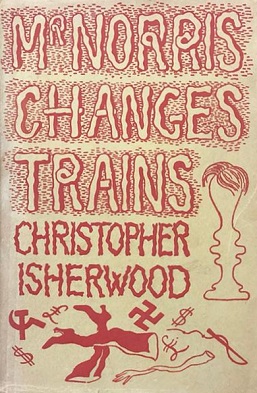
Exquisite prose: reading ‘A Single Man’ and ‘Mr Norris Changes Trains’ by Christopher Isherwood

If there was a poll of the finest writers of the 20th Century, surely Christopher Isherwood would be near the very top of that list.

Over the last few months I’ve had the pleasure of reading three of his novels, starting with the highly autobiographical Goodbye to Berlin, which inspired the hit movie Cabaret and which I have already reviewed on this blog,

After that I read Isherwood’s short novel ‘A Single Man’ (made into a successful 2009 movie by fashion designer Tom Ford) and another set in Berlin, ‘Mr Norris Changes Trains’.

It’s been a delight to read such a lyrical and psychological writer, who with a few beautifully formed sentences can bring a scene to life in the reader’s mind and recreate the inner mental workings of his protagonists.

This ability to penetrate deep into the psyche of his characters is evident in A Single Man, a short novel that chronicles the final day in the life of George, a severely depressed gay college professor mourning the loss of his lover Jim.

It’s set in suburban Los Angeles in 1964. Isherwood, who was also gay, emigrated to the US and moved to California in 1939, to escape the more repressive society in his native England.

The extremely compact timeline for the book allows Isherwood to really focus on the inner workings of George’s depressed, but also buzzing mind as he navigates the challenges of the day and deals with his grief and the people and places that trigger memories of Jim.

The opening of the book is quite startling, and reveals another strength of Isherwood’s writing: his creativity. It begins with George waking up in a discombobulated state – an “it” trying to identify the “I” – as he looks at his tired and sad self in the mirror.

“What it sees there isn’t so much a face, as the expression of a predicament. Here’s what it has done to itself, here’s the mess it has somehow got itself into during its fifty-eight years, expressed in terms of a dull, harassed state, a coarsening nose, a mouth dragged down by the corners into a grimace as if at the sourness of its own toxins, cheeks sagging from their anchors of muscle, a throat hanging limp in tiny wrinkly folds.”

It’s just one example of Isherwood’s marvelous descriptive powers and the poetry of his writing.

By the the time the “it” has gotten dressed, spent some time on the toilet from where he observes the quiet suburban streets and some of his neighbours below and eaten some breakfast, George is himself again and ready to set off on the first challenge of the day: the commute to the work.

Throughout the novel, there is a sense that George is trying to swim back to the surface of the here and now, to reconnect with people and the world, even as memories of the past and what he has lost drag him back down.

On his way to teach an English class at a community college, George’s thoughts drift elsewhere as he drives along Los Angeles’s busy highways on auto-pilot.

“And now as he drives, it is as if some autohypnosis exerts itself. We see the face relax, the shoulders unhunch themselves, the body ease itself back into the seat. The reflexes are taking over…”

As he is now free to direct his attention elsewhere, George engages in a fantasy that involves unleashing a virus against homophobes, and then going on a killing spree. Then his vengeful daydream is ended by his arrival at the campus as he “rapidly puts on the psychological make-up for this role [of well-liked, suave English professor] he must play”.

Amid all the despair, and the sense of hopelessness, there is also fleeting pleasure and the meaningfulness it means to George.

There is the homo-erotic pleasure of watching two young men playing tennis in the heat, the “exhilarating” pleasure of watching the students in his class smile back at him with those “bright young eyes”, the pleasure of conversation with a young, male student called Kenny (with whom he is infatuated), the pleasure of revenge, when visits the dying Doris, with whom the late Jim had an affair, and the simple pleasure of companionship and getting drunk when George changes his mind and decides to accept a dinner invitation from his friend Charley, a single mother and fellow Brit.

In a sense then, George’s story is life-affirming: through the veil of immense grief we can still find space to enjoy those moments that give life a quite rich meaning.

I am alive” George says to himself as he drives back from visiting Doris to a workout at the gym.

“And life-energy surges hotly through him, and delight and appetite. How good to be in a body – even this old beat-up carcass – that still has warm blood and live semen and rich marrow and wholesome flesh.”

Mr Norris Changes Trains is a more traditional plot-driven suspense novel, but still showcases Isherwood’s ability to create fascinating characters that intrigue and beguile the reader.

Set mainly in Berlin, it tells story of the friendship between a young English tutor called William Bradshaw (the story’s narrator, and a kind of fictional alter ego for Isherwood whose full name was Christopher William Bradshaw Isherwood) and Arthur Norris, a charming and rather posh older gent fond of using phrases like “My dear old boy”.

The pair meet on a train travelling from the Netherlands to Berlin when William encounters Arthur in a highly agitated state as they await the arrival of immigration officials and surmises that Arthur is mostly like a smuggler.

William soon learns that Arthur is entangled in all sorts of shady and clandestine activities amid the backdrop of a looming war in Europe

Like Isherwood’s ‘Goodbye to Berlin’ much of the action unfolds as Berlin finds itself at the crossroads of two great epochs: the end of its famous decadent, free-spirited and Golden era of music, art and cinema and the rise of brutal fascism under dictator Adolf Hitler’s Nazi movement.

Bradshaw, who earns his living as a tutor, is drawn into Arthur’s exciting and dangerous world attending rowdy communist party gatherings, bearing witness to his strange business dealings (where Arthur is threatening by his evil business associate Schmidt) and joining Arthur’s bohemian entourage at Berlin’s rowdy bars and night clubs.

On one occasion Norris disappears from the party, and Bradshaw, goes in search for him only to find him engaged in a sado-masochist ritual, which he at first mistakes for Arthur (whom he can hear crying out “Nein, Nein! Mercy!”) being robbed.

“The first person I saw was Anni. She was standing in the middle of the room. Arthur cringed on the floor at her feet. He had removed several more of his garments, and was now dressed lightly, but with perfect decency, in a suite of mauve silk underwear, a rubber abdominal belt, and a pair of socks. In one hand he held a brush, and in the other a yellow shoe rag.

Olga towered behind him brandishing a leather whip. ‘You call that that clean, you swine,’ she called in a terrible voice. ‘Do them again this minute. And if I find a speck of dirt I’ll thrash you till you can’t sit down for a week. As she spoke she gave Arthur a smart cut across the buttocks. He uttered a squeal of pain and pleasure and began to brush and polish Anni’s boots with feverish haste.

Both comical and shocking, it’s one of the many delightfully entertaining episodes in the book that Bradshaw describes without judgement as he drawn deeper into Arthur’s intrigues, plots and plans.

Arthur Norris as I have since found out is based on Gerald Bernard Francis Hamilton, whose friends included Winston Churchill, the American actress Tallulah Bankhead and the notorious occultist Aleister Crowley, who was his landlord in London in the 1930s. Hamilton, who became known as “the wickedest man in Europe” – was a “fixer” for notorious communist Willi Munzenburg and someone who sold secrets for a living.

Hamilton was also imprisoned for bankruptcy and indecency. According to an article in The Spectator magazine, Hamilton lived a “long and disgraceful life” where everything he did was for money, rather than for political reasons.

Regardless of the nature of his clandestine activities, Hamilton clearly cast a spell over Isherwood who turned him into the more genial, but still Machiavellian wig-wearing conman Arthur Norris.

The novel was a critical and commercial success, but Isherwood later condemned it at making light of the suffering of the people he depicted in it.

Whether or not this is fair critique, is largely irrelevant in my mind as you can, like me, read ‘Mr Norris Changes Trains’ as if it were purely historical fiction and revel in the curiously fascinating character of Mr Norris and his affect on a young, naΓ―ve English tutor.

It reminded me of the British noir classic, The Third Man by Orson Welles. ‘No doubt Mr Norris Changes Trains’ would make a brilliant movie in the right hands.

Booze, sex and philosophy from the gutter: Reading Charles Bukowski’s ‘Women’

“I never pump up my vulgarity. I wait for it to arrive on its own terms,” says Henry ‘Hank’ Chinaski the fictional alter-ego of legendary boozehound writer and Β “laureateΒ of American lowlife” (as Time magazine dubbed him) Charles Bukowski in his 1978 novel “Women”.

I’ve read many of Bukowski’s brilliantly irreverent novels – written in a parsed down, forthright and highly entertaining style – and Women is by far the most graphic, indeed almost pornographic in its depiction of Chinaski’s innumerable sexual encounters.

(“I got down there and began licking…the cl*t came out but it wasn’t exactly pink, it was a purplish pink,” is how he describes one of these episodes.)

The semi-autobiographical novel (one can only assume some of his sexual exploits are exaggerated, though perhaps not the prodigious drinking) begins with Chinaski, 50, telling the reader that he has not had sex for four years.

“I had no women friends. I looked at them as I passed them on the street or wherever I saw them, but I looked without yearning, with a sense of futility.”

This drought is then broken by a period of romping that would have made Don Juan proud. It begins with half-crazed divorced mother of two Lydia Vance (the fictional version of Bukowski’s real-life girlfriend, the sculptor and playwright Linda King), whom Chinaski meets at a poetry reading:

She put both hands on the edge of the table, bent over and looked at me. She had long brown hair, quite long, a prominent nose and one eye didn’t quite match the other. But she projected vitality – you knew that she was there. I could feel vibrations running between us.

Woman, Charles Bukowski

Their relationship is full of wild sex, described in intimate detail by Chinaski – “I heard her breathing heavily, then she moaned” – and violent breakups due to his excessive drinking, visits to the racetrack, and infidelities, none of which he apologises for. Chinaski is who he is and the world can go to hell if they don’t like it.

“I walked into the bedroom with just my shorts on. I was conscious of my white belly lolling out over the shorts. But I made no effort to suck in my gut…”

At face value, Women is simply a recollection of Chinaski’s (or Bukowski’s) various relationships with women. These include Lydia, but also brief encounters with star struck fans who are seemingly served up on a platter to the horniest 50-year-old in LA.

It’s also a daily tally of his prodigious alcohol consumption of mostly cheap wine and beer. In between all the boozing and bonking – “Fucking was the best cure for hangovers. It got all the parts ticking again” – we accompany Chinaski on his often hilarious trips to college campuses around the country where he gives readings.

But as with all his writing, Bukowski manages to convey something more profound and meaningful than the sum of his adventures across bedrooms, bars and college campuses.

It is to champion the other side of Los Angeles in the words of his biographer Barry Miles: “Not the LA of ranch homes in the Hollywood Hills with the breathtaking views…” but the LA of tarnished dreams, of dead end jobs, of hookers and workers in the sex industry, of beaten down, damaged and dysfunctional people”.

Miles adds: “Bukowski loved the corner bars, the tawdry fast-food outlets, the sex shops and brothels, the graffiti on the walls…”

Sure Chinaski is the hero of the story, but he is no superman in a cape. He is very much the Bukoswki you see in those grainy black and white poetry readings on YouTube. a disheveled anti-hero with a pockmarked face who says what he thinks, never holds back and for whom nothing is ever taboo.

Chinaski in Women is very much a mirror – if perhaps a distorted and exaggerated one – of Bukowski at the height of his powers and fame: when after decades of struggle, eking out a living and working dead end jobs, he had finally established himself as a figurehead in American literature: the dirty old man of American letters.

Chinaski is not searching for some deeper meaning to life, or for the woman of his dreams. Life is simply about the experiences that happen to him – whether its winning big at the track or walking away broke, having a raging hardon or being unable to perform in the sack because he drank too much, talking to prostitutes or college professors – everything finds its way, uncensored into the book.

And while Chinaski is vulgar, and driven by his baser urges, he can also be sweet and loving. He is not a manipulator, nor does he pretend to be anyone else. And he despises pretentious, fake people.

Most importantly – and perhaps a key reason why I enjoy his books so much – is the poetic nature of his writing: short, descriptive sentences that hit their mark without ever saying too little or too much (a style that would have impressed George Orwell).

If you are a fan of Bukowski other books, or a writer like Raymond Carver who though not as vulgar, employed a similar parsed down style of storytelling, you should definitely give Women a read. (Just don’t leave the book anywhere near young children!)