Australian arrested: the mainstream media is right not to name him for now

2924824370_909cbdd97dIn August 2000 The Guardian reported the story of Dr Yvette Cloete, a specialist registrar in paediatric medicine at the Royal Gwent hospital in Newport, forced to flee her home after “self-styled vigilantes” daubed it with graffiti in the middle of the night.

The vandals wrote the “paedo” across the house she shared with her brother in South Wales, after apparently confusing her professional title of “paediatrician” with that of “paedophile”.

This, I sense, is the type of confused logic and misappropriation of information that has driven some bloggers to howl at the mainstream media for not naming the 83-year-old Australian arrested last week as part of the Metropolitan Police’s Operation Yewtree, set up following the Sir Jimmy Savile scandal.

Newspapers – even the usually forthright ‘name and shame them’ tabloids – have not named this person.

The UK tabloid press usually behave like a bunch of sharks – one sniff of blood in the water and they go into a feeding frenzy, competing for the most attention-grabbing sensationalist headlines, the bigger the font, the better.

But not this time.

Britain’s biggest selling newspaper, The Sun merely published the press statement issued by the police while it’s rival The Daily Mirror went one step further by publishing an interview with the entertainer’s wife – she said it was “easy making historic allegations against showbiz names”- but the paper did not provide clues as to who he may be.

Australian media have gone one step further by calling him “Australian”.

But the only mainstream media outlet (if you can call him that) to explicitly name the person in question is Derryn Hinch, the “human headline”, who has done so on several occasions via Twitter, and seems to have appointed himself judge, jury and executioner even before a charge has been laid.

As have many in that diverse, unchartered universe, the blogosphere.

Bloggers, some with large followings and a significant profiles, have demanded that the main stream press name this individual; that they have in fact a duty to do so.

Their principle source of corroboration appears to be Mark Williams-Thomas, a former UK detective specialising in major sex crimes, who has since become a media personality and television criminology expert.

So what exactly has Williams-Thomas said in relation to this latest arrest?

According to his Twitter account (Williams-Thomas is a prodigious tweeter) absolutely nothing.

He did tweet this in November last year:

Breaking : XX XX currently being interviewed under caution at police station as part of #Savile  other #sexual offences

This tweet – four months old – appears to be the primary source of corroboration used by bloggers for naming the suspect charged by last week, after the Metropolitan Police tweeted this:

An 82-yr-old man from Berkshire [‘Yewtree 5’] was arrested today 28/3 on suspicion of sexual offences. He’s been bailed to a date in May.

Williams-Thomas may be right, but it strikes me as strange that he’s not said a word following the Metropolitan Police’s March 29 tweet and press statement about the arrest.

He hasn’t even bothered to retweet it – this being someone who uses their Twitter feed as a channel to name and shames anyone accused or convicted of sex offences.

So it seems bloggers have very little prima facie evidence for naming this person and certainly less, you’d think, than the major newspapers and television networks, who remain defiantly silent.

As to why the mainstream press is keeping quiet for now, there is one very obvious one:

Fresh in the minds of most journalists will be two recent examples of wrongful accusations made against prominent people in relation to child-sex offences.

Last year, the venerated BBC current affairs program Newsnight got it horribly wrong when it mistakenly named Lord Alistair McAlpine, a former adviser to Margaret Thatcher and Conservative Party treasurer, as being linked to child abuse claims in North Wales.

The claims were repeated on Twitter and on other social media platforms.

Lord McAlpine received £185,000 pounds in damages from the BBC plus costs, its director general resigned while those on Twitter who defamed him, have been pursued, including the writer George Monbiot, who had tweeted on the case to his 55,000 followers and who agreed to carry out £25,000 of work on behalf of three charities of his choice for defaming Lord McAlpine.

(I note that one UK blogger, who has outed the Australian personality continues to call Lord McAlpine a “paedo”.)

In another case, just over a week ago, former BBC producer Wilfred De’ath arrested by police last November was freed without charge after claims he molested a 14 year old woman were withdrawn.

And there are others who have been accused of sex offences and later not charged – 11 people have been arrested so far.

Bloggers currently screaming for tabloid headlines to be splashed across newspapers should not be so sure that their relatively small pockets and size protect them from civil or criminal charges should their contentions prove false.

But even more importantly, they should take greater care when a person’s life and reputation hang by a thread.

Memoirs of a murderous Perth childhood: a review of Robert Drewe’s brilliant ‘The Shark Net’

the shark net‘The Shark Net’ is an acclaimed memoir by Australian journalist and fiction and non-fiction writer Robert Drewe recalling his childhood and journey to adulthood in suburban Perth in the 1950s and early 1960s.

I was drawn to the book by the description on the back cover:

“Aged six. Robert Drewe moved with his family from Melbourne to Perth, the world’s most isolated city – and proud of it….Then a man he knew murdered a boy he also knew. The murderer randomly killed eight strangers – variously shooting, strangling, stabbing, bludgeoning and hacking his victims and running them down with cars – and innocent Perth was changed forever.”

If there was ever a back cover description to entice me to read a memoir, then this was it.

Murder.

Murder by someone the author knew of somone the author also knew.

And in the sleepy, isolated town of Perth.

Growing up in Johannesburg, South Africa, you’d think I’d know someone who had been murdered or been the murderer. But I don’t.

“The Shark Net” is a book I have always had on my mental “must read” list and I was lucky enough to pick up a paper back copy for a couple of dollars while scrounging around in the book section at the Vinne’s op shop in Moonie Ponds.

I’ve known of the author, Robert Drewe, through a collection of excellent short stories I read he edited called “Picador Book of the Beach” and a short story he wrote in it called the “The Body surfers.”

The Shark Net did not disappoint, even though the murders and murderer play a relatively small (but important and binding) part in the plotline of the book.

It begins with Drewe, a young whipper snapper journalist on the Western Australian newspaper attending the trial of the murderer, but then goes back to tell of the story of his family’s move across the country from Melbourne to Perth, a journey that in 1949 took 12 hours by plane with refuelling stops at Adelaide and Kalgoorlie.

Drewe then proceeds to tell the story of his childhood – of his distant, non-communicative father, the archetypal “company man” who was on the rise as a state manager for rubber products maker Dunlop and his overbearing mother who worried about her children dying from “boiled brain” as a result of the Perth heat.

The Perth of Drewe’s childhood bears little resemblance to the modern, mining-rich city it is becoming today.

It’s very much the provincial town where every one seemingly knew each other, so much so that Drewe not only was acquainted with the serial killer, knew one of his victims

Even seven years ago, when I visited Perth for a mortgage conference, it had the feel of a large country town. We stayed in a hotel in the city and my chief memory is of the lack of people on the streets in the middle of the day. You almost expected tumbleweeds to come blowing down. My other memories are of Cottelsoe Beach, delicious oysters, sprawling suburbs with big houses, the historic feel of Fremantle and the long-distances travelled between city and suburb (and lunch at the Little Creatures Brewery).

What Drewe manages to do so powerfully is to create the feeling of being a kid in Perth in this era – of a town that felt seperated in it own universe, far, far away from the rest of Australia. Of the sprawling suburbs among the sand dunes, with the sand working its way into the foundations and onto manicured lawns.

Drewe writes:

“Some people lived in the loose white sand near the ocean. Even though everyone in Perth lived in the dunes I thought of them as Sand People. Every afternoon the fierce sea wind, which they dismissed as The Breeze, blew their sand into the air and corrugated their properties.”

He brilliantly evokes many memorable episodes in his childhood such as his visit to Rottnest Island, where he kills a shark as means to impress a girl (only for it to rot and smelll); a trip with his mother to hear the evangelist Billy Graham speak at  football stadium; a visit by tennis champ Rod Laver, endorsed by Dunlop tennis gear, mysterious suburban prowlers; late night adventures to meet girls and of murder in the suburbs.

Even if you have never ventured as far as Perth or even Australia, it’s an engrossing, entertaining read, with the bland suburbs south of the Swan River turned into places of intrigure, mystery and primal forces.

Make sure you read it.

Modern Perth with its skyscrapers

Modern Perth with its skyscrapers

Dodgy operators and scam artists: Seven tips to avoid getting ripped off this Xmas

sam.gifIt’s the festive season, we’re all spending money, buying things, and perhaps – in the spirit of the moment – being a little bit reckless about how we spend it.

As a property and financial journalist I have written about a  fair number of sharks, charlatans and scheisters and come across a few in person too.

It’s amazing what people try to get away with – there’s this story about a mortgage broker who conned clients out a $1.1 million and this story about a former professional rugby league player who allegedly pocketed $60,000 meant for his elderly clients,which he received by mistake.

I’ve written about unscrupulous mortgage brokers, dodgy estate agents, greedy financial advisers, but these sorts of people operate at all levels of business from the guy selling you a TV to the charity mugger on the corner of the street.

So here’s some tips to avoid getting into trouble:

  • If it sounds too good to be true, it is – run!

If someone is offering to double your money in six months or promises a very high rate of return on your investment, chances are they’re up to no good. They’re acting out of greed and playing on your desire for a quick return. If you want  a quick return, buy a lottery ticket (and pray) or go to the casino and put an amount you are happy to lose on black or red – that could double your stake in a flash, but at least you know the odds and the risks.

  • Always get a second opinion

If you think you’re on to a good thing, then present the idea to someone you trust and ask them for their opinion. It can be a professional in the same industry, a help line, a friend, a family member, just so long as its someone who can give you an objective point of view and has nothing to gain by doing so.

  • Do a Google/internet search

You can find out a great deal of information about someone simply by searching online. Type in the name of the person trying to sell you something and/or the company name and see what results come up. Certainly if your broker or adviser has gotten into professional trouble, you should find some mention of it online. But even if they haven’t you can find out a great deal about someone from online recommendations, their Facebook page, what they say on Twitter, from their blog and their previous roles via their LinkedIn profile etc.

  • Don’t rush into any decision

Whether you are buying a car, a house or a new TV, you should never feel pressured into making your purchase. Remember, there is no shortage of most things and even if it’s a house or collectible car you really like, if the person selling it to you is pressuring you, you should be suspicious.

  • Consider at least one or two alternatives products or services

The other day I was shopping for tea (yes just tea) and there must have been about a 100 varieties to choose from. I spent five minutes just locating the type I was after (Rooibos). This is also the case with most things you purchase these days – maybe not a 100 choices but usually a dozen alternatives. Particularly if it’s an expensive item or where the financial commitment is great, you should consider at least one or two alternative products, which may be better and cheaper or have more suitable features. You can do this without even walking into a store, by using a comparison website. Just make sure its a reputable website with a big range of products and full disclosure of how they compare items. ASIC is currently clamping down on dodgy comparison websites.

  • Ask lots of questions of the salesperson

Don’t be afraid to ask questions, including ones you think may sound silly such as questions about basic information. A good salesman should be happy to answer all of them. Also, by asking a lot of questions you will become better acquainted with the product and the person selling it.

  • Consider the personality, appearance and attitude of the salesperson

Think about the person who is selling to you. Are they likeable? Do you trust them? Do they have a pleasant manner? It’s amazing how often, after someone has sold you something, they lose complete interest in you, which is OK if you’re buying a shirt, but not so good if you’re buying a new car and it breaks down after a week. Trust your instincts. Avoid dealing with slick, fast-talking sales people who sound like second-hand car dealers (apologies to all honest second-hand car dealers). Buy from someone you like and trust. Why give business to a dick-head?

Happy shopping and spending over the festive season!

A public service initiative from freshlyworded.

A glimpse of the real Jimmy Savile -12 years ago

This, for me, is the moment, 12 years ago, that Jimmy Savile, revealed to the world that he was not one of Britain’s most-loved entertainers and charity fund-raisers, but an evil paedophile:

This is a still shot taken from a documentary by celebrated interviewer and documentary film maker Louis Theroux called “”When Louis met Jimmy” filmed in 2000.

In light of the hundreds of allegations of rape and abuse of children made against Savile, the ABC (Australian Broadcasting Corporation) re-broadcast the documentary.

(You can watch the whole thing on Daily Motion)

Apart from showing Savile to be completely eccentric (he had no stove in his flat, smokes a cigar while exercising on his treadmill, never has guests around, prefers sleeping in a minivan to his Highland cottage), manipulative (he turns a question from Theroux about a secret stash of alcohol into an accusation that he may not be a teetotaler) and disturbed (he turned his dead mother’s bedroom into a Norman Bates-like mausoleum complete with her dry-cleaned dresses hanging up in the closet and earlier tells the cameraman that while working as a dance hall manager in the 1950s he liked to “tie people up” that were causing trouble), there are many clues, which in hindsight, point to the hundreds of accusations that emerged a year after Savile’s death.

And so to this photo and the expression it captured.

It comes towards the end of a the hour-long documentary  as Theroux and Savile sit side-by-side on a train.

The discussion turns to Savile’s relationships with children.

Theroux asks Savile why he has said in the past that he hates children.

Savile’s response is that by saying he hates them: “it puts a lot of salacious tabloid people off the hunt”.

Theroux’s response is to ask Savile if this served to put and end to questions about “Is he or is he not a paedophile?”

“Yes,” says Savile. “How does anyone know whether I am or not? Nobody knows whether I am or not. I know I am not.”

Theroux says: “To be honest that makes you sound more suspicious.”

“Well that’s my policy,” Savile replies, shaking his head.

“And it’s worked a dream.”

After a moment’s thought, Theroux asks: “Why have you said in interviews you don’t have emotions?”

“Because if you say have emotions you have to explain them for two hours.”

Savile yawns and adds:

“The truth is I am very good at masking them.”

There is silence. The camera zooms in and crops Savile’s face.

And there’s THAT expression.

Savile looks towards the floor, his eyes lowered in shame and bewilderment.

Perhaps, at that moment he is remembering what he has done to all those innocent young people and who he really is – a sick, lonely old man.

An unexpected letter arrives from Spain

A letter arrived in the mail this week affixed with two colourful ‘Espana’ stamps and an two ink marks baring the words “Barcelona” and “Correos La Campania de Todos” (The Spanish post office).

The stamps cost 35 euro cents and 50 euro cents each.

The letter was addressed to “L Schlesinger” with my home address printed on top and began with an apology for this “unsolicited” correspondence.

“My name is Barrister Mateo Pinto of St. Mary of the Head 15, 28045, Madrid Spain. I got your contact information through the Australian public records while searching for the last name similar to my late client.”

His client, now deceased, was ‘Albert Schlesinger’, an oil magnate who lived in Spain for 28 years and who died along with his immediate family in an “auto car accident on the Damascus Highway in Syria in December 2004”.

The letter went on to detail how there was US$9.6 million unclaimed in a vault at the Madrid Central office and that he was seeking out a relative that shared the same last name as his client.

Having found me, he was willing to share the spoils – though 60:40 in his favour.

Still, I’d come out with a cool $5.76 million.

All I had to do to get the ball rolling was send him a fax or email, but he also provided a phone number though he suggested the first two means of correspondence for “time difference and confidentiality reasons”.

But I better hurry because, according to Barrister Mateo Pinto there is only “three months final notice from the safe keeping firm to present a beneficiary to the vault” or the money would be “forfeited to the Spanish authorities” – something that he “forbid happening”.

The letter was signed with an indecipherable signature and clearly a photocopy.

Obviously, this is a scam and not a very convincing one despite the effort to create authenticity with the posted letter and stamps (and perhaps also playing the part of the greedy lawyer by demanding a 60: 40 split in his favour).

I did some Google searches anyway to placate my curiosity.

The street address on the letter does not exist.

The only Albert Schlesinger of note I could locate died in San Francisco in 1993. His New York Times obituary says he was a civic leader and “founder of one of the largest automobile dealerships on the West Coast”.

There is no Damascus Road, in Syria, though there is one mentioned in the Bible.

And as for Barrister Mateo Pinto of St. Mary of the Head, there is an architect of that name residing in New York and a legal case in the Philippines involving a ‘Mateo Pinto’ who leased a fish pond, but that’s it.

Of course even without the help of Google, there are holes in the story as wide as the Grand Canyon.

For instance: why does he say he comes from Madrid, but posts the letter in Barcelona, on the other side of the country?

And what lawyer would look to give 40% of $9.6 million to someone he’d never met just because they shared the surname of their client?

I found many similar examples with almost the identical plot structure, including one on the Australian government’s SCAM watch website from a Spanish lawyer, whose client had died in a car accident with the recipient offered the  chance to share in $22 million, (though in this letter, the lawyer is more generous willing to share the spoils 50:50).

Does anyone actually fall for these silly scams?

Still, it got me thinking about the person who gone to the trouble of buying the stamps and posting this letter half way around the world in the hope that I’d reply and presumably end up handing over my bank details so that he can steal from me.

Somewhere, in Spain, probably Barcelona, there is a guy posting letters to all the Schlesingers he can locate in overseas phone directories.

Why did he pick Schlesinger? Well there are some very wealthy Schlesingers I believe, sadly I am not one of them, so perhaps that’s why he picked the name. Perhaps he’d also considered the more famous Oppenheimer, Getty or Rothschild surnames for the name of his fictitious client.

I imagine the scam artist hunched over a computer in some darkened flat in a non-descript suburb on the outskirts of Barcelona. The printer whirrs and buzzes as it prints out letter after letter. He bends down, picks up each letter and has a cursory look over it to check it’s printed correctly, folds it neatly and slips it into an envelope. He licks the stamps and presses them onto the envelope firmly. Later, when he has a big enough pile, he heads off late at night, walking along quiet streets, a cigarette dangling from his lips (don’t all villains smoke?) and drops the letters into the nearest mail box, looking around suspiciously as he does so in case someone has finally tracked him down. Then he disappears down a narrow lane, finds a cheap bar that stays open late, orders a beer, finds a seat in the corner, where he sips his cerveza, lights up another cigarette, puffs out a cloud of smoke and dreams up his next scam.

Or perhaps he’s some 16 year old nerd with pimples and a computer.

Evil intent is in the eyes

A few weekends ago, I went to the supermarket to buy groceries. I parked the car in the covered parking and walked up the ramp that leads up to the collection of shops and Woolies.

A group of young Indian guys in boardies and t-shirts, Australian to the core in their attire and manner, walked up the ramp ahead of me.

A balding middle-aged guy in his casual Sunday clothes – jeans, tracksuit top, I forget the details – was walking down the ramp.

As he passed them, his eyes narrowed and he gave the group of Indians one of the nastiest looks I have ever seen. A look of utter revoltion.

I don’t think the Indians even noticed.

I did.

I am not talking about a disapproving look, like the kind a teacher gives a pupil, I am talking about a look with murderous, hateful, extremist intention.

Given the right set of circumstances – a dark alley, a couple of his buddies – and opportunity – daytime instead of daylight, no one else around – and I shudder at what might have happened.

I wrote recently about the man accused of raping and murdering Irishwomen Jill Meagher in Melbourne.

What has really shocked people is that he was a stranger, not an acquaintance of Jill’s or a member of her family as most victims of violent crimes are in Australia or in other countries where the rule of law applies.

What has really jolted people and shaken their faith in society is the Jill Meagher was most likely murdered by a complete stranger, an opportunist.

The man who stands accused of this crime was a reclusive character, but by all accounts a polite man, who lived in a granny flat at the bottom of the garden and kept to himself. He had few friends, had fallen on hard times and was a loner.

Nothing to suggest he was capable of a crime of which he stands accused.

But perhaps, when his eyes are shown – his head was buried in his hands when caught on camera in a police car – they will give him away.

I am not talking about eyes as the clichéd windows of the soul, I am just talking about a kind of look full to the brim with evil intent.

I am sure you know what I mean, and maybe you have witnessed it yourself.

The encounter with the middle-aged guy on a Sunday at the supermarket is just one such episode.

I’ve experienced that look on the train a couple of times, usually late at night. The last train home.

Once I saw a bloke looking at another passenger with utter disgust and violence boiling under surface. He did not say anything, just stared. If it were a horror movie the camera would zoom and crop his eyes and you’d see the menace and the rage.

Other times, I’ve seen the way some men looking at pretty women. Usually the man is older, the woman much younger.

Men do look at women.

There is the appreciative look, the glance upwards at an attractive woman.

And there’s the stereotypical backwards look that construction site workers in the city can’t help but do, when a pretty woman walks passed. Hey, even blokes in suits do it. But there’s no malice in it.

But there is another look beyond lust, way, way beyond that. A snarling look, as though the eyes were salivating. A penetrating, black stare.

I have seen a couple of men give a woman this look and I fear, that as with the Indian guys at the shopping centre, all that’s needed is time, place and opportunity.

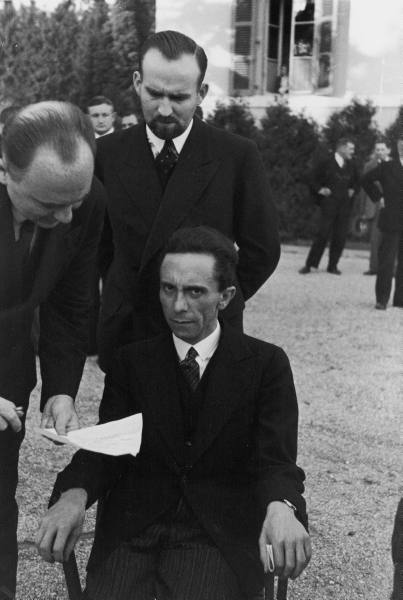
If you think I have an overactive imagination, take a look at the eyes of these two infamous characters: Nazi propaganda chief Joseph Goebbels and serial killer Richard – the Night Stalker – Ramirez:

This is in my opinion the most chilling picture of Goebbels, taken by one of the world’s greatest documentary photographers, Albert Eisenstaedt for LIFE magazine in 1933, before the Nazis began their campaign of genocide.

What’s terrifying about it is that Goebbels is not doing anything particulary menacing, in fact’s its a banal photo, except for the way he looks at the camera.

Eisenstaedt says of this photo: “He looked at me with hateful eyes and waited for me to wither. But I didn’t wither. If I have a camera in my hand, I don’t know fear.”

Richard Ramirez killed 13 people around Los Angeles in the mid-1980s. This photo was taken at his trial.

Should we ban the hoodie instead of the burka?

Is there a modern piece of attire with the potential to be more sinister than the ordinary hoodie?

I’ve been asking myself this question since reading about the tragic abduction, rape and murder of Irishwomen Jill Meagher.

CCTV footage showed a man – the same man now accused of her murder – wearing a blue hoodie as he talked (more likely bothered) Meagher as she tried to stumble home on drunken high-heels, her last fateful journey

The footage shows he does not actually have the hoodie over his face when he was captured on camera talking to Jill Meagher but, no doubt he wore it before or after his heinous deed.

Ironically, if he had worn the hoodie at the time he was captured on CCTV, he might not have been caught so swiftly.

People go on about the need to ban the burka (as it already is in France), fuelling a lot of religious anger and questions about freedom of expression, but I personally have never felt intimidated by someone wearing a burka.

Don’t get me wrong I don’t like the burka. I find them repressive and unpleasant, but not menacing.

Consider this scenario.

You’re walking home at night. It’s after midnight. There’s no one out on the streets. Houses are dead and quiet. Then you hear footsteps and notice someone is now walking behind you…they’re wearing a hoodie and there is face is hidden in shadow.

How would you feel? Safe? Would you pick up the pace? Maybe phone someone on your mobile phone? Your heart-beat would certainly be racing.

Since the murder of  Jill Meagher, well-known writer, comic and blogger, Catherine Deveney has come out and said that she was too attacked by a man wearing a blue hoodie on Sydney Road, possibly by the same person.

It seems the hoodie is often linked with criminal activity.

You put it over your head before you rob the convenience store; before you king hit someone; before you throw a rock at the police in a riot; to hide your face as you spray graffiti on a public space, or as you flee the scene of a crime.

The hoodie shields the face, the eyes and the intentions of the wearer.

Interestingly, I have discovered that hoodies have been banned in the past, though the move was controversial with libertarians screaming out about human rights, freedom of expression and unfairly targeting young people.

It happened in Belmont, a suburb in the Hunter region of NSW, about 20 kilometres out from Newcastle, where a ban on hoodies was introduced in 2010 in the shopping district to “combat young teenage boys defacing the property”.

“The ban was introduced because young teenagers were using jackets with hoods to hide their identity while doing graffiti,” reported the Newcastle Herald.

According to the report, during the first three weeks of the ban, there was no graffiti.

It’s not the only example.

In June last year Brisbane police launched a ‘Hoodie Free Zone’ initiative in the bayside suburb of Wynnum following a series of armed robberies, where the criminals wore hoodies to disguise their identities.

Shopkeepers were encouraged to ask hoodie-wearers to leave.

More recently hoodies were worn by many London rioters last year as they smashed shop windows and looted goods. They also wore hoodies as they threw rocks at police.

Interestingly hoodies have a religious origin (I keep thinking of creepy cultish ceremonies out in the woods somewhere), dating back to medieval Europe when they were worn by monks.

Hoodies entered popular culture in the US in the 1930s when clothes maker Champion started making them for workers as protection from the cold. They became an iconic piece of clothing following the release of the movie Rocky in the 1970s, where Sylvester Stallone wears them in his training scenes.

And of course they’ve been embraced by hip-hop stars and fake Burberry-wearing “chavs” in the UK.

Which is all very interesting, but it does not get away from the fact that wearing a hoodie, especially at night, has the potential to make even the most well-intentioned person appear to be a suspicious, sinister character.

So I maintain if we’re going to ban or put limits on any kind of clothing, perhaps it should be the hoodie, not the burka.

(Author confession: I own a couple of jerseys with hoods. In my defence, I never really wear the hood, certainly never at night and never with any criminal intention. Hey, I’d give them up if asked.)