An opinionated journalist's thoughts on media, film, books, sport, politics and the occasional rant. Or as William Burroughs put it: "A writer must write"
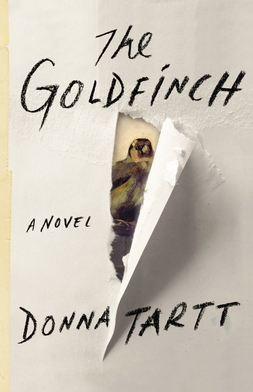
The Goldfinch is the third novel by American writer Donna Tartt, considered by many to be a literary genius.
Tartt’s two other books areThe Secret History, an “inverted detective story” about a college murder, which was published to huge acclaim in 1992 when she was just 29.
This was followed byThe Little Friend a mystery adventure novel set in Mississippi in the early 1970s that appeared in book stores in 2002.
The Goldfinch – an epic novel spanning 864 pages – was published in 2013.
By that you can tell that Tartt, who is now 58, painstakingly completed a book about once every 10 years (and we should expect no.4 soon!).
It also suggests an astonishing level of self-confidence and cerebral stamina – you really have to believe in what you are doing to keep going on with the same story and characters for a decade!
“A beautifully written coming-of-age novel with exquisitely drawn characters that follows a grieving boy’s entanglement with a small famous painting that has eluded destruction, a book that stimulates the mind and touches the heart,” said the Pulitzer Prize judges of The Goldfinch.
It’s a pretty good summary of the novel, which begins in a hotel room in Amsterdam as 27-year-old Theodore Decker’s fever-ridden thoughts return to a fateful stormy morning in Manhattan 14 years ago and the last few hours he spent with is beloved mother.
When a storm descends on them, they seek shelter in the Metropolitan Museum of Art, where a terrorist bomb kills his mother a short while later.
Tartt’s description of the violent explosion and its aftermath are exquisite as she brings the terrible chaos and destruction to life on the page as if the reader is also there. Buried in the rubble, Theo finds himself in a “ragged white cave” with “swags and tatters dangling from the ceiling” and as the ground “tumbled and bucked up with heaps of a gray substance like moon rock”. It is descriptive writing at its finest.
Just as powerful and heart-wrenching are the scenes where Theo makes his way back to their empty, darkened apartment, to wait in vain for his mother, “her coffee cup, green glass from the flea market, with lipstick print on the rim” a reminder of her terrible absence.
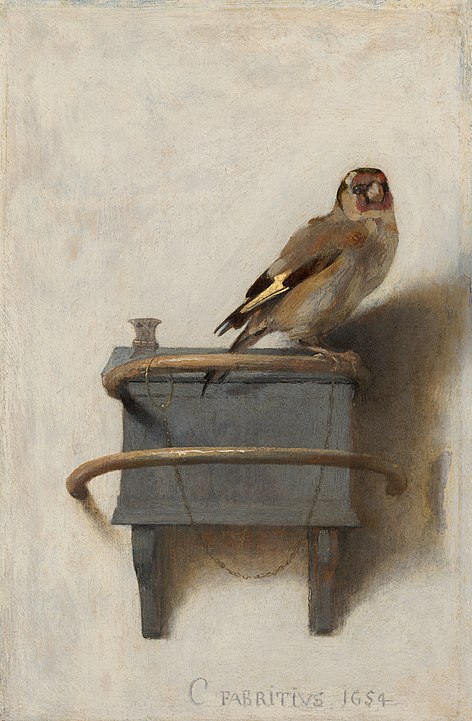
The painting is of a “yellow finch, against a plain, pale ground, chained to a perch by its twig of an ankle”. Just before they were separated, Theo’s mother told him this little painting was “just about the first painting” she ever loved. There is also another parallel: Fabritius also died tragically young, caught in an explosion at the gunpowder magazine in Delft in Southern Holland.
I stepped back, to get a better look. It was a direct and matter-of-fact little creature, with nothing sentimental about it; and something about the neat, compact way it tucked down inside itself – its brightness, its alert watchful expression -made me think of pictures I’d seen of my mother when she was small: a dark-capped finch with steady eyes.
The Gold Finch
The intriguing little painting, which uses an art technique called “Trompe l’oeil” (French for ‘deceive the eye’) to create the illusion that depicted objects exist in three dimensions, becomes a kind of living and breathing character in the life of Theodore Decker as he navigates his way as a lost young boy through adolescence into adulthood.
The painting connects him to the last conversation he had with his mother, and so he holds onto it tight over the next 14 years, keeping it hidden as first he lives with the Barbours, the wealthy, dysfunctional family of his bullied school friend Andy, before his absent father – a failed actor who mistreated his mother – appears on the scene with his girlfriend Xanadu and whisks Theo away to a housing estate on the outskirts of Las Vegas.
Here he experiences the vast desert skies and becomes best friends with another of Tartt’s marvelous creations. a delinquent, enigmatic Ukrainian boy called Boris who entertains Theo with tales of his time in Humpty Doo in Australia’s Northern Territory and introduces him to alcohol and drugs.
The Goldfinch by Fabritius
Written in the first person, Tartt’s ability to get inside the head of a guilt-ridden 14-year-old boy dealing with the monumental loss of his mother and his bumpy journey towards adulthood is truly remarkable.
Thankfully though at 864 pages The Goldfinch is not just the story about a boy and his obsession with a painting that reminds him of his mother.
It also focuses in on relationships, and how we need people to get us through trauma, be it the muddled advice of Boris, or Hobbie, the quiet and patient Greenwich Village antique furniture dealer and restorer who becomes a pseudo father figure and mentor to Theo, when he makes it back to New York, after yet more traumatic events.
The Goldfinch may be long, but like Hanya Yanagihara’s epic, “A Little Life” it’s never dull. Each adventure is part of Theo’s journey towards lifting himself out of despair and to the realisation that “maybe even if we are not always glad to be here, it’s our task to immerse ourselves anyway”.
The highly autobiographical novel is set in Berlin in the early 1930s as the city’s famed reputation for art, music, design, drink and decadence had begun to fade, as economic ruin started to descend on everyday lives, and as Nazi violence starts to assert itself on the streets whilst Hitler began his march to become Fuhrer.
Beginning in Autumn 1930, we find Isherwood living in a “large, dingy flat” above a busy street of shops, where prostitutes gather beneath his window. The flat is owned by Fräulein Schroeder, who was once fairly well off but like so many other Germans has fallen on hard times.
She calls Isherwood “Herr Issyvoo” and takes a keen interest in his life, and that of her other lodgers.
Such is her poor financial situation, that Frl Schroeder has had to take in five lodgers, leaving her without a room of her own. Instead, she “sleeps in the living room, behind a screen, on a small sofa with broken springs”.
Frl Schroeder is just one of the many eccentric and colourful characters Isherwood brings to life on the page. Another is fellow lodger Frl Mayer, a musical hall yodler, actress, proud Bavarian and “ardent Nazi” whose natural enemy is Frau Glauterneck, the Galician Jewess who lives in the apartment below theirs.
Coming into the living room yesterday morning, I found Frl Schroeder and Frl Mayer lying flat on their stomachs with their ears pressed to the carpet. At intervals they exchanged grins of delight or joyfully pinched each other, with simultaneous exclamations of ssh
Goodbye to Berlin
Another is the flamboyant American singer and wannabee actress Sally Bowles whom Isherwood meets one evening, early in October, dressed in black silk, with a small cape over her shoulders “and a little cap like a page boy’s stuck jauntily on one side of her head”,
Isherwood notices her emerald green nails, her nicotine tainted hands and “very large brown eyes”.
Bowles was based on the 19-year-old cabaret singer Jean Ross. Whimsical, flamboyant, stylish, promiscuous and dreamy (and not overly talented despite her ambitions), she is symbolic of the free-spirited Jazz Age in Berlin that flourished in Weimar-era Germany before the Nazis snuffed it out.
Isherwood is immediately drawn to Bowles, and she to him; their platonic friendship a sharp contrast to Bowles’ many lovers.
It is not hard to understand why Isherwood moved to Berlin. A gay man from a wealthy and conservative family from the north west of England, he would have found the German city’s plethora of gay bars, cabaret and experimental theatre alluring alongside its acceptance of homosexuality.
But he arrived there as this tolerance and acceptance was about to crushed by the Nazi regime, and as anti-semitism and intolerance becomes part of the chatter of everyday Germans looking for scapegoats for their economic woes.
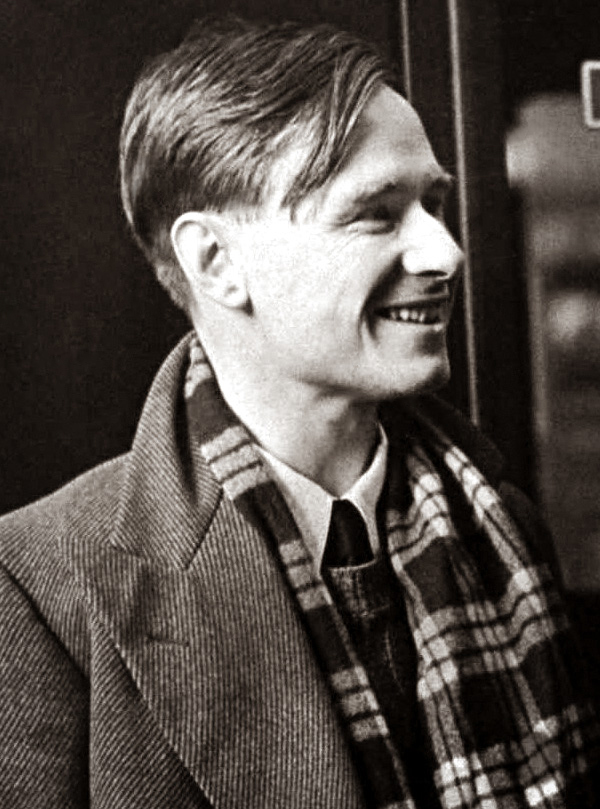
Christopher Isherwood – taken in 1938
Indeed many of the people Isherwood formed close relationships with during his time in Berlin, would have been prime targets for the Gestapo such as the gay couple Otto and Peter, who we find the author living with in a beach house on Rügen Island in the summer of 1931.
There are perpetual little rows going on between Peter and Otto, yet I cannot say I find living with them actually unpleasant
Goodbye to Berlin
Then there are the Landauers, a wealthy Jewish family, who own a Berlin department store. Isherwood befriends their precocious 18-year-old daughter Natalia, whom he accompanies on outings where they discuss art and literature He also forms a friendship with their cousin Bernard, a gay man, and a target for the Nazis.
Indeed Isherwood himself would have been in great personal danger had he chosen to remain in Berlin after the Nazis rose to power. He fled Berlin in May 1933 spent some time back in London and China, before emigrating to the US in 1939 and living in California.
I enjoyed being taken into this now long gone, but exotic world that Isherwood brings so vividly to life with his stories and anecdotes. He was a gifted storyteller with an ear finely tuned to the nuances of speech and character and well worth checking out for those looking for a fly-on-the-wall journalistic literary experience, that warned of the horrors to come.
“’Concentration camps,’ said the fat man, lighting a cigar. They get them in there, make them sign things… . Then their hearts fail’”
Galgut said it was an “abstract allusion” to the family’s youngest daughter Amor Swart, whose affection for their long-suffering black domestic servant Salome is a central theme of the book.
“But,” says Galgut, “I wanted to tie it in with a parallel sense that if one loves South Africa it has to be a dark kind of love”.
This “dark love” is apparent in the two Galgut novels I read back-to-back, The Good Doctor and The Promise, and is something I can relate too deeply, even though I left South Africa 22 years ago.
Dr Waters: trying to “make a difference”
A beautiful, but troubled land, South Africa gets under your skin and in your bones: if you’ve grown up there, you never really leave – even if you do physically.
Galgut’s gift is to draw from that dark well of South African history, culture and experience, and build an engrossing story with deeply South African characters, and to unsettle and enthrall the reader.
“Damon Galgut has written a lovely, lethal, disturbing novel,”
The story of The Good Doctor takes place in a crumbling, ill-equipped rural hospital next to a backwater town in what was once a Black “homeland” – one of a series of puppet states created by the white nationalist apartheid regime to separate blacks from whites – but is now forgotten, left to decay in the new South Africa.
The title of the book refers to Dr. Laurence Waters, an idealistic medical school graduate who comes to the dysfunctional hospital hoping to “make a difference” as part of his year of compulsory, post-graduate community work.
His arrival and subsequent stay at the hospital is narrated by Dr. Frank Eloff a disillusioned and bitter veteran physician, one of just a handful of staff that keep the medical facility barely functioning under the management of its administrator and head surgeon Dr Ngema.
So ill-equipped is the hospital, that patients with more serious injuries have to be transported to the big city hospital, a long drive through the veld.
The hospital’s small band of staff include the Satanders – a doctor couple from Cuba who quarrel a lot about staying in South Africa – and a troubled black orderly called Tehogo, who is symbolic of that “lost generation” of unskilled Black South Africans, left on the margins of society after the fall of apartheid.
In some kind of precarious and delicate balancing act, the hospital has maintained it place in the natural order of things, keeping its distance from the chaos beyond its boundaries, until idealistic Dr Waters arrives and shatters its island status.
“It’s like something terrible happened here,” Laurence said. “That’s how it feels.
“Ja, but the opposite is true. Nothing has ever happened here. Nothing ever will, that’s the problem.”
Race relations, the juxtaposition of wealth and extreme poverty, the battle for power in the new South Africa and the naivety of those who think they can change things are all meshed together in Galgut’s novel with devastating and mesmerising effect.
Galgut also has a way of conjuring up a strange kind of nostalgia (though that may be the wrong word) among those readers who lived through those historical times.
Hanging on the wall in the hotel foyer (I remember this so well) was a portrait of stern-faced Lucas Mangope in all his official puppet-state pomp and regalia, staring down on us wealthy whites, as we arrived for our luxury holidays and a roll of the dice at the roulette table.
It was of course absurd that we (well-off white South Africans) should enjoy our luxurious buffet breakfasts, sip cola-tonics and lemonades poolside and pull the handles of slot machines, all whilst being waited on hand and foot by an army of underpaid black servants.
Equally, it is absurd that young white graduate doctor – Galgut’s Dr Laurence Waters – working in a backwater hospital should think that he can “make a difference”; that he should be so naïve, reflects perhaps that unrealistic feeling we all had, standing to vote in the first elections in 1994, that the past could simply be swept under the rug.
While The Good Doctor confines itself to a relatively short period of narrative time, as well as a specific era in South Africa – the birth of the new democratic country – Galgut’s The Promise starts in 1986, during the State of Emergency, and spans 30 years. Over that time, and set against the backdrop of famous historical events in the evolution of the country towards democratic rule, it tells the tragic story of the Swart family and their haunting farm set amongst the stony koppies and veldt outside Pretoria.
The story is told through eyes and deaths of four members of the Swart family: Rachel Swart or “Ma”, her husband Herman “Manie” Swart (whose post-funeral gathering occurs during the momentous 1995 Rugby World Cup Final), Anton, their first child and only son, and Astrid, the middle daughter.
Connecting them all together is Amor, the youngest child, who carries the family’s guilt – a white person’s guilt for the things done to black South Africans under the apartheid system – and who is determined to fulfil her mother’s dying wishes that their faithful and long-suffering black servant Salome, be granted the deed to the crumbling house, that has been her home all the years she has served the family.
Galgut has a real gift for capturing the feeling of a place and time: for example that deep-seated resentment old Afrikaaners felt about the ending of apartheid and having to share the country with black people, but also their supreme and undying love of rugby.
At the farmhouse, following Manie’s funeral (he died from a poisonous snakebite at the reptile park he ran) the television is switched on in the build up to the World Cup Final.
While some family members are unhappy that the television is playing during what is meant to be a solemn gathering, Ockie, the unloved husband of Manie’s sister Marina has a “warm glow only partly due to Klipdrift” (a famous South African brandy enjoyed with Coke).
“…and God knows he took the new South Africa hard. But he has to admit, it’s nice to be able to play international sport again. Gives us a chance to donner people from faraway lands, and man we really fucked up those Samoan floppies a couple of weeks ago”.
The Promise
In another episode, Galgut writes how Anton, a white child, suckled on the nipple of Salome, such was the motherly bond despite the rules of apartheid forbidding such behaviour. While this may sound extreme to some readers, it was common, even when I was growing up, for black domestic workers (who we called “maids” or “nannies”) to care for white children as if they were their own, to bathe, clothe, feed and nurture them.
“My first nanny was a kind of substitute mother for me when I was really little…I’m talking the age of 2,3,4. Her name was Salome and I named the character after her, partly in tribute to her.”
“As you can imagine,” Galgut says later, “quite meaningful and intimate bonds can spring up in an artificial relationship like that”.
Drawing on the greats that have come before him – Athol Fugard, JM Coetzee, Nadine Gordimer and others – Galgut is the latest gifted writer to explore the complexities of South Africa’s dark history, its often paradoxical race relations, and its troubled democratic rebirth.
He does so, in my opinion, with less literary pretention than those who have come before him. His writing style is more direct and accessible (you could say “modern”) but still poetic. That’s even the case when he’s writing about Joel Stransky kicking that magical drop goal, while an Afrikaaner family cheers him on, but refuses to embrace the New South Africa that allowed that moment to happen.
The last two books I read were both in the true crime genre, and brilliant examples of writers at the top of their craft.
First I read Ann Rule’s Don’t Look Behind You and Other True Cases, a collection of mostly cold case investigations that take place around the Seattle area on America’s west coast,
After finishing it, I then stepped back 160-odd years and into an entirely different landscape, of Victorian England and the ghastly murder of a three-year old boy in a large manor house in the countryside and the London detective recruited to solve it in Kate Summerscale’s The Suspicions of Mr Whicher.
Ann Rule, who died in 2015 aged 83, started her career as a law enforcement officer for the Seattle Police Department, wrote for True Detective magazine under a pen name and then established herself as the Queen of American true crime writing with a long career of best sellers. She is most famous for The Stranger Beside Me published in 1980, her sensational account of her charming, handsome friend Ted, whom she met while working at a Seattle suicide crisis hotline, who turned out to be serial killer Ted Bundy.
Ann Rule’s books are motivated by a strong desire for justice for the victims and their families, especially those heart-wrenching cases that are never solved.
Don’t Look Behind You and Other True Cases is dedicated to “everyone who has lost someone they love, never to find them – or learn the reasons they vanished”.
Rule goes onto explain, in a brief introduction to the first story in the book “North to Alaska” that when she chooses which cases to write about, they are almost always selected from the Cold Case departments of homicide divisions.
“There is something infinitely satisfying about finding killers long after they have become confident that they have walked away free,” Rule writes.
The two long stories in Don’t Look Behind You – “North to Alaska” and “Too Late for the Fair” both track cold case investigations: the former about the disappearance of charismatic meat salesman Joe Tarricone, and the second about Joanne Hansen, a young mother locked in an abusive marriage who vanished one day, never to be seen or heard from again.
Rule is a master of plot, narrative and pace: she is a natural and gifted storyteller. While her stories are rich with procedural detail – the collection of evidence, investigating leads – and the small steps taken by investigators to unravel decades old crimes, they never becoming boring or plodding.
It’s not hard to see why she became a best selling popular writer of true crime: stories are told in an uncomplicated, linear way with plenty of direct dialogue. She brings characters to life on the page, both the perpetrators and the victims, the latter for whom she displays the greatest of empathy.
She once said of her motivation to write about true crime: “I wanted to know why some kids grew up to be criminals and why other people didn’t. That is still the main thrust behind my books: I want to know why these things happen, and so do my readers,”
I highly recommend all of them if you enjoy reading, listening to or watching true crime stories. They’re an easy read, but also engrossing and thought-provoking.
Kate Summerscale is cut from a far more literary cloth than Rule, but none the less entertaining a writer.
In the case of The Suspicions of Mr Whicher – the only book of hers I have read – Summerscale writes from a much broader historical and social perspective, producing in the words of the great spy novelist John le Carre called “a classic of the finest documentary writing”.
Born in London in 1965, but brought up also in Japan and Chile, Summerscale attended Oxford University and then California’s Stanford University, where she obtained a masters in journalism. She worked at a number of English newspapers including the Daily Telegraph and Independent, whilst establishing herself as a writer with an award-winning biography about eccentric speedboat racer Marion Barbara ‘Joe’ Carstairs.
She then wrote The Suspicions of Mr Whicher, which won The Samuel Johnson Prize (since renamed the Baillie Gifford Prize), Britain’s top book award for non-fiction writing. It was also made into an ITV television series, which unfortunately seems very hard to track down.
I’ve actually read the book twice, but enjoyed it just as much the second time round.
It’s not as easy a book to read as the pacier novels of Ann Rule, but if your penchant is for slowly unravelling, procedural crime shows like Inspector Morse, Prime Suspect or Unforgotten I think you’ll immensely enjoy reading The Suspicions of Mr Whicher.
The “Mr Whicher” refers to Jonathan or “Jack” Whicher, one of the first eight police detectives who joined a newly created branch of the London Metropolitan Police, at Scotland Yard in 1842. Whicher was sent from London to the village of Rode, near Trowbridge in the county of Wiltshire to solve the most famous crime of the era, the murder of three-year-old Francis Saville Kent in a stately country home called Road Hill House.
Summerscale does not just tell the story of the Kent family and the terrible events of the night of Friday 29th of June 1860 at Road Hill House, when the young boy’s body was discovered shoved down a privy (outside toilet), his throat cut, and the efforts of Whicher, the most brilliant detective of his day, to solve the baffling crime.
She captures the whole zeitgeist of that time – the public’s fascination with the crime (especially since it occurred in the country home of a wealthy, upper class family) fueled by a legion of city and country daily newspapers that reported on its every detail, theory and rumour.
“While the press and the public condemned Whicher’s prurient, impertinent speculations, they freely made their own,” Summerscale writes, capturing the fascination with the case that gripped the country from the big cities to farming villages, and its distrust of the new class of detectives.
As Summerscale explains in her wonderfully researched book, the crime was the first “whoddunit” set in a quintessential country home, in which all the suspects were inside the house: circumstances which created the template for hundreds of fictional detective stories, movies and TV shows including Agatha Christie and Midsomer Murders.
Not surprisingly, the case influenced many subsequent Victorian novels, captured the attention of the greatest writer of the times Charles Dickens, a friend and admirer of Jack Whicher. Dickens, like everyone else had his own (wrong) theories about who the murderer was.
There are so many fascinating aspects to this book, not least of which is the crime itself, there’s the story of the brilliant career of Jack Whicher, and how the immense pressure to solve the Road Hill House murder almost finished him off, the growing power of daily newspapers to shape public consciousness and the emerging art of crime detection.
Part true crime, part historical and social commentary, The Suspicions of Mr Whicher is non-fiction writing at its finest and a must-read in my opinion.
It has been my custom, on this humble blog, to write reviews (often quite badly, but perhaps sometimes entertainingly) of the books I have read.
I’ve gathered them in one spot on the Freshlyworded virtual bookshelf, mostly for my own nostalgic pleasure, to peruse from time to time and to remind me of what I have read over the years. At worst, its fantastically eclectic mix of genres, themes and styles.
I hope it might also provide some recommendations for friends and strangers who may be looking for a tome to entertain them, and perhaps an escape from Netflix etc.
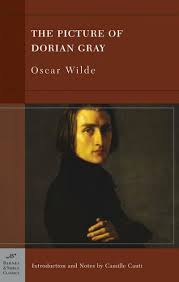
As, I have fallen far behind on the books I have read and not yet reviewed, I’ve decided to gather mini reviews of the last four books I have read – Oscar Wilde’s The Picture of Dorian Gray, David Sedaris’s The Best of Me, Paul Auster’s Moon Palace and Esther Freud’s Hideous Kinky in one handy blog post, sparing my dear reader the lengthy, waffling and rambling diatribes I tend to succumb to when writing reviews.
While it’s hard to find too many commonalities across the four books – Wilde and Auster’s are novels of exquisite imagination set in big cities (London and New York), while Sedaris and Freud’s works are highly autobiographical and deeply observational stories – I can confidently say that all are the product of wonderfully entertaining storytellers that bring characters to life on the page through their precise and elegant writing.
The Picture of Dorian Gray by Oscar Wilde
Oscar Wilde, who famously said “Books are well written, or badly written. That is all” penned one of the best works of Victorian Gothic fiction, The Picture of Dorian Gray, in 1890.
An absolutely wicked and very dark tale about how vanity and the pursuit of pleasure can destroy the soul, it was an absolute pleasure to read it for the second or maybe third time. From the very first page, where we meet the artist Basil Hallward painting the portrait of young, beautiful Dorian Gray in a stately London home, Wilde transports you to upper class world of Victorian England.
Wilde depicts the inner moral decline of Gray, who succumbs to the “new hedonism” promoted by the aristocratic Lord Henry, and goes from a innocent “young Adonis” to a cruel, murderer frightened of his own shadow. While Gray retains his youthful looks, the painting hidden up in the attic of his Mayfair townhouse grows hideous, depicting the corruption of his soul.
An aspect I loved about Wilde’s book is that the “monster” of the gothic tale is handsome young man, with evil growing inside him, rather than the real monsters that inhabit Bram Stoker’s Dracula or Mary Shelley’s Frankenstein. Forget the numerous film adaptions of the book, and read’s Wilde’s brilliant, dark novel.
Rating: 9/10
The Best of Me by David Sedaris
I was pretty late discovering the wonderful writing of David Sedaris, whose celebrated short stories, fables and accounts of his own life have turned him into one of America’s most celebrated humorist and best selling authors.
A friend lent me a copy of a collection of his stores, Holidays on Ice, published in 1997, that included a retelling of his experiences working as a Christmas Elf in Macy’s Department store in New York
Then I came across Sedaris via the great Radio Show/Podcast This American Life. In one episode he read aloud his story about the death of his sister Tiffany, who committed suicide after a troubled life (Now we are five). In another episode, host Ira Glass meets with Sedaris in Paris, where the writer had lived for two years with his boyfriend Hugh. Sedaris takes Glass on an eventful tour of Paris sharing anecdotes of misadventures with the French language and the dangers of buying the wrong butter
Sedaris narrates his own stories with a delightful weariness in his mid-Western voice. He has an almost magical ability to write as if he is confiding only to his reader.
The Best of Me is an anthology of favourite works hand-picked by Sedaris. It begins with a delightfully wicked tale entitled “Glen’s Homophobia Newsletter Vol. 3 No. 2” where Glen (perhaps Sedaris’s alter-ego) describes his brief and doomed friendship with the attractive male cashier at Dave’s Kwik shop. It’s both very funny and unsettling, descriptions which apply to a lot of the stories contained in The Best of Me.
While I enjoyed some of his fable-like fictional stories like Christmas Means Giving, where rivaling super-rich neighbours try to outdo each other’s charitable acts in the most hideous fashion, my favourite stories are the one Sedaris tells about seminal moments in his own life particularly those about his family. Sedaris grew up with five siblings, including the actress and comedian Amy Sedaris.
Sedaris combines both tenderness and great humour in his writing, which is never overly sentimental or lecturing, but always insightful whether it be about relationships, politics, culture or identity.
Many of his stories explore the relationship with his father, who treated him with disdain and unkindly in his youth, but who softened into someone almost likeable as he aged.
To get a taste of Sedaris’s unique voice, you can listen to him narrate the story of his father’s final days in the achingly poignant Unbuttoned via the New Yorker magazine website. Unbuttoned is one of the stories contained in the anthology.
You can also read online – Dentists without Borders – which was first published in The New Yorker in 2012.
You can also listen to him read Now we are five and Americans in Paris on This American Life and dozens of other episodes featuring his stories and essays.
While his writing is a platform to explore his own upbringing, identity, phobias and personality, Sedaris has this amazing ability to make the reader feel good about being alive in a world of contradictions and craziness.
Rating: 8/10
Moon Palace by Paul Auster
I hadn’t realised how many Paul Auster books I had read until I browsed my bookshelf at home, after reading his work of magical realism Moon Palace.
Here I found Mr Vertigo (1994), The Book of Illusions (2002) and Oracle Night (2003).
I also know of Auster through two screenplays he wrote for the movies Smoke, and its follow-up Blue in the Face, both starring Harvey Keitel, who plays the owner of a Brooklyn cigar shop.
Though I don’t remember all the plots in detail, I have a clear memory of the sheer pleasure in reading those books and the sweetness of the movies, especially Smoke.
Auster, is one of the modern greats of American Literature, and has been touted as a potential recipient of the Nobel Prize of Literature. Were he to win it, he would be one of the most accessible and worthy recipients (the prize is often in my opinion given to writers no one has heard of (Abdulrazak Gurnah in 2021?) apart from university professors of English literature.
Auster is a wonderful storyteller and masterful creator of characters, that often draw on his own personal history. Many of characters reappear in his books, at different ages and stages of their lives.
Moon Palace is narrated in Holden Caufield-like fashion by the introverted, intense and tortured orphan Marco Stanley Fogg. It begins with Fogg nearly starving to death in his sparse New York apartment after deciding to “live dangerously” and simply live off the proceeds of the mountain of books he has inherited from his late Uncle Victor. Later he finds love in the arms of the beautiful and kind Kitty Wu and then a live-in job reading and carrying out chores for a blind old, wheel chair-bound man called Thomas Effing in his large Manhattan apartment.
Along the way, all sorts of strange and seemingly unlikely (but believable in the hands of Auster) coincidences take place throughout Marco’s epic, modern odyssey that take him from streets of New York to the sparse wilderness of the American Mid-West and that bring him closer to knowing his back story and finding his identity.
As with other Auster books, there are “stories within stories” as the reader is swept down portals of time and memory. If you’re looking to make a start on the oeuvre (yep, fancy word – look it up!) of Auster, magical and mystical Moon Palace is a good place to start.
Rating: 8/10
Hideous Kinky by Esther Freud
I thought I’d be a bit more enthralled by Esther Freud’s autobiographical tale about her stint living in Morocco with her aimless mother Julia and older sister Bella. (Freud is the daughter of the legendary portrait painter Lucian Freud and the great granddaughter of the founder of psychoanalysis Sigmund Freud).
I picked the book at random from my gigantic 1001 Books You should Read Before You Die and was looking forward to reading it as I’d travelled through Morocco with my wife when we backpacked in 2010 and been entranced by its ancient and bustling cities with their overflowing markets, maze-like laneways and lively squares like the incredible Jemaa el-Fnaa, the main square and marketplace in Marrakesh.
Indeed we stayed in just the kind of cheap hotel Lucy, the six-year-old narrator stays in with her mother and sister (the wonderfully named Hotel Moulay Idriss) close to the Jemma el-Fnaa.
Lucy precociously narrates the family’s adventures across the country, the curious sights she sees in the markets, squares and festivals, the relationships forged with local characters like Bilal (her mother’s Moroccan lover and a father figure for her kids) and the eccentric expats they meet, like the wealthy “prince” Luigi Mancini. The children seem to have a supernatural power to to know which adults to trust, a fortunate quality given their mother is often absent, in spirit if not sometimes physically.
The family are constantly having to find ways to make ends meet as they wait for money to arrive, making dolls to sell in the market, or a few pieces of fruit they have gathered. One “holiday” has them sleeping outdoors on a beach for days.
Esther Freud’s beautiful descriptions transported me back to my time in Morocco, especially Marrakesh, which was wonderful. The novel is magical in parts, but I was also quite bored at times by all the wondering about and waiting around. Perhaps I need to read it again (It’s only 186 pages). I’d also like to watch the movie starring Kate Winslet.
Chances are, if I am at a loss as to what to watch or listen to, I’ll turn to some documentary, dramatised movie or podcast about a serial killer, psychopath or madman.
Just the other day, while my wife tuned out at the end of the day to episodes of The Nanny, I was racing through a new documentary series on Netflix investigating the Son of Sam murders which occurred in New York in the 1976 and 1977.
Narrated by Paul Giamatti, the show called The Sons of Sam (note the plural) focuses on the claim by obsessive investigative journalist Maury Terry who believed that convicted killer David Berkowitz did not act alone but was part of a satanic cult that committed the spree of murders that terrorised the city.
Then before that, I was gripped by an Australian true-crime documentary series on Stan calledAfter the Night which looked into the series of killings that occurred in the affluent and until then quiet and safe suburbs of Perth in the late 1950s and early 1960s. The crimes were perpetrated by deranged family man Eric Edgar Cooke, the last person to be hanged in Western Australia.
David Berkowitz; Did he act alone or was he part of a satanic cult?
After the Night told the story not only of Cooke, but also of two other men who were wrongly convicted of some of his crimes, Darryl Beamish and John Button, and the lengths they and their supporters went to clear their names. It also captured very well the easy-going, carefree life in the well-to-do suburbs of Cottesloe and Nedlands, and how that sense of security was shattered by a violent string of murders and rapes.
A big motivator to watch this show was reading and re-reading Robert Drewe’s wonderful Perth memoir The Shark Net which had as its backdrop the Cooke serial murders and Drewe’s start in journalism as a cadet reporter for the West Australian newspaper. (Read my review here).
Before that both my wife and I watched The Serpent on Netflix about conman and serial murderer Charles Sobhraj (also known as the Bikini Killer) who lured in hippy backpackers travelling around South East Asia in the 1970s with the promise of a place to stay and a luxurious lifestyle and then poisoned them, held them captive and then murdered them and stole their possessions.
Charming and sadistic: Ted Bundy is a fascinating study in evil
Then there was the documentary series The Night Stalker, about the satanic serial killer Richard Ramirez who broke into homes across Los Angeles in the mid-1980s to rape and murder in a vile spree that terrorised the city. The documentary focused on the detectives who tracked Ramirez down and some of the extraordinary stuff-ups that occurred along the way. It also delved into the cult-like rock star status Ramirez enjoyed and the perhaps even crazier women who threw themselves at him.
Prior to that there was Des about the London serial murderer Denis Nilsen who lured in young men into his shabby Muswell Hill flat. Here he smothered them, slept with their corpses and then dismembered and attempted to flush their remains away. ‘Des’ was played by the brilliant David Tennant (a key attraction for watching the series).
Killing for Companythe classic true crime book about Nilsen by Brian Masters (who is played by the great character action Jason Watkins in the television series) that so fascinated me when I read it whilst visiting my London cousin stirred my interest in Nilsen at the time. It also happened that my London cousin lived and still lives in Muswell Hill, a short distance from Nilsen’s flat of horrors, one of the creepy reasons no doubt I chose to read the book at the time.
David Tennant as Dennis Nilsen in Des
I also watched the Netflix documentary series Conversations with a Killer: The Ted Bundy Tapes which re-examined one of America’s most notorious and charismatic serial killers, who also had his own female fan club. There was also the biographical crime drama about Bundy (starring Zac Ephron in the lead role) Extremely Wicked, Shockingly Evil and Vile that I watched maybe a year ago.
My fascination with Bundy began when I read Ann Rule’s classic of the true crime genre The Stranger Beside Me. Rule’s perspective was unlike any other in the history: she was a friend of Bundy.
Part of the fascination for me is the “how they caught them” aspect, the police and detective work, the clues that emerge and the trail that leads them to identify and capture the villain.
It’s probably then not surprising that my favourite detective shows are not the fast-paced glitzy stuff (I can’t stand shows like NCIS) but the slow-paced procedural dramas featuring believable investigators, my favourites being the dour and eternally grumpy Inspector Morse, Idris Elba’s rugged and damaged Luther and most recently, the renegade LA detective Harry Bosch in the Amazon series Bosch played by Titus Welliver (and based on the novels by Michael Connelly).
All these shows and the ones I have described above I highly recommend if that sort of thing intrigues you.
I do wonder why I am so drawn to these dark and disturbing shows, as are so many other people.
I like to think that I am not a secret psychopath with a penchant for blood and violence. Rather I think there is an innate human fascination with evil people or – if you don’t subscribe to that idea – to people who do evil things, especially those who do them over and over again.
After all these ‘monsters’ were soft, and cuddly babies once, not little devils with horns and a pitch fork.
I also think, that there is penchant in all of us – in the right (or wrong) circumstances to commit crimes of violence and descend into a kind of madness. Just think of all those seemingly ordinary Germans and other Europeans who became Hitler’s willing executioners during the holocaust. Might they have gone on living ordinary lives had a mad dictator not come to power?
One of the most entertaining, moving, inspiring and powerful documentary films I have watched in a long time is ‘Life Itself’, about the life of the famous Chicago film critic Roger Ebert. It’s also the title of Ebert’s own memoir published in 2011.
The film by Steve James (who made the Oscar-nominated Hoop Dreams) unintentionally documented the final months in the life of Ebert, who had long battled thyroid cancer, losing his lower jaw in the process, his ability to speak and eat but never his wit or brilliance.
It’s quite shock seeing Ebert for the first time in his hospital bed, missing a large part of his face. But he has these incredibly sparkling eyes, still full of mischief as he types away on his computer, making jokes through a voice synthesizer, writing film reviews and responding to emails.
Just a few months into filming, Ebert passed away in his hospital bed after another medical setback, surrounded by his devoted wife Chaz (who has continued to run rogerebert.com since his passing), friends and family.
The documentary moves between past and present telling the story of how Ebert started out as a young journalist at the Chicago Sun-Times – one of the city’s two main newspapers – and how by chance he became its film critic after a sudden vacancy emerged, a role he maintained and cherished for over four decades.
The documentary features interviews with Gene Siskel’s widow Marlene – Siskel died from cancer aged just 53 in 1999 – who wonderfully channels the love/hate relationship between the pair as well as with director Martin Scorcese, who emotionally praises Ebert for helping resurrect his career when it had sunk to a low point in the 1980s due to cocaine addiction and depression.
“Every medium [Roger Ebert] made use of was, above all, a tool of communication, a way of talking to people — Sun-Times readers, the critic in the other chair, Facebook friends, insomniacs and enthusiasts — about the movies he cared about and, perhaps more important, the human emotions and aspirations those movies represented,” wrote Scott.
Someone who reviewed hundreds of films a year, wrote books and blogs even when battling cancer, he still had time to answer letters, and emails from schoolchildren and college students, said Scott,
In James’ film, Ebert is a larger than life figure with boundless energy. In his earlier years he was always the last person to leave the local bar in the early hours of the morning (his drinking almost killed him) and then later entertained readers with his offbeat and colourful stories from the Cannes Film Festival.
Someone whose well-chosen words could ruin a movie at the Box office (as could the ‘Thumbs up, thumbs down reviews given on television by he and Siskel), Ebert was also one to champion lesser known film makers and smaller independent pictures – among his most ardent admirers is German filmmaker Werner Herzog who dedicated one of his films to him and said, when Ebert passed away that not only was he “the good soldier of cinema” writing about cinema for four decades but that he was also the “wounded soldier who for years in his affliction held out and plowed on”.
A statue of Roger Ebet outside a movie theatre in Champaign, Illinois where he had is first newspaper job.
Never someone who wrote anything out of malice or spite, Ebert was controversial at times, most notably in his review of David Lynch’s cult classic Blue Velvet, a film Ebert despised, but one praised by many critics as a masterpiece.
Ebert gave it one star noting that the “movie is pulled so violently in opposite directions that it pulls itself apart”.
But even if Ebert criticised movies, he would often find things in them to praise (including in Blue Velvet). Scorcese called Ebert’s review of his movie The Colour of Money starring Paul Newman “condemning and helping”.
Still I wondered why the documentary film moved me so much. I hardly knew much about Roger Ebert, apart from having read some of his film reviews, and had not followed his career closely, or his battle with cancer.
Reflecting on that question, I think it has a great deal to do with the storytelling – James is a master storyteller – which manages to capture the totality of Roger Ebert’s “grand adventure” from his small town roots to becoming arguably the famous film writer in the world, with a love of movies that never died.
It’s also this idea of a man who loved sitting in a darkened cinema for 40 years, watching and writing wonderfully about movies, and the emotions and feelings they conveyed (and it’s a nice break from almost every other documentary film I watch and like, which seems to be about true crime, especially serial killers and maniacs).
James also manages to capture Ebert’s magnetic and warm personality and his mischievous nature seen – when most of his body had failed him – in his sparkling eyes.
I’d say roughly a third of Woody Allen’s rather concise autobiography, Apropos of Nothing, is devoted to detailing his professional and personal relationship with Mia Farrow and responding to the allegations made in 1992 that he molested his adopted daughter Dylan at Farrow’s Connecticut home when she was seven.
No matter the three decades of denials and the two major investigations that have cleared his name (Allen has never been charged with any sexual offence) an ‘innocent-until-proven-guilty’ man he is not. Allen has been tried and convicted by the media and by many of his peers in Hollywood, where he has been lumped into the same #metoo boat that includes jailed sex offender and former movie mogul Harvey Weinstein.
At one point during the chat with guest host Sam Sanders, Lee remarked that he had been called the “black Woody Allen” by film critics after the success of his film “She’s Gotta Have it”.
Sanders jumped in: “ How did you feel about that, because in hindsight, none of us want to be Woody Allen?”
To his credit Lee responded “He’s a great filmmaker, he’s from Brooklyn and he’s a Nicks fan”. But no doubt many others in the entertainment industry would have agreed with Sanders.
Indeed, the publication of the memoir itself was caught up in the rebooting of the allegations when Allen’s original publisher Hachette pulped the book following intense pressure from Dylan Farrow and his estranged son Ronan Farrow (the Pulitzer Prize-winning journalist whose own book Catch and Kill was published by Hachette.).
In his June 2020 interview with Allen, Baldwin, a staunch supporter of the filmmaker, asked him why he considered the allegations made against him “ludicrous”.
Allen replied: “The idea that any one of good standing, that has never had any problem in his life at all would suddenly pick an odd day once in his life to do something [like this] in the midst of a hostile break-up…the whole thing was so preposterous, I thought any common sense person looking at it would see it for what it was: The cliched accusation that one party makes against the other so common in custody cases.
“People were saying, my God, this older person has seduced this young girl and he is taking advantage of her. It looked awful. I could understand that. But we’ve know been married over 20 years. We have two girls in college. It was tabloid fodder at the time, and I understand why it would be. I’m not naïve.
“But the charges were something else…they were investigated, they were not swept under the rug and given meticulous investigation in Connecticut and over a year in New York…and they said there was no thought this child was ever bothered in anyway.
“I feel better they investigated it, I don’t have to feel this thing was ever side-pocketed…they really followed up on it and those were the conclusions they came to.
“I was never alone with my daughter [at the time of the alleged behaviour]. My son Moses will testify to this. I was always in a room with a lot of people, on the sofa, watching TV. I may have sat on the floor and lay my head down on her lap for a second, but to infer anything sinister from that is crazy.”
Allen says his philosophy was to not focus on any of the “rubbish” being said, but just to work, which he did .
“From the moment the false accusation was made, I worked. I did a million films, I wrote for the theater, I toured my jazz band, I played every week at the Carlyle Hotel. If you just keep your nose to the grindstone and work…”
All of this is elaborated on in detail in the memoir alongside a deeply affectionate portrait Allen paints of his wife Soon-Yi.
It is interesting to note that Mia Farrow, an outstanding actress in my opinion, has appeared in 13 Woody Allen movies, from a Midsummer Night’s Sex Comedy in 1982 to Husbands and Wives in 1992, the last of which was filmed at the time their relationship was descending into anarchy, when Farrow discovered erotic Polaroid photos of him and Soon-Yi.
Woody Allen at Cannes in 2016. Pic credit: Georges Biard
While the media focus has always been on Allen’s marriage to a woman 35 years his junior, whom he knew as a child, in his memoir he paints a very damaging picture of Farrow as an often cruel mother who collected children like “toys” – she adopted 10 and had four of her own – and who was especially unkind to Soon-Yi, threatening to send her to an insane asylum.
He also notes the irony that Farrow flew to London in 2005 to defend the film director Roman Polanski (Farrow starred in his brilliant horror film Rosemary’s Baby) despite Polanski pleading guilt in 1977 to unlawful sexual intercourse with a 13-year-old minor.
In Allen’s retelling of events, he was a doting father, who was denied a relationship with his children by a woman bent on revenge.
“A little girl, just turned seven…is taken from a loving father forever, placed in the hands of her out-of-control mother during an emotionally confusing crisis, suggested to by her mother that she was abused, then her denials are finessed over years of contact with only one parent and she is taught, led over time, to believe she has been molested.”
Despite the lengthy focus on his relationship with Farrow, where he chides himself for not recognising the “red flags” early on, Allen does not come across as bitter. When he talks about Farrow’s alleged cruel behaviour towards her children he merely asserts that what he is saying is true over and over again.
“And how have I taken all this? And why is it when attacked I rarely spoke out or seemed overly upset? Well, given the malignant chaos of a purposeless universe, what’s one little false allegation in the scheme of things? Second being a misanthropist has its saving grace – people can never disappoint you.”
That attitude certainly helps dealing with a rapid press mob which Allen says have promoted and given substance to Farrow’s claims and the many actors, who worked with Allen in his movies, but who later stated they regretted working with him though never so far, he points out, to return their paychecks or Oscars.
It is interesting to consider, in light of the allegations and theTime’s Up movement to support victims of sexual harassment, that Woody Allen has probably created more memorable and powerful roles for woman than any other director in the history of cinema, many of whom have won or be nominated for Academy Awards for their performances.
He also claims that not a single actress young or old has ever accused him of untoward behaviour, unlike so many other big name directors and actors.
While the memoir is disappointingly and strangely devoid of any photographs, I think it says a lot that the only picture on the back cover, a great shot of Allen stretched out on a couch, was taken by his former girlfriend and long-time collaborator Diane Keaton.
There is of course thankfully a great deal more Allen talks about in the memoir than his disastrous relationship with Mia Farrow and the terrible consequences of it.
I found there was an intimacy to his writing, that I was part of his inner circle. While I have given up hope of ever sharing a coffee with him, I do feel at least that I got to know him a little better.
Perhaps the most enjoyable parts of the book are Allen’s stories about his childhood as a freckly-faced baseball-obssessed redhead living on 14th Street, Brooklyn and the tales of his gambling, philandering, but loving father who would stuff $20 notes into his pocket while he slept, leaving it up to his more stern and serious mother to keep the household together.
He confesses, that even though his mother was the better parent, he loved his father more because he was a “sweet guy, warmer, more demonstrably affectionate, while she took no prisoners”.
It’s a heartfelt and very amusing glimpse into Allen’s early years reminiscent of the opening scenes in Annie Hall, when a young Alvy Singer talks to the camera As a reader you really feel as if Allen is confiding in you and sharing his inner thoughts. A huge fan that I am, it was wonderfully satisfying.
It’s interesting that Allen rejects any claims to be an intellectual – in fact, despite his nerdy appearance he was quite sporty – a point he makes frequently in the book, claiming that he instead has a flair for appropriating erudite snippets that he did not really understand and utilising them in his work “to give the deceptive impression of knowing more than I do”.
He is also extremely self-deprecating about his achievements, especially his work, often attributing its surprising success to cinematographers, editors and co-writers, while always accepting sole responsibility for his flops and failures.
Luck, Allen says played a huge part in the successful career he has had: from getting picked to write jokes that celebrities used in their newspaper columns, to being introduced to the great comedian Sid Caeser (after writing sketches for three seasons at a summer resort in Pennsylvania).
Then, after his stand-up comedy took off, meeting Hollywood superstar Warren Beatty who wanted him to write a comedy. This culminated in 1965’s What’s New Pussycat? which though a bad film in Allen’s opinion, turned into a huge box office hit and paved the way for a long career as an auteur director.
While that luck may have deserted him from 1992 onwards, Allen has just gotten on with his life, making movies, experimenting with different genres and ideas and creating many of his most memorable movies.
While the memoir is ultimately a vehicle for him to tell his side of the story in the Allen-Farrow saga, he has come to terms with the fact that some people won’t ever change their minds about him who “despite all logic, for one reason or another didn’t seem to want to get it.
“Nothing could stir them from the idea that I’d raped Mia’s underage backward child or married my daughter or molested Dylan. I had faith that in due time, common sense, reason and the evidence would descend upon even the most phlegmatic mouth breather, but I also picked Hillary to win.”
An amicable split on screen: Woody Allen and Mia Farrow played a divorced couple in Hannah and Her Sisters.
I had seen it before, but had largely forgotten the plot which is the story of the loves and lives of three sisters in a large well-off New York family of actors and entertainers.
It’s a wonderful movie, blending dark comedy and pathos in a way only Woody Allen can.
Spookily, the cast contains many of the people who would figure prominently in the abuse allegations.
There’s Allen himself, who plays Mickey, a neurotic television executive having an existenial crisis after finding out he doesn’t have cancer.
His ex-wife Hannah, a Broadway star is tenderly played by Mia Farrow while Moses Farrow (a staunch support of his father) and his future wife Soon-Yi both have cameo appearances as guests at the Thanksgiving dinners that bookend the film
But in a case of art not imitating future life, Mickey and Hannah have parted amicably, remain friends and he is welcomed into her apartment to bring birthday presents to their twin boys. He’s even invited to the second thanksgiving family dinner despite marrying Hannah’s cooky sister Holly (played by Dianne Wiest) and impregnating her.
“But why did you go,” my mother asked him, “when it was bound to upset you like this?”
“I went,” he told her, “because every day I ask myself the same question: How can this be happening in America? How can people like these be in charge of our country. If I didn’t see it with my own eyes, I’d think I was having a hallucination.”
The people “in charge” are the famed aviator Charles Lindbergh and his far-right cronies in the Republican party, who in Roth’s re-imagining of American history, have swept to power in 1940 (defeating FDR) on a promise of keeping the country out of the War in Europe (“Vote for Lindbergh or vote for war” is their slogan) and maintaining cordial relations with Adolf Hitler and the Nazis.
Roth tells the story of a Jewish family living in Newark, New Jersey as they adjust – with increasing fear – to life under the anti-semitic policies of a populist leader amid the darkening perceptions of Jews in mainstream American life.
As with many of his books, Roth used his own family as the model for the fictional one in the novel.
He tells the story from the remembered perspective of his seven-year-old self living in a tidy second-floor flat in the “southwest corner of New Jersey’s largest city” which he shares with his father Herman, a hardworking insurance salesman, his loving mother Bess and his willful 12-year-old brother Stanley.
“Our homeland was America.
“Then the Republicans nominated Lindbergh and everything changed,” narrates Philip.
Soon after newly inaugurated President Lindbergh has flown to Iceland to meet Adolf Hitler and sign an agreement of peaceful relations between America and Germany, the Roth family take a long-planned holiday to Washington DC to prove to their children that America is not a fascist country, despite who is in office.
But things soon turns sinister when after returning to their hotel from a day’s sightseeing, the Roth’s find their bags packed and lined up in the hotel foyer, because the room they have booked is no longer available.
“Dear, let’s just go,” she (Philip’s mother) beseeched my father. “Mr Taylor [the Roth’s tour guide] found us a room nearby.”
‘No!” my father cried and he threw off the hand with which she tried to snatch his arm. “This policeman knows why we were evicted. He knows, the manager knows, everybody in this lobby knows.”
Later on in the trip there is an ugly incident in a Washington café involving another diner, who refers to Walter Winchell, the famed New York columnist and radio journalist – a central character in the novel who uses his public platform to denounce Lindbergh – as a “loudmouth Jew with too much power”
“Loudmouth Jew. And for the second time in less than forty-eight hours,” Roth’s young narrator remarks.
Philip Roth, an American literary giant
Philip Roth says he got the inspiration for the book from a line he read in historian Arthur J Schlesinger’s (no relation) book ‘A Life in the 20th Century’ about the isolationist wing of the Republican Party who wanted to nominate Charles Lindbergh as the 1940 presidential candidate.
“It made me think, ‘What if they had?’ and I wrote the question in the margin. Between writing down that question and the fully evolved book there were three years of work, but that’s how the idea came to me,” Roth said in a September 2004 essay he wrote in the New York Times.
He said in a separate NYT interview in 2004 that Lindbergh’s name was “loaded” because he was a hero to the entire world for his record-breaking solo flight across the Atlantic from Long Island to Paris.
“Then in the late 1930s he ceased being a hero in our household because he began to seem like an anti-semite. His diaries….show that he was essentially a white supremecist. Jews were distatestful to him. They were inferior to him,” Roth said.
After the family returns from Washington, Lindbergh’s newly created sinister Office of American Absorption (OAA) creates a program called “Just Folks” designed to get young Jews to work in rural farming areas. The Roth’s elder son Sandy, a gifted artist, signs up and goes to work in Kentucky where he can “live on a farm…draw all the things there. Tractors. Barns. Animals. All kinds of animals”.
To Sandy, who hides a sketch of Charles Lindbergh in his portfolio under his bed, the farm experience is idyllic. But to Herman Roth, Just Folks is merely an anti-Semitic plot to separate Jewish boys from their families.
Herman sees everything the Lindbergh administration does in its true light. This puts him at war with his eldest son and his naive sister-in-law Evelyn, who is engaged to be married to Newark’s conservative Jewish leader, Rabbi Lionel Bengelsdorf.
It is Bengelsdorf, who endorsed Lindbergh at campaign rallies, that helped legitimise the aviator’s anti-war and anti-semitic rhetoric that swept him to power in a landslide. Bengelsdorf is then appointed as executive director of the OAA.
Like Sandy, Evelyn refuses to believe Lindbergh has evil intentions against the Jews because her husband-to-be is part of his administration. She calls her brother-in-law Herman “another Jew afraid of his shadow”.
Telling the story of America’s rapid decline under Lindbegh, Roth brilliantly weaves in reimagined historical events and real political figures of the times into the story including, most chillingly, a state visit to the White House by Nazi Germany’s foreign minister Joachim von Ribbentrop (executed in 1946).
Evelyn attends as the partner of Rabbi Bengelsdorf where she dances with Von Ribbentrop, appearing in news reel footage that Philip watches when he sneaks into the neighbourhood cinema.
“I found him a very charming gentleman and highly intelligent….” says Evelyn of her Nazi dancing companion.
While reading the novel, amid the November presidential election and all its craziness, I could not help think about Donald Trump, a populist and far right sympathiser who unlike Lindbergh did become US president and whose four years in office were marked by chaos and a rapid disintegration of American democratic values. Many have called Trump a dictator.
It also made think of all my fellow Jews around the world, especially in America, who supported President Trump because he is a so-called friend of Israel (that is the most common explanation I hear). However, they conveniently brush aside or willfully forget that Trump has been a strong supporter of the far right white supremacist movement, which is no friend of the Jews.
Poster for the HBO miniseries.
Perhaps they would identify with Roth’s brilliant creation Rabbi Bengelsdorf, who in his pursuit of power, stoops so low as to dine with Lindbergh’s Nazi friends.
In an interview with the New York Times in January 2018 – a few months before he passed away aged 85 – Roth said that while Charles Lindbergh may have been a genuine racist and anti-semite, he was also because of his flying feats a “genuine American hero”
“Trump, by comparison, is a massive fraud, the evil sum of his deficiencies, devoid of everything but the hollow ideology of a megalomaniac, “ says Roth.
I couldn’t agree more.
The Plot Against America is a riveting historical novel that will surely resonate with readers in the post-Trump age as we ponder who might be the next popular figure to make a claim for the White House on a platform of lies and disinformation.
Philip Roth said in the same 2004 NYT essay that because the events he depicted in his novel did not happen in America despite many seeds for them occurring being present (other virulent and influential anti-semites at the time of Lindbergh included carmaker Henry Ford and Father Charles Coughlin, a Catholic priest whose Jew-hating radio show was broadcast to tens of millions), it shows how “how lucky we Americans are”.
While Joe Biden has promised to restore America’s democratic values, that luck may have run out.
Don’t be fooled by the title (which is ironic), this is one of the most disturbing, brilliant and darkly funny films you will ever see.
In the style of other great ensemble cast films like Paul Thomas Anderson’s Magnolia and Robert Altman’s Short Cuts, Happiness follows the intertwining stories of an eclectic band of misfits, losers, perverts, loners and dreamers set against the backdrop of modern American life with its condos, office cubicles and supposedly “happy” family homes.
I watched it twice in 1998, when it first came out. The second time I dragged some friends along and I recall some of them swore they’d never forgive me – it’s that kind of movie.
Then, after reading about the making of Happiness in Peter Biskind’s Down and Dirty Pictures, which chronicled the independent film era (movies like Sex, Lies and Videotape, The Crying Game and Pulp Fiction), I felt compelled to watch it again.
It was pretty hard to find it online – the film has slipped somewhat into obscurity. But with a bit of perseverance I finally tracked a bootleg version* and watched it again, astounded once again by its originality as I was 22 years ago.
Among the highlights of the film, is the brilliant performance of Philip Seymour Hoffman in a role you will never forget.
He plays the pivotal character of Allen, an overweight and deeply unhappy office worker whose sexual frustrations and inability to talk to women (“I have nothing to talk about. I’m boring,” he tells his therapist) has transformed into a penchant for making obscene phone calls to single woman he finds in the telephone directory.
This is a central and recurring theme of Happiness – the extraordinary/unspeakable things supposedly ordinary people do behind close doors, when nobody is watching.
While Allen may be revolting in many aspects, Solondz treats him and other unsavoury and sad characters in the film with great empathy, recognising that people are not just one shade of colour. Allen can also be kind, comforting and understanding – he just needs to find the right woman!
Allen shares his apartment block and often the lift with the glamourous, but vacuous author Helen (Lara Flynn Boyle) one of three sisters whose stories are also told in Happiness.
Allen (Phillip Seymour Hoffman) gets some phone relief
Helen bemoans the inherent phoniness in her writing -“If only I’d been raped as a child” she moans ridiculously as she longs for some authentically awful experience.
These awful experiences rain down on her younger sister, the naive and sweet guitar-playing Joy (Jane Adams) despite Joy’s best efforts to be a good and useful human being.
The first of these humiliations play out in the brilliant opening scene of the film, where Joy is left devastated by her date Andy (played by the comic Jon Lovitz in a great cameo) after she rejects him as a romantic partner.
Andy gives Joy an expensive gift, but then angrily snatches it back telling her it’s for the girl who loves him for who he is – he just wanted to show her what she is missing out on.
Andy: “…you think I’m shit? Well, you’re wrong, ’cause I’m champagne, and you’re shit. Until the day you die, you, not me, will always be shit.“
The third sister is mother hen Trish (Cynthia Stevenson) who believes she is living the life her unhappily single sister Joy can only dream of.
All dimples and smiles, Trish’s near perfect life is centered around her solid marriage to softly-spoken therapist Dr Bill Maplewood ( Dylan Baker in a devastating brilliant performance) and the home they have made in a big double story house filled with three busy young children.
The illusion of happiness: Bill (Dylan Baker) with his son Billy (Rufus Read)
However, Bill, whose patients include the masturbatory Allen, is not quite the wholesome family man and tender father figure his wife and the world thinks he is. He’s a craven pedophile with an uncontrollable lust for young boys around the age of his eldest son Billy, who just happens to be enduring the trials of puberty and his inability to ejaculate (“Dad, when will I cum?”).
In one of the early scenes in the film, we see Bill drive to a convenience store on the way home, purchase a teen magazine from the shelf and then vigorously pleasure himself in the backseat of his sedan as he flips through the images.
We also meet Helen, Joy and Trish’s feuding parents, unhappy Lenny (played by the gravely-voiced veteran character actor Ben Gazzara) and his neurotic wife Mona (another movie veteran Louise Lasser) who share a luxurious condo.
Lenny wants out of the marriage, but insists there is no one else. He just wants to be left alone.
Mona’s frustrations boil over into one of the funniest (and tragic) lines of the film:
“It’s OK. I’m not dumb. Things happen. I’ll get over it. I just wish you had done this 20 years ago. NOW I’LL HAVE TO GET ANOTHER FUCKING FACE LIFT.”
Black humour is a constant throughout the film, often accompanying the most excruciating and humiliating moments.
But, he doesn’t use humour just to break the tension, nor does he use it to mock or belittle the character’s painful experiences. For Solondz, humour is the flipside of what is so sad about the characters he depicts.
“It’s often hard for me to separate what I find so sad from what I find so funny. There’s a kind of poignancy for me…things that I am very moved by I find funny.”
I think this is a fundamental truism (as seen in many great Woody Allen movies, especially Crimes & Misdemeanours). If you don’t agree with this premise, you’ll probably hate Happiness.
Solondz goes on to say: “ I didn’t know if people would laugh or if they wouldn’t laugh, but it didn’t matter. I always believe that however [the audience] felt they would listening to what is going on…that you were seeing something you hadn’t seen before…things that are the most deeply personal are discussed in the most open and devastating way ultimately.
This is especially true of the film’s darkest character, Dr Bill Maplewood, who when confronted by his eldest son Billy about his terrible crimes, confesses in complete honesty
The scene which occurs on the couch in the family’s living room is one of the most devastating father and son moments ever depicted in a movie. Bill, for all his horrendous faults cannot lie to his son, nor will he harm him, despite his uncontrollable proclivities.
Asked by Billy if he would do to him, what he did to his friends (rape them), Bill replies: “No. I’d jerk off instead”.
As the esteemed film critic Roger Ebert wrote in his review of Happiness: In a film that looks into the abyss of human despair, there is the horrifying suggestion that these characters may not be grotesque exceptions, but may in fact be part of the mainstream of humanity.”
Happiness is ultimately a film about the human condition in all its complexities, perversities, hidden layers and deep dark secrets.
It is in my humble opinion, a masterpiece (but not for everyone).
*To track down a version of Happiness, download the Russian social media app OK (trust me on this one). Login via your Facebook account and then simply search for Happiness on the app.











 Freshlyworded