Memoirs of a murderous Perth childhood: a review of Robert Drewe’s brilliant ‘The Shark Net’

the shark net‘The Shark Net’ is an acclaimed memoir by Australian journalist and fiction and non-fiction writer Robert Drewe recalling his childhood and journey to adulthood in suburban Perth in the 1950s and early 1960s.

I was drawn to the book by the description on the back cover:

“Aged six. Robert Drewe moved with his family from Melbourne to Perth, the world’s most isolated city – and proud of it….Then a man he knew murdered a boy he also knew. The murderer randomly killed eight strangers – variously shooting, strangling, stabbing, bludgeoning and hacking his victims and running them down with cars – and innocent Perth was changed forever.”

If there was ever a back cover description to entice me to read a memoir, then this was it.

Murder.

Murder by someone the author knew of somone the author also knew.

And in the sleepy, isolated town of Perth.

Growing up in Johannesburg, South Africa, you’d think I’d know someone who had been murdered or been the murderer. But I don’t.

“The Shark Net” is a book I have always had on my mental “must read” list and I was lucky enough to pick up a paper back copy for a couple of dollars while scrounging around in the book section at the Vinne’s op shop in Moonie Ponds.

I’ve known of the author, Robert Drewe, through a collection of excellent short stories I read he edited called “Picador Book of the Beach” and a short story he wrote in it called the “The Body surfers.”

The Shark Net did not disappoint, even though the murders and murderer play a relatively small (but important and binding) part in the plotline of the book.

It begins with Drewe, a young whipper snapper journalist on the Western Australian newspaper attending the trial of the murderer, but then goes back to tell of the story of his family’s move across the country from Melbourne to Perth, a journey that in 1949 took 12 hours by plane with refuelling stops at Adelaide and Kalgoorlie.

Drewe then proceeds to tell the story of his childhood – of his distant, non-communicative father, the archetypal “company man” who was on the rise as a state manager for rubber products maker Dunlop and his overbearing mother who worried about her children dying from “boiled brain” as a result of the Perth heat.

The Perth of Drewe’s childhood bears little resemblance to the modern, mining-rich city it is becoming today.

It’s very much the provincial town where every one seemingly knew each other, so much so that Drewe not only was acquainted with the serial killer, knew one of his victims

Even seven years ago, when I visited Perth for a mortgage conference, it had the feel of a large country town. We stayed in a hotel in the city and my chief memory is of the lack of people on the streets in the middle of the day. You almost expected tumbleweeds to come blowing down. My other memories are of Cottelsoe Beach, delicious oysters, sprawling suburbs with big houses, the historic feel of Fremantle and the long-distances travelled between city and suburb (and lunch at the Little Creatures Brewery).

What Drewe manages to do so powerfully is to create the feeling of being a kid in Perth in this era – of a town that felt seperated in it own universe, far, far away from the rest of Australia. Of the sprawling suburbs among the sand dunes, with the sand working its way into the foundations and onto manicured lawns.

Drewe writes:

“Some people lived in the loose white sand near the ocean. Even though everyone in Perth lived in the dunes I thought of them as Sand People. Every afternoon the fierce sea wind, which they dismissed as The Breeze, blew their sand into the air and corrugated their properties.”

He brilliantly evokes many memorable episodes in his childhood such as his visit to Rottnest Island, where he kills a shark as means to impress a girl (only for it to rot and smelll); a trip with his mother to hear the evangelist Billy Graham speak atΒ  football stadium; a visit by tennis champ Rod Laver, endorsed by Dunlop tennis gear, mysterious suburban prowlers; late night adventures to meet girls and of murder in the suburbs.

Even if you have never ventured as far as Perth or even Australia, it’s an engrossing, entertaining read, with the bland suburbs south of the Swan River turned into places of intrigure, mystery and primal forces.

Make sure you read it.

Modern Perth with its skyscrapers

Modern Perth with its skyscrapers
A review of “Short Cuts” – nine short stories by short story master Raymond Carver

short cutsI came across my copy of “Short Cuts” by Raymond Carver in much the same way that things happen to characters in his short stories – by a sequence of events that just ‘happened’ to me.

The book had been packed in storage since I don’t know when really, in a cardboard box and brought over to Sydney by my sister and her husband when they emigrated to Australia.

It was delivered to my door in Oak Park, Melbourne by a woman I found online, whom I paid $35 and who had spare space in her car and was driving down to Melbourne from Sydney. I unpacked the cardboard box and placed the book “Short Cuts” in the bookshelf in the lounge, where it remained for a few weeks.

On Monday morning I woke up, dressed for work and realised I’d left my satchel in our daughter’s room with the book I was reading. Not wanting to risk waking her up, I looked for something else to read on the train into work among the books in the lounge.

I chose “Short Cuts” by Raymond Carver, with an introduction by the late US master filmmaker Robert Altman, who constructed his movie “Short Cuts” out of the nine stories in the book, plus one poem.

So one thing led to another, and then another, and then another, and now I find myself contemplating the nine stories and one poem that I read over the past four days.

Raymond Carver was a master of the short story. He is an American literary giant and considered among the greatest exponents of writing a story that can be read and enjoyed in one sitting. He died in 1988, aged 50, from lung cancer, the same year he was posthumously inducted into the American Academy of Arts and Letters.

In each of the nine stories in Short Cuts (and the poem “Lemonade”) things happen to everyday people.

In one story a couple are asked to look after the flat and feed the cat of their better-off neighbours across the hallway and it becomes the focus of their otherwise mundane lives with comic consequences; in another an out-of-work husband convinces his wife, who works as a waitress in a diner, to lose weight when he overhears other men comment on her thighs when she serves them; in another the pent-up frustrations and libido of a married man leads to unexpected tragedy.

In one of Carver’s most famous short stories, “Will you please be quiet, please?” a quiet evening at home between a husband and wife spirals out of control after an adulterous incident from the past is brought up casually in conversation.

It is a story that taps right into our everyday lives – an evening at home, a chance silly remark (we have all made them) and by the end of the night you’re drunk, alone and sleeping on the couch.

Probably the most famous story in the collection (and re-told in the film “Short cuts” and in the Australian movie “Jindabyne”) is “So much water so close to home” about a group of friends who go fishing and find a dead girl in the river. They deliberate about what to do but eventually decide to tie her to the rocks and continue fishing, notifying the sheriff a few days later. The story is told from the point of view of the appalled wife of Stuart, one of the fisherman, who cannot understand his wife’s rage.

People who have seen Robert Altman’s classic film “Short Cuts” with its inter-weaving storylines set against the backdrop of the sprawling Los Angeles suburbs, will recognise elements of the stories in the film, which have been twisted masterfully by Altman into a cinematic narrative.

Suburbia. Ordinary people. Relationships and chance encounters. Tragedy and kindness. Everyday lives and the things that happen to these lives – these are the subjects that Carver writes about in his concise, but elegant prose.

Here’s a short extract from “So much water so close to home”:

“They fish together every spring and early summer, the first two or three months of the season, before family vacations, little league baseball, and visiting relatives can intrude. They are decent men, family men, responsible at their jobs. They have sons and daughters who go to school with our son, Dean. On Friday afternoon these four men left for a three-day fishing trip to the Naches River. They parked the car in the mountains and hiked several miles to where they wanted to fish. They carried their bedrolls, food and cooking utensils, their playing cards, their whiskey. The first evening at the river, even before they could set up camp, Mel Dorn found the girl floating face down in the river, nude, lodged near the shore in some branches.”

If you like the pared-down writing style of Charles Bukowski (read my review of his hilarious memoir “Hollywood”), George Orwell or Ernest Hemingway, you will almost certainly enjoy reading this collection of Carver short stories.

Nice people take heroin too: An interview with Kate Holden, author of “In My Skin”

In-My-Skin-Kate-Holden-196x300“In My Skin” by Melbourne author Kate Holden is the fifth-book I have read as part of a blog project on “the junkie in literature”.

I’ve read and reviewed Trainspotting by Irvine Welsh, Monkey Grip by Helen Gardner, Junky by William S. Burroughs and Confessions of an English Opium-Eater by Thomas De Quincey.

In My Skin is Kate Holden’s memoir of her journey from a middle-class suburban family upbringing into heroin addiction and prostitution and later, successfully beating her addiction.

The book charts how she came to become a heroin addict (curiosity, boredom, wanting to be included) and how she was forced to become a prostitute – first walking the streets of St. Kilda and later working in a number of brothels – to pay for her and her boyfriend Robbie’s habits.

It is an incredibly honest account, and quite shocking in its frank description of the life of a prostitute and quite a compassionate one in terms of her views on the men whom frequent brothels and whom she serviced.

It provides the reader with access to a world behind closed doors: brothel bedrooms, the camaraderie of prostitutes, the nervousness of men of women’s bodies and the ferocious nature of some sexual encounters.

I was lucky enough to chat to Kate Holden about the experience of writing “In My Skin”:

Did you read or take inspirations from any other memoirs (about heroin users or anyone else who has struggled against an illness or personal challenge) before or as you wrote β€œIn my skin”?

Kate: I was an interested reader of heroin-related stories I guess, starting with loving β€˜Monkey Grip’ (although much more for its Melbourne atmosphere and writing style than anything to do with Javo) and then, just as I was beginning to use, I sought out various books like a novel called β€˜Nature Strip’ (by Leonie Stevens set in Melbourne during the 1980s) and another memoir about an American user (name totally forgotten). It was the age of ‘grunge-lit’ so I didn’t have to look far; in the absence of any adult guidance in the ways and destinies of heroin use I had to look for help from literature. I didn’t read anything before I started work on ‘In My Skin’. I can’t stand reading junkie books now.

Who are your favourite writers?

Kate: Hilary Mantel, Anne Michaels, Pablo Neruda, Judith Wright, T. S. Eliot, Geoff Dyer, Michael Chabon.

Was it challenging being so honest about this period in your life or was it mostly cathartic?

Kate: It was refreshing, like jumping in a cold pool.

How did writing the book change how you viewed your journey through heroin addiction? What were the major revelations and insights?

Kate: Mostly I had to figure out a kind of pattern – the arc of addiction, how it made sense within the arc of my life – and to resist the normative ideologies around heroin and the many boring and reductive ways in which people like to either portray it, or pretend to understand it. Generally I came to see that there were some deep, real reasons why I personally came to heroin, and scattered, random, happenstance circumstances that meant I came to heroin. Life is not given to nice moral pat lessons, thank god.

In the books I’ve read about heroin use, I get the sense that something is experienced in the beginning stages of drug use that is of a sublime nature which then makes the ‘ordinary’ world seem dull by comparison? Was this true in your experience?

Kate: The first time I used I lay on a couch feeling slightly sleepy and watched β€˜The X Files.’ There was no ecstatic revelation, no swooning back through the carpet (as happens to Renton in Trainspotting), no orgasmic rush. That’s the movies. There are lots of reasons why people like heroin, or don’t; one is that it’s meant to be interesting, and to make you more interesting by dint of being so wild as to dare take it. This is unfortunately very attractive to a shallow naΓ―ve person, or a sensitive naΓ―ve person like I was.

Do you think there is a certain type of artistic/creative personality (I think of William S. Burroughs, Thomas De Quincey and the character ‘Javo’ in Monkey Grip) that is vulnerable or drawn towards heroin? What is the initial attraction?

Kate: Funny how all the characters or authors you cite are men. I am not a man. So I think automatically it’s unlikely that you have to be William S. Burroughs to be the type to be a heroin user. I will say that most of the users I met were like me, rather nice people when they weren’t desperately savage and haggard.

In β€œJunky” by William S. Burroughs there is a moment in the book where he looks in the mirror and realises his face has changed and that he has become a junky. Did you experience that sort of thing or was it just that you found yourself suddenly disappearing into this different kind of existence?

Kate: I won’t pretend that there weren’t times when I looked and didn’t know quite who I’d see in the mirror. But actually I was fairly healthy-looking when I was using. Mostly just tired and a bit yellow. There were times I looked and rather enjoyed seeing the changed version of myself. Other times I was just too fucking tired and miserable to care.

In the book, you never seem to lose your pride or purpose while working in the brothel. What was keeping you going? Did you always see a positive end to the story?

Kate: What kept me going was the uncompromising need to make around $500Β  a day. The positive end was the slice of home delivery lemon meringue pie that I ordered every night on shift as my reward, without which I was utterly desolate. The other reward was heroin. When I gave up heroin the reward was fistfuls of cash and the promise to myself that finally I was going to stop feeling humiliated, since I now had more savings than anyone I knew.

How important was the support of your family in kicking the drug? Do you think you could have become clean without them?

Kate: Words can’t measure it. But to be honest, I had to do it all myself. My family helped by not hating me.

In the book, you have almost a benevolent/healing view of the sex worker? Do you still feel that way about the industry now that you’re no longer part of it?

Kate: I love and admire sex workers more and more as I go. I do work now with Scarlet Alliance (Australian Sex Workers Association) and Vixen (Victorian Sex Industry Network), and fucking adore the company of people who know that world. It’s such a relief not to have to mince words. And they are total spunks.

What happened to your ex-boyfriend β€œRobbie”? Did he manage to get off heroin and are you still friends?

Kate: He’s around.

Last question, I think of the title β€œIn My Skin” as having two meanings – you learning to be comfortable in your own skin – and also the physical act of injecting heroin in to your skin? Am I reading too much into that?

Kate: No.

A quick word of thanks to Jane Novak from Text Publishing for facilitating this interview. Text published ‘In My Skin by Kate Holden.

Searching for Sugar Man: Finding the real Rodriguez is a delight

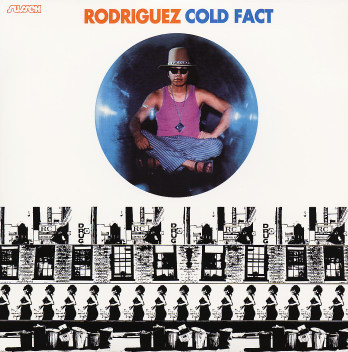
RodriguezcoldfactLike every other person I knew in South Africa, I owned a copy of Rodriguez’s album “Cold Fact”.

All the plaintively sung songs stuck in my head and like everyone else, I knew all the lyrics

“Sugar man. Won’t you hurry.Cause I’m tired of these scenes.For the blue coin, won’t you bring back. All those colours to my dreams. Silver magic ships, you carry, jumpers, coke, sweet mary jane…” I would sing along to the CD in my car or in my bedroom.

You could buy the album in just about any music shop in town. I am sure I bought my copy – now lost – at ‘CD Warehouse’ in Rosebank, in the leafy, northern suburbs of Johannesburg.

It was always on special, alongside the best of Santana, Led Zeppelin IV and Simon Garfunkel’s Bridge over Trouble Waters and something by Van Morrison.

R39 (about $10 Australian) is what you’d pay for a copy in those days.

My friend Doug Cohen, who introduced me to a lot of good bands, told me that Rodriguez was dead. He’d shot himself on stage.

For many years I believed him. Nobody told me otherwise. It’s not the kind of story you make up and at the time I was kind of obssessed with dead rock stars.

I owned and would read and re-read a book called “Rock n’ Roll Heaven” about dead musicians who died in their prime including Jim Morrison of The Doors, Janis Joplin, Bob Marley, Jimi Hendrix and Brian Jones from the Rolling Stones. There were about 30 or so musicians in Rock ‘ Roll Heaven – Buddy Holly, Richie Valens, even ‘dorky’ singers like Karen Carpenter, but no one called Rodriguez.

Then one day I heard he had apparently risen from the dead: he was coming on tour to South Africa.

I never went to the sold out concerts in Cape Town (or the ones in Johannesburg) , but watching the documentary film “Searching for Suger Man” I wish I did.

Not a man who sheds a tear easily, I found my eyes brimful with tears throughout much of film, during which two South African music fans set about finding what happened to this enigmatic singer-songwriter with the haunting voice and lyrics.

The film begins with one of the fansΒ  a Cape Town vinyl record shop owner – Steven ‘Sugar’ Segerman driving along the windy roads of Camps Bay, listening to the track “Sugar Man” and remarking how he too believed that Rodriguez was dead.

Then a journalist – CraigΒ Bartholomew-Strydom-Β  joins him in the quest.

In Segerman’s version of the legend, he heard an even more grotesque ending: Rodriguez had set himself alight on stage.

And so the film follows the two fans as they seek out their hero, finding to their astonishment that he is very much alive.

When they do track him down in one of the poorer neighbourhoods of Detroit and convince him to come to South Africa to play for his adoring fans – “You’re bigger than Elvis over here,” Segerman tell him – they find a softly spoken, gentle man but with the same, haunting voice and guitarmanship.

And despite missing out on fame for much of his life, he is not in the least bit bitter; though he has spent his life restoring houses, working in car factories and raising a family in one of the poorest cities in America, rather than live the lifestyle of a rockstar.

“This is the music business. There are no guarantees,” is how contemplates his very late-realised fame.

But better late than never.

Discovering his legions of fans does not change him. He is the same man he was when his songs were unappreciated, but he is pleased to have been given a chance to be a star and play his music.

They describe him – those people who first discovered him and produced his first records – as better than Dylan, as a poet of the streets, a keen observer and teller of tales at the poorest end of town.

He is proud but unchanged. He talks of his music and the path of his life in that same soft, sweet, gentle voice that comes across in his songs.

What happened to the money? Half a million records sold at least in South Africa alone. He never saw any of it. That’s one question the documentary does not answer.

But Rodriguez appears to be a man beyond bitterness and material gain. His life has been hard, honest, but good. He has raised his three daughters to believe in themselves regardless of money, class or privilege. They are strong and proud.

He is Rodriguez.

And now, as I type away in the kitchen or as I walk to the train station in the morning, I find myself singing all those songs from Cold Fact, the album where he floats in a bubble, a contented shaman with his sunglasses, purple shirt and sandles.

‘H’ is for ‘homeopathy’ or ‘hoax’ or ‘healing’

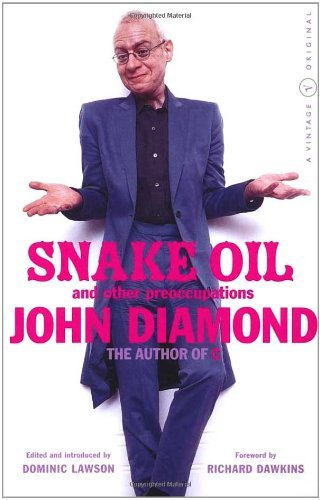
snake skin oilI’ve recently discovered the writings of the late John Diamond.

Many in Britain will know who he is, but many more will know him by association: he was married to the celebrity chef, Nigella Lawson, and they had two children together.

Diamond was a prolific journalist and columnist, writing in a very dry and witty manner about a whole range of subjects that caught his attention from bottled water to second-hand cars to Hasidic jews.

Before he became ill with throat cancer, Diamond tackled the subject of alternative medicine in a number of columns, but as he battled against the ravages of his disease, he dedicated his weekly column in The Times to sharing his struggles – without sentimentality or expecting sympathy – and looked deeper into the billion dollar alternative medicine industry, not least because so many of his readers wrote in to suggest alternative ways of fighting his cancer.

He also starting writing a book that had the working title of “An uncomplimentary look at complimentary medicine”

These six chapters along with a selection of his best columns were compiled into a book called “Snake Skin Oil and Other preoccupations“, which I have just finished reading.

In theΒ  unfinished book he attacks homeopathy, along with all the other alternative treatments, calling it a sham with no healing powers whatsoever.

His principal attack against homeopathy is that it defies rationality and that furthermore, it has never been tested, nor will the homeopathic establishment submit it to proper, scientific testing.

This is an extract from his book:

It is a fundamental tenet of homeopathic theory that the active ingredient – arnica, bee venom or whatever it is – must be successively diluted some large number of timesΒ  until – all calculations agree – there is not a single molecule of that ingredient remaining. Indeed homeopaths make the claim that the more dilute the more potent it’s action.

This is not just John Diamond’s interpretation of the basis of homeopathy – the dilution of substances – but can be found on Wikipedia, or on the website of the Australian Homeopathic Association and numerous other places. Last year, there was a damning indictment of homeopathy as having no medical basis to heal in a leaked Australian government report last year.

Of course, as Diamond points out, the idea of diluting something until nothing remains defies science, chemistry and modern medicine.

But homeopaths will argue, he says, that it’s effects are physical, not chemical, with some trace memory left behind, a “physically imprinted template” on the water that cures the patient.

Diamond points out there would be a “brand new principle of physics” perhaps even a “new fundamental force in the universe” if this theory of dilution wasΒ  proved true.

Excuses made by homeopaths for not having their theories subject to conclusive tests “scrape the bottom of the barrel” including, he says, the homeopathic community’s claim that their theories are “true on a human level and can’t be tested in a laboratory”.

All of this I completely agree with and yet, funny things is, I have my own experience with homeopathy, a treatment I never sought to question at the time (the name sounds so scientific), and which did, by whatever means, make me feel better.

I should give some context.

I was at the time suffering from debilitating panic attacks in London, which were making my life miserable.

I started seeing a cognitive psychologist who suggested I also see a homeopath.

I knew nothing about homeopathy and it was only when I read Diamond’s book that I learned more about it.

Truth be told, when I think back on my consultations with my homeopath, a small, sweet-natured woman, about 50, who worked from a clinic in the East End of London, I remember them very fondly.

She worked from a tiny room up a narrow flight of stairs. I would catch the District Line and get off at Bethnal Green I think to get there.

My first consultation was very much like seeing a psychologist. She asked me to talk about myself and what was troubling me.

I did. I told her my life story.

And she listened.

At the end of it all, she paged through a thick old book with a leather cover and held together with bits of tape.

Then she opened a rectangular wooden box filled with tiny little jars of pills, which all clinked around as she searched for the right one for me.

Each bottle had a little cork stopper on top. She pulled it off and put a few tiny white pillsΒ into a small brown envelope with instructions for when to take them.

I remember I was told not to eat an hour after taking one, or some kind of similar instruction.

And you know what, over the sessions I saw her (maybe half a dozen times), I did start feeling better.

But who can say if it was those little pills of apparently nothing (trace memory of something), which contained, who knows what, that helped me get better.

It could have been them I suppose.

Or maybe it was just the soothing manner in which she spoke to me and put me at ease, or the ritual itself of talking, getting things out of me, then waiting as she selected the pills from her enormous box of tiny jars and the clinking, reassuring sounds they made.

Ritual+ placebo = healing?

PS. This is the final column John Diamond wrote before he died, very poignant and worth reading.

Django Unchained: an entertaining, overly long disappointment (with a great soundtrack)

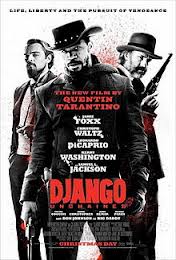
django unchainedI had my misgivings about watching a pirated version of Quentin Tarantino latest “Django Unchained”. It felt almost sacrilegious to watch the great man’s work on the small screen.

Tarantino’s films deserve the expensive big screen treatment, complete with popcorn and coke and maybe even chocolate.

Let me be clear: I didn’t pirate the movie myself, I was given a copy and as I say, I had my misgivings.

But to be honest, I might have felt a tad annoyed if I’d paid top dollar to see this film and popcorn charged at a 5000% mark-up.

It’s not his best.

It’s very long (some judicious editing would have helped and I’ve since read that it was the first film Tarantino has made without regular editor Sally Menke, who died in 2010).

And it’s got some very silly moments, the silliest by far being a ridiculous cameo by Tarantino himself, putting on a very bad Australian accent. What an Australian would be doing in the American wild west in the mid-1800s is the obvious question to ask, but given that it also added nothing to story or film, it made me wonder if Tarantino has got a little too clever for his own good.

But it is an entertaining film, a Western with almost as much violence and gore as Kill Bill (the blood literally explodes off bodies) has a lot of very good scenes and some great songs and atmospheric music; but as the sum of its parts, it does not quite work.

The plot is fairly straightforward:

Eccentric German bounty hunter Dr Schultz (Christoph Waltz) frees slave Django (Jamie Foxx) and invites him to become his partner and fellow outlaw killer and share in the spoils. As a reward for his services, Schultz promises to help Django rescue his wife, Brunhilde (a fellow slave brought up by German speakers, hence the name) from Cotton plantation owner Calvin Candie (Leonardo Di Caprio) and his obsequious slave-hating butler Stephen (Samuel L. Jackson), one of the nastiest characters put on film by Tarantino.

Along the way they kill a lot of people. there’s a lot of blood. A lot violence and gore.

There’s a couple of great cameos from the likes of Jonah Hill as part of a group of bungling Klu Klux Klansmen who complain about how badly their wives have cut the holes into their hoods so they can’t see anything; Don Johnson plays a suave, bigoted plantation owner;Β  and for Australian fans, Wolf Creek’s John Jarrett also pops up as another Australian somehow caught up in the American slave trade.

Christoph Waltz as Dr Schultz is the standout character for me. Jamie Fox as Django is physically impressive and also plays his part with the right amount of style and swagger, but for me Waltz is the star as the happy-go-lucky, but deadly-with-a-pistol bounty hunter, masquerading as a dentist, with a tooth bobbing on the top of his carriage. He plays the role with real panache and is also by far the most likeable character in the film; an enlightened European, he treats Django as an equal, while just about everyone else in the film (including slaves themselves) calls slaves “niggers” (Somewhere, someone has tallied up the number of times the “N” word is used in the film and it must in the 100s.

In his role as the bounty hunter, Waltz is almost the mirror image of Colonel Hans Lander, the smooth, despicably evil Nazi he played with Oscar-winning success in Inglorious Basterds. He is one of those actors that has real magnetism and the film is worth watching just for his performance alone.

Leonardo Di Caprio is good as the wealthy, manipulative plantation boss Calvin Candie, but it did a feel a little as if he was going through the motions in this role, drawing on past characters he’s played.

There’s also the usual snappy Tarantino dialogue through much of the film, especially in the early scenes between Django and Schultz, complimented by some beautiful shots of the American wilderness.

But it’s a disjointed, uneven film that would have been a better film were it shorter, more tightly made.

There’s the sense that Tarantino – the master film-maker and auteur that he is – can do anything and get away with it, hence his own silly Aussie cameo.

In the end he looks a bit foolish and completely out-of-place (and out of his depth I am sorry to say) not quite sure where to place himself on camera.

As for that accent – Strewth mate, you sound like a real drongo!

freshlyworded list of the week: 10 television dramas you have to watch before you die

3533683614_7e4b5741efHaving just watched the final episode of Season 5 of Mad Men – and mourning the long wait I must now endure until Season 6 comes out on DVD, I thought I might jot down the 10 television shows I reckon are among the best to ever grace the small screen.

Plus my wife and sister-in-law are watching Season 3 of The Walking Dead, which I have enjoyed, but there’s only so many gurgling, mindless zombies I can watch chasing the living through an American wasteland.

So these are 10 television shows I reckon are as good as just about anything you could watch at the movies, and in most cases, infinitely better.

(I’d welcome suggestions from other bloggers; yet to watch Boardwalk Empire, Primal Suspect and have a couple of seasons of Inspector Morse on my shelf too as well as The Tudors.)

1. The Sopranos

Apart from the bemusing final episode of Season 6, the Sopranos set a new television benchmark when it hit television screens in 1999. It could be set that it sparked the revival in television entertainment and inspired countless other shows. Who would have thought watching New Jersey mob boss Tony Soprano pouring out his family and “business” problems to a sultry psychologist played by Lorraine Bracco would set the stage for the great gangster drama since The Godfather trilogy and Goodfellas. Plus there’s all the other great characters: power-hungry Junior, stupid but scary Paulie and Tony’s drug-addicted nephew Christopher Moltasanti to name just three.

2. The Wire

Many people argue The Wire – the story about Baltimore police officers and the criminals they pursue – is the greatest television show every created. It’s certainly the greatest show never to win any major awards. Each of the five series looks at a different aspect of Baltimore society: the drug scene, the docks, local politics, the school system and the media. It features the first gay gangster-turned-robin-hood (Omar), arguably the finest portrayal of a police-officer on the small screen (Dominic West as Jimmy McNulty) but the real stars are the dialogue, which captures the language of the street perfectly and the carefully woven plot lines. Personally, my favourite character is Bubbles, the heroin addict turned police informer and in many ways the moral compass of the show.

3. Six Feet Under

The story of a dysfunctional Californian family running a funeral home. Each episode begins with a death and the body being prepared for burial by the Fisher Family. There is never a dull episode. It features great performance from Michael C Hall as David a gay man struggling with his sexuality and his virile brother Nate, caught up in a twisted relationship with Brenda, brilliantly played by Australian actress of Muriel’s Wedding fame Rachel Griffiths. And its darkly funny.

4. Breaking Bad

The story of family man Walter White (Bryan Cranston) a poorly paid high school chemistry teacher who upon being diagnosed with lung cancer, turns to cooking crystal meth with former pupil and local low-life Jessie (Aaron Paul) to build a nest egg for his family.Β  The pair get mixed up with organised crime and one of the scariest, suavest villains in the form of Gus Fring, the proprieter of ‘Pollos Hermanos’. Yet to see Season 5, but can’t wait.

5. Mad Men

Was there ever a cooler show on the television? The story of the lives of Manhattan advertising executives in the 1960s. Every shot is a period piece, the dialogue meticulous; you can sit back and just enjoy the decor and clothes, never mind the characters. Don Draper, Roger Sterling, Pete Cambpell and of course Joan Harris – the most voluptuos woman ever to grace the small screen – are creations that would sit comfortably alongside any in the Great Gatsby.

6. Luther

John Luther (Idris Elba) is the toughest and most brilliant police officer you will ever meet. He operates by his own set of rules and code of ethics as he brings down the sickest criminals on the streets of London.Β  I’ve watched the first two seasons, and believe a third season will air this year. Also a chance to see Paul McGann of Withnail and I fame in a great role.

7. Law & Order: SVU

One of the longest running televisions shows of all time, the Special Victims Unit (SVU) spin-off has generated 14 seasons. The episodes featuring Benson and Stabler as the lead detectives are the best. Very well written, with believable characters and stories, all filmed on location in New York. Plus there’s that bad-ass motherf*cker Ice-T and the freaky, sardonic Munch to entertain you as well.

8. Secret Life of Us

An Australian series about the lives, loves and heartaches of twenty-something Melburnians living in St Kilda. Does not sound like much, but lots of great themes explored. Narrated by the philandering writer-in-training Evan (Samuel Johnson) with career-making performances from Joel Edgerton (now a Hollywood star) Deborah Mailmen and Claudia Karvan to name just a few. The first three seasons are the ones to watch. From Season 4, all the good characters have left the show (I’ve not watched it).

9. Midsomer Murders

Each episode in the 15 seasons set in quaint Midsomer county with its hedges, afternoon teas, quiet woods, grand old mansions and quintessential English villages (the deadliest county in England) is a feature-length whoddunit featuring the unshakeable Inspector Barnaby (John Nettles) and a number of different young side-kicks. The corpses pile up faster than freshly baked scones at a fete but you’ll never guess who the murderer is.

10. Downton Abbey

A period drama about masters and servants who live in palatial Downton Abbey in a changing Britain in the years leading up to World War One and beyond. Headed by the sweet-natured but strong-willed Earl of Grantham (Hugh Bonneville) and his somewhat annoying American wife (Elizabeth McGovern, it features a brilliant performance by an ancient-looking Maggie Smith as Grantham’s mother, the towering Dowager Countess of Grantham.Β  And of course there’s the dour Mr Bates and impeachable Mr Carter, the butler of Downton Abbey.

The incredible bravey of forgotten refugees: a review of “All that I am” by Anna Funder

all that i amI read “All that I am” by Australian author Anna Funder purely on word-of-mouth.

I’d been told and heard that this book was very good, but knew nothing at all about the subject matter, plot or characters.

The cover of the version I read shows aΒ  woman in a red coat walking past what looks like the Reichstag in Berlin, her reflection a red blur on the wet pavement.

The story, as it unfolds inside the cover, is about a group of German refugees (all but oneΒ  are Jews) who are forced to flee their homeland when Hitler rises to powerΒ  in Germany in the early 1930s.

Not only are they Jewish intellectuals, but left-wing leaning and socialist – in complete opposition to all that the National Socialists (the Nazis) stand for.

They all manage to obtain refugee visas in London, where despite the constant and very real risk of deportation, they continue to do what they can to plant stories in the British press about Hitler’s plans forΒ  rearmament and his viscious policies towards the Jews and others he deems undesirable.

The central plot of the novel is what happens to four characters, namely: Ruth Wesseman, a bohemian Jewess and intellectual married to non-jewish journalist Hans, Ruth’s cousin Dora, a firebrand, fearless pursuer of justice and freedom (the heroine of the novel) and Dora’s lover, the celebrated left-wing German playwright and agitator, Ernst Toller

There are two narrators: Ruth, now a frail old women in her nineties, but with all her mental faculties intact, who tells the story of her life in Berlin, London and Shanghai before immigrating to Australia in 1947 while recovering from a fall in a Sydney hospital; and the playwright Ernst Toller, living an agoraphobic, reclusive life in an apartment overlooking Central Park in New York in 1939 who tells of his relationship with Dora Fabian, his one true love.

The novel moves effortlessly back and forth across timelines from the cake shops along Bondi Road to the Bohemian nightclubs of Berlin to an attic apartment in Bloomsbury in Central London and a terrace house in Hampstead.

They are all real people and Funder’s genius is to breathe life into their characters, relationships and pysches and like a detective piece together the story of what happened to them.

One of the most enlightening aspects of the book is its exploration of the lives of German refugees forging an existence in London.

This is the book’s central canvas – the secret, untold stories of people who lived under the very tenuous, conditional protection of the British government, a government not yet aware or perhaps not yet convinced of Hitler’s evil intentions and hopingΒ  that appeasement might prevent war.

It is the brave acts of these refugees, who risk their own safety to connect with those still trapped in Europe and get their stories into the newspapers and public consciousness, which ultimately convinces Britain that war is the only route to peace.

What’s most shocking is how easily refugees fleeing persecution – despite the horrible fate that awaited them – could be sent back to Germany if British bureaucrats got word of political activities, in some cases colluding with Nazi operatives.

Such a fate befalls one of the colleagues of the four protagonists. A former German policeman, he is expelled from Britain for speaking out at a trade union convention, and his mistake is being heard by the wrong people.

Once the expulsion order is granted, an immigration agent is assigned to watch him until he is deported. His fate, severe beatings and a first-class ticket to the concentration camps, where he gets to clean the toilets.

The book also recounts the fate of Jews aboard the MS St Louis, a refugee boat that sailed from Germany to seek asylum in Canada and the USA in 1939. It’s fate is told through the eyes of Clara, a jewish refugee and secretary to Ernst Toller while in exile in New York. Her brother is aboard the ship as it remains moored just outside Havana.

Clara is transcribing Toller’s life story (and what will become his memoir), while he urges her not to give up hope as the fate of the MS St Louis remains uncertain. Eventually it is sent back to Europe, where a quarter of those onboard would later die in the concentration camps.

The refugee’s tale, as told by Funder, should resonate with readers in Australia or anyone fortunate to be living in a free country.

The debate about refugees, particularly those that arrive by boat, is such a political hot potato here, that most forget that these are real people’s lives we talk so glibly about and discuss as if they were not human at all – objects to be “processed” or “turned back”.

Upon reading ‘All that I am’ I did some background reading about all the characters in the book, especially the central character of Dr Ruth Blatt (Ruth Wesseman).

Funder was a friend of Ruth Blatt and was no doubt inspired to write about her life through the incredible story she told her.

Searching online, I came across Funder’s interview with Ruth Blatt for a radio broadcast on the ABC.

After you’ve read this gripping, moving story about heroism, bravery and what it means to be all that you can be, listen to the radio broadcast to hear Ruth Blatt tell her story in her own words.

The junkie in literature: a review of ‘Trainspotting’ by Irvine Welsh

trainspotting‘Trainspotting’ by Irvine Welsh is the fourth in a series of a books I am reading and reviewing based on the theme “The junkie in literature” with the aim to learn more about this sub-culture.

I’ve so far read and reviewed ‘Monkey Grip’ by Helen Garner, ‘Junky’ by William S. Burroughs and ‘Confessions of an English Opium Eater’ by Thomas De Quincey.

When I think of Trainspotting, my mind immediately conjures up scenes from the movie of the novel: Mark “Rent Boy’ Renton emerging from the bowl of the filthiest toilet in Scotland, the dead baby crawling on the ceiling, Begbie throwing his glass of beer over his head in a crowded pub and the lines:

“Choose us. Choose life. Choose mortgage payments; choose washing machine; choose cars; choose sitting oan a couch watching mind numbing and spirit-crushing game shows, stuffing fuckin junk food intae yir mooth.”

The film was fantastic and horrible.

The book is much, much better.

A brilliant, excruciating, haunting and often hilarious story about a group of Scottish junkies (and one pyschotic lunatic – Francis Begbie) set in the impoverished council estates of Edinburgh circa the late 1980s, early 1990s.

Mark Renton is the axis of the novel, an intelligent, ocassionaly cruel, somewhat bitter and philosophical junky, who in between trying to quit heroin, muses about the meaning of his life, what it means to be Scottish (colonised by English ‘wankers’ is how he puts it), trying to understand women and the pleasures and pain of being a junkie.

Many of the chapters are narrated through his eyes, but also through the eyes of sweet, hopeless romantic ‘Spud’, the psychotic fury of Frank Begbie and a number of other characters that form part of the scene.

In this way, the reader gets a 360 degree view of the world of the junky: binge drinking, shooting up in squalid apartments, random sex, attempts at a normal life.

The first thing that will strike anyway who reads the book is that its written phonetically, in Scottish dialect, meaning as a reader you have to adjust to the language and at times decipher the meaning of words.

Here’s Renton describing injecting himself:

…Ah start tae cook up another shot. As ah shakily haud the spoon over the candle, waitin for the junk tae dissolve, ah think; more short-term sea, more long-term poison. This thought though is naewhere near sufficient tae stop us fae what ah huv tae dae.”

Strangely, this does not distract from the story telling or plot, but really centres you in the time and place and experiences of the characters in the book.

It gives parts of the book a poetic quality as Welsh managed to convey the gruff musicality of the working class Scottish accent.

For this is a distinctly Scottish tale about heroin addiction, friendship, betrayal, love, radges (crazy people), gadges (schemers) and futbal (football).

It’s about people caught up at the bottom end of the Scottish welfare state with little hope or ambition to get out.

Intelligent and worldly, Renton shares the common trait of many junkies.

Like the writer/drifter William S. Burroughs in ‘Junky, artist Javo in ‘Monkey Grip’ and perceptive, strong-headed and proud Thomas De Quincey in ‘Confessions of an English Opium Eater’, Renton searches for something to take life beyond the mundane, to rise above crowd, or just to escape the mind-numbing boredom of existence, of everyday life.

Though being a junky is heaven and hell for Renton, Spud and Sick Boy, it is preferable to the familiar storyline of getting married, getting a mortgage, buying a bigger television, a car and watching “mind-numbing, spirit crushing game shows.

Describing the heroin ‘hit’, Renton says: “Take yir best orgasm, multiply the feeling by twenty, and you’re still fuckin miles off the pace.”

On the effects of heroin: “Julie looked really good when she started oan smack. Maist lassies dae. It seems tae bring oot the best in them. It always seem to gie, before it takes back, wi interest.”

On the appeal of heroin.: “Ma problem is, whenever ah sense the possibility, or realise the actuality ay attaining something that ah thought ah wanted…it just seems so dull n sterlie. Junk’s different though. Ye cannae turn yir back oan it sae easy. It willnae let ye. Trying tae manage a junk problem is the ultimate challenge It’s also a fuckin good kick.”

Trainspotting is a harsh book, unpleasant and horrfying as it is hilarious and insightful, but you get an incredible kick out of reading it, because you become part of the scene.

Required reading I say!

freshlyworded list of the week: the 10 Woody Allen films you must see before you die

woody-allenWoody Allen, born in the Bronx as Allen Stewart Koningsberg in 1935, has been making movies since 1965, having starting out as a sketch writer and stand-up comedian.

In total he has written and directed (and in many cases starred in) 46 films starting with ‘What’s Up Tiger Lily?‘ and is currently in post-production on a film called “Blue Jasmine” starring Cate Blanchette and Alec Baldwin.

I admire him immensely: starting from his early stand-up comedy records (watch his famous and hilarious “I shot a Moose” sketch from 1965″) to his early relationship comedies to later more dramatic works.

Manhattan has been the canvas for his stories, but he’s also made London, Paris and Barcelona backdrops for his films.

Not all have been classics, some have been mediocre and forgettable and others have been plain awful.

Why do I admire him so much: it’s the stories he tells about love, relationships, anxiety, existentialism, religion all brought together with classic Woody Allen wit and insight.

It’s also his iconic angst-ridden, questioning, self-doubting and fallible jewish male character, portrayed so often in his films that I love so much.

These are 10 of his films that I have loved (I’ve not seen all of his films) and recommend highly:

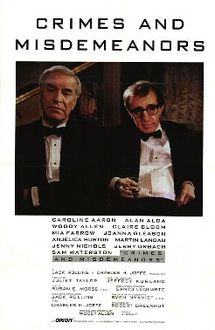
215px-Crimes_and_misdemeanors2Crimes and Misdemeanours (1989) is Woody Allen’s greatest cinematic achievement. It brings together all of his key themes – religion, morality, family, guilt, the meaning and purpose of life – in a seemless way with great writing, a pitch-perfect soundtrack and wonderful performances by its ensemble cast. There are numerous plots and sub-plots, but the film principally revolves around Judah Rosenthal (a brilliant Martin Landau), a successful and wealthy ophthalmologist, who resorts to desperate measures to end an affair with Dolores Paley (equally brilliant Angelica Huston).Β  Despite the heavy material, it is also extremely funny with the humour provided by Allen himself an idealistic documentary film-maker Clifford Stern, given the opportunity to make a documentary about his brother-in-law Lester (Alan Alda), an obnoxious big-time television producer. He does it so that he can earn enough money to make a documentary about a life-affirming jewish professor, Louis Levy, all the while falling in love with Lester’s associate producer Halley Reed (Mia Farrow).

Annie Hall

Annie Hall (1977)Β would be top of many people’s lists of favourite Woody Allen films. At its heart it’s a love story between the angst-ridden, neurotic Alvy Singer (Allen) and quirky, lovable, absent-minded Annie Hall (Diane Keaton) with some of his best lines and jokes thrown in and questions about God and the meaning of life. There’s also some great cameos from Paul Simon, Christopher Walken and Sigourney Weaver.

One memorable line comes after Annie Hall parks her VW beetle almost perpendicular to the curb following an exhibtion of some of the worst driving ever seen on film.

Alvy remarks: Don’t worry. We can walk to the curb from here.

ManhattanShot beautifully in black and white, Manhattan (1979)Β is Woody Allen’s visual homage to the city that he loves. The city is the backdropΒ  to Isaac’s (Allen) affair with 17-year-old Tracy (Mariel Hemingway), while pursuing the mistress of his best friend, Yale. There are so many iconic shots of Manhattan to drool over and great lines like:

Yale: You are so self-righteous, you know. I mean we’re just people. We’re just human beings, you know? You think you’re God.

Isaac Davis: I… I gotta model myself after someone.

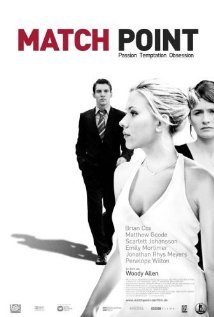
matchpoint

Matchpoint (2005)Β sees Woody Allen move locations to London with this dark tale about seduction and murder starring Scarlett Johansson and Jonathan Rhys Meyers.

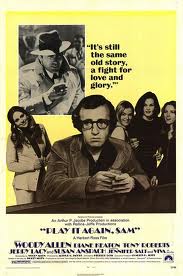
play it again sam

Play it Again Sam (1972)Β is actually directly by Herbert Ross, but based on Woody Allen’s stage play and stars him in the lead role of a love-sick film critic and schmuck who turns to his alter ego – Humphrey Bogart in his role as smooth talking Rick Blaine from Casablanca – for inspiration as to how to be a lady’s man.

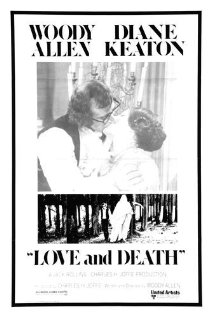
love and death

Love and Death (1975) is a historical comedy set against the backdrop of the Napoleonic invasion of Russia. Woody Allen plays neurotic soldier Boris, in love with his Sonja (Diane Keaton) who gets involved in a plot to assassinate Napoleon, with philosophical musing and some very silly (but hilarious) skits thrown in.

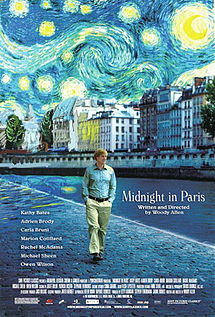
215px-Midnight_in_Paris_Poster

In Midnight in Paris (2011), Owen Wilson plays Gil, an American would-be writer in Paris with his pretentious fiancΓ©e who finds himself transported back to the Paris of the 1920s where he meets, drinks and parties with his literary idols including F Scott and Zelda Fitzgerald, Ernest Hemingway, Gertrude Stein and artists like Picasso, Gauguin and Toulouse-Lautrec.

images

Zelig (1983) sees Woody Allen play the title role of the chameleon (literally) like Leonard Zelig who can change his appearance to match the people he is with and becomes a global phenomenon. Told in documentary style, it’s hilarious.

deconstructing harry

In Deconstructing Harry (1997) Woody Allen plays Harry block, a writer suffering from writer’s block, with a penchant for prostitutes and vulgarity. It’s a very funny film as Block recalls events from his past and characters from his books. There’s a memorable scene played by Robin Williams, an actor worried about losing his focus who is shown as actually out of focus in the movie.

broadway-danny-rose-1

Broadway Danny Rose (1984) sees Woody Allen play a talent agent to a string of bizarre performers that no one else will hire. One of them is Lou, a talented lounge singer, making a comeback. Allen goes out of his way to help Lou, but finds himself being pursued by mobsters after trying to bring Lou’s crazy mistress Tina (Mia Farrow) to his concert.

And here’s four to definitely avoid:

The Curse of the Jade Scorpion

Small Time Crooks

Celebrity

Scoop